oil CHEVROLET TRACKER 1997 Owner's Manual
[x] Cancel search | Manufacturer: CHEVROLET, Model Year: 1997, Model line: TRACKER, Model: CHEVROLET TRACKER 1997Pages: 388, PDF Size: 20.12 MB
Page 261 of 388
Front Axle
When to Check and Change Lubricant
Refer to the Maintenance Schedule to determine how
often to check the lubricant and when to change it. See
“Periodic Maintenance Inspections” and “Scheduled
Maintenance Services” in the Index.
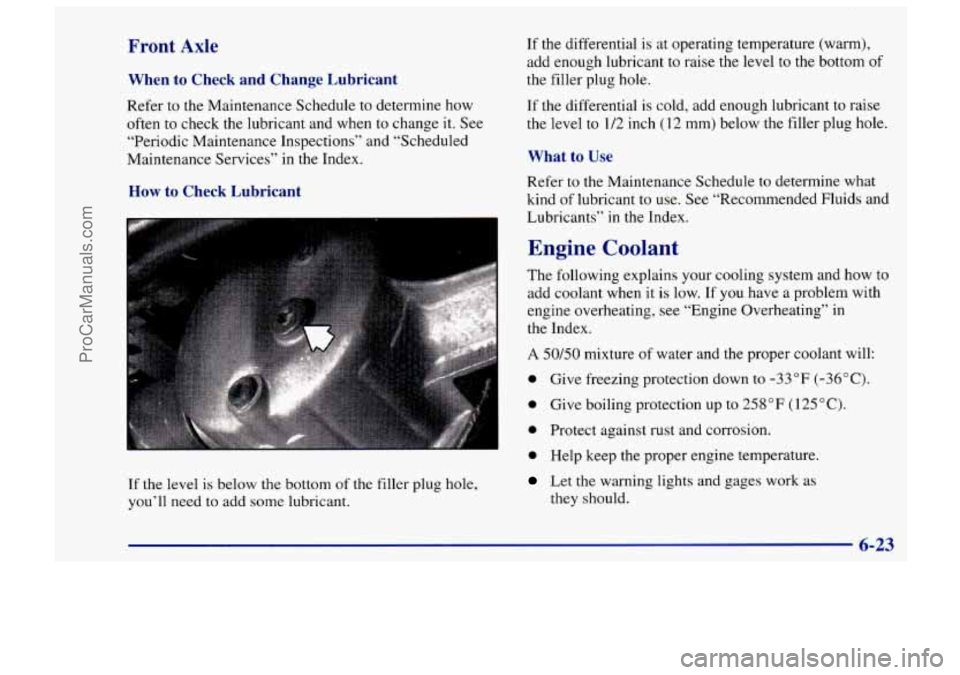
How to Check Lubricant
If the differential is at operating temperature (warm),
add enough lubricant to raise the level to the bottom of
the filler plug
hole.
If the differential is cold, add enough lubricant to raise
the level to 1/2 inch
(I 2 mm) below the filler plug hole.
What to Use
Refer to the Maintenance Schedule to determine what
kind
of lubricant to use. See “Recommended Fluids and
Lubricants”
in the Index.
Engine Coolant
The following explains your cooling system and how to
add coolant when it is low. If you have a problem with
engine overheating, see “Engine Overheating” in
the Index.
If the level is below the bottom of the filler plug hole,
you’ll need to add some lubricant.
A 50/50 mixture of water and the proper coolant will:
0 Give freezing protection down to -33°F (-36°C).
0 Give boiling protection up to 258°F (125°C).
0 Protect against rust and corrosion.
0 Help keep the proper engine temperature.
Let the warning lights and gages work as
they should.
6-23
I
ProCarManuals.com
Page 262 of 388
What to Use
Use a mixture of one-half clean water (preferably
distilled) and one-half coolant that meets
GM
Specification 1825-M, which won’t damage aluminum
parts. You can also use a recycled coolant conforming to
GM Specification 1825-M with a complete coolant flush
and refill. If you use this mixture, you don’t need to add
anything else.
Adding only plain water to your cooling system
can be dangerous. Plain water, or some other
liquid like alcohol, can boil before the proper
coolant mix will. Your vehicle’s coolant warning
system is set for the proper coolant mix. With
plain water or the wrong mix, your engine could
get too hot but you wouldn’t get the overheat
warning. Your engine could catch fire and you
or
others could be burned. Use a 50/50 mix of clean
water and the proper coolant.
I
NOTICE:
If you use an improper coolant mix, your engine
could overheat and be badly damaged. The
repair cost wouldn’t be covered by your
warranty.
Too much water in the mix can freeze
and crack the engine, radiator, heater core and
other parts.
If you have to add coolant more than four times a year,
have your dealer check your cooling system.
I NOTICE:
If you use the proper coolant, you don’t have to
add extra inhibitors or additives which claim to
improve the system. These can be harmful.
6-24
ProCarManuals.com
Page 269 of 388
Brake Wear
NOTICE:
0
0 Using the wrong fluid can badly damage
brake system parts. For example, just
a few
drops of mineral-based oil, such as engine
oil, in your brake system can damage brake
system parts
so badly that they’ll have to be
replaced. Don’t let someone put in the
wrong kind
of fluid.
If you spill brake fluid on your vehicle’s
painted surfaces, the paint finish can be
damaged. Be careful not to spill brake fluid
on your vehicle.
If you do, wash it off
immediately. See “Appearance Care” in
the Index. Your Geo has
front disc brakes and rear drum brakes.
Disc brake pads have built-in wear indicators that make a
high-pitched warning sound when the brake pads are worn and new pads are needed. The sound may come and go or
be heard
all the time your vehicle is moving (except when
you are pushing on the brake
pedal firmly).
I
The brake wear warning sound means that soon
your brakes won’t work well. That could lead to
an accident. When
you hear the brake wear
warning sound, have your vehicle serviced.
I NOTICE:
Continuing to drive with worn-out brake pads
could result in costly brake repair.
I
6-31
ProCarManuals.com
Page 288 of 388
Using Solvent-Type Cleaner on Fabric
First, see if you have to use solvent-type cleaner at all.
Some spots and stains will clean off better with just
water and mild soap.
If you need to use a solvent:
1. Gently scrape excess soil from the trim material with
2. Use very little cleaner, light pressure and clean cloths
(preferably cheesecloth). Cleaning should start at the
outside
of the stain, “feathering” toward the center.
a clean, dull
knife or scraper.
3. Keep changing to a clean section of the cloth.
4. When you clean
a stain from fabric, immediately
dry the area with a blow dryer to help prevent a
cleaning ring.
Fabric Protection
Your Geo has upholstery that has been treated with
Scotchgard” Fabric Protector, a
3M product. It protects
fabrics by repelling oil and water, which are the carriers
of most stains. Even with this protection, you still need
to clean your upholstery often to keep it looking new.
Further information on cleaning is available by calling
1-800-433-3296 (in Minnesota, 1-800-642-6167).
Special Cleaning Problems
Greasy or Oily Stains
Stains caused by grease, oil, butter, margarine, shoe
polish, coffee with cream, chewing gum, cosmetic
creams, vegetable oils, wax crayon, tar and asphalt
can be removed as follows:
1. Carefully scrape off excess stain.
2. Follow the solvent-type instructions described earlier.
Shoe polish, wax crayon, tar and asphalt will stain
if left
on a vehicle’s seat fabric. They should be removed as
soon as possible. Be careful, because the cleaner will
dissolve them and may cause them to spread.
6-50
ProCarManuals.com
Page 289 of 388
Non-Greasy Stains
Stains caused by catsup, coffee (black), egg, fruit, fruit
juice, milk, soft drinks, wine, vomit, urine and blood can
be removed as follows:
1. Carefully scrape off excess stain, then sponge the
soiled area with cool water.
2. If a stain remains, follow the foam-type instructions
described earlier.
3. If an odor lingers after cleaning vomit or urine, treat
the area with
a waterhaking soda solution:
1 teaspoon (5 ml) of baking soda to 1 cup (250 ml)
of lukewarm water.
4. If needed, clean lightly with solvent-type cleaner.
Combination Stains
Stains caused by candy, ice cream, mayonnaise, chili
sauce and unknown stains can be removed as follows:
1. Carefully scrape off excess stain.
2. Clean with cool water and allow to dry.
3. If a stain remains, clean it with solvent-type cleaner.
Cleaning Vinyl
Use warm water and a clean cloth.
Rub with a clean, damp cloth to remove dirt. You
may have
to do it more than once.
0 Things like tar, asphalt and shoe polish will stain
if
you don’t get them off quickly. Use a clean
cloth and a vinyl/leather cleaner. See your dealer
for this product.
Cleaning the Top of the Instrument Panel
Use only mild soap and water to clean the top surfaces
of the instrument panel. Sprays containing silicones or
waxes may cause annoying reflections in the windshield
and even make it difficult to see through the windshield
under certain conditions.
6-51
ProCarManuals.com
Page 292 of 388
Foreign materials such as calcium chloride and other
salts, ice melting agents, road oil and tar, tree sap, bird
droppings, chemicals from industrial chimneys, etc., can
damage your vehicle’s finish if they remain on painted
surfaces. Wash the vehicle as soon as possible. If
necessary, use non-abrasive cleaners that are marked
safe for painted surfaces to remove foreign matter.
Exterior painted surfaces are subject to aging, weather
and chemical fallout that can take their toll over a
period of years. You can help to keep the paint finish
looking new by keeping your Geo garaged or covered
whenever possible.
Protecting Exterior Bright Metal Parts
Bright metal parts should be cleaned regularly to
keep their luster. Washing with water is all that is
usually needed. However, you may
use chrome polish
on chrome or stainless steel trim, if necessary.
Use special care with aluminum trim.
To avoid
damaging protective trim, never use auto or chrome
polish, steam or caustic soap to clean aluminum. A
coating
of wax, rubbed to high polish, is recommended
for all bright metal parts.
Special Care for Canvas Top and
Plastic
Windows
To protect the canvas top:
0 After you wash the vehicle, make sure the top is
completely dry before you open or remove it.
0 Don’t get any vinyl cleaner on the vehicle’s painted
finish; it could leave streaks.
0 Don’t go through automatic car washes; the canvas
top could be damaged.
The plastic windows are pliable and can be scratched
if
you don’t take these precautions when you clean them:
0 Wipe off dust with a soft cotton cloth moistened with
clean, cool or lukewarm water. Don’t use a “dry”
cloth. Wipe in one direction only, not back and forth.
To remove frost, snow or ice, use lukewarm water.
Don’t
use a scraper or any de-icing fluids.
Wash the windows with a soft cloth and clean, cool
or lukewarm water. Never use a dry cloth, hot water,
strong soap or detergent, solvents or harsh cleaning
agents. Rinse thoroughly and wipe with a slightly
moist soft, clean cloth.
6-54
ProCarManuals.com
Page 300 of 388
Replacement Bulbs
Center High-Mounted Stop ................. 921
Dome
........ GM Part No. 96051559 or equivalent
Front Parking and Turn Signal
........... 11 57 NA
Headlamp (Halogen) ..................... 9004
Rear Hazard and Turn Signal
............... 1156
Rear Parking and Stop
.................... 1157
Sidemarker
.............................. 194
Capacities and
Engine
Type ............
Specifications
........................ L4
Compression Ratio ....................... 9.5: 1
Firing Order
.......................... 1-3-4-2
Horsepower
.............................. 95
Fuel Delivery .................... Fuel Injection
Piston Displacement
............... 97 CTD (1.6L)
Valve Arrangement
............ In-Head “V” Type AC
Belt Tension
........ Deflect Belt 0.24-0.3 inch
(6-9 mm)
@ 22 lbs. (10 kg) Pressure
Fan Belt Tension
Inspection
.......... Deflect Belt 0.24-0.32 inch
(6-8 mm)
@ 22 lbs. (10 kg) Pressure
Replacement
........ Deflect Belt 0.20-0.28 inch
(5-7 mm)
@ 22 lbs. (10 kg) Pressure
Specification
................... 180” F (82 O C)
Thermostat Temperature
Replacement Parts
Air Cleaner Filter ................. 13780-58k20
GM Part No. 96068629 or equivalent
Battery
....... .................... 26R-50s
Engine
Oil Filter .......... GM Part No. 25014441
Fuel Filter
..................... AC Type GF571
GM Part No. 96058022 or equivalent
PCV Valve
............... GM Part No. 96058079
or equivalent
Radiator Pressure Cap
............ 13 psi (90 kPa)
Spark Plug
................... AC Type R43XLS
Gap: 0.028-0.032 inches
(0.7-0.8 mm)
ProCarManuals.com
Page 301 of 388
Capacities (Approximate)
The following approximate capacities are given in
English and metric conversions.
Air Conditioning?
............. See the refrigerant
information label under
the hood and “Air Conditioning
Refrigerants” at the end
of this section.
Automatic Transmission
Pan Removal and Replacement Three-Speed
............. 3.0 quarts (2.8 L)**
Four-Speed ............... 2.64 quarts (2.5 L)
After Complete Overhaul
Three-Speed
............... 5.3 quarts (5.1 L)
Four-Speed ................ 7.3 quarts (6.9 L)
Cooling System
Automatic Transmission
....... 5.5 quarts (5.2 L)
Manual Transmission ......... 5.6 quarts (5.3 L)
Crankcase With Filter Change
.......... 4.5 quarts (4.2 L)*
Front Differential ............ 1.1 quarts (1 .O L)
Fuel Tank
Two-Door Convertible
....... 11.1 gallons (42 L)
Four-Door Hardtop .......... 14.5 gallons (55 L)
Manual Transmission
Four-wheel Drive
.......... 1.6 quarts (1.5 L)**
Two-Wheel Drive .......... 2.0 quarts (1.9 L)**
Rear Differential ............. 2.3 quarts (2.2 L)
Transfer Case ............... 1.8 quarts (1.7 L)
* When changing the oil filter, additional oil may be
needed. Recheck the oil level after filling. See
“Engine Oil” in the Index.
** Recheck fluid level after filling. See “Automatic
Transmission Fluid” or “Manual Transmission
Fluid” in
the Index.
6-63
ProCarManuals.com
Page 304 of 388
I
IMPORTANT.
KEEP ENGINE OIL
AT THE PROPER
LEVEL AND CHANGE AS
RECOMMENDED
Have you purchased the GM Protection Plan? The Plan
supplements
your new vehicle warranties. See your
Warranty and Owner Assistance booklet, or your
Geo dealer for details.
Introduction
Your Vehicle and the Environment
Proper vehicle maintenance not only helps to keep your
vehicle
in good working condition, but also helps the
environment. All recommended maintenance procedures
are important. Improper vehicle maintenance can even
affect the quality
of the air we breathe. Improper fluid
levels or the wrong tire inflation can increase the level
of emissions from your vehicle. To help protect our
environment, and to keep your vehicle in good
condition, please maintain your vehicle properly.
7-2
ProCarManuals.com
Page 307 of 388
Maintenance Schedule
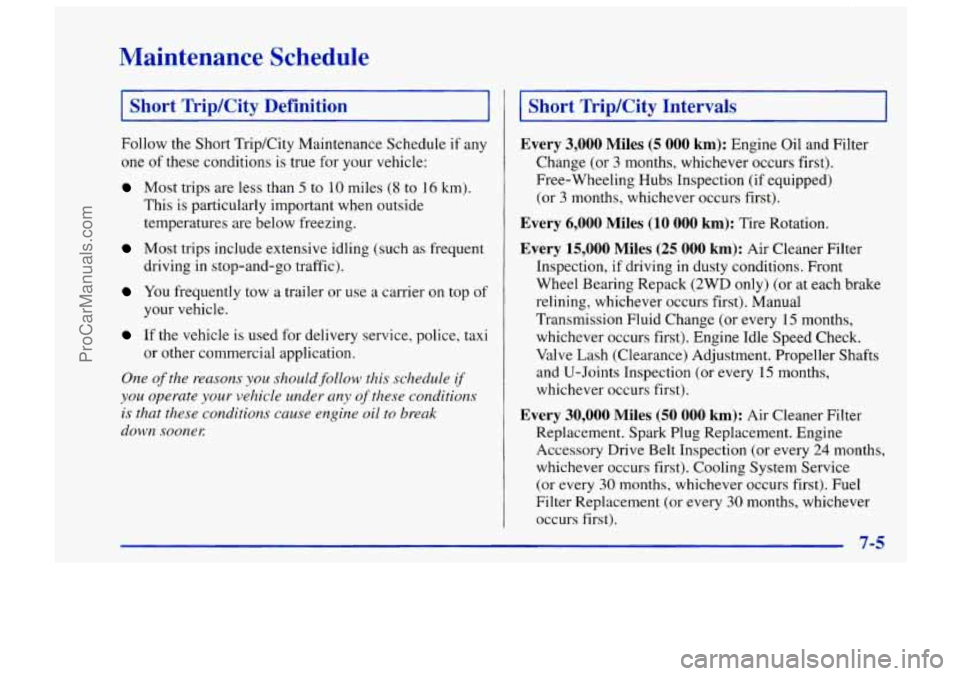
Short Trip/City Definition
Follow the Short Trip/City Maintenance Schedule if any
one
of these conditions is true for your vehicle:
Most trips are less than 5 to 10 miles (8 to 16 km).
This is particularly important when outside
temperatures are below freezing.
Most trips include extensive idling (such as frequent
driving in stop-and-go traffic).
You frequently tow a trailer or use a carrier on top of
your vehicle.
If the vehicle is used for delivery service, police, taxi
or other commercial application.
One of the reasons you should follow this schedule if
you operate your vehicle under any of these conditions
is that these conditions
cause engine oil to breuk
down sooneE
Short Trip/City Intervals
Every 3,000 Miles (5 000 km): Engine Oil and Filter
Change (or
3 months, whichever occurs first).
Free-Wheeling Hubs Inspection (if equipped)
(or
3 months, whichever occurs first).
Every 6,000 Miles (10 000 km): Tire Rotation.
Every 15,000 Miles (25 000 km): Air Cleaner Filter
Inspection, if driving in dusty conditions. Front
Wheel Bearing Repack (2WD only) (or at each brake
relining, whichever occurs first). Manual
Transmission Fluid Change (or every
15 months,
whichever occurs first). Engine Idle Speed Check.
Valve Lash (Clearance) Adjustment. Propeller Shafts
and U-Joints Inspection (or every
15 months,
whichever occurs first).
Every 30,000 Miles (50 000 km): Air Cleaner Filter
Replacement. Spark Plug Replacement. Engine
Accessory Drive Belt Inspection (or every
24 months,
whichever occurs first). Cooling System Service
(or every
30 months, whichever occurs first). Fuel
Filter Replacement (or every
30 months, whichever
occurs first).
ProCarManuals.com