tires CHEVROLET TRACKER 1997 Owner's Guide
[x] Cancel search | Manufacturer: CHEVROLET, Model Year: 1997, Model line: TRACKER, Model: CHEVROLET TRACKER 1997Pages: 388, PDF Size: 20.12 MB
Page 284 of 388
Temperature -9 A, B, C
The temperature grades are A (the highest), B, and C,
representing the tire’s resistance to the generation of
heat and its ability to dissipate heat when tested under
controlled conditions on a specified indoor laboratory
test wheel. Sustained high temperature can cause the
material
of the tire to degenerate and reduce tire life,
and excessive temperature can lead to sudden tire
failure. The grade
C corresponds to a level of
performance which all passenger car tires must meet
under the Federal Motor Vehicle Safety Standard
No. 109. Grades B and A represent higher levels of
performance on the laboratory test wheel than the
minimum required by law.
Warning: The temperature grade for this tire is
established for a tire that is properly inflated and not
overloaded. Excessive speed, underinflation, or
excessive loading, either separately or in combination,
can cause heat buildup and possible tire failure.
Wheel Alignment and Tire Balance
The wheels on your vehicle were aligned and balanced
carefully at the factory to give you the longest
tire life
and best overall performance. Scheduled
wheel alignment and wheel balancing are not
needed. However, if you notice unusual tire wear or
your vehicle pulling one way or the other, the alignment
may need to be reset. If you notice your vehicle
vibrating when driving on a smooth road, your wheels
may need
to be rebalanced.
Wheel Replacement
Replace any wheel that is bent, cracked, or badly
rusted or corroded. If wheel nuts keep coming loose,
the wheel, wheel bolts and wheel nuts should be
replaced. If the wheel leaks air, replace it (except some
aluminum wheels, which can sometimes be repaired).
See your Geo dealer if any of these conditions exist.
Your dealer will know the kind
of wheel you need.
Each new wheel should have the same load-carrying
capacity, diameter, width, offset and be mounted the same way as the one it replaces.
If you need to replace any of your wheels, wheel
bolts or wheel nuts, replace them only with new
GM
original equipment parts. This way, you will be sure
to have the right wheel, wheel bolts and wheel nuts for
your Geo model.
6-46
ProCarManuals.com
Page 285 of 388
A CAUTION:
Using the wrong replacement wheels, wheel
bolts or wheel nuts on your vehicle can be
dangerous.
It could affect the braking and
handling of your vehicle, make your tires lose
air and make you lose control.
You could have
a collision in which you or others could be
injured. Always use the correct wheel, wheel
bolts and wheel nuts for replacement.
NOTICE:
The wrong wheel can also cause problems with
bearing life, brake cooling, speedometer or
odometer calibration, headlamp aim, bumper
height, vehicle ground clearance and tire or tire
chain clearance to the body and chassis.
See “Changing a Flat Tire” in the Index for
more information.
Used Replacement Wheels
I A CAUTION:
Putting a used wheel on your vehicle is
dangerous.
You can’t know how it’s been used
or how far it’s been driven.
It could fail suddenly
and cause an accident.
If you have to replace a
wheel, use a new GM original equipment 1 wheel.
6-47
ProCarManuals.com
Page 286 of 388
Tire Chains
NOTICE:
Use tire chains only where legal and only when
you must. Use only
SAE Class “S” type chains
that are the proper size for your tires. Install them
on the tires
of the drive axle (fourwheel-drive
vehicles can use chains on both axles).
Tighten them as tightly as possible with the ends
securely fastened. Drive slowly and follow the
chain manufacturer’s instructions.
If you can
hear the chains contacting your vehicle, stop
and retighten them.
If the contact continues,
slow down until it stops. Driving too fast or
spinning the wheels with chains on will
damage your vehicle.
Appearance Care
Remember, cleaning products can be hazardous. Some
are toxic. Others can burst into flame if you strike a
match or get them on
a hot part of the vehicle. Some are
dangerous if you breathe their fumes in a closed space.
When you
use anything from a container to clean your
Geo, be sure to follow the manufacturer’s warnings and
instructions. And always open your doors or windows
when you’re cleaning the inside.
Never use these to clean your vehicle:
0 Gasoline
0 Benzene
0 Naphtha
0 Carbon Tetrachloride
Acetone
0 Paint Thinner
Turpentine
0 Lacquer Thinner
0 Nail Polish Remover
They can all be hazardous
-- some more than
others
-- and they can all damage your vehicle, too.
6-48
ProCarManuals.com
Page 293 of 388
Don’t put any labels, stickers or tape on windows.
It’s hard to remove adhesives left on the window
when such items
are removed. If a sticker or label
must be removed, remove any adhesive left
on the
window while the adhesive is still soft and sticky,
Press
on a new sticker or piece of tape and then lift it
off again; keep doing this until all the adhesive lifts
off with the sticker or tape.
Cleaning Aluminum Wheels
(If Equipped)
Keep your wheels clean using a soft clean cloth with
mild soap and water, Rinse with clean water. After
rinsing thoroughly, dry with a soft clean towel.
A wax
may then be applied.
The surface
of these wheels is similar to the painted
surface
of your vehicle. Don’t use strong soaps,
chemicals, abrasive polishes, abrasive cleaners or abrasive cleaning brushes on them because you could
damage the surface.
Don’t take your vehicle through an automatic car wash
that has silicon carbide tire cleaning brushes. These
brushes can also damage the surface of these wheels.
Cleaning Tires
To clean your tires, use a stiff brush with a tire cleaner.
NOTICE:
When applying a tire dressing always take care
to wipe off any overspray or splash from
all
painted surfaces on the body or wheels of the
vehicle. Petroleum-based products may damage
the paint finish.
Sheet Metal Damage
If your vehicle is damaged and requires sheet metal
repair
or replacement, make sure the body repair shop
applies anti-corrosion material to the parts repaired
or
replaced to restore corrosion protection.
6-55
ProCarManuals.com
Page 312 of 388
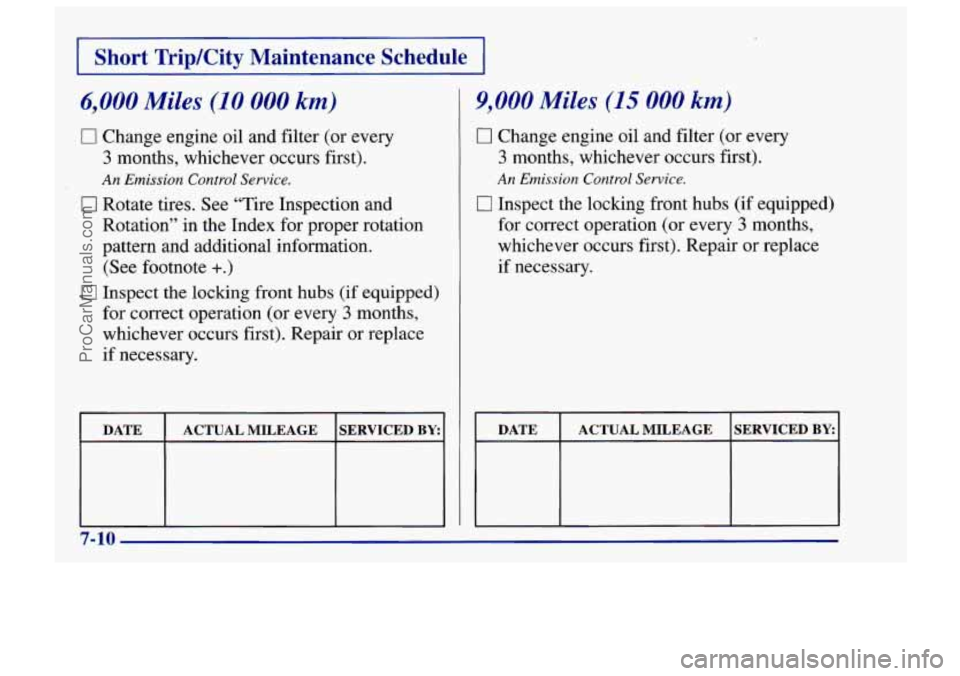
1 Short TripKity Maintenance Schedule I
6,000 Miles (10 000 km)
0 Change engine oil and filter (or every
3 months, whichever occurs first).
An Emission Control Service.
0 Rotate tires. See “Tire Inspection and
Rotation’’ in the Index for proper rotation
pattern and additional information.
(See footnote
+.)
0 Inspect the locking front hubs (if equipped)
for correct operation (or every
3 months,
whichever occurs first). Repair or replace
if necessary.
I DATE I ACTUALMILEAGE SERVICED BYI
9,000 Miles (15 000 km)
iJ Change engine oil and filter (or every
3 months, whichever occurs first).
An Emission Control Service.
0 Inspect the locking front hubs (if equipped)
for correct operation (or every
3 months,
whichever occurs first). Repair or replace
if necessary.
DATE
SERVICED BY ACTUAL MILEAGE
7-10
ProCarManuals.com
Page 313 of 388
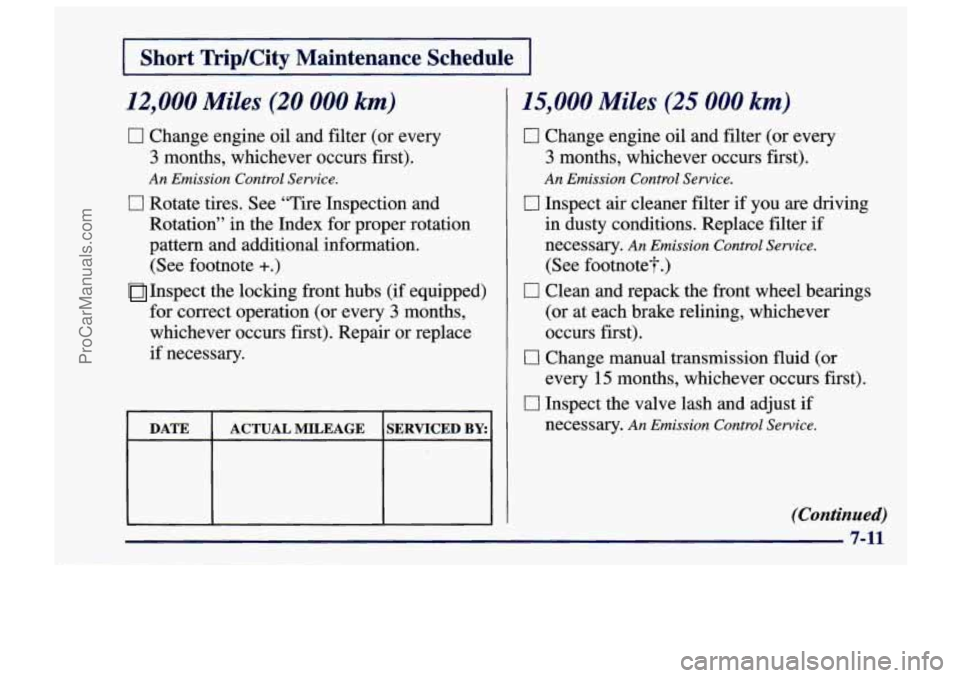
Short Trip/City Maintenance Schedule
12,000 Miles (20 000 km)
0 Change engine oil and filter (or every
3 months, whichever occurs first).
An Emission Control Service.
17 Rotate tires. See “Tire Inspection and
Rotation” in the Index for proper rotation
pattern and additional information.
(See footnote
+.)
Inspect the locking front hubs (if equipped)
for correct operation (or every
3 months,
whichever occurs first). Repair or replace
if necessary.
DATE SERVICED BY: ACTUAL MILEAGE
15,000 Miles (25 000 km)
0 Change engine oil and filter (or every
3 months, whichever occurs first).
An Emission Control Service.
0 Inspect air cleaner filter if you are driving
in dusty conditions. Replace filter
if
necessary. An Emission Control Service.
(See footnote-f..)
0 Clean and repack the front wheel bearings
(or at each brake relining, whichever
occurs first).
0 Change manual transmission fluid (or
every 15 months, whichever occurs first).
0 Inspect the valve lash and adjust if
necessary.
An Emission Control Service.
(Continued)
-11
ProCarManuals.com
Page 314 of 388
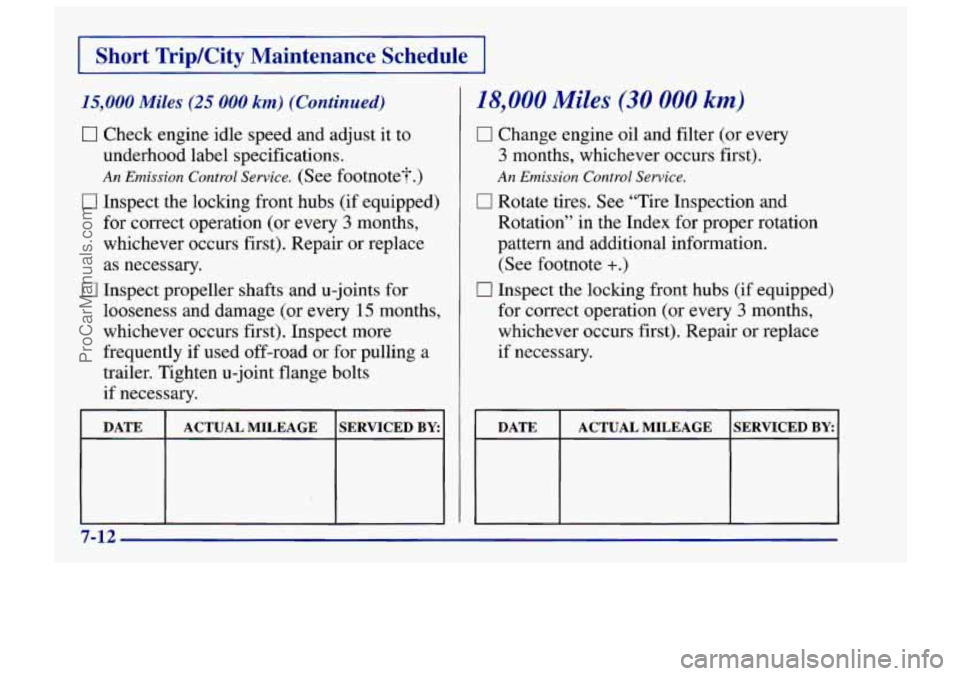
I Short TripKity Maintenance Schedule I
15,000 Miles (25 000 km) (Continued)
0 Check engine idle speed and adjust it to
underhood label specifications.
An Emission Control Service. (See footnote”f)
0 Inspect the locking front hubs (if equipped)
for correct operation (or every
3 months,
whichever occurs first). Repair or replace
as necessary.
0 Inspect propeller shafts and u-joints for
looseness and damage (or every
15 months,
whichever occurs first). Inspect more
frequently if used off-road
or for pulling a
trailer. Tighten u-joint flange bolts
if necessary.
18,000 Miles (30 000 km)
0 Change engine oil and filter (or every
3 months, whichever occurs first).
An Emission Control Service.
0 Rotate tires. See “Tire Inspection and
Rotation” in the Index for proper rotation
pattern and additional information.
(See footnote
+.)
0 Inspect the locking front hubs (if equipped)
for correct operation (or every
3 months,
whichever occurs first). Repair or replace
if necessary.
I DATE I ACTUAL MILEAGE ISERVICED BY I
7-12
ProCarManuals.com
Page 315 of 388
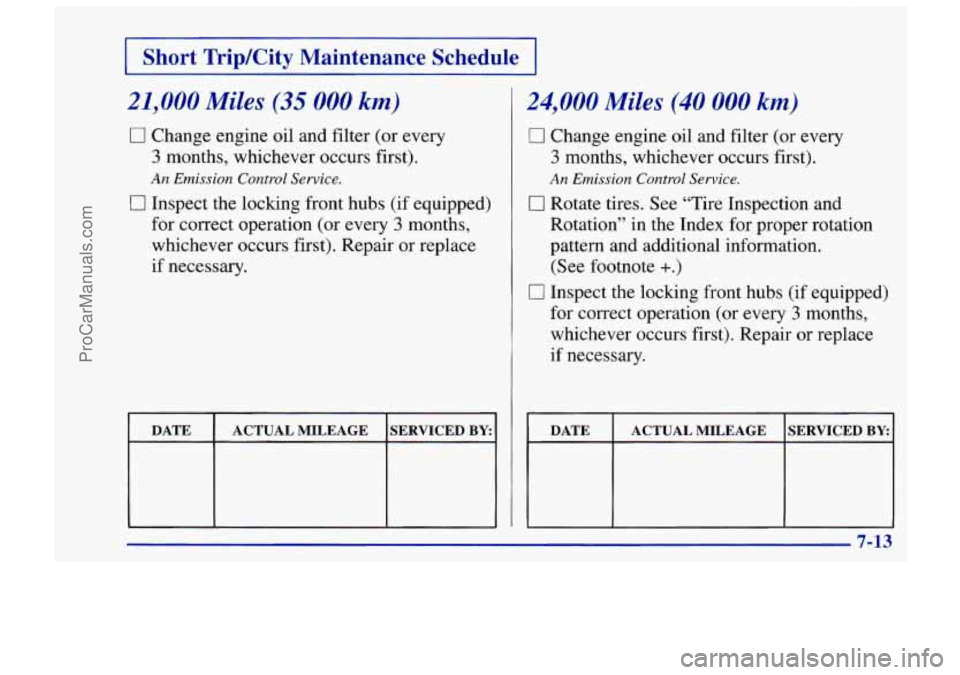
1 Short Trip/City Maintenance Schedule 1
21,000 Miles (35 000 km)
0 Change engine oil and filter (or every
3 months, whichever occurs first).
An Emission Control Service.
0 Inspect the locking front hubs (if equipped)
for correct operation (or every
3 months,
whichever occurs first). Repair
or replace
if necessary.
I DATE I ACTUALMILEAGE SERVICED BY:^
24,000 Miles (40 000 km)
0 Change engine oil and filter (or every
3 months, whichever occurs first).
0 Rotate tires. See “Tire Inspection and
Rotation’’ in the Index for proper rotation
pattern and additional information. (See footnote
+.)
An Emission Control Service.
0 Inspect the locking front hubs (if equipped)
for correct operation (or every
3 months,
whichever occurs first). Repair or replace
if necessary.
DATE
SERVICED BY: ACTUAL MILEAGE
7-13
ProCarManuals.com
Page 317 of 388
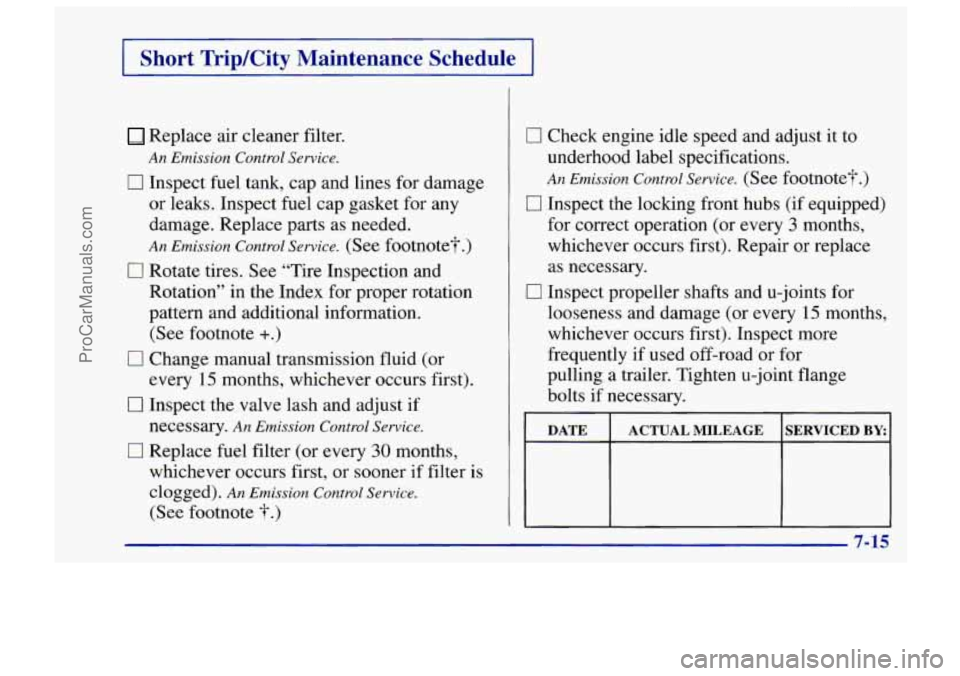
Short TripKity Maintenance Schedule
Replace air cleaner filter.
An Emission Control Sewice.
17 Inspect fuel tank, cap and lines for damage
or leaks. Inspect fuel cap gasket for any
damage. Replace parts as needed.
An Emission Control Service. (See footnote?.)
0 Rotate tires. See “Tire Inspection and
Rotation” in the Index for proper rotation
pattern and additional information.
(See footnote
+.)
0 Change manual transmission fluid (or
every
15 months, whichever occurs first).
0 Inspect the valve lash and adjust if
necessary. An Emission Control Service.
0 Replace fuel filter (or every 30 months,
whichever occurs first, or sooner if filter is
clogged).
An Emission Control Service.
(See footnote “f.)
0 Check engine idle speed and adjust it to
underhood label specifications.
An Emission Control Service. (See footnote?.)
0 Inspect the locking front hubs (if equipped)
for correct operation (or every
3 months,
whichever occurs first). Repair or replace as necessary.
0 Inspect propeller shafts and u-joints for
looseness and damage (or every
15 months,
whichever occurs first). Inspect more
frequently
if used off-road or for
pulling a trailer. Tighten u-joint flange
bolts if necessary.
DATE
SERVICED BY: ACTUAL MILEAGE
I I I
7-15
ProCarManuals.com
Page 318 of 388
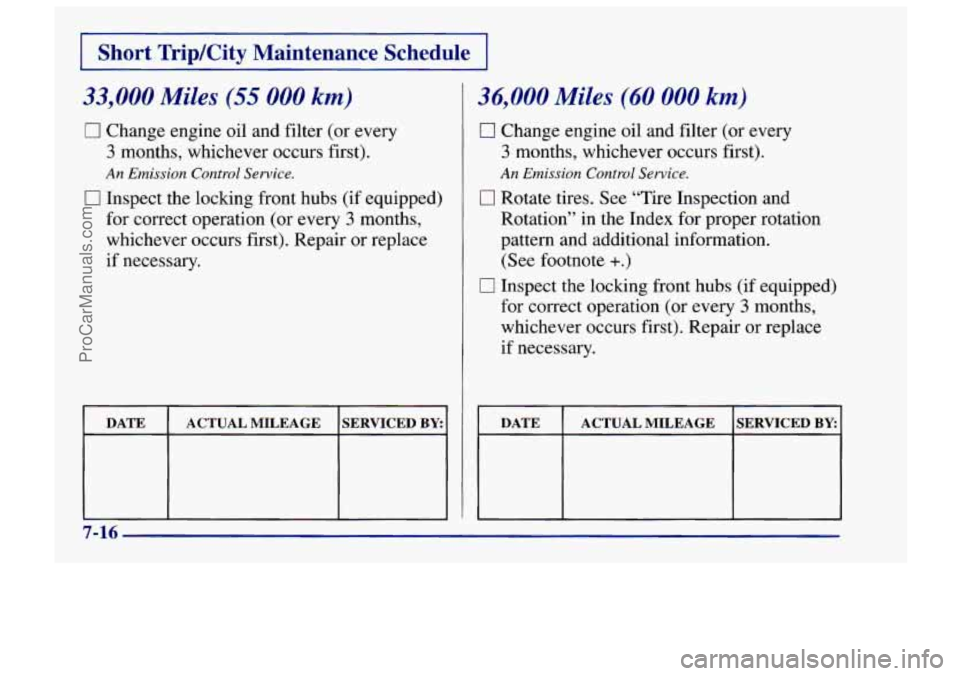
I Short TripKity Maintenance Schedule I
33,000 Miles (55 000 km)
0 Change engine oil and filter (or every
3 months, whichever occurs first).
An Emission Control Service.
0 Inspect the locking front hubs (if equipped)
for correct operation (or every
3 months,
whichever occurs first). Repair or replace
if necessary.
DATE ACTUAL MILEAGE SERVICED BY
36,000 Miles (60 000 km)
[7 Change engine oil and filter (or every
3 months, whichever occurs first).
0 Rotate tires. See “Tire Inspection ana
Rotation” in the Index for proper rotation
pattern and additional information.
(See footnote
+.)
0 Inspect the locking front hubs (if equipped)
for correct operation (or every
3 months,
whichever occurs first). Repair or replace if necessary.
An Emission Control Service.
I I I 1
DATE ACTUAL MILEAGE SERVICED BY:
7-16
ProCarManuals.com