change wheel CHEVROLET TRACKER 1997 Owners Manual
[x] Cancel search | Manufacturer: CHEVROLET, Model Year: 1997, Model line: TRACKER, Model: CHEVROLET TRACKER 1997Pages: 388, PDF Size: 20.12 MB
Page 64 of 388
NOTICE:
Your engine is designed to work with the
electronics
in your vehicle. If you add electrical
parts or accessories, you could change the
way
the engine operates. Before adding electrical
equipment, check with your dealer.
If you don’t,
your engine might not perform properly.
If you ever have to have your vehicle towed, see
the part
of this manual that tells how to do it
without damaging your vehicle. See “Towing
Your Vehicle” in the Index.
Automatic Transmission Operation
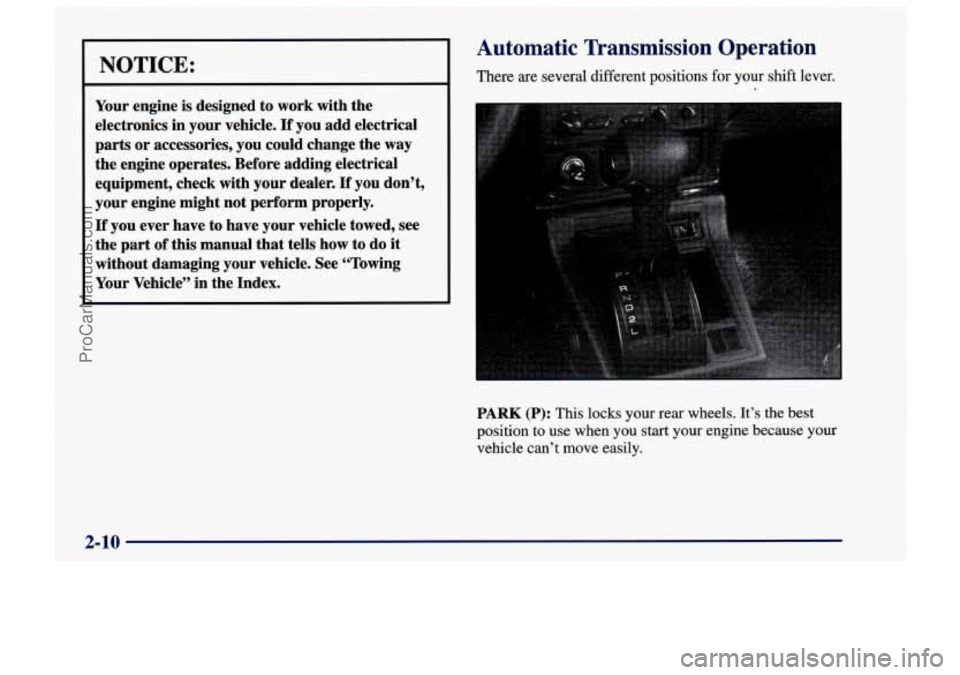
There are several different positions for your shift lever.
PARK (P): This locks your rear wheels. It’s the best
position
to use when you start your engine because your
vehicle can’t move easily.
2-10
ProCarManuals.com
Page 83 of 388
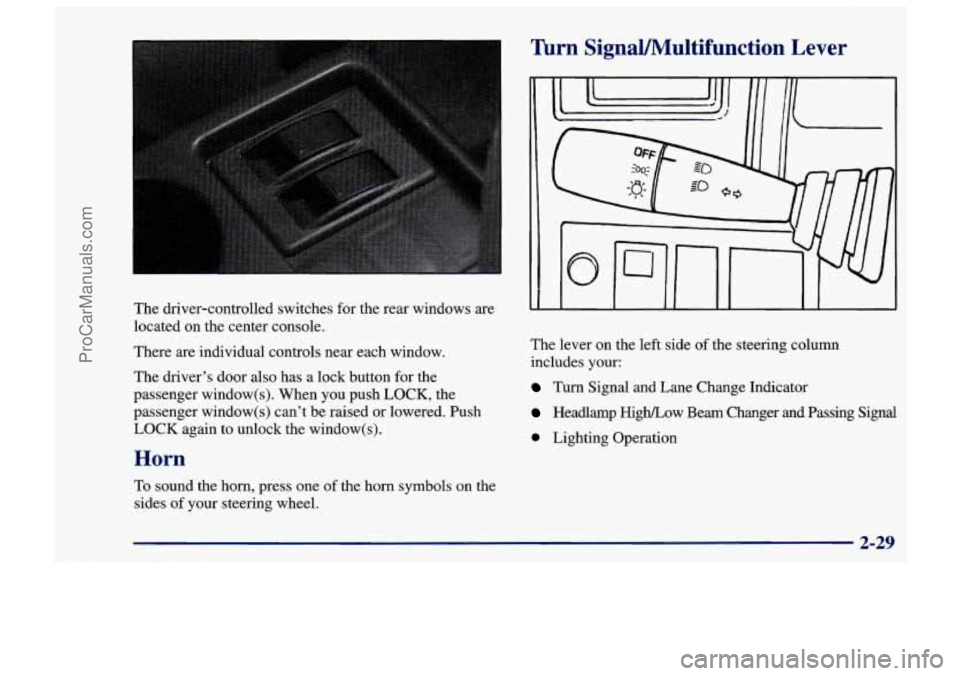
The driver-controlled switches for the rear windows are
located on the center console.
There are individual controls near each window.
The driver’s door also has a lock button for the
passenger window(s). When you push LOCK, the
passenger window(s) can’t be raised or lowered. Push
LOCK again to unlock the window(s).
Horn Turn SignaVMultifunction
Lever
The lever on the left
side of the steering column
includes your:
Turn Signal and Lane Change Indicator
Headlamp HigwLow Beam Changer and Passing Signal
0 Lighting Operation
To sound the horn, press one of the horn symbols on the
sides of your steering wheel.
ProCarManuals.com
Page 88 of 388
Cruise Control (If Equipped)
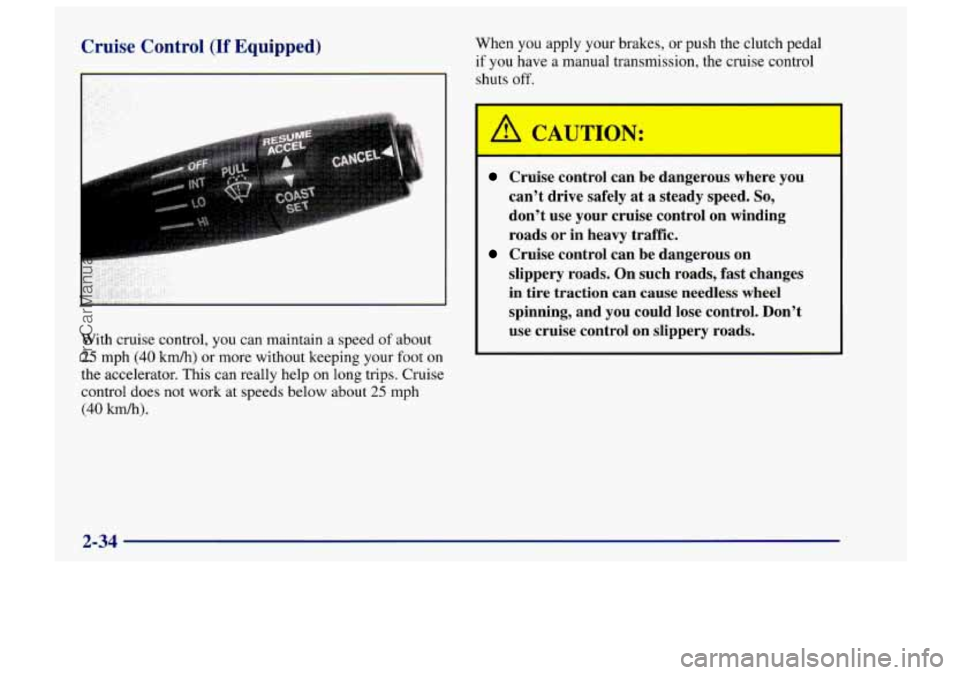
With cruise control, you can maintain a speed of about
25 mph (40 km/h) or more without keeping your foot on
the accelerator. This can really help on long trips. Cruise
control does not work at speeds below about
25 mph
(40 kmh). When you
apply your brakes, or push the clutch pedal
if you have a manual transmission, the cruise control
shuts
off.
Cruise control can be dangerous where you
can’t drive safely at a steady speed.
So,
don’t use your cruise control on winding
roads
or in heavy traffic.
slippery roads. On such roads,
fast changes
in tire traction can cause needless wheel
spinning, and you could lose control. Don’t
use cruise control on slippery roads.
Cruise control can be dangerous on
2-34
ProCarManuals.com
Page 154 of 388
t
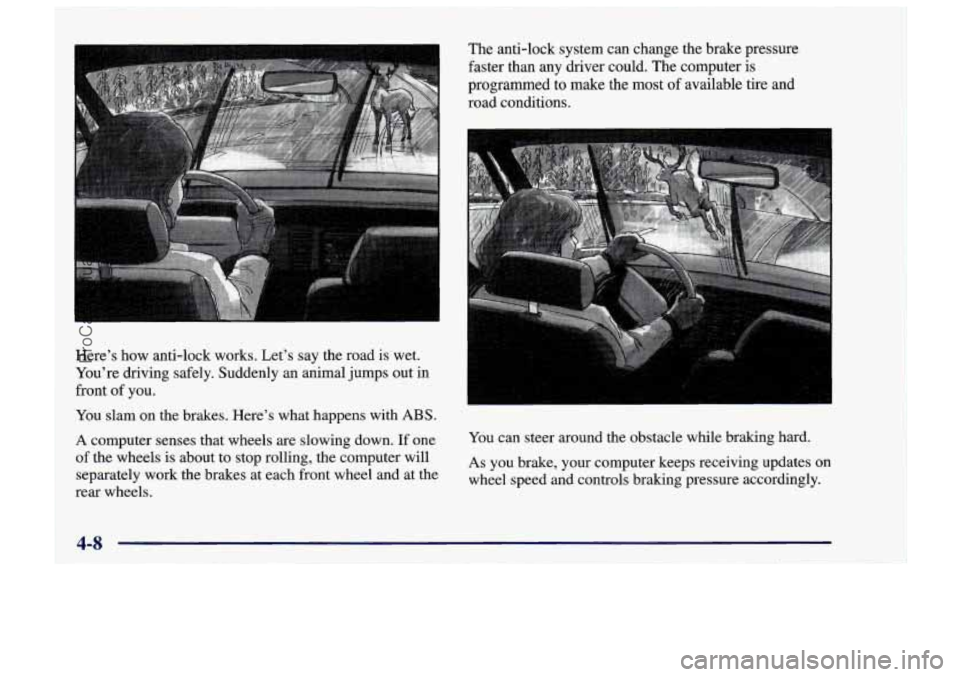
Here’s how anti-lock works. Let’s say the road is wet.
You’re driving safely. Suddenly an animal jumps out in
front of you.
You slam on the brakes. Here’s what happens with ABS.
A computer senses that wheels are slowing down. If one
of the wheels is about to stop rolling, the computer will
separately work the brakes at each front wheel and at the
rear wheels. The anti-lock system can change the brake pressure
faster than any
dnver could. The computer is
programmed to make the most of available tire and
road conditions.
You can steer around the obstacle while braking hard.
As you brake, your computer keeps receiving updates or
wheel speed and controls braking pressure accordingly.
4-8
ProCarManuals.com
Page 155 of 388
Remember: Anti-lock doesn’t change the time you need
to get your foot up to the brake pedal or always decrease
stopping distance. If you get too close to the vehicle in
front
of you, you won’t have time to apply your brakes
if that vehicle suddenly slows or
stops. Always leave
enough room up ahead to stop, even though you have
anti-lock brakes.
Using Anti-Lock
Don’t pump the brakes. Just hold the brake pedal down
and let anti-lock work for
you. You may feel the system
working, or
you may notice some noise, but this is normal.
ABS
ACTIVE
When your anti-lock system
is adjusting brake pressure
to help avoid a braking skid,
this light will come on. See
“Anti-Lock Brake System
Active Light” in
the Index.
Braking in Emergencies
At some time, nearly every driver gets into a situation
that requires hard braking.
If you have anti-lock, you can steer and brake at the
same time. However,
if you don’t have anti-lock, your
first reaction
-- to hit the brake pedal hard and hold it
down
-- may be the wrong thing to do. Your wheels
can stop rolling. Once they do, the vehicle can’t respond
to your steering. Momentum will carry it in whatever
direction it was headed when the wheels stopped rolling.
That could be off the road, into the very thing you were
trying to avoid, or into traffic.
If you don’t have anti-lock, use a “squeeze” braking
technique. This will give you maximum braking while
maintaining steering control.
You do this by pushing on
the brake pedal with steadily increasing pressure.
In
an emergency, you will probably want to squeeze the
brakes hard without locking the wheels. If
you hear or
feel the wheels sliding, ease
off the brake pedal. This
will help you retain steering control. (If you
do have
anti-lock, it’s different: see “Anti-Lock Brakes” in
the Index.)
In many emergencies, steering can help you more than
even the very best braking.
~ 4-9
I
ProCarManuals.com
Page 156 of 388
Steering
Power Steering
If you lose power steering assist because the engine
stops or the system is not functioning, you can steer but
it will take much more effort.
Steering Tips
Driving on Curves
It’s important to take curves at a reasonable speed.
A lot of the “driver lost control” accidents mentioned on
the news happen on curves. Here’s why:
Experienced driver or beginner, each of us is subject to
the same laws
of physics when driving on curves. The
traction
of the tires against the road surface makes it
possible for the vehicle to change its path when you turn
the front wheels. If there’s no traction, inertia will keep
the vehicle going
in the same direction. If you’ve ever
tried to steer a vehicle on wet ice, you’ll understand this.
The traction you can get in a curve depends on the
condition of your tires and the road surface, the angle at
which the curve
is banked, and your speed. While you‘re
in a curve, speed is the one factor you can control. Suppose you’re steering through
a sharp curve. Then you
suddenly apply the brakes. Both control systems
-- steering
and braking
-- have to do their work where the tires meet
the road. Unless you have four-wheel anti-lock brakes,
adding the hard braking can demand too much of those
places. You can lose control.
The same thing can happen
if you’re steering through a
sharp curve and you suddenly accelerate. Those two
control systems
-- steering and acceleration -- can
overwhelm those places where the tires meet the road
and make you lose control.
What should
you do if this ever happens? Ease up on the
brake or accelerator pedal, steer the vehicle the way
you
want it to go, and slow down.
Speed limit signs near curves warn that you should
adjust your speed. Of course, the posted speeds are
based
on good weather and road conditions. Under less
favorable conditions you’ll want to go slower.
If you need to reduce your speed as you approach a
curve, do
it before you enter the curve, while your front
wheels are straight ahead.
Try to adjust your speed
so you can “drive” through the
curve. Maintain
a reasonable, steady speed. Wait to
accelerate
until you are out of the curve, and then
accelerate gently into the straightaway.
4-10
ProCarManuals.com
Page 160 of 388
Loss of Control
Let’s review what driving experts say about what
happens when the three control systems (brakes, steering
and acceleration) don’t have enough friction where the
tires meet the road to do what the driver has asked.
In any emergency, don’t give up. Keep trying to steer and
constantly seek an escape route or area
of less danger.
Skidding
In a skid, a driver can lose control of the vehicle.
Defensive drivers avoid most skids by taking reasonable
care suited to existing conditions, and by not
“overdriving” those conditions. But skids are
always possible.
The three types of skids correspond to your Geo’s three
control systems.
In the braking skid, your wheels aren’t
rolling.
In the steering or cornering skid, too much speed
or steering
in a curve causes tires to slip and lose
cornering force. And in the acceleration skid, too much
throttle causes the driving wheels to spin.
A cornering skid and an acceleration skid are best
handled by easing your foot off the accelerator pedal.
If your vehicle starts to slide, ease your foot off
the
accelerator pedal and quickly steer the way you want the vehicle
to go. 11 you
start steering quickly enough, your
vehicle may straighten out. Always be ready for a
second skid if it occurs.
Of course, traction
is reduced when water, snow, ice,
gravel or other material is on
the road. For safety, you’ll
want to slow down and adjust your driving to these
conditions. It is important to slow down on slippery
surfaces because stopping distance will be longer and
vehicle control more limited.
While driving on
a surface with reduced traction, try
your best to avoid sudden steering, acceleration or
braking (including engine braking by shifting to a lower
gear). Any sudden changes could cause the tires to slide.
You may not realize the surface is slippery until your
vehicle is skidding. Learn to recognize warning clues
--
such as enough water, ice or packed snow on the road to
make a “mirrored surface’’
-- and slow down when you
have any doubt.
If you have the anti-lock braking system, remember:
It helps avoid only the braking skid. If you do not have
anti-lock, then
in a braking skid (where the wheels are
no longer rolling), release enough pressure on the brakes
to get
the wheels rolling again. This restores steering
control. Push the brake pedal down steadily when you
have to stop suddenly.
As long as the wheels are rolling,
you will have steering control.
4-14
ProCarManuals.com
Page 165 of 388
Scanning the Terrain
Off-road driving can take you over many different kinds
of terrain. You need to be familiar with the terrain and its
many different features. Here are some things to consider.
Suqfiuce Conditions. Off-roading can take you over
hard-packed dirt, gravel, rocks, grass, sand, mud, snow or
ice. Each of these surfaces affects the steering, acceleration
and braking of your vehicle
in different ways. Depending
upon the kind of surface you are on, you may experience
slipping, sliding, wheel spinning, delayed acceleration,
poor traction and longer braking distances.
Suflace Obstacles. Unseen or hidden obstacles can be
hazardous.
A rock, log, hole, rut or bump can startle you if
you’re not prepared for them. Often these obstacles are
hidden by grass, bushes, snow or even the rise and fall of
the terrain itself. Here are some things to consider:
Is the path ahead clear?
Will the surface texture change abruptly up ahead?
Does the travel take you uphill or downhill? (There’s
more discussion of these subjects later.)
Will you have to stop suddenly or change
direction quickly? When
you drive over obstacles or
rough terrain, keep a
firm grip on the steering wheel. Ruts, troughs or other
surface features can jerk the wheel out of your hands if
you’re not prepared.
When you drive over bumps, rocks, or other obstacles,
your wheels can leave
the ground. If this happens, even
with one or two wheels,
you can’t control the vehicle as
well or at all.
Because you will be on an unpaved surface, it’s
especially important to avoid sudden acceleration,
sudden turns or sudden braking.
In a way, off-road driving requires a different kind of
alertness from driving on paved roads and highways.
There are no road signs, posted speed limits or signal
lights. You have to use your own good judgment about
what is safe and what isn’t.
Drinking and driving can be very dangerous on any
road. And this is certainly true for off-road driving.
At the very time you need special alertness and driving
skills, your reflexes, perceptions and judgment can be
affected by even a small amount of alcohol. You could
have a serious
-- or even fatal -- accident if you drink
and drive or ride with a driver who has been drinking.
See “Drunken Driving”
in the Index.
4-19
ProCarManuals.com
Page 174 of 388
Driving in Mud, Sand, Snow or Ice Hard packed snow and ice offer the worst tire traction.
When you drive in mud, snow or sand, your wheels
turning is more difficult, and you’ll need longer
braking distances.
It’s best to use
a low gear when you’re in mud -- the
deeper
the mud, the lower the gear. In really deep mud,
the idea is to keep your vehicle moving
so you don’t
get stuck. On
these surfaces, it’s very easy to lose control. On wet
ice, for example, the traction is
so poor that you will
poor steering and difficult braking can cause you to slide
out of control.
won’t
get good traction. you can’t accelerate as quickly,
have difficulty accelerating. And if you do get moving,
When you drive on sand, you’ll sense a change in wheel
traction. But it will depend upon how loosely packed the
sand
is. On loosely packed sand (as on beaches or sand
dunes) your tires will tend to sink into the sand. This has
an effect on steering, accelerating and braking. You may
want to reduce the air pressure in your tires slightly
when driving on sand. This will improve traction.
Driving on frozen lakes, ponds or rivers can be
dangerous. Underwater springs, currents under
the ice, or sudden thaws can weaken the ice.
Your
vehicle could fall through the ice and you and
your passengers could drown. Drive your vehicle
on safe surfaces only.
4-28
ProCarManuals.com
Page 201 of 388
Turn Signals When Towing a Trailer
When you tow a trailer, your vehicle has to have extra
wiring (included in the optional trailering package).
The arrows on your instrument panel will flash
whenever you signal a turn or lane change. Properly
hooked up, the trailer lamps will also flash, telling other
drivers you’re about to turn, change lanes or stop.
When towing a trailer, the arrows on your instrument panel
will flash for turns even if
the bulbs on the trailer are burned
out. Thus, you may think drivers behind
you are seeing your
signal when they are not. It’s important to check occasionally
to be sure the trailer bulbs are still working.
Driving On Grades
Reduce speed and shift to a lower gear before you start
down a long or steep downgrade. If you don’t shift
down, you might have
to use your brakes so much that
they would get hot and no longer work well.
On a long uphill grade, shift down and reduce your
speed to around
45 mph (70 km/h) to reduce the
possibility of engine and transmission overheating.
If you are towing a trailer and
you have a manual
transmission with FIFTH
(5) gear, you may prefer not to
use FIFTH (5). Just drive in FOURTH (4) (or, as you
need to, a lower gear).
Parking on Hills
You really should not park your vehicle, with a trailer
attached, on a
hill. If something goes wrong, your rig
could start to move. People can be injured, and both
your vehicle and the trailer can
be damaged.
But
if you ever have to park your rig on a hill, here’s
how to do it:
1.
2.
3.
4.
5.
6.
Apply your regular brakes, but don’t shift into
PARK (P)
yet, or into gear for a manual transmission.
Have someone place chocks under the trailer wheels.
When the wheel chocks are
in place, release the
regular brakes until the chocks absorb the load.
Reapply the regular brakes.
Then apply your parking
brake, and then shift to
PARK (P), or REVERSE (R)
for a manual transmission.
If you have a four-wheel-drive vehicle, be sure
the transfer case
is in a drive gear -- not in
NEUTRAL (N).
Release the regular brakes.
4-55
I
ProCarManuals.com