ignition CHEVROLET TRACKER 1998 1.G User Guide
[x] Cancel search | Manufacturer: CHEVROLET, Model Year: 1998, Model line: TRACKER, Model: CHEVROLET TRACKER 1998 1.GPages: 386, PDF Size: 21.17 MB
Page 84 of 386
Downloaded from www.Manualslib.com manuals search engine Shifting Out of PARK (P)
(Automatic Transmission)
Your vehicle has a brake-transmission shift interlock.
You have to fully apply your regular brakes before you
can shift from
PARK (P) when the ignition is in the ON
position. See “Automatic Transmission” in the Index.
If you cannot shift out of PARK (P), ease pressure on
the shift lever
-- push the shift lever all the way into
PARK
(P) and release the shift lever button as you
maintain brake application. Then press the shift lever
button and move the shift lever into the gear you wish.
If you ever hold the brake pedal down but still can’t
shift out
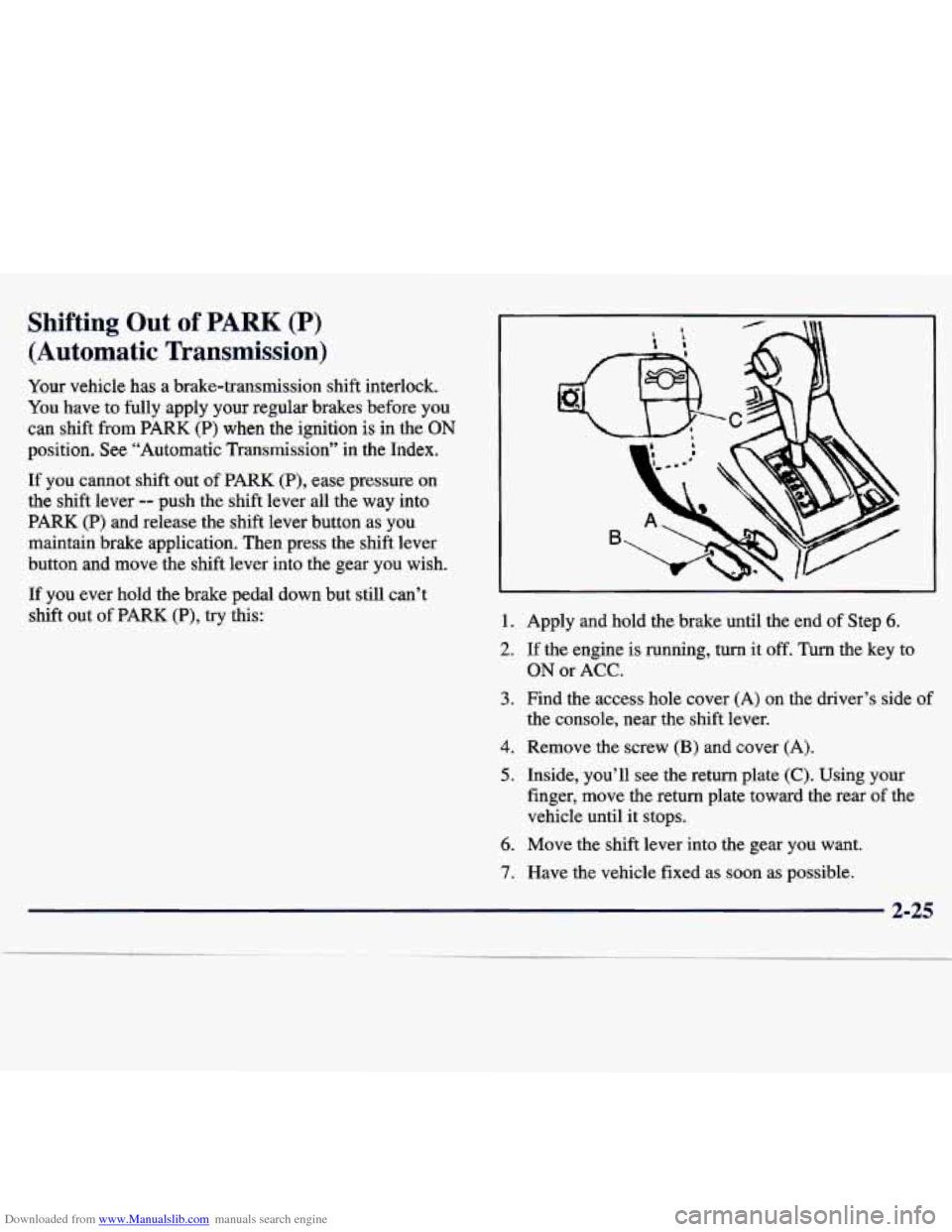
of PARIS (P), try this: 1. Apply and hold the brake until the end of Step 6.
2. If the engine is running, turn it off. Turn the key to
ON or ACC.
3. Find the access hole cover (A) on the driver’s side of
the console, near the shift lever.
4. Remove the screw (B) and cover (A).
5. Inside, you’ll see the return plate (C). Using your
finger, move the return plate toward the rear of the
vehicle until it stops.
6. Move the shift lever into the gear you want.
7. Have the vehicle fixed as soon as possible.
2-25
Page 88 of 386
Downloaded from www.Manualslib.com manuals search engine Windows
Manual Windows
Use the window crank to open and close each
door window.
Power Windows (If Equipped)
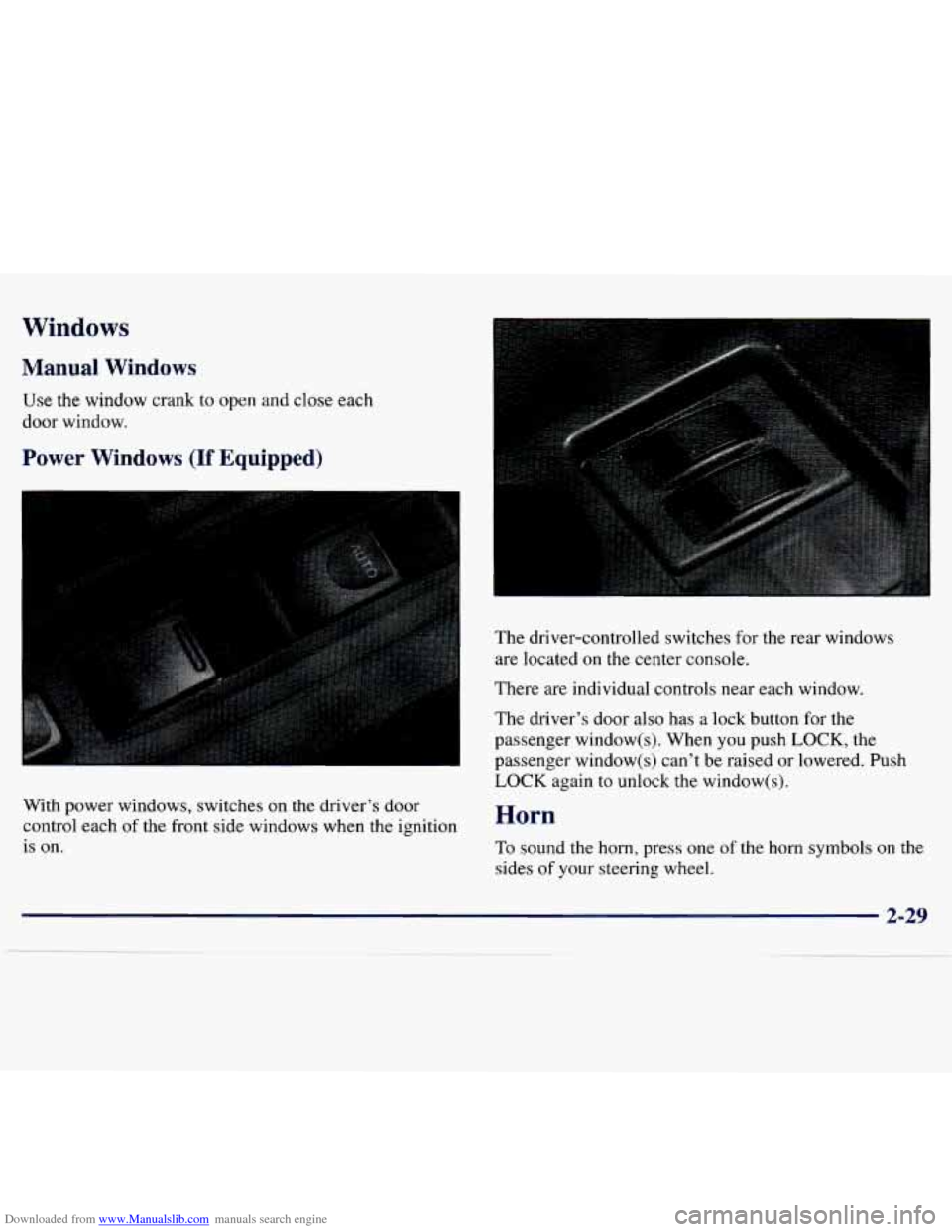
With power windows, switches on the driver’s door
control each
of the front side windows when the ignition
is on. The
driver-controlled switches for the rear windows
are located on the center console.
There
are individual controls near each window.
The driver’s door also has a lock button for the
passenger window(s). When you push
LOCK, the
passenger window(s) can’t be raised or lowered. Push
LOCK again to unlock the window(s).
Horn
To sound the horn, press one of the horn symbols on the
sides of your steering wheel.
2-29
Page 90 of 386
Downloaded from www.Manualslib.com manuals search engine To signal a lane change, just raise or lower the lever
until the arrow
starts to flash. Hold it there until you
complete your lane change. The lever will return by
itself when you release
it.
As you signal a turn or a lane change, if the arrows
don’t flash but just stay on, a signal bulb may be burned
out and other drivers won’t
see your turn signal.
If a bulb is burned out, replace it to help avoid an
accident. If the arrows don’t go on at all when you
signal a
turn, check the fuse (see “Fuses and Circuit
Breakers” in the Index) and for burned-out bulbs.
Lamps On Reminder
If you turn the ignition off, remove the key, open the
door and leave the lamps on, a tone will remind you
to
turn off your lamps.
Headlamp High/Low Beam Changer
First, you must have the headlamps on. For high beams,
push the
turn signal lever toward the instrument panel.
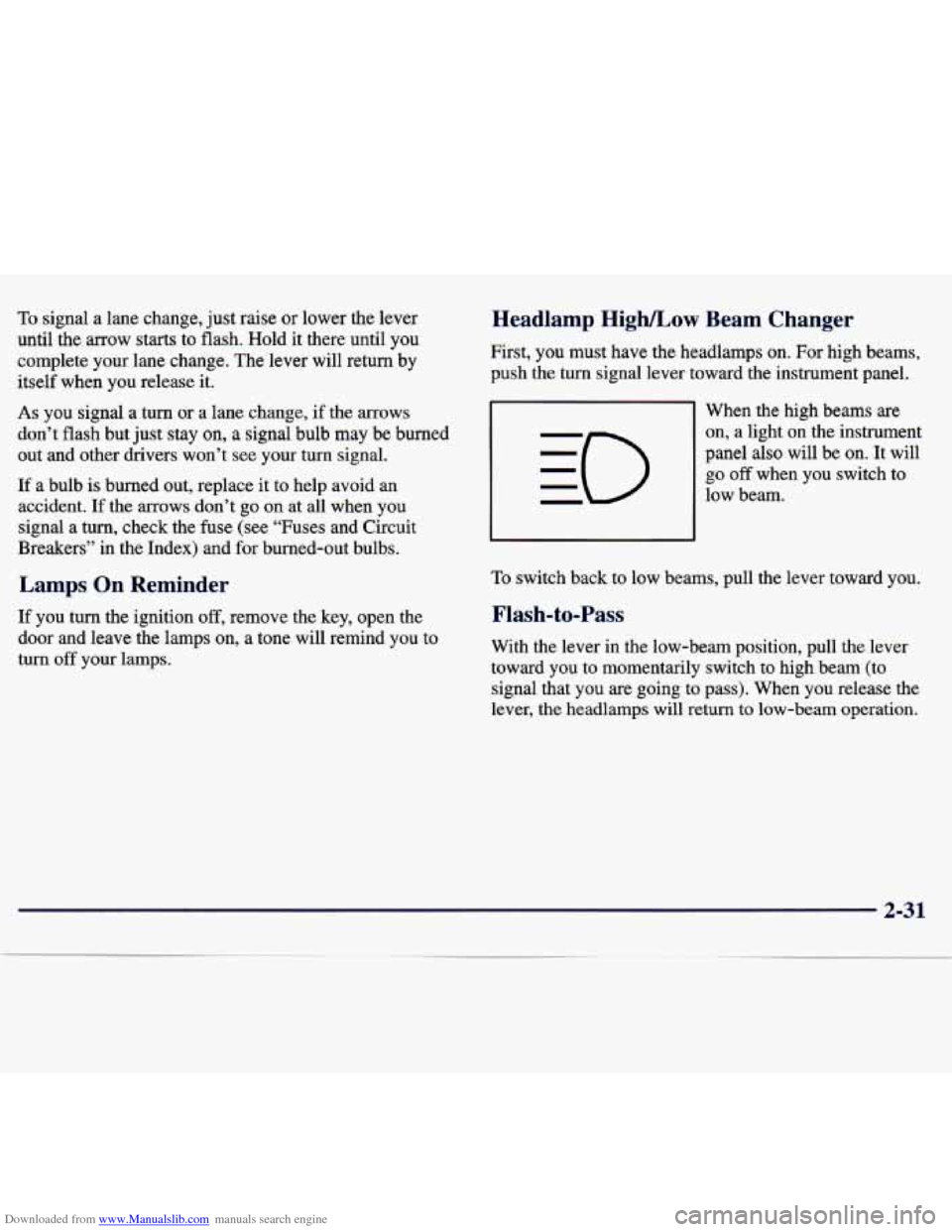
When the high beams are
on, a light on the instrument
panel also will be on. It will
go off when you switch to
low beam.
To switch back to low beams, pull the lever toward you.
Flash-to-Pass
With the lever in the low-beam position, pull the lever
toward you to momentarily switch to high beam (to
signal that you are going to pass). When you release the
lever,
the headlamps will return to low-beam operation.
2-31
Page 95 of 386
Downloaded from www.Manualslib.com manuals search engine Increasing Speed While Using Cruise Control
There are two ways to go to a higher speed.
Use the accelerator pedal to go to a higher speed.
Turn the lever to COAST/SET and release. Take
your foot
off the accelerator pedal. You’ll now
cruise at the higher speed.
at RESUME/ACCEL until you get up to the speed
you want, then release the lever.
Turn the lever to RESUME/ACCEL. Hold the lever
Reducing Speed While Using Cruise Control
To reduce your speed, turn and hold the lever in the
COASTISET position until you reach the lower speed
you want, then release the lever.
Passing Another Vehicle While Using Cruise Control
Use the accelerator pedal to increase your speed. When
you take your
foot off the pedal, your vehicle will slow
down to the cruise control speed you set earlier.
Using Cruise Control on Hills
How well your cruise control will work on hills depends
upon your speed, load and
the steepness of the hills.
When going up steep hills, you may have to step on the
accelerator pedal
to maintain your speed. When going
downhill, you may have to brake or shift to a lower
gear
to keep your speed down. Of course, applying the brake
takes you out of cruise control. Many drivers find this to
be too much trouble and don’t use cruise control on
steep hills.
Getting Out of Cruise Control
There are three ways to turn off cruise control:
Step lightly on the brake pedal, or push the clutch
pedal if you have a manual transmission.
Push in the CANCEL button on the end of the
cruise control lever.
Press the CRUISE CTlU switch on the
instrument panel.
Erasing Speed Memory
When you turn off the cruise control or the ignition,
your cruise control set speed memory
is erased.
2-36
Page 96 of 386
Downloaded from www.Manualslib.com manuals search engine Exterior Lamps
Daytime Running Lamps
Daytime Running Lamps (DIU) can make it easier
for others to see the front of your vehicle during the
day.
DRL can be helpful in many different driving
conditions, but they can be especially helpful in the
short periods after dawn and before sunset.
The DIU system will make your low-beam headlamps
come on at
a reduced brightness when:
0 The ignition is on,
0 The headlamp switch is off and
The parking brake is released.
When you turn on the headlamp switch, your DRL will
go out, and your headlamps will come on.
The other lamps that come on with your headlamps
will also come on. To
idle your vehicle with the DRL off, set the parking
brake. The
DRL will stay off until you release the
parking brake.
As with any vehicle, you should turn on the regular
headlamp system when you need it.
Interior Lamps
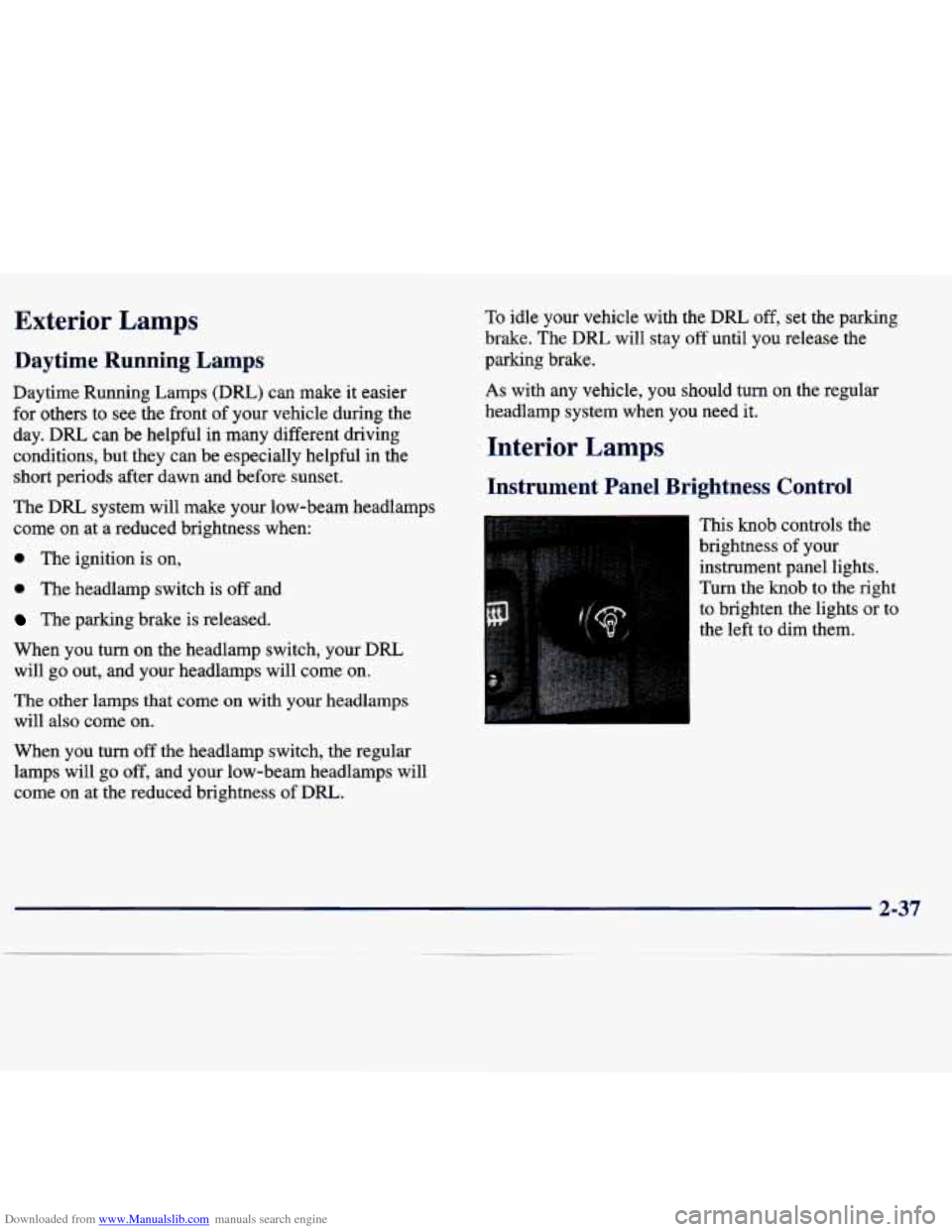
Instrument Panel Brightness Control
This knob controls the
brightness of your
instrument panel lights.
Turn the knob
to the right
to brighten the lights or to
the left to dim them.
When
you turn off the headlamp switch, the regular
lamps will go off, and your low-beam headlamps will
come on at the reduced brightness of DRL.
2-37
Page 98 of 386
Downloaded from www.Manualslib.com manuals search engine Power Remote Control Mirrors
(If Equipped)
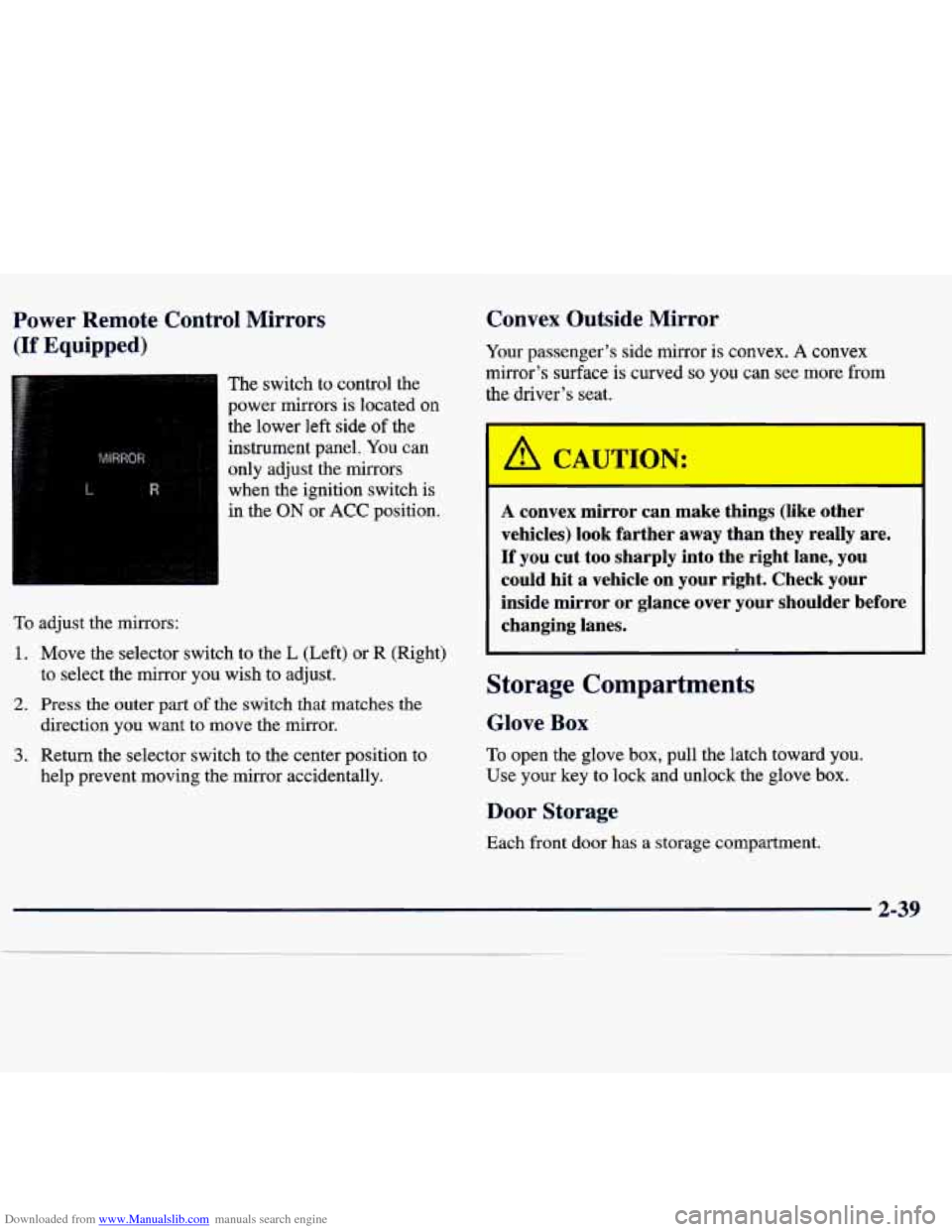
The switch to control the
power mirrors
is located on
the lower left side
of the
instrument panel.
You can
only adjust the mirrors
when the ignition switch is
in the
ON or ACC position.
To adjust the mirrors:
1. Move the selector switch to the L (Left) or R (Right)
to select the
mirror you wish to adjust.
2. Press the outer part of the switch that matches the
3. Return the selector switch to the center position to direction you want to move
the mirror.
help prevent moving the mirror accidentally.
Convex Outside Mirror
Your passenger’s side mirror is convex. A convex
mirror’s surface is curved
so you can Bee more from
the driver’s seat.
/A CA,TION:
A convex mirror can make things (like other
vehicles) look farther away than they really are.
If you cut too sharply into the right lane, you
could hit a vehicle on your right. Check your
inside mirror or glance over your shoulder before changing lanes.
Storage Compartments
Glove Box
To open the glove box, pull the latch toward you.
Use your key to lock and unlock the glove box.
Door Storage
Each front door has a storage compartment.
2-39
Page 114 of 386
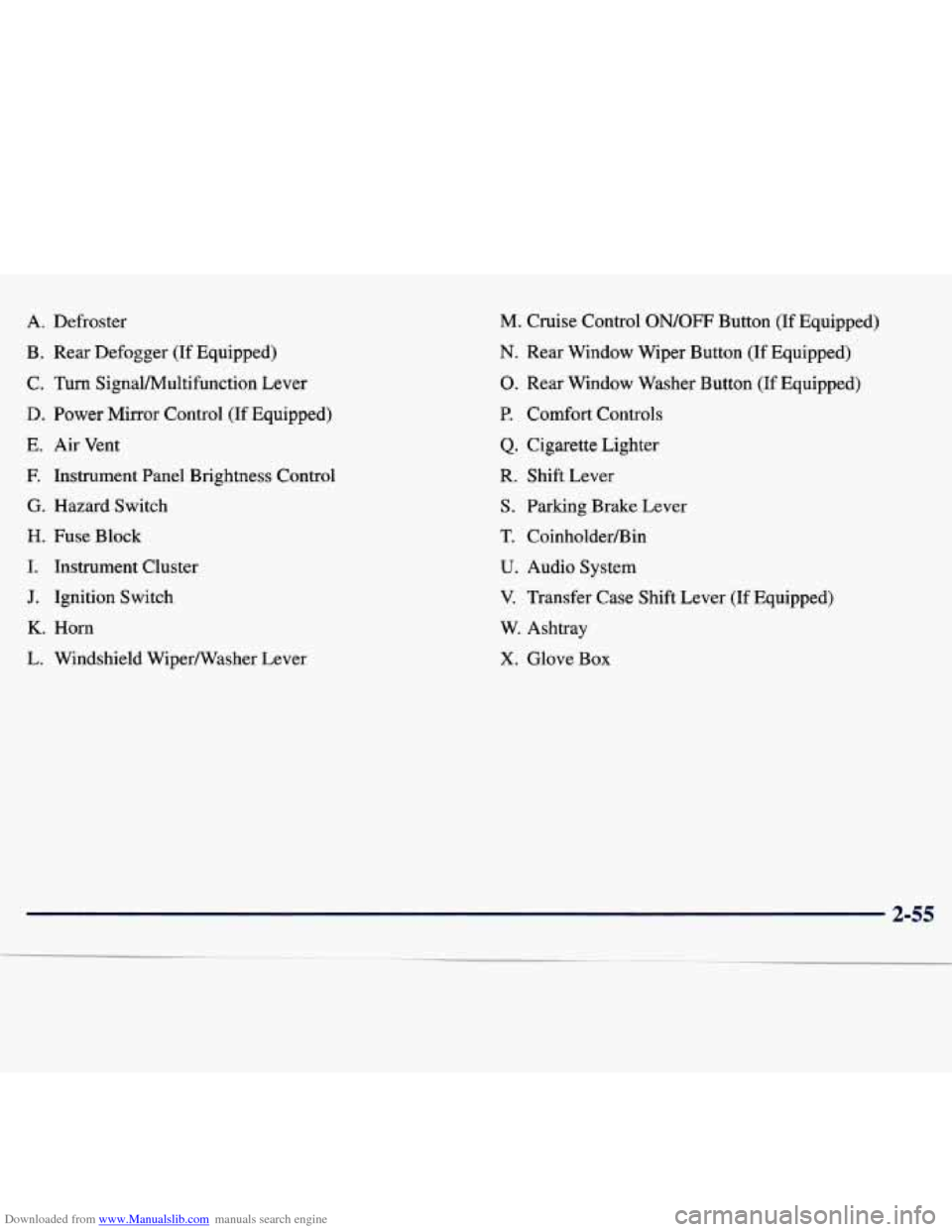
Downloaded from www.Manualslib.com manuals search engine A. Defroster
B. Rear Defogger (If Equipped)
C.
Turn SignalMultifunction Lever
D. Power Mirror Control (If Equipped)
E. Air Vent
E Instrument Panel Brightness Control
G. Hazard Switch
H. Fuse Block
I. Instrument Cluster
J. Ignition Switch
K. Horn
L. Windshield WiperNasher Lever
M. Cruise Control ON/OFF Button (If Equipped)
N. Rear Window Wiper Button (If Equipped)
0. Rear Window Washer Button (If Equipped)
P. Comfort Controls
Q. Cigarette Lighter
R. Shift Lever
S. Parking Brake Lever
T. CoinholderBin
U. Audio System
V. Transfer Case Shift Lever (If Equipped)
W. Ashtray
X. Glove Box
2-55
Page 118 of 386
Downloaded from www.Manualslib.com manuals search engine Air Bag Readiness Light
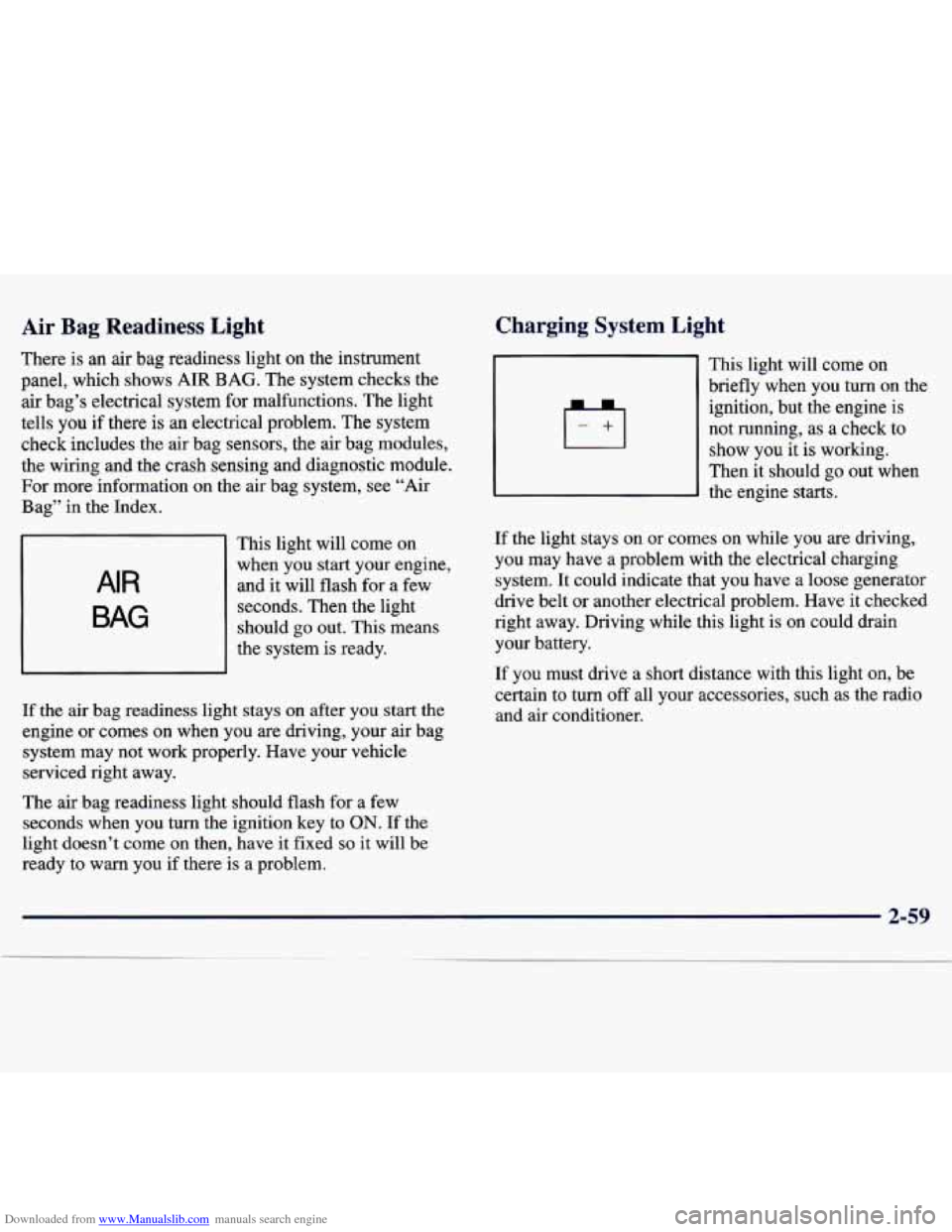
There is an air bag readiness light on the instrument
panel, which shows
AIR BAG. The system checks the
air bag’s electrical system for malfunctions. The light
tells you if there is an electrical problem. The system
check includes the air bag sensors, the air bag modules,
the wiring and the crash sensing and diagnostic module.
For more information on the air bag system, see “Air
Bag” in the Index.
AIR
BAG
This light will come on
when you start your engine,
and it will flash for a few
seconds. Then the light
should
go out. This means
the system is ready.
If
the air bag readiness light stays on after you start the
engine or comes on when you are driving, your air bag
system may not work properly. Have your vehicle
serviced right away.
The air bag readiness light should flash for a few
seconds when you turn the ignition key to
ON. If the
light doesn’t come on then, have it fixed
so it will be
ready
to warn you if there is a problem.
Charging System Light
This light will come on
briefly when you turn on the
ignition, but the engine
is
not running, as a check to
show you it is working.
Then it should go out when
the engine starts.
If the light stays on or comes on while you are driving,
you may have a problem with the electrical charging
system. It could indicate that you have a loose generator
drive belt or another electrical problem. Have it checked
right away. Driving while this light is on could drain
your battery.
If you must drive a short distance with this light
on, be
certain to
turn off all your accessories, such as the radio
and air conditioner.
2-59
- .. ~
Page 119 of 386
Downloaded from www.Manualslib.com manuals search engine Brake System Warning Light
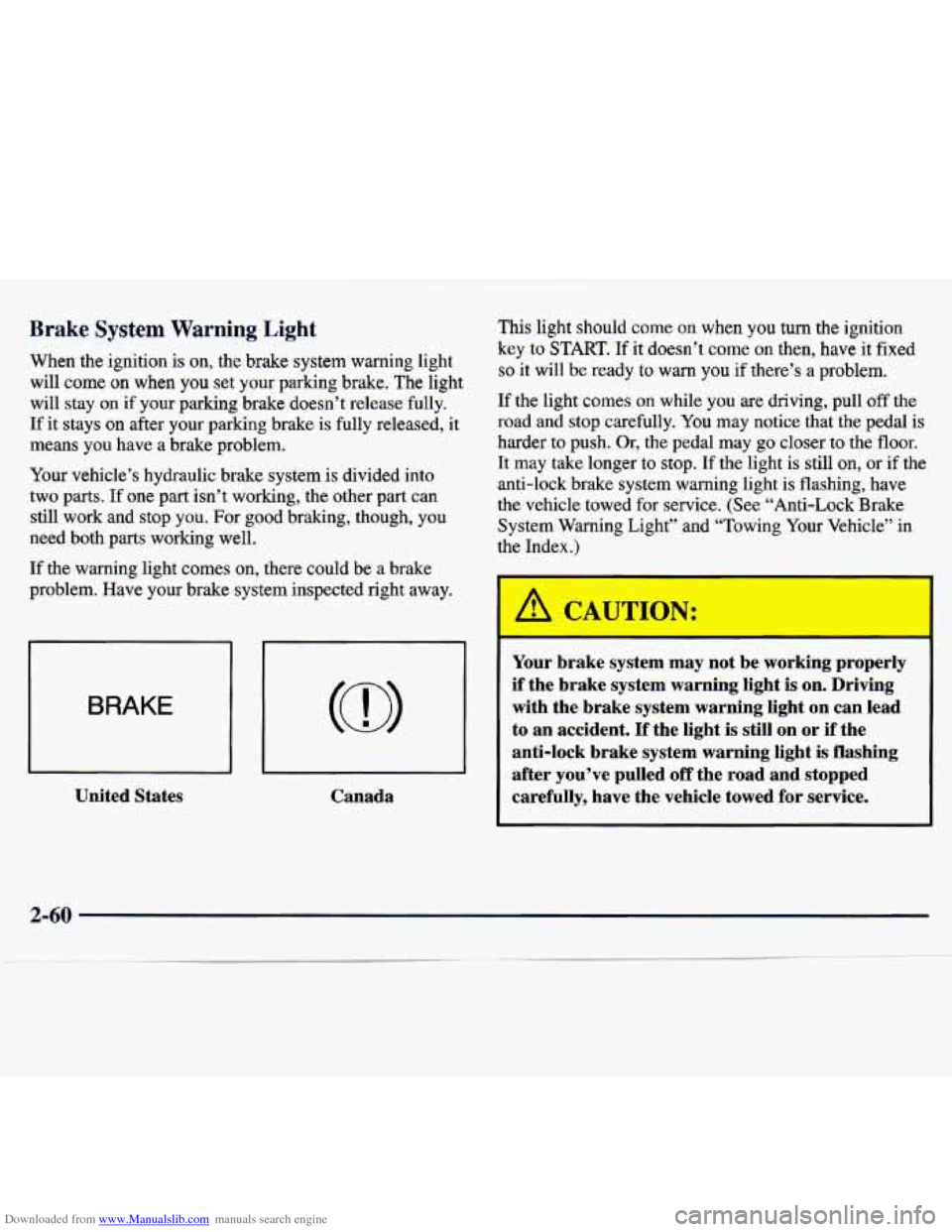
When the ignition is on, the brake system warning light will come
on when you set your parking brake. The light
will stay on if your parking brake doesn’t release fully.
If it stays on after your parking brake is fully released, it
means
you have a brake problem.
Your vehicle’s hydraulic brake system is divided into
two
parts. If one part isn’t working, the other part can
still work and stop you. For good braking, though, you
need both parts working well.
If the warning light comes on, there could be a brake
problem. Have your brake system inspected right away.
BRAKE
United States Canada
This light should come on when you turn the ignition
key to START. If it doesn’t come on then, have it fixed
so it will be ready to warn you if there’s a problem.
If the light comes
on while you are driving, pull off the
road and stop carefully. You may notice that the pedal is
harder to push. Or,
the pedal may go closer to the floor.
It may take longer to stop.
If the light is still on, or if the
anti-lock brake system warning light is flashing, have
the vehicle towed for service. (See “Anti-Lock Brake
System Warning Light” and “Towing Your Vehicle” in
the Index.)
I k!, CAUTION:
Your brake system may not be working properly
if the brake system warning light is on. Driving
with the brake system warning light on can lead
to an accident. If the light is still on or if the
anti-lock brake system warning light is flashing
after you’ve pulled
off the road and stopped
carefully, have the vehicle towed for service.
2-60
Page 120 of 386
Downloaded from www.Manualslib.com manuals search engine Anti-Lock Brake System Warning
Light (Option)
ABS
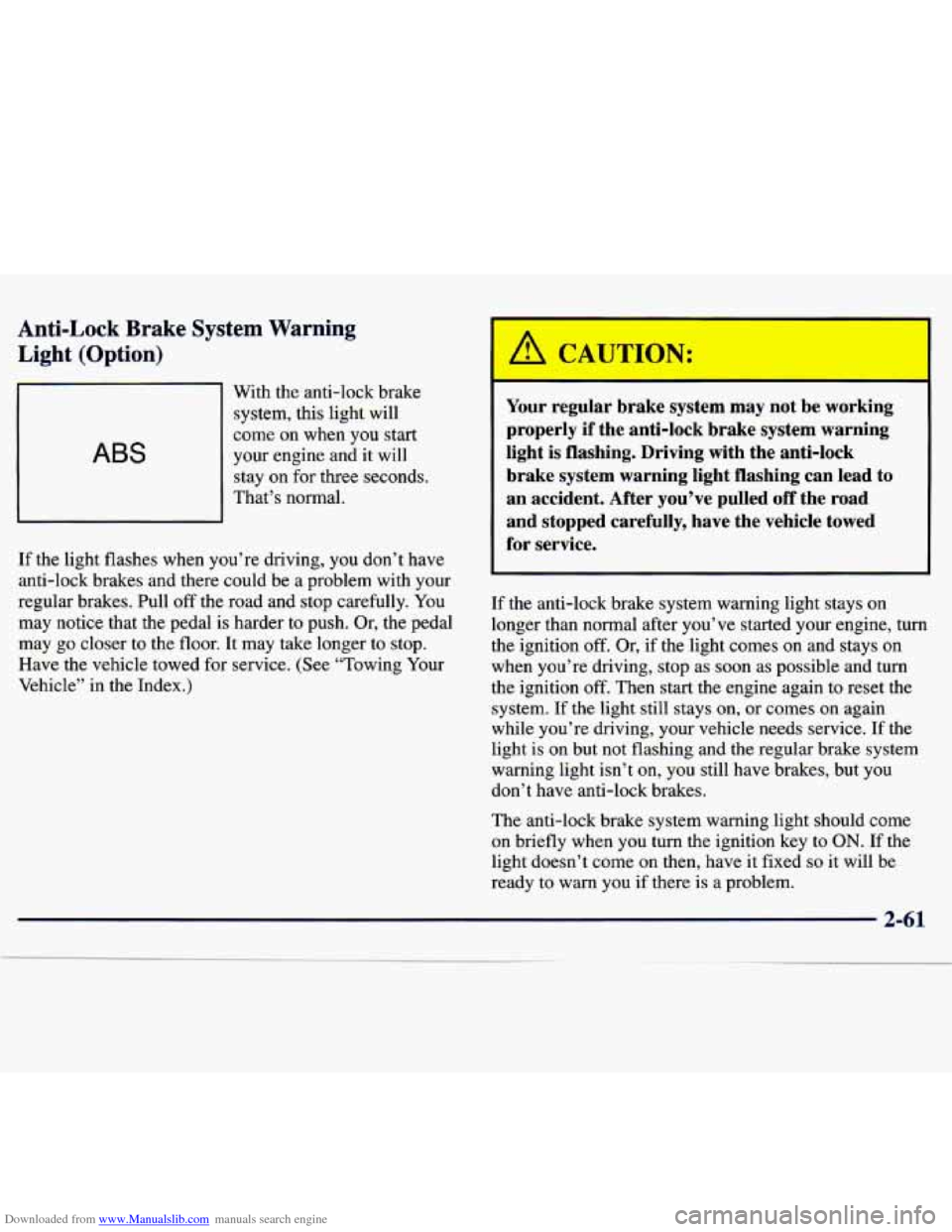
With the anti-lock brake
system, this light will
come on when you start
your engine and it will
stay on for three seconds.
That’s normal.
If the light flashes when you’re driving, you don’t have
anti-lock brakes and there could be a problem with your
regular brakes. Pull
off the road and stop carefully. You
may notice that the pedal is harder to push. Or, the pedal
may
go closer to the floor. It may take longer to stop.
Have the vehicle towed for service. (See “Towing Your
Vehicle’’ in the Index.)
I
I h, CAUTION:
Your regular brake system may not be working
properly if the anti-lock brake system warning
light is flashing. Driving with the anti-lock
brake system warning light flashing can lead to an accident. After you’ve pulled off the road
and stopped carefully, have the vehicle towed
for service.
If the anti-lock brake system warning light stays on longer than normal after you’ve started your engine, turn
the ignition off. Or, if the light comes
on and stays on
when you’re driving, stop
as soon as possible and turn
the ignition off. Then start the engine again to reset the
system.
If the light still stays on, or comes on again
while you’re driving, your vehicle needs service. If the
light is on but not flashing and the regular brake system
warning light isn’t on, you still have brakes, but
you
don’t have anti-lock brakes.
The anti-lock brake system warning light should come
on briefly when you turn the ignition key to
ON. If the
light doesn’t come on
then, have it fixed so it will be
ready to warn you
if there is a problem.