ignition CHEVROLET TRACKER 1998 1.G Owner's Manual
[x] Cancel search | Manufacturer: CHEVROLET, Model Year: 1998, Model line: TRACKER, Model: CHEVROLET TRACKER 1998 1.GPages: 386, PDF Size: 21.17 MB
Page 121 of 386
Downloaded from www.Manualslib.com manuals search engine Anti-Lock Brake System Active
Light (Option)
~
._.a
Engine Coolant Temperature Gage
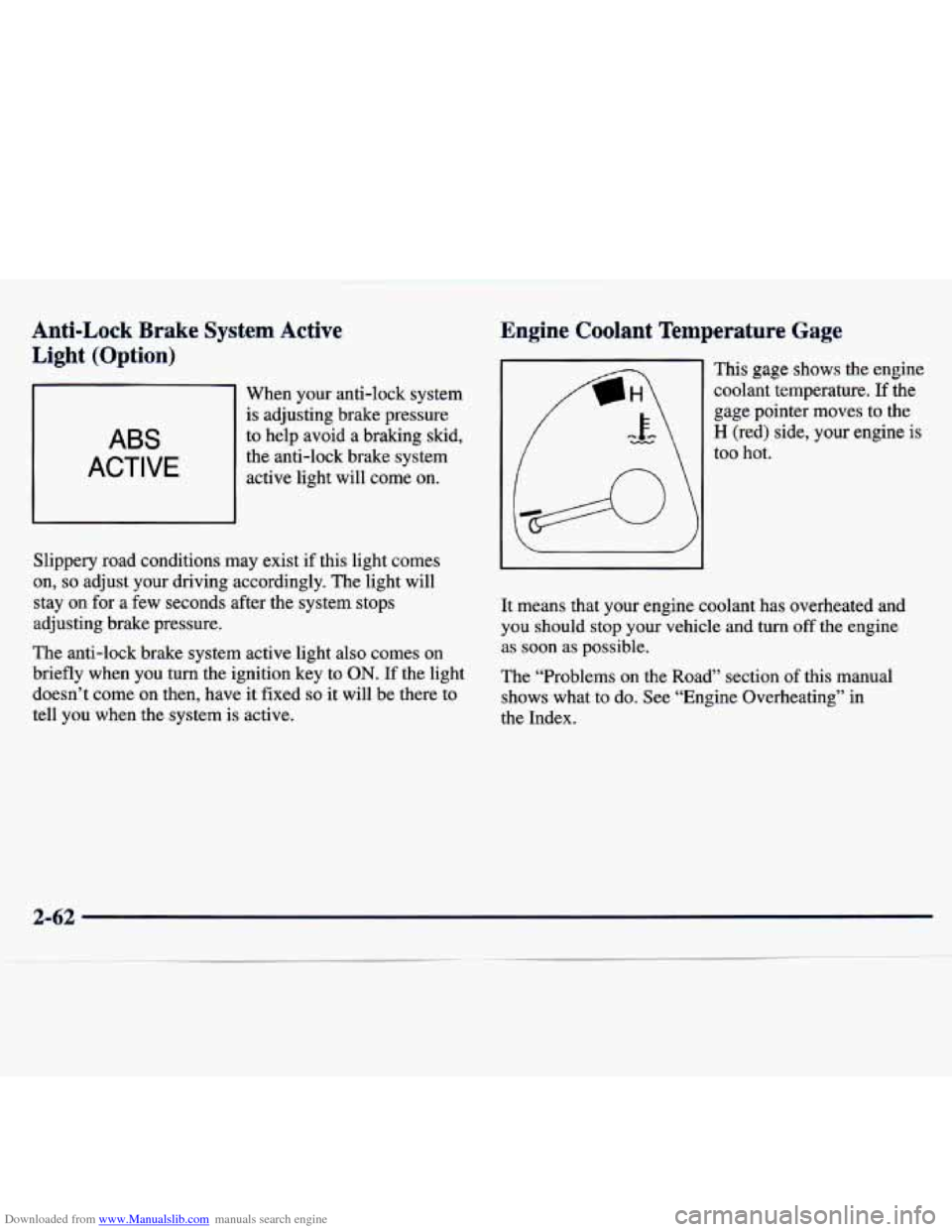
ABS
ACTIVE
r 1
When your anti-lock system is adjusting brake pressure
to help avoid a braking skid,
the anti-lock brake system active light will come on.
Slippery road conditions may exist if this light comes
on,
so adjust your driving accordingly. The light will
stay on for a few seconds after the system stops
adjusting brake pressure.
The anti-lock brake system active light also comes on
briefly when you turn the ignition key to
ON. If the light
doesn’t come on then, have it fixed
so it will be there to
tell you when the system is active. This
gage shows the engine
coolant temperature. If the
gage pointer moves to the
H (red) side, your engine is
too hot.
It means that your engine coolant has overheated and
you should stop your vehicle and
turn off the engine
as soon as possible.
The “Problems on the Road” section of this manual
shows what to do. See “Engine Overheating’’ in
the Index.
2-62
Page 122 of 386
Downloaded from www.Manualslib.com manuals search engine Malfunction Indicator Lamp (Service Engine Soon
Light)
Your vehicle is equipped
with a computer which
monitors operation of the
control systems.
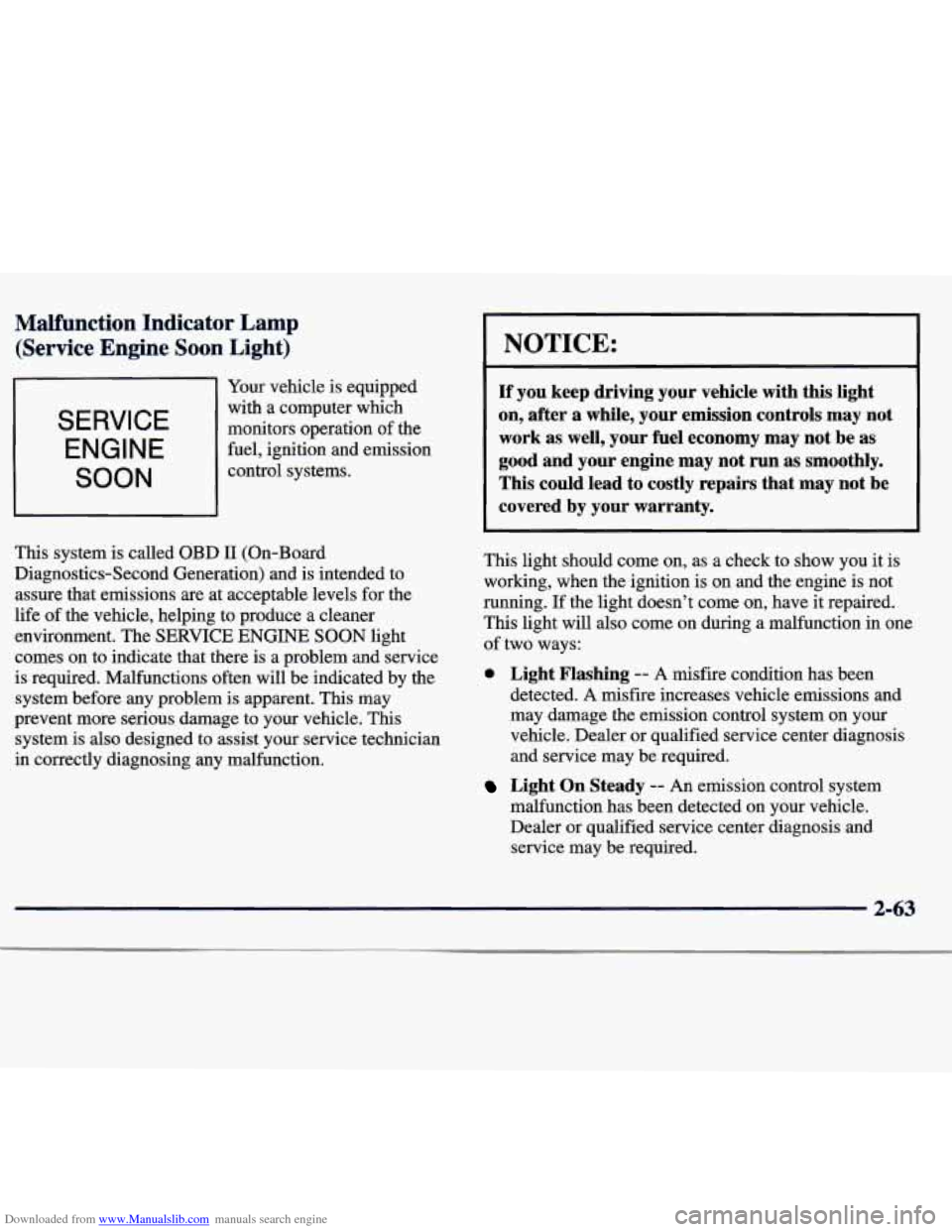
SERVICE
ENGINE
SOON
fuel, ignition and emission
This system is called OBD I1 (On-Board
Diagnostics-Second Generation) and is intended to
assure that emissions are at acceptable levels for the
life of the vehicle, helping to produce a cleaner
environment. The
SERVICE ENGINE SOON light
comes on to indicate that there is a problem and service
is required. Malfunctions often will be indicated by the
system before any problem is apparent. This may
prevent more serious damage to your vehicle. This system is also designed to assist your service technician
in correctly diagnosing any malfunction.
NOTICE:
If you keep driving your vehicle with this light
on, after a while, your emission controls may not
work as well, your fuel economy may not
be as
good and your engine may not run as smoothly.
This could lead to costly repairs that may not be
covered by your warranty.
This light should come on, as a check to show you it is
working, when the ignition is on and the engine is not
running. If the light doesn’t come on, have it repaired.
This light
will also come on durinp a malfunction in one
of two ways:
0 Light Flashing -- A misfire condition has been
detected. A misfire increases vehicle emissions and
may damage the emission control system
on your
vehicle. Dealer or qualified service center diagnosis
and service may be required.
Light On Steady -- An emission control system
malfunction has been detected on your vehicle.
Dealer or qualified service center diagnosis and service may be required.
2-63
Page 124 of 386
Downloaded from www.Manualslib.com manuals search engine Have you recently changed brands of fuel?
If
so, be sure to fuel your vehicle with quality fuel (see
“Fuel” in the Index). Poor fuel quality will cause your
engine not to run as efficiently as designed. You may
notice this as stalling after start-up, stalling when you
put the vehicle into gear,
misfiring, hesitation on
acceleration or stumbling on acceleration. (These
conditions may go away once
the engine is warmed up.)
This will be detected by the system and cause the light
to turn
on.
If you experience one or more of these conditions,
change the fuel brand you use. It will require at least one
hll tank of the proper fuel to turn the light
off.
If none of the above steps have made the light turn off,
have your dealer or qualified service center check the
vehicle. Your dealer has the proper test equipment and
diagnostic tools to fix any mechanical or electrical
problems that may have developed.
Oil Pressure Light
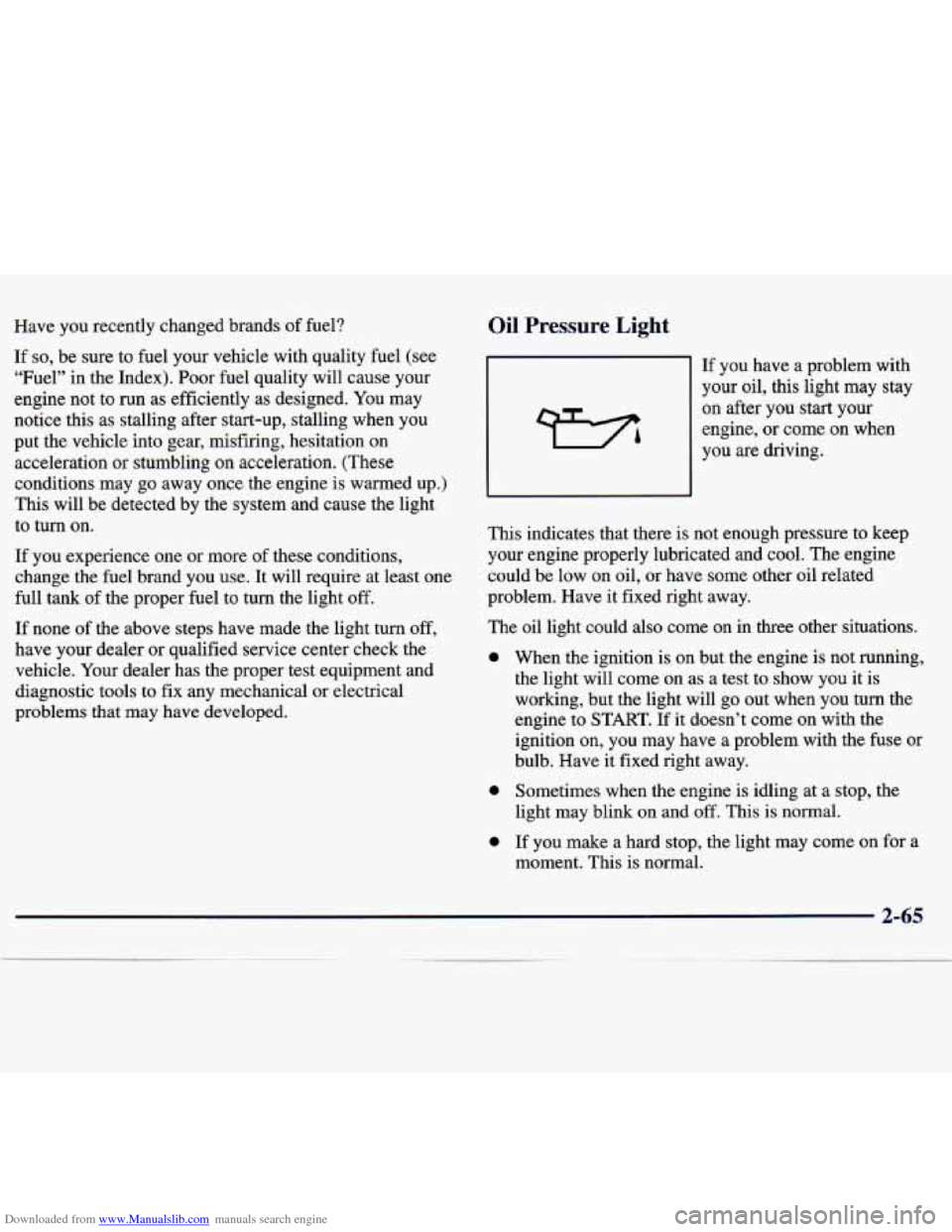
If you have a problem with
your oil, this light may stay
on after you start your
engine,
or come on when
you are driving.
This indicates that there is not enough pressure to keep
your engine properly lubricated and cool. The engine
could be low on oil, or have some other oil related
problem. Have it fixed right away.
The oil light could also come
on in three other situations.
e
e
e
When the ignition is on but the engine is not running,
the light will come on as a test
to show you it is
working, but the light will go out when you turn the
engine to START.
If it doesn’t come on with the
ignition on, you may have a problem with the fuse or
bulb. Have it fixed right away.
Sometimes when the engine is idling at a stop, the
light may blink on and off. This is normal.
If you make a hard stop, the light may come on for a
moment. This
is normal.
2-65
Page 125 of 386
Downloaded from www.Manualslib.com manuals search engine Don’t keep driving if the oil pressure is low. If
you do, your engine can become so hot that it
catches fire. You or others could be burned.
Check your oil
as soon as possible and have
your vehicle serviced.
I NOTICE:
Damage to your engine from neglected oil
problems can be costly and is not covered by
your warranty.
Power Indicator Light (If Equipped)
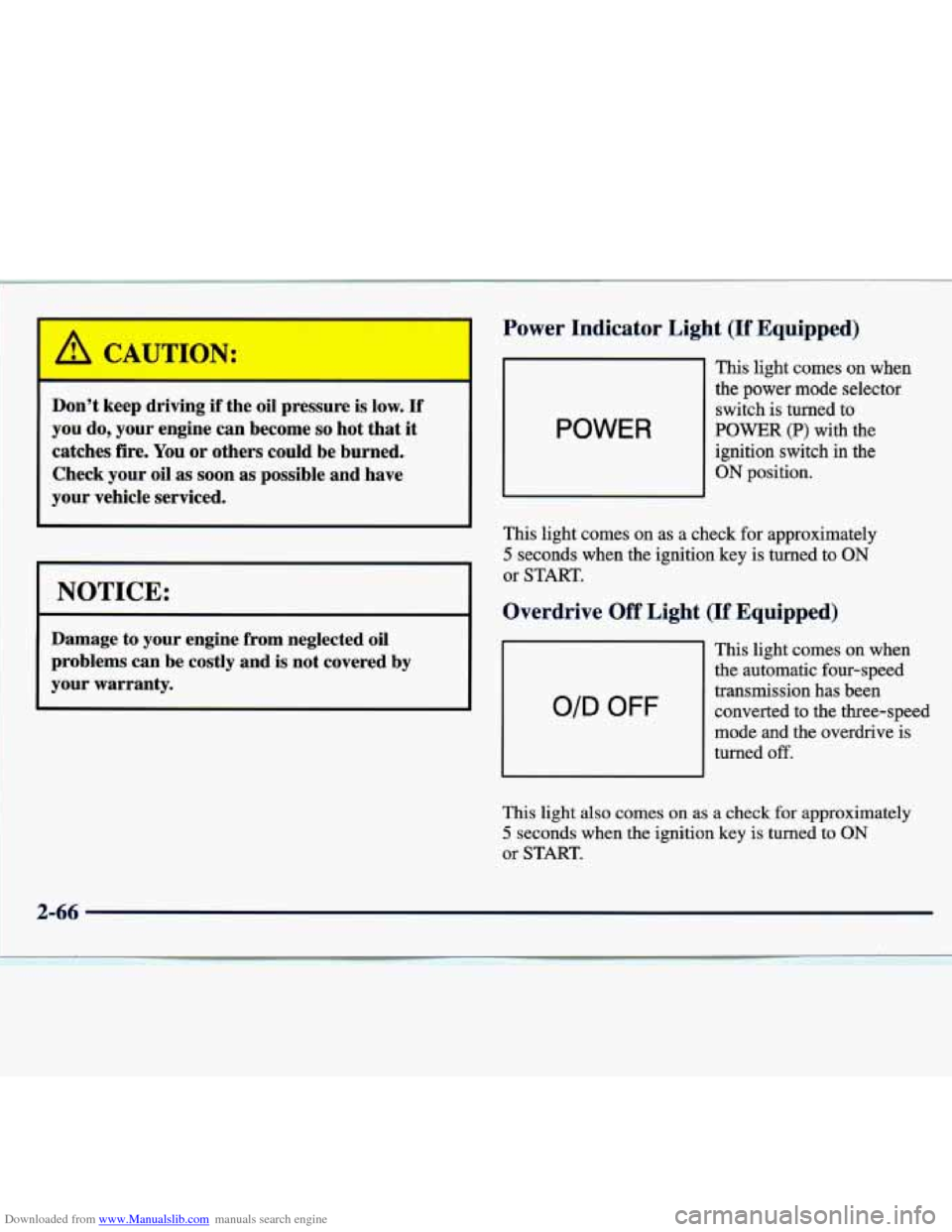
POWER
This light comes on when
the power mode selector
switch is turned to
POWER
(P) with the
ignition switch in the
ON position.
This light comes on as a check for approximately
5 seconds when the ignition key is turned to ON
or START.
Overdrive Off Light (If Equipped)
O/D OFF
This light comes on when
the automatic four-speed
transmission has been
converted to the three-speed
mode and the overdrive is
turned
off.
This light also comes on as a check for approximately
5 seconds when the ignition key is turned to ON
or STmT.
2-66
Page 132 of 386
Downloaded from www.Manualslib.com manuals search engine Ventilation Tips Rear Window Defogger (If Equipped)
Keep the hood and front air inlet free of ice, snow or any
other obstruction (such
as leaves). The heater and
defroster will work far better, reducing the chance of
fogging the inside
of your windows.
When
you enter a vehicle in cold weather, move the fan
control lever toward the fan symbol for a few moments
before driving
off. This helps clear the intake ducts of
snow and moisture, and reduces the chance
of fogging
the inside
of your windows. The
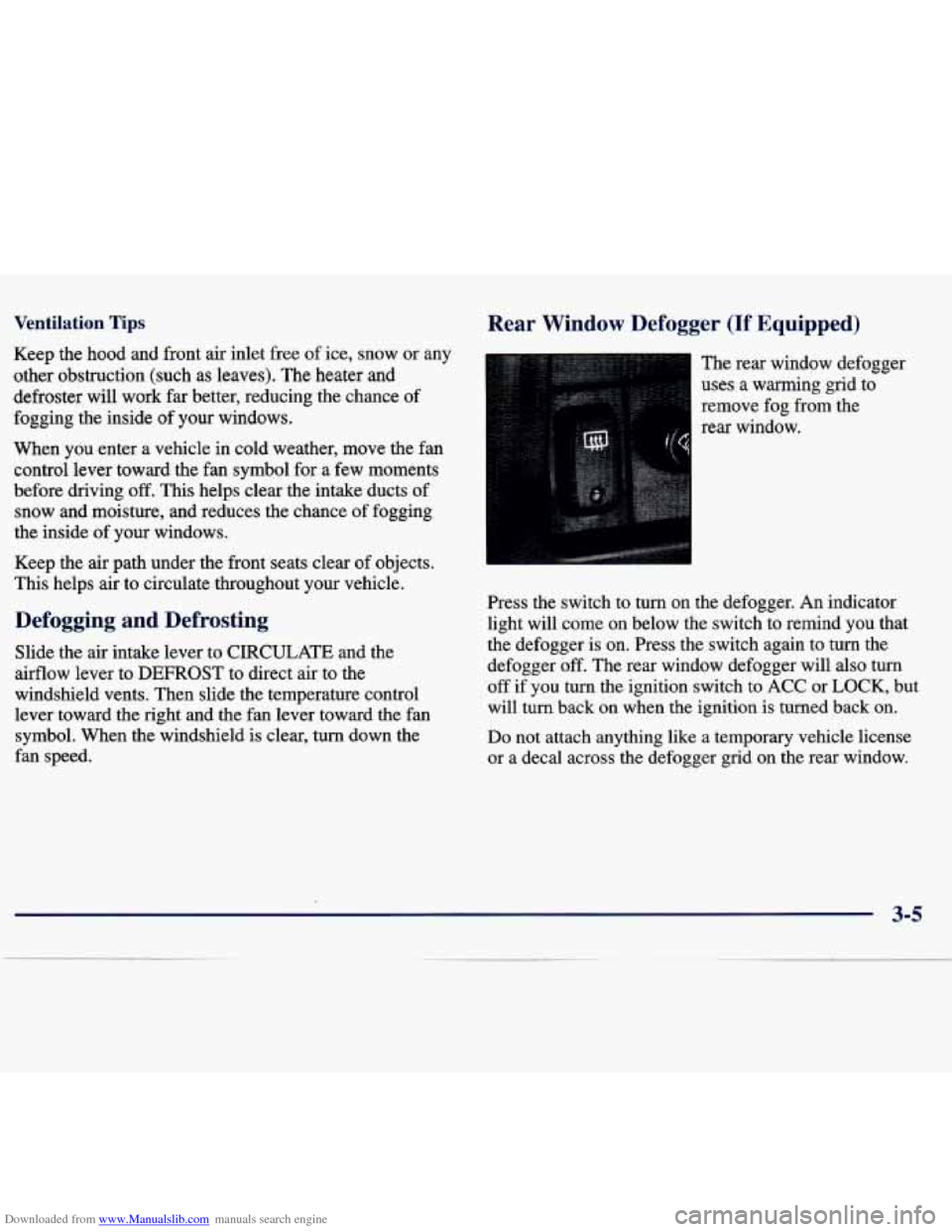
rear window defogger
uses
a warming grid to
remove fog from the
rear window.
Keep the air path under the front seats clear of objects.
This helps air to circulate throughout your vehicle.
Defogging and Defrosting
Slide the air intake lever to CIRCULATE and the
airflow lever to DEFROST to direct air to the
windshield vents. Then slide the temperature control
lever toward
the right and the fan lever toward the fan
symbol. When the windshield is clear, turn down the
fan speed. Press the switch to turn on the defogger. An indicator
light will come on below the switch to remind you that
the defogger is on. Press the switch again to turn the
defogger
off. The rear window defogger will also turn
off if you turn the ignition switch to ACC or LOCK, but
will turn back on when the ignition is turned back on.
Do not attach anything like a temporary vehicle license
or a decal across the defogger grid on the rear window.
3-5
Page 133 of 386
Downloaded from www.Manualslib.com manuals search engine NOTICE:
Don't use a razor blade or something else sharp on the inside
of the rear window. If you do, you
could cut or damage the warming grid, and the
repairs wouldn't be covered
by your warranty.
Audio Systems
Your Delco Electronics audio system has been designed
to operate easily and give years
of listening pleasure.
You will get the most enjoyment out
of it if you acquaint
yourself with it first. Find out what your Delco
Electronics system can do and how to operate all its
controls, to be sure you're getting the most out of the
advanced engineering that went into it.
Setting the Clock
Press and hold RECALL (TIME SET) to set the correct
hour. At the same time, press and hold the TUNE left arrow
(H) until the correct hour appears.
Press and hold
RECALL (TIME SET) to set the correct
minute. At the same time, press and hold the TUNE
right arrow
(M) until the correct minute appears.
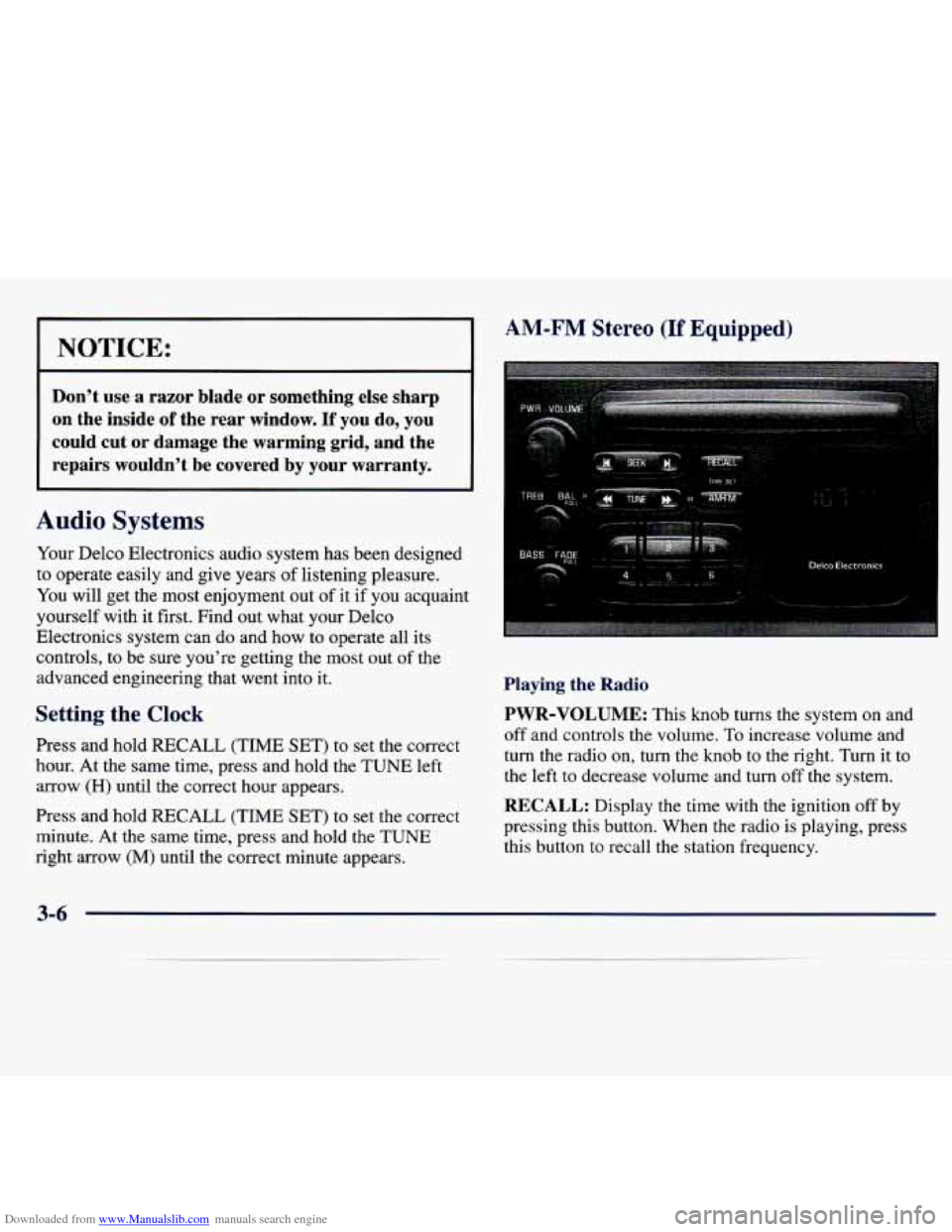
AM-FM Stereo (If Equipped)
Playing the Radio
PWR-VOLUME:
This knob turns the system on and
off and controls the volume. To increase volume and
turn the radio on, turn the knob to the right. Turn it to
the left to decrease volume and
turn off the system.
RECALL: Display the time with the ignition off by
pressing this button. When the radio
is playing, press
this button to recall the station frequency.
3-6
Page 135 of 386

Downloaded from www.Manualslib.com manuals search engine AM-FM Stereo with Cassette Tape Player
and Automatic Tone Control (If Equipped)
Playing the Radio
PWR-VOLUME:
This knob turns the system on and
off and controls the volume. To increase volume and
turn the radio on, turn the
knob to the right. Turn it to
the left to decrease volume and turn
off the system.
RECALL: Display the time with the ignition off by
pressing this button. When the radio is playing, press
this button to recall the station frequency.
Finding a Station
AM-FM: Press this button to switch between AM, FM1
and
FM2. The display shows your selection.
TUNE: Press the right or left arrows to go to a higher or
lower station. Press and hold to continue tuning and
release when you find your station. The display will
show the frequency of each station tuned.
SEEK: Press the right or left arrow to go to the next
higher or lower station and stay there.
PUSHBUTTONS: The six numbered pushbuttons
let you return to your previously played stations. You
can
set up to 18 stations (six AM, six FM1 and six
FM2). Just:
1. Turn the radio on.
2. Press AM-FM to select the band.
3. Tune in the desired station.
4. Press and hold one of the six pushbu ittons
for a .t least
two seconds. The sound will mute and then return
when the station is stored. Whenever you press that
numbered button, the station you set will return.
5. Repeat the steps for each pushbutton.
3-8
Page 137 of 386

Downloaded from www.Manualslib.com manuals search engine Playing a Cassette Tape
With the ignition and radio on, insert a cassette tape.
The tape will begin playing as soon as it is inserted.
Press EJECT or RECALL to load a tape with the
ignition
off. Then insert the cassette tape. A tape symbol
is shown in the center
of the graphic display whenever a
tape is inserted. When a tape is active, the tape symbol
will be accompanied by a direction arrow.
Your tape player is built to work best with tapes that are
30 to 45 minutes long on each side. Tapes longer than
that are
so thin they may not work well in this player.
The longer side with the tape visible should face to the
right.
If you hear nothing or hear just a garbled sound, it
may not be in squarely. Press
EJECT to remove the tape
and start over.
While the tape is playing, use the VOLUME, FADE,
BAL, TREB, BASS and TONE controls just as you do for
the
radio. The display will show an arrow to show which
side of the tape is playing. When the down indicator arrow
is lit, selections listed on the bottom side of the cassette \
are
playing. When the up arrow is lit, selections listed on the top side of the cassette are playing.
REV (TUNE): Press the left arrows to reverse the tape
rapidly. Press
REV (TUNE) or TAPE to return to
playing speed.
FWD (TUNE): Press the right arrows to advance
rapidly to another part
of the tape. Press FWD (TUNE)
or TAPE to return to playing speed.
PREV (SEEK): Press the left arrow to go to the start of
the current selection if more than eight seconds have
played. If you hold the button or press it more than once,
the player will continue moving back through the tape.
Press the left arrow or TAPE to return to playing speed.
NEXT (SEEK): Press the right arrow to go to the start of
the next selection if more than eight seconds have played. If
you hold the button or press it more than once, the player
will continue moving forward through
the tape. Press the
right
arrow or TAPE to return to playing speed.
01 (2): Press this button to reduce background noise
from tapes encoded with Dolby
NR.
Dolby Noise Reduction is manufactured under a license
from Dolby Laboratories Licensing Corporation. Dolby and the double-D symbol are trademarks of Dolby
Laboratories Licensing Corporation.
Page 138 of 386
Downloaded from www.Manualslib.com manuals search engine MTL: Your bias is set automatically. MTL will appear
on your display when a metal or chrome tape is inserted.
AMeFM: Press this button to play the radio when a tape
is playing.
TAPE: With a tape loaded in the player and the radio
playing, press this button once to play the tape.
To
switch from the tape to the radio when the tape is
playing, press the AMeFM button. Press this button to
switch from one side of the tape to the other. Your
cassette tape player can play continuously because the
player has an auto-reverse feature.
EJECT: Press this button to remove the tape. The radio
will play.
CLEAN: If this message appears on the display, the
cassette tape player needs to be cleaned. It will still play
tapes, but you should clean
it as soon as possible to
prevent damage to the tapes and player. See “Care of
Your Cassette Tape Player” in the Index. After you clean
the player, press and hold EJECT for five seconds to
reset the
CLEAN indicator. The radio will display --- to
show the indicator was reset.
AM-FM Stereo with Compact Disc Player
and Automatic Tone Control
(If Equipped)
Playing the Radio
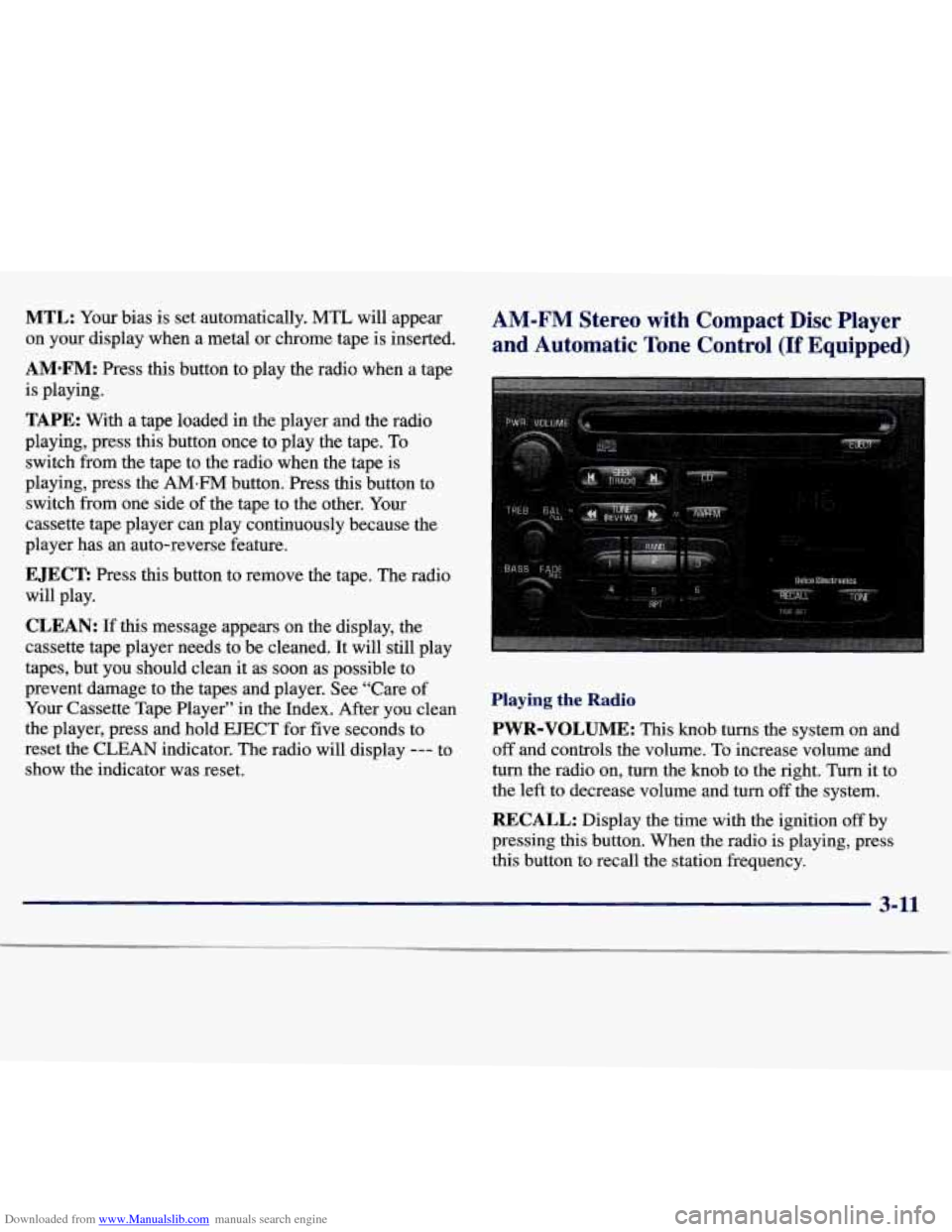
PWR-VOLUME: This knob turns the system on and
off and controls the volume. To increase volume and
turn the radio on, turn the knob to the right. Turn it to
the left to decrease volume and turn
off the system.
RECALL: Display the time with the ignition off by
pressing this button. When the radio is playing, press
this button to recall the station frequency.
3-11
Page 143 of 386

Downloaded from www.Manualslib.com manuals search engine Care of Your Cassette Tape Player
A tape player that is not cleaned regularly can cause
reduced sound quality, ruined cassettes or a damaged
mechanism. Cassette tapes should be stored in their
cases away from contaminants, direct sunlight and
extreme heat. If they aren’t, they may not operate
properly or may cause failure of the tape player.
Your tape player should be cleaned regularly after every
50 hours of use. Your radio may display CLEAN to
indicate that you have used your tape player for
50 hours without resetting the tape clean timer. If this
message appears on the display, your cassette tape
player needs to be cleaned. It will still play tapes, but
you should clean it as soon as possible to prevent
damage to your tapes and player. If you notice a
reduction in sound quality, try a known good cassette to
see if it is the tape or the tape player at fault.
If this other
cassette has no improvement in sound quality, clean the
tape player.
The recommended cleaning method for your cassette
tape player is the use
of a scrubbing action,
non-abrasive cleaning cassette with pads which scrub
the tape head as the hubs of the cleaner cassette turn.
The recommended cleaning cassette is available through
your dealership
(GM Part No. 12344789). When
using a scrubbing action, non-abrasive cleaning
cassette, it is normal
for the cassette to eject because
your unit is equipped with a cut tape detection feature and a cleaning cassette may appear as a broken tape.
To
prevent the cleaning cassette from being ejected, use the
following’steps.
1. Turn the ignition to ON or ACC.
2. Turn the radio off.
3. Press and hold the
TAPE button for five seconds. The
tape symbol on the display will flash for two seconds.
4. Insert the scrubbing action cleaning cassette.
5. Eject the cleaning cassette after the manufacturer’s
recommended cleaning time.
When the cleaning cassette has been ejected, the cut tape
detection feature is active again.
You may also choose a non-scrubbing action, wet-type
cleaner which uses a cassette with a fabric belt to clean
the tape head. This type of cleaning cassette will not
eject on its own.
A non-scrubbing action cleaner may
not clean as thoroughly as the scrubbing type cleaner.
The use of a non-scrubbing action, dry-type cleaning
cassette is not recommended.