light CHEVROLET TRACKER 1998 1.G User Guide
[x] Cancel search | Manufacturer: CHEVROLET, Model Year: 1998, Model line: TRACKER, Model: CHEVROLET TRACKER 1998 1.GPages: 386, PDF Size: 21.17 MB
Page 74 of 386
Downloaded from www.Manualslib.com manuals search engine Overdrive Off Switch (If Equipped)
The Overdrive Off switch is located on the left side of
the shifter.
By operating the Overdrive Off switch, the
four-speed automatic transmission (three-speed plus
overdrive} can be converted to a three-speed automatic
transmission. While in the three-speed mode, the
transmission will
not shift into the Overdrive position.
To convert the transmission to the three-speed mode,
push in the Overdrive
off switch and release it. The
switch comes out and the
OD/OFF indicator light on the
instrument panel comes on.
To return the transmission to the four-speed mode,
push in the Overdrive
off switch again. The switch will
remain in and the
OD/OFF indicator light goes off.
Please note that if the transfer case shift lever is in the
4L position, the four-speed automatic transmission will
remain in the three-speed mode.
Manual Transmission Operation
5-Speed
L
L
1
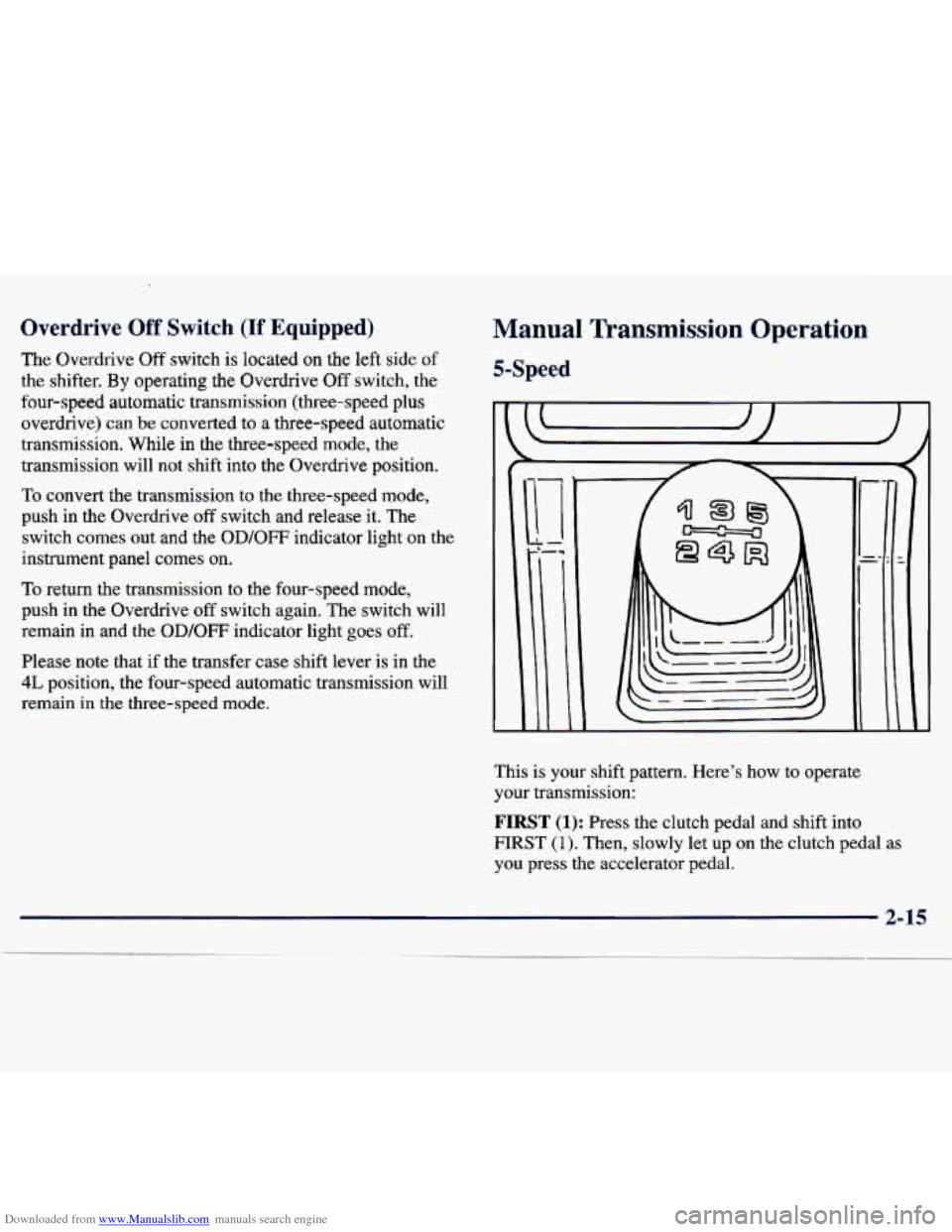
This is your shift pattern. Here's how to operate
your transmission:
FIRST (1): Press the clutch pedal and shift into
FIRST (1). Then, slowly let up on the clutch pedal as
you press the accelerator pedal.
2-15
Page 79 of 386
Downloaded from www.Manualslib.com manuals search engine Unlocking the Hubs
1. Stop your vehicle.
2. Drive 7 feet (2 m) in the direction opposite to the
direction
you were driving before you stopped.
3. Then, press
the clutch if you have a manual
transmission, and shift the transfer case to
TWO-WHEEL HIGH (2H). The hubs will unlock.
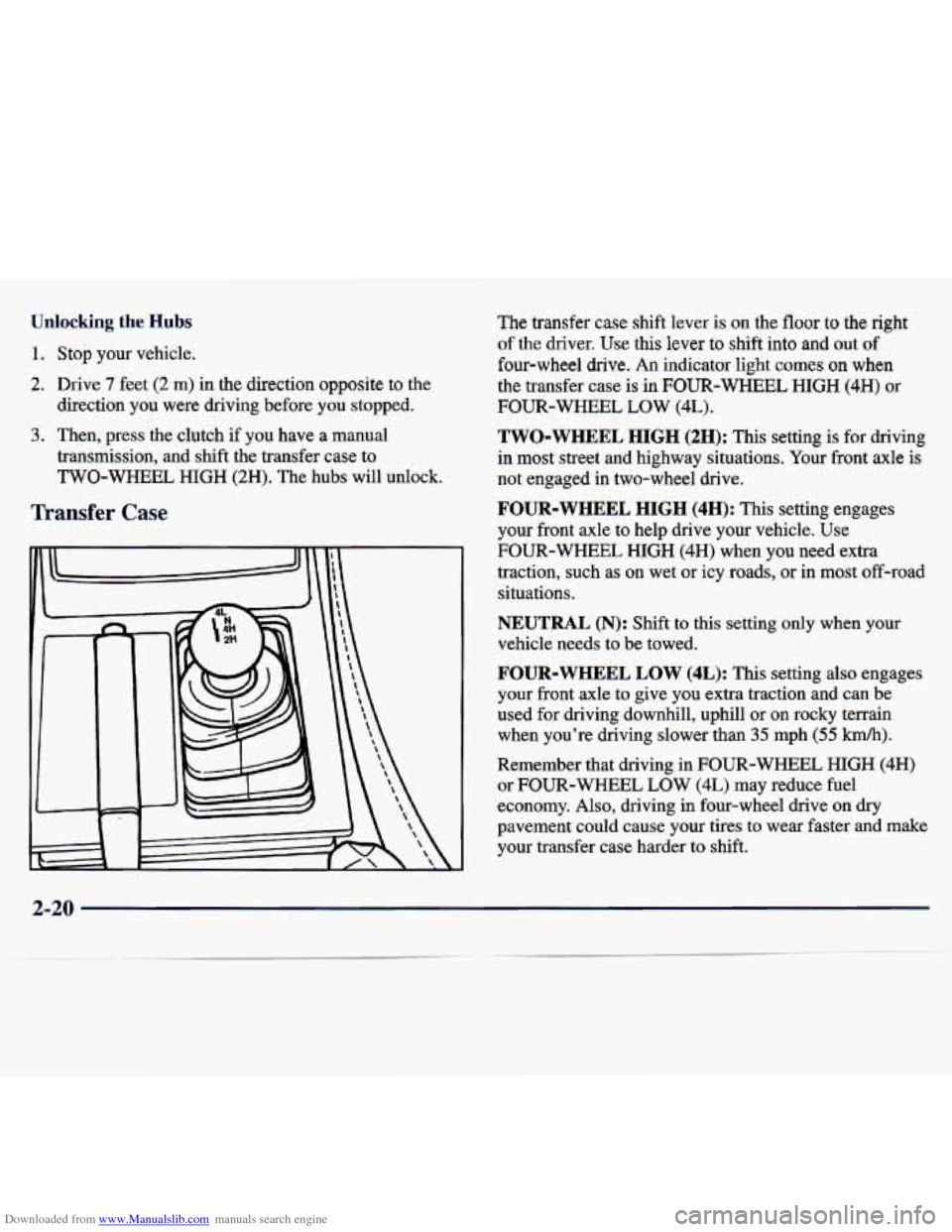
Transfer Case
E
The transfer case shift lever is on the floor to the right
of the driver.
Use this lever to shift into and out of
four-wheel drive.
An indicator light comes on when
the transfer case is in FOUR-WHEEL HIGH (4H) or
FOUR-WHEEL LOW (4L).
TWO-WHEEL HIGH (2H): This setting is for driving
in
most street and highway situations. Your front axle is
not engaged in two-wheel drive.
FOUR-WHEEL HIGH (4H): This setting engages
your front axle to help drive your vehicle. Use
FOUR-WHEEL HIGH (4H) when you need extra
traction, such as on wet or icy roads,
or in most off-road
situations.
NEUTRAL (N): Shift to this setting only when your
vehicle needs to be towed.
FOUR-WHEEL LOW (4L): This setting also engages
your front axle to give you extra traction and can be
used for driving downhill, uphill or on rocky terrain
when you’re driving slower than 35 mph (55
km/h).
Remember that driving in FOUR-WHEEL HIGH (4H)
or FOUR-WHEEL LOW (4L) may reduce fuel
economy. Also, driving in four-wheel drive on
dry
pavement could cause your tires to wear faster and make
your transfer case harder to shift.
2-20
Page 80 of 386
Downloaded from www.Manualslib.com manuals search engine You can shift from TWO-WHEEL HIGH (2H) to
FOUR-WHEEL HIGH
(4H) or from FOUR-WHEEL
HIGH
(4H) to TWO-WHEEL HIGH (2H) at any speed
if your hubs are locked and your wheels are straight
ahead. Your front axle will engage faster if
you take
your foot off the accelerator pedal for a few seconds
as you shift.
Shifting Into or Out of FOUR-WHEEL LOW (4L)
1. Stop your vehicle and shift your transmission to
2. Shift the transfer case in one continuous motion.
NEUTRAL (N).
Parking Brake
Don’t pause in NEUTRAL (N) as you shift into
FOUR-WHEEL HIGH (4H), or your gears could clash.
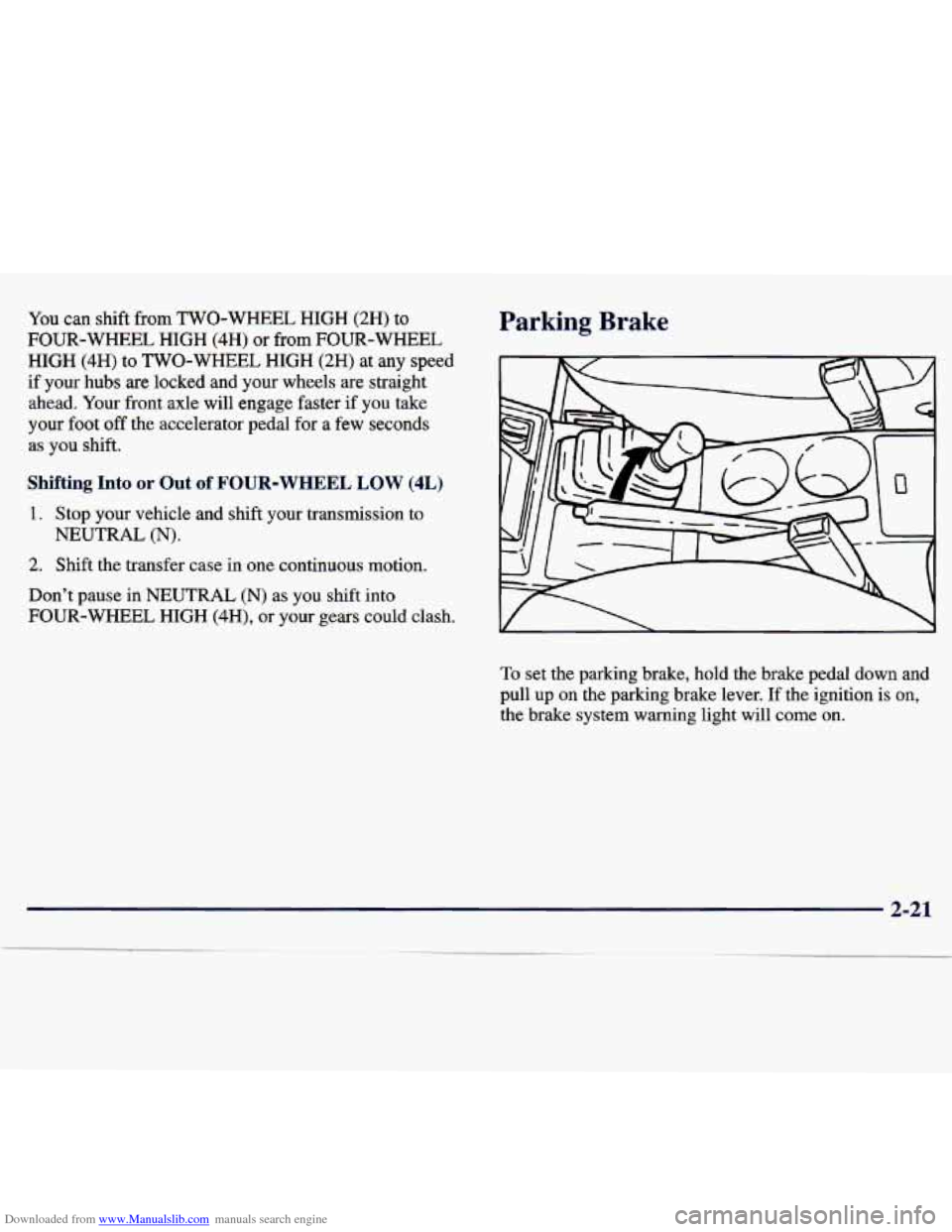
To set the parking brake, hold the brake pedal down and
pull up on the parking brake lever. If the ignition is on,
the brake system warning light will come on.
2-21
Page 89 of 386
Downloaded from www.Manualslib.com manuals search engine firn SignaVMultifunction Lever
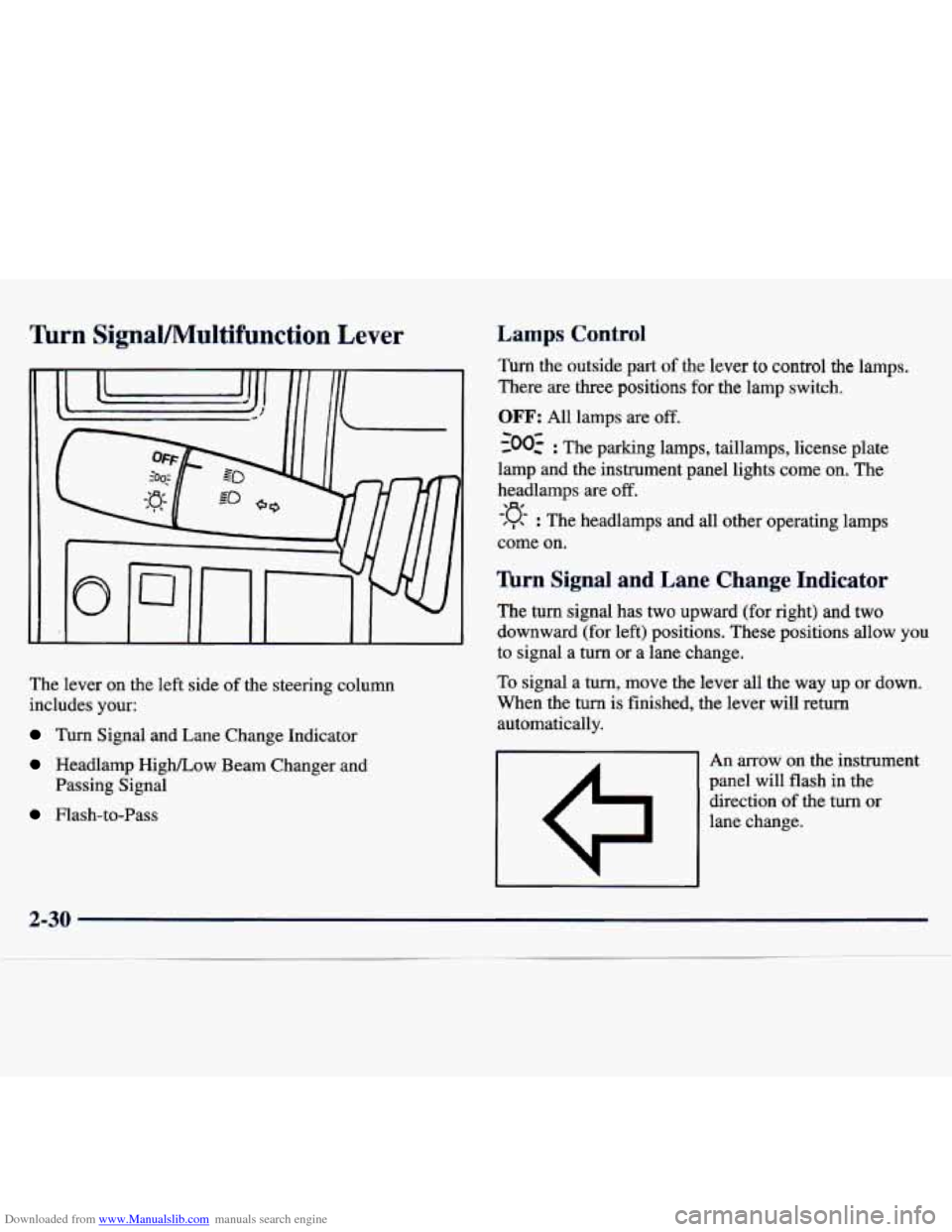
The lever on the left side of the steering column
includes your:
Turn Signal and Lane Change Indicator
Headlamp High/Low Beam Changer and
Passing Signal
Flash-to-Pass
Lamps Control
Turn the outside part of the lever to control the lamps.
There
are three positions for the lamp switch.
OFF: All lamps are off.
~00~ : The parking lamps, taillamps, license plate
lamp and the instrument panel lights come on. The
headlamps are
off.
-:q- : The headlamps and all other operating lamps
come on.
lbrn Signal and Lane Change Indicator
The turn signal has two upward (for right) and two
downward (for left) positions. These positions allow you
to signal a
turn or a lane change.
To signal a turn, move the lever all the way
up or down.
When the turn is finished, the lever will return
automatically.
An arrow on the instrument
panel will flash in the direction
of the turn or
lane change.
a-erv
Page 90 of 386
Downloaded from www.Manualslib.com manuals search engine To signal a lane change, just raise or lower the lever
until the arrow
starts to flash. Hold it there until you
complete your lane change. The lever will return by
itself when you release
it.
As you signal a turn or a lane change, if the arrows
don’t flash but just stay on, a signal bulb may be burned
out and other drivers won’t
see your turn signal.
If a bulb is burned out, replace it to help avoid an
accident. If the arrows don’t go on at all when you
signal a
turn, check the fuse (see “Fuses and Circuit
Breakers” in the Index) and for burned-out bulbs.
Lamps On Reminder
If you turn the ignition off, remove the key, open the
door and leave the lamps on, a tone will remind you
to
turn off your lamps.
Headlamp High/Low Beam Changer
First, you must have the headlamps on. For high beams,
push the
turn signal lever toward the instrument panel.
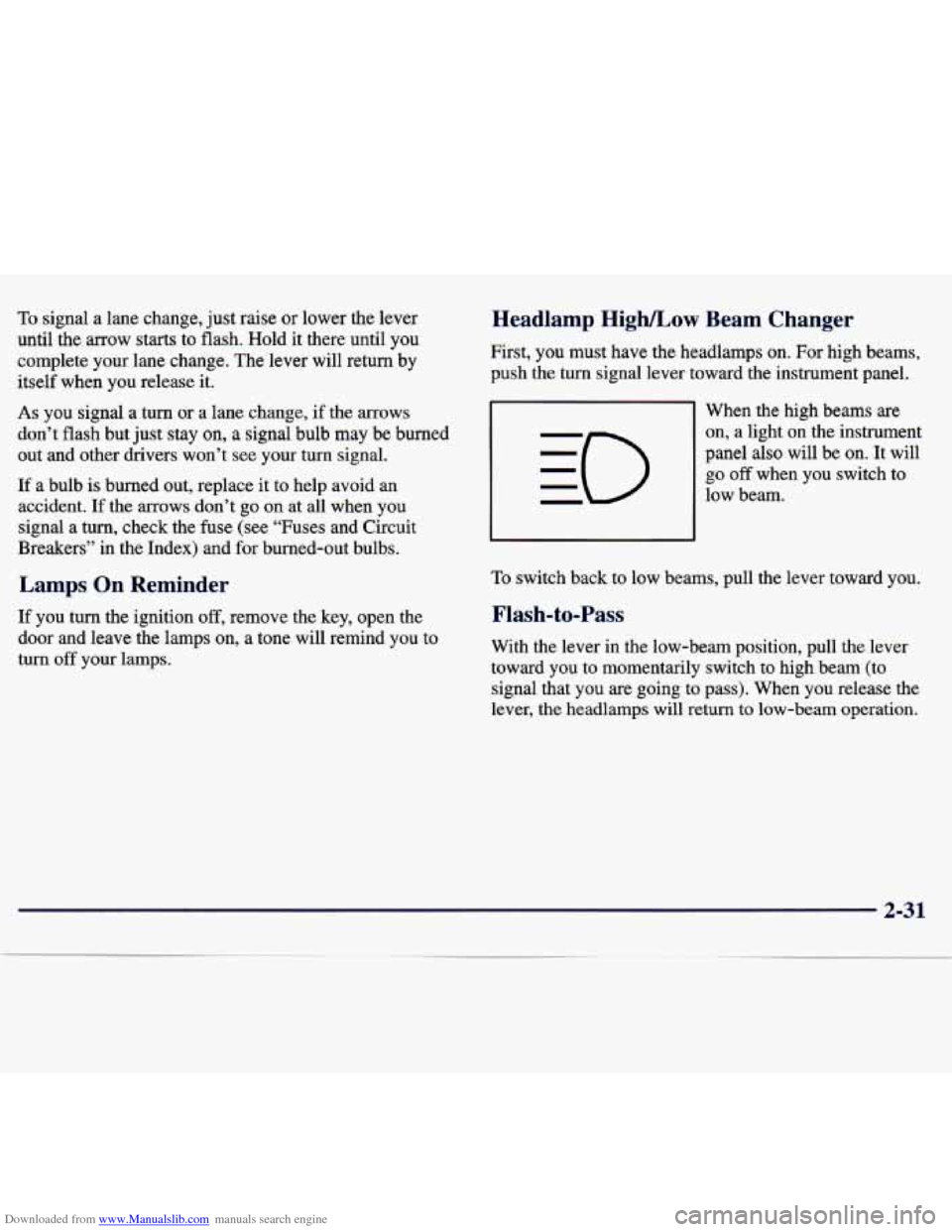
When the high beams are
on, a light on the instrument
panel also will be on. It will
go off when you switch to
low beam.
To switch back to low beams, pull the lever toward you.
Flash-to-Pass
With the lever in the low-beam position, pull the lever
toward you to momentarily switch to high beam (to
signal that you are going to pass). When you release the
lever,
the headlamps will return to low-beam operation.
2-31
Page 91 of 386
Downloaded from www.Manualslib.com manuals search engine Windshield WiperNasher Lever
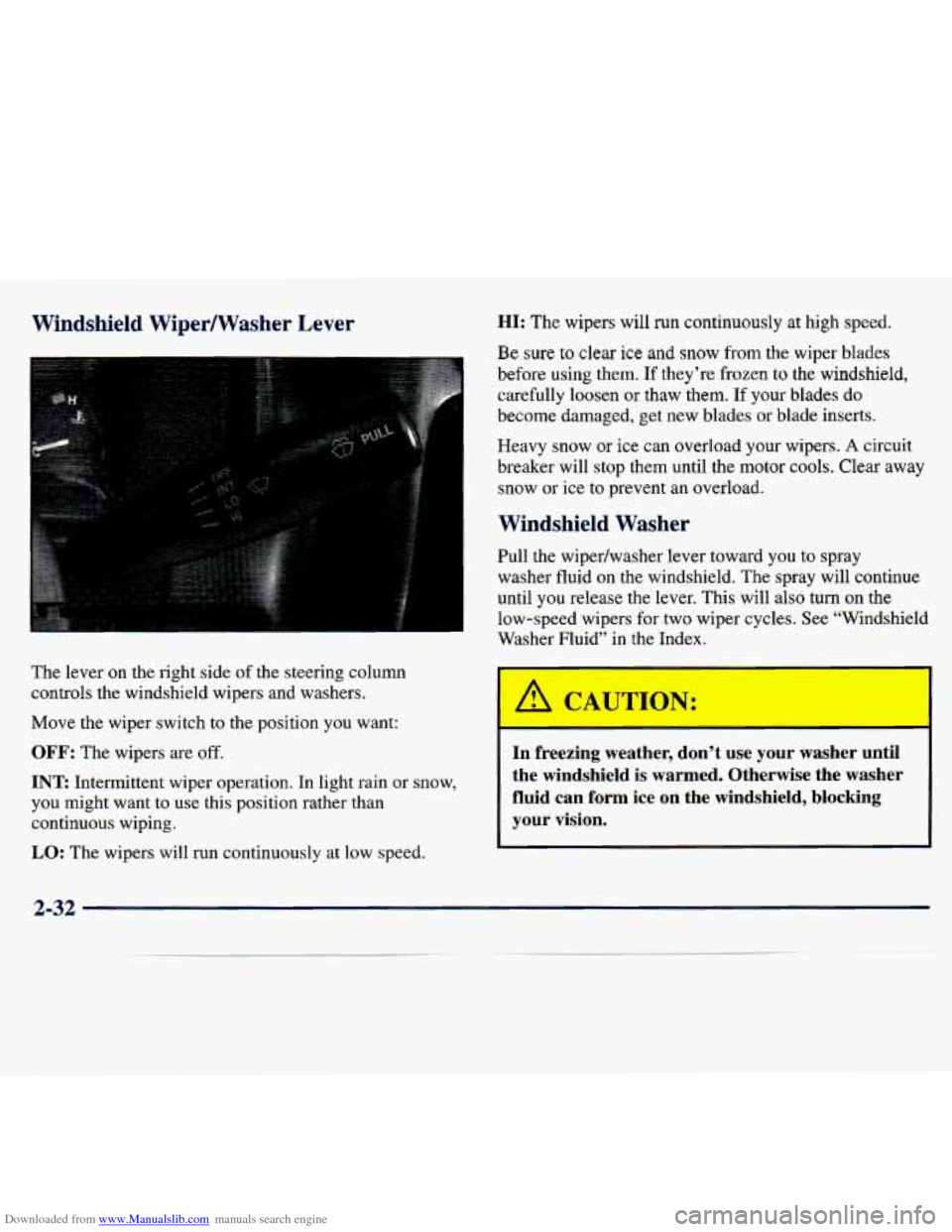
The lever on the right side of the steering column
controls the windshield wipers and washers.
Move the wiper switch to the position
you want:
OFF: The wipers are off.
INT Intermittent wiper operation. In light rain or snow,
you might want to use this position rather than
continuous wiping.
LO: The wipers will run continuously at low speed.
HI: The wipers will run continuously at high speed.
Be sure to clear ice and snow from the wiper blades
before using them.
If they’re frozen to the windshield,
carefully loosen
or thaw them. If your blades do
become damaged, get new blades or blade inserts.
Heavy snow or ice can overload your wipers.
A circuit
breaker will stop them until the motor cools. Clear away
snow or ice to prevent an overload.
Windshield Washer
Pull the wipedwasher lever toward you to spray
washer fluid on the windshield. The spray will continue
until you release
the lever. This will also turn on the
low-speed wipers
for two wiper cycles. See “Windshield
Washer Fluid” in the Index.
A CAUTIC -V:
I-=--
In freezing weather, don’t use your washer until
the windshield is warmed. Otherwise the washer
fluid can form ice
on the windshield, blocking
your vision.
M
2-32
Page 93 of 386
Downloaded from www.Manualslib.com manuals search engine a
0
Cruise control can be dangerous where you
can’t drive safely
at a steady speed. So,
don’t use your cruise control on winding
roads or in heavy traffic.
Cruise control can be dangerous on
slippery roads. On such roads,
fast changes
in tire traction can cause needless wheel
spinning, and you could lose control. Don’t
use cruise control on slippery roads.
Setting Cruise Control
I .& CAUTION:
If you leave your cruise control switch on when
you’re not using cruise, you might hit
a button
and go into cruise when you don’t want to. You
could be startled and even lose control. Keep the
cruise control switch
off until you want to use it.
. , .... .... . ,. . .
,. .
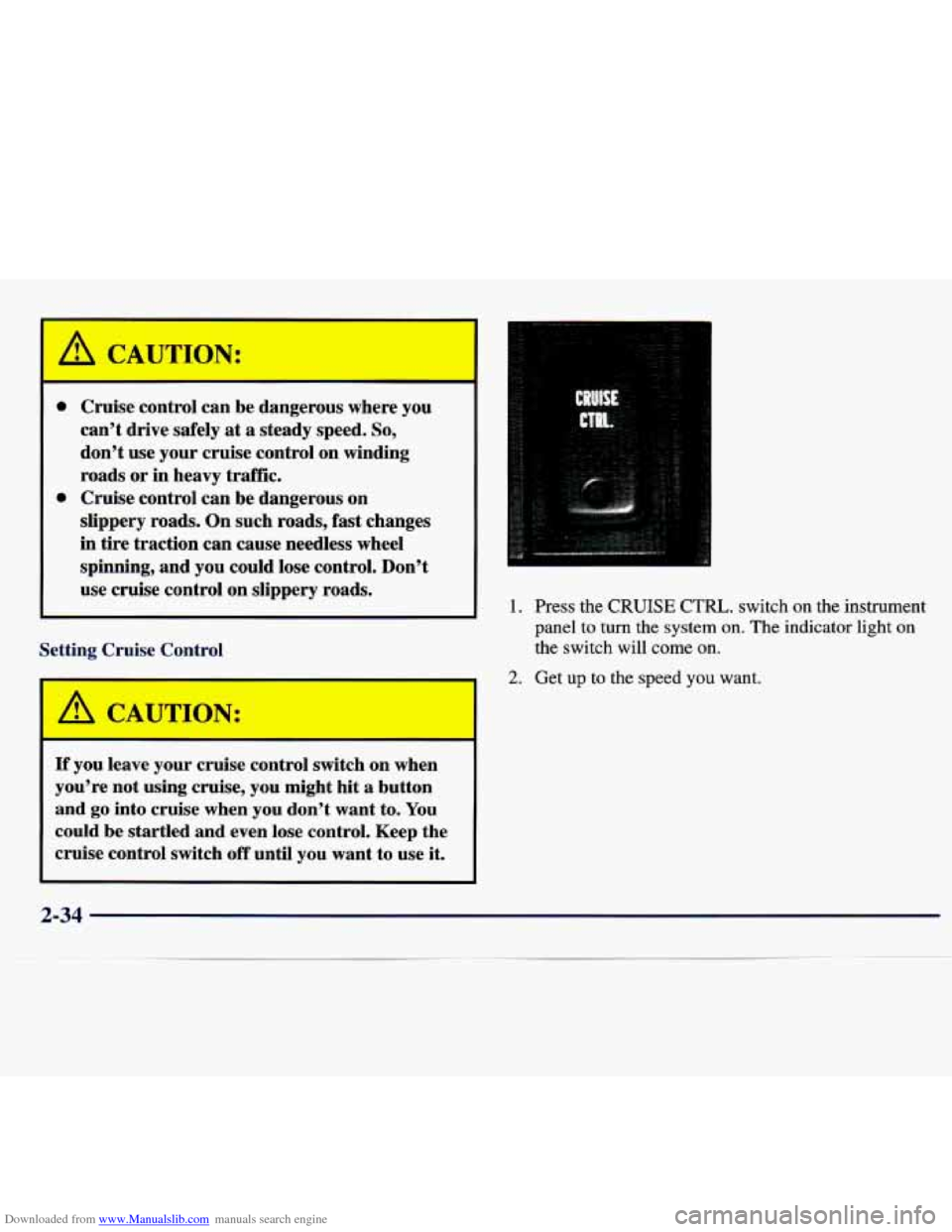
1. Press the CRUISE CTRL. switch on the instrument
panel to turn the system on. The indicator light on
the switch will come on.
2. Get up to the speed you want.
2-34
Page 95 of 386
Downloaded from www.Manualslib.com manuals search engine Increasing Speed While Using Cruise Control
There are two ways to go to a higher speed.
Use the accelerator pedal to go to a higher speed.
Turn the lever to COAST/SET and release. Take
your foot
off the accelerator pedal. You’ll now
cruise at the higher speed.
at RESUME/ACCEL until you get up to the speed
you want, then release the lever.
Turn the lever to RESUME/ACCEL. Hold the lever
Reducing Speed While Using Cruise Control
To reduce your speed, turn and hold the lever in the
COASTISET position until you reach the lower speed
you want, then release the lever.
Passing Another Vehicle While Using Cruise Control
Use the accelerator pedal to increase your speed. When
you take your
foot off the pedal, your vehicle will slow
down to the cruise control speed you set earlier.
Using Cruise Control on Hills
How well your cruise control will work on hills depends
upon your speed, load and
the steepness of the hills.
When going up steep hills, you may have to step on the
accelerator pedal
to maintain your speed. When going
downhill, you may have to brake or shift to a lower
gear
to keep your speed down. Of course, applying the brake
takes you out of cruise control. Many drivers find this to
be too much trouble and don’t use cruise control on
steep hills.
Getting Out of Cruise Control
There are three ways to turn off cruise control:
Step lightly on the brake pedal, or push the clutch
pedal if you have a manual transmission.
Push in the CANCEL button on the end of the
cruise control lever.
Press the CRUISE CTlU switch on the
instrument panel.
Erasing Speed Memory
When you turn off the cruise control or the ignition,
your cruise control set speed memory
is erased.
2-36
Page 96 of 386
Downloaded from www.Manualslib.com manuals search engine Exterior Lamps
Daytime Running Lamps
Daytime Running Lamps (DIU) can make it easier
for others to see the front of your vehicle during the
day.
DRL can be helpful in many different driving
conditions, but they can be especially helpful in the
short periods after dawn and before sunset.
The DIU system will make your low-beam headlamps
come on at
a reduced brightness when:
0 The ignition is on,
0 The headlamp switch is off and
The parking brake is released.
When you turn on the headlamp switch, your DRL will
go out, and your headlamps will come on.
The other lamps that come on with your headlamps
will also come on. To
idle your vehicle with the DRL off, set the parking
brake. The
DRL will stay off until you release the
parking brake.
As with any vehicle, you should turn on the regular
headlamp system when you need it.
Interior Lamps
Instrument Panel Brightness Control
This knob controls the
brightness of your
instrument panel lights.
Turn the knob
to the right
to brighten the lights or to
the left to dim them.
When
you turn off the headlamp switch, the regular
lamps will go off, and your low-beam headlamps will
come on at the reduced brightness of DRL.
2-37
Page 99 of 386
Downloaded from www.Manualslib.com manuals search engine Front Seat Side Pockets
On the outside of each front seat is a storage pocket.
Coinholder and Bin
Your console has a coinholder and a small storage bin.
Cupholder
Two cupholders are on the center console next to the
parking brake lever.
Ashtrays and Cigarette Lighter
To use the lighter, push the lighter in all the way and let
go. When it’s ready, it will pop back by itself.
I NOTICE:
Pull the door to open the ashtray. To remove it, press
down on the silver tab and pull the ashtray out. To
replace the ashtray, push it in until the silver tab latches.
The rear ashtray is on the back of the center console.
Pull on the top
of the door to open it. To remove the
ashtray, press
down on the tab and pull it out.
NOTICE:
Don’t put papers and other things that burn
into your ashtray.
If you do, cigarettes or other
smoking materials could set them on fire,
causing damage.
Sun Visors ~
Don’t hold a cigarette lighter in with your hand
while
it is heating. If you do, it won’t be able to You can also swing them to the side. If the visors swing
back
away from the heating element when it’s too easily, tighten the screw on the roof rail.
ready. That can make
it overheat, damaging the
lighter and the heating element.
To block out glare, you can swing down the visors.
2-40