transmission CHEVROLET TRACKER 1998 1.G User Guide
[x] Cancel search | Manufacturer: CHEVROLET, Model Year: 1998, Model line: TRACKER, Model: CHEVROLET TRACKER 1998 1.GPages: 386, PDF Size: 21.17 MB
Page 76 of 386
Downloaded from www.Manualslib.com manuals search engine Shift Speeds
If you skip more than one gear when you
downshift, you could lose control
of your vehicle.
And you could injure yourself
or others. Don’t
shift from
FIFTH (5) to SECOND (2) or
FOURTH (4) to FIRST (1).
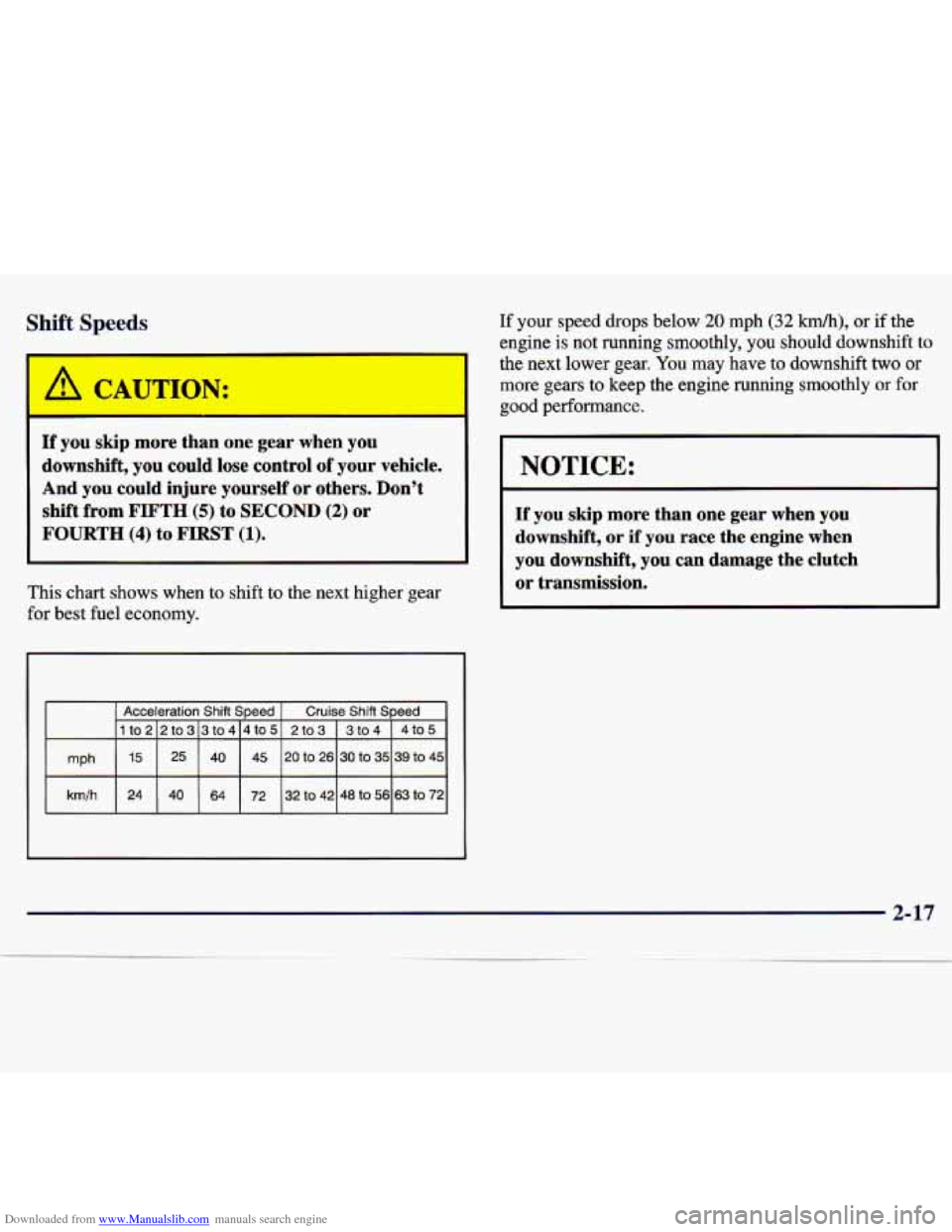
This chart shows when to shift to the next higher gear
for best fuel economy.
Acceleration Shift Speed Cruise Shifl: Speed
lto212to313to414t05 2to3 I 3to4 I 4to5 I I I I I
I mph I 15 I 25 I 40 1 45 I I I 120 to 26 30 to 35 39 to45
I I I I I I I I I I I I I I I I
I km/h I 24 I 40 1 64 I 72 (32 to 42148 to56163 to 721
I I I I I I I I I
If your speed drops below 20 mph (32 M), or if the
engine
is not running smoothly, you should downshift to
the next lower gear.
You may have to downshift two or
more gears to keep the engine running smoothly or for
good performance.
NOTICE:
If you skip more than one gear when you
downshift, or
if you race the engine when
you downshift, you can damage the clutch
or transmission.
2-17
Page 79 of 386
Downloaded from www.Manualslib.com manuals search engine Unlocking the Hubs
1. Stop your vehicle.
2. Drive 7 feet (2 m) in the direction opposite to the
direction
you were driving before you stopped.
3. Then, press
the clutch if you have a manual
transmission, and shift the transfer case to
TWO-WHEEL HIGH (2H). The hubs will unlock.
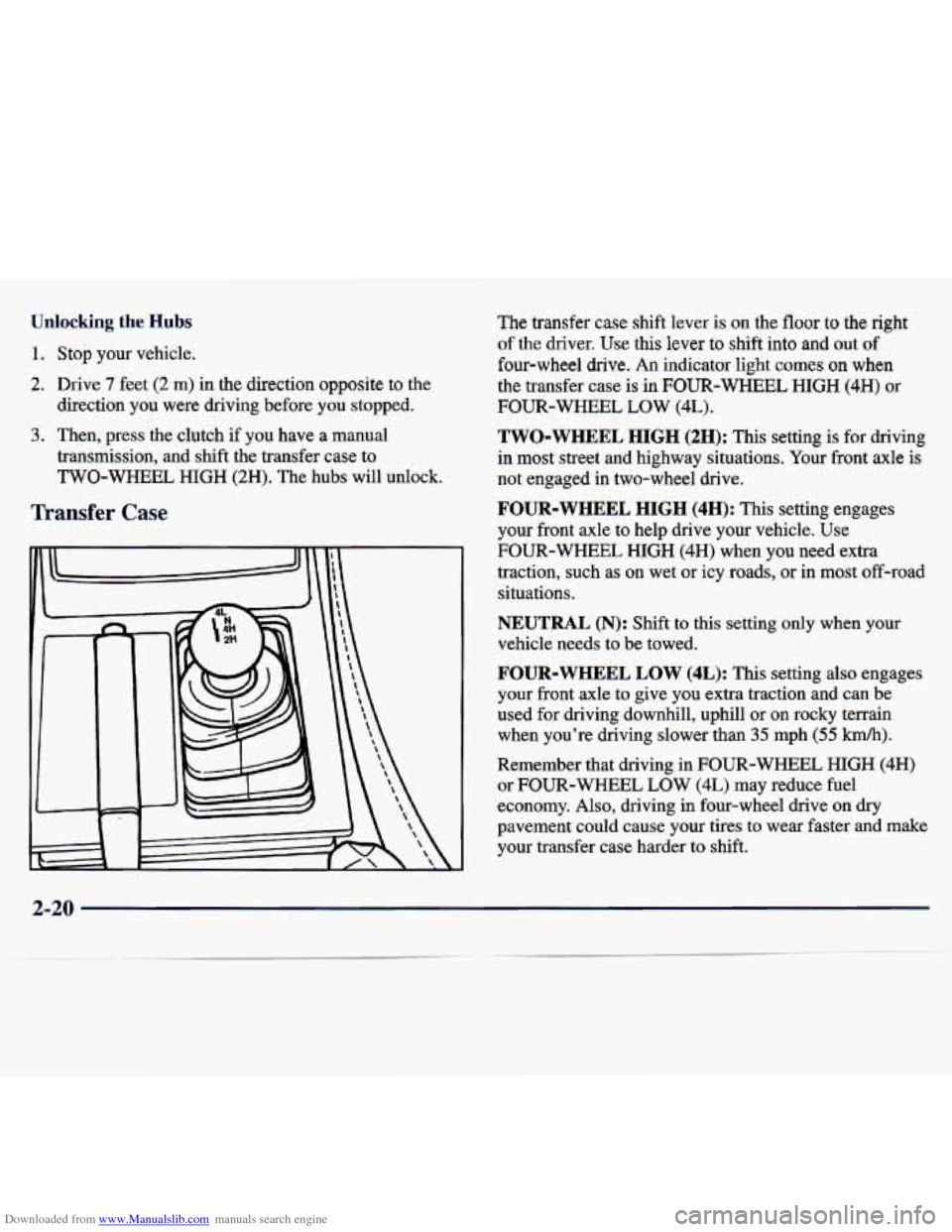
Transfer Case
E
The transfer case shift lever is on the floor to the right
of the driver.
Use this lever to shift into and out of
four-wheel drive.
An indicator light comes on when
the transfer case is in FOUR-WHEEL HIGH (4H) or
FOUR-WHEEL LOW (4L).
TWO-WHEEL HIGH (2H): This setting is for driving
in
most street and highway situations. Your front axle is
not engaged in two-wheel drive.
FOUR-WHEEL HIGH (4H): This setting engages
your front axle to help drive your vehicle. Use
FOUR-WHEEL HIGH (4H) when you need extra
traction, such as on wet or icy roads,
or in most off-road
situations.
NEUTRAL (N): Shift to this setting only when your
vehicle needs to be towed.
FOUR-WHEEL LOW (4L): This setting also engages
your front axle to give you extra traction and can be
used for driving downhill, uphill or on rocky terrain
when you’re driving slower than 35 mph (55
km/h).
Remember that driving in FOUR-WHEEL HIGH (4H)
or FOUR-WHEEL LOW (4L) may reduce fuel
economy. Also, driving in four-wheel drive on
dry
pavement could cause your tires to wear faster and make
your transfer case harder to shift.
2-20
Page 80 of 386
Downloaded from www.Manualslib.com manuals search engine You can shift from TWO-WHEEL HIGH (2H) to
FOUR-WHEEL HIGH
(4H) or from FOUR-WHEEL
HIGH
(4H) to TWO-WHEEL HIGH (2H) at any speed
if your hubs are locked and your wheels are straight
ahead. Your front axle will engage faster if
you take
your foot off the accelerator pedal for a few seconds
as you shift.
Shifting Into or Out of FOUR-WHEEL LOW (4L)
1. Stop your vehicle and shift your transmission to
2. Shift the transfer case in one continuous motion.
NEUTRAL (N).
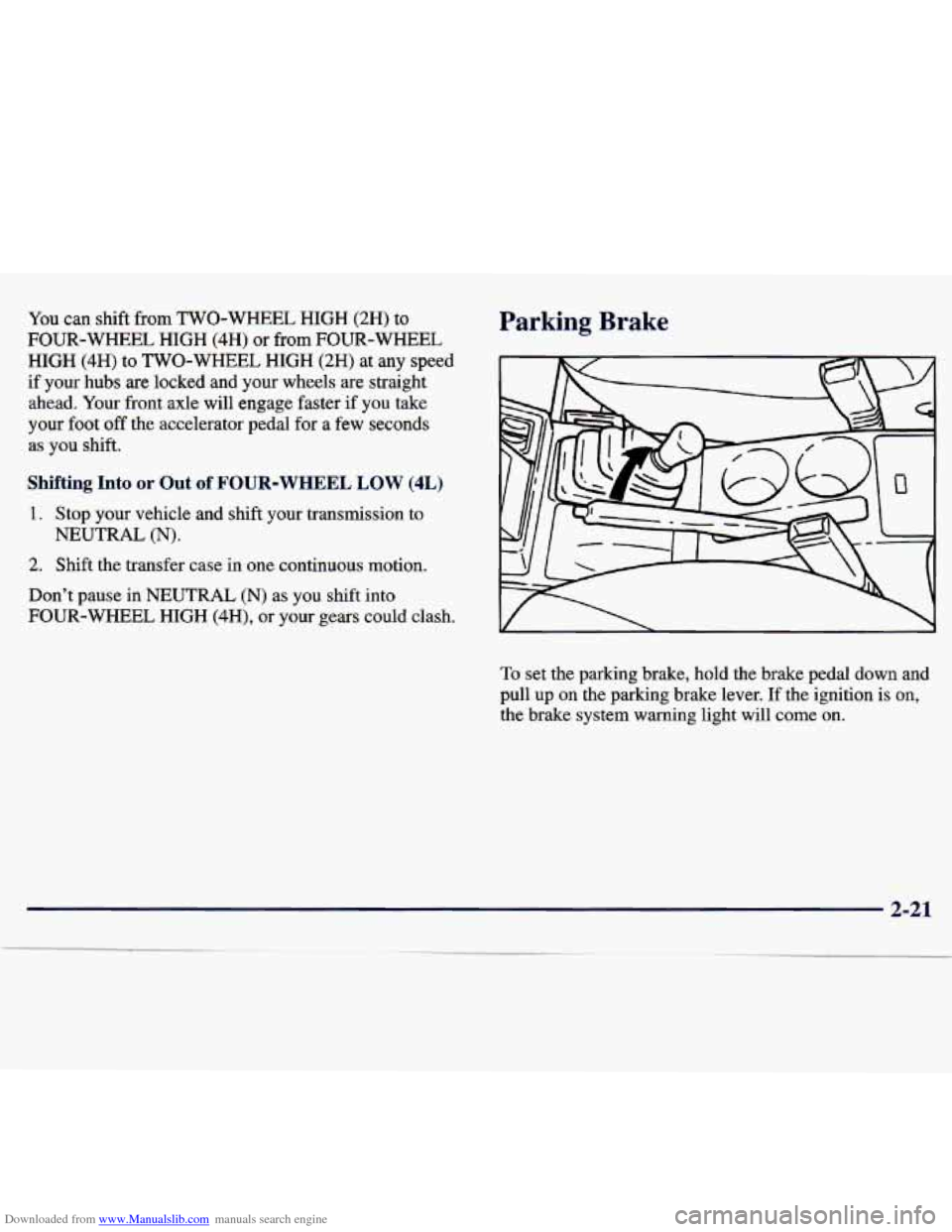
Parking Brake
Don’t pause in NEUTRAL (N) as you shift into
FOUR-WHEEL HIGH (4H), or your gears could clash.
To set the parking brake, hold the brake pedal down and
pull up on the parking brake lever. If the ignition is on,
the brake system warning light will come on.
2-21
Page 83 of 386
Downloaded from www.Manualslib.com manuals search engine Leaving Your Vehicle With the Engine
Running (Automatic Transmission Only)
I
It can be dangerous to leave yuur vehicle with
the engine running.
Your vehicle could move
suddenly
if the shift lever is not fully in PARK (P)
with the parking brake firmly set. If you have
four-wheel drive and your transfer case is in
NEUTRAL (N), your vehicle will be free to roll,
even
if your shift lever is in PARK (P). So be sure
the transfer case is in
a drive gear -- not in
NEUTRAL (N). And, if you leave the vehicle with
the engine running,
it could overheat and even
catch fire.
You or others could be injured. Don’t
leave your vehicle with the engine running unless
you have to.
Torque Lock (Automatic Transmission)
If you are parking on a hill and you don’t shift your
transmission into PARK (P) properly, the weight of the
vehicle may put too much force on the parking pawl
in
the transmission. You may find it difficult to pull the
shift lever out of PARK (P). This is called “torque lock.”
To prevent torque lock, set the parking brake and then
shift into PARK (P) properly before you leave the
driver’s seat.
To find out how, see “Shifting Into
PARK (P)” in the Index.
When you are ready to
drive, move the shift lever out
of PARK (P) before you release the parking brake.
If torque lock does occur, you may need to have another
vehicle push yours a little uphill
to take some of the
pressure from the parking pawl in the transmission,
so
you can pull the shift lever out of PARK (P).
2-24
Page 84 of 386
Downloaded from www.Manualslib.com manuals search engine Shifting Out of PARK (P)
(Automatic Transmission)
Your vehicle has a brake-transmission shift interlock.
You have to fully apply your regular brakes before you
can shift from
PARK (P) when the ignition is in the ON
position. See “Automatic Transmission” in the Index.
If you cannot shift out of PARK (P), ease pressure on
the shift lever
-- push the shift lever all the way into
PARK
(P) and release the shift lever button as you
maintain brake application. Then press the shift lever
button and move the shift lever into the gear you wish.
If you ever hold the brake pedal down but still can’t
shift out
of PARIS (P), try this: 1. Apply and hold the brake until the end of Step 6.
2. If the engine is running, turn it off. Turn the key to
ON or ACC.
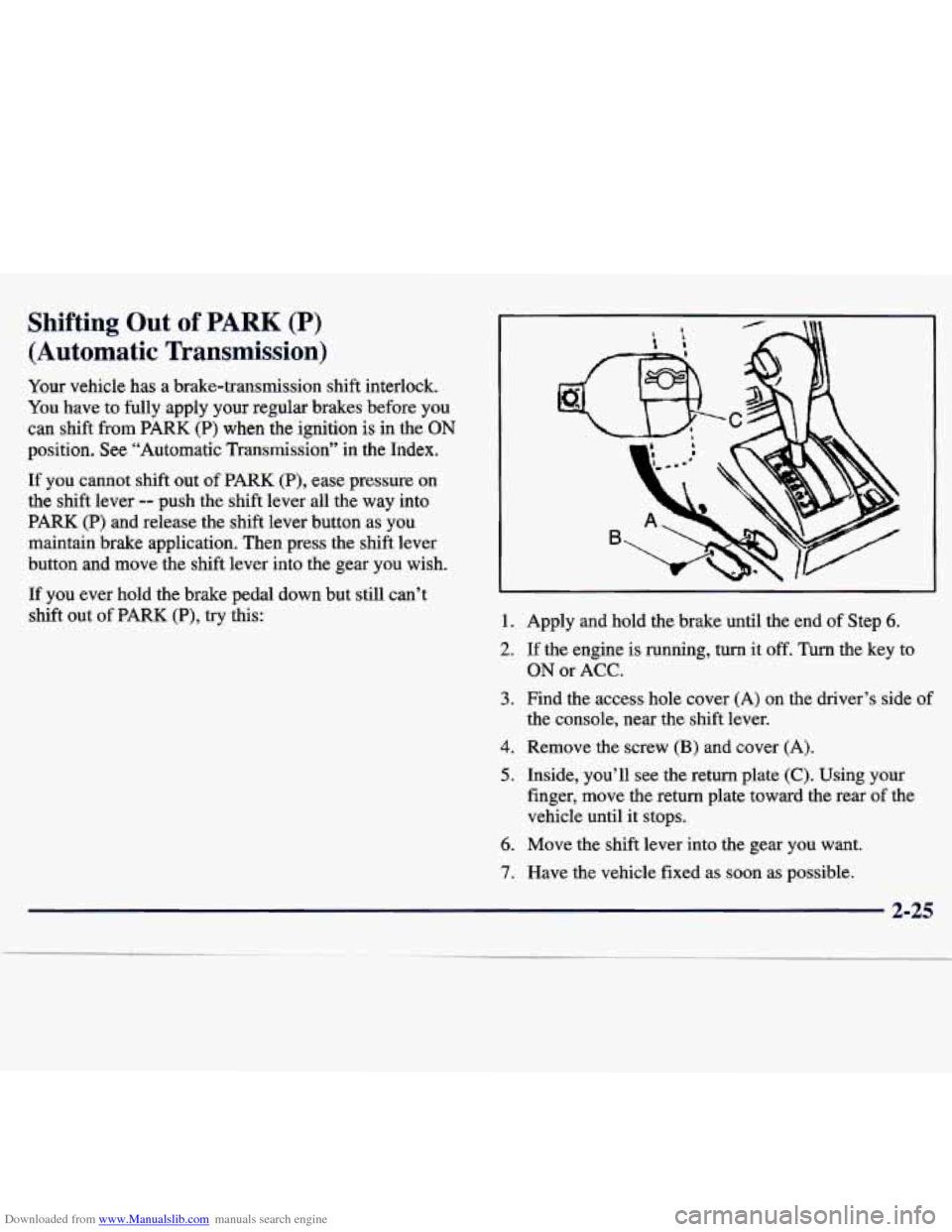
3. Find the access hole cover (A) on the driver’s side of
the console, near the shift lever.
4. Remove the screw (B) and cover (A).
5. Inside, you’ll see the return plate (C). Using your
finger, move the return plate toward the rear of the
vehicle until it stops.
6. Move the shift lever into the gear you want.
7. Have the vehicle fixed as soon as possible.
2-25
Page 85 of 386
Downloaded from www.Manualslib.com manuals search engine Parking Your Vehicle
(Manual Transmission)
Before you get out of your vehicle, put your manual
transmission in
REVERSE (R) and firmly apply the
parking brake.
If you have four-wheel drive, be sure your transfer case
is
in a drive gear. Your vehicle could roll if it isn't.
If you are towing a trailer, see "Towing a Trailer" in
the Index.
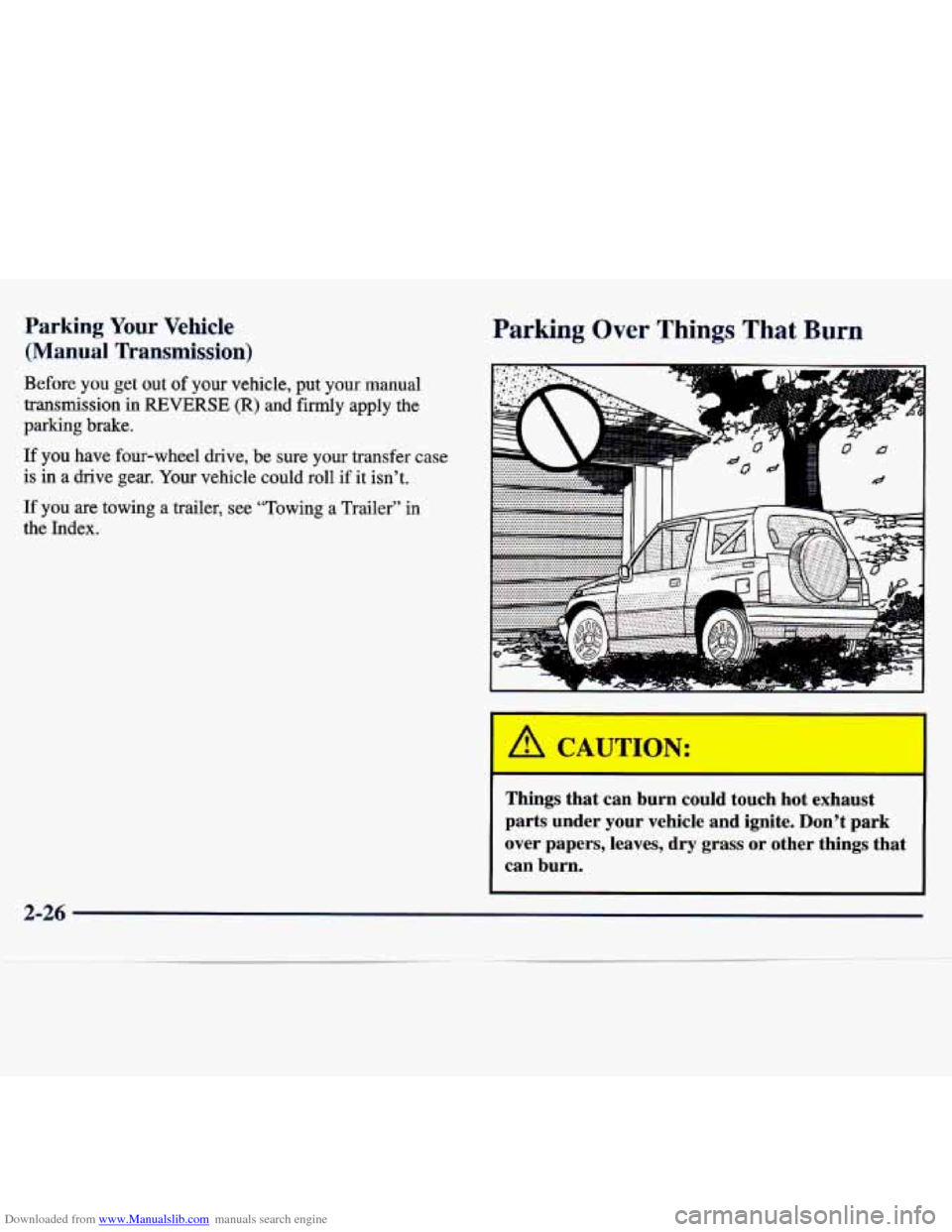
Parking Over Things That Burn
c. .. I
R
Things that can burn could touch hot exhaust
parts under your vehicle and ignite. Don't park
over papers, leaves, dry grass or other things that
can burn.
2-26
Page 86 of 386
Downloaded from www.Manualslib.com manuals search engine Engine Exhaust
/! CAUTION:
I
Engine exhaust can kill. It contains the gas
carbon monoxide
(CO), which you can’t see or
smell. It can cause unconsciousness and death.
You might have exhaust coming in
if:
Your exhaust system sounds strange
Your vehicle gets rusty underneath.
0 Your vehicle was damaged in a conision.
0 Your vehicle was damaged when driving over
high points on the road or over road debris.
0 Repairs weren’t done correctly.
0 Your vehicle or exhaust system had been
If you ever suspect exhaust is coming into
your vehicle:
0 Drive it only with all the windows down to
0 Have your vehicle fixed immediately.
or different.
modified improperly. blow out any
CO; and
Running Your Engine While You’re
Parked (Automatic Transmission)
It’s better not to park with the engine running. But if
ever
you have to, here are some things to know.
I
Idling the engine with the air system control
off could allow dangerous exhaust into
your vehicle
(see the earlier Caution under
“Engine Exhaust”).
Also, idling in a closed-in place can let deadly
carbon monoxide (CO) into your vehicle even
if the fan switch is at the highest setting. One
place this can happen
is a garage. Exhaust -- wit1
CO -- can come in easily. NEVER park in a
garage with the engine running.
Another closed-in place can be a blizzard. (See
“Blizzard” in the Index.)
2-27
Page 92 of 386
Downloaded from www.Manualslib.com manuals search engine Rear Window Wiper/Washer (If Equipped)
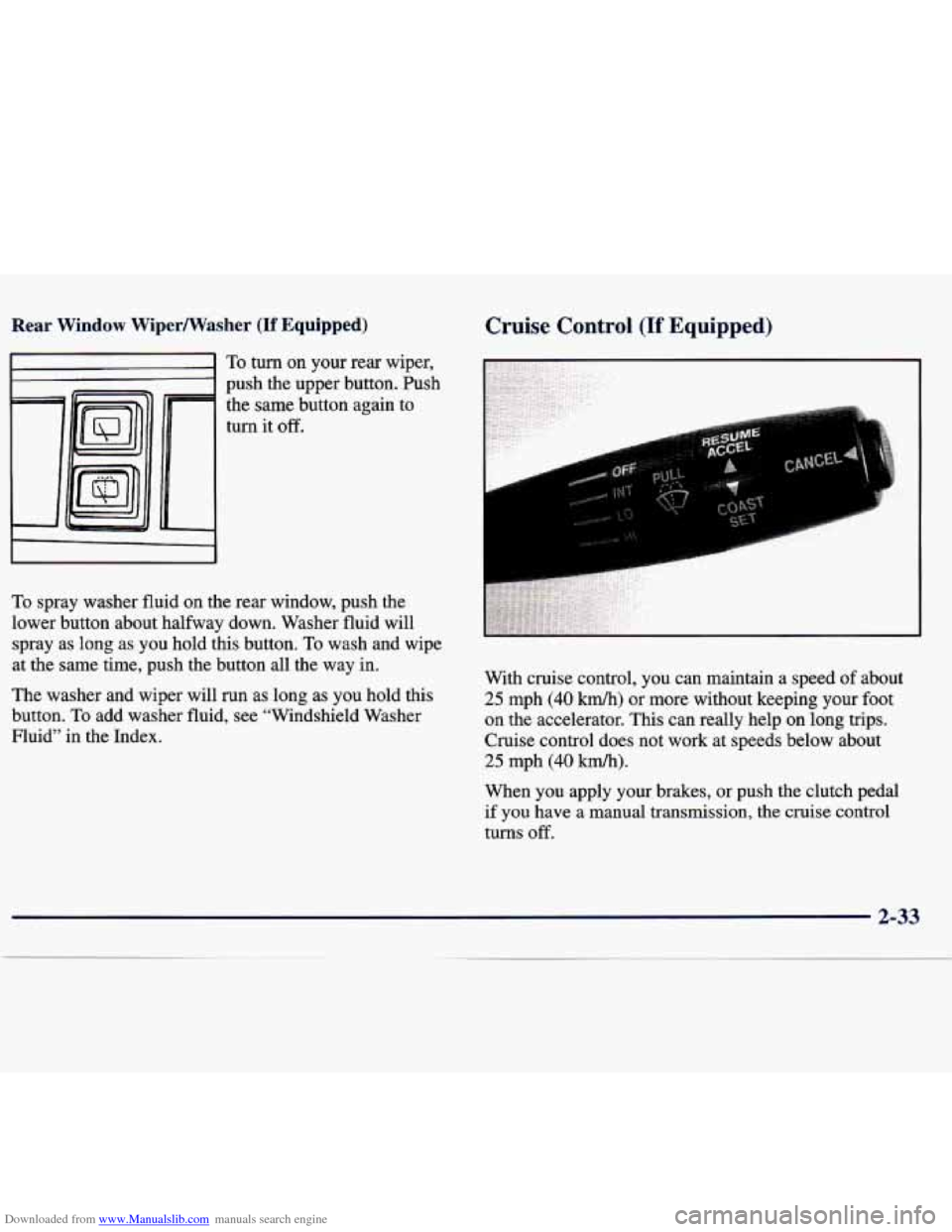
To turn on your rear wiper,
push
the upper button. hsh
the same button again to
turn it
off.
To spray washer fluid on the rear window, push the
lower button about halfway down. Washer fluid will
spray as long as you hold this button. To wash and wipe
at the same time, push the button all the way in.
The washer and wiper will run as long
as you hold this
button.
To add washer fluid, see “Windshield Washer
Fluid” in the Index.
Cruise Control (If Equipped)
With cruise control, you can maintain a speed of about
25 mph (40 kmk) or more without keeping your foot
on the accelerator. This can really help on long trips.
Cruise control does not work at speeds below about
25 mph (40 krn/h).
When you apply your brakes, or push the clutch pedal
if you have a manual transmission, the cruise control
turns off.
2-33
Page 95 of 386
Downloaded from www.Manualslib.com manuals search engine Increasing Speed While Using Cruise Control
There are two ways to go to a higher speed.
Use the accelerator pedal to go to a higher speed.
Turn the lever to COAST/SET and release. Take
your foot
off the accelerator pedal. You’ll now
cruise at the higher speed.
at RESUME/ACCEL until you get up to the speed
you want, then release the lever.
Turn the lever to RESUME/ACCEL. Hold the lever
Reducing Speed While Using Cruise Control
To reduce your speed, turn and hold the lever in the
COASTISET position until you reach the lower speed
you want, then release the lever.
Passing Another Vehicle While Using Cruise Control
Use the accelerator pedal to increase your speed. When
you take your
foot off the pedal, your vehicle will slow
down to the cruise control speed you set earlier.
Using Cruise Control on Hills
How well your cruise control will work on hills depends
upon your speed, load and
the steepness of the hills.
When going up steep hills, you may have to step on the
accelerator pedal
to maintain your speed. When going
downhill, you may have to brake or shift to a lower
gear
to keep your speed down. Of course, applying the brake
takes you out of cruise control. Many drivers find this to
be too much trouble and don’t use cruise control on
steep hills.
Getting Out of Cruise Control
There are three ways to turn off cruise control:
Step lightly on the brake pedal, or push the clutch
pedal if you have a manual transmission.
Push in the CANCEL button on the end of the
cruise control lever.
Press the CRUISE CTlU switch on the
instrument panel.
Erasing Speed Memory
When you turn off the cruise control or the ignition,
your cruise control set speed memory
is erased.
2-36
Page 125 of 386
Downloaded from www.Manualslib.com manuals search engine Don’t keep driving if the oil pressure is low. If
you do, your engine can become so hot that it
catches fire. You or others could be burned.
Check your oil
as soon as possible and have
your vehicle serviced.
I NOTICE:
Damage to your engine from neglected oil
problems can be costly and is not covered by
your warranty.
Power Indicator Light (If Equipped)
POWER
This light comes on when
the power mode selector
switch is turned to
POWER
(P) with the
ignition switch in the
ON position.
This light comes on as a check for approximately
5 seconds when the ignition key is turned to ON
or START.
Overdrive Off Light (If Equipped)
O/D OFF
This light comes on when
the automatic four-speed
transmission has been
converted to the three-speed
mode and the overdrive is
turned
off.
This light also comes on as a check for approximately
5 seconds when the ignition key is turned to ON
or STmT.
2-66