transmission CHEVROLET TRACKER 1998 1.G Owner's Guide
[x] Cancel search | Manufacturer: CHEVROLET, Model Year: 1998, Model line: TRACKER, Model: CHEVROLET TRACKER 1998 1.GPages: 386, PDF Size: 21.17 MB
Page 201 of 386
Downloaded from www.Manualslib.com manuals search engine When You Are Ready to Leave After
Parking
on a Hill
1. Apply your regular brakes and hold the pedal down
while you:
Start your engine;
0 Shift into a gear; and
Release the parking brake.
2. Let up on the brake pedal.
3. Drive slowly until the trailer is clear of the chocks.
4. Stop and have someone pick up and store the chocks.
Maintenance When Trailer Towing
Your vehicle will need service more often when you’re
pulling a trailer. See the Maintenance Schedule for more
on this. Things that are especially important in trailer
operation are automatic transmission fluid (don’t
overfill), engine oil, axle lubricant, belts, cooling system
and brake adjustment. Each of these is covered in this
manual, and the Index will help you find them quickly.
If you’re trailering, it’s a good idea to review these
sections before you start your trip.
Check periodically to see that all hitch nuts and bolts
are tight.
4-56
Page 208 of 386
Downloaded from www.Manualslib.com manuals search engine 11. Try to start the vehicle with the dead battery. If it
won’t start after a few tries,
it probably needs
service.
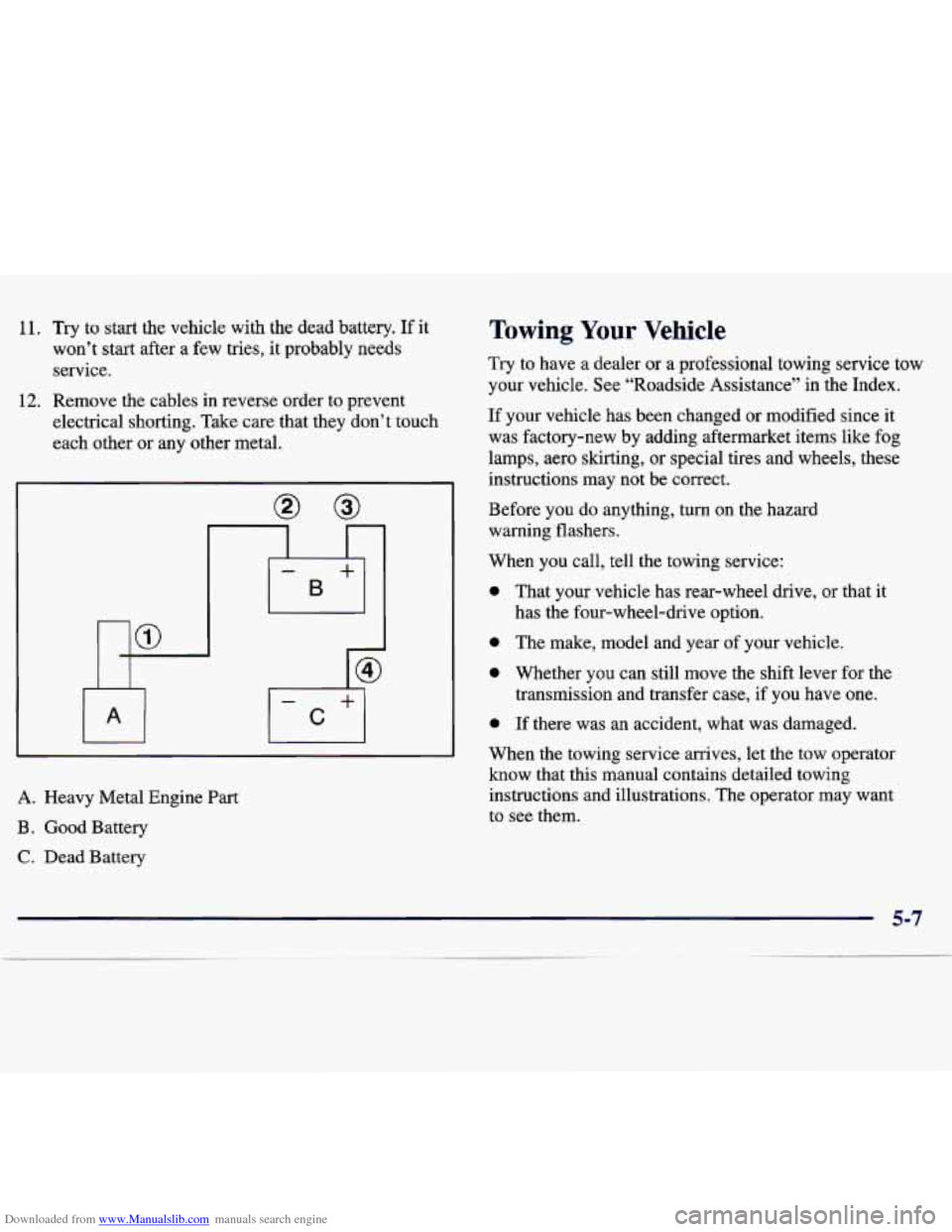
12. Remove the cables in reverse order to prevent
electrical shorting. Take care that they don’t touch
each other or any other metal.
-
B
+
b
A. Heavy Metal Engine Part
B. Good Battery
C. Dead Battery
Towing Your Vehicle
Try to have a dealer or a professional towing service tow
your vehicle. See “Roadside Assistance” in the Index.
If your vehicle has been changed or modified since it
was factory-new by adding aftermarket items like fog
lamps, aero skirting,
or special tires and wheels, these
instructions may not be correct.
Before you do anything, turn on the hazard warning flashers.
When you call, tell the towing service:
0
0
0
0
That your vehicle has rear-wheel drive, or that it
has the four-wheel-drive option.
The make, model and year of your vehicle.
Whether you can still move the shift lever for the
transmission and trans€er case, if you have one.
If there was an accident, what was damaged.
When the towing service arrives,
let the tow operator
know that this manual contains detailed towing
instructions and illustrations. The operator may want
to see them.
Page 210 of 386
Downloaded from www.Manualslib.com manuals search engine When your vehicle is being towed, have the ignition
key turned to OFF. The steering wheel should be
clamped
in a straight-ahead position, with a clamping
device designed for towing service.
Do not use the
vehicle’s steering column lock for this. The transmission
and transfer case, if
you have one, should be in
NEUTRAL (N) and the parking brake released.
Don’t have your vehicle towed on the drive wheels
unless you must.
If the vehicle must be towed on the
drive wheels, be sure to follow any speed and distance
restrictions later in this section, or
your transmission
will be damaged. If these limitations must be exceeded,
then the drive wheels have to be supported on a dolly.
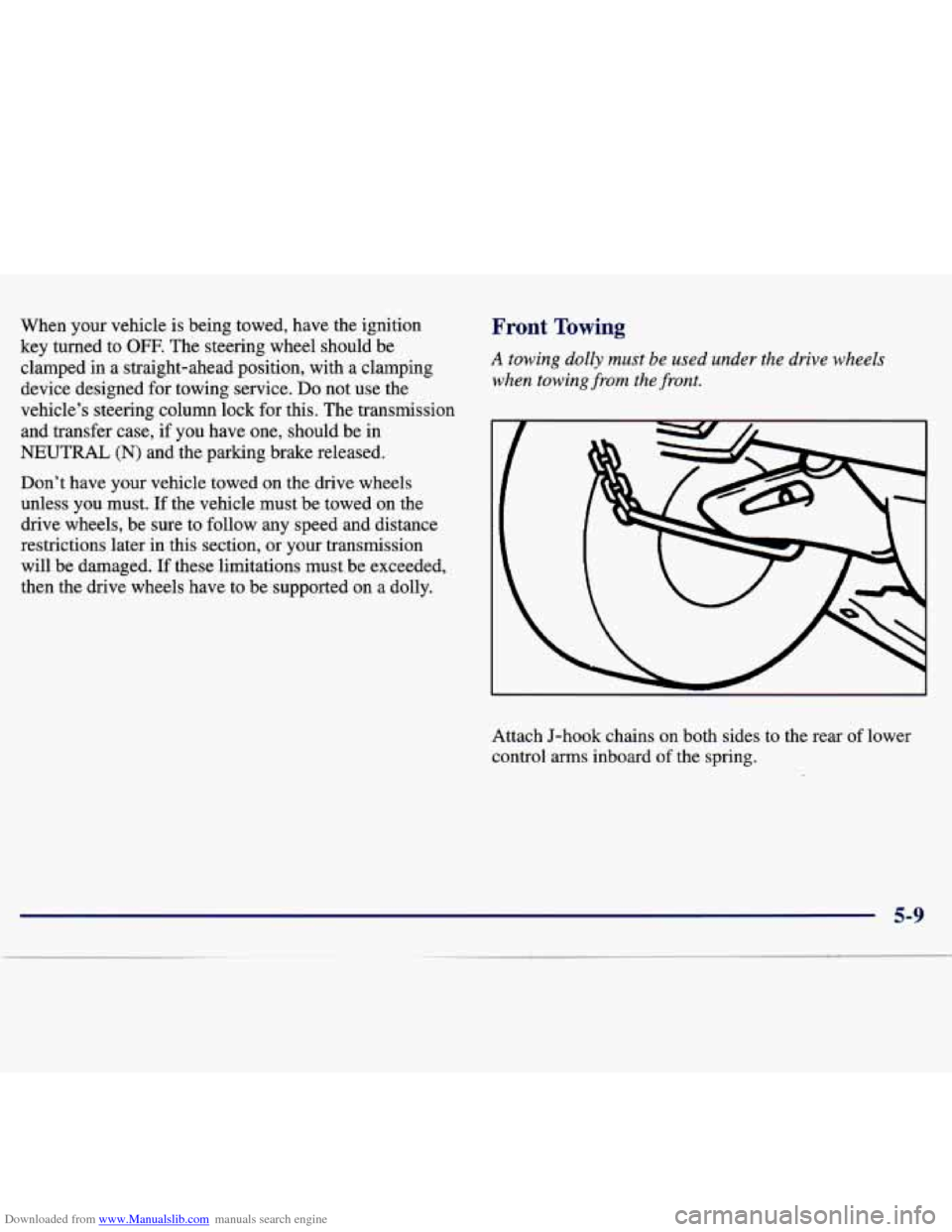
Front Towing
A towing dolly must be used under the drive wheels
when towing from the front.
Attach J-hook chains on both sides to the rear of lower
control arms inboard
of the spring.
5-9
Page 215 of 386
Downloaded from www.Manualslib.com manuals search engine If you get the overheat warning with no sign of steam,
try this for a minute or so:
1. If you have an air conditioner, turn it off.
2. Turn on your heater to full hot at the highest fan
speed and open the window as necessary.
3. If you’re in a traffic jam, shift to NEUTRAL (N);
otherwise, shift to the highest gear while
driving
-- AUTOMATIC OVERDRIVE (a) or
DRIVE (D) for automatic transmissions.
If you no longer have the overheat warning, you
can drive. Just to be safe, drive slower for about
10 minutes. If the warning doesn’t come back on,
you can drive normally.
If the warning continues, pull over, stop, and park your
vehicle right away.
If there’s still no sign of steam, you can idle the engine
for two or three minutes while you’re parked, to see
if the warning stops. But then,
if you still have the
warning,
turn ojjfthe engine and get everyone out of
the vehicle until it cools down.
You may decide not to lift the hood but to get service
help right away.
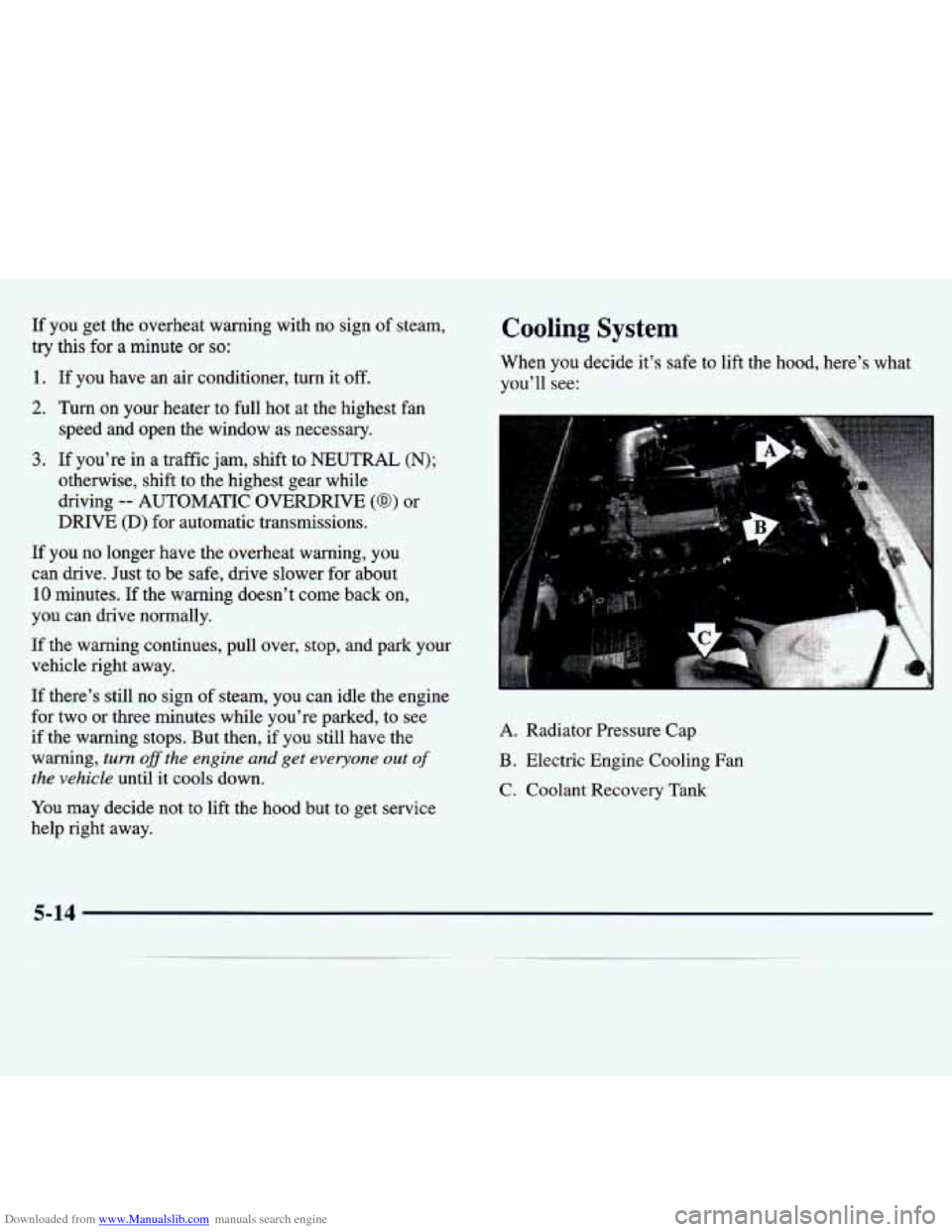
Cooling System
When you decide it’s safe to lift the hood, here’s what \
you’ll see:
A. Radiator Pressure Cap
B. Electric Engine Cooling Fan
C. Coolant Recovery Tank
5-14
Page 223 of 386
Downloaded from www.Manualslib.com manuals search engine Changing a Flat Tire
If a tire goes flat, avoid further tire and wheel damage
by driving slowly to a level place. Turn on your hazard
warning flashers.
A CAUTION:
Changing a tire can cause an injury. The vehicle
can slip
off the jack and roll over you or other
people.
You and they could be badly injured.
Find
a level place to change your tire. To help
prevent the vehicle from moving:
1. Set the parking brake firmly.
2. Put an automatic transmission shift lever in
PARK
(P) or shift a manual transmission to
FIRST
(1) or REVERSE (R).
3. If you have a four-wheel-drive vehicle,
be sure the transfer case
is in a drive
gear
-- not in NEUTRAL (N).
4. 'hrn off the engine.
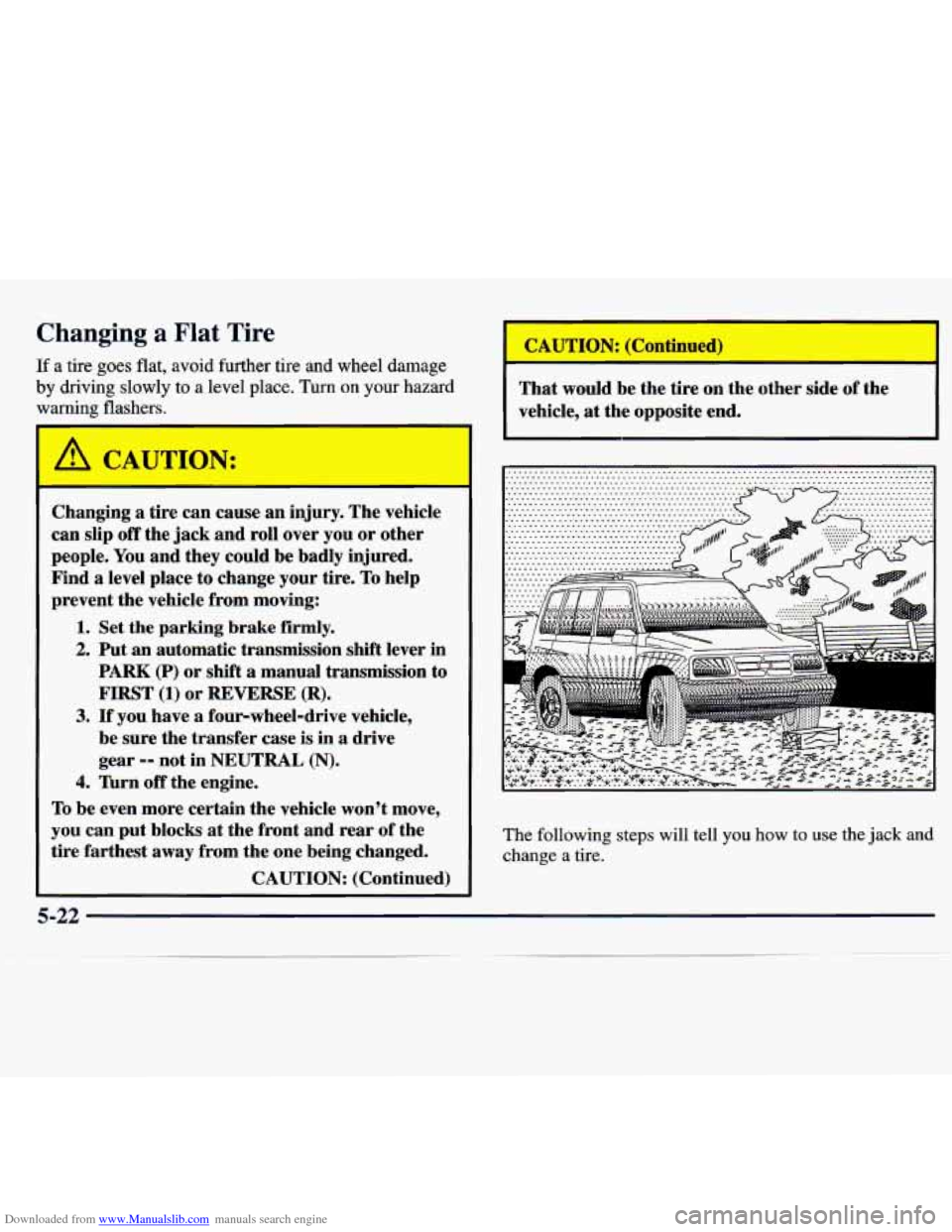
To be even more certain the vehicle won't move,
you can put blocks at the front and rear
of the
tire farthest
away from the one being changed.
CAUTION: (Continued) That
would be the tire
on the other side of the
vehicle,
at the opposite end.
The following steps will tell
you how to use the jack and
change a tire.
Page 233 of 386
Downloaded from www.Manualslib.com manuals search engine If You’re Stuck: In Sand, Mud,
Ice or Snow
What you don’t want to do when your vehicle is stuck is
to spin your wheels too fast. The method known as
“rocking” can help you get out when you’re stuck, but \
you must use caution.
If you let your tires spin
at high speed, they can
explode, and you
or others could be injured. And,
the transmission or other parts of the vehicle can
overheat. That could cause an engine
compartment fire or other damage. When you’re
stuck, spin the wheels as little as possible. Don’t
spin the wheels above
35 mph (55 km/h) as shown
on the speedometer.
NOTICE:
Spinning your wheels can destroy parts of your
vehicle as well as the tires.
If you spin the wheels
too fast while shifting your transmission back
and forth, you can destroy your transmission.
For information about using tire chains on your vehicle,
see “Tire Chains” in the Index.
5-32
Page 234 of 386
Downloaded from www.Manualslib.com manuals search engine Rocking Your Vehicle To Get It Out Using the Recovery Hooks
First, turn your steering wheel left and right. That will
clear the area around your front wheels.
If you have a
four-wheel drive vehicle, shift into 4HI. Then shift back
and forth between
REVERSE (R) and a forward gear
(or with a manual transmission, between
FIRST (1) or
SECOND (2) and REVERSE (R)), spinning the wheels
as little as possible. Release the accelerator pedal while
you shift, and press lightly on the accelerator pedal
when the transmission
is in gear. If that doesn’t get you
out after
a few tries, you may need to be towed out. Or,
you can use your recovery hooks
if your vehicle has
them.
If you do need to be towed out, see “Towing Your
Vehicle”
in the Index.
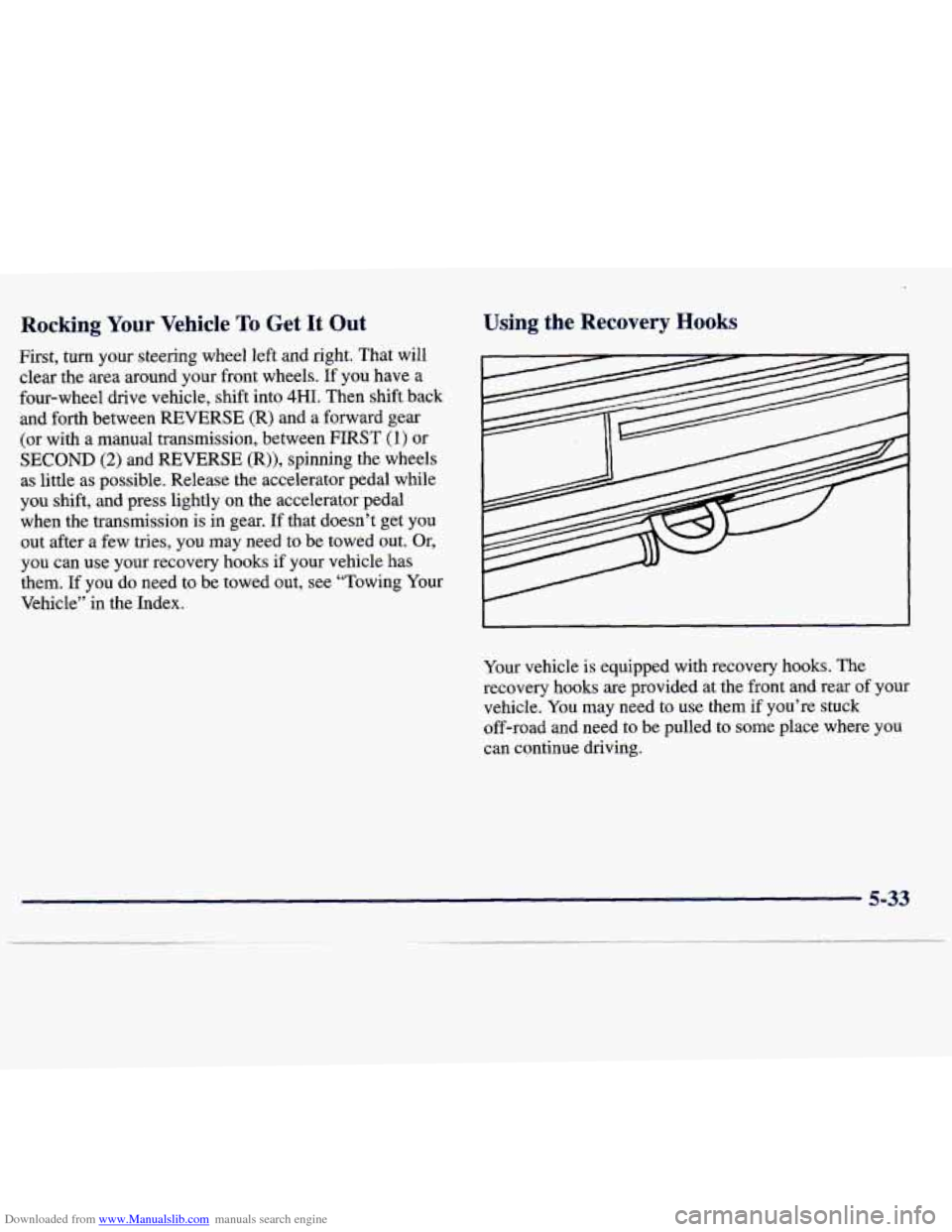
Your vehicle
is equipped with recovery hooks. The
recovery hooks are provided at the front and rear of your
vehicle. You
may need to use them if you’re stuck
off-road and need to
be pulled to some place where you
can continue driving.
Page 238 of 386
Downloaded from www.Manualslib.com manuals search engine 0 Section 6 Service and Appearance Care
Here you will find information about the care of your vehicle. This section begins with service and fuel information,
and then it shows how to check important fluid and lubricant levels. There is also technical i\
nformation about your
vehicle, and a part devoted to its appearance care.
6-2
6-3
6-5
6-5
6-7
6- 8 6-11
6-15
6-17
6-20
6-24
6-26
6-27
6-27
6-28
6-29
6-33
6-34 Service
Fuel
Fuels in Foreign Countries
Filling Your Tank
Filling a Portable Fuel Container
Checking Things Under the Hood
Engine Oil
Air Cleaner
Automatic Transmission Fluid
Manual Transmission Fluid
Engine Coolant
Radiator Pressure Cap
Thermostat
Power Steering Fluid
Windshield Washer Fluid Brakes
Battery
Bulb Replacement 6-40
6-48
6-49
6-5
1
6-52
6-53
6-54
6-54
6-55
6-55
6-56 6-57
6-57
6-61
6-6
1
6-63 Tires
Appearance Care Cleaning the Inside of Your Vehicle
Cleaning the Outside
of the Windshield,
Backglass and Wiper Blades
Cleaning the Outside of Your Vehicle
Special Care for Canvas Top and
Plastic Windows
Cleaning Aluminum Wheels
(If Equipped)
Cleaning Tires
Finish Damage
Underbody Maintenance
Appearance Care Materials Chart
Vehicle Identification Number (VIN)
Electrical System Replacement Bulbs
Capacities and Specifications
Air Conditioning Refrigerants
6-1
Page 247 of 386
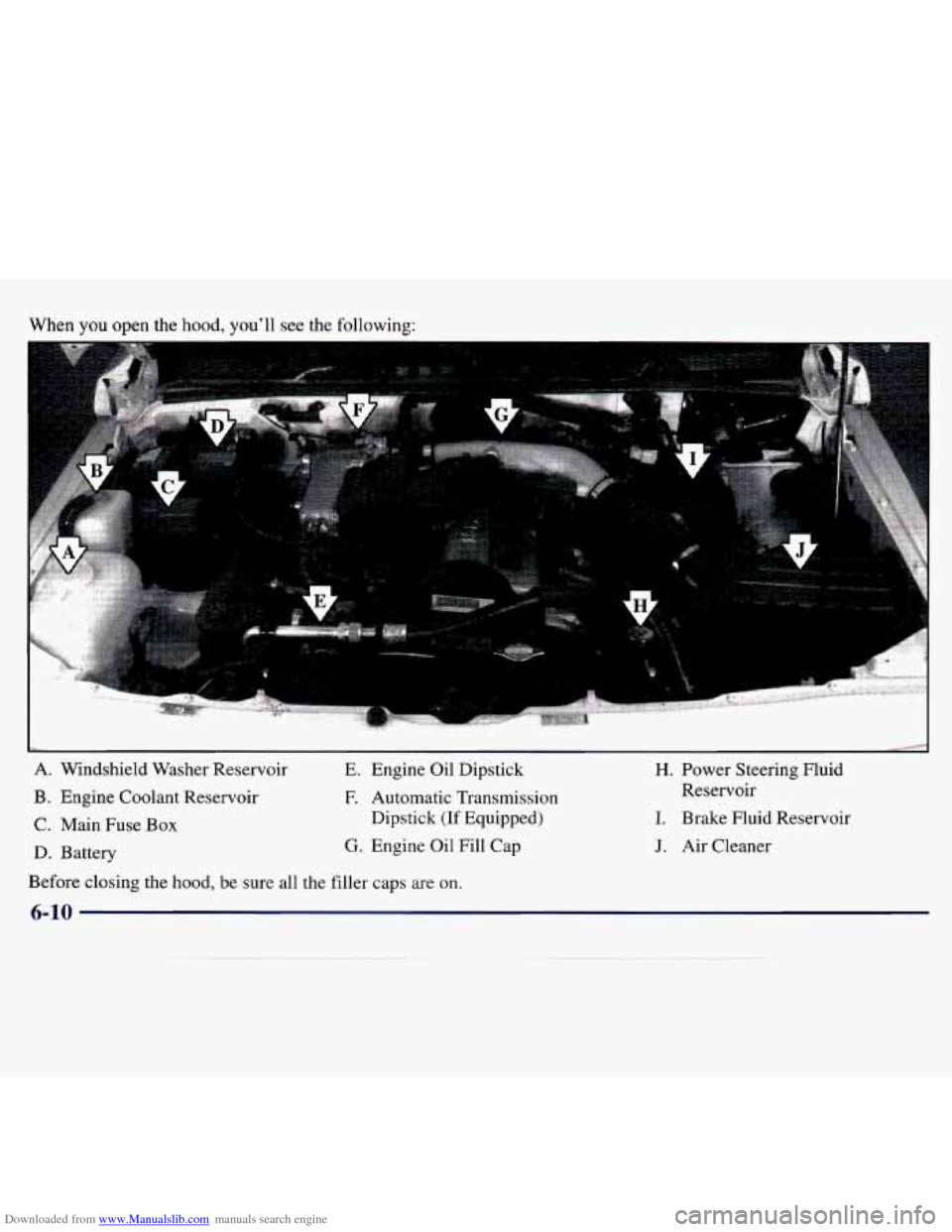
Downloaded from www.Manualslib.com manuals search engine When you open the hood, you’ll see the following:
A. Windshield Washer Reservoir
B. Engine Coolant Reservoir
C. Main Fuse
Box
D. Battery E. Engine Oil Dipstick
E Automatic Transmission
Dipstick
(If Equipped)
G. Engine Oil Fill Cap
H. Power Steering Fluid
I. Brake Fluid Reservoir
J. Air Cleaner
Reservoir
Before closing the hood, be sure all the filler caps are
on.
Page 254 of 386

Downloaded from www.Manualslib.com manuals search engine Automatic Transmission Fluid
3. Pull out the filter and replace it.
4. Replace the cover and the screws.
When to Check and Change
A good time to check your automatic transmission fluid
level is when the engine oil is changed.
Change both the fluid and filter every
15,000 miles
(25 000 km) if the vehicle is mainly driven under one
or more of these conditions:
In heavy city traffic where the outside temperature
regularly reaches
90 OF (32 O C) or higher.
0 In hilly or mountainous terrain.
0 When doing frequent trailer towing.
Uses such as found in taxi, police or delivery service.
If
you do not use your vehicle under any of these
conditions, change the fluid and filter
every
100,000 miles (166 000 km).
See “Scheduled Maintenance Services” in the Index.
6-17