wheel CHEVROLET TRACKER 1998 1.G User Guide
[x] Cancel search | Manufacturer: CHEVROLET, Model Year: 1998, Model line: TRACKER, Model: CHEVROLET TRACKER 1998 1.GPages: 386, PDF Size: 21.17 MB
Page 70 of 386
Downloaded from www.Manualslib.com manuals search engine Automatic Transmission Operation
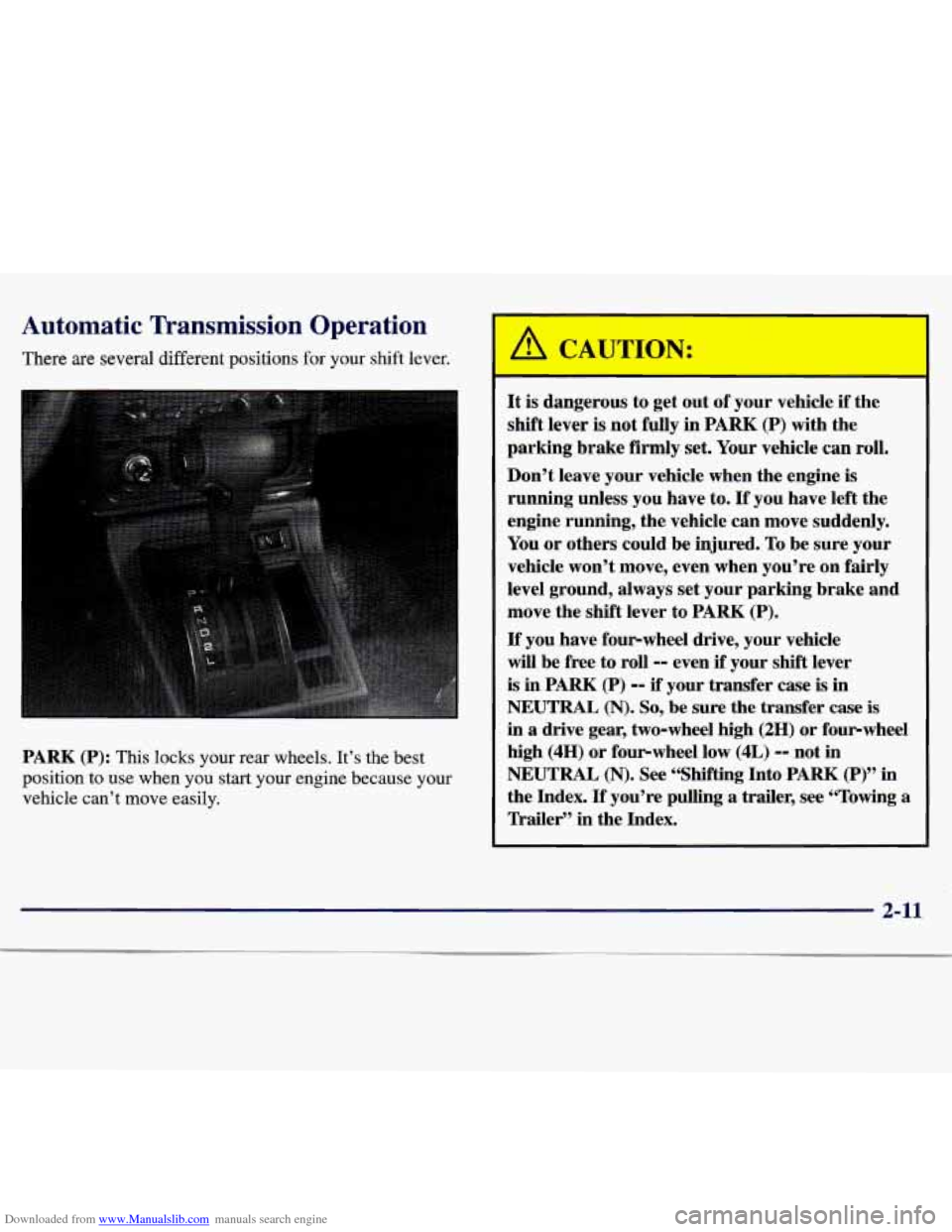
There are several different positions for your shift lever.
PARK
(P): This locks your rear wheels. It’s the best
position to use when
you start your engine because your
vehicle can’t move easily. It
is dangerous to
get out of your vehicle if the
shift lever is not fully in
PARK (P) with the
parking brake firmly
set. Your vehicle can roll.
Don’t leave your vehicle when the engine is
running unless you have to.
If you have left the
engine running, the vehicle can move suddenly.
You or others could be injured. To be sure your
vehicle won’t move, even when you’re
on fairly
level ground, always set your parking brake and
move the shift lever to PARK
(P).
If you have four-wheel drive, your vehicle
will be free to roll
-0 even if your shift lever
is in PARK (P) -- if your transfer case is in
NEUTRAL (N). So, be sure the transfer case is
in a drive gear, two-wheel high (2H) or four-wheel
high (4H) or four-wheel low (4L)
-- not in
NEUTRAL
(N). See “Shifting Into PARK (P)” in
the Index.
If you’re pulling a trailer, see “Towing a
lkailer” in the Index.
2-11
Page 71 of 386
Downloaded from www.Manualslib.com manuals search engine Ensure the shift lever is fully in PARK (P) before starting
the engine. Your vehicle has a brake-transmission shift
interlock. You
have to fully apply your regular brakes
before you can shift from PARK (P) when the ignition
key is in
ON. If you cannot shift out of PARK (P), ease
pressure on the shift lever
-- push the shift lever all the
way into PARK (P) and release the shift lever button as
you maintain brake application. Then press the shift lever
button
and move the shift lever into the gear you wish.
See “Shifting Out of
PARK (P)” in the Index.
REVERSE (R): Use this gear to back up.
NOTICE:
Shifting to REVERSE (R) while your vehicle
is moving forward could damage your
transmission. Shift to REVERSE (R) only
after your vehicle is stopped.
To rock your vehicle back and forth to get out of snow,
ice or sand without damaging your transmission, see
“Stuck: In Sand, Mud, Ice or Snow” in the Index. NEUTRAL
(N): In this position, your engine doesn’t
connect with
the wheels. To restart when you’re
already moving,
use NEUTRAL (N) only. Also, use
NEUTRAL (N) when your vehicle is being towed.
Shifting out of
PARK (P) or NEUTRAL (N)
while your engine is “racing” (running at high
speed)
is dangerous. Unless your foot is firmly on
the brake pedal, your vehicle could move very
rapidly. You could lose control and hit people or
objects. Don’t shift out of
PARK (P) or
NEUTRAL
(N) while your engine is racing.
I NOTICE:
Damage to your transmission caused by shifting
out of PARK
(P) or NEUTRAL (N) with the
engine racing isn’t covered by your warranty.
1
2-12
Page 72 of 386
Downloaded from www.Manualslib.com manuals search engine DRIVE (D): This position is for normal driving.
If you need more power for passing, and you’re:
Going less than about 15 mph (25 km/h), push
your accelerator pedal about halfway down.
Going about 15 mph (25 km/h) or more, push your
accelerator pedal all the way down.
You’ll shift down
to the next gear and have
more power.
SECOND (2): This position gives you more power but
lower fuel economy. You can use SECOND (2) on hills.
It
can help control your speed as you go down steep
mountain roads, but then
you would also want to use
your brakes
off and on.
NOTICE:
Don’t shift into SECOND (2) unless you are going
slower than
65 mph (105 kmh) with the transfer
case in
FOUR HIGH (4H), or 35 mph (55 km/h)
with the transfer case in FOUR LOW (4L) or you
can damage your transmission. LOW
(L): This position gives you even more power
(but lower
fuel economy) than SECOND (2). You
can use it on very steep hills, or in deep snow or mud.
If the selector lever
is put in LOW (L), the transmission
won’t shift into
low gear until the vehicle is going
slowly enough.
I NOTICE:
Don’t shift into LOW (L) at speeds above
40 mph
(65 kmh) with the transfer case in
FOUR-WHEEL LOW
(4L), or you can damage
your transmission.
2-13
Page 73 of 386
Downloaded from www.Manualslib.com manuals search engine NOTICE:
If your rear wheels can’t rotate, don’t try to
drive. This might happen
if you were stuck in
very deep sand or mud
or were up against a solid
object. You could damage your transmission.
Also, if you stop when going uphill, don’t hold
your vehicle there with only the accelerator
pedal. This could overheat and damage the
transmission.
Use your brakes to hold your
vehicle in position on a hill.
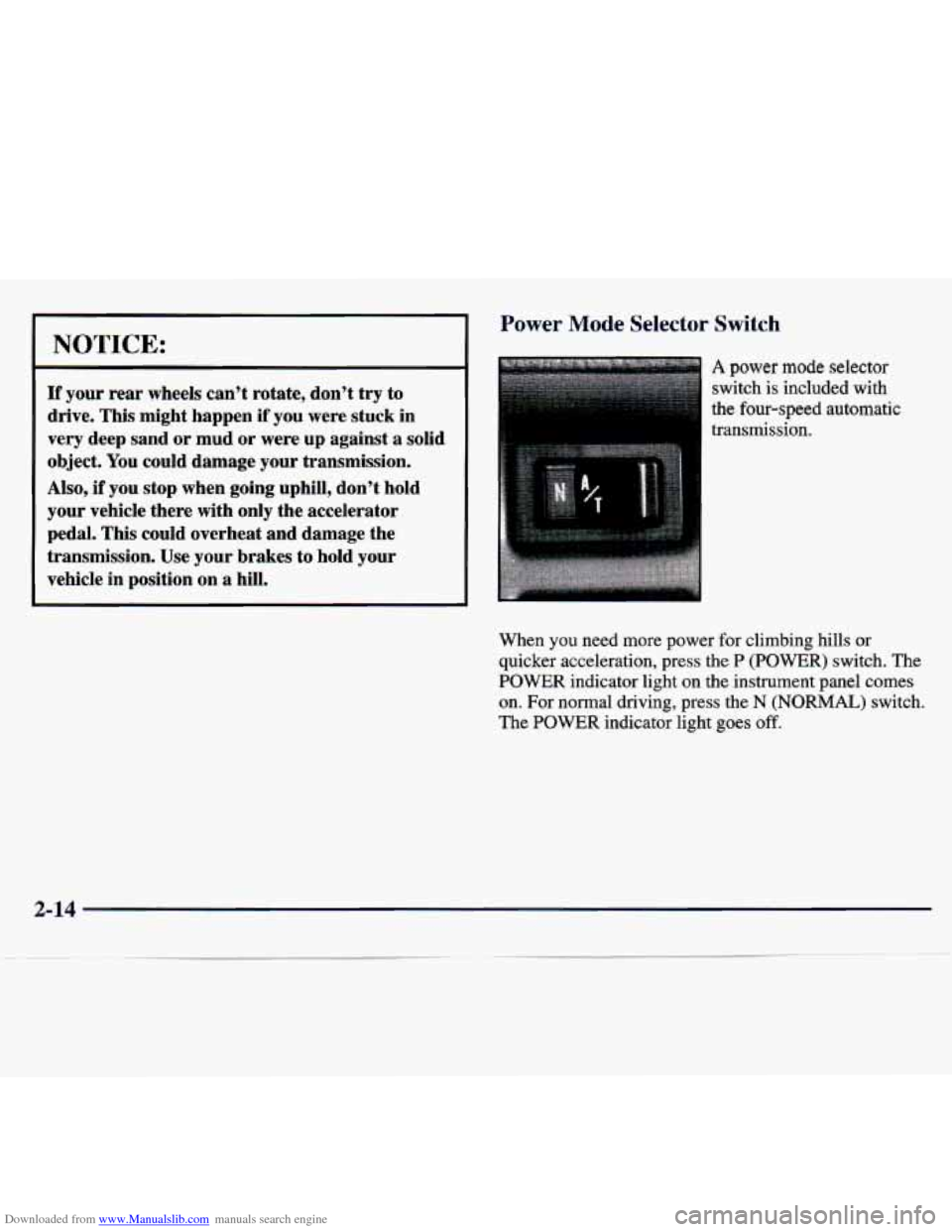
Power Mode Selector Switch
A power mode selector
switch is included
with
the four-speed automatic
transmission.
When
you need more power for climbing hills or
quicker acceleration, press
the P (POWER) switch. The
POWER indicator light on the instrument panel comes
on. For normal driving, press the N (NORMAL) switch.
The POWER indicator light goes
off.
2-14
Page 77 of 386
Downloaded from www.Manualslib.com manuals search engine Four- Wheel Drive (If Equipped)
If your vehicle has four-wheel drive, you can send your
engine’s driving power to all four wheels for extra
traction. To shift out of two-wheel drive and into
four-wheel drive, lock the freewheeling hubs (manual
hubs only)
and move the transfer case shift lever to
FOUR-WHEEL HIGH (4H) or FOUR-WHEEL
LOW (4L) (see
the following). You should use
TWO-WHEEL HIGH (2H) for most normal driving.
NOTICE:
Driving in FOUR-WHEEL HIGH (4H) or
FOUR-WHEEL LOW (4L) positions for a long
time on dry
or wet pavement could shorten the
life of your vehicle’s drivetrain.
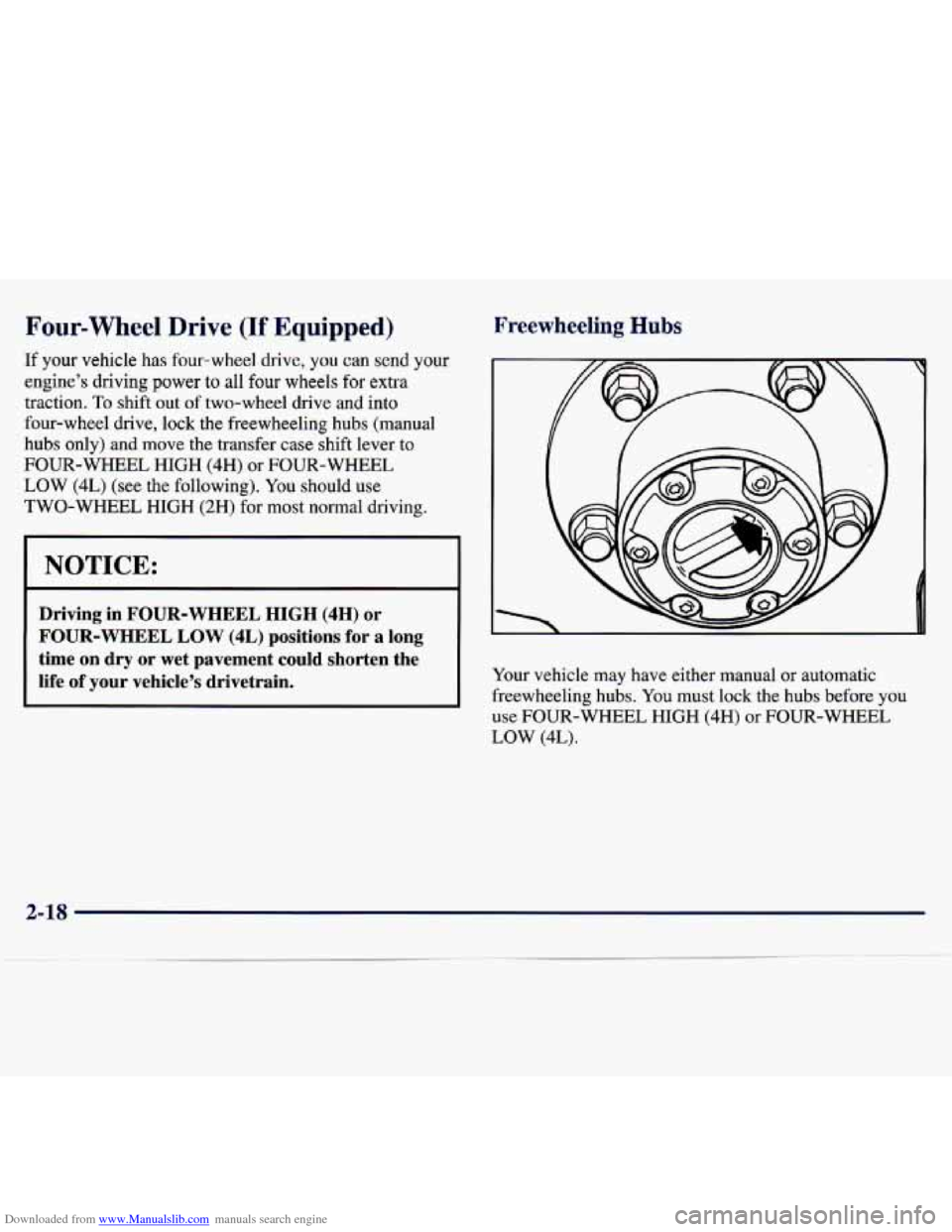
Freewheeling Hubs
Your vehicle may have either manual or automatic
freewheeling hubs.
You must lock the hubs before you
use FOUR-WHEEL HIGH (4H)
or FOUR-WHEEL
LOW (4L).
2-18
Page 78 of 386
Downloaded from www.Manualslib.com manuals search engine Manual
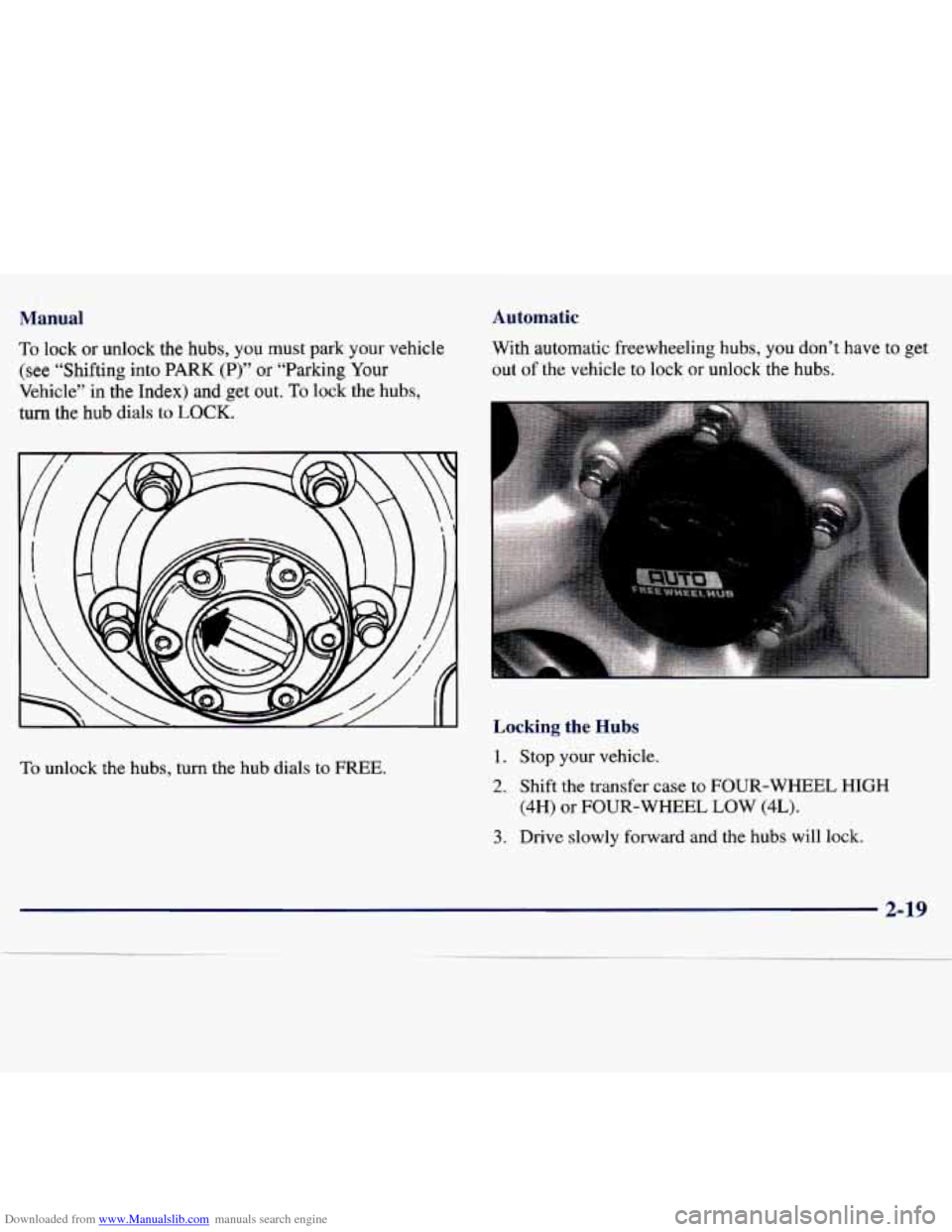
To lock or unlock the hubs, you must park your vehicle
(see “Shifting into PARK (P)” or “Parking Your
Vehicle” in the Index) and get out.
To lock the hubs,
turn the hub dials to
LOCK.
To unlock the hubs, turn the hub dials to FREE.
Automatic
With automatic freewheeling hubs, you don’t have to get
out
of the vehicle to lock or unlock the hubs.
Locking the Hubs
1. Stop your vehicle.
2. Shift the transfer case to FOUR-WHEEL HIGH
(4H)
or FOUR-WHEEL LOW (4L).
3. Drive slowly forward and the hubs will lock.
2-19
Page 79 of 386
Downloaded from www.Manualslib.com manuals search engine Unlocking the Hubs
1. Stop your vehicle.
2. Drive 7 feet (2 m) in the direction opposite to the
direction
you were driving before you stopped.
3. Then, press
the clutch if you have a manual
transmission, and shift the transfer case to
TWO-WHEEL HIGH (2H). The hubs will unlock.
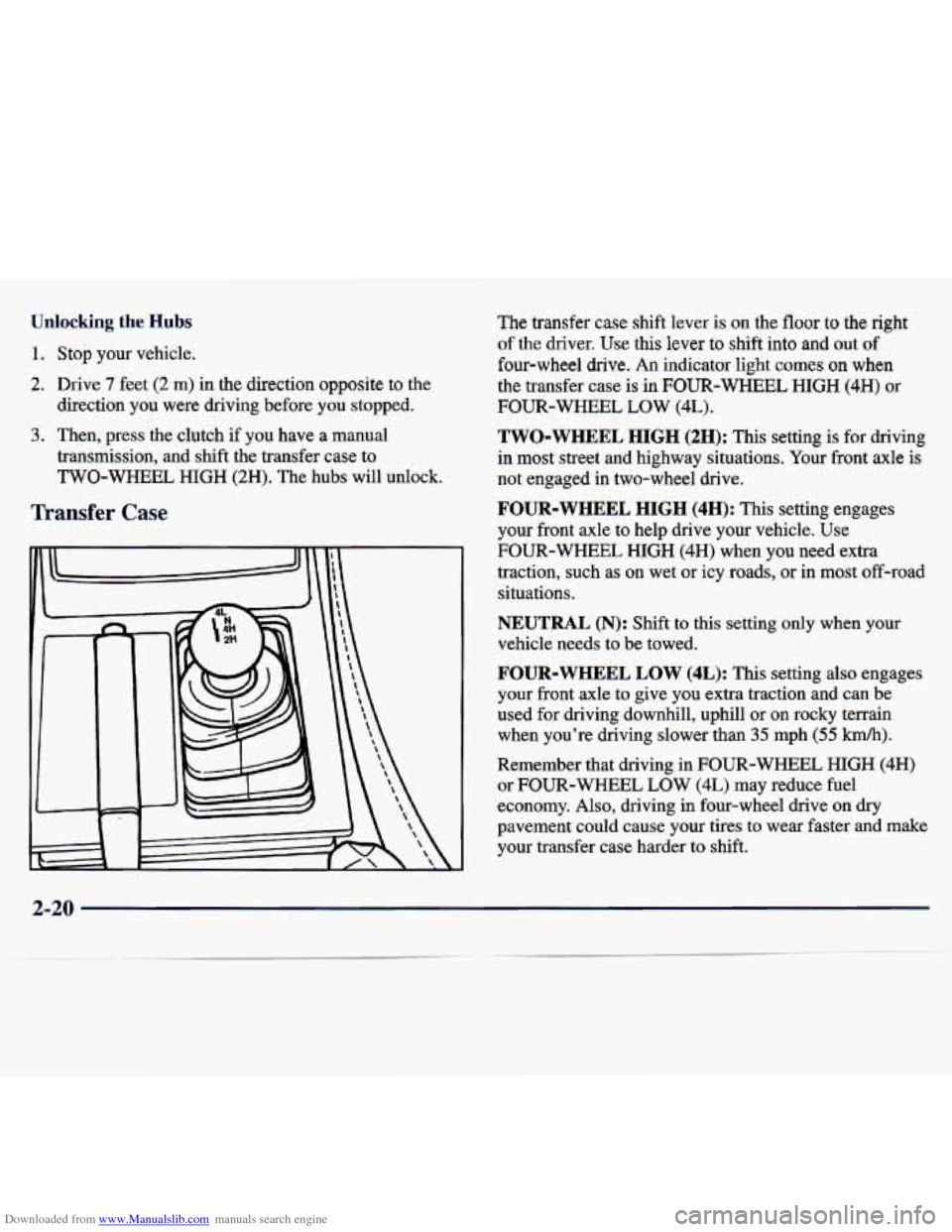
Transfer Case
E
The transfer case shift lever is on the floor to the right
of the driver.
Use this lever to shift into and out of
four-wheel drive.
An indicator light comes on when
the transfer case is in FOUR-WHEEL HIGH (4H) or
FOUR-WHEEL LOW (4L).
TWO-WHEEL HIGH (2H): This setting is for driving
in
most street and highway situations. Your front axle is
not engaged in two-wheel drive.
FOUR-WHEEL HIGH (4H): This setting engages
your front axle to help drive your vehicle. Use
FOUR-WHEEL HIGH (4H) when you need extra
traction, such as on wet or icy roads,
or in most off-road
situations.
NEUTRAL (N): Shift to this setting only when your
vehicle needs to be towed.
FOUR-WHEEL LOW (4L): This setting also engages
your front axle to give you extra traction and can be
used for driving downhill, uphill or on rocky terrain
when you’re driving slower than 35 mph (55
km/h).
Remember that driving in FOUR-WHEEL HIGH (4H)
or FOUR-WHEEL LOW (4L) may reduce fuel
economy. Also, driving in four-wheel drive on
dry
pavement could cause your tires to wear faster and make
your transfer case harder to shift.
2-20
Page 80 of 386
Downloaded from www.Manualslib.com manuals search engine You can shift from TWO-WHEEL HIGH (2H) to
FOUR-WHEEL HIGH
(4H) or from FOUR-WHEEL
HIGH
(4H) to TWO-WHEEL HIGH (2H) at any speed
if your hubs are locked and your wheels are straight
ahead. Your front axle will engage faster if
you take
your foot off the accelerator pedal for a few seconds
as you shift.
Shifting Into or Out of FOUR-WHEEL LOW (4L)
1. Stop your vehicle and shift your transmission to
2. Shift the transfer case in one continuous motion.
NEUTRAL (N).
Parking Brake
Don’t pause in NEUTRAL (N) as you shift into
FOUR-WHEEL HIGH (4H), or your gears could clash.
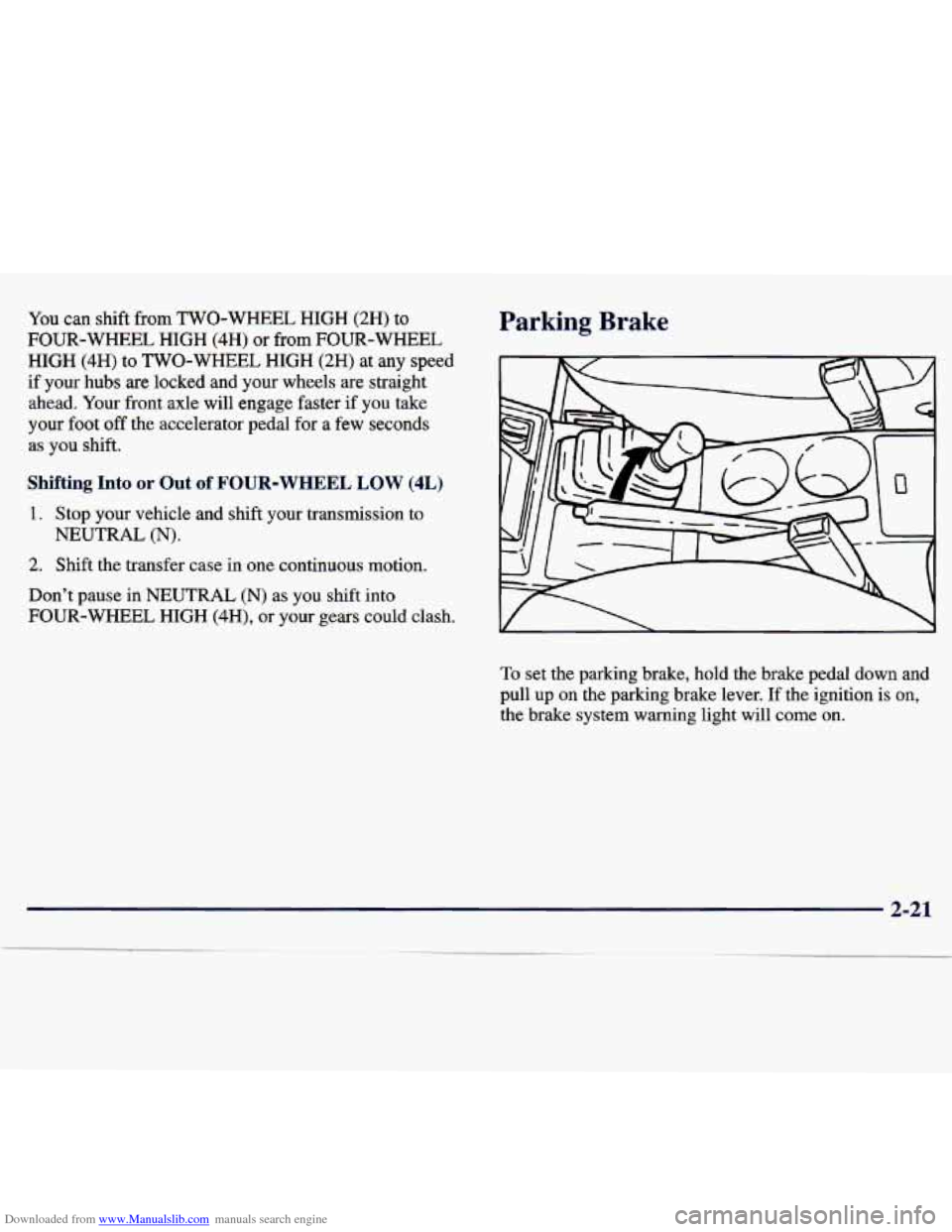
To set the parking brake, hold the brake pedal down and
pull up on the parking brake lever. If the ignition is on,
the brake system warning light will come on.
2-21
Page 82 of 386
![CHEVROLET TRACKER 1998 1.G User Guide Downloaded from www.Manualslib.com manuals search engine Shifting Into PARK (P)
(Automatic Translnission Only)
It can be dz Jerous to get out of you] ehicle if
the shift lever is not full](/img/24/8351/w960_8351-81.png "CHEVROLET TRACKER 1998 1.G User Guide Downloaded from www.Manualslib.com manuals search engine Shifting Into PARK (P)
(Automatic Translnission Only)
It can be dz Jerous to get out of you] ehicle if
the shift lever is not full")
Downloaded from www.Manualslib.com manuals search engine Shifting Into PARK (P)
(Automatic Translnission Only)
It can be dz Jerous to get out of you] ehicle if
the shift lever is not fully in PARK (P) with the
parking brake firmly set. Your vehicle can roll.
If you have left the engine running, the vehicle
can move suddenly. You
or others could be
injured. To be sure your vehicle won’t move, even
when you’re on fairly level ground, use the steps
that follow.
If you have four-wheel drive and
your transfer case
is in NEUTRAL (N), your
vehicle will be free to roll, even if your shift
lever
is in PARK (P). So, be sure the transfer
case
is in a drive gear -0 not in NEUTRAL (N).
If you’re pulling a trailer, see &‘Towing a Trailer”
in the Index.
1. Hold the brake pedal down with your right foot and
set the parking
brake.
2. Move the shift lever into PARK (P) by holding in the
button
on the lever and pushing the lever all the way
toward the front
of your vehicle.
3. If you have four-wheel drive, be sure the transfer
case is in a drive gear
-- not in NEUTRAL (N).
4. Move the key to LOCK.
5. Remove the key and take it with you. If you can
leave your vehicle with the key in your hand, your
vehicle is in
PARK (P).
2-23
Page 83 of 386
Downloaded from www.Manualslib.com manuals search engine Leaving Your Vehicle With the Engine
Running (Automatic Transmission Only)
I
It can be dangerous to leave yuur vehicle with
the engine running.
Your vehicle could move
suddenly
if the shift lever is not fully in PARK (P)
with the parking brake firmly set. If you have
four-wheel drive and your transfer case is in
NEUTRAL (N), your vehicle will be free to roll,
even
if your shift lever is in PARK (P). So be sure
the transfer case is in
a drive gear -- not in
NEUTRAL (N). And, if you leave the vehicle with
the engine running,
it could overheat and even
catch fire.
You or others could be injured. Don’t
leave your vehicle with the engine running unless
you have to.
Torque Lock (Automatic Transmission)
If you are parking on a hill and you don’t shift your
transmission into PARK (P) properly, the weight of the
vehicle may put too much force on the parking pawl
in
the transmission. You may find it difficult to pull the
shift lever out of PARK (P). This is called “torque lock.”
To prevent torque lock, set the parking brake and then
shift into PARK (P) properly before you leave the
driver’s seat.
To find out how, see “Shifting Into
PARK (P)” in the Index.
When you are ready to
drive, move the shift lever out
of PARK (P) before you release the parking brake.
If torque lock does occur, you may need to have another
vehicle push yours a little uphill
to take some of the
pressure from the parking pawl in the transmission,
so
you can pull the shift lever out of PARK (P).
2-24