instrument panel CHEVROLET TRACKER 1998 1.G Owner's Manual
[x] Cancel search | Manufacturer: CHEVROLET, Model Year: 1998, Model line: TRACKER, Model: CHEVROLET TRACKER 1998 1.GPages: 386, PDF Size: 21.17 MB
Page 118 of 386
Downloaded from www.Manualslib.com manuals search engine Air Bag Readiness Light
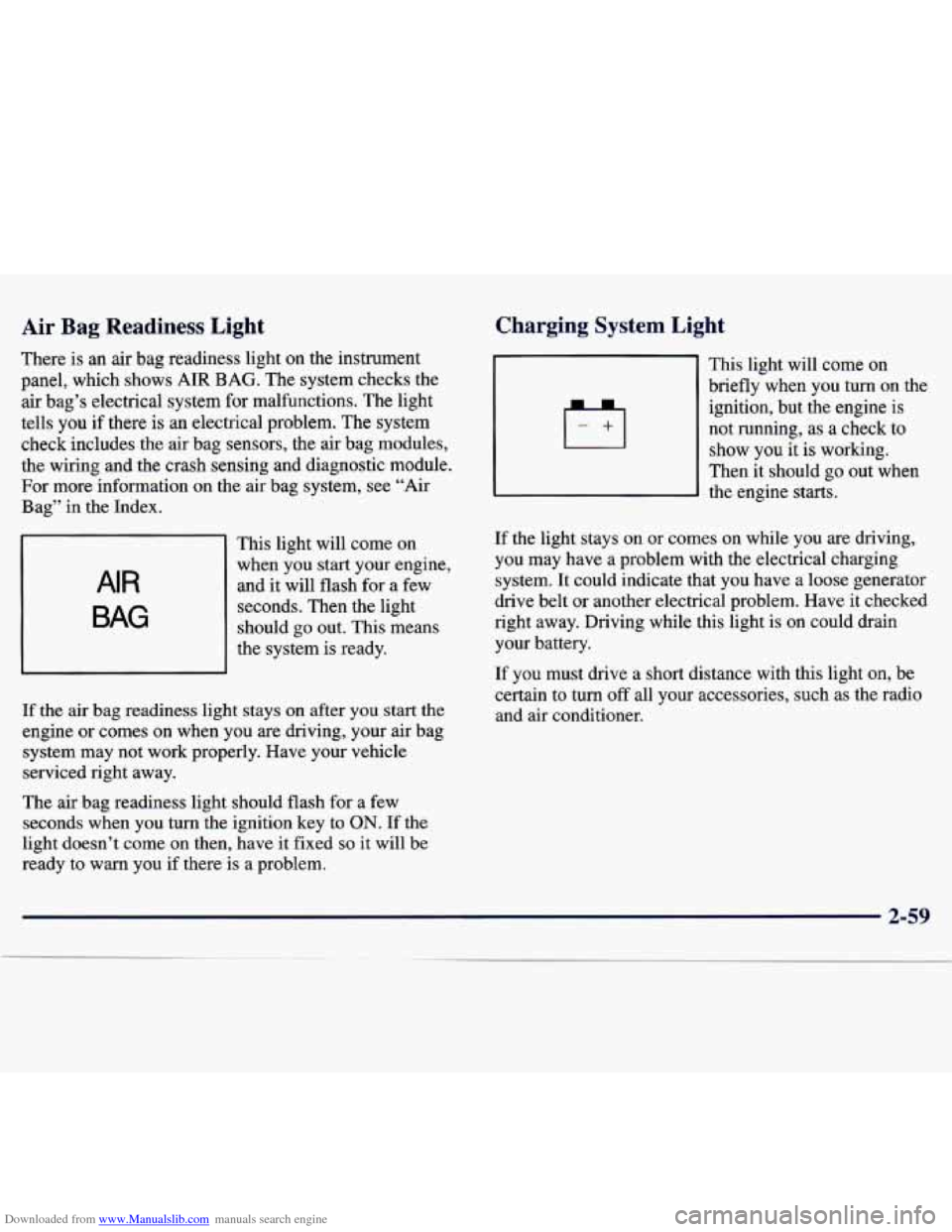
There is an air bag readiness light on the instrument
panel, which shows
AIR BAG. The system checks the
air bag’s electrical system for malfunctions. The light
tells you if there is an electrical problem. The system
check includes the air bag sensors, the air bag modules,
the wiring and the crash sensing and diagnostic module.
For more information on the air bag system, see “Air
Bag” in the Index.
AIR
BAG
This light will come on
when you start your engine,
and it will flash for a few
seconds. Then the light
should
go out. This means
the system is ready.
If
the air bag readiness light stays on after you start the
engine or comes on when you are driving, your air bag
system may not work properly. Have your vehicle
serviced right away.
The air bag readiness light should flash for a few
seconds when you turn the ignition key to
ON. If the
light doesn’t come on then, have it fixed
so it will be
ready
to warn you if there is a problem.
Charging System Light
This light will come on
briefly when you turn on the
ignition, but the engine
is
not running, as a check to
show you it is working.
Then it should go out when
the engine starts.
If the light stays on or comes on while you are driving,
you may have a problem with the electrical charging
system. It could indicate that you have a loose generator
drive belt or another electrical problem. Have it checked
right away. Driving while this light is on could drain
your battery.
If you must drive a short distance with this light
on, be
certain to
turn off all your accessories, such as the radio
and air conditioner.
2-59
- .. ~
Page 129 of 386
Downloaded from www.Manualslib.com manuals search engine Comfort Controls
With this system, you can control the heating and
ventilation in your vehicle.
If you have the air
conditioning option, you can also control cooling.
Your vehicle also has the flow-through ventilation
system described later in this section.
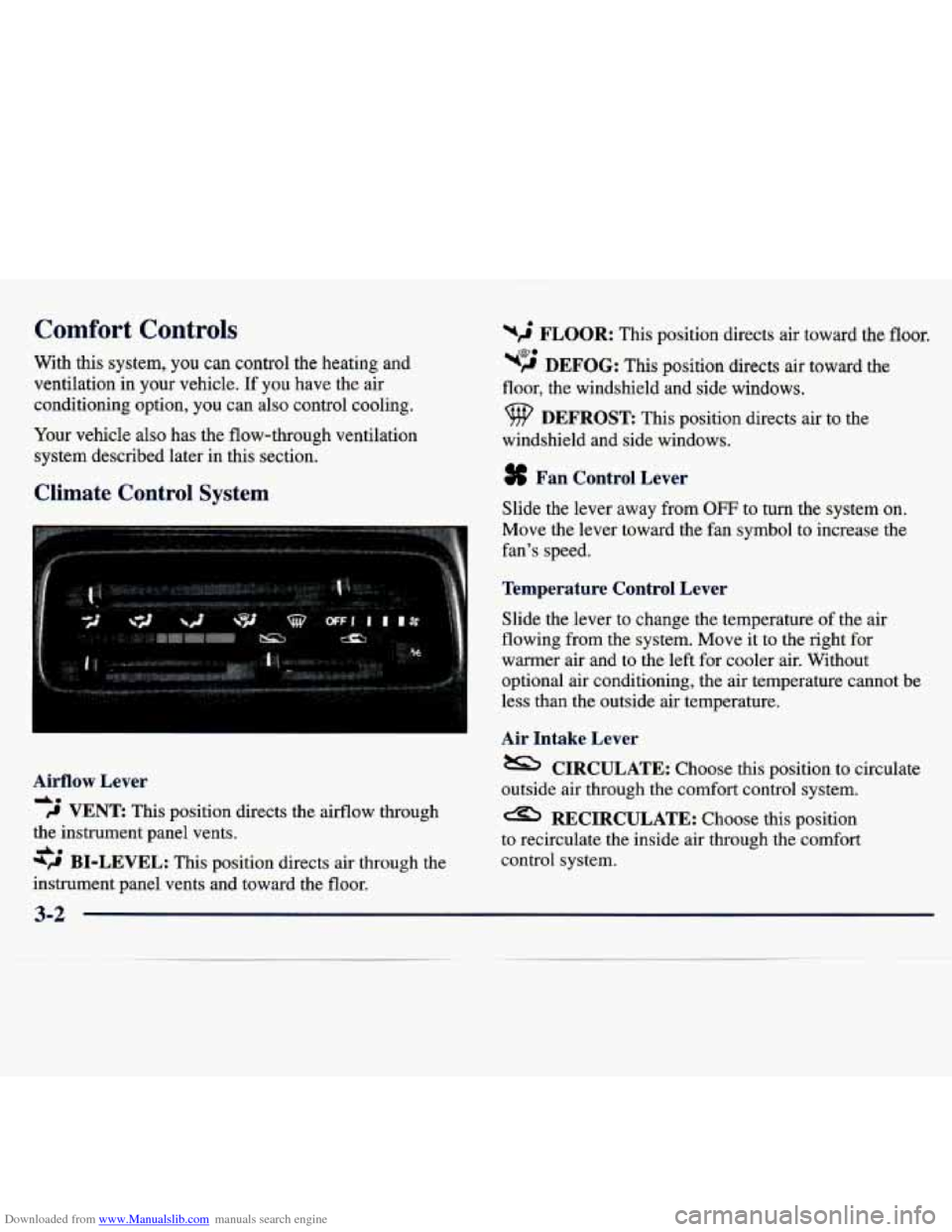
Climate Control System
Airflow Lever
dm
9 VENT This position directs the airflow through
the instrument panel vents.
*P BI-LEVEL: This position directs air through the
instrument panel vents and toward the floor.
A.
wJ FLOOR: This position directs air toward the floor.
w? DEFOG: This position directs air toward the
floor, the windshield and side windows.
DEFROST This position directs air to the
windshield and side windows.
Fan Control Lever
Slide the lever away from OFF to turn the system on.
Move the lever toward the fan symbol to increase the
fan’s speed.
Temperature Control Lever
Slide the lever to change the temperature of the air
flowing from the system. Move it to the right for
warmer air and to the left for cooler air. Without
optional air conditioning, the air temperature cannot be
less than the outside air temperature.
Air Intake Lever
CIRCULATE:
Choose this position to circulate
outside air through the comfort control system.
a RECIRCULATE: Choose this position
to recirculate the inside air through the
comfort
control system.
3-2
Page 152 of 386
Downloaded from www.Manualslib.com manuals search engine Avoid needless heavy braking. Some people drive in
spurts
-- heavy acceleration followed by heavy
braking
-- rather than keeping pace with traffic. This is a
mistake. Your brakes may not have time to cool between
hard stops.
Your brakes will wear out much faster if you
do a lot of heavy braking.
If you keep pace with the
traffic and allow realistic following distances, you will
eliminate a lot of unnecessary braking. That means
better braking and longer brake life.
If your engine ever stops while you’re driving, brake
normally but don’t pump your brakes. If you do, the
pedal may get harder to push down. If your engine
stops, you will still have some power brake assist. But
you will
use it when you brake. Once the power assist is
used up, it may take longer to stop and the brake pedal
will be harder to push.
Anti-Lock Brakes (Option)
Your vehicle may have anti-lock brakes (ABS). ABS is
an advanced electronic braking system that will help
prevent a braking skid.
ABS
If your vehicle has anti-lock
brakes, this warning light on
the instrument panel will
come on briefly when you
start your vehicle.
When you start your engine, or when you begin to drive away, your anti-lock brake system will check
itself. You
may hear a momentary motor or clicking noise while
this test is going on, and you may even notice that your
brake pedal moves or pulses a little. This is normal.
If there’s
a problem with the anti-lock brake system, the
anti-lock brake system warning light will stay on or
flash. See “Anti-Lock Brake System Warning Light” in
the Index.
4-7
Page 199 of 386
Downloaded from www.Manualslib.com manuals search engine lbrn Signals When Towing a nailer
When you tow a trailer, your vehicle has to have extra
wiring (included in the optional trailering package).
The arrows on your instrument panel will flash
whenever you signal a
turn or lane change. Properly
hooked up, the trailer lamps will also flash, telling other
drivers you’re about to turn, change lanes or stop.
When towing a trailer, the arrows on your instrument
panel will flash for
turns even if the bulbs on the trailer
are burned out. Thus, you may think drivers behind you
are seeing your signal when they
are not. It’s important
to check occasionally to be sure the trailer bulbs are still working.
Driving On Grades
Reduce speed and shift to a lower gear before you start
down a long or steep downgrade.
If you don’t shift
down, you might have to use your brakes
so much that
they would get hot and no longer work well.
On a long uphill grade, shift down and reduce your
speed to around
45 mph (70 km/h) to reduce the
possibility of engine and transmission overheating.
If
you are towing a trailer and you have a manual
transmission with
FIFTH (5) gear, you may prefer not to
use FIFTH
(5). Just drive in FOURTH (4) (or, as you
need to, a lower gear).
4-54
Page 213 of 386
Downloaded from www.Manualslib.com manuals search engine I I I /
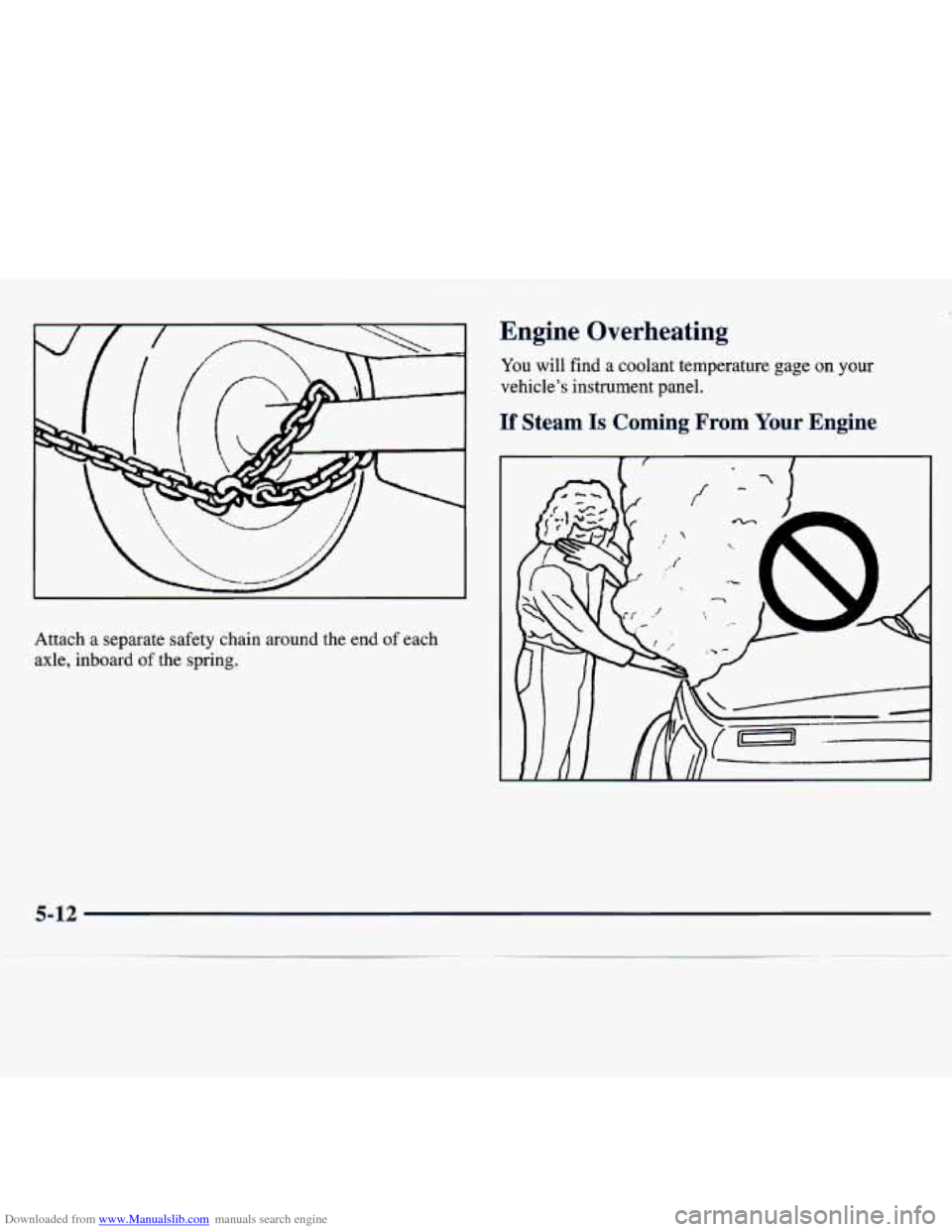
Attach a separate safety chain around the end
of each
axle, inboard of the spring.
Engine Overheating
You will find a coolant temperature gage on your
vehicle’s instrument panel.
If Steam Is Coming From Your Engine
5-12
Page 241 of 386

Downloaded from www.Manualslib.com manuals search engine If your vehicle is certified to meet California Emission
Standards (indicated on the underhood emission control
label), it is designed to operate on fuels that meet
California specifications. If such fuels are not available
in states adopting California emissions standards, your
vehicle will operate satisfactorily on fuels meeting
federal specifications, but emission control system
performance may be affected. The malfunction indicator lamp on your instrument panel may turn on and/or your
vehicle may fail a smog-check test. If this occurs, return
to your authorized Chevrolet dealer for diagnosis to determine the cause of failure.
In the event it is
determined that the cause of the condition is the type of
fuels used, repairs may not
be covered by your warranty.
Some gasolines that are not reformulated for low
emissions contain an octane-enhancing additive called
methylcyclopentadienyl manganese tricarbonyl (MMT); ask your service station operator whether or not his fuel
contains
MMT. General Motors does not recommend the
use of such gasolines. If fuels containing MMT are used,
spark plug life may be reduced and your emission
control system performance may be affected. The
malfunction indicator lamp on your instrument panel
may turn on.
If this occurs, return to your authorized
Chevrolet dealer for service.
To provide cleaner air, all gasolines in the United States
are now required to contain additives that will help
prevent deposits from forming in your engine and fuel
system, allowing your emission control system
to
function properly. Therefore, you should not have to
add anything to the fuel. In addition, gasolines
containing oxygenates, such as ethers and ethanol, and
reformulated gasolines may be available in your area to
help clean the air. General Motors recommends that you
use these gasolines
if they comply with the
specifications described earlier.
NOTICE:
Your vehicle was not designed for fuel that
contains methanol. Don’t use it. It can corrode
metal parts in your fuel system and
also damage
plastic and rubber parts. That damage wouldn’t
be covered under your warranty.
6-4
Page 248 of 386
Downloaded from www.Manualslib.com manuals search engine Then lift the hood to relieve pressure on the hood prop.
Remove the hood prop from the slot in the hood and
return the prop to its retainer. Then let the hood down
and close it firmly.
Engine Oil
If the engine oil pressure
light
on the instrument
panel comes on,
it means
you need to check your
engine oil level right away.
For more information, see “Engine Oil Pressure Light”
in the Index.
You should check your engine oil level
regularly; this is an added reminder.
It’s
a good idea to check your engine oil every time you
get fuel. In order to get an accurate reading, the oil must
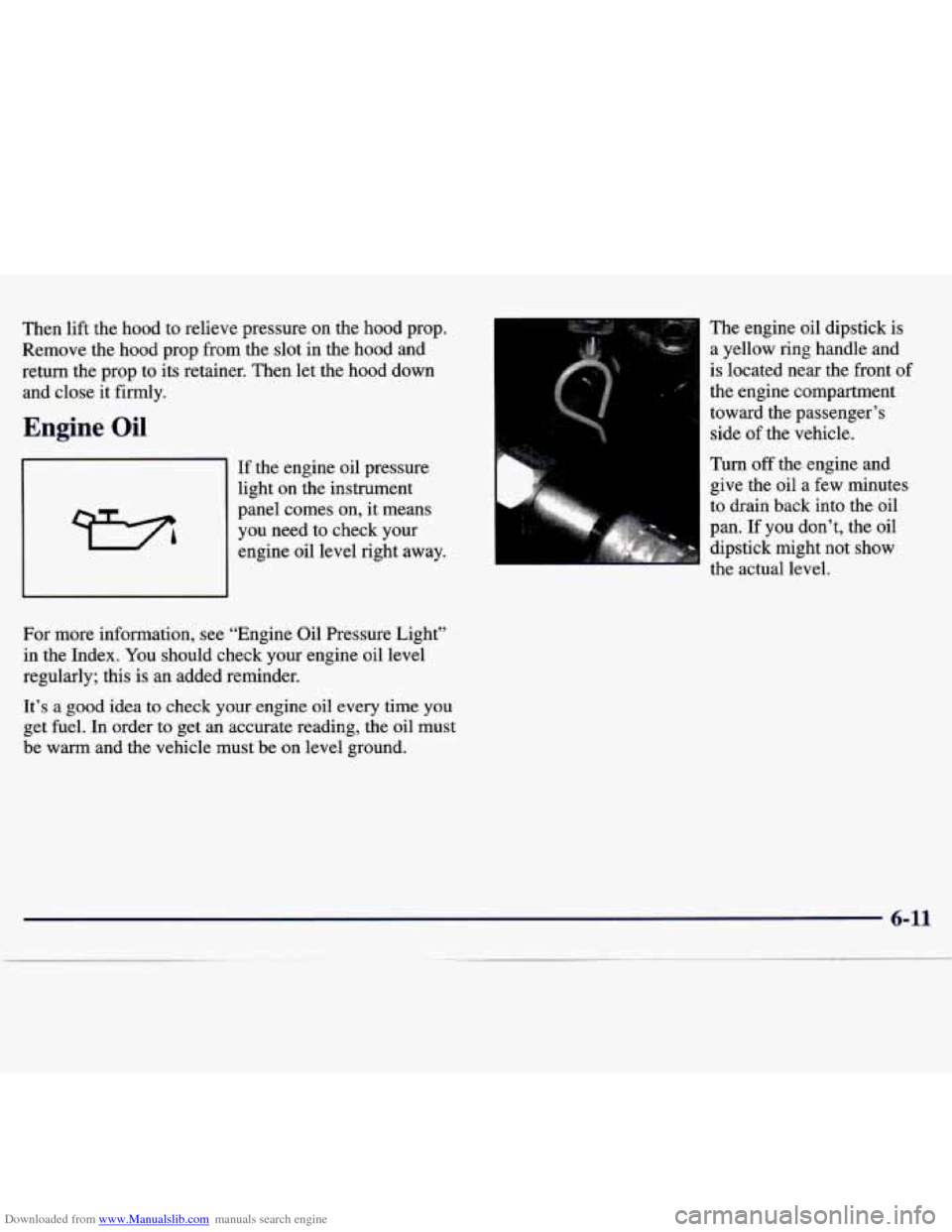
be warm and the vehicle must be on level ground. The engine
oil dipstick is
a yellow ring handle and
is located near the front
of
the engine compartment
toward the passenger’s side
of the vehicle.
Turn
off the engine and
give the oil a few minutes
to drain back into the oil
pan. If you don’t, the oil dipstick might not show
the actual level.
Page 287 of 386
Downloaded from www.Manualslib.com manuals search engine Special Fabric Cleaning Pr-+ms
Stains caused by such things as catsup, coffee (black),
egg, fruit, fruit juice, milk, soft
drinks, vomit, urine and
blood can be removed as follows:
1. Carefully scrape off excess stain, then sponge the
soiled area with cool water.
2. If a stain remains, follow the multi-purpose interior
cleaner instructions described earlier.
3. If an odor lingers after cleaning vomit
or urine,
treat the area with a waterhaking soda solution:
1 teaspoon
(5 ml) of baking soda to 1 cup (250 ml)
of lukewarm water.
4. Let dry.
Stains caused by candy, ice cream, mayonnaise, chili
sauce and unknown stains can be removed as follows:
1. Carefully scrape off excess stain.
2. First, clean with cool water and allow to
dry completely.
3. If a stain remains, follow instructions for
Multi-Purpose Interior Cleaner.
Fabric Protection
Your vehicle has upholstery that has been treated with
Scotchgard Fabric Protector, a
3M product. It protects
fabrics by repelling oil and water, which
are the carriers
of most stains. Even with this protection, you still need
to clean your upholstery often to keep
it looking new.
Further information on cleaning is available by calling 1-800-433-3296 (in Minnesota, 1-800-642-6167).
Cleaning Vinyl
Use warm water and a clean cloth.
0 Rub with a clean, damp cloth to remove dirt. You
may have to do it more than once.
Things like tar, asphalt and shoe polish will stain
if you don't get them off quickly. Use a clean cloth
and a vinyueather cleaner. See your dealer for
this product.
Cleaning the Top of the Instrument Panel
Use only mild soap and water to clean the top surfaces
of the instrument panel. Sprays containing silicones
or
waxes may cause annoying reflections in the windshield
and even make it difficult to see through the windshield
under certain conditions.
6-50
Page 293 of 386
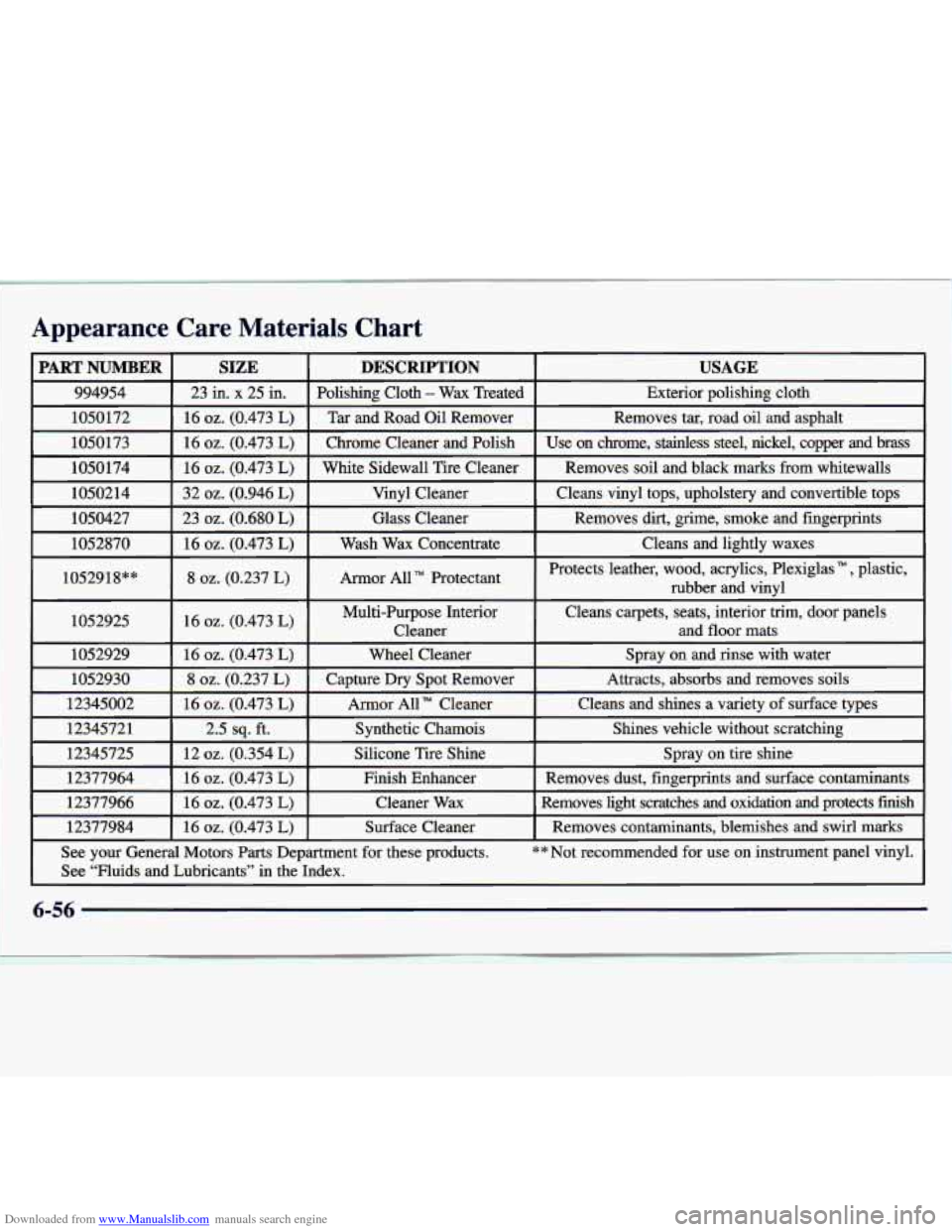
Downloaded from www.Manualslib.com manuals search engine Appearance Care Materials Chart
PART NUMBER SIZE
DESCRIPTION USAGE
~~
994954 23 in. x 25 in. Polishing Cloth - Wax Treated Exterior polishing cloth
~~
1050172 16 oz. (0.473 L) Tar and Road Oil Remover Removes tar, road oil an\
d asDhalt
1050173 16
oz. (0.473 L) Chrome Cleaner and Polish Use on chrome, stainless steel, nickel, copper and bras7
1050174
16 oz. (0.473 L) White Sidewall Tire Cleaner Removes soil and black marks from whitewalls
1050214 32
oz. (0.946 L) Vinyl Cleaner Cleans vinyl tops, upholstery and convertible tops
1050427 23
oz. (0.680 L) Glass Cleaner Removes dirt, grime, smoke and fingerprints
1052870 16
oz. (0.473 L) Wash Wax Concentrate Cleans and lightly waxes
I 1052918"" I 8 oz. (0.237 L) I Armor
All" Protectant I
Protects leather, wood, acrylics, Plexiglas " , plastic,
rubber and vinvl
I
1052925 16 oz. (0.473 L)
1052929 16 oz. (0.473 L) Wheel Cleaner Spray on and rinse with water
Multi-Purpose Interior Cleans carpets, seats, interior trim, door\
panels
Cleaner and floor mats I I I
I 1052930 I 8 oz. (0.237 L) I Capture Dry Spot Remover I Attracts, absorbs and removes soils I
--
I
I I A ..L I
12345002 I 16 oz. (0.473 L) I Armor All TM Cleaner I Cleans and shines a variety of surface types I I I
I 1234572 1 I 2.5 sq. ft. I Synthetic Chamois I Shines vehicle without scratching;
--
I I I
I 12345725 I 12 oz. (0.354 L) I Silicone Tire Shine I Spray on tire shine I
v
I I I
I 12377964 I 16 oz. (0.473 L) I Finish Enhancer I Removes dust, fingerprints and surface contaminants I
--
12377966 16 oz. (0.473 L) Cleaner Wax Removes light scratches and oxidation and protects finish
12377984 16
oz. (0.473 L) Surface Cleaner Removes contaminants, blemishes and swirl marks
See your General Motors
Parts Department for these products. ** Not recommended for use on instrument panel vinyl.
See
"Fluids and Lubricants" in the Index. __ -_ _ - c
6-56
Page 294 of 386
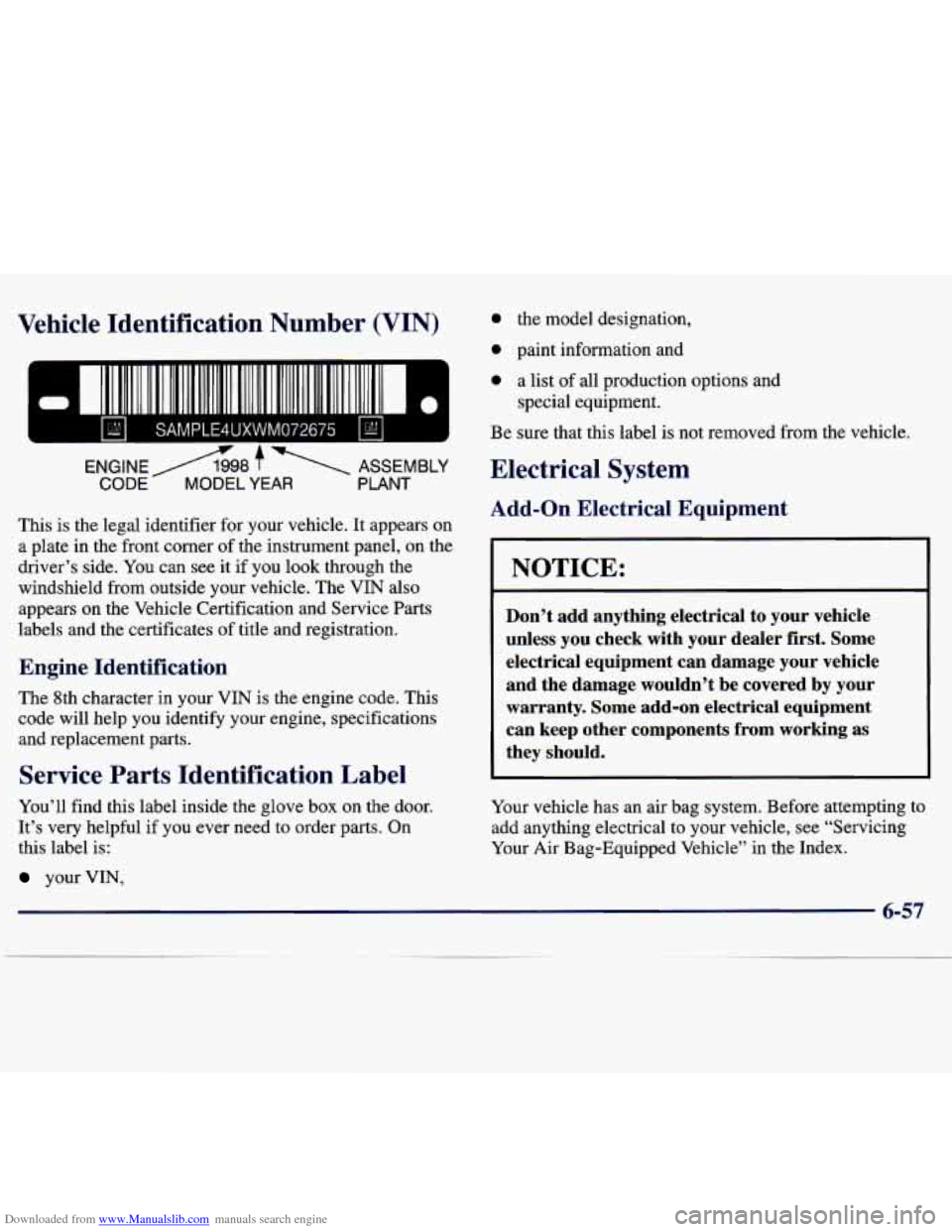
Downloaded from www.Manualslib.com manuals search engine Vehicle Identification Number (VIN)
ENGlNEA98 f ASSEMBLY
CODE MODEL YEAR PLANT
This is the legal identifier for your vehicle. It appears on
a plate in the front corner of the instrument panel, on the
driver’s side. You can see it if
you look through the
windshield from outside your vehicle. The VIN also
appears on the Vehicle Certification and Service Parts
labels and the certificates of title and registration.
Engine Identification
The 8th character in your VIN is the engine code. This
code will help you identify your engine, specifications
and replacement parts.
Service Parts Identification Label
You’ll find this label inside the glove box on the door.
It’s very helpful if you ever need to order parts. On
this label is:
your VIN,
0 the model designation,
0 paint information and
0 a list of all production options and
special equipment.
Be sure that this label
is not removed from the vehicle.
Electrical System
Add-on Electrical Equipment
I NOTICE:
-
Don’t add anything electrical to your vehicle
unless you check with your dealer first. Some
electrical equipment can damage
your vehicle
and the damage wouldn’t be covered by your warranty. Some add-on electrical equipment
can keep other components from working as
they should.
Your vehicle has an air bag system. Before attempting to
add anything electrical to your vehicle, see “Servicing
Your Air Bag-Equipped Vehicle” in
the Index.
6-57