brake CHEVROLET TRACKER 1998 1.G Repair Manual
[x] Cancel search | Manufacturer: CHEVROLET, Model Year: 1998, Model line: TRACKER, Model: CHEVROLET TRACKER 1998 1.GPages: 386, PDF Size: 21.17 MB
Page 266 of 386
Downloaded from www.Manualslib.com manuals search engine NOTICE:
0
0
0
0
When using concentrated washer fluid,
follow the manufacturer’s instructions for
adding water.
Don’t mix water with ready-to-use wasner
fluid. Water can cause the solution to freeze and damage your washer fluid tank and
other parts of the washer system. Also,
water doesn’t clean
as well as washer fluid.
Fill your washer fluid tank only
three-quarters full when it’s very cold. This
allows for expansion
if freezing occurs,
which could damage the tank if it is
completely
full.
Don’t use engine coolant (antifreeze) in
your windshield washer. It can damage
your washer system and paint.
Brakes
Brake Fluid
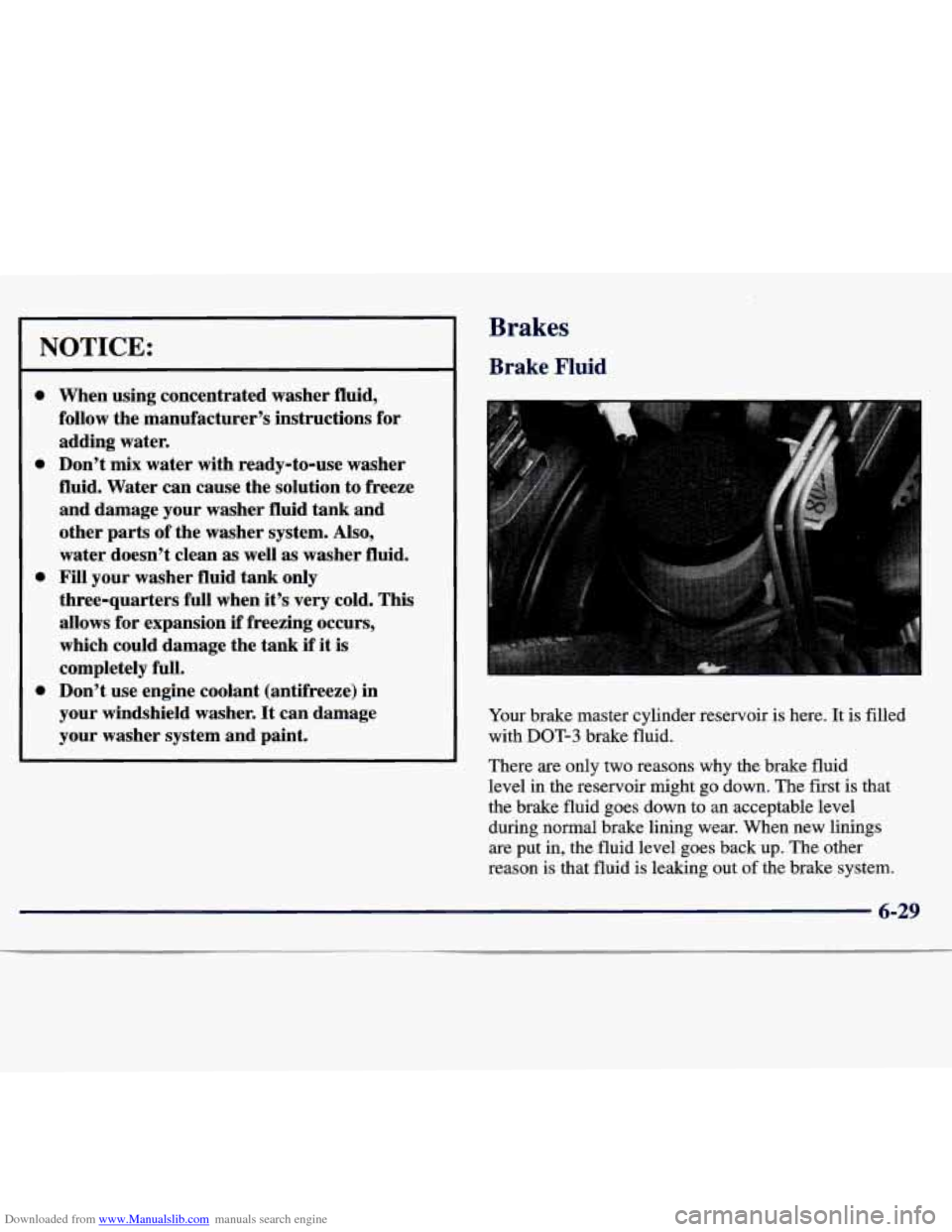
Your brake master cylinder reservoir is here. It is filled
with DOT-3 brake fluid.
There are only two reasons why the brake fluid
level in the reservoir might go down. The first is that
the brake fluid goes down to an acceptable level
during normal brake lining wear. When new linings
are put in, the fluid level goes back up. The other
reason
is that fluid is leaking out of the brake system.
Page 267 of 386
Downloaded from www.Manualslib.com manuals search engine If it is, you should have your brake system fixed, since a Checking Brake Fluid
leak means that sooner or later your brakes won’t work
well, or won’t work at all.
So, it isn’t a good idea to “top off’ your brake fluid.
Adding brake fluid won’t correct a leak.
If you add fluid
when your linings
are worn, then you’ll have too much
fluid when you get new brake linings. You should add
(or remove) brake fluid, as necessary,
only when work
is done on the brake hydraulic system.
If you have too much brake fluid, it can spill on
the engine. The fluid will burn
if the engine is
hot enough. You or others could be burned,
and your vehicle could be damaged. Add brake
fluid only when work is done on the brake
hydraulic system.
Refer to the Maintenance Schedule to determine when to
check your brake fluid. See “Periodic Maintenance
Inspections” in the Index.
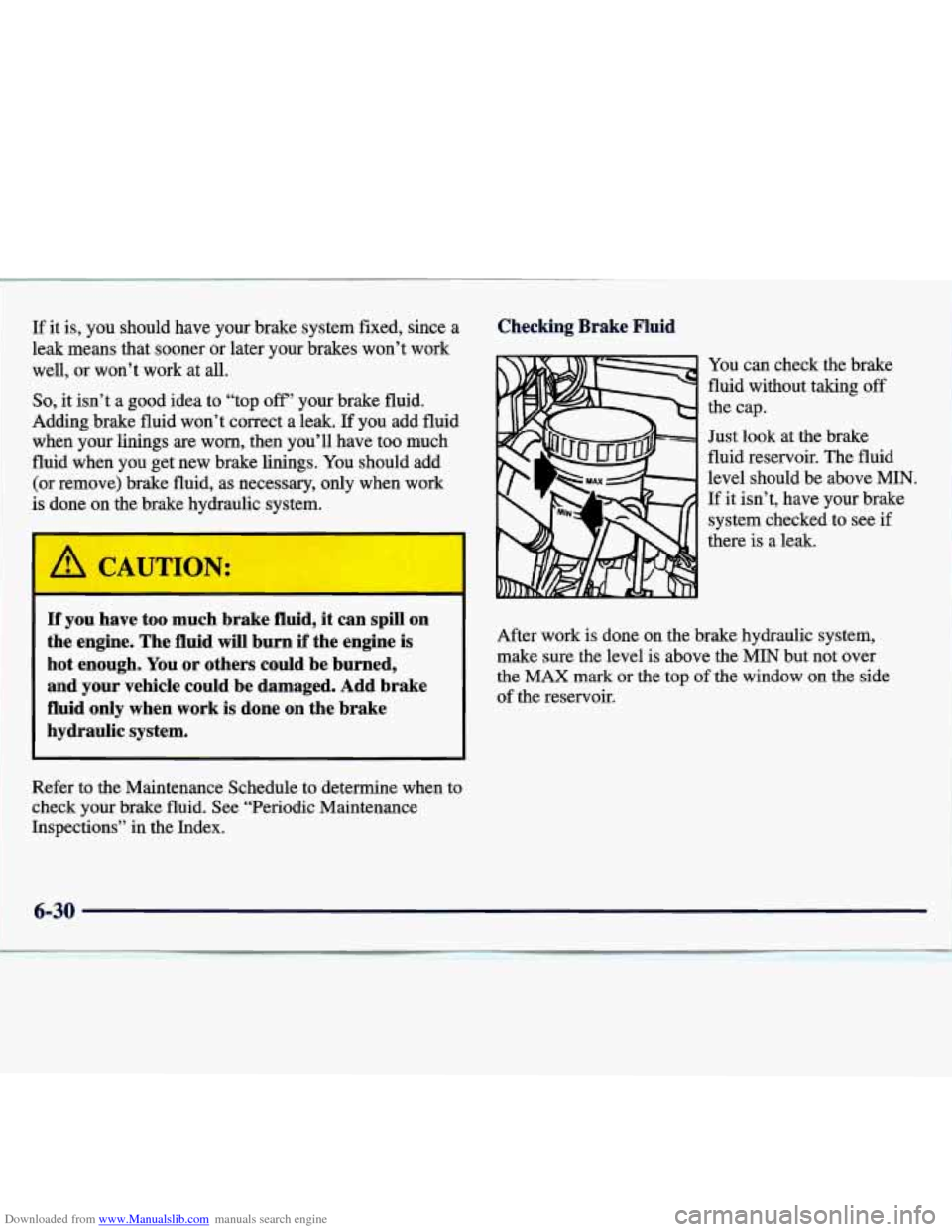
You can check the brake
fluid without taking
off
the cap.
Just look at the brake
fluid reservoir. The fluid level should be above MIN.
If it isn’t, have your brake
system checked to see
if
there is a leak.
After work is done
on the brake hydraulic system,
make sure the level is above the MIN but not over
the
MAX mark or the top of the window on the side
of the reservoir.
6-30
Page 268 of 386
Downloaded from www.Manualslib.com manuals search engine What to Add
When you do need brake fluid, use only DOT-3
brake fluid
-- such as Delco Supreme 11 @ (GM Part
No. 12377967). Use new brake fluid from a sealed
container only.
Always clean the brake fluid reservoir cap and the area
around the cap before removing it. This will help keep
dirt from entering the reservoir.
I
With the wrong kind of fluid in your brake
system, your brakes may not work well, or they
may not even work at
all. This could cause a
crash. Always use the proper brake fluid.
NOTICE:
0
0
Using the wrong fluid can badly damage
brake system parts. For example, just
a few
drops of mineral-based oil, such as engine
oil, in your brake system
can damage brake
system parts
so badly that they’ll have to be
replaced. Don’t let someone put in the
wrong kind of fluid.
If you spill brake fluid on your vehicle’s
painted surfaces, the paint finish can be
damaged. Be careful not
to spill brake fluid
on your vehicle.
If you do, wash it off
immediately. See “Appearance Care” in
the Index.
6-31
-
Page 269 of 386
Downloaded from www.Manualslib.com manuals search engine Brake Wear
Your vehicle has front disc brakes and rear drum brakes.
Disc brake pads have built-in wear indicators that
make a high-pitched warning sound when the brake
pads are worn and new pads are needed. The sound
may come and go or be heard all the time your vehicle
is moving (except when you are pushing on the brake
pedal firmly).
The brake wear warning sound means that soon
your brakes won’t work well. That could lead to
an accident. When you hear the brake wear
warning sound, have your vehicle serviced.
NOTICE:
Continuing to drive with worn-out brake pads
could result in costly brake repair.
Some driving conditions or climates may cause a
brake squeal when the brakes are first applied
or
lightly applied. This does not mean something is
wrong with your brakes.
Properly torqued wheel nuts are necessary to help
prevent brake pulsation. When tires are rotated, inspect
brake pads for wear and evenly torque wheel nuts in
the proper sequence to
GM specifications.
Your rear drum brakes don’t have wear indicators,
but if you ever hear a rear brake rubbing noise, have the
rear brake linings inspected immediately. Also, the rear
brake drums should be removed and inspected each time
the tires are removed for rotation or changing. When
you have the front brake pads replaced, have the rear
brakes inspected, too.
Brake linings should always be replaced as complete
axle sets.
See “Brake System Inspection” in Section
7 of this
manual under Part C “Periodic Maintenance Inspections.”
Brake Pedal Travel
See your dealer if the brake pedal does not return to
normal height, or if there is a rapid increase in pedal
travel. This could be a sign
of brake trouble.
6-32
Page 270 of 386
Downloaded from www.Manualslib.com manuals search engine Brake Adjustment
Every time you make a brake stop, your disc brakes
adjust for wear.
Replacing Brake System Parts
The braking system on a modern vehicle is complex.
Its many parts have to be of top
quality and work well
together
if the vehicle is to have really good braking. Your
vehicle was designed and tested with top-quality
GM
brake parts. When you replace parts of your braking
system
-- for example, when your brake linings wear
down and you have to have new ones put
in -- be sure you
get new approved
GM replacement parts. If you don’t,
your brakes may no longer work properly. For example, if someone puts in brake linings that are wrong for your
vehicle, the balance between your front and rear brakes
can change
-- for the worse. The braking performance
you’ve come to expect can change
in many other ways
if someone puts in the wrong replacement brake parts.
Battery
Every new Chevrolet has an ACDelco Freedom@ battery. You never have to add water to one of these. When it’s
time for a new battery, we recommend an ACDelco
Freedom battery. Get one that has the replacement number shown on the original battery’s label.
Vehicle Storage
If you’re not going to drive your vehicle for 25 days
or more, remove the black, negative
(-) cable from
the battery. This will help keep your battery from
running down.
Batteries have acid that can burn you and gas
that can explode. You can be badly hurt if you
aren’t careful. See “Jump Starting’’ in the Index
for tips on working around a battery without
getting hurt.
Contact your dealer to learn how to prepare your vehicle
for longer storage periods.
Page 284 of 386
Downloaded from www.Manualslib.com manuals search engine ,A CAUTION:
Using the wrong replacement wheels, wheel
bolts or wheel nuts on your vehicle can be
dangerous. It could affect the braking and
handling of your vehicle, make your tires lose
air and make you lose control. You could have
a collision in which you or others could be
injured. Always use the correct wheel, wheel
bolts and wheel nuts for replacement.
NOTICE:
The wrong wheel can also cause problems with
bearing
life, brake cooling, speedometer or
odometer calibration, headlamp aim, bumper
height, vehicle ground clearance and
tire or tire
chain clearance to the body and chassis.
See “Changing a Flat Tire” in the Index for
more information.
Used Replacement Wheels
L A CAUTION:
Putting a used wheel on your vehicle is
dangerous. You can’t know how it’s been used
or
how far it’s been driven. It could fail suddenly
and cause an accident.
If you have to replace a
wheel, use a new GM original equipment wheel.
Tire Chains
NOTICE:
Use tire chains only where legal and only
when you must. Use only SAE Class “S” type
chains that are the proper size for your tires.
Install them on the tires of the drive axle
(four-wheel-drive vehicles can use chains
on both axles).
NOTICE: (Continued)
6-47
Page 297 of 386
Downloaded from www.Manualslib.com manuals search engine 1
Main Fuse Block
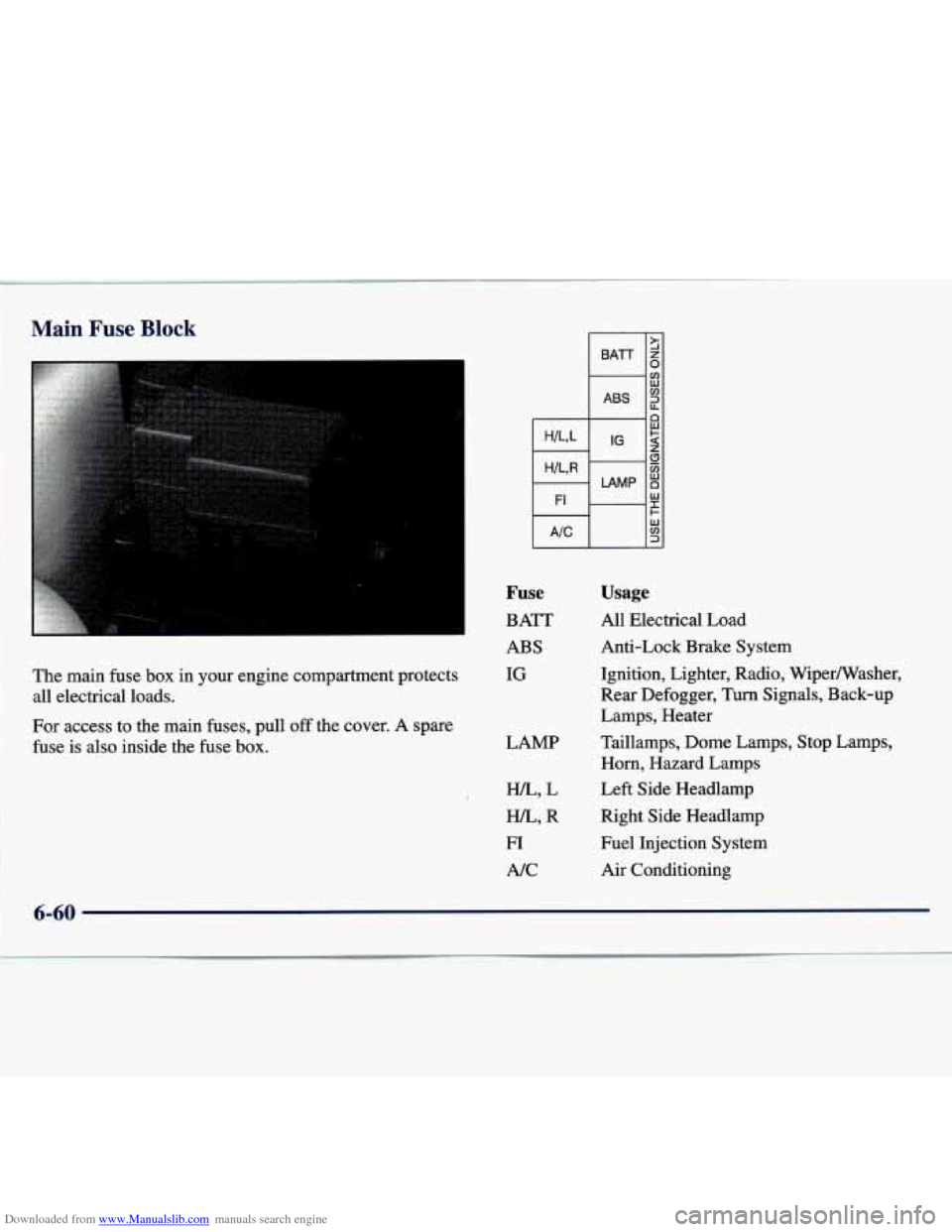
The main fuse box in your engine compartment protects
all electrical loads.
For access to the main fuses, pull
off the cover. A spare
fuse is also inside the fuse
box.
Fuse
BATT
ABS
IG
LAMP
Usage
All Electrical Load
Anti-Lock Brake System
Ignition, Lighter, Radio, WiperNasher,
Rear Defogger,
Turn Signals, Back-up
Lamps, Heater
Taillamps, Dome
Lamp, Stop Lamps,
Horn, Hazard Lamps
Left Side Headlamp
Right Side Headlamp
Fuel Injection System
Air Conditioning
6-60
Page 308 of 386
Downloaded from www.Manualslib.com manuals search engine Maintenance Schedule
I 1
I Short Trip/City Definition
Follow the Short Trip/City Maintenance Schedule if
any one of these conditions is true for your vehicle:
Most trips are less than 5 to 10 miles (8 to 16 km).
This is particularly important when outside
temperatures are below freezing.
driving in stop-and-go traffic).
of your vehicle. or other commercial application.
Most trips include extensive idling (such as frequent
You frequently tow a trailer or use a carrier on top
If the vehicle is used for delivery service, police, taxi
One of the reasons you should follow this schedule
if you operate your vehicle under any of these
conditions is that these conditions cause engine
oil to break down soonex
I Short Trip/City Intervals
Every 3,000 Miles (5 000 km): Engine Oil and
Filter Change (or
3 months, whichever occurs first).
Free-Wheeling
Hubs Inspection (if equipped)
(or
3 months, whichever occurs first).
Every 6,000 Miles (10 000 km): Tire Rotation.
Every 15,000 Miles (25 000 km): Air Cleaner Filter
Inspection,
if driving in dusty conditions. Front
Wheel Bearing Repack
(2WD only) (or at each
brake relining, whichever occurs first). Automatic
Transmission Service (severe conditions only).
Manual Transmission Fluid Change. Transfer Case
Fluid Change. Differential Fluid Change. Engine Idle
Speed Check. Valve Lash (Clearance) Adjustment.
Propeller Shafts and U-Joints Inspection (or every
15 months, whichever occurs fist).
Every 30,000 Miles (50 000 km): Air Cleaner Filter
Replacement. Spark Plug Replacement. Engine
Accessory Drive Belt Inspection (or every
24 months,
whichever occurs first). Cooling System Service
(or every
30 months, whichever occurs first). Fuel
Filter Replacement (or every
30 months, whichever
occurs first).
(Continued)
Page 309 of 386
Downloaded from www.Manualslib.com manuals search engine Maintenance Schedule
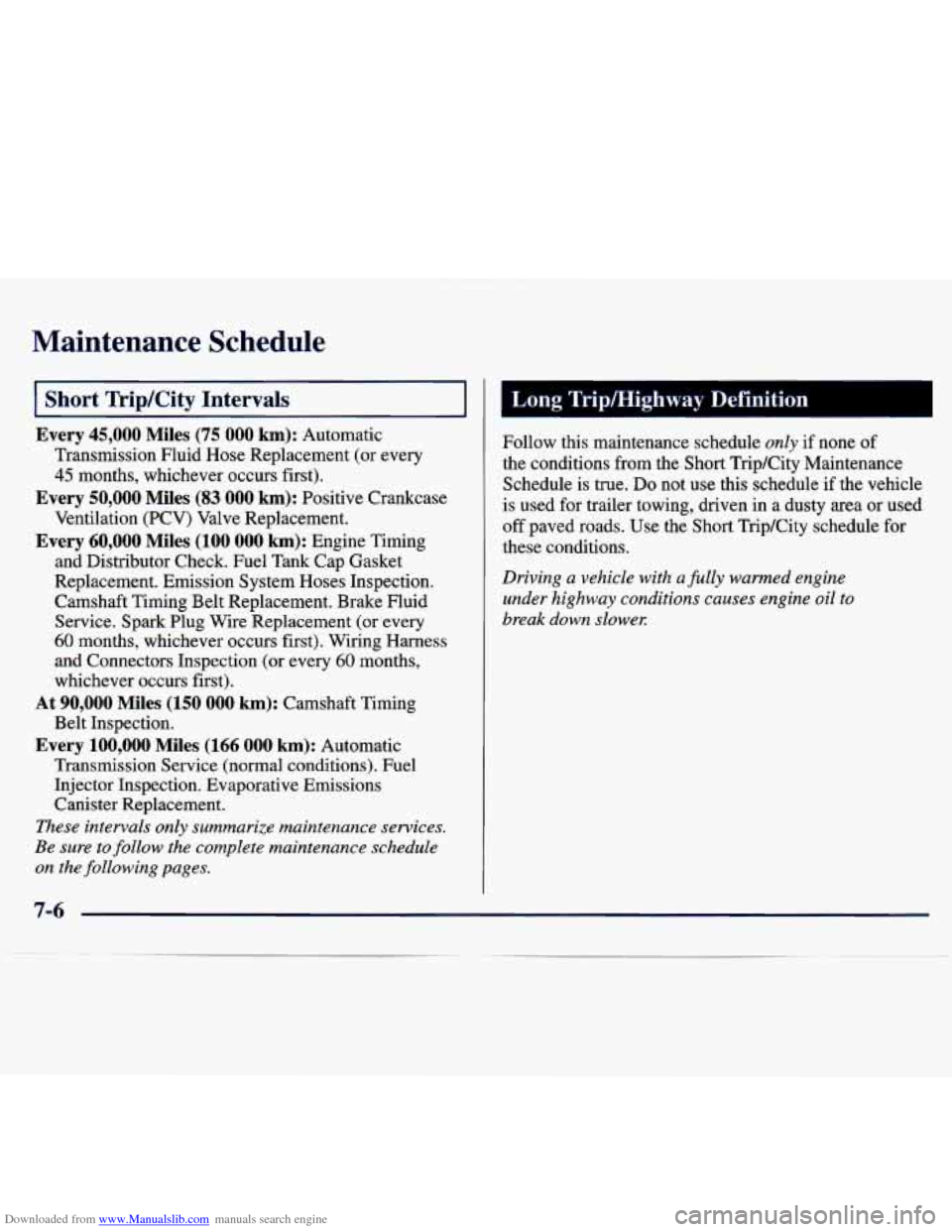
I Short TripKity Intervals I
Every 45,000 Miles (75 000 km): Automatic
Transmission Fluid Hose Replacement (or every
45 months, whichever occurs first).
Every 50,000 Miles (83 000 km): Positive Crankcase
Ventilation (PCV) Valve Replacement.
Every 60,000 Miles (100 000 km): Engine Timing
and Distributor Check. Fuel Tank Cap Gasket
Replacement. Emission System Hoses Inspection.
Camshaft Timing Belt Replacement. Brake Fluid Service. Spark Plug Wire Replacement (or every
60 months, whichever occurs first). Wiring Harness
and Connectors Inspection (or every
60 months,
whichever occurs first).
At 90,000 Miles (150 000 km): Camshaft Timing
Belt Inspection.
Every 100,000 Miles (166 000 km): Automatic
Transmission Service (normal conditions). Fuel
Injector Inspection. Evaporative Emissions
Canister Replacement.
These intervals only summarize maintenance services.
Be sure to follow the complete maintenance schedule
on the following pages.
{Long Trip/Highway Definition
Follow this maintenance schedule only if none of
the conditions from the Short TripKity Maintenance
Schedule is true. Do not use this schedule if the vehicle
is used for trailer towing, driven in a dusty area or used
off paved roads. Use the Short TripKity schedule for
these conditions.
Driving a vehicle with a filly warmed engine
under highway conditions causes engine oil to
break down slowel:
7-6
Page 310 of 386
Downloaded from www.Manualslib.com manuals search engine Maintenance Schedule
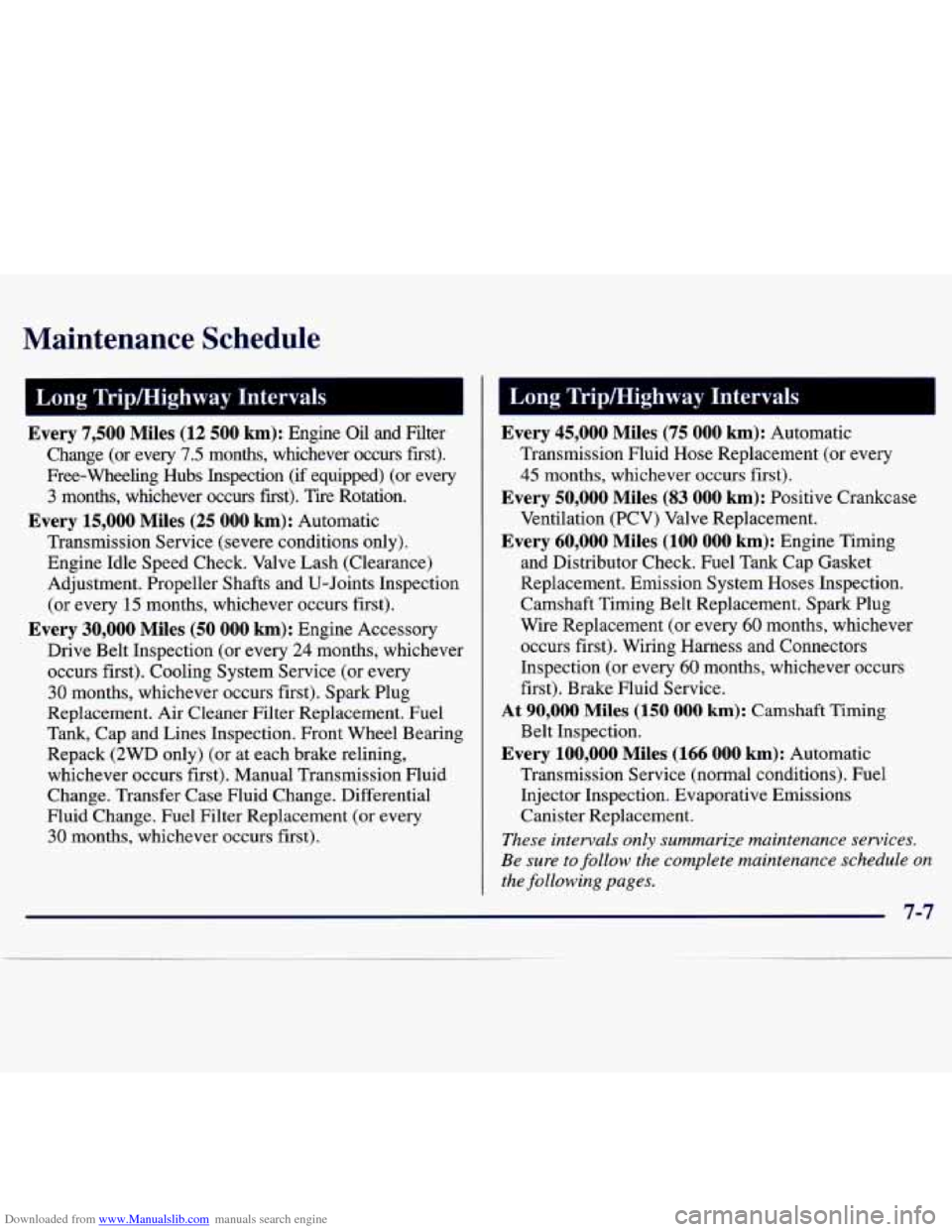
Long TriplHighway Intervals I
Every 7,500 Miles (12 500 km): Engine Oil and Filter
Change (or every
7.5 months, whichever occurs first).
Free-Wheeling Hubs Inspection (if equipped) (or every
3 months, whichever occurs first). Tire Rotation.
Transmission Service (severe conditions only).
Engine Idle Speed Check. Valve Lash (Clearance)
Adjustment. Propeller Shafts and U-Joints Inspection (or every
15 months, whichever occurs first).
Every 30,000 Miles (50 000 km): Engine Accessory
Drive Belt Inspection (or every
24 months, whichever
occurs first). Cooling System Service (or every
30 months, whichever occurs first). Spark Plug
Replacement. Air Cleaner Filter Replacement. Fuel
Tank, Cap and Lines Inspection. Front Wheel Bearing
Repack (2WD only) (or at each brake relining,
whichever occurs first). Manual Transmission Fluid
Change. Transfer Case Fluid Change. Differential
Fluid Change. Fuel Filter Replacement (or every
30 months, whichever occurs first).
Every 15,000 Miles (25 000 km): Automatic
Long Tripmighway Intervals
Every 45,000 Miles (75 000 km): Automatic
Transmission Fluid Hose Replacement (or every
45 months, whichever occurs first).
Every 50,000 Miles (83 000 km): Positive Crankcase
Ventilation (PCV) Valve Replacement.
Every 60,000 Miles (100 000 km): Engine Timing
and Distributor Check. Fuel Tank Cap Gasket
Replacement. Emission System Hoses Inspection.
Camshaft Timing Belt Replacement. Spark Plug
Wire Replacement (or every
60 months, whichever
occurs first). Wiring Harness and Connectors
Inspection (or every
60 months, whichever occurs
first). Brake Fluid Service.
At 90,000 Miles (150 000 km): Camshaft Timing
Belt Inspection.
Every 100,000 Miles (166 000 km): Automatic
Transmission Service (normal conditions). Fuel
Injector Inspection. Evaporative Emissions
Canister Replacement.
These intervals only summarize maintenance services.
Be sure to
follow the complete maintenance schedule on
the following pages.
7-7