cooling CHEVROLET TRACKER 1998 1.G Owners Manual
[x] Cancel search | Manufacturer: CHEVROLET, Model Year: 1998, Model line: TRACKER, Model: CHEVROLET TRACKER 1998 1.GPages: 386, PDF Size: 21.17 MB
Page 65 of 386
Downloaded from www.Manualslib.com manuals search engine Tailgate
It can be dangerous to drive with the tailgate
window open because carbon monoxide (CO) gas
can come into your vehicle. You can’t see or smell
CO. It can cause unconsciousness and even death.
If you must drive with the tailgate window open
or
if electrical wiring or other cable connections
must pass through the seal between the body and
the tailgate window:
0 Make sure all windows are shut.
0 ’hrn the fan on your heating or cooling
system to its highest speed with the setting
on CIRCULATE. That will force outside
air into your vehicle. See “Comfort
Controls” in the Index.
0 If you have air outlets on or under the
instrument panel, open them all the way.
See “Engine Exhaust” in the Index.
Tailgate Lock Release
Use your key to lock or unlock your tailgate.
If you have a convertible, you can still open
or close
the tailgate with the rear window
closed.
Theft
Vehicle theft is big business, especially in some cities.
Although
your vehicle has a number of theft-deterrent
features, we know that nothing we put on
it can make
it impossible to steal. However, there are ways
you
can help.
2-6
Page 129 of 386
Downloaded from www.Manualslib.com manuals search engine Comfort Controls
With this system, you can control the heating and
ventilation in your vehicle.
If you have the air
conditioning option, you can also control cooling.
Your vehicle also has the flow-through ventilation
system described later in this section.
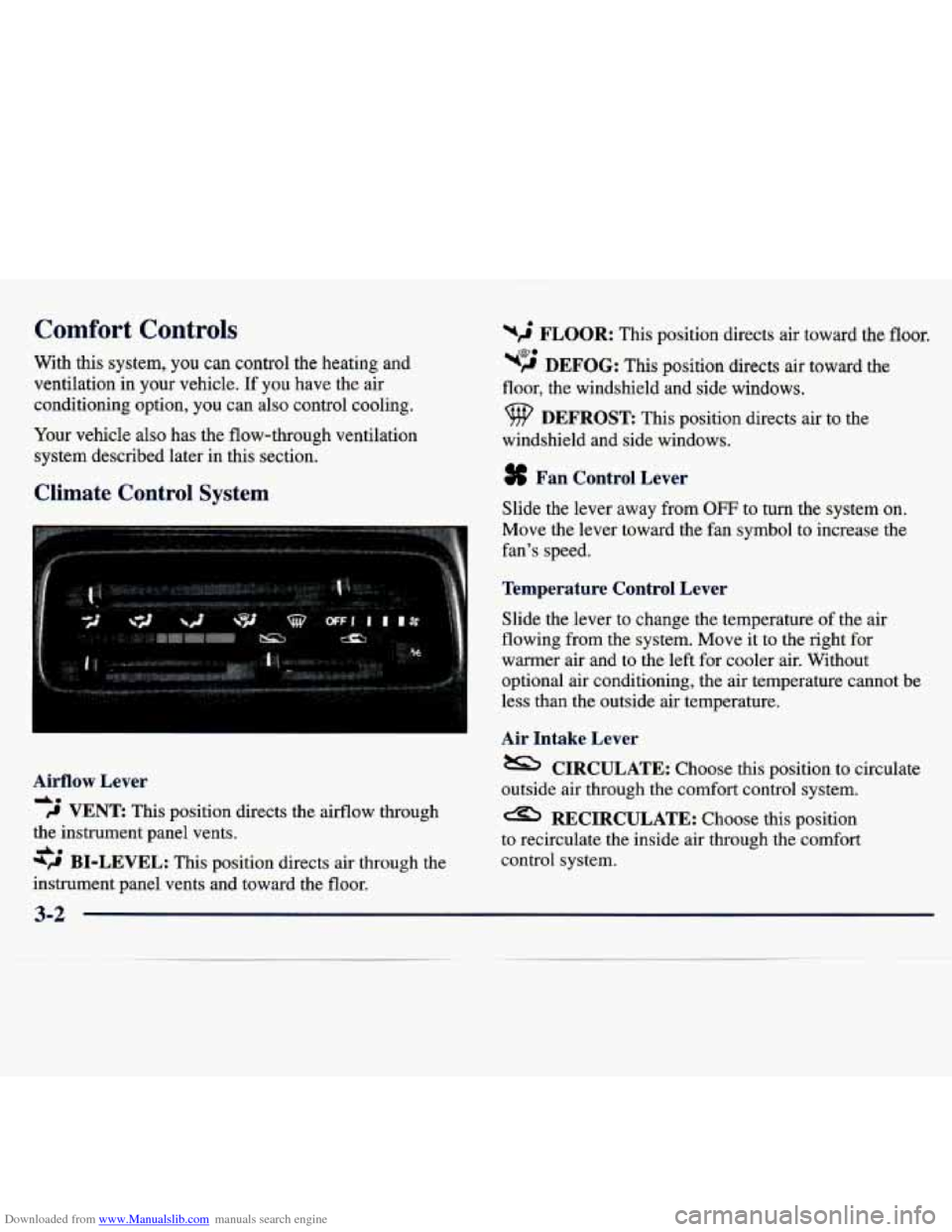
Climate Control System
Airflow Lever
dm
9 VENT This position directs the airflow through
the instrument panel vents.
*P BI-LEVEL: This position directs air through the
instrument panel vents and toward the floor.
A.
wJ FLOOR: This position directs air toward the floor.
w? DEFOG: This position directs air toward the
floor, the windshield and side windows.
DEFROST This position directs air to the
windshield and side windows.
Fan Control Lever
Slide the lever away from OFF to turn the system on.
Move the lever toward the fan symbol to increase the
fan’s speed.
Temperature Control Lever
Slide the lever to change the temperature of the air
flowing from the system. Move it to the right for
warmer air and to the left for cooler air. Without
optional air conditioning, the air temperature cannot be
less than the outside air temperature.
Air Intake Lever
CIRCULATE:
Choose this position to circulate
outside air through the comfort control system.
a RECIRCULATE: Choose this position
to recirculate the inside air through the
comfort
control system.
3-2
Page 130 of 386
Downloaded from www.Manualslib.com manuals search engine Air Conditioner Controls (Option)
c
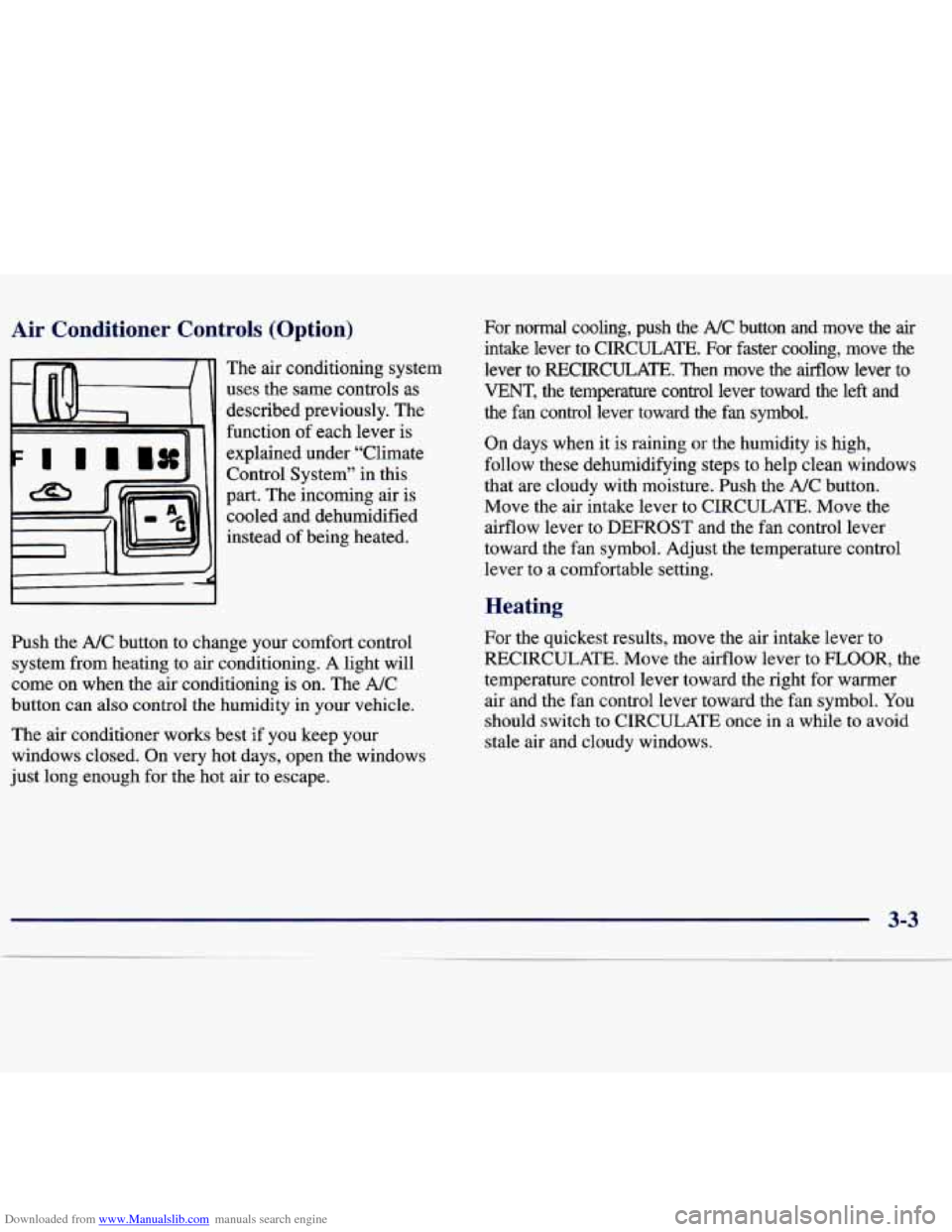
The air conditioning system
uses the same controls
as
described previously. The
function
of each lever is
explained under “Climate
Control System” in this
part. The incoming air is
cooled and dehumidified
instead of being heated.
Push the
A/C button to change your comfort control
system from heating to air conditioning. A light will
come on when the air conditioning is on. The
A/C
button can also control the humidity in your vehicle.
The air conditioner works best if you keep your
windows closed. On very hot days, open the windows
just long enough for the hot air to escape. For normal cooling, push the
A/C button and move the air
intake lever to CIRCULATE. For faster cooling, move the
lever to
RECIRCULAR. Then move the airflow lever to
VENT, the temperature control lever toward the left and
the fan control lever toward the fan symbol.
On days when it is raining or the humidity is high,
follow these dehumidifying steps to help clean windows
that are cloudy with moisture. Push the
A/C button.
Move the air intake lever to CIRCULATE. Move the
airflow lever to DEFROST and the fan control lever
toward the fan symbol. Adjust the temperature control
lever to a comfortable setting.
Heating
For the quickest results, move the air intake lever to
RECIRCULATE. Move the airflow lever to FLOOR, the
temperature control lever toward the right for warmer
air and the fan control lever toward the fan symbol. You
should switch to CIRCULATE once in a while to avoid
stale air and cloudy windows.
3-3
-
Page 131 of 386
Downloaded from www.Manualslib.com manuals search engine Ventilation System
For mild outside temperatures, when little heating or
cooling
is needed, you can still direct outside air through
your vehicle.
Move the air intake lever to CIRCULATE and the aifflow lever to
BI-LEVEL. Adjust the temperature
control lever
to a comfortable setting and move the fan
control lever toward the fan symbol.
Your vehicle’s flow-through ventilation system supplies outside air into the vehicle when it is moving. Outside
air will also enter the vehicle when the fan is running
and the air intake lever is at
CIRCULATE.
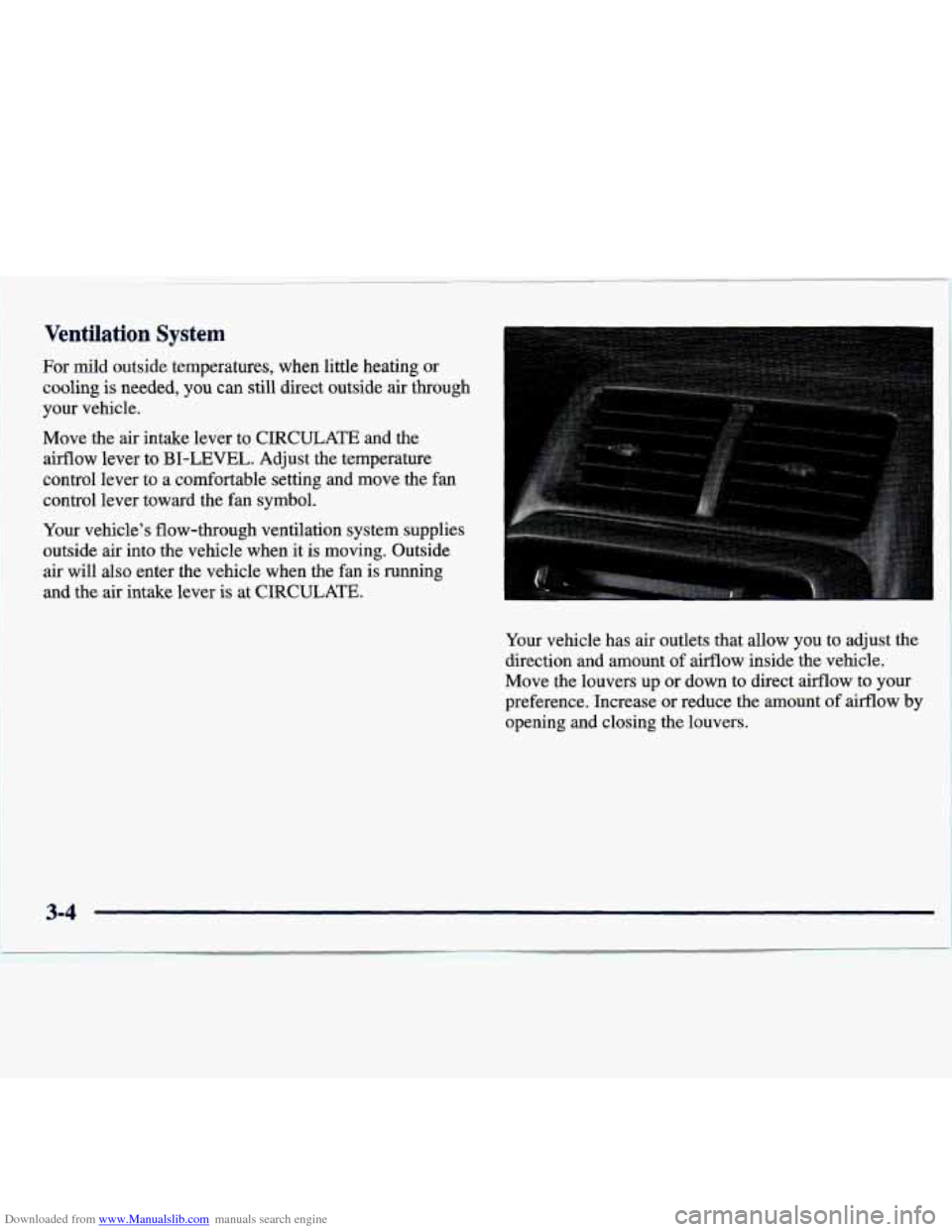
Your vehicle has air outlets that allow you to adjust the
direction and mount of airflow inside the vehicle.
Move the louvers up or down to direct airflow to your preference. Increase
or reduce the amount of airflow by
opening and closing the louvers.
Page 174 of 386
Downloaded from www.Manualslib.com manuals search engine After Off-Road Driving
Remove any brush or debris that has collected on the
underbody, chassis or under the hood. These
accumulations can be a fire hazard.
After operation in mud or sand, have the brake linings
cleaned and checked. These substances can cause glazing and uneven braking. Check the body structure, steering, suspension, wheels, tires and exhaust system
for damage. Also, check the fuel lines and cooling
system for any leakage.
Your vehicle will require more frequent service due to
off-road use. Refer to the Maintenance Schedule for
additional information.
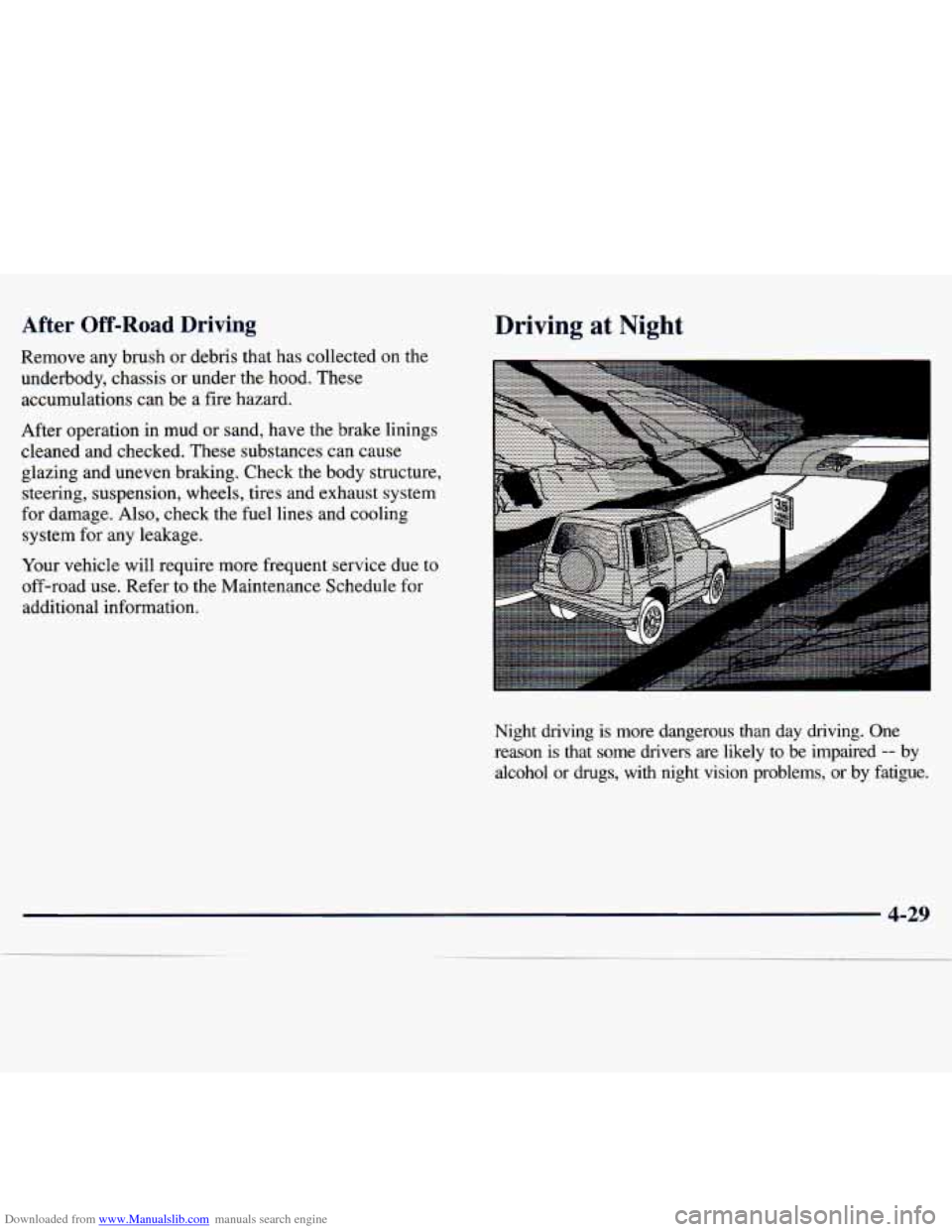
Driving at Night
L ..
Night driving is more dangerous than day driving. One
reason is that some drivers are likely
to be impaired -- by
alcohol or drugs, with night vision problems, or by fatigue.
4-29
Page 183 of 386
Downloaded from www.Manualslib.com manuals search engine If you drive regularly in steep country, or if you’re
planning to visit there, here are some tips that can
make your trips safer and more enjoyable. (See “Off-Road Driving” in the Index for information
about driving off-road.)
Keep your vehicle in good shape. Check all fluid
levels and also the brakes, tires, cooling system and
transmission. These parts can work hard on
mountain roads.
0 Know how to go down hills. The most important
thing
to know is this: let your engine do some of the
slowing down. Shift to a lower gear when you go
down a steep or long hill.
If you don’t shift down, your brakes could
get
so hot that they wouldn’t work well. You
would then have poor braking or even none going
down
a hill. You could crash. Shift down to let
your engine assist your brakes on a steep
downhill slope. Coasting downhill
in
NEUTRAL (N) or with
the ignition
off is dangerous. Your brakes will
have to do all the work of slowing down. They
could get
so hot that they wouldn’t work well.
You would then have
poor braking or even none
going down a hill. You could crash. Always have
your engine running and your vehicle in gear
when
you go downhill.
L
Know how to go uphill. You may want to shift down
to a lower gear. The lower gears help cool your engine and transmission, and you can climb the
hill better.
Stay in your own lane when driving on two-lane
roads in hills or mountains. Don’t swing wide or cut across the center of the road. Drive at speeds that let
you stay in your own lane.
0 As you go over the top of a hill, be alert. There could be
something in your lane, like a stalled car
or an accident.
You may see highway signs on mountains that warn of
special problems. Examples
are long grades, passing or
no-passing zones, a falling rocks area or winding
roads. Be alert to these and take appropriate action.
4-38
Page 201 of 386
Downloaded from www.Manualslib.com manuals search engine When You Are Ready to Leave After
Parking
on a Hill
1. Apply your regular brakes and hold the pedal down
while you:
Start your engine;
0 Shift into a gear; and
Release the parking brake.
2. Let up on the brake pedal.
3. Drive slowly until the trailer is clear of the chocks.
4. Stop and have someone pick up and store the chocks.
Maintenance When Trailer Towing
Your vehicle will need service more often when you’re
pulling a trailer. See the Maintenance Schedule for more
on this. Things that are especially important in trailer
operation are automatic transmission fluid (don’t
overfill), engine oil, axle lubricant, belts, cooling system
and brake adjustment. Each of these is covered in this
manual, and the Index will help you find them quickly.
If you’re trailering, it’s a good idea to review these
sections before you start your trip.
Check periodically to see that all hitch nuts and bolts
are tight.
4-56
Page 202 of 386
Downloaded from www.Manualslib.com manuals search engine 0 Section 5 Problems on the Road
Here you’ll find what to do about some problems that can occur on the road.
5-2 5-2
5-3
5-7
5-12 Hazard Warning Flashers
Other Warning Devices
Jump Starting
Towing
Your Vehicle
Engine Overheating
5- 14
5-21
5-22
5-32 Cooling System If a Tire Goes Flat
Changing a Flat Tire
If You’re Stuck: In Sand, Mud, Ice or Snow
5-1
Page 215 of 386
Downloaded from www.Manualslib.com manuals search engine If you get the overheat warning with no sign of steam,
try this for a minute or so:
1. If you have an air conditioner, turn it off.
2. Turn on your heater to full hot at the highest fan
speed and open the window as necessary.
3. If you’re in a traffic jam, shift to NEUTRAL (N);
otherwise, shift to the highest gear while
driving
-- AUTOMATIC OVERDRIVE (a) or
DRIVE (D) for automatic transmissions.
If you no longer have the overheat warning, you
can drive. Just to be safe, drive slower for about
10 minutes. If the warning doesn’t come back on,
you can drive normally.
If the warning continues, pull over, stop, and park your
vehicle right away.
If there’s still no sign of steam, you can idle the engine
for two or three minutes while you’re parked, to see
if the warning stops. But then,
if you still have the
warning,
turn ojjfthe engine and get everyone out of
the vehicle until it cools down.
You may decide not to lift the hood but to get service
help right away.
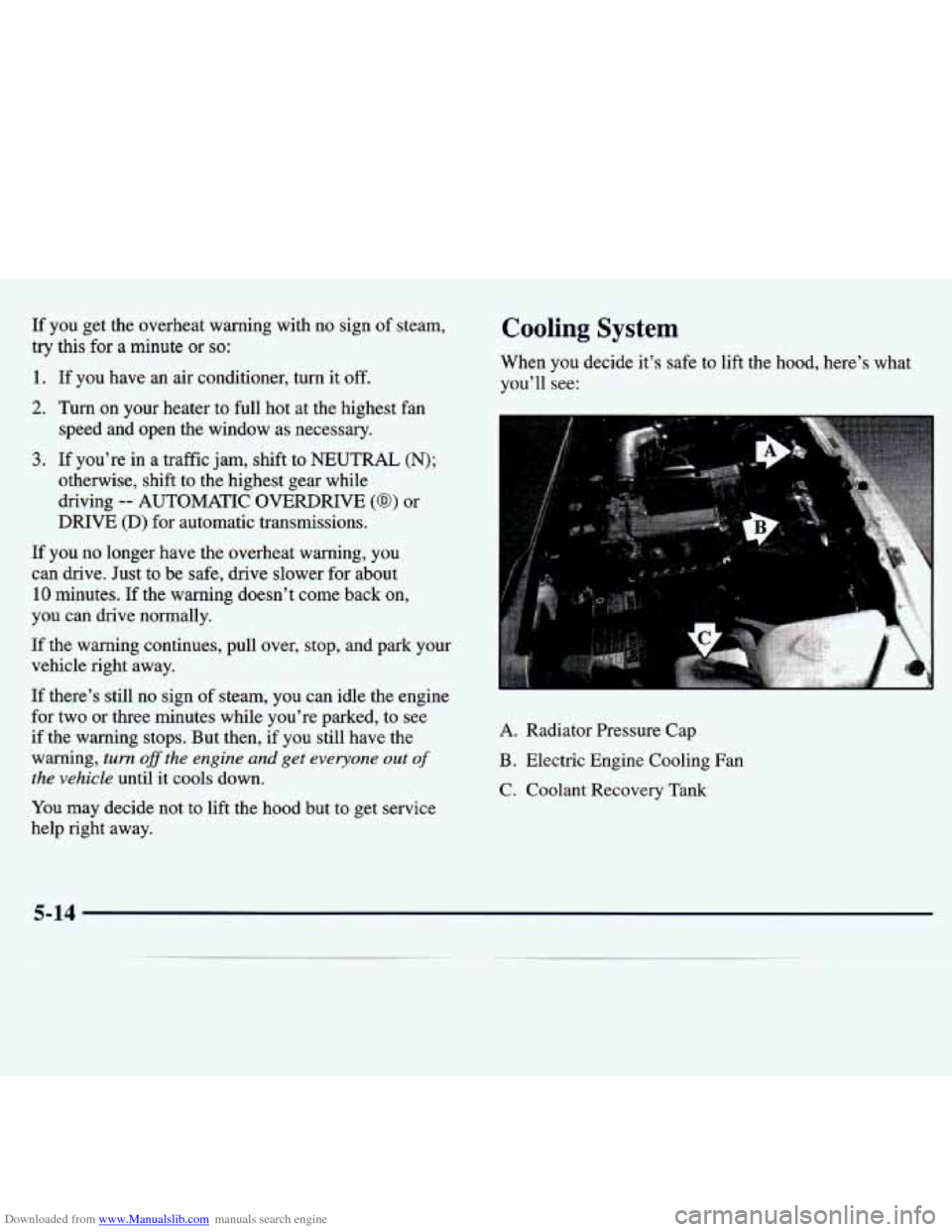
Cooling System
When you decide it’s safe to lift the hood, here’s what \
you’ll see:
A. Radiator Pressure Cap
B. Electric Engine Cooling Fan
C. Coolant Recovery Tank
5-14
Page 216 of 386
Downloaded from www.Manualslib.com manuals search engine I
An electric engine cooling fan under the hood
can start
up even when the engine is not running
and can injure
you. Keep hands, clothing and
tools away from any underhood electric fan.
Don’t reach through the grille
to release the
underhood lever.
If the coolant inside the coolant recovery tank is boiling,
don’t
do anything else until it cools down.
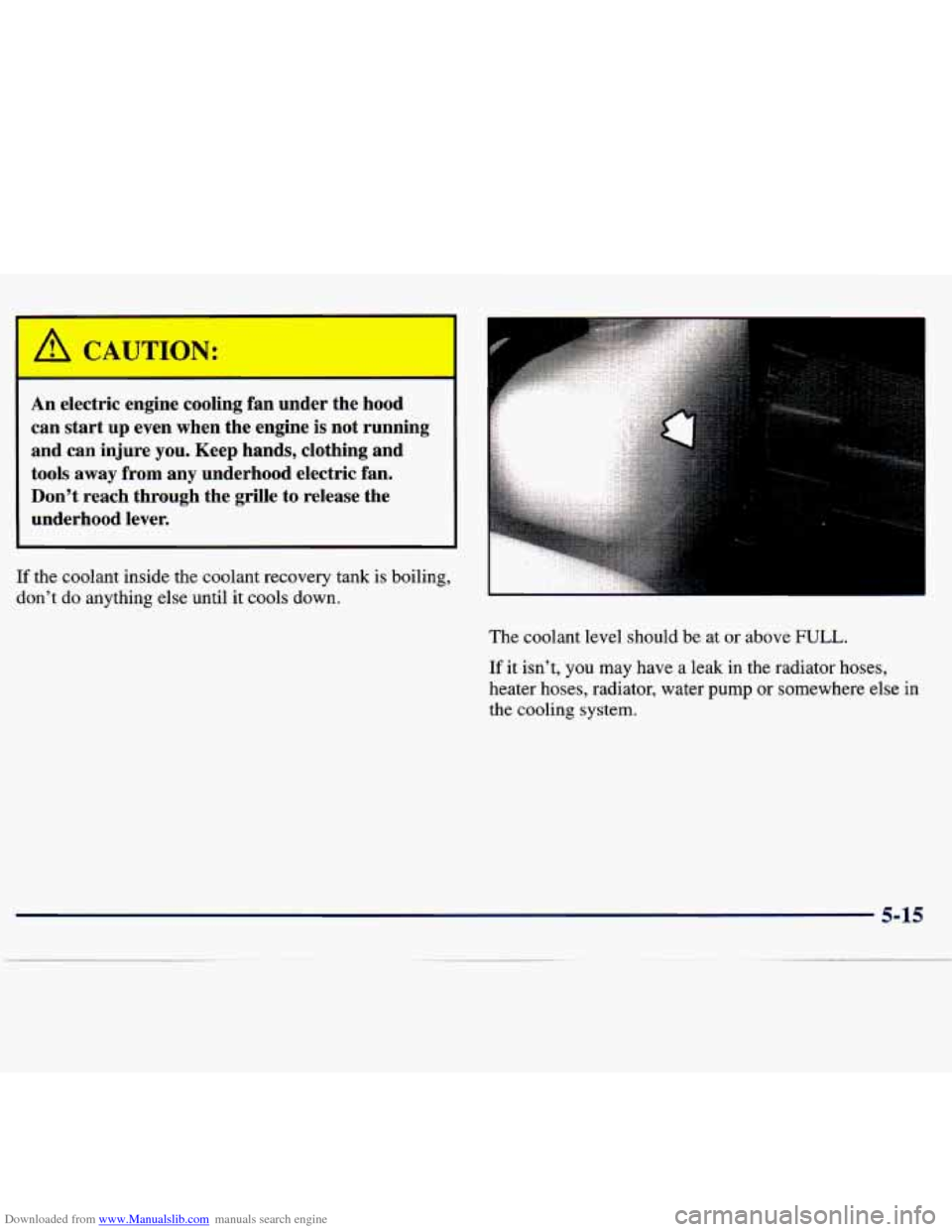
The coolant level should be at
or above FULL.
If it isn’t, you may have a leak in the radiator hoses,
heater hoses, radiator, water pump or somewhere else in
the cooling system.
5-15