instrument panel CHEVROLET TRACKER 2001 2.G Owner's Manual
[x] Cancel search | Manufacturer: CHEVROLET, Model Year: 2001, Model line: TRACKER, Model: CHEVROLET TRACKER 2001 2.GPages: 391, PDF Size: 2.84 MB
Page 128 of 391

2-62
The Instrument Panel -- Your Information System
Page 129 of 391

2-63
The main components of your instrument panel are the following:
A. Side Defroster Vent
B. Air Vent
C. Turn Signal/Multifunction Lever
D. Instrument Panel Cluster
E. Windshield Wiper/Washer Lever
F. Hazard Switch
G. Rear Window Defogger (If Equipped)
H. Comfort Controls
I. Rear Window Wiper/Washer (If Equipped)
J. Coinholder
K. Cruise Control Button (If Equipped)L. Power Remote Control Mirror (If Equipped)
M. Instrument Panel Brightness Control
N. Hood Release
O. Instrument Panel Fuse Block
P. Ignition Switch
Q. Cigarette Lighter/Power Outlet
R. Power Mode Selector Switch (If Equipped)
S. Shift Lever
T. Ashtray
U. Audio System
V. Vent Shut
-off Thumbwheel
Page 130 of 391

2-64
Instrument Panel Cluster
Your instrument cluster is designed to let you know at a glance how your vehicle is running. You'll know how fast you're
going, about how much fuel you have left, and many other things you'll need to know to drive safely and economically.
United States cluster shown; Canada similar
Page 133 of 391
2-67 Air Bag Readiness Light
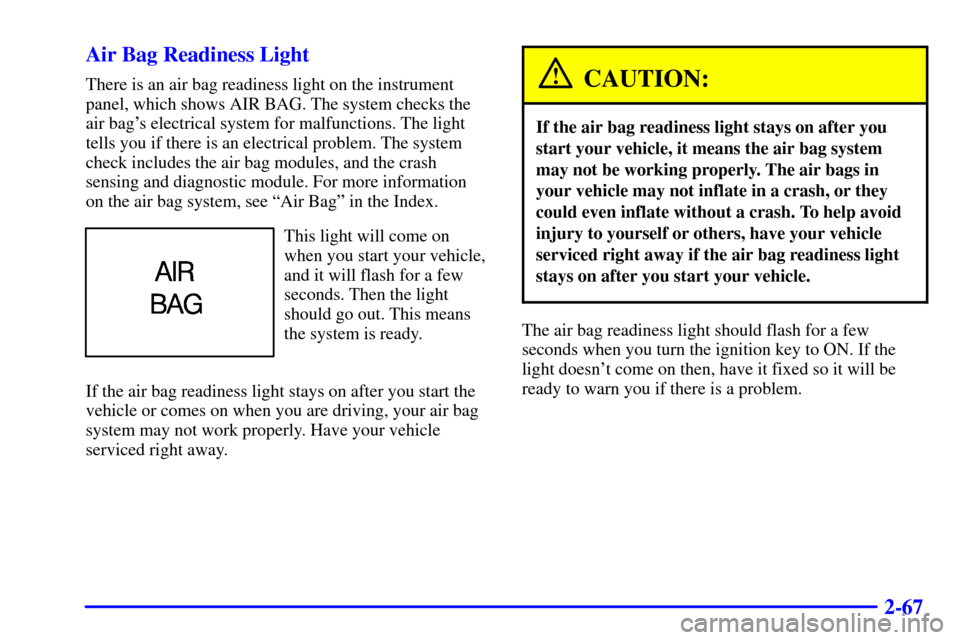
There is an air bag readiness light on the instrument
panel, which shows AIR BAG. The system checks the
air bag's electrical system for malfunctions. The light
tells you if there is an electrical problem. The system
check includes the air bag modules, and the crash
sensing and diagnostic module. For more information
on the air bag system, see ªAir Bagº in the Index.
This light will come on
when you start your vehicle,
and it will flash for a few
seconds. Then the light
should go out. This means
the system is ready.
If the air bag readiness light stays on after you start the
vehicle or comes on when you are driving, your air bag
system may not work properly. Have your vehicle
serviced right away.
CAUTION:
If the air bag readiness light stays on after you
start your vehicle, it means the air bag system
may not be working properly. The air bags in
your vehicle may not inflate in a crash, or they
could even inflate without a crash. To help avoid
injury to yourself or others, have your vehicle
serviced right away if the air bag readiness light
stays on after you start your vehicle.
The air bag readiness light should flash for a few
seconds when you turn the ignition key to ON. If the
light doesn't come on then, have it fixed so it will be
ready to warn you if there is a problem.
Page 145 of 391

3-2
Comfort Controls
With this system, you can control the heating and
ventilation in your vehicle. Your vehicle's air
conditioning can also control cooling.
Your vehicle also has the flow
-through ventilation
system described later in this section.
Climate Control System
Airflow Lever
VENT: This position directs the airflow through
the instrument panel vents.
BI-LEVEL: This position directs air through the
instrument panel vents and toward the floor.
FLOOR: This position directs air toward the floor.
DEFOG: This position directs air toward the
floor, the windshield and side windows. The air also
comes from both vents at the ends of the instrument
panel if the thumbwheel below them is in the open
position. The air conditioning compressor will run
automatically in this setting without turning on the
A/C button light.
DEFROST: This position directs air to the
windshield and side windows. The air also comes from
both vents at the ends of the instrument panel if the
thumbwheel below them is in the open position. The air
conditioning compressor will run automatically in this
setting without turning on the A/C button light. For
maximum defrosting, adjust the temperature control
lever to the hot end and adjust the side outlets so the air
blows on the side window.
Page 172 of 391

4-8
Avoid needless heavy braking. Some people drive in
spurts
-- heavy acceleration followed by heavy
braking
-- rather than keeping pace with traffic. This is a
mistake. Your brakes may not have time to cool between
hard stops. Your brakes will wear out much faster if you
do a lot of heavy braking. If you keep pace with the
traffic and allow realistic following distances, you will
eliminate a lot of unnecessary braking. That means
better braking and longer brake life.
If your engine ever stops while you're driving, brake
normally but don't pump your brakes. If you do, the
pedal may get harder to push down. If your engine
stops, you will still have some power brake assist. But
you will use it when you brake. Once the power assist is
used up, it may take longer to stop and the brake pedal
will be harder to push.
Anti-Lock Brakes (Option)
Your vehicle may have anti-lock brakes (ABS). ABS is
an advanced electronic braking system that will help
prevent a braking skid.
If your vehicle has anti-lock
brakes, this warning light on
the instrument panel will
come on briefly when you
start your vehicle.
When you start your engine, or when you begin to drive
away, your anti
-lock brake system will check itself. You
may hear a momentary motor or clicking noise while
this test is going on, and you may even notice that your
brake pedal moves or pulses a little. This is normal.
If there's a problem with the anti
-lock brake system, the
anti
-lock brake system warning light will stay on. See
ªAnti
-Lock Brake System Warning Lightº in the Index.
Page 209 of 391
4-45
2. If your vehicle is a four-wheel-drive vehicle, turn the
ignition key to ON, move the transfer case lever into
NEUTRAL and make sure the 4WD light on the
instrument panel cluster is turned off. See
ªFour
-Wheel Driveº in the Index.
3. Turn the ignition key to ACC to unlock the
steering wheel.
4. Make sure the front wheels are facing straight
forward and secure the steering wheel with a steering
wheel clamping device designed for towing.
NOTICE:
Make sure that the towing speed does not exceed
55 mph (90 km/h), or your vehicle could be
badly damaged.
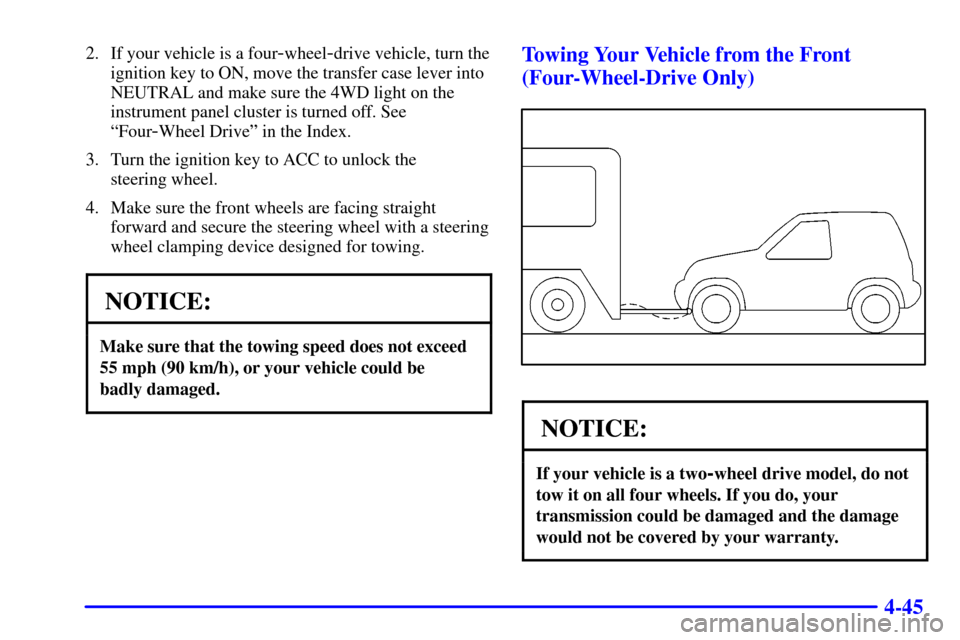
Towing Your Vehicle from the Front
(Four-Wheel-Drive Only)
NOTICE:
If your vehicle is a two-wheel drive model, do not
tow it on all four wheels. If you do, your
transmission could be damaged and the damage
would not be covered by your warranty.
Page 210 of 391
4-46
Follow these steps:
1. Set the parking brake.
2. Shift your automatic transmission into PARK (P), or
your manual transmission to SECOND (2).
3. With the ignition key in the ON position, move the
transfer case to NEUTRAL and make sure the 4WD
light on the instrument panel cluster is off. See
ªFour
-Wheel Driveº in the Index.
4. Turn the ignition key to ACC to unlock the
steering wheel.
5. Release the parking brake.
NOTICE:
If you tow your four-wheel-drive vehicle from
the front, make sure to move the transfer case
into NEUTRAL or your vehicle could be badly
damaged and the damage would not be covered
by your warranty.
Stop towing every 200 miles (300 km) and start the
engine. Leave the transfer case shift lever in
NEUTRAL. Shift your automatic transmission to
DRIVE (D); leave a manual transmission in
SECOND (2) with the clutch engaged. Run the engine at
medium speed for one minute to circulate oil in the
transfer case. Turn the ignition key to ACC. Now, you
can continue towing your vehicle.
NOTICE:
The front wheels transmit shocks during towing.
The steering column may not be strong enough to
withstand the shocks. Always unlock the steering
wheel before towing.
NOTICE:
Make sure that the towing speed does not
exceed 50 mph (80 km/h), or your vehicle could
be badly damaged.
Page 218 of 391
4-54 Making Turns
NOTICE:
Making very sharp turns while trailering could
cause the trailer to come in contact with the
vehicle. Your vehicle could be damaged. Avoid
making very sharp turns while trailering.
When you're turning with a trailer, make wider turns than
normal. Do this so your trailer won't strike soft shoulders,
curbs, road signs, trees or other objects. Avoid jerky or
sudden maneuvers. Signal well in advance.
Turn Signals When Towing a Trailer
When you tow a trailer, your vehicle has to have extra
wiring (included in the optional trailering package).
The arrows on your instrument panel will flash
whenever you signal a turn or lane change. Properly
hooked up, the trailer lamps will also flash, telling other
drivers you're about to turn, change lanes or stop.When towing a trailer, the arrows on your instrument
panel will flash for turns even if the bulbs on the trailer
are burned out. Thus, you may think drivers behind you
are seeing your signal when they are not. It's important
to check occasionally to be sure the trailer bulbs are
still working.
Driving On Grades
Reduce speed and shift to a lower gear before you start
down a long or steep downgrade. If you don't shift
down, you might have to use your brakes so much that
they would get hot and no longer work well.
If you are towing a trailer and you have a manual
transmission with FIFTH (5) gear, you may prefer not to
use FIFTH (5). Just drive in FOURTH (4) (or, as you
need to, a lower gear).
Page 222 of 391
5-2
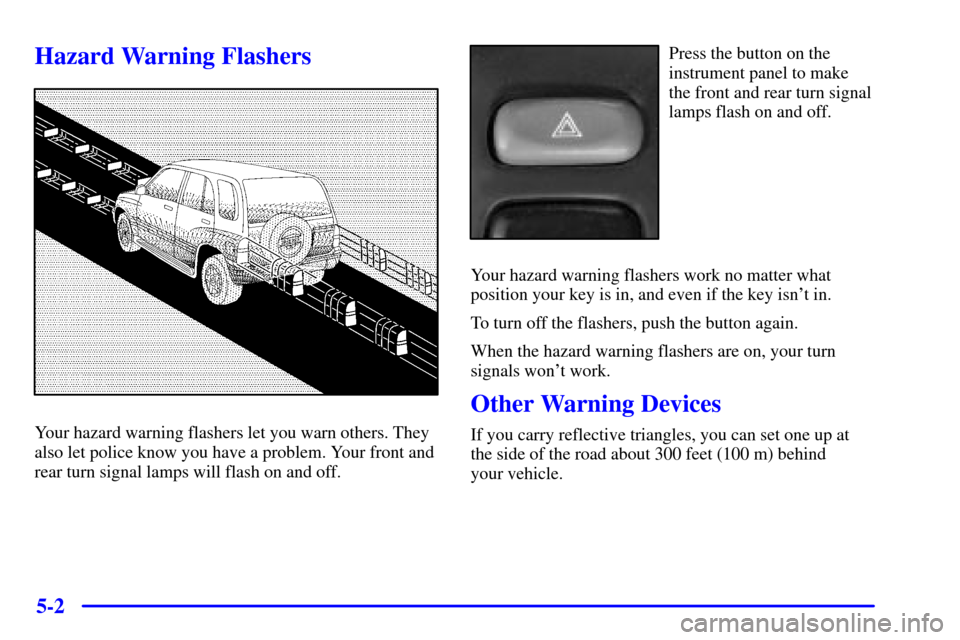
Hazard Warning Flashers
Your hazard warning flashers let you warn others. They
also let police know you have a problem. Your front and
rear turn signal lamps will flash on and off.
Press the button on the
instrument panel to make
the front and rear turn signal
lamps flash on and off.
Your hazard warning flashers work no matter what
position your key is in, and even if the key isn't in.
To turn off the flashers, push the button again.
When the hazard warning flashers are on, your turn
signals won't work.
Other Warning Devices
If you carry reflective triangles, you can set one up at
the side of the road about 300 feet (100 m) behind
your vehicle.