check oil CHEVROLET TRACKER 2003 2.G User Guide
[x] Cancel search | Manufacturer: CHEVROLET, Model Year: 2003, Model line: TRACKER, Model: CHEVROLET TRACKER 2003 2.GPages: 372, PDF Size: 2.65 MB
Page 244 of 372
Engine Coolant
The following explains your cooling system and how to
add coolant when it is low. If you have a problem
with engine overheating, see
Engine Overheating on
page 5-31.
A 50/50 mixture of clean, drinkable water and the proper
coolant will:
·Give freezing protection down to-33ÉF (-36ÉC)
·Give boiling protection up to 258ÉF (125ÉC).
·Protect against rust and corrosion.
·Help keep the proper engine temperature.
·Let the warning lights and gages work as they
should.
What to Use
Use a 50/50 mixture ofclean, drinkable waterand coolant
that meets GM Speci®cation 1825-M, which won't
damage aluminum parts. You can also use a recycled
coolant conforming to GM Speci®cation 1825-M with a
complete coolant ¯ush and re®ll. If you use this coolant
mixture, you don't need to add anything else.
{CAUTION:
Adding only plain water to your cooling
system can be dangerous. Plain water, or
some other liquid such as alcohol, can boil
before the proper coolant mixture will. Your
vehicle's coolant warning system is set for the
proper coolant mixture. With plain water or the
wrong mixture, your engine could get too hot
but you wouldn't get the overheat warning.
Your engine could catch ®re and you or others
could be burned. Use a 50/50 mixture of clean,
drinkable water and the proper coolant.
Notice:If you use an improper coolant mixture,
your engine could overheat and be badly damaged.
The repair cost wouldn't be covered by your
warranty. Too much water in the mixture can freeze
and crack the engine, radiator, heater core and
other parts.
If you have to add coolant more than four times a year,
have your dealer check your cooling system.
Notice:If you use the proper coolant, you don't
have to add extra inhibitors or additives which claim
to improve the system. These can be harmful.
5-28
Page 259 of 372
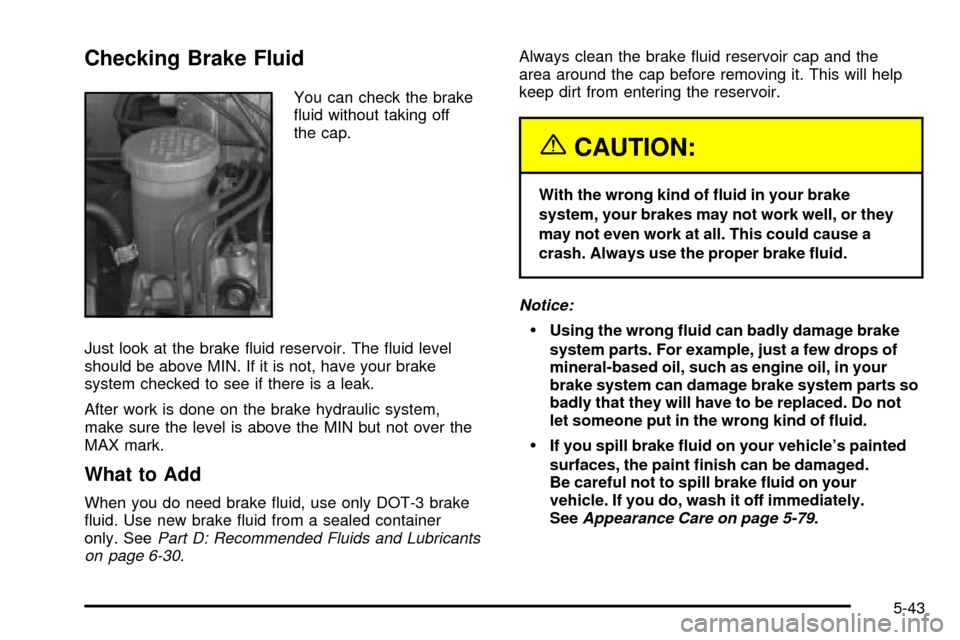
Checking Brake Fluid
You can check the brake
¯uid without taking off
the cap.
Just look at the brake ¯uid reservoir. The ¯uid level
should be above MIN. If it is not, have your brake
system checked to see if there is a leak.
After work is done on the brake hydraulic system,
make sure the level is above the MIN but not over the
MAX mark.
What to Add
When you do need brake ¯uid, use only DOT-3 brake
¯uid. Use new brake ¯uid from a sealed container
only. See
Part D: Recommended Fluids and Lubricants
on page 6-30.Always clean the brake ¯uid reservoir cap and the
area around the cap before removing it. This will help
keep dirt from entering the reservoir.
{CAUTION:
With the wrong kind of ¯uid in your brake
system, your brakes may not work well, or they
may not even work at all. This could cause a
crash. Always use the proper brake ¯uid.
Notice:
·Using the wrong ¯uid can badly damage brake
system parts. For example, just a few drops of
mineral-based oil, such as engine oil, in your
brake system can damage brake system parts so
badly that they will have to be replaced. Do not
let someone put in the wrong kind of ¯uid.
·If you spill brake ¯uid on your vehicle's painted
surfaces, the paint ®nish can be damaged.
Be careful not to spill brake ¯uid on your
vehicle. If you do, wash it off immediately.
See
Appearance Care on page 5-79.
5-43
Page 306 of 372
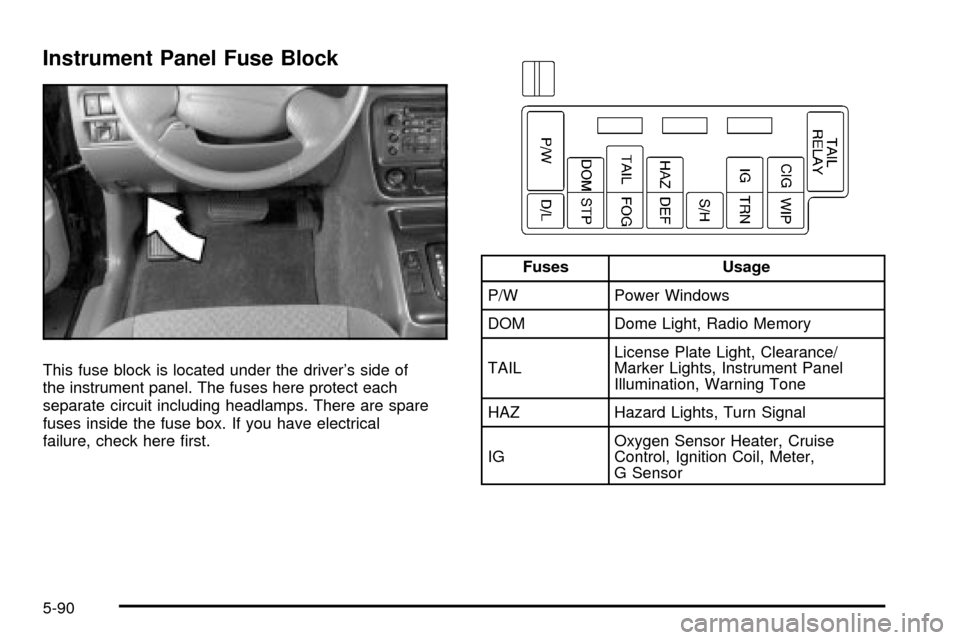
Instrument Panel Fuse Block
This fuse block is located under the driver's side of
the instrument panel. The fuses here protect each
separate circuit including headlamps. There are spare
fuses inside the fuse box. If you have electrical
failure, check here ®rst.
Fuses Usage
P/W Power Windows
DOM Dome Light, Radio Memory
TAILLicense Plate Light, Clearance/
Marker Lights, Instrument Panel
Illumination, Warning Tone
HAZ Hazard Lights, Turn Signal
IGOxygen Sensor Heater, Cruise
Control, Ignition Coil, Meter,
G Sensor
5-90
Page 310 of 372
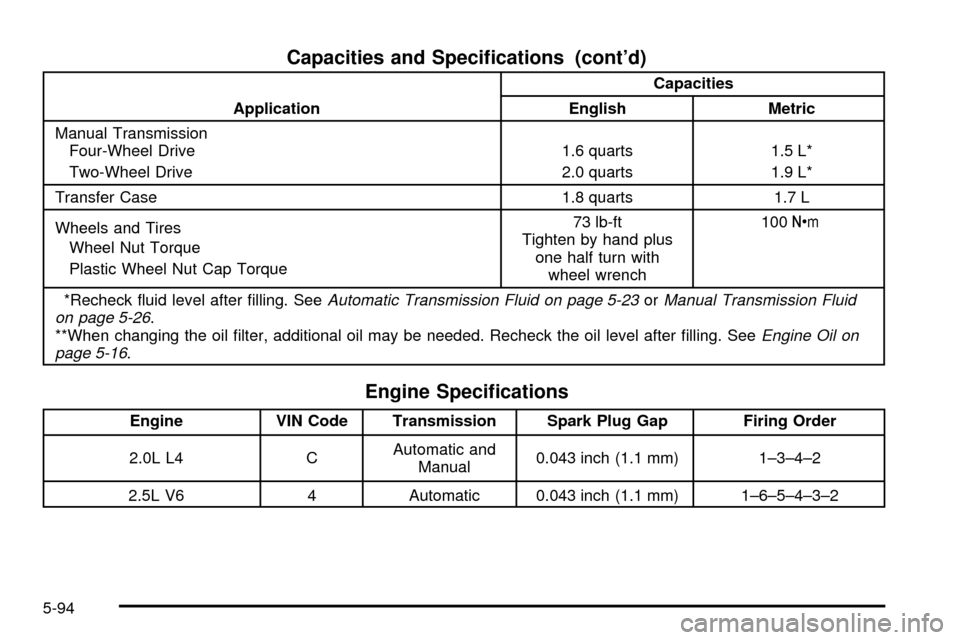
Capacities and Speci®cations (cont'd)
ApplicationCapacities
English Metric
Manual Transmission
Four-Wheel Drive
Two-Wheel Drive1.6 quarts
2.0 quarts1.5 L*
1.9 L*
Transfer Case 1.8 quarts 1.7 L
Wheels and Tires
Wheel Nut Torque
Plastic Wheel Nut Cap Torque73 lb-ft
Tighten by hand plus
one half turn with
wheel wrench100Y
*Recheck ¯uid level after ®lling. See
Automatic Transmission Fluid on page 5-23orManual Transmission Fluid
on page 5-26.
**When changing the oil ®lter, additional oil may be needed. Recheck the oil level after ®lling. SeeEngine Oil on
page 5-16.
Engine Speci®cations
Engine VIN Code Transmission Spark Plug Gap Firing Order
2.0L L4 CAutomatic and
Manual0.043 inch (1.1 mm) 1±3±4±2
2.5L V6 4 Automatic 0.043 inch (1.1 mm) 1±6±5±4±3±2
5-94
Page 314 of 372

Maintenance Schedule
Introduction
Important: Keep engine oil at the proper level and
change as recommended.
Have you purchased the GM Protection Plan? The Plan
supplements your new vehicle warranties. See your
Warranty and Owner Assistance booklet or your dealer
for details.
Your Vehicle and the Environment
Proper vehicle maintenance not only helps to keep your
vehicle in good working condition, but also helps the
environment. Improper vehicle maintenance can
even affect the quality of the air we breathe. Improper
¯uid levels or the wrong tire in¯ation can increase
the level of emissions from your vehicle. To help protect
our environment, and to keep your vehicle in good
condition, be sure to maintain your vehicle properly.
Maintenance Requirements
Maintenance intervals, checks, inspections and
recommended ¯uids and lubricants as prescribed in this
manual are necessary to keep your vehicle in good
working condition. Any damage caused by failure
to follow scheduled maintenance may not be covered
by warranty.
6-2
Page 319 of 372

Every 30,000 Miles (50 000 km):Engine Accessory
Drive Belt Inspection (or every 30 months, whichever
occurs ®rst). Cooling System Service (or every
30 months, whichever occurs ®rst). Fuel Tank, Cap and
Lines Inspection. Engine Air Cleaner Filter Replacement.
Passenger Compartment Air Filter Replacement
(If Equipped). Ignition Coil Plug Cap Inspection (or every
30 months, whichever occurs ®rst). Manual Transmission
Fluid Change. Transfer Case Fluid Change. Differential
Fluid Change. Fuel Filter Replacement (or every
30 months, whichever occurs ®rst).
Every 45,000 Miles (75 000 km):Automatic
Transmission Fluid Hose Inspection (or every
45 months, whichever occurs ®rst).
Every 60,000 Miles (100 000 km):Fuel Tank Cap
Gasket Replacement. Emission System Hoses
Inspection. Spark Plug Replacement. Brake Fluid
Service.
Every 100,000 Miles (166 000 km):Automatic
Transmission Service (normal conditions).
Every 120,000 Miles (200 000 km):Evaporative
Emissions Canister and Air Suction Filter Replacement
(or every 120 months, whichever occurs ®rst).
These intervals only summarize maintenance services.
Be sure to follow the complete scheduled maintenance
on the following pages.
Short Trip/City Scheduled
Maintenance
The services shown in this schedule up to 100,000 miles
(166 000 km) should be repeated after 100,000 miles
(166 000 km) at the same intervals for the life of
this vehicle. The service shown at 120,000 miles
(200 000 km) should be repeated at the same interval
after 120,000 miles (200 000 km) for the life of this
vehicle.
See
Part B: Owner Checks and Services on page 6-24andPart C: Periodic MaintenanceInspections on
page 6-28.
Footnotes
²The U.S. Environmental Protection Agency or the
California Air Resources Board has determined that the
failure to perform this maintenance item will not nullify
the emission warranty or limit recall liability prior to
the completion of the vehicle's useful life. We, however,
urge that all recommended maintenance services be
performed at the indicated intervals and the
maintenance be recorded.
+A good time to check your brakes is during tire
rotation. See Brake System Inspection on page 6-29.
6-7
Page 329 of 372

Long Trip/Highway Scheduled
Maintenance
The services shown in this schedule up to 100,000 miles
(166 000 km) should be repeated after 100,000 miles
(166 000 km) at the same intervals for the life of
this vehicle. The services shown at 120,000 miles
(200 000 km) should be repeated at the same interval
after 120,000 miles (200 000 km) for the life of this
vehicle.
See
Part B: Owner Checks and Services on page 6-24andPart C: Periodic MaintenanceInspections on
page 6-28.
Footnotes
²The U.S. Environmental Protection Agency or the
California Air Resources Board has determined that the
failure to perform this maintenance item will not nullify
the emission warranty or limit recall liability prior to
the completion of the vehicle's useful life. We, however,
urge that all recommended maintenance services be
performed at the indicated intervals and the
maintenance be recorded.
+A good time to check your brakes is during tire
rotation. See Brake System Inspection on page 6-29.
7,500 Miles (12 500 km)
qChange engine oil and ®lter (or every 7.5 months,
whichever occurs ®rst).An Emission Control Service.
qRotate tires. SeeTire Inspection and Rotation on
page 5-60for proper rotation pattern and additional
information.(See footnote +.)
15,000 Miles (25 000 km)
qChange engine oil and ®lter (or every 7.5 months,
whichever occurs ®rst).An Emission Control
Service.
qInspect engine air cleaner ®lter. SeeEngine Air
Cleaner/Filter on page 5-20for more information.An Emission Control Service. (See footnote ².)
qIf Equipped: Inspect passenger compartment air ®lters.
qChange automatic transmission ¯uid and ®lter if the
vehicle is mainly driven under one or more of these
conditions:
þ In heavy city traffic where the outside
temperature regularly reaches 90ÉF (32ÉC)
or higher.
þ In hilly or mountainous terrain.
þ When doing frequent trailer towing.
þ Uses such as found in taxi, police or delivery
service.
6-17
Page 336 of 372

Part B: Owner Checks and Services
Listed in this part are owner checks and services
which should be performed at the intervals speci®ed to
help ensure the safety, dependability and emission
control performance of your vehicle.
Be sure any necessary repairs are completed at once.
Whenever any ¯uids or lubricants are added to your
vehicle, make sure they are the proper ones, as shown
in Part D.
At Each Fuel Fill
It is important for you or a service station attendant to
perform these underhood checks at each fuel ®ll.
Engine Oil Level Check
Check the engine oil level and add the proper oil if
necessary. SeeEngine Oil on page 5-16for further
details.
Engine Coolant Level Check
Check the engine coolant level and add the proper
coolant mixture if necessary. SeeEngine Coolant on
page 5-28for further details.
Windshield Washer Fluid Level Check
Check the windshield washer ¯uid level in the windshield
washer tank and add the proper ¯uid if necessary.
See
Windshield Washer Fluid on page 5-41for further
details.
Hood Latch Operation Check
Pull the primary hood latch release handle inside the
vehicle. The secondary latch should keep the hood from
opening all the way when the primary latch is released.
Make sure the hood closes ®rmly. See
Hood Release
on page 5-10for further details.
At Least Once a Month
Tire In¯ation Check
Visually inspect your tires and make sure tires are
in¯ated to the correct pressures. Don't forget to check
your spare tire. See
Tires on page 5-59for further
details.
6-24
Page 360 of 372

Brake............................................................2-27
Parking......................................................2-27
System Inspection.......................................6-29
System Warning Light..................................3-28
Brakes..........................................................5-42
Braking in Emergencies...................................4-10
Braking........................................................... 4-7
Break-In, New Vehicle.....................................2-14
Bulb Replacement...........................................5-55
Front Turn Signal and Parking Lamps.............5-57
Halogen Bulbs............................................5-55
Headlamps.................................................5-55
Rear Combination Lamps.............................5-58
Replacement Bulbs......................................5-59
Sidemarker Lamps.......................................5-57
Buying New Tires...........................................5-62
CCalifornia Fuel.................................................. 5-5
Canada ± Customer Assistance.......................... 7-4
Canadian Owners................................................ ii
Canadian Roadside Assistance........................... 7-7
Canceling a Rear Door Security Lock................2-10
Capacities and Speci®cations............................5-93
Carbon Monoxide...................4-40, 4-53, 2-11, 2-32
Care of.........................................................5-82
Safety Belts................................................5-82
Your CD Player...........................................3-43
Your CDs ...................................................3-43Cargo Cover..................................................2-38
Cargo Lamp...................................................3-16
Center Passenger Position, Safety Belts.............1-26
Chains, Tires..................................................5-66
Charging System Light....................................3-28
Checking Brake Fluid......................................5-43
Checking Coolant............................................5-29
Checking Engine Oil........................................5-16
Checking Things Under the Hood....................... 5-9
Checking Your Restraint Systems......................1-61
Check...........................................................3-31
Engine Light...............................................3-31
Chemical Paint Spotting...................................5-86
Child Restraints..............................................1-37
Child Restraint Systems...............................1-37
Infants and Young Children...........................1-34
Lower Anchorages and Top Tethers for
Children (LATCH System)..........................1-44
Older Children.............................................1-31
Securing a Child Restraint Designed for
the LATCH System...................................1-46
Securing a Child Restraint in a Center
Rear Seat Position...................................1-49
Securing a Child Restraint in a Rear
Outside Seat Position...............................1-46
Securing a Child Restraint in the Right
Front Seat Position...................................1-51
Top Strap Anchor Location............................1-43
Top Strap...................................................1-41
Where to Put the Restraint...........................1-40
2
Page 362 of 372

Dinghy Towing................................................4-48
Doing Your Own Service Work........................... 5-3
Dolly Towing..................................................4-50
Dome Lamp...................................................3-15
Door............................................................... 2-8
Locks.......................................................... 2-8
Power Door Locks......................................... 2-9
Rear Door Security Locks.............................2-10
Driver Behavior................................................ 4-2
Driver............................................................1-16
Position, Safety Belt.....................................1-16
Driving Across an Incline..................................4-26
Driving Downhill..............................................4-24
Driving in Mud, Sand, Snow or Ice....................4-28
Driving in Water..............................................4-29
Driving On Grades..........................................4-58
Driving on Off-Road Hills.................................4-20
Driving On Snow or Ice...................................4-40
Driving Through Deep Standing Water...............4-34
Driving Through Flowing Water.........................4-34
Driving Uphill..................................................4-21
Driving with a Trailer.......................................4-57
Driving..........................................................4-30
At Night.....................................................4-30
City...........................................................4-35
Defensive..................................................... 4-3
Drunken....................................................... 4-4
Environment................................................. 4-2
Freeway.....................................................4-36Driving (cont.)
Hill and Mountain Roads..............................4-38
In Rain and on Wet Roads...........................4-32
Winter........................................................4-40
E
Easy Entry Seat............................................... 1-5
Electrical System............................................5-89
Add-On Equipment......................................5-89
Fuses and Circuit Breakers...........................5-89
Emissions Inspection and
Maintenance Programs.................................3-34
Engine Compartment Fuse Block......................5-91
Engine Coolant Level Check.............................6-24
Engine Oil Additives........................................5-19
Engine Oil Level Check...................................6-24
Engine..........................................................5-20
Air Cleaner/Filter.........................................5-20
Battery.......................................................5-45
Check and Service Engine Soon Light............3-31
Compartment Overview................................5-12
Coolant Heater............................................2-17
Coolant Temperature Gage...........................3-31
Coolant......................................................5-28
Cooling System Inspection............................6-28
Exhaust.....................................................2-32
Oil .............................................................5-16
4