lights CHEVROLET TRACKER 2003 2.G User Guide
[x] Cancel search | Manufacturer: CHEVROLET, Model Year: 2003, Model line: TRACKER, Model: CHEVROLET TRACKER 2003 2.GPages: 372, PDF Size: 2.65 MB
Page 187 of 372

Here are some tips on night driving.
·Drive defensively.
·Don't drink and drive.
·Adjust your inside rearview mirror to reduce the
glare from headlamps behind you.
·Since you can't see as well, you may need to slow
down and keep more space between you and
other vehicles.
·Slow down, especially on higher speed roads. Your
headlamps can light up only so much road ahead.
·In remote areas, watch for animals.
·If you're tired, pull off the road in a safe place
and rest.
No one can see as well at night as in the daytime.
But as we get older these differences increase.
A 50-year-old driver may require at least twice as much
light to see the same thing at night as a 20-year-old.
What you do in the daytime can also affect your night
vision. For example, if you spend the day in bright
sunshine you are wise to wear sunglasses. Your eyes
will have less trouble adjusting to night. But if you're
driving, don't wear sunglasses at night. They may
cut down on glare from headlamps, but they also make
a lot of things invisible.You can be temporarily blinded by approaching
headlamps. It can take a second or two, or even
several seconds, for your eyes to readjust to the dark.
When you are faced with severe glare (as from a
driver who doesn't lower the high beams, or a vehicle
with misaimed headlamps), slow down a little.
Avoid staring directly into the approaching headlamps.
Keep your windshield and all the glass on your
vehicle clean Ð inside and out. Glare at night is made
much worse by dirt on the glass. Even the inside of
the glass can build up a ®lm caused by dust. Dirty glass
makes lights dazzle and ¯ash more than clean glass
would, making the pupils of your eyes contract
repeatedly.
Remember that your headlamps light up far less of a
roadway when you are in a turn or curve. Keep your eyes
moving; that way, it's easier to pick out dimly lighted
objects. Just as your headlamps should be checked
regularly for proper aim, so should your eyes be
examined regularly. Some drivers suffer from night
blindness Ð the inability to see in dim light Ð and aren't
even aware of it.
4-31
Page 212 of 372

Hitches
It's important to have the correct hitch equipment.
Crosswinds, large trucks going by and rough roads
are a few reasons why you'll need the right hitch.
Here are some rules to follow:
·If you make holes in the body of your vehicle, be
sure to seal them when you remove the trailering
equipment. If you don't seal them, dirt, water,
and even deadly carbon monoxide (CO) from your
exhaust can get into your vehicle. See
Engine
Exhaust on page 2-32.
Your vehicle is readily designed to accept a trailer hitch.
The frame rail ends already have holes and weld
nuts in place to accept the four bolts needed to attach
the hitch bar.
To help simplify setting up your trailer lights, there is a
trailer wiring connector located behind the left rear
trim panel. If needed, your dealer can provide help in
removing the trim panel and accessing this wiring
connector.
Your vehicle's trailer wiring has separate turn signal and
brake light circuits, which means you will most likely
need to purchase a converter to operate conventional
trailer lights.
Safety Chains
You should always attach chains between your vehicle
and your trailer. Cross the safety chains under the
tongue of the trailer to help prevent the tongue from
contacting the road if it becomes separated from
the hitch. Instructions about safety chains may be
provided by the hitch manufacturer or by the
trailer manufacturer. Follow the manufacturer's
recommendation for attaching safety chains and do not
attach them to the bumper. Always leave just enough
slack so you can turn with your rig. Never allow
safety chains to drag on the ground.
Trailer Brakes
If your trailer weighs more than 1,000 lbs. (450 kg)
loaded, then it needs its own surge brakes. Tapping into
your vehicle's brake system is not recommended.
4-56
Page 244 of 372

Engine Coolant
The following explains your cooling system and how to
add coolant when it is low. If you have a problem
with engine overheating, see
Engine Overheating on
page 5-31.
A 50/50 mixture of clean, drinkable water and the proper
coolant will:
·Give freezing protection down to-33ÉF (-36ÉC)
·Give boiling protection up to 258ÉF (125ÉC).
·Protect against rust and corrosion.
·Help keep the proper engine temperature.
·Let the warning lights and gages work as they
should.
What to Use
Use a 50/50 mixture ofclean, drinkable waterand coolant
that meets GM Speci®cation 1825-M, which won't
damage aluminum parts. You can also use a recycled
coolant conforming to GM Speci®cation 1825-M with a
complete coolant ¯ush and re®ll. If you use this coolant
mixture, you don't need to add anything else.
{CAUTION:
Adding only plain water to your cooling
system can be dangerous. Plain water, or
some other liquid such as alcohol, can boil
before the proper coolant mixture will. Your
vehicle's coolant warning system is set for the
proper coolant mixture. With plain water or the
wrong mixture, your engine could get too hot
but you wouldn't get the overheat warning.
Your engine could catch ®re and you or others
could be burned. Use a 50/50 mixture of clean,
drinkable water and the proper coolant.
Notice:If you use an improper coolant mixture,
your engine could overheat and be badly damaged.
The repair cost wouldn't be covered by your
warranty. Too much water in the mixture can freeze
and crack the engine, radiator, heater core and
other parts.
If you have to add coolant more than four times a year,
have your dealer check your cooling system.
Notice:If you use the proper coolant, you don't
have to add extra inhibitors or additives which claim
to improve the system. These can be harmful.
5-28
Page 306 of 372
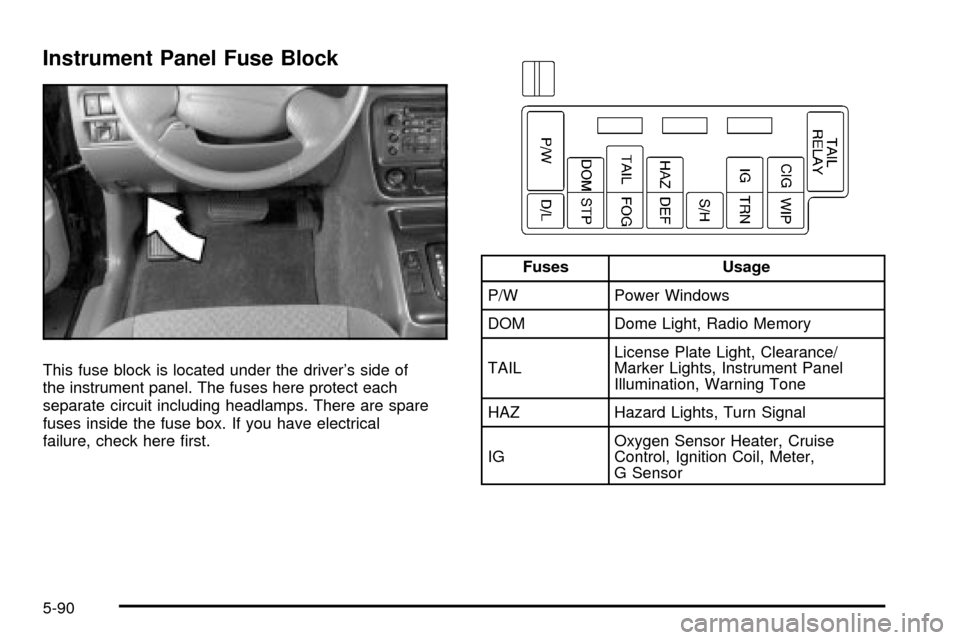
Instrument Panel Fuse Block
This fuse block is located under the driver's side of
the instrument panel. The fuses here protect each
separate circuit including headlamps. There are spare
fuses inside the fuse box. If you have electrical
failure, check here ®rst.
Fuses Usage
P/W Power Windows
DOM Dome Light, Radio Memory
TAILLicense Plate Light, Clearance/
Marker Lights, Instrument Panel
Illumination, Warning Tone
HAZ Hazard Lights, Turn Signal
IGOxygen Sensor Heater, Cruise
Control, Ignition Coil, Meter,
G Sensor
5-90
Page 307 of 372
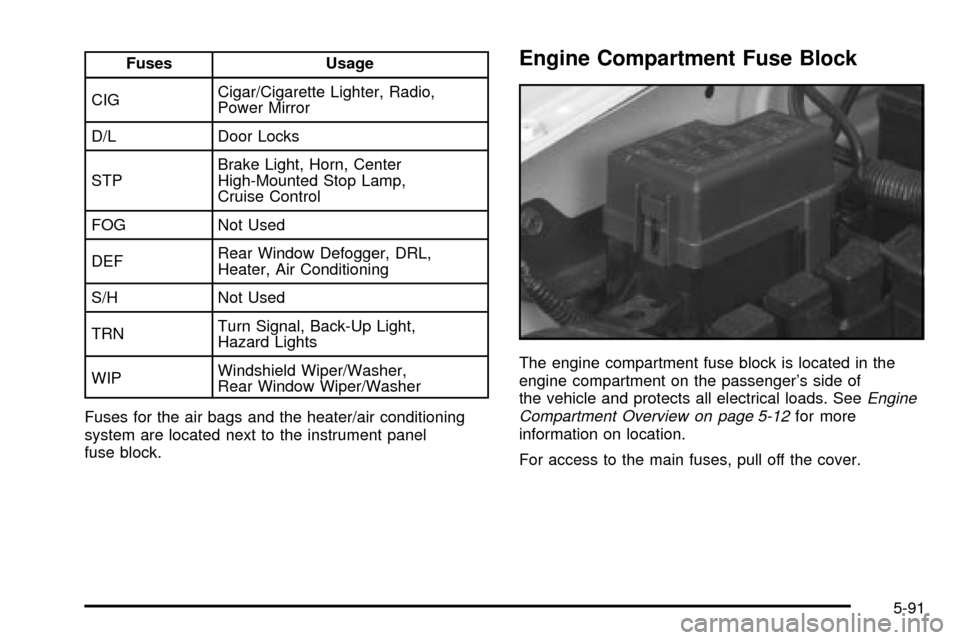
Fuses Usage
CIGCigar/Cigarette Lighter, Radio,
Power Mirror
D/L Door Locks
STPBrake Light, Horn, Center
High-Mounted Stop Lamp,
Cruise Control
FOG Not Used
DEFRear Window Defogger, DRL,
Heater, Air Conditioning
S/H Not Used
TRNTurn Signal, Back-Up Light,
Hazard Lights
WIPWindshield Wiper/Washer,
Rear Window Wiper/Washer
Fuses for the air bags and the heater/air conditioning
system are located next to the instrument panel
fuse block.Engine Compartment Fuse Block
The engine compartment fuse block is located in the
engine compartment on the passenger's side of
the vehicle and protects all electrical loads. See
Engine
Compartment Overview on page 5-12for more
information on location.
For access to the main fuses, pull off the cover.
5-91
Page 371 of 372

Top Strap......................................................1-41
Torque Lock...................................................2-29
Total Weight on Your Vehicle's Tires..................4-55
Towing..........................................................4-47
Recreational Vehicle.....................................4-47
Towing a Trailer..........................................4-53
Your Vehicle...............................................4-47
Trailer Brakes.................................................4-56
Transfer Case........................................2-25, 5-53
Transmission Operation, Automatic....................2-19
Transmission Operation, Manual........................2-23
Transmission, Transaxle, Transfer Case Unit
Repair Manual............................................7-11
Transmission..................................................5-23
Fluid, Automatic...........................................5-23
Fluid, Manual..............................................5-26
Transportation Options...................................... 7-8
Traveling to Remote Areas...............................4-18
Trip Odometer................................................3-26
Turn and Lane-Change Signals.......................... 3-6
Turn Signal/Multifunction Lever........................... 3-5
Turn Signals When Towing a Trailer..................4-58
U
Underbody Flushing Service.............................6-27
Understanding Radio Reception........................3-42
Uniform Tire Quality Grading............................5-63
United States ± Customer Assistance.................. 7-4Used Replacement Wheels..............................5-65
Using Cleaner on Fabric..................................5-80
Using the Rear Door Security Lock...................2-10
Using the Recovery Hooks...............................4-45
V
Vehicle Identi®cation........................................5-88
Number (VIN).............................................5-88
Service Parts Identi®cation Label...................5-88
Vehicle Storage..............................................5-46
Vehicle............................................................ 4-7
Control........................................................ 4-7
Damage Warnings........................................... iv
Design......................................................... 4-3
Loading......................................................4-51
Parking Your...............................................2-31
Symbols......................................................... iv
Ventilation Adjustment......................................3-21
Visor Vanity Mirror..........................................2-14
Visors...........................................................2-14
W
Warning Lights, Gages and Indicators................3-24
Warnings......................................................... 3-4
Hazard Warning Flashers............................... 3-4
Other Warning Devices.................................. 3-4
13