mirror CHEVROLET TRACKER 2003 2.G Owners Manual
[x] Cancel search | Manufacturer: CHEVROLET, Model Year: 2003, Model line: TRACKER, Model: CHEVROLET TRACKER 2003 2.GPages: 372, PDF Size: 2.65 MB
Page 1 of 372

Seats and Restraint Systems........................... 1-1
Front Seats
............................................... 1-2
Rear Seats
............................................... 1-7
Safety Belts
.............................................1-11
Child Restraints
.......................................1-31
Supplemental Restraint System (SRS)
.........1-54
Restraint System Check
............................1-61
Features and Controls..................................... 2-1
Keys
........................................................ 2-2
Doors and Locks
....................................... 2-8
Windows
.................................................2-12
Starting and Operating Your Vehicle
...........2-14
Mirrors
....................................................2-34
Storage Areas
.........................................2-35
Sunroof
..................................................2-38
Convertible Top
.......................................2-40
Instrument Panel............................................. 3-1
Instrument Panel Overview
.......................... 3-2
Climate Controls
......................................3-18
Warning Lights, Gages and Indicators
.........3-24
Audio System(s)
.......................................3-37Driving Your Vehicle....................................... 4-1
Your Driving, the Road, and Your Vehicle
........ 4-2
Towing
...................................................4-47
Service and Appearance Care.......................... 5-1
Service
..................................................... 5-3
Fuel
......................................................... 5-4
Checking Things Under the Hood
................. 5-9
Rear Axle
...............................................5-52
Four-Wheel Drive
.....................................5-53
Bulb Replacement
....................................5-55
Tires
......................................................5-59
Appearance Care
.....................................5-79
Vehicle Identi®cation
.................................5-88
Electrical System
......................................5-89
Capacities and Speci®cations
.....................5-93
Normal Maintenance Replacement Parts
......5-95
Maintenance Schedule..................................... 6-1
Maintenance Schedule
................................ 6-2
Customer Assistance Information.................... 7-1
Customer Assistance Information
.................. 7-2
Reporting Safety Defects
...........................7-10
Index................................................................ 1
2003 Chevrolet Tracker Owner ManualM
Page 69 of 372

Keys...............................................................2-2
Remote Keyless Entry System.........................2-4
Remote Keyless Entry System Operation...........2-5
Doors and Locks.............................................2-8
Door Locks....................................................2-8
Power Door Locks..........................................2-9
Rear Door Security Locks..............................2-10
Leaving Your Vehicle....................................2-11
Tailgate.......................................................2-11
Windows........................................................2-12
Manual Windows..........................................2-13
Power Windows............................................2-13
Sun Visors...................................................2-14
Starting and Operating Your Vehicle................2-14
New Vehicle Break-In....................................2-14
Ignition Positions..........................................2-15
Starting Your Engine.....................................2-16
Engine Coolant Heater..................................2-17
Automatic Transmission Operation...................2-19
Manual Transmission Operation......................2-23
Four-Wheel Drive..........................................2-25
Parking Brake..............................................2-27
Shifting Into Park (P).....................................2-28Shifting Out of Park (P).................................2-30
Parking Your Vehicle.....................................2-31
Parking Over Things That Burn.......................2-31
Engine Exhaust............................................2-32
Running Your Engine While You Are Parked.......2-32
Mirrors...........................................................2-34
Manual Rearview Mirror.................................2-34
Outside Manual Mirrors..................................2-34
Outside Power Mirrors...................................2-34
Outside Convex Mirror...................................2-35
Storage Areas................................................2-35
Glove Box...................................................2-35
Cupholder(s)................................................2-35
Coinholder(s)................................................2-35
Luggage Carrier...........................................2-36
Convenience Net..........................................2-37
Cargo Cover................................................2-38
Sunroof.........................................................2-38
Opening and Closing the Sunroof...................2-38
Convertible Top..............................................2-40
Removing and Installing the Rear Window........2-40
Removing and Installing the Side Window........2-41
Lowering and Raising the Canvas Top.............2-43
Section 2 Features and Controls
2-1
Page 82 of 372

Window Lock
On four-door models, press the right side of the switch
to activate the lock feature. The passenger windows
will not operate while this feature is active. Press the left
side of the switch to return to normal window operation.
On two-door models, press the WINDOW LOCK
button to activate the lock feature. The passenger
window will not operate while this feature is active.
Press the button again to return to normal window
operation.
On both models, while the window lock switch is
engaged, the driver's window will still operate but all
passenger window switches will not operate.
Sun Visors
To block out glare, you can swing down the visors.
You can also swing them to the side. The visors may
have extensions to give additional sun blockage.
Visor Vanity Mirror
If your vehicle has this feature, pull down the visor to
expose the passenger's side vanity mirror.
Starting and Operating Your
Vehicle
New Vehicle Break-In
Notice:Your vehicle does not need an elaborate
ªbreak-in.º But it will perform better in the long run
if you follow these guidelines:
·Keep your speed at 55 mph (88 km/h) or less
for the ®rst 500 miles (805 km).
·Do not drive at any one speed Ð fast or
slow Ð for the ®rst 500 miles (805 km).
Do not make full-throttle starts.
·Avoid making hard stops for the ®rst 200 miles
(322 km) or so. During this time your new brake
linings are not yet broken in. Hard stops with new
linings can mean premature wear and earlier
replacement. Follow this breaking-in guideline
every time you get new brake linings.
·Do not tow a trailer during break-in. SeeTowing a
Trailer on page 4-53
for more information.
2-14
Page 102 of 372
Mirrors
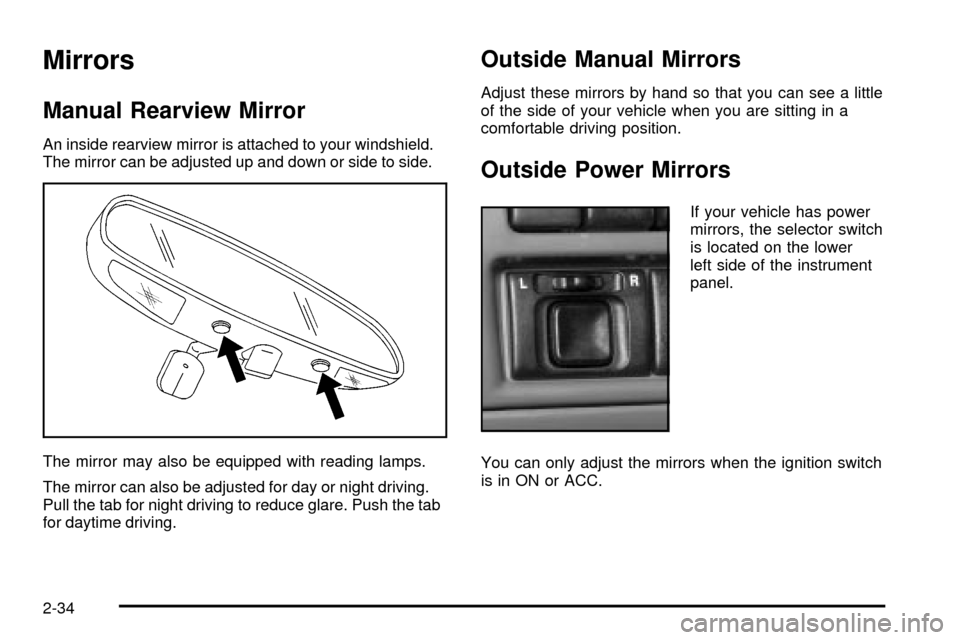
Manual Rearview Mirror
An inside rearview mirror is attached to your windshield.
The mirror can be adjusted up and down or side to side.
The mirror may also be equipped with reading lamps.
The mirror can also be adjusted for day or night driving.
Pull the tab for night driving to reduce glare. Push the tab
for daytime driving.
Outside Manual Mirrors
Adjust these mirrors by hand so that you can see a little
of the side of your vehicle when you are sitting in a
comfortable driving position.
Outside Power Mirrors
If your vehicle has power
mirrors, the selector switch
is located on the lower
left side of the instrument
panel.
You can only adjust the mirrors when the ignition switch
is in ON or ACC.
2-34
Page 103 of 372

To adjust the mirrors do the following:
1. Move the selector switch to the L (left) or R (right)
to select the mirror you wish to adjust.
2. Press the outer part of the four-way control pad,
located below the selector switch, that coincides
with the direction you want the mirror to go.
3. Return the selector switch to the center position to
help prevent moving the mirror accidentally.
Outside Convex Mirror
Your passenger's side mirror is convex. A convex
mirror's surface is curved so you can see more from the
driver's seat.
{CAUTION:
A convex mirror can make things (like other
vehicles) look farther away than they really are.
If you cut too sharply into the right lane, you
could hit a vehicle on your right. Check your
inside mirror or glance over your shoulder
before changing lanes.
Storage Areas
Glove Box
Use your key to lock and unlock the glove box. To open
the glove box, pull the latch toward you.
The glove box may have a two-position detent for
opening the door. Lower the door to the ®rst detent for
access to the glove box. Pull it to the next detent
for further access.
Cupholder(s)
Two cupholders are on the center console next to the
parking brake lever.
Coinholder(s)
Your instrument panel may have two coinholders
located to the left of the steering wheel.
2-35
Page 115 of 372

The main components of your instrument panel are the following:
A. Side Defroster Outlets. See
Outlet Adjustment on
page 3-21.
B. Air Outlets. See
Outlet Adjustment on page 3-21.
C. Turn Signal/Multifunction Lever. See
Turn
Signal/Multifunction Lever on page 3-5.
D. Instrument Panel Cluster. See
Instrument Panel
Cluster on page 3-25.
E. Windshield Wipers Lever. See ªWindshield Wipersº
under
Turn Signal/Multifunction Lever on page 3-5.
F. Hazard Button. See
Hazard Warning Flashers
on page 3-4.
G. Rear Window Defogger Button (If Equipped).
See ªRear Window Defoggerº under
Climate Control
System on page 3-18.
H. Cruise Control Button (If Equipped). See ªCruise
Controlº under
Turn Signal/Multifunction Lever
on page 3-5.
I. Climate Controls. See
Climate Control System on
page 3-18.
J. Rear Window Washer/Wiper Button (If Equipped).
See ªRear Window Washer/Wiperº under
Turn
Signal/Multifunction Lever on page 3-5.
K. Coinholder (If Equipped). See
Coinholder(s) on
page 2-35.L. Outside Power Mirrors (If Equipped). See
Outside
Power Mirrors on page 2-34.
M. Instrument Panel Brightness Thumbwheel.
See ªInstrument Panel Brightnessº under
Interior
Lamps on page 3-15.
N. Hood Release. See
Hood Release on page 5-10.
O. Instrument Panel Fuse Block. See ªInstrument Panel
Fuse Blockº under
Fuses and Circuit Breakers on
page 5-89.
P. Ignition Switch. See
Ignition Positions on page 2-15.
Q. Cigarette Lighter/Accessory Power Outlet
(If Equipped). See
Accessory Power Outlets on
page 3-17.
R. Power Mode Selector Button (If Equipped).
See ªPower Modeº under
Automatic Transmission
Operation on page 2-19.
S. Shift Lever. See
Shifting Into Park (P) on page 2-28.
T. Ashtray. See
Ashtrays and Cigarette Lighter on
page 3-17.
U. Audio System (If Equipped). See
Audio System(s)
on page 3-37.
V. Vent Shut-off Thumbwheel. See
Outlet Adjustment
on page 3-21.
3-3
Page 128 of 372

Entry Lighting
If your vehicle has remote keyless entry, it is equipped
with an entry lighting feature that controls your dome
lamp (and cargo lamp, if equipped). For the dome lamp
to operate as described below, the switch must be in
the middle position:
Your interior lamps will come on and stay on for a set
time whenever you press the UNLOCK button on
the remote keyless entry transmitter.
If you open any door, the lamps will stay on while
the door is open, then turn off automatically about
40 seconds after the last door is closed. If you press the
UNLOCK button on the remote keyless entry transmitter
and don't open a door, the lamps will come on and
then turn off after about 40 seconds.
The lamps will turn off immediately if you turn the
ignition key to ON. When the ignition is on, the entry
lighting feature is inactive. The interior lamps will come
on only if they are turned on by the dome lamp
switch or one of the doors is opened.
When you press the LOCK button on the remote keyless
entry transmitter, the interior lamps will come on for about
three seconds, and then shut off.
Reading Lamps
Your vehicle's inside rearview mirror may have reading
lamps.
Push the buttons on the bottom of the mirror to turn the
reading lamps on and off.
Cargo Lamp
Some four-door models are equipped with a cargo
lamp. The cargo lamp comes on when any door
is opened, and goes off when all doors are shut.
3-16
Page 170 of 372

·Do not get too close to the vehicle you want to
pass while you are awaiting an opportunity. For one
thing, following too closely reduces your area of
vision, especially if you are following a larger
vehicle. Also, you will not have adequate space if
the vehicle ahead suddenly slows or stops.
Keep back a reasonable distance.
·When it looks like a chance to pass is coming up,
start to accelerate but stay in the right lane and
do not get too close. Time your move so you will be
increasing speed as the time comes to move into
the other lane. If the way is clear to pass, you
will have a ªrunning startº that more than makes up
for the distance you would lose by dropping
back. And if something happens to cause you to
cancel your pass, you need only slow down
and drop back again and wait for another
opportunity.
·If other vehicles are lined up to pass a slow vehicle,
wait your turn. But take care that someone is not
trying to pass you as you pull out to pass the slow
vehicle. Remember to glance over your shoulder
and check the blind spot.
·Check your mirrors, glance over your shoulder, and
start your left lane change signal before moving out
of the right lane to pass. When you are far enough
ahead of the passed vehicle to see its front in your
inside mirror, activate your right lane change signal
and move back into the right lane. (Remember that
your right outside mirror is convex. The vehicle you
just passed may seem to be farther away from you
than it really is.)
·Try not to pass more than one vehicle at a time on
two-lane roads. Reconsider before passing the next
vehicle.
·Do not overtake a slowly moving vehicle too rapidly.
Even though the brake lamps are not ¯ashing, it may
be slowing down or starting to turn.
·If you are being passed, make it easy for the
following driver to get ahead of you. Perhaps you can
ease a little to the right.
4-14
Page 171 of 372

Loss of Control
Let us review what driving experts say about what
happens when the three control systems (brakes,
steering and acceleration) do not have enough friction
where the tires meet the road to do what the driver
has asked.
In any emergency, do not give up. Keep trying to steer
and constantly seek an escape route or area of less
danger.
Skidding
In a skid, a driver can lose control of the vehicle.
Defensive drivers avoid most skids by taking reasonable
care suited to existing conditions, and by not ªoverdrivingº
those conditions. But skids are always possible.
The three types of skids correspond to your vehicle's
three control systems. In the braking skid, your wheels
are not rolling. In the steering or cornering skid, too much
speed or steering in a curve causes tires to slip and lose
cornering force. And in the acceleration skid, too much
throttle causes the driving wheels to spin.
A cornering skid and an acceleration skid are best
handled by easing your foot off the accelerator pedal.If your vehicle starts to slide, ease your foot off the
accelerator pedal and quickly steer the way you want
the vehicle to go. If you start steering quickly enough,
your vehicle may straighten out. Always be ready
for a second skid if it occurs.
Of course, traction is reduced when water, snow, ice,
gravel or other material is on the road. For safety,
you will want to slow down and adjust your driving to
these conditions. It is important to slow down on slippery
surfaces because stopping distance will be longer and
vehicle control more limited.
While driving on a surface with reduced traction,
try your best to avoid sudden steering, acceleration or
braking (including engine braking by shifting to a
lower gear). Any sudden changes could cause the tires
to slide. You may not realize the surface is slippery
until your vehicle is skidding. Learn to recognize warning
clues Ð such as enough water, ice or packed snow
on the road to make a ªmirrored surfaceº Ð and slow
down when you have any doubt.
If you have the anti-lock braking system, remember:
It helps avoid only the braking skid. If you do not have
anti-lock, then in a braking skid (where the wheels
are no longer rolling), release enough pressure on the
brakes to get the wheels rolling again. This restores
steering control. Push the brake pedal down steadily
when you have to stop suddenly. As long as the wheels
are rolling, you will have steering control.
4-15
Page 187 of 372

Here are some tips on night driving.
·Drive defensively.
·Don't drink and drive.
·Adjust your inside rearview mirror to reduce the
glare from headlamps behind you.
·Since you can't see as well, you may need to slow
down and keep more space between you and
other vehicles.
·Slow down, especially on higher speed roads. Your
headlamps can light up only so much road ahead.
·In remote areas, watch for animals.
·If you're tired, pull off the road in a safe place
and rest.
No one can see as well at night as in the daytime.
But as we get older these differences increase.
A 50-year-old driver may require at least twice as much
light to see the same thing at night as a 20-year-old.
What you do in the daytime can also affect your night
vision. For example, if you spend the day in bright
sunshine you are wise to wear sunglasses. Your eyes
will have less trouble adjusting to night. But if you're
driving, don't wear sunglasses at night. They may
cut down on glare from headlamps, but they also make
a lot of things invisible.You can be temporarily blinded by approaching
headlamps. It can take a second or two, or even
several seconds, for your eyes to readjust to the dark.
When you are faced with severe glare (as from a
driver who doesn't lower the high beams, or a vehicle
with misaimed headlamps), slow down a little.
Avoid staring directly into the approaching headlamps.
Keep your windshield and all the glass on your
vehicle clean Ð inside and out. Glare at night is made
much worse by dirt on the glass. Even the inside of
the glass can build up a ®lm caused by dust. Dirty glass
makes lights dazzle and ¯ash more than clean glass
would, making the pupils of your eyes contract
repeatedly.
Remember that your headlamps light up far less of a
roadway when you are in a turn or curve. Keep your eyes
moving; that way, it's easier to pick out dimly lighted
objects. Just as your headlamps should be checked
regularly for proper aim, so should your eyes be
examined regularly. Some drivers suffer from night
blindness Ð the inability to see in dim light Ð and aren't
even aware of it.
4-31