instrument panel CHEVROLET TRACKER 2003 2.G Owner's Manual
[x] Cancel search | Manufacturer: CHEVROLET, Model Year: 2003, Model line: TRACKER, Model: CHEVROLET TRACKER 2003 2.GPages: 372, PDF Size: 2.65 MB
Page 123 of 372

Reducing Speed While Using Cruise
Control
To reduce your speed, turn the switch and hold it down
in the COAST SET position until you reach the lower
speed you want, then release the switch.
Passing Another Vehicle While Using
Cruise Control
Use the accelerator pedal to increase your speed.
When you take your foot off the pedal, your vehicle will
slow down to the cruise control speed you set earlier.
Using Cruise Control on Hills
How well your cruise control will work on hills depends
upon your speed, load and the steepness of the
hills. When going up steep hills, you may have to step
on the accelerator pedal to maintain your speed.
When going downhill, you may have to brake or shift
to a lower gear to keep your speed down. Of course,
applying the brake suspends cruise control. Many
drivers ®nd this to be too much trouble and don't use
cruise control on steep hills.
Suspending Cruise Control
There are two ways to suspend cruise control:
·Step lightly on the brake pedal, or push the clutch
pedal if you have a manual transmission.
·Push in the CANCEL button on the end of the
cruise control lever.
Ending Cruise Control
To end cruise control press CRUISE ON/OFF on the
instrument panel.
Erasing Speed Memory
Cruise control set speed memory is erased when you
turn off the CRUISE ON/OFF switch or anytime you turn
the ignition off.
3-11
Page 124 of 372

Exterior Lamps
The lever on the left side of the steering column
operates the exterior lamps.
Turn the outside part of the lever to operate the lamps.The exterior lamps control has three positions:
OFF:Turn the control to this position to turn off all
lamps, except the Daytime Running Lamps (DRL) or
if the Automatic Headlamp System is working.
;(Parking Lamps):Turn the control to this position
to turn on the parking lamps, together with the
following:
·Sidemarker Lamps
·Taillamps
·License Plate Lamp
·Instrument Panel Lights
P(Headlamps):Turn the control to this position to
turn on the headlamps, together with the previously
listed lamps and lights.
3-12
Page 125 of 372

Daytime Running Lamps
Daytime Running Lamps (DRL) can make it easier for
others to see the front of your vehicle during the
day. DRL can be helpful in many different driving
conditions, but they can be especially helpful in the short
periods after dawn and before sunset. Fully functional
daytime running lamps are required on all vehicles
®rst sold in Canada.
The DRL system will make your headlamps come on at
a reduced brightness when the three following
conditions are met:
·The ignition is on with the engine running,
·the exterior lamps control is off or the parking lights
are on, and
·the parking brake is released.
When the DRL are on, only your headlamps will be on
at a reduced brightness. The taillamps, sidemarker
and other lamps won't be on. Your instrument panel
won't be lit up either.When you move the exterior lamps control to the
headlamp position, your DRL will go off and your
headlamps will come on. The other lamps that come on
with your headlamps will also come on.
When it begins to get dark, the headlamps will
automatically switch from DRL to the regular headlamps.
See ªAutomatic Headlamp Systemº following.
When you turn the exterior lamp control to off, the
regular lamps will go off and your headlamps will change
to the reduced brightness of DRL provided it is not
dark outside. DRL will also come on if only the parking
lamps are being used.
As with any vehicle, you should turn on the regular
headlamp system when you need it.
3-13
Page 126 of 372

Automatic Headlamp System
Your vehicle is equipped with an automatic light sensor
on top of the instrument panel, on the passenger's
side of the vehicle, so be sure it is not covered. If it is,
the headlamps will remain on continuously.
There is a delay in the transition between the daytime
and nighttime operation of the DRL and the Automatic
Headlamp Systems so that driving under bridges or
bright overhead street lights does not affect the system.
The DRL and Automatic Headlamp Systems will only
be affected when the light sensor sees a change
in lighting lasting longer than this delay.
When it is dark enough outside, or you are driving
through a parking garage, heavy overcast weather
or a tunnel, the system will turn on your low-beam
headlamps at normal brightness. Along with your
vehicle's headlamps, the taillamps, sidemarker, parking
lamps and the instrument panel lights will also turn
on. The radio display will dim.
As with any vehicle, you should turn on the regular
headlamps when you need them.To temporarily disable your vehicle's DRL and Automatic
Headlamp Systems functions, do the following:
1. Before turning the ignition key to ON or START,
set the parking brake.
2. Then turn the ignition key to ON or START.
·The Automatic Headlamp System will not turn on
under any conditions, even in darkness.
·The DRL will not turn on.
The DRL and Automatic Headlamp System functions will
stay off with the ignition on, until you release the parking
brake. Once the parking brake is released the DRL will
turn on if it is daylight or the Automatic Headlamp System
will turn on if it is dark enough outside.
If you turn the ignition key to ON or START and then set
the parking brake, the DRL will turn off (in all conditions)
and the Automatic Headlamp System will remain on
(if dark enough outside). Any other uses of the parking
brake after the engine is turned on will have no effect on
the normal Automatic Headlamp System operation.
Headlamps On Reminder
If you turn the ignition off, remove the key, open the
door and leave the lamps on, a tone will remind you to
turn off your lamps.
3-14
Page 127 of 372
Interior Lamps
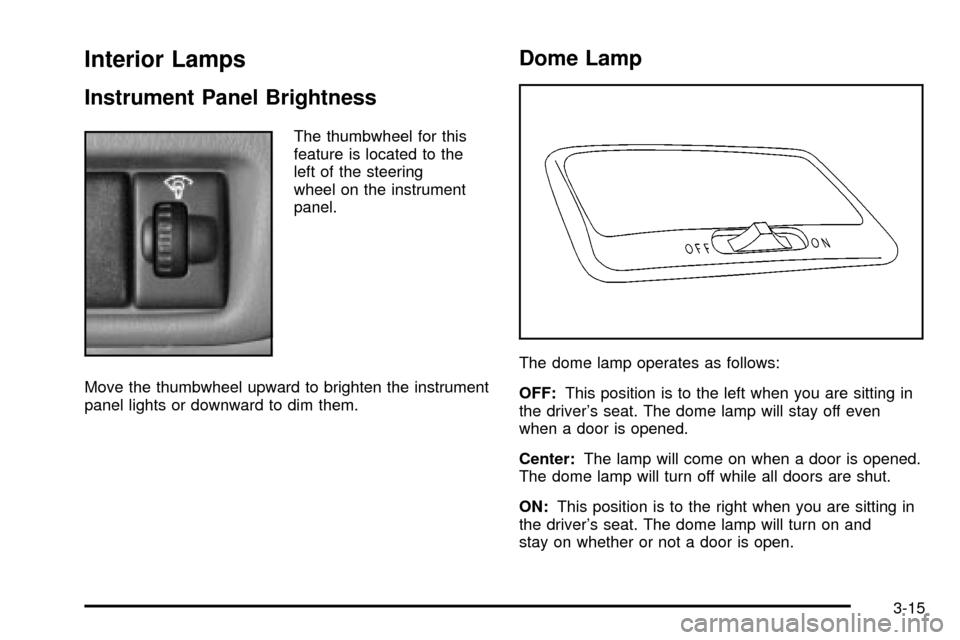
Instrument Panel Brightness
The thumbwheel for this
feature is located to the
left of the steering
wheel on the instrument
panel.
Move the thumbwheel upward to brighten the instrument
panel lights or downward to dim them.
Dome Lamp
The dome lamp operates as follows:
OFF:This position is to the left when you are sitting in
the driver's seat. The dome lamp will stay off even
when a door is opened.
Center:The lamp will come on when a door is opened.
The dome lamp will turn off while all doors are shut.
ON:This position is to the right when you are sitting in
the driver's seat. The dome lamp will turn on and
stay on whether or not a door is open.
3-15
Page 130 of 372

Climate Controls
Climate Control System
With this system you can control the heating, cooling
and ventilation for your vehicle.
Operation
9
(Fan):Move the lever away from OFF to turn the
system on. Slide the top right lever to the left or right to
increase or decrease the fan speed.If the air¯ow seems low when the fan is at the
highest setting, the passenger compartment air ®lter,
if equipped, may need to be replaced. For more
information, see
Passenger Compartment Air Filter on
page 3-22andShort Trip/City Scheduled Maintenance
on page 6-7.
Slide the top left lever to the left or right to direct the
air¯ow inside of your vehicle.
To change the current mode, select one of the following:
H(Vent):This mode directs air to the instrument
panel outlets.
)(Bi-Level):This mode directs most of the air to the
instrument panel outlets, and then directs the remaining
air to the ¯oor outlets.
6(Floor):This mode directs half of the air to the
¯oor outlets with some air directed to the outboard
outlets (for the side windows) and some air directed to
the windshield.
This lever can also be used to select defog or defrost
mode. Information on defogging and defrosting can
be found later in this section.
3-18
Page 132 of 372
Defogging and Defrosting
Fog on the inside of windows is a result of high humidity
(moisture) condensing on the cool window glass.
This can be minimized if the climate control system is
used properly. There are two modes to clear fog or frost
from your windshield. Use the defog mode to clear
the windows of fog or moisture and warm the
passengers. Use the defrost mode to remove fog or
frost from the windshield more quickly.
-(Defog):This mode directs the air between the
windshield, side windows, instrument panel outlets and
the ¯oor outlets. The air-conditioning compressor
will run automatically in this setting without pressing
A/C, unless the outside temperature is at or below
freezing.
1(Defrost):This mode directs the air to the
windshield and the side windows. The air-conditioning
compressor will run automatically in this setting without
pressing A/C, unless the outside temperature is at or
below freezing. Do not drive the vehicle until all the
windows are clear.
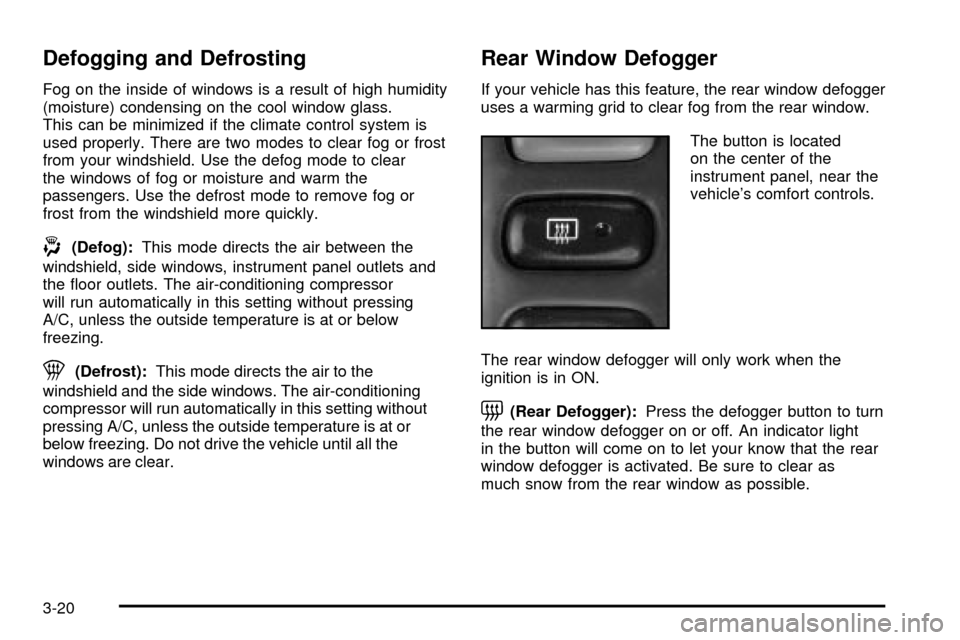
Rear Window Defogger
If your vehicle has this feature, the rear window defogger
uses a warming grid to clear fog from the rear window.
The button is located
on the center of the
instrument panel, near the
vehicle's comfort controls.
The rear window defogger will only work when the
ignition is in ON.
=(Rear Defogger):Press the defogger button to turn
the rear window defogger on or off. An indicator light
in the button will come on to let your know that the rear
window defogger is activated. Be sure to clear as
much snow from the rear window as possible.
3-20
Page 133 of 372
The rear window defogger will turn off automatically
about 15 minutes after the button is pressed.
The defogger can also be turned off by pressing the
button again or by turning off the engine.
Notice:Using a razor blade or sharp object to clear
the inside rear window may damage the rear
window defogger. Repairs would not be covered by
your warranty. Do not clear the inside of the rear
window with sharp objects.
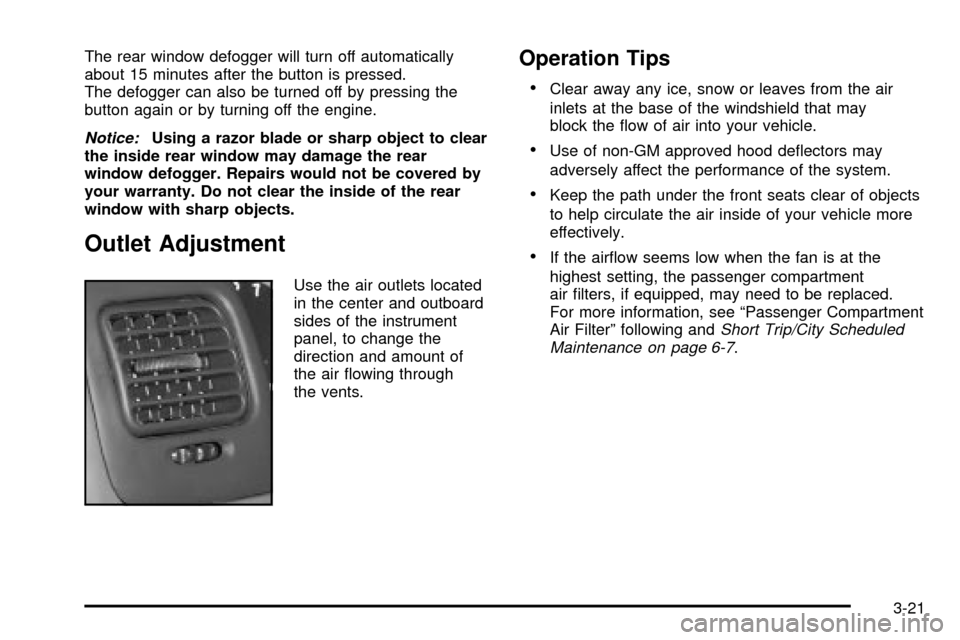
Outlet Adjustment
Use the air outlets located
in the center and outboard
sides of the instrument
panel, to change the
direction and amount of
the air ¯owing through
the vents.
Operation Tips
·Clear away any ice, snow or leaves from the air
inlets at the base of the windshield that may
block the ¯ow of air into your vehicle.
·Use of non-GM approved hood de¯ectors may
adversely affect the performance of the system.
·Keep the path under the front seats clear of objects
to help circulate the air inside of your vehicle more
effectively.
·If the air¯ow seems low when the fan is at the
highest setting, the passenger compartment
air ®lters, if equipped, may need to be replaced.
For more information, see ªPassenger Compartment
Air Filterº following and
Short Trip/City Scheduled
Maintenance on page 6-7.
3-21
Page 137 of 372

Instrument Panel Cluster
Your instrument cluster is designed to let you know at a glance how your vehicle is running. You'll know how fast
you're going, about how much fuel you have left, and many other things you'll need to know to drive safely and
economically.
United States cluster shown, Canada similar
3-25
Page 139 of 372
Air Bag Readiness Light
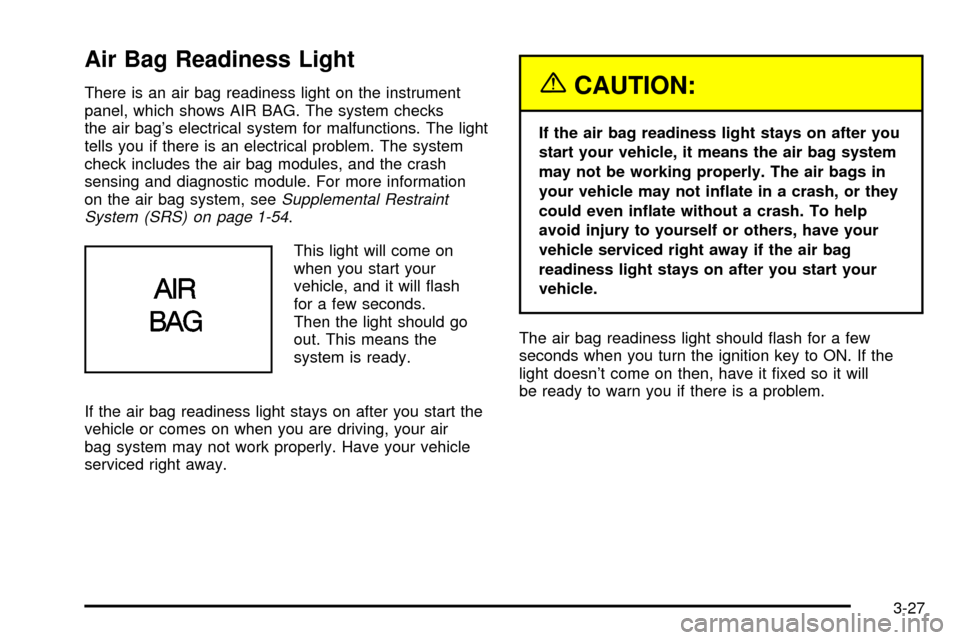
There is an air bag readiness light on the instrument
panel, which shows AIR BAG. The system checks
the air bag's electrical system for malfunctions. The light
tells you if there is an electrical problem. The system
check includes the air bag modules, and the crash
sensing and diagnostic module. For more information
on the air bag system, see
Supplemental Restraint
System (SRS) on page 1-54.
This light will come on
when you start your
vehicle, and it will ¯ash
for a few seconds.
Then the light should go
out. This means the
system is ready.
If the air bag readiness light stays on after you start the
vehicle or comes on when you are driving, your air
bag system may not work properly. Have your vehicle
serviced right away.
{CAUTION:
If the air bag readiness light stays on after you
start your vehicle, it means the air bag system
may not be working properly. The air bags in
your vehicle may not in¯ate in a crash, or they
could even in¯ate without a crash. To help
avoid injury to yourself or others, have your
vehicle serviced right away if the air bag
readiness light stays on after you start your
vehicle.
The air bag readiness light should ¯ash for a few
seconds when you turn the ignition key to ON. If the
light doesn't come on then, have it ®xed so it will
be ready to warn you if there is a problem.
3-27