child seat CHEVROLET TRACKER 2004 2.G User Guide
[x] Cancel search | Manufacturer: CHEVROLET, Model Year: 2004, Model line: TRACKER, Model: CHEVROLET TRACKER 2004 2.GPages: 374, PDF Size: 2.57 MB
Page 46 of 374
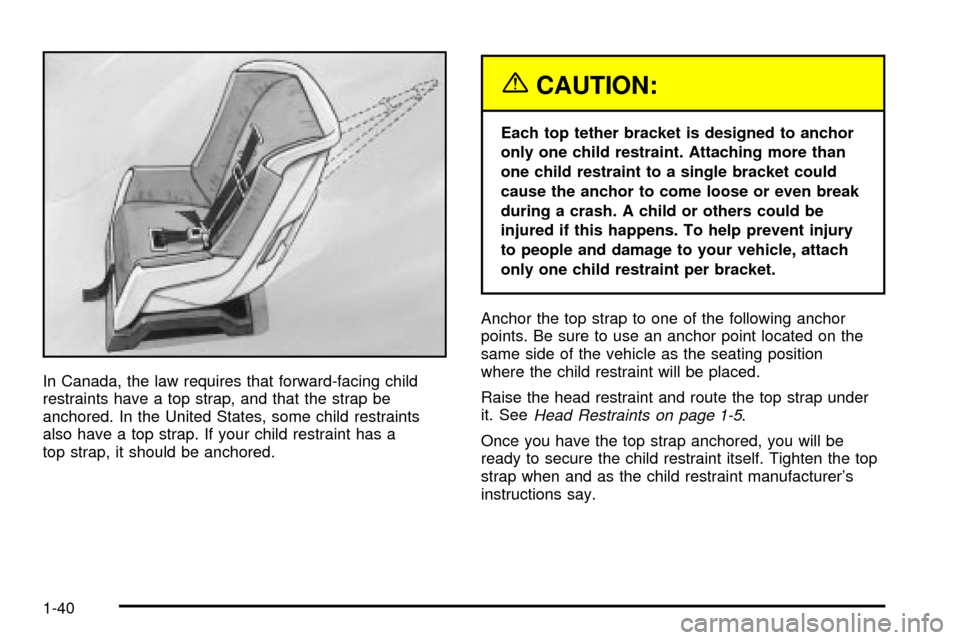
In Canada, the law requires that forward-facing child
restraints have a top strap, and that the strap be
anchored. In the United States, some child restraints
also have a top strap. If your child restraint has a
top strap, it should be anchored.
{CAUTION:
Each top tether bracket is designed to anchor
only one child restraint. Attaching more than
one child restraint to a single bracket could
cause the anchor to come loose or even break
during a crash. A child or others could be
injured if this happens. To help prevent injury
to people and damage to your vehicle, attach
only one child restraint per bracket.
Anchor the top strap to one of the following anchor
points. Be sure to use an anchor point located on the
same side of the vehicle as the seating position
where the child restraint will be placed.
Raise the head restraint and route the top strap under
it. See
Head Restraints on page 1-5.
Once you have the top strap anchored, you will be
ready to secure the child restraint itself. Tighten the top
strap when and as the child restraint manufacturer's
instructions say.
1-40
Page 47 of 374
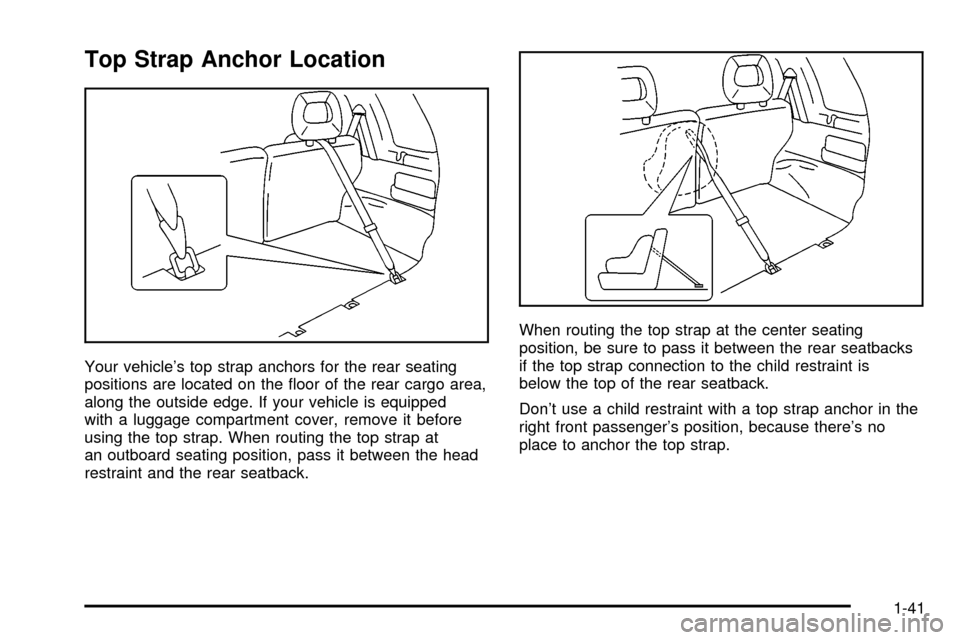
Top Strap Anchor Location
Your vehicle's top strap anchors for the rear seating
positions are located on the ¯oor of the rear cargo area,
along the outside edge. If your vehicle is equipped
with a luggage compartment cover, remove it before
using the top strap. When routing the top strap at
an outboard seating position, pass it between the head
restraint and the rear seatback.When routing the top strap at the center seating
position, be sure to pass it between the rear seatbacks
if the top strap connection to the child restraint is
below the top of the rear seatback.
Don't use a child restraint with a top strap anchor in the
right front passenger's position, because there's no
place to anchor the top strap.
1-41
Page 48 of 374
Lower Anchorages and Top Tethers
for Children (LATCH System)
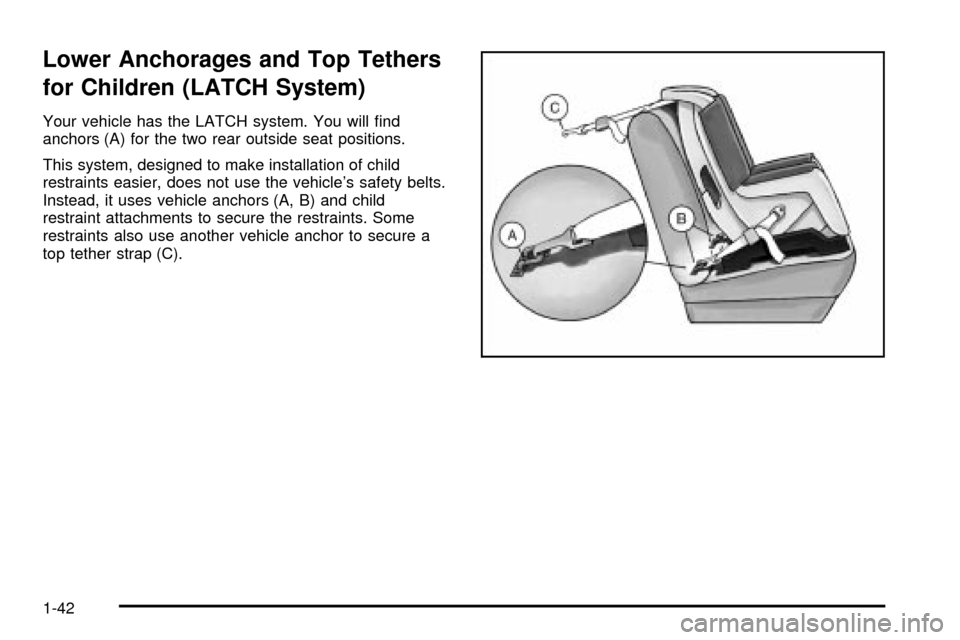
Your vehicle has the LATCH system. You will ®nd
anchors (A) for the two rear outside seat positions.
This system, designed to make installation of child
restraints easier, does not use the vehicle's safety belts.
Instead, it uses vehicle anchors (A, B) and child
restraint attachments to secure the restraints. Some
restraints also use another vehicle anchor to secure a
top tether strap (C).
1-42
Page 49 of 374
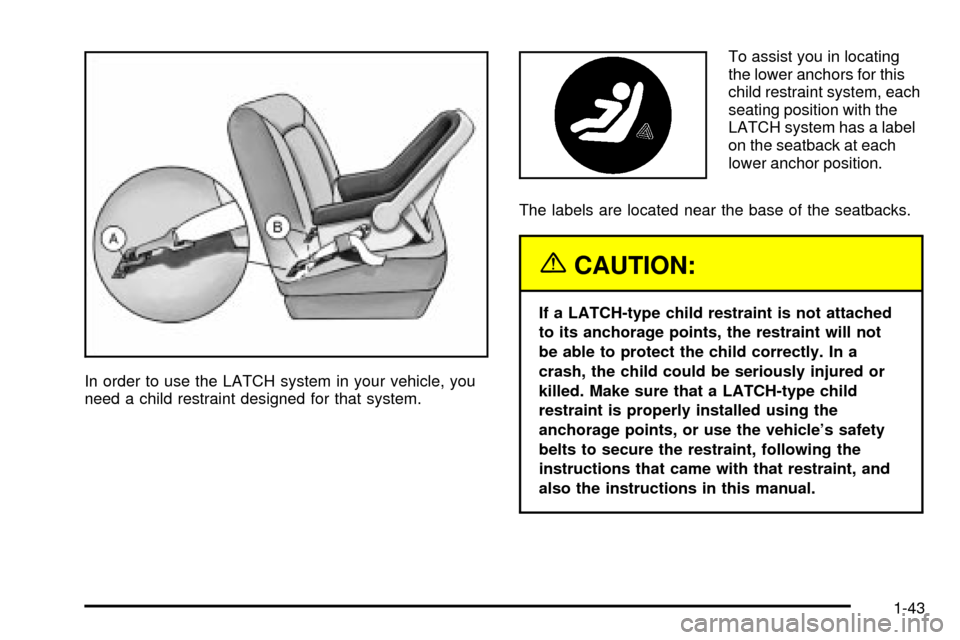
In order to use the LATCH system in your vehicle, you
need a child restraint designed for that system.To assist you in locating
the lower anchors for this
child restraint system, each
seating position with the
LATCH system has a label
on the seatback at each
lower anchor position.
The labels are located near the base of the seatbacks.
{CAUTION:
If a LATCH-type child restraint is not attached
to its anchorage points, the restraint will not
be able to protect the child correctly. In a
crash, the child could be seriously injured or
killed. Make sure that a LATCH-type child
restraint is properly installed using the
anchorage points, or use the vehicle's safety
belts to secure the restraint, following the
instructions that came with that restraint, and
also the instructions in this manual.
1-43
Page 50 of 374

Securing a Child Restraint Designed
for the LATCH System
1. Find the LATCH anchorages for the seating
position you want to use, where the bottom of the
seatback meets the back of the seat cushion.
2. Put the child restraint on the seat.
3. Attach and tighten the LATCH attachments on the
child restraint to the LATCH anchorages in the
vehicle. The child restraint instructions will show
you how.
4. If the child restraint is forward-facing, attach and
tighten the top tether to the top tether anchorage.
The child restraint instructions will show you
how. Also see
Top Strap on page 1-39.
5. Push and pull the child restraint in different
directions to be sure it is secure.
To remove the child restraint, simply unhook the top
tether from the top tether anchorage and then
disconnect the LATCH attachments from the LATCH
anchorages.
Securing a Child Restraint in a Rear
Outside Seat Position
If your child restraint is equipped with the LATCH
system, seeLower Anchorages and Top Tethers for
Children (LATCH System) on page 1-42. SeeTop Strap
on page 1-39if the child restraint has one.
If your child restraint does not have the LATCH system,
you will be using the lap-shoulder belt to secure the
child restraint in this position. Be sure to follow the
instructions that came with the child restraint. Secure
the child in the child restraint when and as the
instructions say.
1. Put the restraint on the seat.
2. Pick up the latch plate, and run the lap and shoulder
portions of the vehicle's safety belt through or
around the restraint. The child restraint instructions
will show you how.
1-44
Page 53 of 374
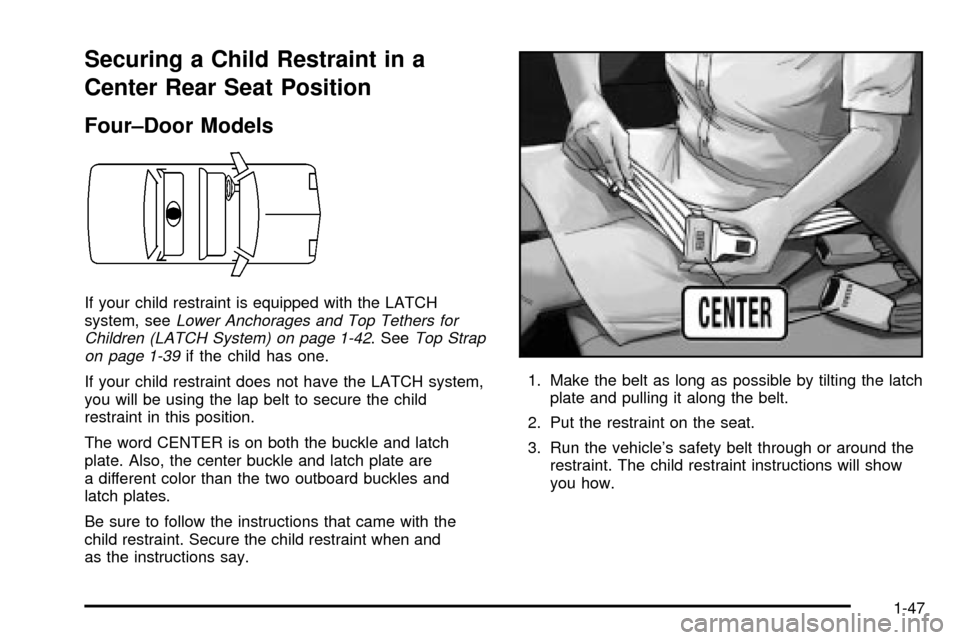
Securing a Child Restraint in a
Center Rear Seat Position
Four±Door Models
If your child restraint is equipped with the LATCH
system, seeLower Anchorages and Top Tethers for
Children (LATCH System) on page 1-42. SeeTop Strap
on page 1-39if the child has one.
If your child restraint does not have the LATCH system,
you will be using the lap belt to secure the child
restraint in this position.
The word CENTER is on both the buckle and latch
plate. Also, the center buckle and latch plate are
a different color than the two outboard buckles and
latch plates.
Be sure to follow the instructions that came with the
child restraint. Secure the child restraint when and
as the instructions say.1. Make the belt as long as possible by tilting the latch
plate and pulling it along the belt.
2. Put the restraint on the seat.
3. Run the vehicle's safety belt through or around the
restraint. The child restraint instructions will show
you how.
1-47
Page 55 of 374
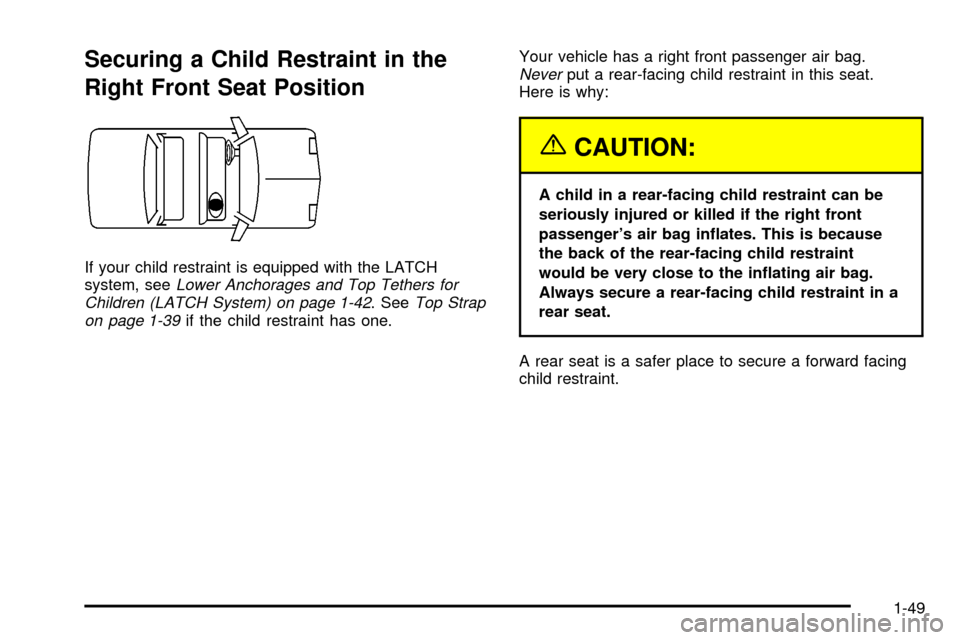
Securing a Child Restraint in the
Right Front Seat Position
If your child restraint is equipped with the LATCH
system, seeLower Anchorages and Top Tethers for
Children (LATCH System) on page 1-42. SeeTop Strap
on page 1-39if the child restraint has one.Your vehicle has a right front passenger air bag.
Neverput a rear-facing child restraint in this seat.
Here is why:
{CAUTION:
A child in a rear-facing child restraint can be
seriously injured or killed if the right front
passenger's air bag in¯ates. This is because
the back of the rear-facing child restraint
would be very close to the in¯ating air bag.
Always secure a rear-facing child restraint in a
rear seat.
A rear seat is a safer place to secure a forward facing
child restraint.
1-49
Page 56 of 374
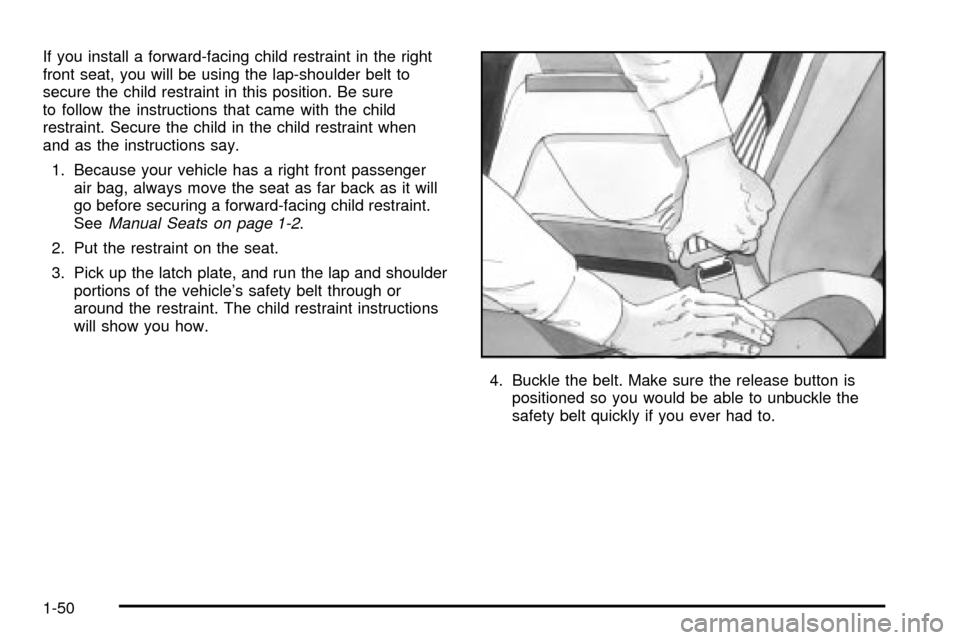
If you install a forward-facing child restraint in the right
front seat, you will be using the lap-shoulder belt to
secure the child restraint in this position. Be sure
to follow the instructions that came with the child
restraint. Secure the child in the child restraint when
and as the instructions say.
1. Because your vehicle has a right front passenger
air bag, always move the seat as far back as it will
go before securing a forward-facing child restraint.
See
Manual Seats on page 1-2.
2. Put the restraint on the seat.
3. Pick up the latch plate, and run the lap and shoulder
portions of the vehicle's safety belt through or
around the restraint. The child restraint instructions
will show you how.
4. Buckle the belt. Make sure the release button is
positioned so you would be able to unbuckle the
safety belt quickly if you ever had to.
1-50
Page 204 of 374
And, if you do have a heavy load, you should spread it
out. Don't carry more than 400 lbs. (181 kg) in your
rear area when four people are in your two-wheel-drive
vehicle. If you have a four-wheel-drive vehicle, don't
carry more than 200 lbs. (91 kg) in your rear area when
four people are in your vehicle.
{CAUTION:
Do not load your vehicle any heavier than the
GVWR, or either the maximum front or rear
GAWR. If you do, parts on your vehicle can
break, and it can change the way your vehicle
handles. These could cause you to lose
control and crash. Also, overloading can
shorten the life of your vehicle.
Notice:Overloading your vehicle may cause
damage. Repairs would not be covered by your
warranty. Do not overload your vehicle.
If you put things inside your vehicle Ð like suitcases,
tools, packages or anything else Ð they will go as fast
as the vehicle goes. If you have to stop or turn
quickly, or if there is a crash, they'll keep going.
{CAUTION:
Things you put inside your vehicle can strike
and injure people in a sudden stop or turn, or
in a crash.
·Put things in the cargo area of your
vehicle. Try to spread the weight evenly.
·Never stack heavier things, like suitcases,
inside the vehicle so that some of them
are above the tops of the seats.
·Do not leave an unsecured child restraint
in your vehicle.
·When you carry something inside the
vehicle, secure it whenever you can.
·Do not leave a seat folded down unless
you need to.
There's also important loading information for off-road
driving in this manual. See
Loading Your Vehicle
on page 4-51.
4-56
Page 362 of 374

Brake
Parking......................................................2-24
System Inspection.......................................6-29
System Warning Light..................................3-30
Brake Adjustment............................................5-41
Brake Fluid....................................................5-39
Brake Pedal Travel.........................................5-41
Brake Wear...................................................5-41
Brakes..........................................................5-39
Braking........................................................... 4-7
Braking in Emergencies...................................4-10
Break-In, New Vehicle.....................................2-12
Bulb Replacement...........................................5-51
Front Turn Signal and Parking Lamps.............5-53
Halogen Bulbs............................................5-51
Headlamps.................................................5-51
Rear Combination Lamps.............................5-54
Replacement Bulbs......................................5-55
Sidemarker Lamps.......................................5-53
Buying New Tires...........................................5-67
C
California Fuel.................................................. 5-5
Canada ± Customer Assistance.......................... 7-4
Canadian Owners................................................ ii
Canadian Roadside Assistance........................... 7-6
Canceling a Rear Door Security Lock.................. 2-9
Capacities and Speci®cations............................5-98Carbon Monoxide.....................4-40, 4-57, 2-9, 2-29
Care of
Safety Belts................................................5-88
Your CD Player...........................................3-45
Your CDs ...................................................3-45
Cargo Cover..................................................2-36
Cargo Lamp...................................................3-17
CD Messages................................................3-44
Center Passenger Position, Safety Belts.............1-24
Chains, Tires..................................................5-71
Charging System Light....................................3-30
Check
Engine Light...............................................3-33
Checking Brake Fluid......................................5-40
Checking Coolant............................................5-26
Checking Engine Oil........................................5-14
Checking Things Under the Hood......................5-10
Checking Your Restraint Systems......................1-59
Chemical Paint Spotting...................................5-91
Child Restraints
Child Restraint Systems...............................1-35
Infants and Young Children...........................1-31
Lower Anchorages and Top Tethers for
Children (LATCH System)..........................1-42
Older Children.............................................1-29
Securing a Child Restraint Designed for the
LATCH System........................................1-44
Securing a Child Restraint in a Center Rear
Seat Position...........................................1-47
2