child seat CHEVROLET TRACKER 2004 2.G Owners Manual
[x] Cancel search | Manufacturer: CHEVROLET, Model Year: 2004, Model line: TRACKER, Model: CHEVROLET TRACKER 2004 2.GPages: 374, PDF Size: 2.57 MB
Page 1 of 374

Seats and Restraint Systems........................... 1-1
Front Seats
............................................... 1-2
Rear Seats
............................................... 1-5
Safety Belts
.............................................. 1-9
Child Restraints
.......................................1-29
Supplemental Restraint System (SRS)
.........1-52
Restraint System Check
............................1-59
Features and Controls..................................... 2-1
Keys
........................................................ 2-2
Doors and Locks
....................................... 2-6
Windows
.................................................2-10
Starting and Operating Your Vehicle
...........2-12
Mirrors
....................................................2-31
Storage Areas
.........................................2-33
Instrument Panel............................................. 3-1
Instrument Panel Overview
.......................... 3-2
Climate Controls
......................................3-19
Warning Lights, Gages and Indicators
.........3-26
Audio System(s)
.......................................3-39Driving Your Vehicle....................................... 4-1
Your Driving, the Road, and Your Vehicle
..... 4-2
Towing
...................................................4-47
Service and Appearance Care.......................... 5-1
Service
..................................................... 5-3
Fuel
......................................................... 5-4
Checking Things Under the Hood
...............5-10
Rear Axle
...............................................5-48
Four-Wheel Drive
.....................................5-49
Bulb Replacement
....................................5-51
Tires
......................................................5-55
Appearance Care
.....................................5-85
Vehicle Identi®cation
.................................5-93
Electrical System
......................................5-93
Capacities and Speci®cations
.....................5-98
Normal Maintenance Replacement Parts
....5-100
Maintenance Schedule..................................... 6-1
Maintenance Schedule
................................ 6-2
Customer Assistance and Information.............. 7-1
Customer Assistance and Information
........... 7-2
Reporting Safety Defects
...........................7-10
Index................................................................ 1
2004 Chevrolet Tracker Owner ManualM
Page 7 of 374

Front Seats......................................................1-2
Manual Seats................................................1-2
Manual Lumbar..............................................1-3
Reclining Seatbacks........................................1-3
Head Restraints.............................................1-5
Rear Seats.......................................................1-5
Rear Seat Operation.......................................1-5
Safety Belts.....................................................1-9
Safety Belts: They Are for Everyone.................1-9
Questions and Answers About Safety Belts......1-13
How to Wear Safety Belts Properly.................1-14
Driver Position..............................................1-15
Safety Belt Use During Pregnancy..................1-23
Right Front Passenger Position.......................1-24
Center Passenger Position.............................1-24
Rear Seat Passengers..................................1-26
Safety Belt Extender.....................................1-28
Child Restraints.............................................1-29
Older Children..............................................1-29
Infants and Young Children............................1-31
Child Restraint Systems.................................1-35
Where to Put the Restraint.............................1-38
Top Strap....................................................1-39
Top Strap Anchor Location.............................1-41Lower Anchorages and Top Tethers for
Children (LATCH System)...........................1-42
Securing a Child Restraint Designed for the
LATCH System.........................................1-44
Securing a Child Restraint in a Rear Outside
Seat Position............................................1-44
Securing a Child Restraint in a Center Rear
Seat Position............................................1-47
Securing a Child Restraint in the Right Front
Seat Position............................................1-49
Supplemental Restraint System (SRS)..............1-52
Where Are the Air Bags?...............................1-54
When Should an Air Bag In¯ate?....................1-55
What Makes an Air Bag In¯ate?.....................1-55
How Does an Air Bag Restrain?.....................1-56
What Will You See After an Air Bag
In¯ates?...................................................1-56
Servicing Your Air Bag-Equipped Vehicle.........1-58
Adding Equipment to Your Air Bag-Equipped
Vehicle....................................................1-59
Restraint System Check..................................1-59
Checking Your Restraint Systems...................1-59
Replacing Restraint System Parts After
a Crash...................................................1-60
Section 1 Seats and Restraint Systems
1-1
Page 35 of 374
Child Restraints
Older Children
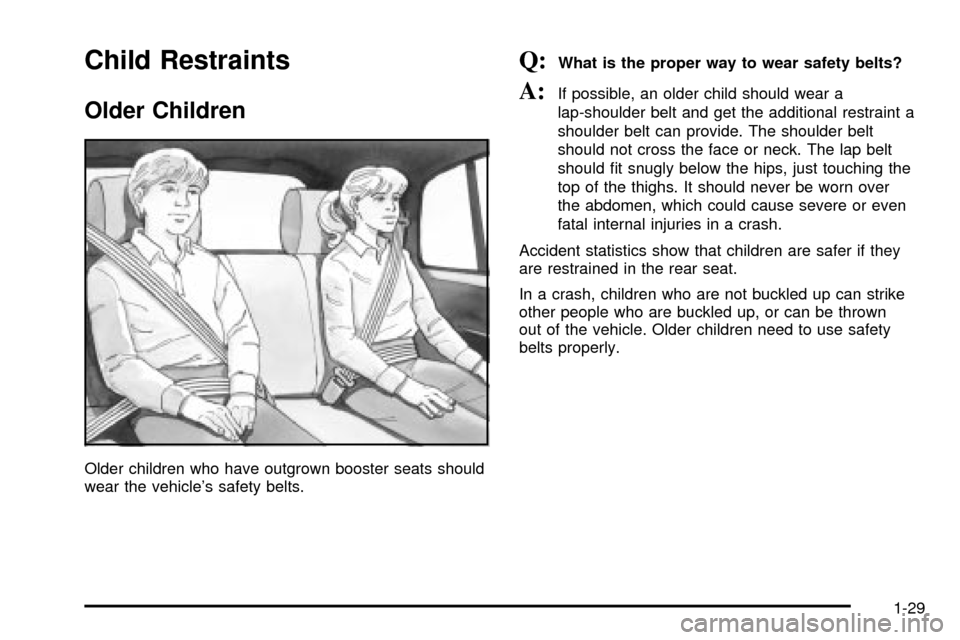
Older children who have outgrown booster seats should
wear the vehicle's safety belts.
Q:What is the proper way to wear safety belts?
A:If possible, an older child should wear a
lap-shoulder belt and get the additional restraint a
shoulder belt can provide. The shoulder belt
should not cross the face or neck. The lap belt
should ®t snugly below the hips, just touching the
top of the thighs. It should never be worn over
the abdomen, which could cause severe or even
fatal internal injuries in a crash.
Accident statistics show that children are safer if they
are restrained in the rear seat.
In a crash, children who are not buckled up can strike
other people who are buckled up, or can be thrown
out of the vehicle. Older children need to use safety
belts properly.
1-29
Page 36 of 374
{CAUTION:
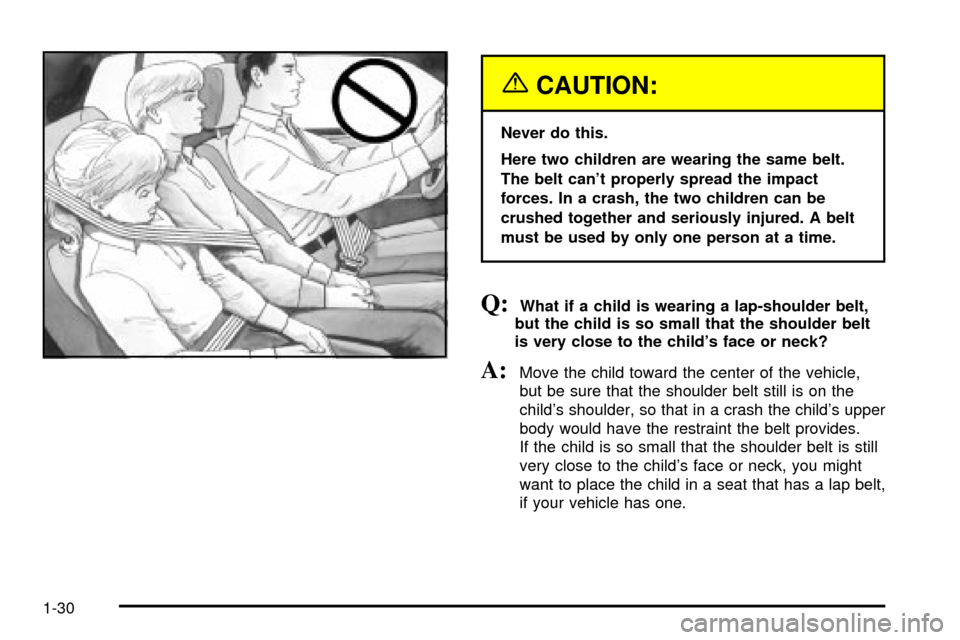
Never do this.
Here two children are wearing the same belt.
The belt can't properly spread the impact
forces. In a crash, the two children can be
crushed together and seriously injured. A belt
must be used by only one person at a time.
Q:What if a child is wearing a lap-shoulder belt,
but the child is so small that the shoulder belt
is very close to the child's face or neck?
A:Move the child toward the center of the vehicle,
but be sure that the shoulder belt still is on the
child's shoulder, so that in a crash the child's upper
body would have the restraint the belt provides.
If the child is so small that the shoulder belt is still
very close to the child's face or neck, you might
want to place the child in a seat that has a lap belt,
if your vehicle has one.
1-30
Page 37 of 374
{CAUTION:
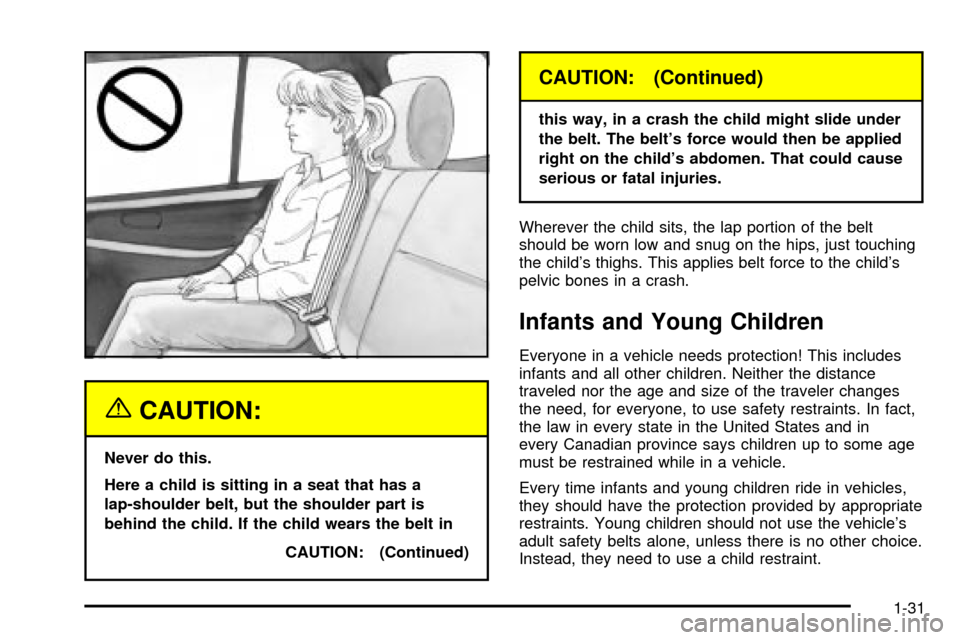
Never do this.
Here a child is sitting in a seat that has a
lap-shoulder belt, but the shoulder part is
behind the child. If the child wears the belt in
CAUTION: (Continued)
CAUTION: (Continued)
this way, in a crash the child might slide under
the belt. The belt's force would then be applied
right on the child's abdomen. That could cause
serious or fatal injuries.
Wherever the child sits, the lap portion of the belt
should be worn low and snug on the hips, just touching
the child's thighs. This applies belt force to the child's
pelvic bones in a crash.
Infants and Young Children
Everyone in a vehicle needs protection! This includes
infants and all other children. Neither the distance
traveled nor the age and size of the traveler changes
the need, for everyone, to use safety restraints. In fact,
the law in every state in the United States and in
every Canadian province says children up to some age
must be restrained while in a vehicle.
Every time infants and young children ride in vehicles,
they should have the protection provided by appropriate
restraints. Young children should not use the vehicle's
adult safety belts alone, unless there is no other choice.
Instead, they need to use a child restraint.
1-31
Page 40 of 374
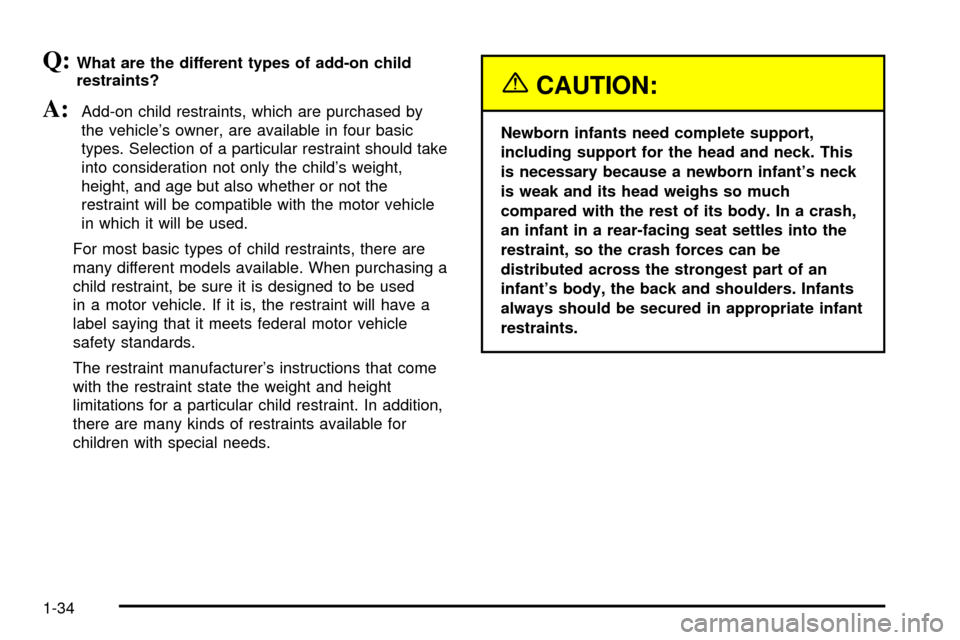
Q:What are the different types of add-on child
restraints?
A:Add-on child restraints, which are purchased by
the vehicle's owner, are available in four basic
types. Selection of a particular restraint should take
into consideration not only the child's weight,
height, and age but also whether or not the
restraint will be compatible with the motor vehicle
in which it will be used.
For most basic types of child restraints, there are
many different models available. When purchasing a
child restraint, be sure it is designed to be used
in a motor vehicle. If it is, the restraint will have a
label saying that it meets federal motor vehicle
safety standards.
The restraint manufacturer's instructions that come
with the restraint state the weight and height
limitations for a particular child restraint. In addition,
there are many kinds of restraints available for
children with special needs.
{CAUTION:
Newborn infants need complete support,
including support for the head and neck. This
is necessary because a newborn infant's neck
is weak and its head weighs so much
compared with the rest of its body. In a crash,
an infant in a rear-facing seat settles into the
restraint, so the crash forces can be
distributed across the strongest part of an
infant's body, the back and shoulders. Infants
always should be secured in appropriate infant
restraints.
1-34
Page 42 of 374
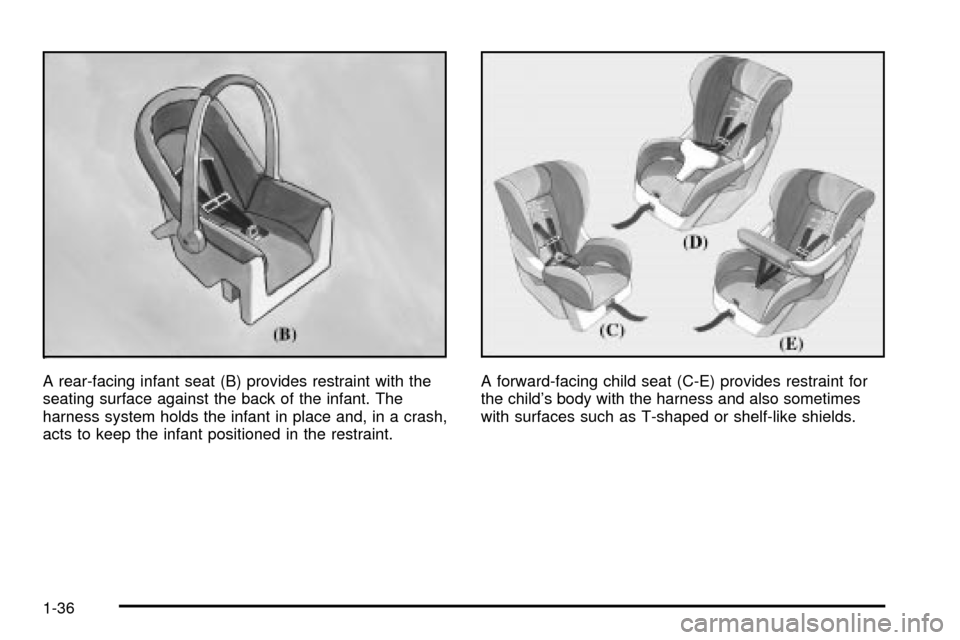
A rear-facing infant seat (B) provides restraint with the
seating surface against the back of the infant. The
harness system holds the infant in place and, in a crash,
acts to keep the infant positioned in the restraint.A forward-facing child seat (C-E) provides restraint for
the child's body with the harness and also sometimes
with surfaces such as T-shaped or shelf-like shields.
1-36
Page 43 of 374
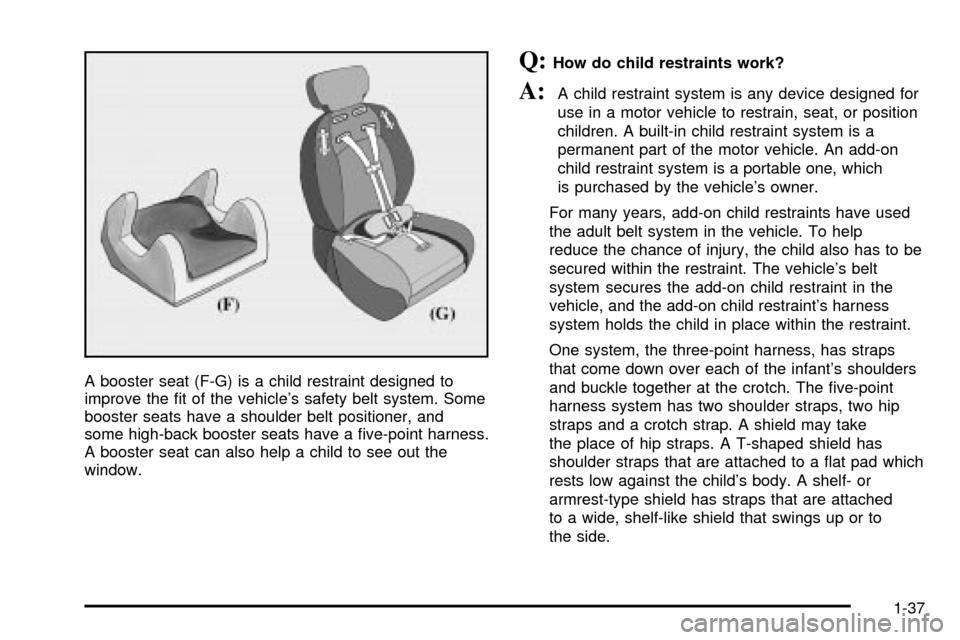
A booster seat (F-G) is a child restraint designed to
improve the ®t of the vehicle's safety belt system. Some
booster seats have a shoulder belt positioner, and
some high-back booster seats have a ®ve-point harness.
A booster seat can also help a child to see out the
window.
Q:How do child restraints work?
A:A child restraint system is any device designed for
use in a motor vehicle to restrain, seat, or position
children. A built-in child restraint system is a
permanent part of the motor vehicle. An add-on
child restraint system is a portable one, which
is purchased by the vehicle's owner.
For many years, add-on child restraints have used
the adult belt system in the vehicle. To help
reduce the chance of injury, the child also has to be
secured within the restraint. The vehicle's belt
system secures the add-on child restraint in the
vehicle, and the add-on child restraint's harness
system holds the child in place within the restraint.
One system, the three-point harness, has straps
that come down over each of the infant's shoulders
and buckle together at the crotch. The ®ve-point
harness system has two shoulder straps, two hip
straps and a crotch strap. A shield may take
the place of hip straps. A T-shaped shield has
shoulder straps that are attached to a ¯at pad which
rests low against the child's body. A shelf- or
armrest-type shield has straps that are attached
to a wide, shelf-like shield that swings up or to
the side.
1-37
Page 44 of 374
When choosing a child restraint, be sure the child
restraint is designed to be used in a vehicle. If it is, it
will have a label saying that it meets federal motor
vehicle safety standards.
Then follow the instructions for the restraint. You may
®nd these instructions on the restraint itself or in a
booklet, or both. These restraints use the belt system or
the LATCH system in your vehicle, but the child also
has to be secured within the restraint to help reduce the
chance of personal injury. When securing an add-on
child restraint, refer to the instructions that come with the
restraint which may be on the restraint itself or in a
booklet, or both, and to this manual. The child restraint
instructions are important, so if they are not available,
obtain a replacement copy from the manufacturer.Where to Put the Restraint
Accident statistics show that children are safer if they
are restrained in the rear rather than the front seat. We,
therefore, recommend that child restraints be secured
in a rear seat, including an infant riding in a rear-facing
infant seat, a child riding in a forward-facing child
seat and an older child riding in a booster seat.
Neverput a rear-facing child restraint in the front passenger
seat. Here's why:
{CAUTION:
A child in a rear-facing child restraint can be
seriously injured or killed if the right front
passenger's air bag in¯ates. This is because
the back of the rear-facing child restraint
would be very close to the in¯ating air bag.
Always secure a rear-facing child restraint in a
rear seat.
CAUTION: (Continued)
1-38
Page 45 of 374
CAUTION: (Continued)
If you secure a forward-facing child restraint
in the right front seat, always move the front
passenger seat as far back as it will go.
It is better to secure the child restraint in a
rear seat.
Wherever you install it, be sure to secure the child
restraint properly.
Keep in mind that an unsecured child restraint can
move around in a collision or sudden stop and injure
people in the vehicle. Be sure to properly secure
any child restraint in your vehicle ± even when no
child is in it.
Top Strap
Some child restraints have a top strap, or ªtop tether.º
It can help restrain the child restraint during a collision.
For it to work, a top strap must be properly anchored
to the vehicle. Some top strap-equipped child restraints
are designed for use with or without the top strap
being anchored. Others require the top strap always to
be anchored. Be sure to read and follow the
instructions for your child restraint. If yours requires that
the top strap be anchored, do not use the restraint
unless it is anchored properly.
If the child restraint does not have a top strap, one can
be obtained, in kit form, for many child restraints.
Ask the child restraint manufacturer whether or not a kit
is available.
1-39