cooling CHEVROLET TRACKER 2004 2.G User Guide
[x] Cancel search | Manufacturer: CHEVROLET, Model Year: 2004, Model line: TRACKER, Model: CHEVROLET TRACKER 2004 2.GPages: 374, PDF Size: 2.57 MB
Page 244 of 374
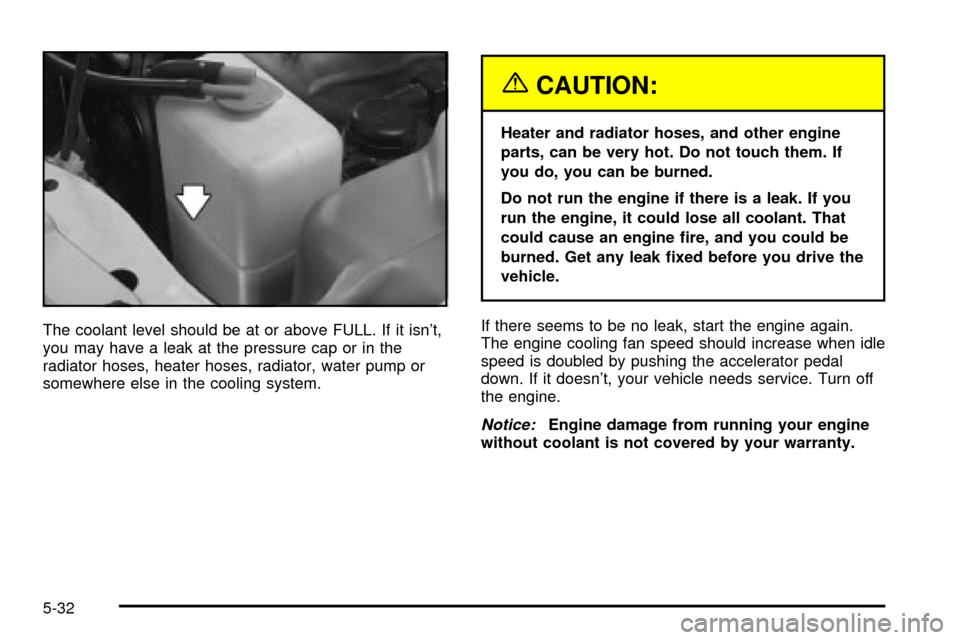
The coolant level should be at or above FULL. If it isn't,
you may have a leak at the pressure cap or in the
radiator hoses, heater hoses, radiator, water pump or
somewhere else in the cooling system.
{CAUTION:
Heater and radiator hoses, and other engine
parts, can be very hot. Do not touch them. If
you do, you can be burned.
Do not run the engine if there is a leak. If you
run the engine, it could lose all coolant. That
could cause an engine ®re, and you could be
burned. Get any leak ®xed before you drive the
vehicle.
If there seems to be no leak, start the engine again.
The engine cooling fan speed should increase when idle
speed is doubled by pushing the accelerator pedal
down. If it doesn't, your vehicle needs service. Turn off
the engine.
Notice:Engine damage from running your engine
without coolant is not covered by your warranty.
5-32
Page 245 of 374
How to Add Coolant to the Coolant
Recovery Tank
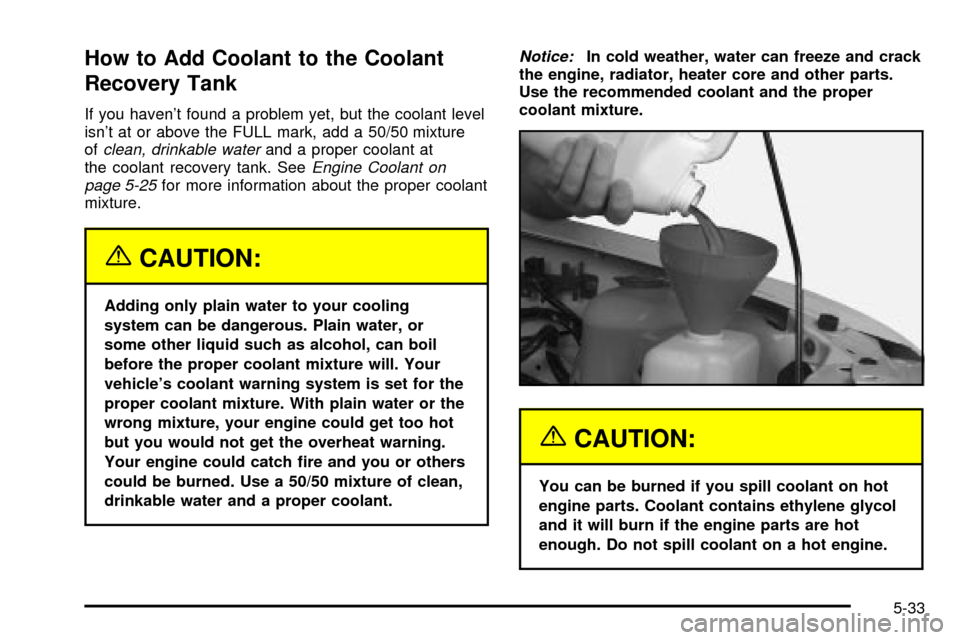
If you haven't found a problem yet, but the coolant level
isn't at or above the FULL mark, add a 50/50 mixture
of
clean, drinkable waterand a proper coolant at
the coolant recovery tank. SeeEngine Coolant on
page 5-25for more information about the proper coolant
mixture.
{CAUTION:
Adding only plain water to your cooling
system can be dangerous. Plain water, or
some other liquid such as alcohol, can boil
before the proper coolant mixture will. Your
vehicle's coolant warning system is set for the
proper coolant mixture. With plain water or the
wrong mixture, your engine could get too hot
but you would not get the overheat warning.
Your engine could catch ®re and you or others
could be burned. Use a 50/50 mixture of clean,
drinkable water and a proper coolant.
Notice:In cold weather, water can freeze and crack
the engine, radiator, heater core and other parts.
Use the recommended coolant and the proper
coolant mixture.
{CAUTION:
You can be burned if you spill coolant on hot
engine parts. Coolant contains ethylene glycol
and it will burn if the engine parts are hot
enough. Do not spill coolant on a hot engine.
5-33
Page 246 of 374
When the coolant in the coolant recovery tank is at or
above the FULL mark, start your vehicle.
If the overheat warning continues, there's one more
thing you can try. You can add the proper coolant
mixture directly to the radiator, but be sure the cooling
system is cool before you do it.
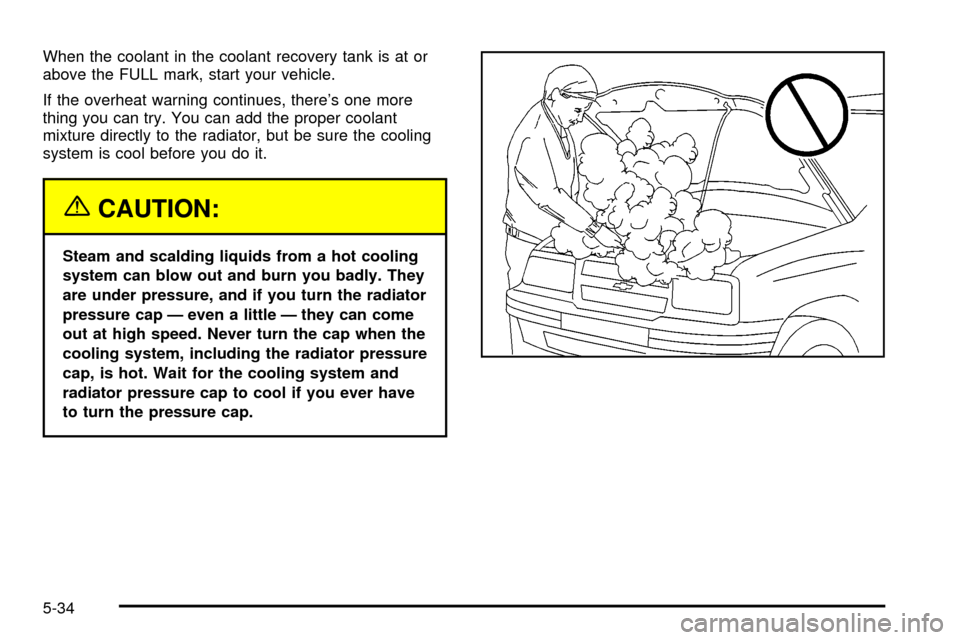
{CAUTION:
Steam and scalding liquids from a hot cooling
system can blow out and burn you badly. They
are under pressure, and if you turn the radiator
pressure cap Ð even a little Ð they can come
out at high speed. Never turn the cap when the
cooling system, including the radiator pressure
cap, is hot. Wait for the cooling system and
radiator pressure cap to cool if you ever have
to turn the pressure cap.
5-34
Page 247 of 374
How to Add Coolant to the Radiator
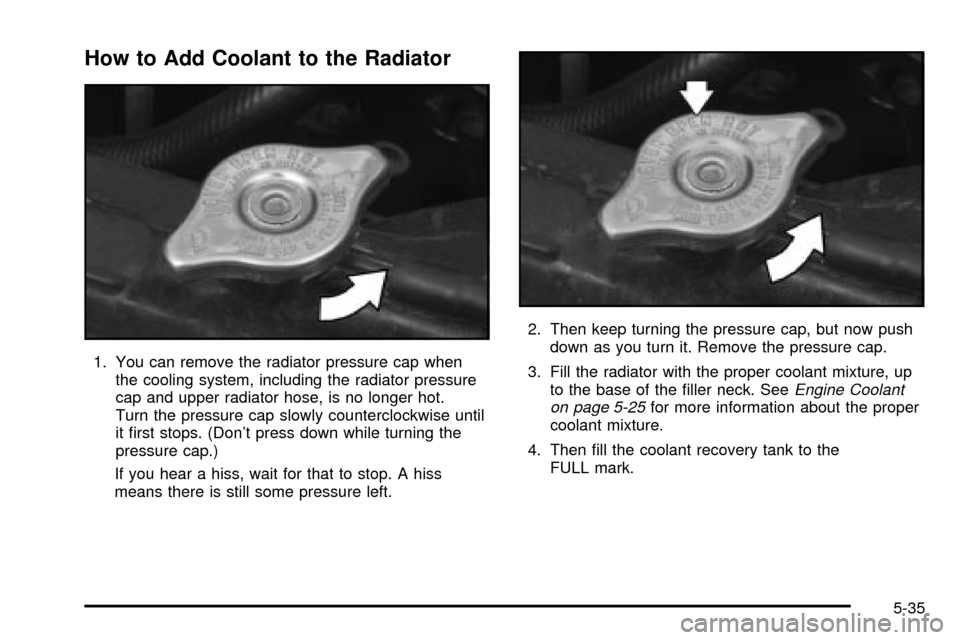
1. You can remove the radiator pressure cap when
the cooling system, including the radiator pressure
cap and upper radiator hose, is no longer hot.
Turn the pressure cap slowly counterclockwise until
it ®rst stops. (Don't press down while turning the
pressure cap.)
If you hear a hiss, wait for that to stop. A hiss
means there is still some pressure left.2. Then keep turning the pressure cap, but now push
down as you turn it. Remove the pressure cap.
3. Fill the radiator with the proper coolant mixture, up
to the base of the ®ller neck. See
Engine Coolant
on page 5-25for more information about the proper
coolant mixture.
4. Then ®ll the coolant recovery tank to the
FULL mark.
5-35
Page 248 of 374
5. Put the cap back on the coolant recovery tank, but
leave the radiator pressure cap off.
6. Start the engine and let it run until you can feel the
upper radiator hose getting hot. Watch out for the
engine cooling fan.
7. By this time, the coolant level inside the radiator
®ller neck may be lower. If the level is lower, add
more of the proper coolant mixture through the
®ller neck until the level reaches the base of the
®ller neck.
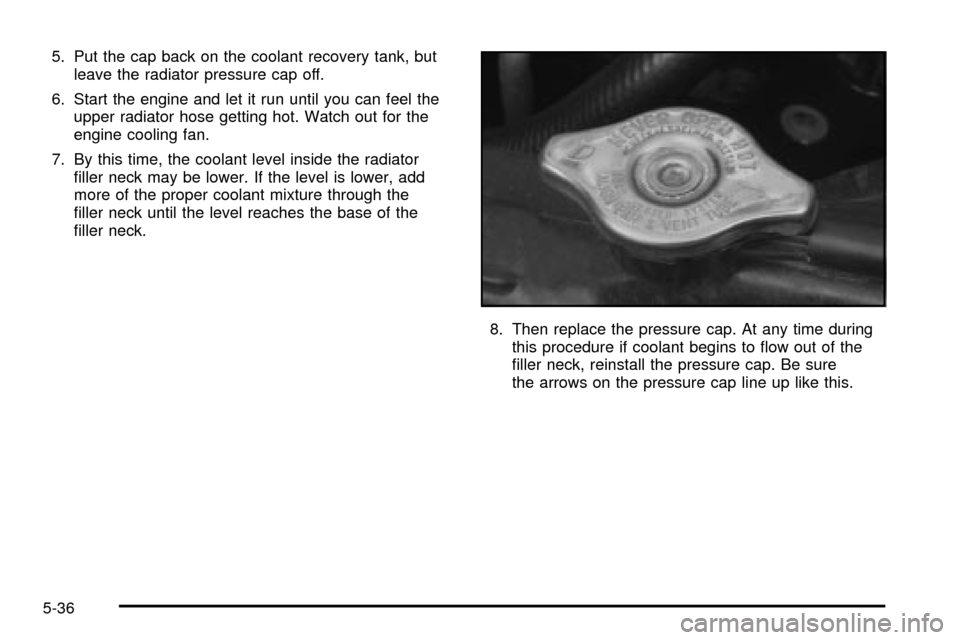
8. Then replace the pressure cap. At any time during
this procedure if coolant begins to ¯ow out of the
®ller neck, reinstall the pressure cap. Be sure
the arrows on the pressure cap line up like this.
5-36
Page 282 of 374
Wheel Replacement
Replace any wheel that is bent, cracked or badly rusted
or corroded. If wheel nuts keep coming loose, the
wheel, wheel bolts and wheel nuts should be replaced.
If the wheel leaks air, replace it (except some
aluminum wheels, which can sometimes be repaired).
See your dealer if any of these conditions exist.
Your dealer will know the kind of wheel you need.
Each new wheel should have the same load-carrying
capacity, diameter, width, offset and be mounted
the same way as the one it replaces.
If you need to replace any of your wheels, wheel bolts
or wheel nuts, replace them only with new GM
original equipment parts. This way, you will be sure to
have the right wheel, wheel bolts and wheel nuts
for your vehicle.{CAUTION:
Using the wrong replacement wheels, wheel
bolts or wheel nuts on your vehicle can be
dangerous. It could affect the braking and
handling of your vehicle, make your tires lose
air and make you lose control. You could have
a collision in which you or others could be
injured. Always use the correct wheel, wheel
bolts and wheel nuts for replacement.
Notice:The wrong wheel can also cause problems
with bearing life, brake cooling, speedometer or
odometer calibration, headlamp aim, bumper height,
vehicle ground clearance and tire or tire chain
clearance to the body and chassis.
See
Changing a Flat Tire on page 5-72for more
information.
5-70
Page 310 of 374
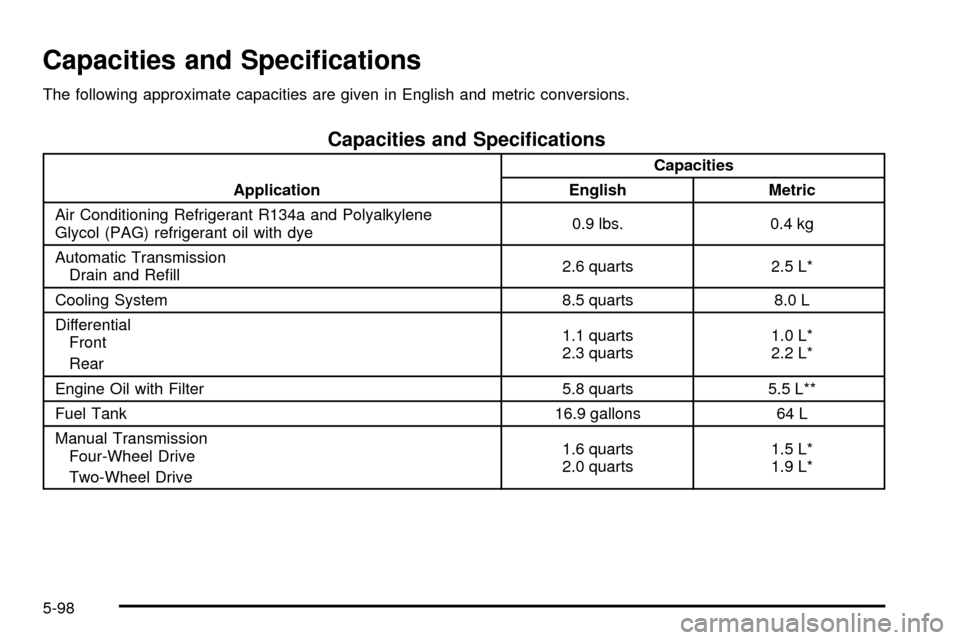
Capacities and Speci®cations
The following approximate capacities are given in English and metric conversions.
Capacities and Speci®cations
ApplicationCapacities
English Metric
Air Conditioning Refrigerant R134a and Polyalkylene
Glycol (PAG) refrigerant oil with dye0.9 lbs. 0.4 kg
Automatic Transmission
Drain and Re®ll2.6 quarts 2.5 L*
Cooling System 8.5 quarts 8.0 L
Differential
Front
Rear1.1 quarts
2.3 quarts1.0 L*
2.2 L*
Engine Oil with Filter 5.8 quarts 5.5 L**
Fuel Tank 16.9 gallons 64 L
Manual Transmission
Four-Wheel Drive
Two-Wheel Drive1.6 quarts
2.0 quarts1.5 L*
1.9 L*
5-98
Page 315 of 374
Maintenance Schedule......................................6-2
Introduction...................................................6-2
Maintenance Requirements..............................6-2
Your Vehicle and the Environment....................6-2
How This Section is Organized.........................6-3
Part A: Scheduled Maintenance Services...........6-4
Using Your Maintenance Schedule....................6-4
Selecting the Right Schedule...........................6-4
Short Trip/City Scheduled Maintenance..............6-7
Long Trip/Highway Scheduled Maintenance......6-17
Part B: Owner Checks and Services................6-24
At Each Fuel Fill..........................................6-24
At Least Once a Month.................................6-24
At Least Twice a Year...................................6-25At Least Once a Year...................................6-25
Part C: Periodic Maintenance Inspections.........6-28
Steering, Suspension and Front Drive Axle
Boot and Seal Inspection............................6-28
Exhaust System Inspection............................6-28
Fuel System Inspection..................................6-28
Engine Cooling System Inspection...................6-28
Throttle System Inspection.............................6-29
Rear Axle and Front Axle (Four-Wheel-Drive)
Service....................................................6-29
Brake System Inspection................................6-29
Part D: Recommended Fluids and
Lubricants................................................6-30
Part E: Maintenance Record...........................6-32
Section 6 Maintenance Schedule
6-1
Page 319 of 374

Short Trip/City De®nition
Follow the Short Trip/City Scheduled Maintenance if any
one of these conditions is true for your vehicle:
·Most trips are less than 5 miles (8 km). This is
particularly important when outside temperatures
are below freezing.
·Most trips include extensive idling (such as frequent
driving in stop-and-go traffic).
·You frequently tow a trailer or use a carrier on top
of your vehicle.
·If the vehicle is used for delivery service, police,
taxi or other commercial application.
One of the reasons you should follow this schedule if
you operate your vehicle under any of these conditions
is that these conditions cause engine oil to break
down sooner.
Short Trip/City Intervals
Every 3,000 Miles (5 000 km):Engine Oil and Filter
Change (or 3 months, whichever occurs ®rst).
Every 6,000 Miles (10 000 km):Passenger
Compartment Air Filter Inspection (If Equipped).
Tire Rotation.
Every 15,000 Miles (25 000 km):Engine Air Cleaner
Filter Inspection. Automatic Transmission Service
(severe conditions only). Manual Transmission Fluid
Change. Transfer Case Fluid Change. Differential Fluid
Change. Propeller Shafts and U-Joints Inspection
(or every 15 months, whichever occurs ®rst).
Every 30,000 Miles (50 000 km):Engine Air Cleaner
Filter Replacement. Air Filter Replacement (If Equipped).
Ignition Coil Plug Cap Inspection (or every 30 months,
whichever occurs ®rst). Engine Accessory Drive Belt
Inspection (or every 30 months, whichever occurs ®rst).
Cooling System Service (or every 30 months,
whichever occurs ®rst). Fuel Tank, Cap, and Lines
Inspection. Fuel Filter Replacement (or every 30 months,
whichever occurs ®rst).
6-5
Page 321 of 374

Every 30,000 Miles (50 000 km):Engine Accessory
Drive Belt Inspection (or every 30 months, whichever
occurs ®rst). Cooling System Service (or every
30 months, whichever occurs ®rst). Fuel Tank, Cap and
Lines Inspection. Engine Air Cleaner Filter Replacement.
Passenger Compartment Air Filter Replacement (If
Equipped). Ignition Coil Plug Cap Inspection (or every
30 months, whichever occurs ®rst). Manual Transmission
Fluid Change. Transfer Case Fluid Change. Differential
Fluid Change. Fuel Filter Replacement (or every
30 months, whichever occurs ®rst).
Every 45,000 Miles (75 000 km):Automatic
Transmission Fluid Hose Inspection (or every
45 months, whichever occurs ®rst).
Every 60,000 Miles (100 000 km):Fuel Tank Cap
Gasket Replacement. Emission System Hoses
Inspection. Spark Plug Replacement. Brake Fluid
Service.
Every 100,000 Miles (166 000 km):Automatic
Transmission Service (normal conditions).
Every 120,000 Miles (200 000 km):Evaporative
Emissions Canister and Air Suction Filter Replacement
(or every 120 months, whichever occurs ®rst).
These intervals only summarize maintenance services.
Be sure to follow the complete scheduled maintenance
on the following pages.
Short Trip/City Scheduled
Maintenance
The services shown in this schedule up to 100,000 miles
(166 000 km) should be repeated after 100,000 miles
(166 000 km) at the same intervals for the life of
this vehicle. The service shown at 120,000 miles
(200 000 km) should be repeated at the same interval
after 120,000 miles (200 000 km) for the life of this
vehicle.
See
Part B: Owner Checks and Services on page 6-24andPart C: Periodic Maintenance Inspections on
page 6-28.
Footnotes
²The U.S. Environmental Protection Agency or the
California Air Resources Board has determined that the
failure to perform this maintenance item will not nullify
the emission warranty or limit recall liability prior to
the completion of the vehicle's useful life. We, however,
urge that all recommended maintenance services be
performed at the indicated intervals and the
maintenance be recorded.
+A good time to check your brakes is during tire
rotation. See Brake System Inspection on page 6-29.
6-7