coolant CHEVROLET TRACKER 2004 2.G Owner's Manual
[x] Cancel search | Manufacturer: CHEVROLET, Model Year: 2004, Model line: TRACKER, Model: CHEVROLET TRACKER 2004 2.GPages: 374, PDF Size: 2.57 MB
Page 273 of 374
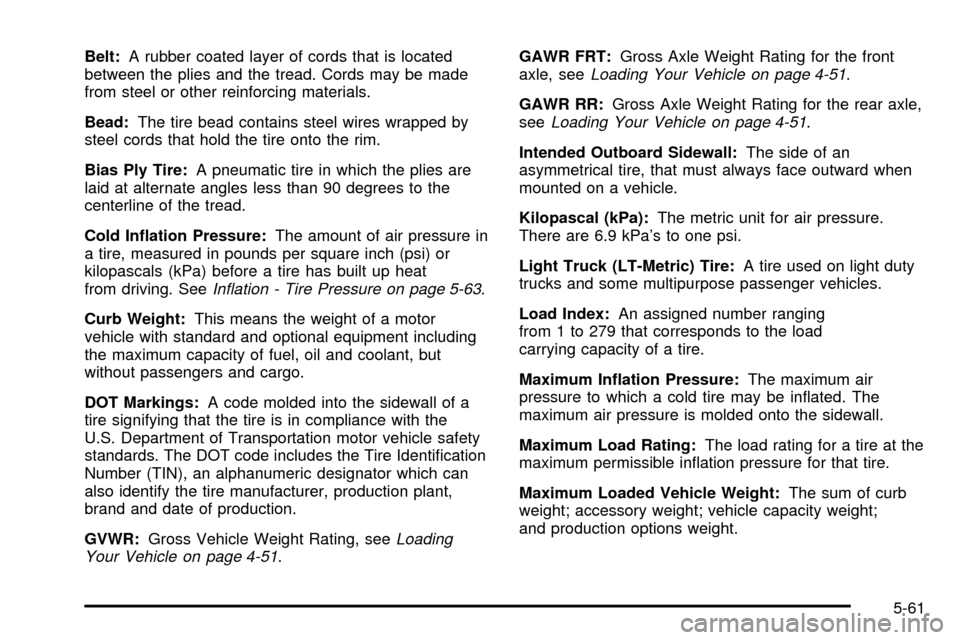
Belt:A rubber coated layer of cords that is located
between the plies and the tread. Cords may be made
from steel or other reinforcing materials.
Bead:The tire bead contains steel wires wrapped by
steel cords that hold the tire onto the rim.
Bias Ply Tire:A pneumatic tire in which the plies are
laid at alternate angles less than 90 degrees to the
centerline of the tread.
Cold In¯ation Pressure:The amount of air pressure in
a tire, measured in pounds per square inch (psi) or
kilopascals (kPa) before a tire has built up heat
from driving. See
In¯ation - Tire Pressure on page 5-63.
Curb Weight:This means the weight of a motor
vehicle with standard and optional equipment including
the maximum capacity of fuel, oil and coolant, but
without passengers and cargo.
DOT Markings:A code molded into the sidewall of a
tire signifying that the tire is in compliance with the
U.S. Department of Transportation motor vehicle safety
standards. The DOT code includes the Tire Identi®cation
Number (TIN), an alphanumeric designator which can
also identify the tire manufacturer, production plant,
brand and date of production.
GVWR:Gross Vehicle Weight Rating, see
Loading
Your Vehicle on page 4-51.GAWR FRT:Gross Axle Weight Rating for the front
axle, see
Loading Your Vehicle on page 4-51.
GAWR RR:Gross Axle Weight Rating for the rear axle,
see
Loading Your Vehicle on page 4-51.
Intended Outboard Sidewall:The side of an
asymmetrical tire, that must always face outward when
mounted on a vehicle.
Kilopascal (kPa):The metric unit for air pressure.
There are 6.9 kPa's to one psi.
Light Truck (LT-Metric) Tire:A tire used on light duty
trucks and some multipurpose passenger vehicles.
Load Index:An assigned number ranging
from 1 to 279 that corresponds to the load
carrying capacity of a tire.
Maximum In¯ation Pressure:The maximum air
pressure to which a cold tire may be in¯ated. The
maximum air pressure is molded onto the sidewall.
Maximum Load Rating:The load rating for a tire at the
maximum permissible in¯ation pressure for that tire.
Maximum Loaded Vehicle Weight:The sum of curb
weight; accessory weight; vehicle capacity weight;
and production options weight.
5-61
Page 324 of 374
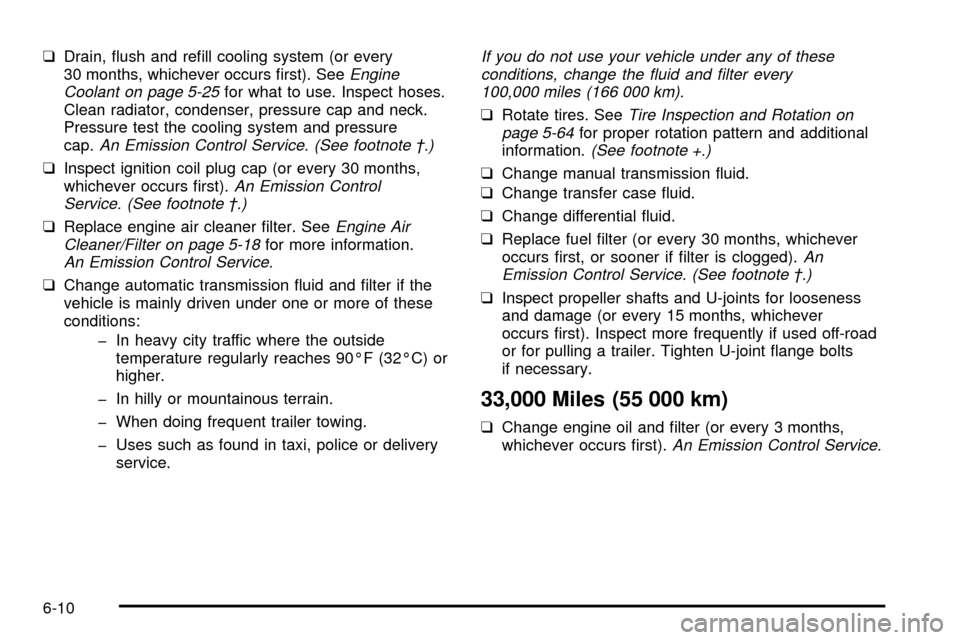
qDrain, ¯ush and re®ll cooling system (or every
30 months, whichever occurs ®rst). SeeEngine
Coolant on page 5-25for what to use. Inspect hoses.
Clean radiator, condenser, pressure cap and neck.
Pressure test the cooling system and pressure
cap.
An Emission Control Service. (See footnote ².)
qInspect ignition coil plug cap (or every 30 months,
whichever occurs ®rst).An Emission Control
Service. (See footnote ².)
qReplace engine air cleaner ®lter. SeeEngine Air
Cleaner/Filter on page 5-18for more information.An Emission Control Service.
qChange automatic transmission ¯uid and ®lter if the
vehicle is mainly driven under one or more of these
conditions:
þ In heavy city traffic where the outside
temperature regularly reaches 90ÉF (32ÉC) or
higher.
þ In hilly or mountainous terrain.
þ When doing frequent trailer towing.
þ Uses such as found in taxi, police or delivery
service.
If you do not use your vehicle under any of these
conditions, change the ¯uid and ®lter every
100,000 miles (166 000 km).
qRotate tires. SeeTire Inspection and Rotation on
page 5-64for proper rotation pattern and additional
information.(See footnote +.)
qChange manual transmission ¯uid.
qChange transfer case ¯uid.
qChange differential ¯uid.
qReplace fuel ®lter (or every 30 months, whichever
occurs ®rst, or sooner if ®lter is clogged).
An
Emission Control Service. (See footnote ².)
qInspect propeller shafts and U-joints for looseness
and damage (or every 15 months, whichever
occurs ®rst). Inspect more frequently if used off-road
or for pulling a trailer. Tighten U-joint ¯ange bolts
if necessary.
33,000 Miles (55 000 km)
qChange engine oil and ®lter (or every 3 months,
whichever occurs ®rst).An Emission Control Service.
6-10
Page 327 of 374
If you do not use your vehicle under any of these
conditions, change the ¯uid and ®lter every
100,000 miles (166 000 km).
qInspect engine accessory drive belts (or every
30 months, whichever occurs ®rst).An Emission
Control Service.
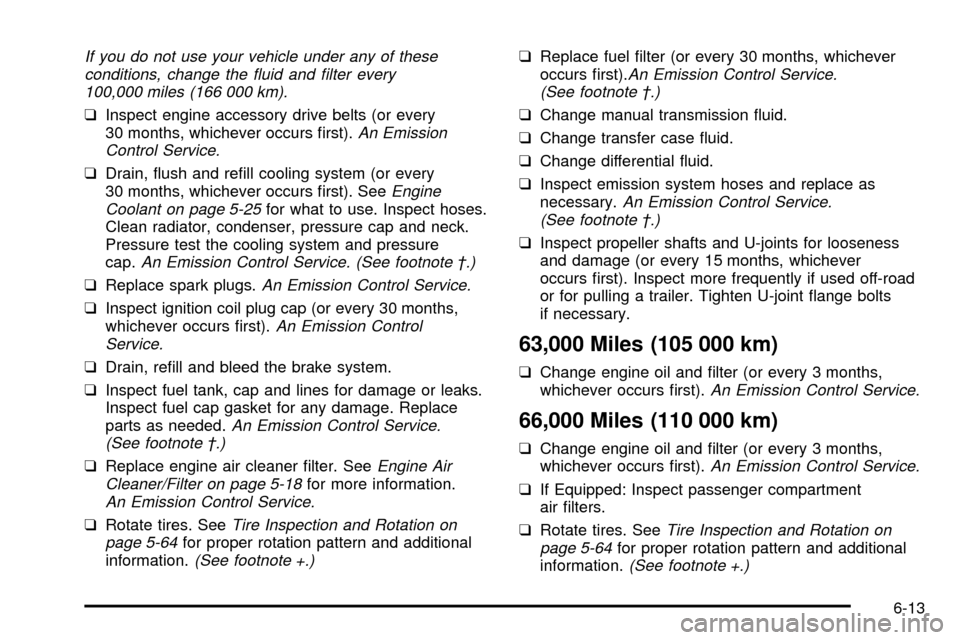
qDrain, ¯ush and re®ll cooling system (or every
30 months, whichever occurs ®rst). SeeEngine
Coolant on page 5-25for what to use. Inspect hoses.
Clean radiator, condenser, pressure cap and neck.
Pressure test the cooling system and pressure
cap.
An Emission Control Service. (See footnote ².)
qReplace spark plugs.An Emission Control Service.
qInspect ignition coil plug cap (or every 30 months,
whichever occurs ®rst).An Emission Control
Service.
qDrain, re®ll and bleed the brake system.
qInspect fuel tank, cap and lines for damage or leaks.
Inspect fuel cap gasket for any damage. Replace
parts as needed.
An Emission Control Service.
(See footnote ².)
qReplace engine air cleaner ®lter. SeeEngine Air
Cleaner/Filter on page 5-18for more information.An Emission Control Service.
qRotate tires. SeeTire Inspection and Rotation on
page 5-64for proper rotation pattern and additional
information.(See footnote +.)
qReplace fuel ®lter (or every 30 months, whichever
occurs ®rst).An Emission Control Service.
(See footnote ².)
qChange manual transmission ¯uid.
qChange transfer case ¯uid.
qChange differential ¯uid.
qInspect emission system hoses and replace as
necessary.
An Emission Control Service.
(See footnote ².)
qInspect propeller shafts and U-joints for looseness
and damage (or every 15 months, whichever
occurs ®rst). Inspect more frequently if used off-road
or for pulling a trailer. Tighten U-joint ¯ange bolts
if necessary.
63,000 Miles (105 000 km)
qChange engine oil and ®lter (or every 3 months,
whichever occurs ®rst).An Emission Control Service.
66,000 Miles (110 000 km)
qChange engine oil and ®lter (or every 3 months,
whichever occurs ®rst).An Emission Control Service.
qIf Equipped: Inspect passenger compartment
air ®lters.
qRotate tires. See
Tire Inspection and Rotation on
page 5-64for proper rotation pattern and additional
information.(See footnote +.)
6-13
Page 330 of 374
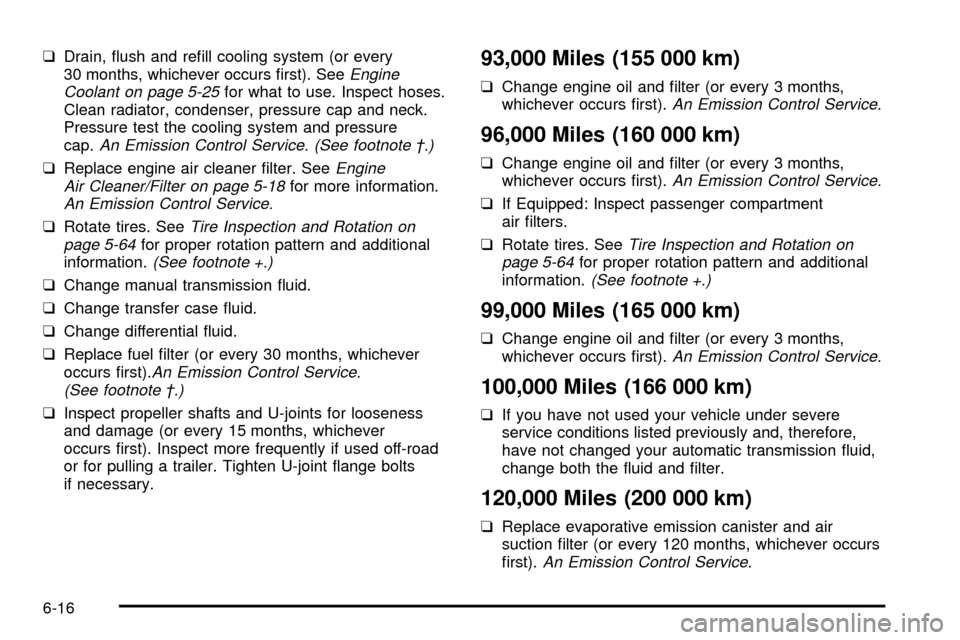
qDrain, ¯ush and re®ll cooling system (or every
30 months, whichever occurs ®rst). SeeEngine
Coolant on page 5-25for what to use. Inspect hoses.
Clean radiator, condenser, pressure cap and neck.
Pressure test the cooling system and pressure
cap.
An Emission Control Service. (See footnote ².)
qReplace engine air cleaner ®lter. SeeEngine
Air Cleaner/Filter on page 5-18for more information.An Emission Control Service.
qRotate tires. SeeTire Inspection and Rotation on
page 5-64for proper rotation pattern and additional
information.(See footnote +.)
qChange manual transmission ¯uid.
qChange transfer case ¯uid.
qChange differential ¯uid.
qReplace fuel ®lter (or every 30 months, whichever
occurs ®rst).
An Emission Control Service.
(See footnote ².)
qInspect propeller shafts and U-joints for looseness
and damage (or every 15 months, whichever
occurs ®rst). Inspect more frequently if used off-road
or for pulling a trailer. Tighten U-joint ¯ange bolts
if necessary.
93,000 Miles (155 000 km)
qChange engine oil and ®lter (or every 3 months,
whichever occurs ®rst).An Emission Control Service.
96,000 Miles (160 000 km)
qChange engine oil and ®lter (or every 3 months,
whichever occurs ®rst).An Emission Control Service.
qIf Equipped: Inspect passenger compartment
air ®lters.
qRotate tires. See
Tire Inspection and Rotation on
page 5-64for proper rotation pattern and additional
information.(See footnote +.)
99,000 Miles (165 000 km)
qChange engine oil and ®lter (or every 3 months,
whichever occurs ®rst).An Emission Control Service.
100,000 Miles (166 000 km)
qIf you have not used your vehicle under severe
service conditions listed previously and, therefore,
have not changed your automatic transmission ¯uid,
change both the ¯uid and ®lter.
120,000 Miles (200 000 km)
qReplace evaporative emission canister and air
suction ®lter (or every 120 months, whichever occurs
®rst).
An Emission Control Service.
6-16
Page 332 of 374
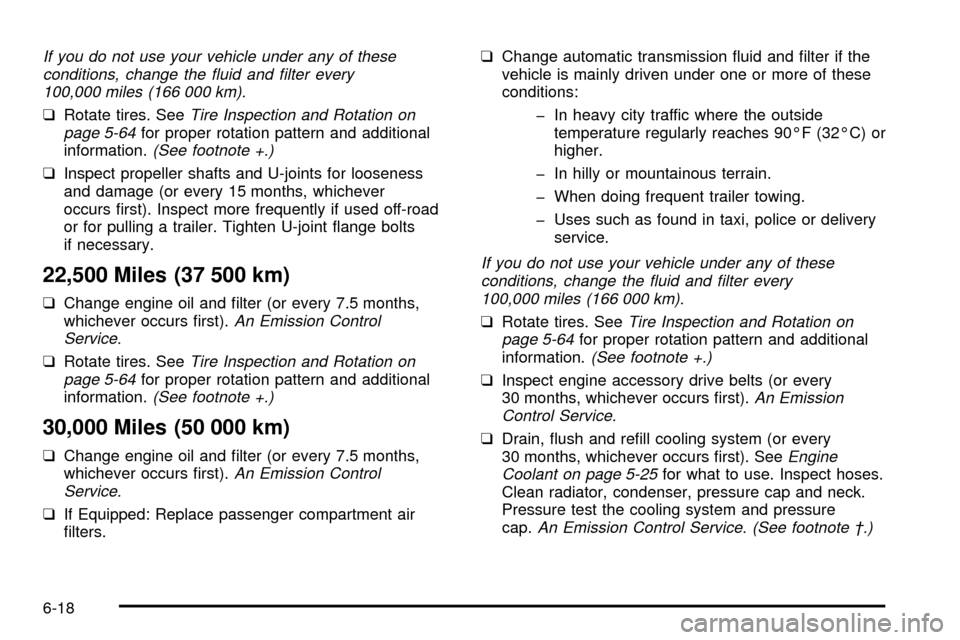
If you do not use your vehicle under any of these
conditions, change the ¯uid and ®lter every
100,000 miles (166 000 km).
qRotate tires. SeeTire Inspection and Rotation on
page 5-64for proper rotation pattern and additional
information.(See footnote +.)
qInspect propeller shafts and U-joints for looseness
and damage (or every 15 months, whichever
occurs ®rst). Inspect more frequently if used off-road
or for pulling a trailer. Tighten U-joint ¯ange bolts
if necessary.
22,500 Miles (37 500 km)
qChange engine oil and ®lter (or every 7.5 months,
whichever occurs ®rst).An Emission Control
Service.
qRotate tires. SeeTire Inspection and Rotation on
page 5-64for proper rotation pattern and additional
information.(See footnote +.)
30,000 Miles (50 000 km)
qChange engine oil and ®lter (or every 7.5 months,
whichever occurs ®rst).An Emission Control
Service.
qIf Equipped: Replace passenger compartment air
®lters.qChange automatic transmission ¯uid and ®lter if the
vehicle is mainly driven under one or more of these
conditions:
þ In heavy city traffic where the outside
temperature regularly reaches 90ÉF (32ÉC) or
higher.
þ In hilly or mountainous terrain.
þ When doing frequent trailer towing.
þ Uses such as found in taxi, police or delivery
service.
If you do not use your vehicle under any of these
conditions, change the ¯uid and ®lter every
100,000 miles (166 000 km).
qRotate tires. SeeTire Inspection and Rotation on
page 5-64for proper rotation pattern and additional
information.(See footnote +.)
qInspect engine accessory drive belts (or every
30 months, whichever occurs ®rst).An Emission
Control Service.
qDrain, ¯ush and re®ll cooling system (or every
30 months, whichever occurs ®rst). SeeEngine
Coolant on page 5-25for what to use. Inspect hoses.
Clean radiator, condenser, pressure cap and neck.
Pressure test the cooling system and pressure
cap.
An Emission Control Service. (See footnote ².)
6-18
Page 334 of 374
If you do not use your vehicle under any of these
conditions, change the ¯uid and ®lter every
100,000 miles (166 000 km).
qRotate tires. SeeTire Inspection and Rotation on
page 5-64for proper rotation pattern and additional
information.(See footnote +.)
qInspect propeller shafts and U-joints for looseness
and damage (or every 15 months, whichever
occurs ®rst). Inspect more frequently if used off-road
or for pulling a trailer. Tighten U-joint ¯ange bolts
if necessary.
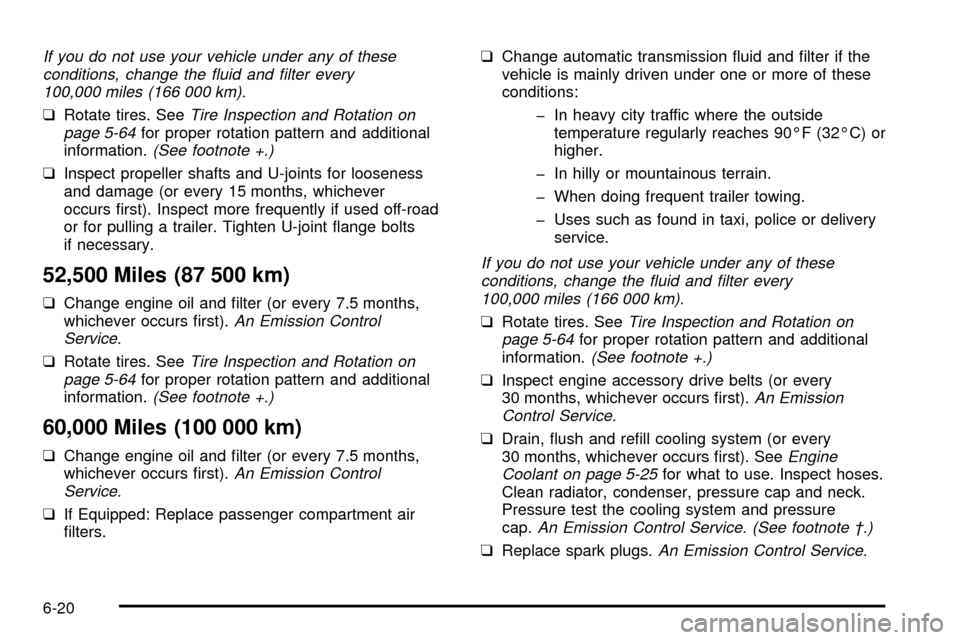
52,500 Miles (87 500 km)
qChange engine oil and ®lter (or every 7.5 months,
whichever occurs ®rst).An Emission Control
Service.
qRotate tires. SeeTire Inspection and Rotation on
page 5-64for proper rotation pattern and additional
information.(See footnote +.)
60,000 Miles (100 000 km)
qChange engine oil and ®lter (or every 7.5 months,
whichever occurs ®rst).An Emission Control
Service.
qIf Equipped: Replace passenger compartment air
®lters.qChange automatic transmission ¯uid and ®lter if the
vehicle is mainly driven under one or more of these
conditions:
þ In heavy city traffic where the outside
temperature regularly reaches 90ÉF (32ÉC) or
higher.
þ In hilly or mountainous terrain.
þ When doing frequent trailer towing.
þ Uses such as found in taxi, police or delivery
service.
If you do not use your vehicle under any of these
conditions, change the ¯uid and ®lter every
100,000 miles (166 000 km).
qRotate tires. SeeTire Inspection and Rotation on
page 5-64for proper rotation pattern and additional
information.(See footnote +.)
qInspect engine accessory drive belts (or every
30 months, whichever occurs ®rst).An Emission
Control Service.
qDrain, ¯ush and re®ll cooling system (or every
30 months, whichever occurs ®rst). SeeEngine
Coolant on page 5-25for what to use. Inspect hoses.
Clean radiator, condenser, pressure cap and neck.
Pressure test the cooling system and pressure
cap.
An Emission Control Service. (See footnote ².)
qReplace spark plugs.An Emission Control Service.
6-20
Page 336 of 374
If you do not use your vehicle under any of these
conditions, change the ¯uid and ®lter every
100,000 miles (166 000 km).
qRotate tires. SeeTire Inspection and Rotation on
page 5-64for proper rotation pattern and additional
information.(See footnote +.)
qInspect propeller shafts and U-joints for looseness
and damage (or every 15 months, whichever
occurs ®rst). Inspect more frequently if used off-road
or for pulling a trailer. Tighten U-joint ¯ange bolts
if necessary.
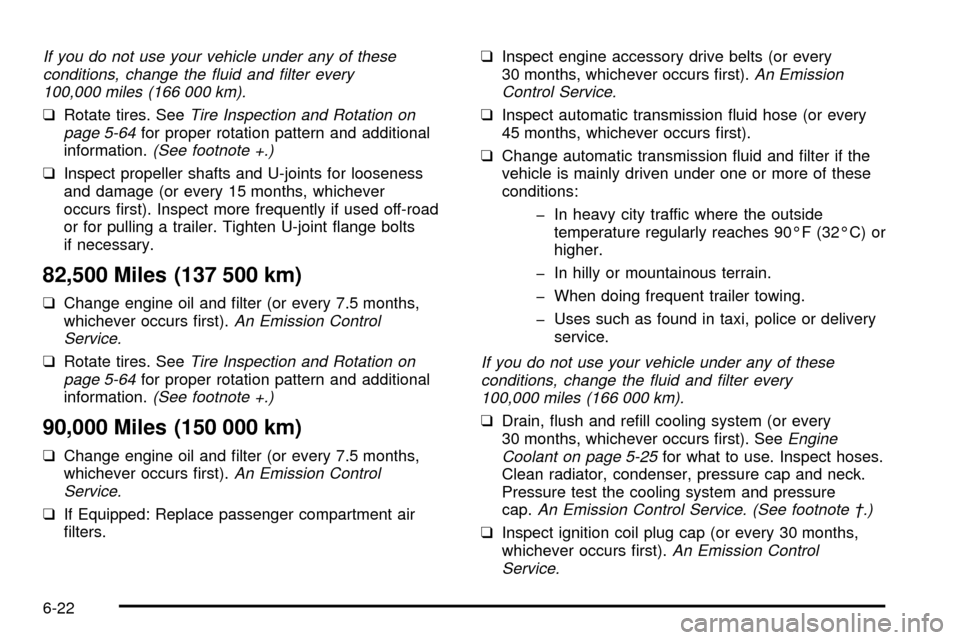
82,500 Miles (137 500 km)
qChange engine oil and ®lter (or every 7.5 months,
whichever occurs ®rst).An Emission Control
Service.
qRotate tires. SeeTire Inspection and Rotation on
page 5-64for proper rotation pattern and additional
information.(See footnote +.)
90,000 Miles (150 000 km)
qChange engine oil and ®lter (or every 7.5 months,
whichever occurs ®rst).An Emission Control
Service.
qIf Equipped: Replace passenger compartment air
®lters.qInspect engine accessory drive belts (or every
30 months, whichever occurs ®rst).
An Emission
Control Service.
qInspect automatic transmission ¯uid hose (or every
45 months, whichever occurs ®rst).
qChange automatic transmission ¯uid and ®lter if the
vehicle is mainly driven under one or more of these
conditions:
þ In heavy city traffic where the outside
temperature regularly reaches 90ÉF (32ÉC) or
higher.
þ In hilly or mountainous terrain.
þ When doing frequent trailer towing.
þ Uses such as found in taxi, police or delivery
service.
If you do not use your vehicle under any of these
conditions, change the ¯uid and ®lter every
100,000 miles (166 000 km).
qDrain, ¯ush and re®ll cooling system (or every
30 months, whichever occurs ®rst). SeeEngine
Coolant on page 5-25for what to use. Inspect hoses.
Clean radiator, condenser, pressure cap and neck.
Pressure test the cooling system and pressure
cap.
An Emission Control Service. (See footnote ².)
qInspect ignition coil plug cap (or every 30 months,
whichever occurs ®rst).An Emission Control
Service.
6-22
Page 338 of 374
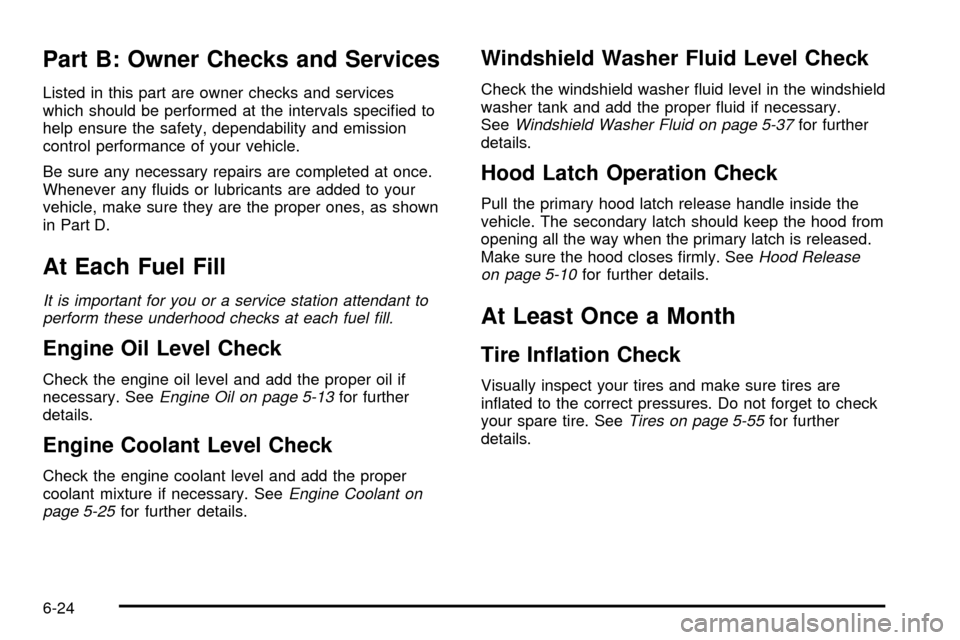
Part B: Owner Checks and Services
Listed in this part are owner checks and services
which should be performed at the intervals speci®ed to
help ensure the safety, dependability and emission
control performance of your vehicle.
Be sure any necessary repairs are completed at once.
Whenever any ¯uids or lubricants are added to your
vehicle, make sure they are the proper ones, as shown
in Part D.
At Each Fuel Fill
It is important for you or a service station attendant to
perform these underhood checks at each fuel ®ll.
Engine Oil Level Check
Check the engine oil level and add the proper oil if
necessary. SeeEngine Oil on page 5-13for further
details.
Engine Coolant Level Check
Check the engine coolant level and add the proper
coolant mixture if necessary. SeeEngine Coolant on
page 5-25for further details.
Windshield Washer Fluid Level Check
Check the windshield washer ¯uid level in the windshield
washer tank and add the proper ¯uid if necessary.
See
Windshield Washer Fluid on page 5-37for further
details.
Hood Latch Operation Check
Pull the primary hood latch release handle inside the
vehicle. The secondary latch should keep the hood from
opening all the way when the primary latch is released.
Make sure the hood closes ®rmly. See
Hood Release
on page 5-10for further details.
At Least Once a Month
Tire In¯ation Check
Visually inspect your tires and make sure tires are
in¯ated to the correct pressures. Do not forget to check
your spare tire. See
Tires on page 5-55for further
details.
6-24
Page 344 of 374
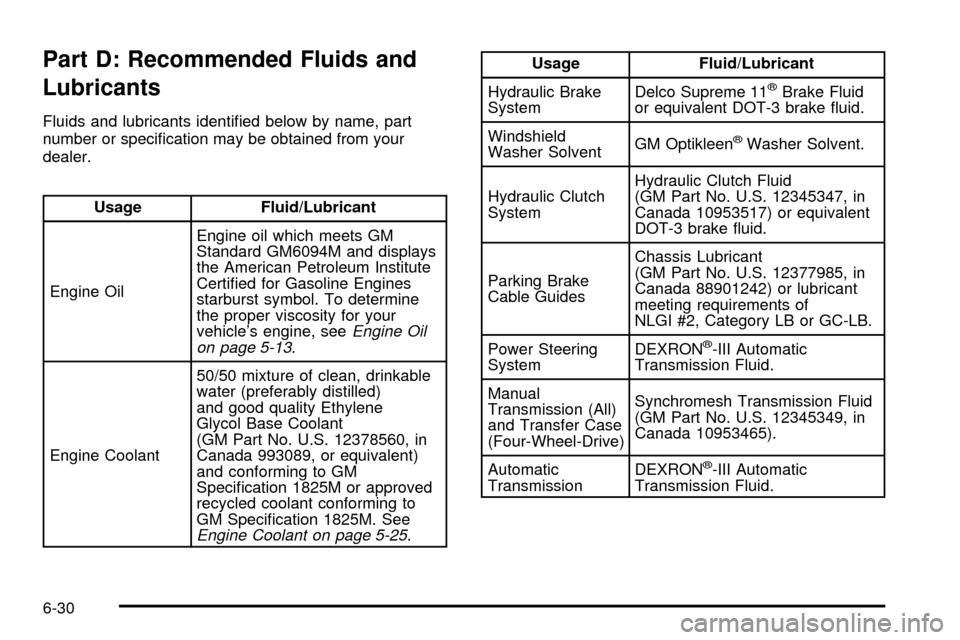
Part D: Recommended Fluids and
Lubricants
Fluids and lubricants identi®ed below by name, part
number or speci®cation may be obtained from your
dealer.
Usage Fluid/Lubricant
Engine OilEngine oil which meets GM
Standard GM6094M and displays
the American Petroleum Institute
Certi®ed for Gasoline Engines
starburst symbol. To determine
the proper viscosity for your
vehicle's engine, see
Engine Oil
on page 5-13.
Engine Coolant50/50 mixture of clean, drinkable
water (preferably distilled)
and good quality Ethylene
Glycol Base Coolant
(GM Part No. U.S. 12378560, in
Canada 993089, or equivalent)
and conforming to GM
Speci®cation 1825M or approved
recycled coolant conforming to
GM Speci®cation 1825M. See
Engine Coolant on page 5-25.
Usage Fluid/Lubricant
Hydraulic Brake
SystemDelco Supreme 11
žBrake Fluid
or equivalent DOT-3 brake ¯uid.
Windshield
Washer SolventGM Optikleen
žWasher Solvent.
Hydraulic Clutch
SystemHydraulic Clutch Fluid
(GM Part No. U.S. 12345347, in
Canada 10953517) or equivalent
DOT-3 brake ¯uid.
Parking Brake
Cable GuidesChassis Lubricant
(GM Part No. U.S. 12377985, in
Canada 88901242) or lubricant
meeting requirements of
NLGI #2, Category LB or GC-LB.
Power Steering
SystemDEXRON
ž-III Automatic
Transmission Fluid.
Manual
Transmission (All)
and Transfer Case
(Four-Wheel-Drive)Synchromesh Transmission Fluid
(GM Part No. U.S. 12345349, in
Canada 10953465).
Automatic
TransmissionDEXRON
ž-III Automatic
Transmission Fluid.
6-30
Page 362 of 374
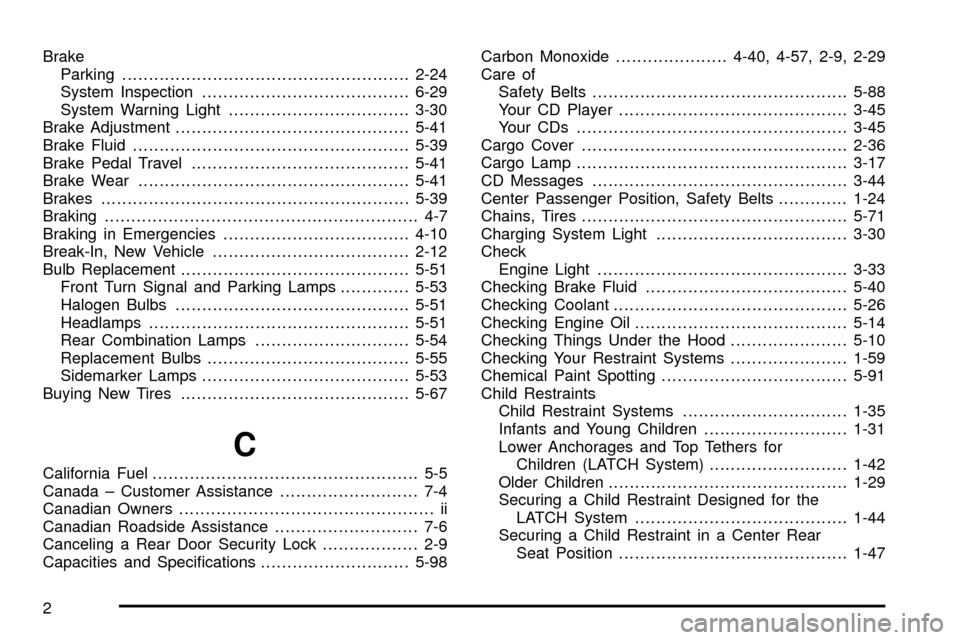
Brake
Parking......................................................2-24
System Inspection.......................................6-29
System Warning Light..................................3-30
Brake Adjustment............................................5-41
Brake Fluid....................................................5-39
Brake Pedal Travel.........................................5-41
Brake Wear...................................................5-41
Brakes..........................................................5-39
Braking........................................................... 4-7
Braking in Emergencies...................................4-10
Break-In, New Vehicle.....................................2-12
Bulb Replacement...........................................5-51
Front Turn Signal and Parking Lamps.............5-53
Halogen Bulbs............................................5-51
Headlamps.................................................5-51
Rear Combination Lamps.............................5-54
Replacement Bulbs......................................5-55
Sidemarker Lamps.......................................5-53
Buying New Tires...........................................5-67
C
California Fuel.................................................. 5-5
Canada ± Customer Assistance.......................... 7-4
Canadian Owners................................................ ii
Canadian Roadside Assistance........................... 7-6
Canceling a Rear Door Security Lock.................. 2-9
Capacities and Speci®cations............................5-98Carbon Monoxide.....................4-40, 4-57, 2-9, 2-29
Care of
Safety Belts................................................5-88
Your CD Player...........................................3-45
Your CDs ...................................................3-45
Cargo Cover..................................................2-36
Cargo Lamp...................................................3-17
CD Messages................................................3-44
Center Passenger Position, Safety Belts.............1-24
Chains, Tires..................................................5-71
Charging System Light....................................3-30
Check
Engine Light...............................................3-33
Checking Brake Fluid......................................5-40
Checking Coolant............................................5-26
Checking Engine Oil........................................5-14
Checking Things Under the Hood......................5-10
Checking Your Restraint Systems......................1-59
Chemical Paint Spotting...................................5-91
Child Restraints
Child Restraint Systems...............................1-35
Infants and Young Children...........................1-31
Lower Anchorages and Top Tethers for
Children (LATCH System)..........................1-42
Older Children.............................................1-29
Securing a Child Restraint Designed for the
LATCH System........................................1-44
Securing a Child Restraint in a Center Rear
Seat Position...........................................1-47
2