brake CHEVROLET TRACKER 2004 2.G Service Manual
[x] Cancel search | Manufacturer: CHEVROLET, Model Year: 2004, Model line: TRACKER, Model: CHEVROLET TRACKER 2004 2.GPages: 374, PDF Size: 2.57 MB
Page 181 of 374

Driving too fast through large water puddles or even
going through some car washes can cause problems,
too. The water may affect your brakes. Try to avoid
puddles. But if you can not, try to slow down before you
hit them.
{CAUTION:
Wet brakes can cause accidents. They will not
work as well in a quick stop and may cause
pulling to one side. You could lose control of
the vehicle.
After driving through a large puddle of water
or a car wash, apply your brake pedal lightly
until your brakes work normally.
Hydroplaning
Hydroplaning is dangerous. So much water can build up
under your tires that they can actually ride on the
water. This can happen if the road is wet enough and
you are going fast enough. When your vehicle is
hydroplaning, it has little or no contact with the road.
Hydroplaning does not happen often. But it can if your
tires do not have much tread or if the pressure in
one or more is low. It can happen if a lot of water is
standing on the road. If you can see re¯ections
from trees, telephone poles or other vehicles, and
raindrops ªdimpleº the water's surface, there could be
hydroplaning.
Hydroplaning usually happens at higher speeds. There
just is not a hard and fast rule about hydroplaning.
The best advice is to slow down when it is raining.
Driving Through Deep Standing Water
Notice:If you drive too quickly through deep
puddles or standing water, water can come in
through your engine's air intake and badly damage
your engine. Never drive through water that is
slightly lower than the underbody of your vehicle. If
you can not avoid deep puddles or standing
water, drive through them very slowly.
4-33
Page 186 of 374
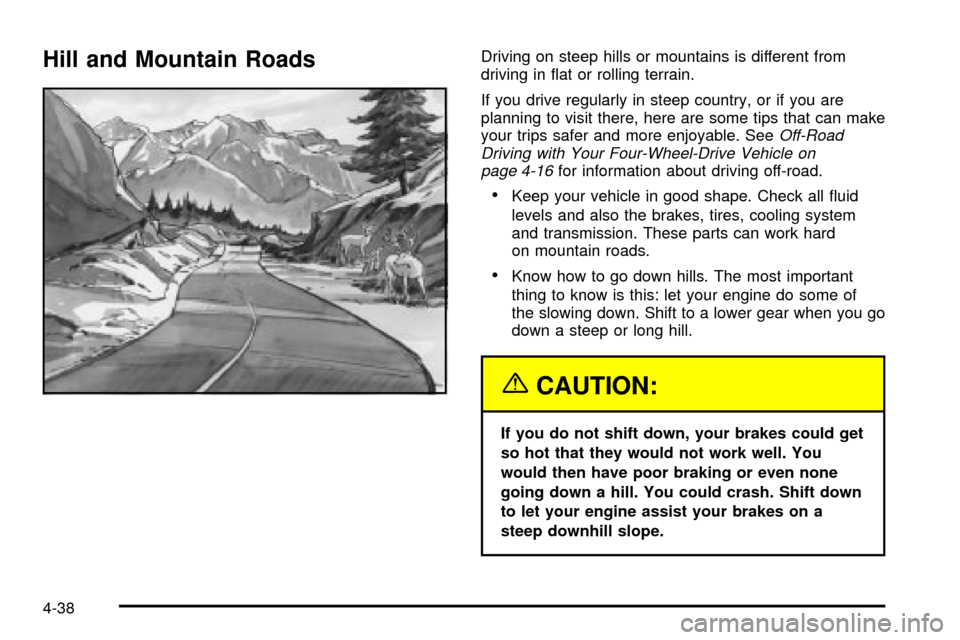
Hill and Mountain RoadsDriving on steep hills or mountains is different from
driving in ¯at or rolling terrain.
If you drive regularly in steep country, or if you are
planning to visit there, here are some tips that can make
your trips safer and more enjoyable. See
Off-Road
Driving with Your Four-Wheel-Drive Vehicle on
page 4-16
for information about driving off-road.
·Keep your vehicle in good shape. Check all ¯uid
levels and also the brakes, tires, cooling system
and transmission. These parts can work hard
on mountain roads.
·Know how to go down hills. The most important
thing to know is this: let your engine do some of
the slowing down. Shift to a lower gear when you go
down a steep or long hill.
{CAUTION:
If you do not shift down, your brakes could get
so hot that they would not work well. You
would then have poor braking or even none
going down a hill. You could crash. Shift down
to let your engine assist your brakes on a
steep downhill slope.
4-38
Page 187 of 374

{CAUTION:
Coasting downhill in NEUTRAL (N) or with the
ignition off is dangerous. Your brakes will have
to do all the work of slowing down. They could
get so hot that they would not work well. You
would then have poor braking or even none
going down a hill. You could crash. Always
have your engine running and your vehicle in
gear when you go downhill.
·Know how to go uphill. You may want to shift down
to a lower gear. The lower gears help cool your
engine and transmission, and you can climb the
hill better.
·Stay in your own lane when driving on two-lane
roads in hills or mountains. Do not swing wide
or cut across the center of the road. Drive at speeds
that let you stay in your own lane.
·As you go over the top of a hill, be alert. There
could be something in your lane, like a stalled car or
an accident.
·You may see highway signs on mountains that
warn of special problems. Examples are long
grades, passing or no-passing zones, a falling rocks
area or winding roads. Be alert to these and take
appropriate action.
4-39
Page 189 of 374

Driving On Snow or Ice
Most of the time, those places where your tires meet
the road probably have good traction.
However, if there is snow or ice between your tires and
the road, you can have a very slippery situation. You
will have a lot less traction or ªgripº and will need to be
very careful.What is the worst time for this? ªWet ice.º Very cold
snow or ice can be slick and hard to drive on. But wet
ice can be even more trouble because it may offer
the least traction of all. You can get wet ice when it is
about freezing (32ÉF; 0ÉC) and freezing rain begins
to fall. Try to avoid driving on wet ice until salt and sand
crews can get there.
Whatever the condition Ð smooth ice, packed, blowing
or loose snow Ð drive with caution.
Accelerate gently. Try not to break the fragile traction. If
you accelerate too fast, the drive wheels will spin and
polish the surface under the tires even more.
Unless you have the anti-lock braking system, you will
want to brake very gently, too. If you do have anti-lock,
see
Braking on page 4-7. This system improves your
vehicle's stability when you make a hard stop on a
slippery road. Whether you have the anti-lock braking
system or not, you will want to begin stopping
sooner than you would on dry pavement. Without
anti-lock brakes, if you feel your vehicle begin to slide,
let up on the brakes a little. Push the brake pedal
down steadily to get the most traction you can.
4-41
Page 190 of 374

Remember, unless you have anti-lock, if you brake so
hard that your wheels stop rolling, you will just slide.
Brake so your wheels always keep rolling and you can
still steer.
·Whatever your braking system, allow greater
following distance on any slippery road.
·Watch for slippery spots. The road might be ®ne
until you hit a spot that is covered with ice. On
an otherwise clear road, ice patches may appear in
shaded areas where the sun can not reach:
around clumps of trees, behind buildings or under
bridges. Sometimes the surface of a curve or
an overpass may remain icy when the surrounding
roads are clear. If you see a patch of ice ahead
of you, brake before you are on it. Try not to brake
while you are actually on the ice, and avoid
sudden steering maneuvers.
If You Are Caught in a Blizzard
If you are stopped by heavy snow, you could be in a
serious situation. You should probably stay with
your vehicle unless you know for sure that you are near
help and you can hike through the snow. Here are
some things to do to summon help and keep yourself
and your passengers safe:
·Turn on your hazard ¯ashers.
·Tie a red cloth to your vehicle to alert police that
you have been stopped by the snow.
4-42
Page 196 of 374

Dinghy Towing
To tow your vehicle from the front (four-wheel-drive
only), do the following:
Notice:If you tow a two-wheel-drive vehicle with all
four wheels on the ground, the transmission
could be damaged. The repairs would not be
covered by your warranty. Do not tow a
two-wheel-drive vehicle with all four wheels on the
ground.
Follow these steps:
1. Set the parking brake.
2. Shift your automatic transmission into PARK (P), or
your manual transmission to SECOND (2).
3. With the ignition key in the ON position, move the
transfer case to NEUTRAL and make sure the
4WD light on the instrument panel cluster is off.
See
Four-Wheel Drive on page 5-49.
4. Turn the ignition key to ACC.
5. Release the parking brake.
4-48
Page 197 of 374
Notice:If you do not put the transfer case in
NEUTRAL before towing a four-wheel-drive vehicle
from the front, the vehicle could be damaged.
The repairs would not be covered by your warranty.
Always put the transfer case in NEUTRAL before
towing your vehicle.
Stop towing every 200 miles (300 km) and start the
engine. Leave the transfer case shift lever in NEUTRAL.
Shift your automatic transmission to DRIVE (D); leave
a manual transmission in SECOND (2) with the
clutch engaged. Run the engine at 2,000 rpm for one
minute to circulate oil in the transfer case. Turn the
ignition key to ACC. Now, you can continue towing your
vehicle.
Notice:Locking the steering column when towing
your vehicle may damage the steering column.
Always unlock the steering column before towing.
Notice:If you exceed 55 mph (90 km/h) while
towing your vehicle, it could be damaged. Never
exceed 55 mph (90 km/h) while towing your vehicle.
{CAUTION:
Shifting a four-wheel-drive vehicle's transfer
case into NEUTRAL can cause your vehicle to
roll even if the transmission is in Park (P) for
an automatic transmission, or if your vehicle is
in gear, for a manual transmission. You or
others could be injured. Make sure the parking
brake is ®rmly set before you shift the transfer
case to NEUTRAL.
4-49
Page 198 of 374
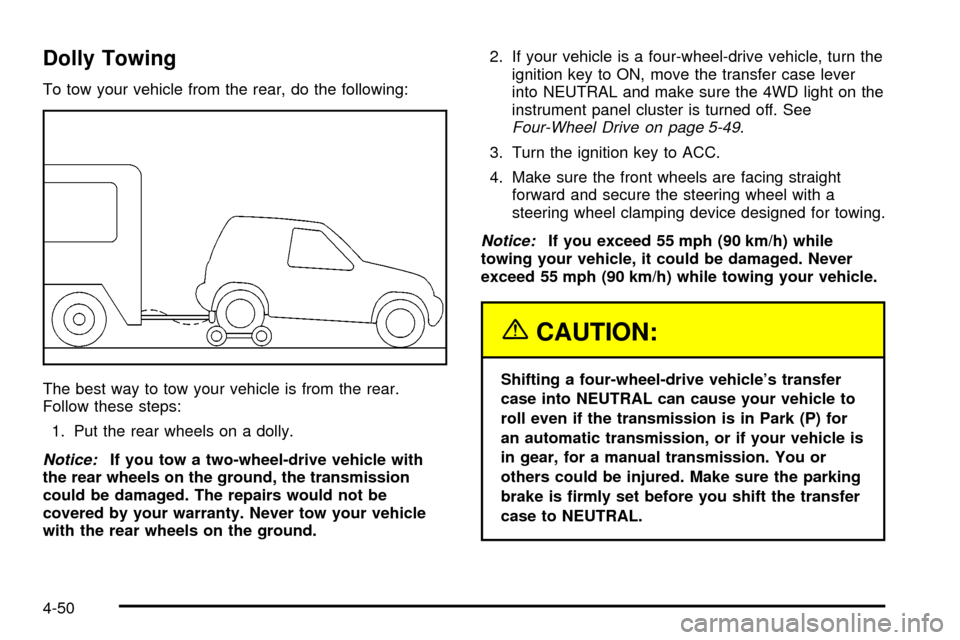
Dolly Towing
To tow your vehicle from the rear, do the following:
The best way to tow your vehicle is from the rear.
Follow these steps:
1. Put the rear wheels on a dolly.
Notice:If you tow a two-wheel-drive vehicle with
the rear wheels on the ground, the transmission
could be damaged. The repairs would not be
covered by your warranty. Never tow your vehicle
with the rear wheels on the ground.2. If your vehicle is a four-wheel-drive vehicle, turn the
ignition key to ON, move the transfer case lever
into NEUTRAL and make sure the 4WD light on the
instrument panel cluster is turned off. See
Four-Wheel Drive on page 5-49.
3. Turn the ignition key to ACC.
4. Make sure the front wheels are facing straight
forward and secure the steering wheel with a
steering wheel clamping device designed for towing.
Notice:If you exceed 55 mph (90 km/h) while
towing your vehicle, it could be damaged. Never
exceed 55 mph (90 km/h) while towing your vehicle.
{CAUTION:
Shifting a four-wheel-drive vehicle's transfer
case into NEUTRAL can cause your vehicle to
roll even if the transmission is in Park (P) for
an automatic transmission, or if your vehicle is
in gear, for a manual transmission. You or
others could be injured. Make sure the parking
brake is ®rmly set before you shift the transfer
case to NEUTRAL.
4-50
Page 205 of 374

Towing a Trailer
{CAUTION:
If you do not use the correct equipment and
drive properly, you can lose control when you
pull a trailer. For example, if the trailer is too
heavy, the brakes may not work well Ð or even
at all. You and your passengers could be
seriously injured. Pull a trailer only if you have
followed all the steps in this section. Ask your
dealer for advice and information about towing
a trailer with your vehicle.
Notice:Pulling a trailer improperly can damage
your vehicle and result in costly repairs that would
not be covered by your warranty. Always follow
the instructions in this section and check with your
dealer for more information about towing a trailer
with your vehicle.Your vehicle can tow a trailer. To identify what the
vehicle trailering capacity is for your vehicle, you should
read the information in ªWeight of the Trailerº that
appears later in this section. But trailering is different
than just driving your vehicle by itself. Trailering means
changes in handling, durability and fuel economy.
Successful, safe trailering takes correct equipment, and
it has to be used properly.
That's the reason for this section. In it are many
time-tested, important trailering tips and safety rules.
Many of these are important for your safety and that of
your passengers. So please read this section carefully
before you pull a trailer.
Load-pulling components such as the engine,
transmission, wheel assemblies and tires are forced to
work harder against the drag of the added weight.
The engine is required to operate at relatively higher
speeds and under greater loads, generating extra heat.
What's more, the trailer adds considerably to wind
resistance, increasing the pulling requirements.
4-57
Page 208 of 374

Hitches
It's important to have the correct hitch equipment.
Crosswinds, large trucks going by and rough roads are
a few reasons why you'll need the right hitch. Here
are some rules to follow:
·If you make holes in the body of your vehicle, be
sure to seal them when you remove the trailering
equipment. If you don't seal them, dirt, water,
and even deadly carbon monoxide (CO) from your
exhaust can get into your vehicle. See
Engine
Exhaust on page 2-29.
Your vehicle is readily designed to accept a trailer hitch.
The frame rail ends already have holes and weld
nuts in place to accept the four bolts needed to attach
the hitch bar.
To help simplify setting up your trailer lights, there is a
trailer wiring connector located behind the left rear
trim panel. If needed, your dealer can provide help in
removing the trim panel and accessing this wiring
connector.
Your vehicle's trailer wiring has separate turn signal and
brake light circuits, which means you will most likely
need to purchase a converter to operate conventional
trailer lights.
Safety Chains
You should always attach chains between your vehicle
and your trailer. Cross the safety chains under the
tongue of the trailer to help prevent the tongue from
contacting the road if it becomes separated from
the hitch. Instructions about safety chains may be
provided by the hitch manufacturer or by the trailer
manufacturer. Follow the manufacturer's
recommendation for attaching safety chains and do not
attach them to the bumper. Always leave just enough
slack so you can turn with your rig. Never allow
safety chains to drag on the ground.
Trailer Brakes
If your trailer weighs more than 1,000 lbs. (450 kg)
loaded, then it needs its own surge brakes. Tapping into
your vehicle's brake system is not recommended.
4-60