brake CHEVROLET TRACKER 2004 2.G Manual PDF
[x] Cancel search | Manufacturer: CHEVROLET, Model Year: 2004, Model line: TRACKER, Model: CHEVROLET TRACKER 2004 2.GPages: 374, PDF Size: 2.57 MB
Page 307 of 374
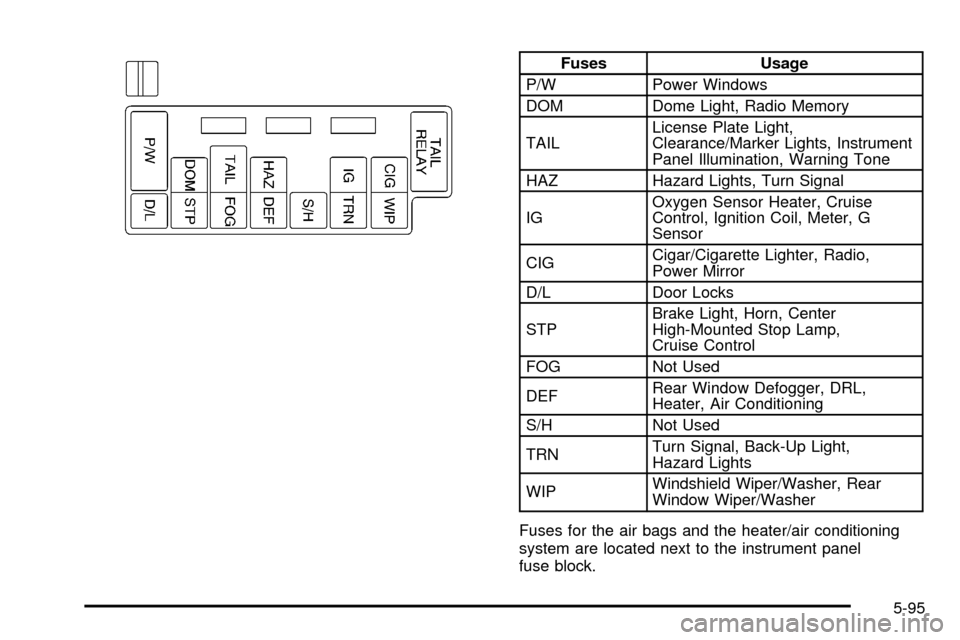
Fuses Usage
P/W Power Windows
DOM Dome Light, Radio Memory
TAILLicense Plate Light,
Clearance/Marker Lights, Instrument
Panel Illumination, Warning Tone
HAZ Hazard Lights, Turn Signal
IGOxygen Sensor Heater, Cruise
Control, Ignition Coil, Meter, G
Sensor
CIGCigar/Cigarette Lighter, Radio,
Power Mirror
D/L Door Locks
STPBrake Light, Horn, Center
High-Mounted Stop Lamp,
Cruise Control
FOG Not Used
DEFRear Window Defogger, DRL,
Heater, Air Conditioning
S/H Not Used
TRNTurn Signal, Back-Up Light,
Hazard Lights
WIPWindshield Wiper/Washer, Rear
Window Wiper/Washer
Fuses for the air bags and the heater/air conditioning
system are located next to the instrument panel
fuse block.
5-95
Page 309 of 374
Fuses/Relays Usage
8 Anti-Lock Brake System
9 All Electrical Loads
10 Shift Lock (Relay)
11
(2.5L Engine
Only)Horn (Relay)Fuses/Relays Usage
12 Air Conditioning Compressor (Relay)
13Air Conditioning Condenser Fan
(Relay)
14 Air Conditioning
5-97
Page 315 of 374

Maintenance Schedule......................................6-2
Introduction...................................................6-2
Maintenance Requirements..............................6-2
Your Vehicle and the Environment....................6-2
How This Section is Organized.........................6-3
Part A: Scheduled Maintenance Services...........6-4
Using Your Maintenance Schedule....................6-4
Selecting the Right Schedule...........................6-4
Short Trip/City Scheduled Maintenance..............6-7
Long Trip/Highway Scheduled Maintenance......6-17
Part B: Owner Checks and Services................6-24
At Each Fuel Fill..........................................6-24
At Least Once a Month.................................6-24
At Least Twice a Year...................................6-25At Least Once a Year...................................6-25
Part C: Periodic Maintenance Inspections.........6-28
Steering, Suspension and Front Drive Axle
Boot and Seal Inspection............................6-28
Exhaust System Inspection............................6-28
Fuel System Inspection..................................6-28
Engine Cooling System Inspection...................6-28
Throttle System Inspection.............................6-29
Rear Axle and Front Axle (Four-Wheel-Drive)
Service....................................................6-29
Brake System Inspection................................6-29
Part D: Recommended Fluids and
Lubricants................................................6-30
Part E: Maintenance Record...........................6-32
Section 6 Maintenance Schedule
6-1
Page 320 of 374

Every 45,000 Miles (75 000 km):Automatic
Transmission Fluid Hose Inspection (or every
45 months, whichever occurs ®rst).
Every 60,000 Miles (100 000 km):Fuel Tank Cap
Gasket Replacement. Emission System Hoses
Inspection. Brake Fluid Service. Spark Plug
Replacement.
Every 100,000 Miles (166 000 km):Automatic
Transmission Service (normal conditions).
Every 120 000 Miles (200 000 km):Evaporative
Emissions Canister and Air Suction Filter Replacement
(or every 120 months, whichever occurs ®rst). Engine
Accessory Drive Belt Replacement (or every
120 months, whichever occurs ®rst).
These intervals only summarize maintenance services.
Be sure to follow the complete scheduled maintenance
on the following pages.
Long Trip/Highway De®nition
Follow this scheduled maintenanceonlyif none of the
conditions from the Short Trip/City Scheduled
Maintenance are true. Do not use this schedule if the
vehicle is used for trailer towing, driven in a dusty area
or used off paved roads. Use the Short Trip/City
schedule for these conditions.
Driving a vehicle with a fully warmed engine under
highway conditions will cause engine oil to break down
slower.
Long Trip/Highway Intervals
Every 7,500 Miles (12 500 km):Engine Oil and Filter
Change (or every 7.5 months, whichever occurs
®rst). Tire Rotation.
Every 15,000 Miles (25 000 km):Engine Air Cleaner
Filter Inspection. Automatic Transmission Service
(severe conditions only). Passenger Compartment Air
Filter Inspection (If Equipped). Propeller Shafts and
U-Joints Inspection (or every 15 months, whichever
occurs ®rst).
6-6
Page 321 of 374

Every 30,000 Miles (50 000 km):Engine Accessory
Drive Belt Inspection (or every 30 months, whichever
occurs ®rst). Cooling System Service (or every
30 months, whichever occurs ®rst). Fuel Tank, Cap and
Lines Inspection. Engine Air Cleaner Filter Replacement.
Passenger Compartment Air Filter Replacement (If
Equipped). Ignition Coil Plug Cap Inspection (or every
30 months, whichever occurs ®rst). Manual Transmission
Fluid Change. Transfer Case Fluid Change. Differential
Fluid Change. Fuel Filter Replacement (or every
30 months, whichever occurs ®rst).
Every 45,000 Miles (75 000 km):Automatic
Transmission Fluid Hose Inspection (or every
45 months, whichever occurs ®rst).
Every 60,000 Miles (100 000 km):Fuel Tank Cap
Gasket Replacement. Emission System Hoses
Inspection. Spark Plug Replacement. Brake Fluid
Service.
Every 100,000 Miles (166 000 km):Automatic
Transmission Service (normal conditions).
Every 120,000 Miles (200 000 km):Evaporative
Emissions Canister and Air Suction Filter Replacement
(or every 120 months, whichever occurs ®rst).
These intervals only summarize maintenance services.
Be sure to follow the complete scheduled maintenance
on the following pages.
Short Trip/City Scheduled
Maintenance
The services shown in this schedule up to 100,000 miles
(166 000 km) should be repeated after 100,000 miles
(166 000 km) at the same intervals for the life of
this vehicle. The service shown at 120,000 miles
(200 000 km) should be repeated at the same interval
after 120,000 miles (200 000 km) for the life of this
vehicle.
See
Part B: Owner Checks and Services on page 6-24andPart C: Periodic Maintenance Inspections on
page 6-28.
Footnotes
²The U.S. Environmental Protection Agency or the
California Air Resources Board has determined that the
failure to perform this maintenance item will not nullify
the emission warranty or limit recall liability prior to
the completion of the vehicle's useful life. We, however,
urge that all recommended maintenance services be
performed at the indicated intervals and the
maintenance be recorded.
+A good time to check your brakes is during tire
rotation. See Brake System Inspection on page 6-29.
6-7
Page 327 of 374

If you do not use your vehicle under any of these
conditions, change the ¯uid and ®lter every
100,000 miles (166 000 km).
qInspect engine accessory drive belts (or every
30 months, whichever occurs ®rst).An Emission
Control Service.
qDrain, ¯ush and re®ll cooling system (or every
30 months, whichever occurs ®rst). SeeEngine
Coolant on page 5-25for what to use. Inspect hoses.
Clean radiator, condenser, pressure cap and neck.
Pressure test the cooling system and pressure
cap.
An Emission Control Service. (See footnote ².)
qReplace spark plugs.An Emission Control Service.
qInspect ignition coil plug cap (or every 30 months,
whichever occurs ®rst).An Emission Control
Service.
qDrain, re®ll and bleed the brake system.
qInspect fuel tank, cap and lines for damage or leaks.
Inspect fuel cap gasket for any damage. Replace
parts as needed.
An Emission Control Service.
(See footnote ².)
qReplace engine air cleaner ®lter. SeeEngine Air
Cleaner/Filter on page 5-18for more information.An Emission Control Service.
qRotate tires. SeeTire Inspection and Rotation on
page 5-64for proper rotation pattern and additional
information.(See footnote +.)
qReplace fuel ®lter (or every 30 months, whichever
occurs ®rst).An Emission Control Service.
(See footnote ².)
qChange manual transmission ¯uid.
qChange transfer case ¯uid.
qChange differential ¯uid.
qInspect emission system hoses and replace as
necessary.
An Emission Control Service.
(See footnote ².)
qInspect propeller shafts and U-joints for looseness
and damage (or every 15 months, whichever
occurs ®rst). Inspect more frequently if used off-road
or for pulling a trailer. Tighten U-joint ¯ange bolts
if necessary.
63,000 Miles (105 000 km)
qChange engine oil and ®lter (or every 3 months,
whichever occurs ®rst).An Emission Control Service.
66,000 Miles (110 000 km)
qChange engine oil and ®lter (or every 3 months,
whichever occurs ®rst).An Emission Control Service.
qIf Equipped: Inspect passenger compartment
air ®lters.
qRotate tires. See
Tire Inspection and Rotation on
page 5-64for proper rotation pattern and additional
information.(See footnote +.)
6-13
Page 331 of 374

Long Trip/Highway Scheduled
Maintenance
The services shown in this schedule up to 100,000 miles
(166 000 km) should be repeated after 100,000 miles
(166 000 km) at the same intervals for the life of
this vehicle. The services shown at 120,000 miles
(200 000 km) should be repeated at the same interval
after 120,000 miles (200 000 km) for the life of this
vehicle.
See
Part B: Owner Checks and Services on page 6-24andPart C: Periodic Maintenance Inspections on
page 6-28.
Footnotes
²The U.S. Environmental Protection Agency or the
California Air Resources Board has determined that the
failure to perform this maintenance item will not nullify
the emission warranty or limit recall liability prior to
the completion of the vehicle's useful life. We, however,
urge that all recommended maintenance services be
performed at the indicated intervals and the
maintenance be recorded.
+A good time to check your brakes is during tire
rotation. See Brake System Inspection on page 6-29.
7,500 Miles (12 500 km)
qChange engine oil and ®lter (or every 7.5 months,
whichever occurs ®rst).An Emission Control
Service.
qRotate tires. SeeTire Inspection and Rotation on
page 5-64for proper rotation pattern and additional
information.(See footnote +.)
15,000 Miles (25 000 km)
qChange engine oil and ®lter (or every 7.5 months,
whichever occurs ®rst).An Emission Control
Service.
qInspect engine air cleaner ®lter. SeeEngine Air
Cleaner/Filter on page 5-18for more information.An Emission Control Service. (See footnote ².)
qIf Equipped: Inspect passenger compartment air
®lters.
qChange automatic transmission ¯uid and ®lter if the
vehicle is mainly driven under one or more of these
conditions:
þ In heavy city traffic where the outside
temperature regularly reaches 90ÉF (32ÉC) or
higher.
þ In hilly or mountainous terrain.
þ When doing frequent trailer towing.
þ Uses such as found in taxi, police or delivery
service.
6-17
Page 335 of 374

qInspect ignition coil plug cap (or every 30 months,
whichever occurs ®rst).An Emission Control
Service.
qReplace engine air cleaner ®lter. SeeEngine Air
Cleaner/Filter on page 5-18for more information.An Emission Control Service.
qInspect fuel tank, cap and lines for damage or leaks.
Inspect fuel cap gasket for any damage. Replace
parts as needed.
An Emission Control Service.
(See footnote ².)
qChange manual transmission ¯uid.
qChange transfer case ¯uid.
qChange differential ¯uid.
qReplace fuel ®lter (or every 30 months, whichever
occurs ®rst.
An Emission Control Service.
(See footnote ².)
qInspect emission system hoses and replace as
necessary.An Emission Control Service.
(See footnote ².)
qInspect propeller shafts and U-joints for looseness
and damage (or every 15 months, whichever
occurs ®rst). Inspect more frequently if used off-road
or for pulling a trailer. Tighten U-joint ¯ange bolts
if necessary.
qDrain, re®ll and bleed the brake system.
67,500 Miles (112 500 km)
qChange engine oil and ®lter (or every 7.5 months,
whichever occurs ®rst).An Emission Control
Service.
qRotate tires. SeeTire Inspection and Rotation on
page 5-64for proper rotation pattern and additional
information.(See footnote +.)
75,000 Miles (125 000 km)
qChange engine oil and ®lter (or every 7.5 months,
whichever occurs ®rst).An Emission Control
Service.
qInspect engine air cleaner ®lter. SeeEngine Air
Cleaner/Filter on page 5-18for more information.An Emission Control Service. (See footnote ².)
qIf Equipped: Inspect passenger compartment air
®lters.
qChange automatic transmission ¯uid and ®lter if the
vehicle is mainly driven under one or more of these
conditions:
þ In heavy city traffic where the outside
temperature regularly reaches 90ÉF (32ÉC) or
higher.
þ In hilly or mountainous terrain.
þ When doing frequent trailer towing.
þ Uses such as found in taxi, police or delivery
service.
6-21
Page 340 of 374

Starter Switch Check
{CAUTION:
When you are doing this inspection, the
vehicle could move suddenly. If the vehicle
moves, you or others could be injured.
1. Before you start, be sure you have enough room
around the vehicle.
2. Firmly apply both the parking brake and the regular
brake. See
Parking Brake on page 2-24if
necessary.
Do not use the accelerator pedal, and be ready to
turn off the engine immediately if it starts.
3. On automatic transmission vehicles, try to start the
engine in each gear. The starter should work only
in PARK (P) or NEUTRAL (N). If the starter works in
any other position, your vehicle needs service.
On manual transmission vehicles, put the shift lever
in NEUTRAL (N), push the clutch down halfway and
try to start the engine. The starter should work only
when the clutch is pushed down all the way to the
¯oor. If the starter works when the clutch is not
pushed all the way down, your vehicle needs service.
Automatic Transmission Shift Lock
Control System Check
{CAUTION:
When you are doing this inspection, the
vehicle could move suddenly. If the vehicle
moves, you or others could be injured.
1. Before you start, be sure you have enough room
around the vehicle. It should be parked on a level
surface.
2. Firmly apply the parking brake. See
Parking Brake
on page 2-24if necessary.
Be ready to apply the regular brake immediately if
the vehicle begins to move.
3. With the engine off, turn the key to the ON position,
but do not start the engine. Without applying the
regular brake, try to move the shift lever out
of PARK (P) with normal effort. If the shift lever
moves out of PARK (P), your vehicle needs service.
6-26
Page 341 of 374
Ignition Transmission Lock Check
While parked, and with the parking brake set, try to turn
the ignition key to LOCK in each shift lever position.
·With an automatic transmission, the key should turn
to LOCK only when the shift lever is in PARK (P).
·With a manual transmission, the key should turn to
LOCK only if you push the key in farther, while
turning it towards LOCK.
On all vehicles, the key should come out only in LOCK.
Parking Brake and Automatic
Transmission Park (P) Mechanism
Check
{CAUTION:
When you are doing this check, your vehicle
could begin to move. You or others could be
injured and property could be damaged. Make
sure there is room in front of your vehicle in
case it begins to roll. Be ready to apply the
regular brake at once should the vehicle begin
to move.Park on a fairly steep hill, with the vehicle facing
downhill. Keeping your foot on the regular brake, set the
parking brake.
·To check the parking brake's holding ability: With
the engine running and transmission in
NEUTRAL (N), slowly remove foot pressure from
the regular brake pedal. Do this until the vehicle is
held by the parking brake only.
·To check the PARK (P) mechanism's holding ability:
With the engine running, shift to PARK (P). Then
release the parking brake followed by the regular
brake.
If your vehicle is four-wheel drive, be sure the
transfer case is not in NEUTRAL.
Underbody Flushing Service
At least every spring, use plain water to ¯ush any
corrosive materials from the underbody. Take care to
clean thoroughly any areas where mud and other debris
can collect.
6-27