light CHEVROLET TRAIL BLAZER 2007 1.G Owner's Manual
[x] Cancel search | Manufacturer: CHEVROLET, Model Year: 2007, Model line: TRAIL BLAZER, Model: CHEVROLET TRAIL BLAZER 2007 1.GPages: 574, PDF Size: 2.94 MB
Page 122 of 574
Automatic Transfer Case
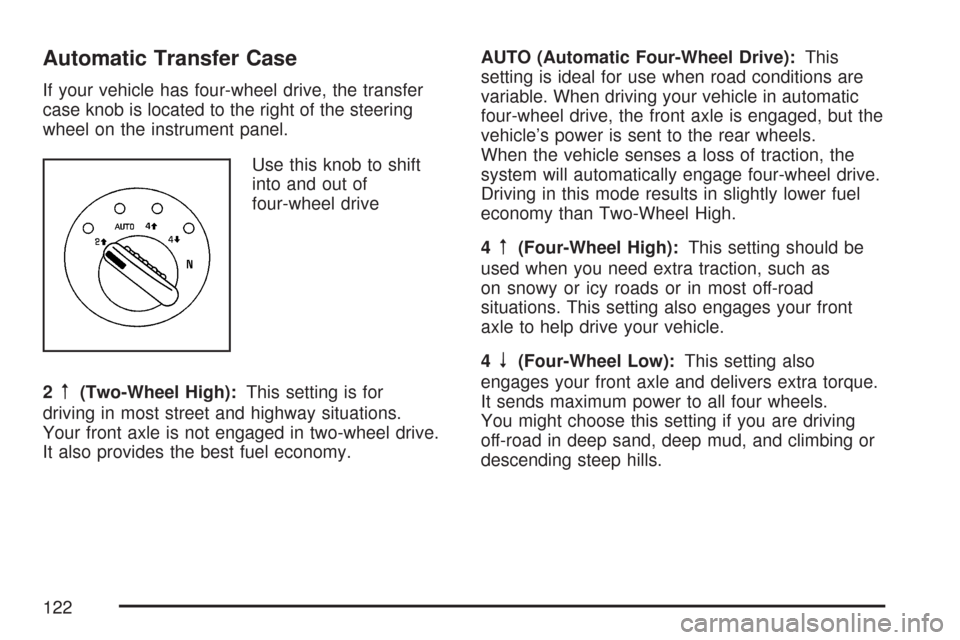
If your vehicle has four-wheel drive, the transfer
case knob is located to the right of the steering
wheel on the instrument panel.
Use this knob to shift
into and out of
four-wheel drive
2
m(Two-Wheel High):This setting is for
driving in most street and highway situations.
Your front axle is not engaged in two-wheel drive.
It also provides the best fuel economy.AUTO (Automatic Four-Wheel Drive):This
setting is ideal for use when road conditions are
variable. When driving your vehicle in automatic
four-wheel drive, the front axle is engaged, but the
vehicle’s power is sent to the rear wheels.
When the vehicle senses a loss of traction, the
system will automatically engage four-wheel drive.
Driving in this mode results in slightly lower fuel
economy than Two-Wheel High.
4
m(Four-Wheel High):This setting should be
used when you need extra traction, such as
on snowy or icy roads or in most off-road
situations. This setting also engages your front
axle to help drive your vehicle.
4
n(Four-Wheel Low):This setting also
engages your front axle and delivers extra torque.
It sends maximum power to all four wheels.
You might choose this setting if you are driving
off-road in deep sand, deep mud, and climbing or
descending steep hills.
122
Page 123 of 574
{CAUTION:
Shifting the transfer case to NEUTRAL can
cause your vehicle to roll even if the
transmission is in PARK (P). You or
someone else could be seriously injured.
Be sure to set the parking brake before
placing the transfer case in NEUTRAL.
SeeParking Brake on page 126.
NEUTRAL:Shift the vehicle’s transfer case to
NEUTRAL only when towing your vehicle.
SeeRecreational Vehicle Towing on page 362for
more information.
An indicator light in the knob will show you which
position the transfer case is in. The indicator lights
will come on briey when you turn on the ignition
and one will stay on. If the lights do not come on,
you should take your vehicle to your dealer for
service. An indicator light will ash while shiftingthe transfer case. It will stay on when the shift is
complete. If for some reason the transfer case
cannot make a requested shift, it will return to the
last chosen setting.
If the service Four-Wheel Drive Warning Light on
the instrument panel cluster stays on, you
should take your vehicle to your dealer for service.
SeeService Four-Wheel Drive Warning Light on
page 218for further information.
Shifting Into Four-Wheel High or Automatic
Four-Wheel Drive
Turn the knob to Four-Wheel High or Automatic
Four-Wheel Drive. This can be done at any speed
unless you are shifting out of Four-Wheel Low.
The indicator light will ash while shifting.
It will remain on when the shift is complete.
Shifting Into Two-Wheel High
Turn the knob to Two-Wheel High. This can be
done at any speed unless you are shifting
out of Four-Wheel Low.
123
Page 124 of 574
Shifting Into Four-Wheel Low
To shift to Four-Wheel Low, the vehicle’s engine
must be running and the vehicle must be stopped
or moving less than 2 mph (3.2 km/h) with the
transmission in NEUTRAL (N). The preferred
method for shifting into Four-Wheel Low is to have
your vehicle moving 1 or 2 mph (1.6 to 3.2 km/h).
Turn the knob to Four-Wheel Low. You must
wait for the Four-Wheel Low indicator light to stop
ashing and stay on before shifting the
transmission into gear.
If you turn the knob to Four-Wheel Low when your
vehicle is in gear and/or moving, the Four-Wheel
Low indicator light will ash for 30 seconds and not
complete the shift unless your vehicle is moving
less than 2 mph (3.2 km/h) and the transmission is
in NEUTRAL (N). After 30 seconds, the transfer
case will return to the setting last chosen.
Shifting Out of Four-Wheel Low
To shift from Four-Wheel Low to Four-Wheel High,
Auto Four-Wheel Drive, or Two-Wheel High,
your vehicle must be stopped or moving less than
2 mph (3.2 km/h) with the transmission in
NEUTRAL (N) and the engine running. The
preferred method for shifting out of Four-Wheel
Low is to have your vehicle moving 1 or 2 mph
(1.6 to 3.2 km/h). Turn the knob to Four-Wheel
High, Auto Four-Wheel Drive, or Two-Wheel High.
You must wait for the Four-Wheel High, Auto
Four-Wheel Drive, or Two-Wheel High indicator
light to stop ashing and stay off before shifting
your transmission into gear.
If the knob is turned to Four Wheel-High, Auto
Four-Wheel Drive, or Two-Wheel High when your
vehicle is in gear and/or moving, the Four-Wheel
High, Auto Four-Wheel Drive, or Two-Wheel
High indicator light will ash for 30 seconds. It will
not complete the shift unless your vehicle is
moving less than 2 mph (3.2 km/h) with the
transmission in NEUTRAL (N).
124
Page 125 of 574
Shifting into NEUTRAL
Before shifting the transfer case to NEUTRAL,
rst make sure the vehicle is parked so that it will
not roll.
1. Set the parking brake.
2. Start the vehicle.
3. Put the transmission in NEUTRAL (N).
4. Shift the transfer case to Two-Wheel High.
5. Turn the transfer case knob all of the way past
Four-Wheel Low and hold it there for a
minimum of 10 seconds. The neutral indicator
light will come on.
6. With the engine running, shift the transmission
to REVERSE (R) for one second, then shift
the transmission to DRIVE (D) for one second,
to ensure that the transfer case is in
NEUTRAL.
7. Turn the engine off, by turning the key to
ACCESSORY.
8. Place the transmission shift lever in PARK (P).
9. Turn the ignition to LOCK.
Shifting Out of NEUTRAL
To shift the transfer case out of NEUTRAL, do the
following:
1. Set the parking brake and apply the regular
brake pedal.
2. Turn the ignition to RUN with the engine off.
3. Put the transmission in NEUTRAL (N).
4. Turn the transfer case knob to the desired
position (Two-Wheel High, Four-Wheel
High, or Auto Four-Wheel Drive).
5. After the transfer case has shifted out of
NEUTRAL, the indicator light will go out.
6. Release the parking brake.
7. Start the engine and shift the transmission to
the desired position.
125
Page 126 of 574
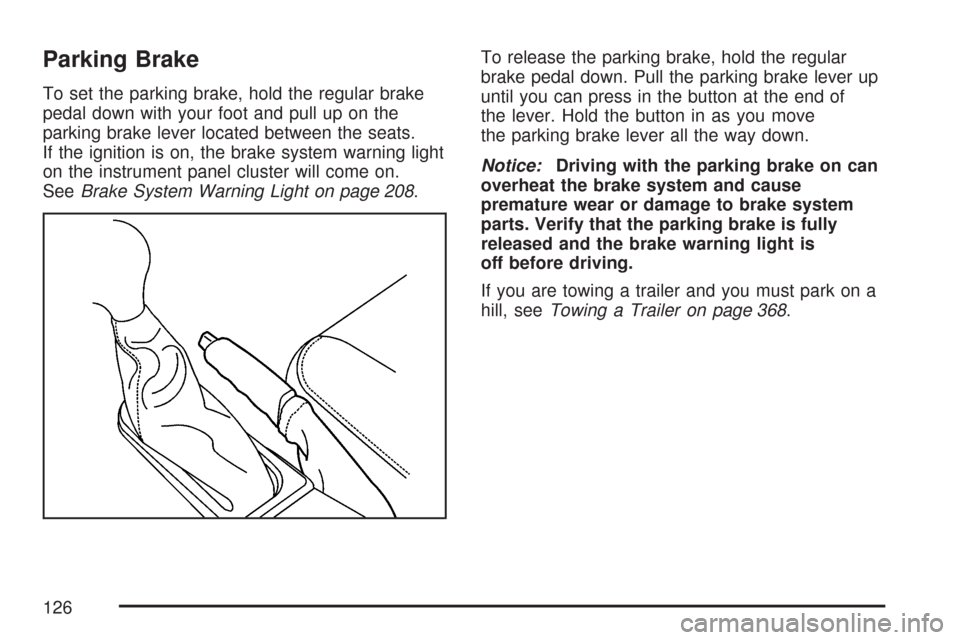
Parking Brake
To set the parking brake, hold the regular brake
pedal down with your foot and pull up on the
parking brake lever located between the seats.
If the ignition is on, the brake system warning light
on the instrument panel cluster will come on.
SeeBrake System Warning Light on page 208.To release the parking brake, hold the regular
brake pedal down. Pull the parking brake lever up
until you can press in the button at the end of
the lever. Hold the button in as you move
the parking brake lever all the way down.
Notice:Driving with the parking brake on can
overheat the brake system and cause
premature wear or damage to brake system
parts. Verify that the parking brake is fully
released and the brake warning light is
off before driving.
If you are towing a trailer and you must park on a
hill, seeTowing a Trailer on page 368.
126
Page 133 of 574
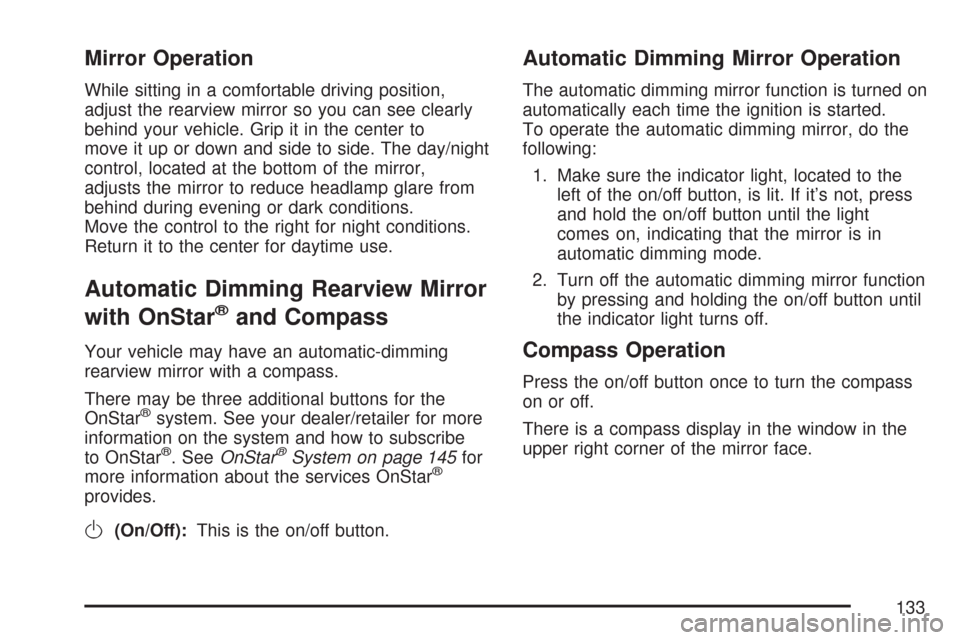
Mirror Operation
While sitting in a comfortable driving position,
adjust the rearview mirror so you can see clearly
behind your vehicle. Grip it in the center to
move it up or down and side to side. The day/night
control, located at the bottom of the mirror,
adjusts the mirror to reduce headlamp glare from
behind during evening or dark conditions.
Move the control to the right for night conditions.
Return it to the center for daytime use.
Automatic Dimming Rearview Mirror
with OnStar
®and Compass
Your vehicle may have an automatic-dimming
rearview mirror with a compass.
There may be three additional buttons for the
OnStar
®system. See your dealer/retailer for more
information on the system and how to subscribe
to OnStar
®. SeeOnStar®System on page 145for
more information about the services OnStar®
provides.
O(On/Off):This is the on/off button.
Automatic Dimming Mirror Operation
The automatic dimming mirror function is turned on
automatically each time the ignition is started.
To operate the automatic dimming mirror, do the
following:
1. Make sure the indicator light, located to the
left of the on/off button, is lit. If it’s not, press
and hold the on/off button until the light
comes on, indicating that the mirror is in
automatic dimming mode.
2. Turn off the automatic dimming mirror function
by pressing and holding the on/off button until
the indicator light turns off.
Compass Operation
Press the on/off button once to turn the compass
on or off.
There is a compass display in the window in the
upper right corner of the mirror face.
133
Page 135 of 574
3. Scroll through the zone numbers that appear in
the window on the mirror by pressing the on/off
button. Once you nd your zone number,
release the button. After about four seconds,
the mirror will return to the compass display,
and the new zone number will be set. If C or
CAL appears in the compass window, the
compass may need calibration. See “Compass
Calibration” listed previously.
Automatic Dimming Rearview Mirror
with OnStar
®, Compass and
Temperature Display
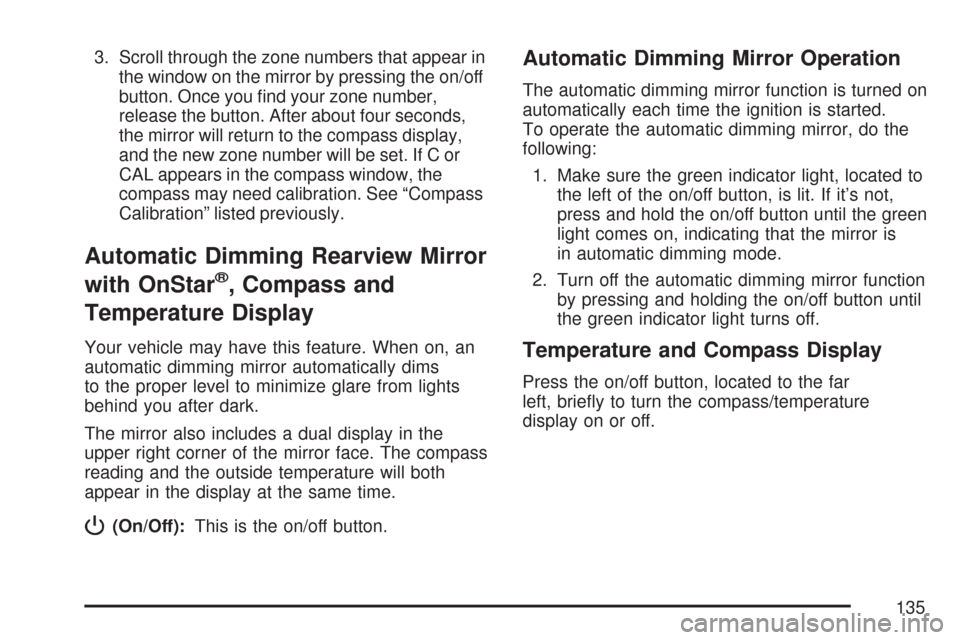
Your vehicle may have this feature. When on, an
automatic dimming mirror automatically dims
to the proper level to minimize glare from lights
behind you after dark.
The mirror also includes a dual display in the
upper right corner of the mirror face. The compass
reading and the outside temperature will both
appear in the display at the same time.
P(On/Off):This is the on/off button.
Automatic Dimming Mirror Operation
The automatic dimming mirror function is turned on
automatically each time the ignition is started.
To operate the automatic dimming mirror, do the
following:
1. Make sure the green indicator light, located to
the left of the on/off button, is lit. If it’s not,
press and hold the on/off button until the green
light comes on, indicating that the mirror is
in automatic dimming mode.
2. Turn off the automatic dimming mirror function
by pressing and holding the on/off button until
the green indicator light turns off.
Temperature and Compass Display
Press the on/off button, located to the far
left, briey to turn the compass/temperature
display on or off.
135
Page 138 of 574
Automatic Dimming Rearview Mirror
with Compass
Your vehicle may have an automatic-dimming
rearview mirror with a compass.
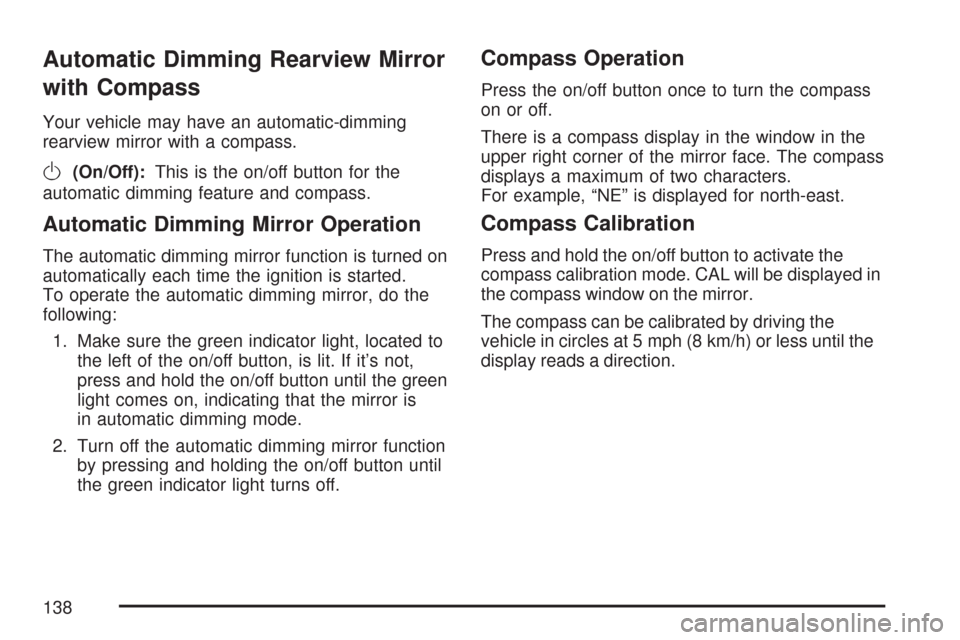
O(On/Off):This is the on/off button for the
automatic dimming feature and compass.
Automatic Dimming Mirror Operation
The automatic dimming mirror function is turned on
automatically each time the ignition is started.
To operate the automatic dimming mirror, do the
following:
1. Make sure the green indicator light, located to
the left of the on/off button, is lit. If it’s not,
press and hold the on/off button until the green
light comes on, indicating that the mirror is
in automatic dimming mode.
2. Turn off the automatic dimming mirror function
by pressing and holding the on/off button until
the green indicator light turns off.
Compass Operation
Press the on/off button once to turn the compass
on or off.
There is a compass display in the window in the
upper right corner of the mirror face. The compass
displays a maximum of two characters.
For example, “NE” is displayed for north-east.
Compass Calibration
Press and hold the on/off button to activate the
compass calibration mode. CAL will be displayed in
the compass window on the mirror.
The compass can be calibrated by driving the
vehicle in circles at 5 mph (8 km/h) or less until the
display reads a direction.
138
Page 140 of 574
Automatic Dimming Rearview Mirror
with Compass and Temperature
Display
If the vehicle is equipped with an automatic mirror,
it will, when on, automatically dim to the proper
level to minimize glare from lights behind you
after dark.
The mirror also includes a display in the upper
right corner of the mirror face. The compass
reading and the outside temperature will both
appear in the display at the same time. The dual
display can be turned on or off by briey
pressing either the TEMP or the COMP button.
Automatic Dimming Mirror Operation
The automatic dimming mirror function is turned on
automatically each time the ignition is started.
To operate the automatic dimming mirror, do the
following:
1. Make sure the green indicator light, located to
the left of the on/off button, is lit. If it’s not,
press and hold the on/off button until the green
light comes on, indicating that the mirror is
in automatic dimming mode.
2. Turn off the automatic dimming mirror function
by pressing and holding the on/off button until
the green indicator light turns off.
140
Page 148 of 574
How OnStar®Service Works
In order to provide you with OnStar®services, your
vehicle’s OnStar®system has the capability of
recording and transmitting vehicle information.
This information is automatically sent to an OnStar
®
Call Center at the time of an OnStar®button press,
Emergency button press or if your airbags or AACN
system deploys. The vehicle information usually
includes your GPS location and, in the event of a
crash, additional information regarding the accident
that your vehicle has been involved in (e.g. the
direction from which your vehicle was hit). When
you use the Virtual Advisor feature of OnStar
®
Hands-Free Calling, your vehicle also sends
OnStar®your GPS location so that we can provide
you with location-based services.
OnStar
®service cannot work unless your vehicle is
in a place where OnStar®has an agreement with a
wireless service provider for service in that area.
OnStar
®service also cannot work unless you are
in a place where the wireless service provider
OnStar
®has hired for that area has coverage,
network capacity and reception when the service is
needed, and technology that is compatible with theOnStar
®service. Not all services are available
everywhere, particularly in remote or enclosed
areas, or at all times.
OnStar
®service that involves location information
about your vehicle cannot work unless GPS
satellite signals are unobstructed and available in
that place as well.
Your vehicle must have a working electrical system
(including adequate battery power) for the OnStar
®
equipment to operate. There are other problems
OnStar®cannot control that may prevent OnStar®
from providing OnStar®service to you at any
particular time or place. Some examples are
damage to important parts of your vehicle in an
accident, hills, tall buildings, tunnels, weather or
wireless phone network congestion.
Your Responsibility
You may need to increase the volume of your radio
to hear the OnStar®advisor. If the light next to the
OnStar®buttons is red, this means that your system
is not functioning properly and should be checked
by your dealer/retailer. If the light appears clear (no
light is appearing), your OnStar
®subscription has
expired. You can always press the OnStar®button
to conrm that your OnStar®equipment is active.
148