warning light CHEVROLET TRAVERSE 2009 1.G Owner's Manual
[x] Cancel search | Manufacturer: CHEVROLET, Model Year: 2009, Model line: TRAVERSE, Model: CHEVROLET TRAVERSE 2009 1.GPages: 422, PDF Size: 2.06 MB
Page 184 of 422
TIGHTEN GAS CAP
This message may display along
with the check engine light on the
instrument panel cluster if the
vehicle’s fuel cap is not tightened
properly. SeeMalfunction Indicator
Lamp on page 3-39. Reinstall the
fuel cap fully. SeeFilling the Tank
on page 5-7. The diagnostic system
can determine if the fuel cap has
been left off or improperly installed.
A loose or missing fuel cap
allows fuel to evaporate into the
atmosphere. A few driving trips
with the cap properly installed
should turn this light and
message off.
TIRE LEARNING ACTIVE
On vehicles with the Tire Pressure
Monitor System (TPMS), this
message displays when the TPMS
is re-learning the tire positions on
your vehicle. The tire positions must
be re-learned after rotating the tires
or after replacing a tire or sensor.
SeeTire Inspection and Rotation
on page 5-48,Tire Pressure
Monitor System on page 5-43,
andInflation - Tire Pressure on
page 5-42for more information.
TRACTION CONTROL OFF
This message displays when
the Traction Control System (TCS)
is turned off. Adjust your driving
accordingly. SeeStabiliTrak
®
System on page 4-5for more
information. This message
clears itself after 10 seconds.
TRANSMISSION HOT IDLE
ENGINE
Notice:If you drive your vehicle
while the transmission uid is
overheating and the transmission
temperature warning is displayed
on the instrument panel cluster
and/or DIC, you can damage the
transmission. This could lead to
costly repairs that would not be
covered by your warranty. Do not
drive your vehicle with overheated
transmission uid or while the
transmission temperature warning
is displayed.
This message displays and a chime
sounds if the transmission uid in the
vehicle gets hot. Driving with the
transmission uid temperature high
can cause damage to the vehicle.
Stop the vehicle and let it idle to
allow the transmission to cool.
This message clears when the uid
temperature reaches a safe level.
3-64 Instrument Panel
Page 251 of 422
Police records show that
almost 40 percent of all motor
vehicle-related deaths involve
alcohol. In most cases, these deaths
are the result of someone who
was drinking and driving. In recent
years, more than 17,000 annual
motor vehicle-related deaths have
been associated with the use of
alcohol, with about 250,000 people
injured.
For persons under 21, it is against
the law in every U.S. state to drink
alcohol. There are good medical,
psychological, and developmental
reasons for these laws.
The obvious way to eliminate the
leading highway safety problem
is for people never to drink alcohol
and then drive.
Medical research shows that alcohol
in a person’s system can make crash
injuries worse, especially injuries
to the brain, spinal cord, or heart.This means that when anyone who
has been drinking — driver or
passenger — is in a crash, that
person’s chance of being killed or
permanently disabled is higher than
if the person had not been drinking.
Control of a Vehicle
The following three systems
help to control the vehicle while
driving — brakes, steering, and
accelerator. At times, as when
driving on snow or ice, it is easy to
ask more of those control systems
than the tires and road can provide.
Meaning, you can lose control of the
vehicle. SeeStabiliTrak
®System on
page 4-5.
Adding non-dealer/non-retailer
accessories can affect vehicle
performance. SeeAccessories and
Modifications on page 5-3.
Braking
SeeBrake System Warning Light on
page 3-36.
Braking action involves perception
time and reaction time. Deciding
to push the brake pedal is
perception time. Actually doing
it is reaction time.
Average reaction time is about
three-fourths of a second. But
that is only an average. It might be
less with one driver and as long as
two or three seconds or more with
another. Age, physical condition,
alertness, coordination, and eyesight
all play a part. So do alcohol, drugs,
and frustration. But even in
three-fourths of a second, a vehicle
moving at 60 mph (100 km/h) travels
66 feet (20 m). That could be a lot of
distance in an emergency, so
keeping enough space between the
vehicle and others is important.
Driving Your Vehicle 4-3
Page 252 of 422
And, of course, actual stopping
distances vary greatly with the
surface of the road, whether it is
pavement or gravel; the condition of
the road, whether it is wet, dry, or icy;
tire tread; the condition of the brakes;
the weight of the vehicle; and the
amount of brake force applied.
Avoid needless heavy braking. Some
people drive in spurts — heavy
acceleration followed by heavy
braking — rather than keeping pace
with traffic. This is a mistake. The
brakes might not have time to cool
between hard stops. The brakes will
wear out much faster with a lot of
heavy braking. Keeping pace with
the traffic and allowing realistic
following distances eliminates a lot of
unnecessary braking. That means
better braking and longer brake life.
If the engine ever stops while
the vehicle is being driven, brake
normally but do not pump the brakes.
If the brakes are pumped, the
pedal could get harder to push down.If the engine stops, there will still be
some power brake assist but it will
be used when the brake is applied.
Once the power assist is used up, it
can take longer to stop and the brake
pedal will be harder to push.
Adding non-dealer/non-retailer
accessories can affect vehicle
performance. SeeAccessories and
Modifications on page 5-3.
Antilock Brake
System (ABS)
This vehicle has the Antilock
Brake System (ABS), an advanced
electronic braking system that helps
prevent a braking skid.
When the engine is started and the
vehicle begins to drive away, ABS
checks itself. A momentary motor or
clicking noise might be heard while
this test is going on, and it might
even be noticed that the brake pedal
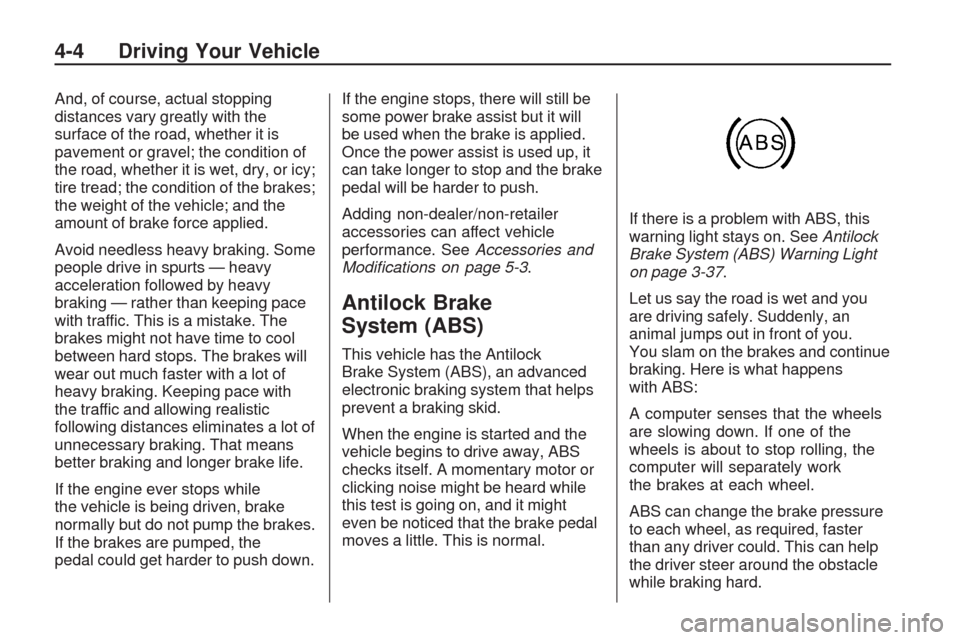
moves a little. This is normal.If there is a problem with ABS, this
warning light stays on. SeeAntilock
Brake System (ABS) Warning Light
on page 3-37.
Let us say the road is wet and you
are driving safely. Suddenly, an
animal jumps out in front of you.
You slam on the brakes and continue
braking. Here is what happens
with ABS:
A computer senses that the wheels
are slowing down. If one of the
wheels is about to stop rolling, the
computer will separately work
the brakes at each wheel.
ABS can change the brake pressure
to each wheel, as required, faster
than any driver could. This can help
the driver steer around the obstacle
while braking hard.
4-4 Driving Your Vehicle
Page 255 of 422
It may also be necessary to turn off
the system when driving in extreme
off-road conditions where high wheel
spin is required. SeeIf Your Vehicle
is Stuck in Sand, Mud, Ice, or Snow
on page 4-16.
Traction Control Operation
The traction control system is part
of the StabiliTrak system. Traction
control limits wheel spin by reducing
engine power to the wheels (engine
speed management) and by applying
brakes to each individual wheel
(brake-traction control) as necessary.
The traction control system is
enabled automatically when the
vehicle is started. It will activate
and the StabiliTrak light will ash
if it senses that any of the wheels
are spinning or beginning to lose
traction while driving. If traction
control is turned off, only the
brake-traction control portion of
traction control will work. The engine
speed management will be disabled.In this mode, engine power is not
reduced automatically and the driven
wheels can spin more freely. This
can cause the brake-traction control
to activate constantly.
Notice:If the wheel(s) of one axle
is allowed to spin excessively
while the StabiliTrak, ABS and
brake warning lights and any
relevant DIC messages are
displayed, the transfer case could
be damaged. The repairs would
not be covered by the vehicle
warranty. Reduce engine power
and do not spin the wheel(s)
excessively while these lights and
messages are displayed.
The traction control system may
activate on dry or rough roads or
under conditions such as heavy
acceleration while turning or
abrupt upshifts/downshifts of the
transmission. When this happens, a
reduction in acceleration may be
noticed, or a noise or vibration may
be heard. This is normal.If cruise control is being used when
the system activates, the StabiliTrak
light will ash and cruise control will
automatically disengage. Cruise
control may be reengaged when
road conditions allow. SeeCruise
Control on page 3-9.
StabiliTrak may also turn off
automatically if it determines that a
problem exists with the system.
If the problem does not clear itself
after restarting the vehicle, see your
dealer/retailer for service.
All-Wheel Drive (AWD)
System
If the vehicle has this feature, engine
power is sent to all four wheels when
extra traction is needed. This is like
four-wheel drive, but there is no
separate lever or switch to engage
or disengage the axle. It is fully
automatic, and adjusts itself as
needed for road conditions.
Driving Your Vehicle 4-7
Page 258 of 422
Loss of Control
Let us review what driving experts
say about what happens when the
three control systems — brakes,
steering, and acceleration — do not
have enough friction where the tires
meet the road to do what the driver
has asked.
In any emergency, do not give up.
Keep trying to steer and constantly
seek an escape route or area of
less danger.
Skidding
In a skid, a driver can lose control of
the vehicle. Defensive drivers avoid
most skids by taking reasonable care
suited to existing conditions, and by
not overdriving those conditions. But
skids are always possible.
The three types of skids correspond
to the vehicle’s three control
systems. In the braking skid, the
wheels are not rolling. In the steering
or cornering skid, too much speed
or steering in a curve causes tires
to slip and lose cornering force.And in the acceleration skid, too
much throttle causes the driving
wheels to spin.
If the vehicle starts to slide, ease
your foot off the accelerator pedal
and quickly steer the way you want
the vehicle to go. If you start steering
quickly enough, the vehicle may
straighten out. Always be ready
for a second skid if it occurs.
Of course, traction is reduced when
water, snow, ice, gravel, or other
material is on the road. For safety,
slow down and adjust your driving
to these conditions. It is important
to slow down on slippery surfaces
because stopping distance is longer
and vehicle control more limited.
While driving on a surface with
reduced traction, try your best to
avoid sudden steering, acceleration,
or braking, including reducing vehicle
speed by shifting to a lower gear.
Any sudden changes could cause
the tires to slide. You might not
realize the surface is slippery until
the vehicle is skidding. Learn torecognize warning clues — such as
enough water, ice, or packed snow
on the road to make a mirrored
surface — and slow down when
you have any doubt.
Remember: Any Antilock Brake
System (ABS) helps avoid only the
braking skid.
Driving at Night
Night driving is more dangerous than
day driving because some drivers
are likely to be impaired — by alcohol
or drugs, with night vision problems,
or by fatigue.
Night driving tips include:
Drive defensively.
Do not drink and drive.
Reduce headlamp glare by
adjusting the inside rearview
mirror.
Slow down and keep more space
between you and other vehicles
because headlamps can only
light up so much road ahead.
4-10 Driving Your Vehicle
Page 259 of 422
Watch for animals.
When tired, pull off the road.
Do not wear sunglasses.
Avoid staring directly into
approaching headlamps.
Keep the windshield and all glass
on your vehicle clean — inside
and out.
Keep your eyes moving,
especially during turns or curves.
No one can see as well at night
as in the daytime. But, as we get
older, these differences increase.
A 50-year-old driver might need at
least twice as much light to see the
same thing at night as a 20-year-old.
Driving in Rain and on
Wet Roads
Rain and wet roads can reduce
vehicle traction and affect your
ability to stop and accelerate.
Always drive slower in these types
of driving conditions and avoid
driving through large puddles and
deep-standing or owing water.
{CAUTION
Wet brakes can cause crashes.
They might not work as well in a
quick stop and could cause
pulling to one side. You could
lose control of the vehicle.
(Continued)
CAUTION (Continued)
After driving through a large
puddle of water or a car/vehicle
wash, lightly apply the brake pedal
until the brakes work normally.
Flowing or rushing water creates
strong forces. Driving through
owing water could cause your
vehicle to be carried away. If this
happens, you and other vehicle
occupants could drown. Do not
ignore police warnings and be very
cautious about trying to drive
through owing water.
Driving Your Vehicle 4-11
Page 297 of 422
If the vehicle has Driver Information
Center (DIC) buttons:
1. Turn the ignition to ON/RUN,
with the engine off.
2. Press the vehicle information
button until OIL LIFE
REMAINING displays.
3. Press and hold the set/reset
button until 100% is displayed.
Three chimes sound and
the CHANGE ENGINE OIL
SOON message goes off.
4. Turn the key to LOCK/OFF.
If the CHANGE ENGINE OIL SOON
message comes back on when the
vehicle is started, the engine oil life
system has not reset. Repeat the
procedure.What to Do with Used Oil
Used engine oil contains certain
elements that can be unhealthy for
your skin and could even cause
cancer. Do not let used oil stay on
your skin for very long. Clean your
skin and nails with soap and water,
or a good hand cleaner. Wash or
properly dispose of clothing or rags
containing used engine oil. See the
manufacturer’s warnings about the
use and disposal of oil products.
Used oil can be a threat to the
environment. If you change your own
oil, be sure to drain all the oil from the
lter before disposal. Never dispose
of oil by putting it in the trash, pouring
it on the ground, into sewers, or into
streams or bodies of water. Recycle
it by taking it to a place that collects
used oil.
Engine Air Cleaner/Filter
When to Inspect the Engine
Air Cleaner/Filter
Inspect the air cleaner/lter at the
MaintenanceIIintervals and replace
it at the rst oil change after each
50,000 mile (80 000 km) interval.
SeeScheduled Maintenance on
page 6-3for more information. If you
are driving in dusty/dirty conditions,
inspect the lter at each engine oil
change.
SeeEngine Compartment Overview
on page 5-10for the location of
the engine air cleaner/lter.
How to Inspect the Engine Air
Cleaner/Filter
To inspect the air cleaner/lter,
remove the lter from the vehicle and
lightly shake the lter (away from
vehicle) to release loose dust and
dirt. If the lter remains caked with
dirt, a new lter is required.
Service and Appearance Care 5-15
Page 308 of 422
There are only two reasons why the
brake uid level in the reservoir
might go down:
The brake uid level goes down
because of normal brake lining
wear. When new linings are
installed, the uid level goes
back up.
A uid leak in the brake hydraulic
system can also cause a low uid
level. Have the brake hydraulic
system xed, since a leak means
that sooner or later the brakes will
not work well.
Do not top off the brake uid. Adding
uid does not correct a leak. If uid
is added when the linings are worn,
there will be too much uid when new
brake linings are installed. Add or
remove brake uid, as necessary,
only when work is done on the brake
hydraulic system.
{CAUTION
If too much brake uid is added, it
can spill on the engine and burn, if
the engine is hot enough. You or
others could be burned, and the
vehicle could be damaged. Add
brake uid only when work is done
on the brake hydraulic system.
When the brake uid falls to a low
level, the brake warning light comes
on. SeeBrake System Warning
Light on page 3-36.What to Add
Use only new DOT 3 brake uid
from a sealed container. See
Recommended Fluids and
Lubricants on page 6-12.
Always clean the brake uid
reservoir cap and the area around
the cap before removing it. This
helps keep dirt from entering
the reservoir.
{CAUTION
With the wrong kind of uid in the
brake hydraulic system, the
brakes might not work well. This
could cause a crash. Always use
the proper brake uid.
5-26 Service and Appearance Care
Page 309 of 422
Notice:
Using the wrong uid can badly
damage brake hydraulic system
parts. For example, just a few
drops of mineral-based oil,
such as engine oil, in the brake
hydraulic system can damage
brake hydraulic system parts so
badly that they will have to be
replaced. Do not let someone
put in the wrong kind of uid.
If brake uid is spilled on the
vehicle’s painted surfaces, the
paint nish can be damaged. Be
careful not to spill brake uid
on the vehicle. If you do, wash it
off immediately. SeeWashing
Your Vehicle on page 5-81.
Brake Wear
This vehicle has disc brakes. Disc
brake pads have built-in wear
indicators that make a high-pitched
warning sound when the brake
pads are worn and new pads are
needed. The sound can come
and go or be heard all the time the
vehicle is moving, except when
applying the brake pedal rmly.
{CAUTION
The brake wear warning sound
means that soon the brakes will
not work well. That could lead to
an accident. When the brake wear
warning sound is heard, have the
vehicle serviced.
Notice:Continuing to drive with
worn-out brake pads could
result in costly brake repair.Some driving conditions or climates
can cause a brake squeal when the
brakes are rst applied or lightly
applied. This does not mean
something is wrong with the brakes.
Properly torqued wheel nuts are
necessary to help prevent brake
pulsation. When tires are rotated,
inspect brake pads for wear and
evenly tighten wheel nuts in
the proper sequence to torque
specications inCapacities and
Specifications on page 5-92.
Brake linings should always be
replaced as complete axle sets.
Brake Pedal Travel
See your dealer/retailer if the brake
pedal does not return to normal
height, or if there is a rapid increase
in pedal travel. This could be a sign
that brake service might be required.
Service and Appearance Care 5-27
Page 327 of 422
Vehicles with TPMS operate on a
radio frequency and comply with
RSS-210 of Industry and Science
Canada. Operation is subject to the
following two conditions:
1. This device may not cause
interference.
2. This device must accept any
interference received, including
interference that may cause
undesired operation of the device.
Changes or modications to this
system by other than an authorized
service facility could void
authorization to use this equipment.Tire Pressure Monitor
Operation
This vehicle may have a Tire
Pressure Monitor System (TPMS).
The TPMS is designed to warn
the driver when a low tire pressure
condition exists. TPMS sensors
are mounted onto each tire
and wheel assembly, excluding the
spare tire and wheel assembly,
if the vehicle has one. The TPMS
sensors monitor the air pressure in
the vehicle’s tires and transmits
the tire pressure readings to
a receiver located in the vehicle.
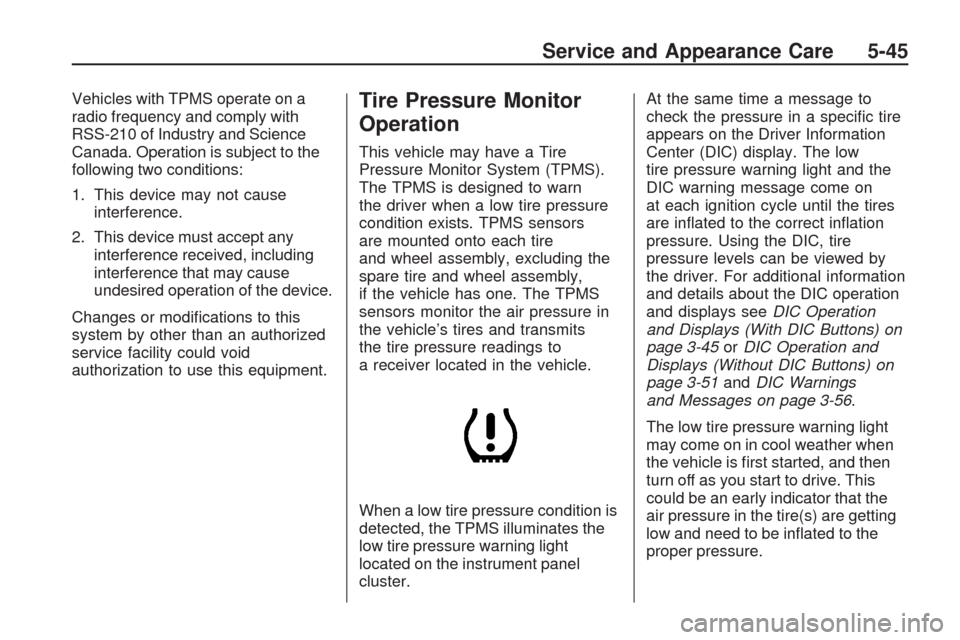
When a low tire pressure condition is
detected, the TPMS illuminates the
low tire pressure warning light
located on the instrument panel
cluster.At the same time a message to
check the pressure in a specic tire
appears on the Driver Information
Center (DIC) display. The low
tire pressure warning light and the
DIC warning message come on
at each ignition cycle until the tires
are inated to the correct ination
pressure. Using the DIC, tire
pressure levels can be viewed by
the driver. For additional information
and details about the DIC operation
and displays seeDIC Operation
and Displays (With DIC Buttons) on
page 3-45orDIC Operation and
Displays (Without DIC Buttons) on
page 3-51andDIC Warnings
and Messages on page 3-56.
The low tire pressure warning light
may come on in cool weather when
the vehicle is rst started, and then
turn off as you start to drive. This
could be an early indicator that the
air pressure in the tire(s) are getting
low and need to be inated to the
proper pressure.
Service and Appearance Care 5-45