trailer CHEVROLET TRAVERSE 2017 1.G Owner's Manual
[x] Cancel search | Manufacturer: CHEVROLET, Model Year: 2017, Model line: TRAVERSE, Model: CHEVROLET TRAVERSE 2017 1.GPages: 394, PDF Size: 6.47 MB
Page 265 of 394
Chevrolet Traverse Owner Manual (GMNA-Localizing-U.S./Canada/Mexico-
9955676) - 2017 - crc - 4/1/16
264 Driving and Operating
.Gray: Illumination
. Dark Blue: Trailer Brake Signal
. Black: Ground
The electric trailer brake controller
should be installed by your dealer or
a qualified service center.Conversions and
Add-Ons
Add-On Electrical
Equipment
{Warning
The Data Link Connector (DLC) is
used for vehicle service and
Emission Inspection/Maintenance
testing. See Malfunction Indicator
Lamp (Check Engine Light)
0 124. A device connected to the
DLC —such as an aftermarket
fleet or driver-behavior tracking
device —may interfere with
vehicle systems. This could affect
vehicle operation and cause a
crash. Such devices may also
access information stored in the
vehicle’s systems.
Caution
Some electrical equipment can
damage the vehicle or cause
components to not work and
would not be covered by the
vehicle warranty. Always check
with your dealer before adding
electrical equipment.
Add-on equipment can drain the
vehicle's 12-volt battery, even if the
vehicle is not operating.
The vehicle has an airbag system.
Before attempting to add anything
electrical to the vehicle, see
Servicing the Airbag-Equipped
Vehicle 082 and Adding Equipment
to the Airbag-Equipped
Vehicle 082.
Page 281 of 394
Chevrolet Traverse Owner Manual (GMNA-Localizing-U.S./Canada/Mexico-
9955676) - 2017 - crc - 3/29/16
280 Vehicle Care
should be running. If they are not,
do not continue to run the engine
and have the vehicle serviced.
Caution
Running the engine without
coolant may cause damage or a
fire. Vehicle damage would not be
covered by the vehicle warranty.
SeeOverheated Engine
Protection Operating Mode 0281
for information on driving to a
safe place in an emergency.
If Steam Is Coming from the
Engine Compartment
{Warning
Steam from an overheated engine
can burn you badly, even if you
just open the hood. Stay away
from the engine if you see or hear
steam coming from it. Turn it off
and get everyone away from the
vehicle until it cools down. Wait
(Continued)
Warning (Continued)
until there is no sign of steam or
coolant before you open
the hood.
If you keep driving when the
vehicles engine is overheated,
the liquids in it can catch fire. You
or others could be badly burned.
Stop the engine if it overheats,
and get out of the vehicle until the
engine is cool.
SeeOverheated Engine
Protection Operating Mode 0281
for information on driving to a
safe place in an emergency.
If No Steam Is Coming from
the Engine Compartment
If an engine overheat warning is
displayed but no steam can be seen
or heard, the problem may not be
too serious. Sometimes the engine
can get a little too hot when the
vehicle:
. Climbs a long hill on a hot day. .
Stops after high-speed driving.
. Idles for long periods in traffic.
. Tows a trailer.
If the overheat warning is displayed
with no sign of steam: 1. Turn the air conditioning off.
2. Turn the heater on to the highest temperature and to the
highest fan speed. Open the
windows as necessary.
3. When it is safe to do so, pull off the road, shift to P (Park) or
N (Neutral), and let the
engine idle.
If the temperature overheat gauge is
no longer in the overheat zone or an
overheat warning no longer
displays, the vehicle can be driven.
Continue to drive the vehicle slow
for about 10 minutes. Keep a safe
vehicle distance from the car in front
of you. If the warning does not come
back on, continue to drive normally
and have the cooling system
checked for proper fill and function.
Page 282 of 394
Chevrolet Traverse Owner Manual (GMNA-Localizing-U.S./Canada/Mexico-
9955676) - 2017 - crc - 3/29/16
Vehicle Care 281
If the warning continues, pull over,
stop, and park the vehicle
right away.
If there is no sign of steam, idle the
engine for three minutes while
parked. If the warning is still
displayed, turn off the engine until it
cools down. Also, see“Overheated
Engine Protection Operating Mode”
next in this section.
Overheated Engine
Protection
Operating Mode
This emergency operating mode lets
the vehicle be driven to a safe place
in an emergency situation. If an
overheated engine condition exists,
an overheat protection mode which
alternates firing groups of cylinders
helps prevent engine damage. In
this mode, there is a significant loss
in power and engine performance.
The temperature gauge indicates an
overheat condition exists. Driving
extended distances and/or towing a
trailer in the overheat protection
mode should be avoided.
Caution
After driving in the overheated
engine protection operating
mode, the engine oil will be
severely degraded. Any repairs
performed before the engine is
cool may cause engine damage.
Allow the engine to cool before
attempting any repair. Repair the
cause of coolant loss, change the
oil, and reset the oil life system.
See Engine Oil 0270.
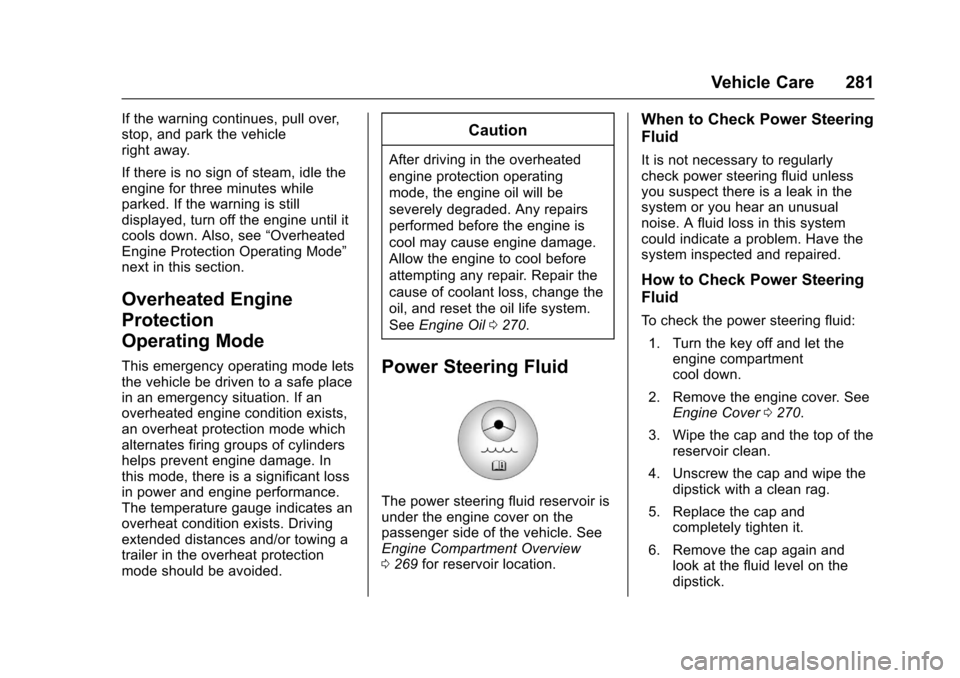
Power Steering Fluid
The power steering fluid reservoir is
under the engine cover on the
passenger side of the vehicle. See
Engine Compartment Overview
0269 for reservoir location.
When to Check Power Steering
Fluid
It is not necessary to regularly
check power steering fluid unless
you suspect there is a leak in the
system or you hear an unusual
noise. A fluid loss in this system
could indicate a problem. Have the
system inspected and repaired.
How to Check Power Steering
Fluid
To check the power steering fluid:
1. Turn the key off and let the engine compartment
cool down.
2. Remove the engine cover. See Engine Cover 0270.
3. Wipe the cap and the top of the reservoir clean.
4. Unscrew the cap and wipe the dipstick with a clean rag.
5. Replace the cap and completely tighten it.
6. Remove the cap again and look at the fluid level on the
dipstick.
Page 294 of 394
Chevrolet Traverse Owner Manual (GMNA-Localizing-U.S./Canada/Mexico-
9955676) - 2017 - crc - 3/29/16
Vehicle Care 293
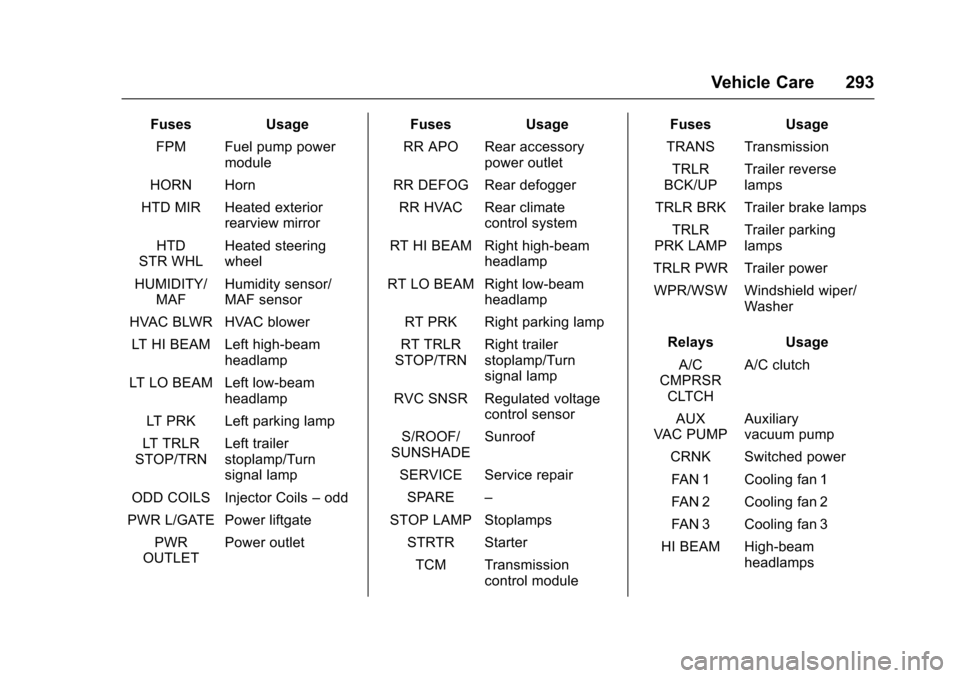
FusesUsage
FPM Fuel pump power module
HORN Horn
HTD MIR Heated exterior rearview mirror
HTD
STR WHL Heated steering
wheel
HUMIDITY/ MAF Humidity sensor/
MAF sensor
HVAC BLWR HVAC blower LT HI BEAM Left high-beam headlamp
LT LO BEAM Left low-beam headlamp
LT PRK Left parking lamp
LT TRLR
STOP/TRN Left trailer
stoplamp/Turn
signal lamp
ODD COILS Injector Coils –odd
PWR L/GATE Power liftgate
PWR
OUTLET Power outlet Fuses
Usage
RR APO Rear accessory power outlet
RR DEFOG Rear defogger RR HVAC Rear climate control system
RT HI BEAM Right high-beam headlamp
RT LO BEAM Right low-beam headlamp
RT PRK Right parking lamp
RT TRLR
STOP/TRN Right trailer
stoplamp/Turn
signal lamp
RVC SNSR Regulated voltage control sensor
S/ROOF/
SUNSHADE Sunroof
SERVICE Service repair SPARE –
STOP LAMP Stoplamps
STRTR StarterTCM Transmission control module Fuses
Usage
TRANS Transmission TRLR
BCK/UP Trailer reverse
lamps
TRLR BRK Trailer brake lamps TRLR
PRK LAMP Trailer parking
lamps
TRLR PWR Trailer power WPR/WSW Windshield wiper/ Washer
Relays Usage
A/C
CMPRSR CLTCH A/C clutch
AUX
VAC PUMP Auxiliary
vacuum pump
CRNK Switched power
FAN 1 Cooling fan 1
FAN 2 Cooling fan 2
FAN 3 Cooling fan 3
HI BEAM High-beam headlamps
Page 295 of 394

Chevrolet Traverse Owner Manual (GMNA-Localizing-U.S./Canada/Mexico-
9955676) - 2017 - crc - 3/29/16
294 Vehicle Care
RelaysUsage
HID/
LO BEAM Low-beam HID
headlamps
HORN Horn IGN Ignition –main
LT TRLR
STOP/TRN Left trailer
stoplamp/Turn
signal lamp
PRK LAMP Parking lamps PWR/TRN Powertrain
RR DEFOG Rear window defogger
RT LO BEAM Right low-beam headlamp
RT TRLR
STOP/TRN Right trailer
stoplamp/Turn
signal lamp
STOP LAMP Stoplamps TRLR
BCK/UP Trailer reverse
lamps
WPR Windshield wiper
WPR HI Windshield wiper –
high speedInstrument Panel Fuse
Block
The instrument panel fuse block is
under the instrument panel on the
passenger side of the vehicle. Pull
down on the cover to access the
fuse block.
Fuse Side
Page 331 of 394
Chevrolet Traverse Owner Manual (GMNA-Localizing-U.S./Canada/Mexico-
9955676) - 2017 - crc - 3/29/16
330 Vehicle Care
Recreational Vehicle
Towing
Recreational vehicle towing means
towing the vehicle behind another
vehicle–such as behind a motor
home. The two most common types
of recreational vehicle towing are
known as dinghy towing and dolly
towing. Dinghy towing is towing the
vehicle with all four wheels on the
ground. Dolly towing is towing the
vehicle with two wheels on the
ground and two wheels up on a
device known as a dolly.
Here are some important things to
consider before recreational vehicle
towing:
. The towing capacity of the
towing vehicle. Be sure to read
the tow vehicle manufacturer's
recommendations.
. How far the vehicle will be
towed. Some vehicles have
restrictions on how far and how
long they can be towed. .
The proper towing equipment.
See your dealer or trailering
professional for additional advice
and equipment
recommendations.
. If the vehicle is ready to be
towed. Just as preparing the
vehicle for a long trip, make sure
the vehicle is prepared to be
towed.
Caution
Use of a shield mounted in front
of the vehicle grille could restrict
airflow and cause damage to the
transmission. The repairs would
not be covered by the vehicle
warranty. If using a shield, only
use one that attaches to the
towing vehicle.
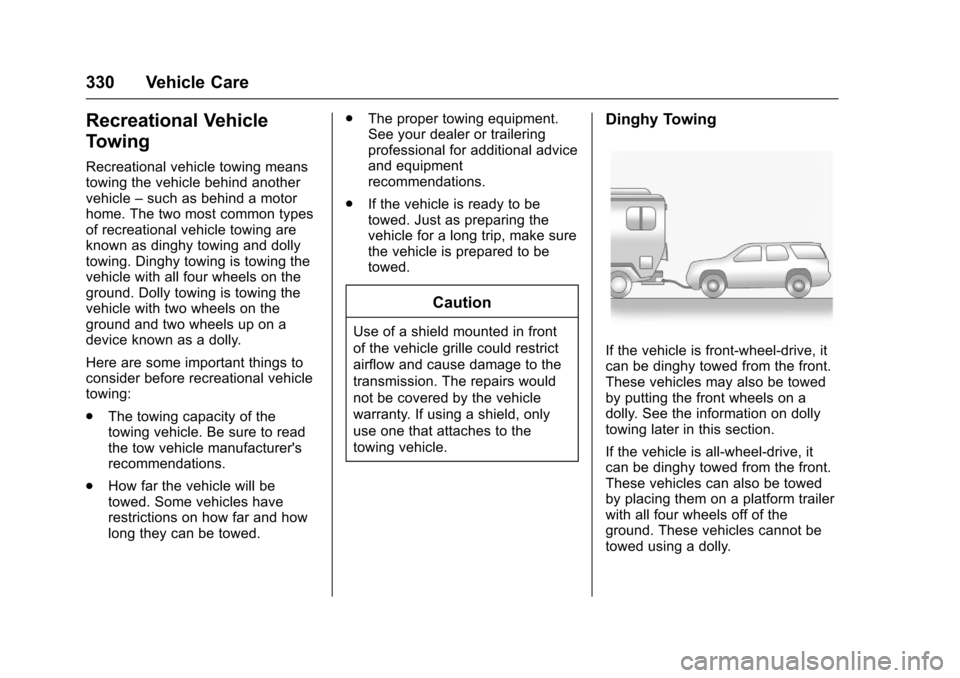
Dinghy Towing
If the vehicle is front-wheel-drive, it
can be dinghy towed from the front.
These vehicles may also be towed
by putting the front wheels on a
dolly. See the information on dolly
towing later in this section.
If the vehicle is all-wheel-drive, it
can be dinghy towed from the front.
These vehicles can also be towed
by placing them on a platform trailer
with all four wheels off of the
ground. These vehicles cannot be
towed using a dolly.
Page 333 of 394
Chevrolet Traverse Owner Manual (GMNA-Localizing-U.S./Canada/Mexico-
9955676) - 2017 - crc - 3/29/16
332 Vehicle Care
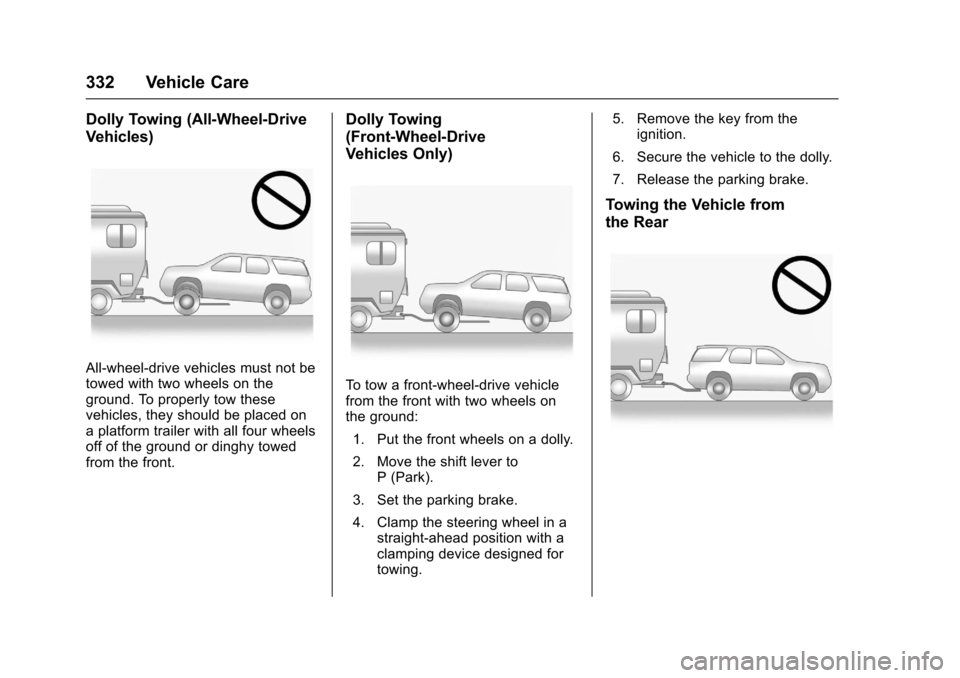
Dolly Towing (All-Wheel-Drive
Vehicles)
All-wheel-drive vehicles must not be
towed with two wheels on the
ground. To properly tow these
vehicles, they should be placed on
a platform trailer with all four wheels
off of the ground or dinghy towed
from the front.
Dolly Towing
(Front-Wheel-Drive
Vehicles Only)
To tow a front-wheel-drive vehicle
from the front with two wheels on
the ground:1. Put the front wheels on a dolly.
2. Move the shift lever to P (Park).
3. Set the parking brake.
4. Clamp the steering wheel in a straight-ahead position with a
clamping device designed for
towing. 5. Remove the key from the
ignition.
6. Secure the vehicle to the dolly.
7. Release the parking brake.
Towing the Vehicle from
the Rear
Page 345 of 394
Chevrolet Traverse Owner Manual (GMNA-Localizing-U.S./Canada/Mexico-
9955676) - 2017 - crc - 3/29/16
344 Service and Maintenance
frequent checks and services. The
Additional Required Services -
Normal are for vehicles that:
.Carry passengers and cargo
within recommended limits on
the Tire and Loading Information
label. See Vehicle Load
Limits 0223.
. Are driven on reasonable road
surfaces within legal driving
limits.
. Use the recommended fuel. See
Fuel 0253.
Refer to the information in the
Maintenance Schedule Additional
Required Services - Normal chart.
The Additional Required Services -
Severe are for vehicles that are:
. Mainly driven in heavy city traffic
in hot weather.
. Mainly driven in hilly or
mountainous terrain.
. Frequently towing a trailer.
. Used for high speed or
competitive driving. .
Used for taxi, police, or delivery
service.
Refer to the information in the
Maintenance Schedule Additional
Required Services - Severe chart.
{Warning
Performing maintenance work can
be dangerous and can cause
serious injury. Perform
maintenance work only if the
required information, proper tools,
and equipment are available.
If they are not, see your dealer to
have a trained technician do the
work. See Doing Your Own
Service Work 0267.
Maintenance
Schedule
Owner Checks and Services
At Each Fuel Stop
.
Check the engine oil level. See
Engine Oil 0270.
Once a Month
. Check the tire inflation
pressures. See Tire
Pressure 0304.
. Inspect the tires for wear. See
Tire Inspection 0309.
. Check the windshield washer
fluid level. See Washer
Fluid 0282.
Engine Oil Change
When the CHANGE ENGINE OIL
SOON message displays, have the
engine oil and filter changed within
the next 1 000 km/600 mi. If driven
under the best conditions, the
engine oil life system may not
indicate the need for vehicle service
for up to a year.
Page 393 of 394

Chevrolet Traverse Owner Manual (GMNA-Localizing-U.S./Canada/Mexico-
9955676) - 2017 - crc - 3/29/16
392 Index
StabiliTrakIndicator Light . . . . . . . . . . . . . . . . 127
Start Assist, Hill . . . . . . . . . . . . . . . . . 240
Start Vehicle, Remote . . . . . . . . . . . 35
Starter Switch Check . . . . . . . . . . . 285
Starting the Engine . . . . . . . . . . . . . 229
Steering . . . . . . . . . . . . . . . . . . . . . . . . 218 Fluid, Power . . . . . . . . . . . . . . . . . . 281
Heated Wheel . . . . . . . . . . . . . . . . . 111
Wheel Adjustment . . . . . . . . . . . . 109
Wheel Controls . . . . . . . . . . 109, 110
Storage Areas Armrest . . . . . . . . . . . . . . . . . . . . . . . 104
Cargo Cover . . . . . . . . . . . . . . . . . . 105
Cargo ManagementSystem . . . . . . . . . . . . . . . . . . . . . . 105
Center Console . . . . . . . . . . . . . . . 104
Convenience Net . . . . . . . . . . . . . 106
Glove Box . . . . . . . . . . . . . . . . . . . . 103
Instrument Panel . . . . . . . . . . . . . 103
Roof Rack System . . . . . . . . . . . . 106
Storage Compartments . . . . . . . . . 103
Stuck Vehicle . . . . . . . . . . . . . . . . . . . 223
Summer Tires . . . . . . . . . . . . . . . . . . 298
Sun Visors . . . . . . . . . . . . . . . . . . . . . . . 49
Sunroof . . . . . . . . . . . . . . . . . . . . . . . . . . 50
Symbols . . . . . . . . . . . . . . . . . . . . . . . . . . 3 System
Forward Collision
Alert (FCA) . . . . . . . . . . . . . . . . . . 248
Infotainment . . . . . . . . . . . . . 164, 372
Rear Seat Audio (RSA) . . . . . . . 194
Roof Rack . . . . . . . . . . . . . . . . . . . . 106
T
Tachometer . . . . . . . . . . . . . . . . . . . . . 119
Taillamps Turn Signal and Stoplamps . . . 288
Text Telephone (TTY) Users . . . . 362
Theft-Deterrent Systems . . . . . . . . . 43
Immobilizer . . . . . . . . . . . . . . . . . . . . . 43
Third-Row Seats . . . . . . . . . . . . . . . . . 61
Time . . . . . . . . . . . . . . . . . . . . . . . 114, 115
Tires . . . . . . . . . . . . . . . . . . . . . . . . . . . . 297 All-Season . . . . . . . . . . . . . . . . . . . . 297
Buying New Tires . . . . . . . . . . . . . .311
Chains . . . . . . . . . . . . . . . . . . . . . . . . 316
Changing . . . . . . . . . . . . . . . . . . . . . 317
Compact Spare . . . . . . . . . . . . . . . 325
Designations . . . . . . . . . . . . . . . . . 301
Different Size . . . . . . . . . . . . . . . . . 313
If a Tire Goes Flat . . . . . . . . . . . . 316
Inspection . . . . . . . . . . . . . . . . . . . . 309
Messages . . . . . . . . . . . . . . . . . . . . 144
Pressure Light . . . . . . . . . . . . . . . . 128
Pressure Monitor Operation . . 306 Tires (cont'd)
Pressure Monitor System . . . . . 305
Rotation . . . . . . . . . . . . . . . . . . . . . . 310
Sidewall Labeling . . . . . . . . . . . . . 299
Terminology and Definitions . . 302
Uniform Tire Quality
Grading . . . . . . . . . . . . . . . . . . . . . 313
Wheel Alignment and Tire Balance . . . . . . . . . . . . . . . . . . . . . 315
Wheel Replacement . . . . . . . . . . 315
When It Is Time for New Tires . . . . . . . . . . . . . . . . . . . . . . . . .311
Winter . . . . . . . . . . . . . . . . . . . . . . . . 298
Tow/Haul Mode . . . . . . . . . . . . . . . . . 237
Tow/Haul Mode Light . . . . . . . . . . . 127
Towing
Driving Characteristics . . . . . . . . 256
Equipment . . . . . . . . . . . . . . . . . . . . 262
General Information . . . . . . . . . . 256
Recreational Vehicle . . . . . . . . . . 330
Trailer . . . . . . . . . . . . . . . . . . . . . . . . 260
Vehicle . . . . . . . . . . . . . . . . . . . . . . . 329
Traction Control/Electronic
Stability Control . . . . . . . . . . . . . . . 240
Trademarks and License Agreements . . . . . . . . . . . . . . . . . . . 204
Trailer Towing . . . . . . . . . . . . . . . . . . . . . . . . 260