tire pressure CHEVROLET UPLANDER 2005 1.G User Guide
[x] Cancel search | Manufacturer: CHEVROLET, Model Year: 2005, Model line: UPLANDER, Model: CHEVROLET UPLANDER 2005 1.GPages: 460, PDF Size: 2.75 MB
Page 373 of 460
UTQGS (Uniform Tire Quality Grading Standards):A
tire information system that provides consumers with
ratings for a tire’s traction, temperature, and treadwear.
Ratings are determined by tire manufacturers using
government testing procedures. The ratings are molded
into the sidewall of the tire. SeeUniform Tire Quality
Grading on page 5-61.
Vehicle Capacity Weight:The number of designated
seating positions multiplied by 150 lbs (68 kg) plus
the rated cargo load. SeeLoading Your Vehicle
on page 4-33.
Vehicle Maximum Load on the Tire:Load on an
individual tire due to curb weight, accessory weight,
occupant weight, and cargo weight.
Vehicle Placard:A label permanently attached to a
vehicle showing the vehicle’s capacity weight and
the original equipment tire size and recommended
ination pressure. See “Tire and Loading Information
Label” underLoading Your Vehicle on page 4-33.Ination - Tire Pressure
Tires need the correct amount of air pressure to operate
effectively.
Notice:Do not let anyone tell you that
under-ination or over-ination is all right. It is not.
If your tires do not have enough air (under-ination),
you can get the following:
Too much exing
Too much heat
Tire overloading
Premature or irregular wear
Poor handling
Reduced fuel economy
If your tires have too much air (over-ination), you
can get the following:
Unusual wear
Poor handling
Rough ride
Needless damage from road hazards
5-57
Page 374 of 460
A Tire and Loading Information label is attached to the
vehicle’s center pillar (B-pillar), below the driver’s
door latch. This label shows your vehicle’s original
equipment tires and the correct ination pressures for
your tires when they are cold. The recommended
cold tire ination pressure, shown on the label, is the
minimum amount of air pressure needed to support your
vehicle’s maximum load carrying capacity.
For additional information regarding how much weight
your vehicle can carry, and an example of the tire
and loading information label, seeLoading Your Vehicle
on page 4-33. How you load your vehicle affects
vehicle handling and ride comfort, never load your
vehicle with more weight than it was designed to carry.
When to Check
Check your tires once a month or more. Do not forget to
check the compact spare tire, it should be at 60 psi
(420 kPa). For additional information regarding
the compact spare tire, seeCompact Spare Tire on
page 5-84.
How to Check
Use a good quality pocket-type gage to check tire
pressure. You cannot tell if your tires are properly
inated simply by looking at them. Radial tires may look
properly inated even when they are under-inated.
Check the tire’s ination pressure when the tires
are cold. Cold means your vehicle has been sitting for
at least three hours or driven no more than 1 mile
(1.6 km).
Remove the valve cap from the tire valve stem. Press
the tire gage rmly onto the valve to get a pressure
measurement. If the cold tire ination pressure matches
the recommended pressure on the Tire and Loading
Information label, no further adjustment is necessary. If
the ination pressure is low, add air until you reach
the recommended amount.
If you overll the tire, release air by pushing on the
metal stem in the center of the tire valve. Re-check the
tire pressure with the tire gage.
Be sure to put the valve caps back on the valve stems.
They help prevent leaks by keeping out dirt and
moisture.
5-58
Page 375 of 460
Tire Inspection and Rotation
Tires should be rotated every 5,000 to 8,000 miles
(8 000 to 13 000 km).
Any time you notice unusual wear, rotate your tires as
soon as possible and check wheel alignment. Also
check for damaged tires or wheels. SeeWhen It Is Time
for New Tires on page 5-60andWheel Replacement
on page 5-63for more information.
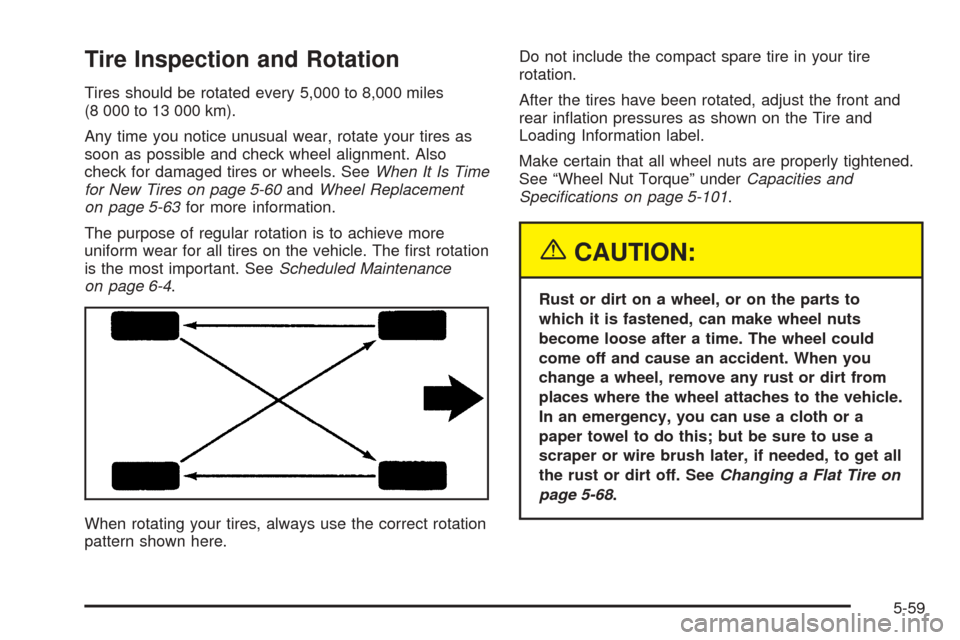
The purpose of regular rotation is to achieve more
uniform wear for all tires on the vehicle. The rst rotation
is the most important. SeeScheduled Maintenance
on page 6-4.
When rotating your tires, always use the correct rotation
pattern shown here.Do not include the compact spare tire in your tire
rotation.
After the tires have been rotated, adjust the front and
rear ination pressures as shown on the Tire and
Loading Information label.
Make certain that all wheel nuts are properly tightened.
See “Wheel Nut Torque” underCapacities and
Specications on page 5-101.
{CAUTION:
Rust or dirt on a wheel, or on the parts to
which it is fastened, can make wheel nuts
become loose after a time. The wheel could
come off and cause an accident. When you
change a wheel, remove any rust or dirt from
places where the wheel attaches to the vehicle.
In an emergency, you can use a cloth or a
paper towel to do this; but be sure to use a
scraper or wire brush later, if needed, to get all
the rust or dirt off. SeeChanging a Flat Tire on
page 5-68.
5-59
Page 381 of 460
Accessory Inator
Your vehicle may have an accessory inator. With it,
you can inate things like air mattresses and
basketballs, and you can also use it to bring your tires
up to the proper pressure.
The accessory inator is located in the rear
compartment on the driver’s side. To access the
accessory inator, do the following:
1. Open the liftgate. SeeLiftgate on page 2-23for
more information.
2. Lift the lever to move the third row rear seatback
forward. SeeThird Row Seat on page 1-19for
more information.
3. Remove the cover by pulling the lever up.This symbol is on the
accessory inator switch.
There may be an accessory inator kit stored in the rear
compartment on the passenger’s side. It includes a
20-foot (6 m) hose with an air pressure gage and nozzle
adapters.
{CAUTION:
Inating something too much can make it
explode, and you or others could be injured.
Be sure to read the inator instructions, and
inate any object only to its recommended
pressure.
5-65
Page 397 of 460
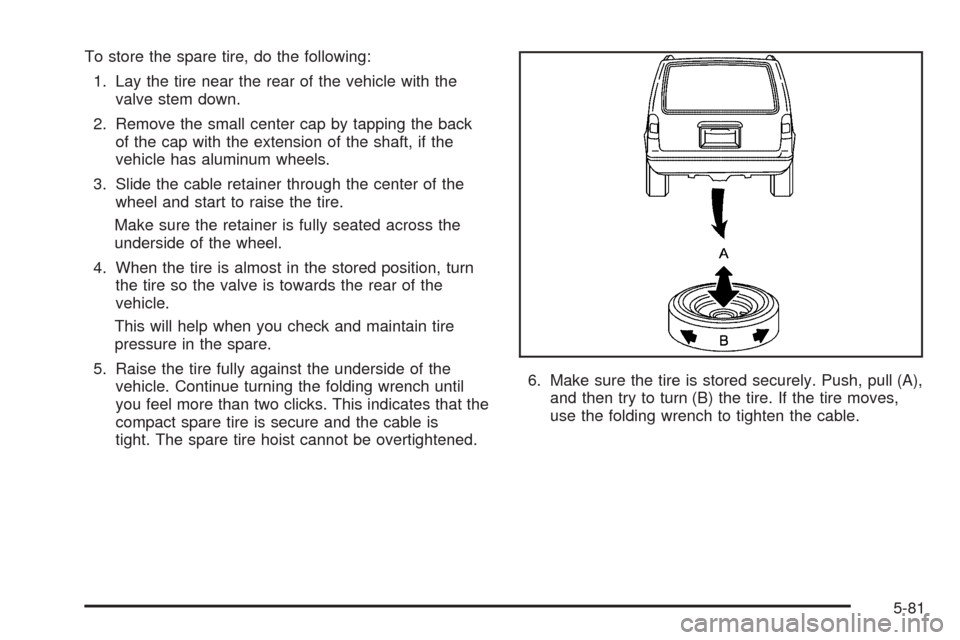
To store the spare tire, do the following:
1. Lay the tire near the rear of the vehicle with the
valve stem down.
2. Remove the small center cap by tapping the back
of the cap with the extension of the shaft, if the
vehicle has aluminum wheels.
3. Slide the cable retainer through the center of the
wheel and start to raise the tire.
Make sure the retainer is fully seated across the
underside of the wheel.
4. When the tire is almost in the stored position, turn
the tire so the valve is towards the rear of the
vehicle.
This will help when you check and maintain tire
pressure in the spare.
5. Raise the tire fully against the underside of the
vehicle. Continue turning the folding wrench until
you feel more than two clicks. This indicates that the
compact spare tire is secure and the cable is
tight. The spare tire hoist cannot be overtightened.6. Make sure the tire is stored securely. Push, pull (A),
and then try to turn (B) the tire. If the tire moves,
use the folding wrench to tighten the cable.
5-81
Page 400 of 460
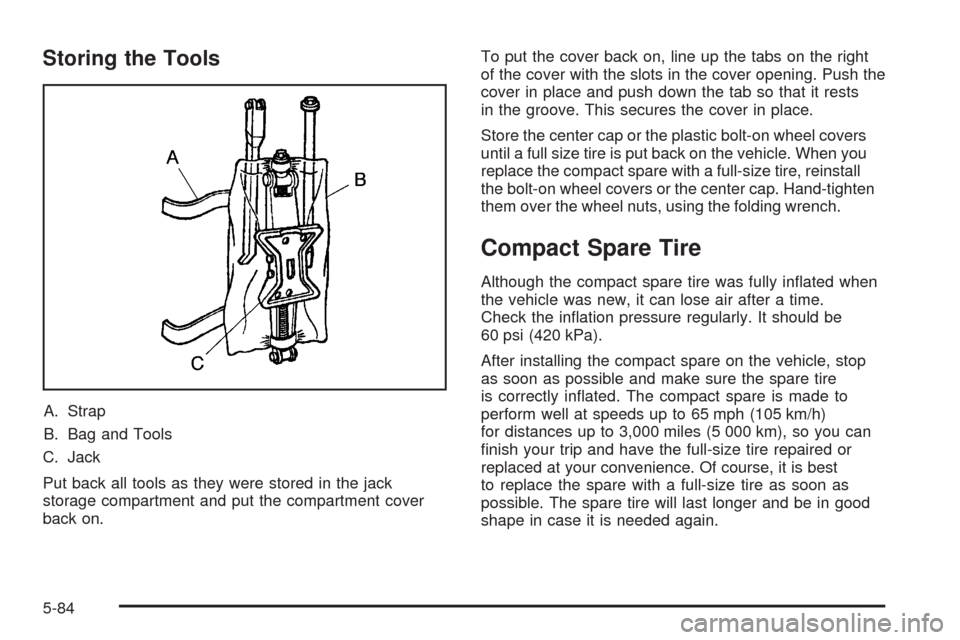
Storing the Tools
A. Strap
B. Bag and Tools
C. Jack
Put back all tools as they were stored in the jack
storage compartment and put the compartment cover
back on.To put the cover back on, line up the tabs on the right
of the cover with the slots in the cover opening. Push the
cover in place and push down the tab so that it rests
in the groove. This secures the cover in place.
Store the center cap or the plastic bolt-on wheel covers
until a full size tire is put back on the vehicle. When you
replace the compact spare with a full-size tire, reinstall
the bolt-on wheel covers or the center cap. Hand-tighten
them over the wheel nuts, using the folding wrench.
Compact Spare Tire
Although the compact spare tire was fully inated when
the vehicle was new, it can lose air after a time.
Check the ination pressure regularly. It should be
60 psi (420 kPa).
After installing the compact spare on the vehicle, stop
as soon as possible and make sure the spare tire
is correctly inated. The compact spare is made to
perform well at speeds up to 65 mph (105 km/h)
for distances up to 3,000 miles (5 000 km), so you can
nish your trip and have the full-size tire repaired or
replaced at your convenience. Of course, it is best
to replace the spare with a full-size tire as soon as
possible. The spare tire will last longer and be in good
shape in case it is needed again.
5-84
Page 423 of 460
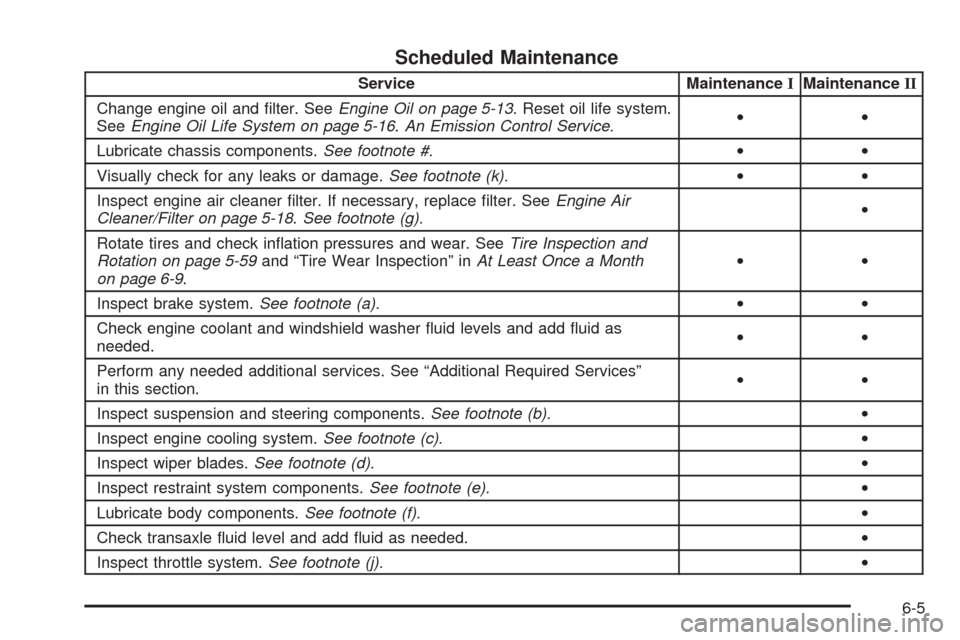
Scheduled Maintenance
Service MaintenanceIMaintenanceII
Change engine oil and lter. SeeEngine Oil on page 5-13. Reset oil life system.
SeeEngine Oil Life System on page 5-16.An Emission Control Service.••
Lubricate chassis components.See footnote #.••
Visually check for any leaks or damage.See footnote (k).••
Inspect engine air cleaner lter. If necessary, replace lter. SeeEngine Air
Cleaner/Filter on page 5-18.See footnote (g).•
Rotate tires and check ination pressures and wear. SeeTire Inspection and
Rotation on page 5-59and “Tire Wear Inspection” inAt Least Once a Month
on page 6-9.••
Inspect brake system.See footnote (a).••
Check engine coolant and windshield washer uid levels and add uid as
needed.••
Perform any needed additional services. See “Additional Required Services”
in this section.••
Inspect suspension and steering components.See footnote (b).•
Inspect engine cooling system.See footnote (c).•
Inspect wiper blades.See footnote (d).•
Inspect restraint system components.See footnote (e).•
Lubricate body components.See footnote (f).•
Check transaxle uid level and add uid as needed.•
Inspect throttle system.See footnote (j).•
6-5
Page 427 of 460
Engine Coolant Level Check
Check the engine coolant level and add
DEX-COOL®coolant mixture if necessary. SeeEngine
Coolant on page 5-22for further details.
Windshield Washer Fluid Level Check
Check the windshield washer uid level in the windshield
washer tank and add the proper uid if necessary.
At Least Once a Month
Tire Ination Check
Visually inspect your vehicle’s tires and make sure they
are inated to the correct pressures. Do not forget to
check the spare tire. SeeTires on page 5-51for further
details. Check to make sure the spare tire is stored
securely. SeeChanging a Flat Tire on page 5-68.
Tire Wear Inspection
Tire rotation may be required for high mileage highway
drivers prior to the Engine Oil Life System service
notication. Check the tires for wear and, if necessary,
rotate the tires. SeeTire Inspection and Rotation on
page 5-59.
At Least Once a Year
Starter Switch Check
{CAUTION:
When you are doing this inspection, the
vehicle could move suddenly. If the vehicle
moves, you or others could be injured.
1. Before you start, be sure you have enough room
around the vehicle.
2. Firmly apply both the parking brake and the regular
brake. SeeParking Brake on page 2-38.
Do not use the accelerator pedal, and be ready to
turn off the engine immediately if it starts.
3. Try to start the engine in each gear. The vehicle
should start only in PARK (P) or NEUTRAL (N). If
the vehicle starts in any other position, contact your
GM Goodwrench
®dealer for service.
6-9
Page 453 of 460
I
Ignition Positions.............................................2-32
Infants and Young Children, Restraints...............1-45
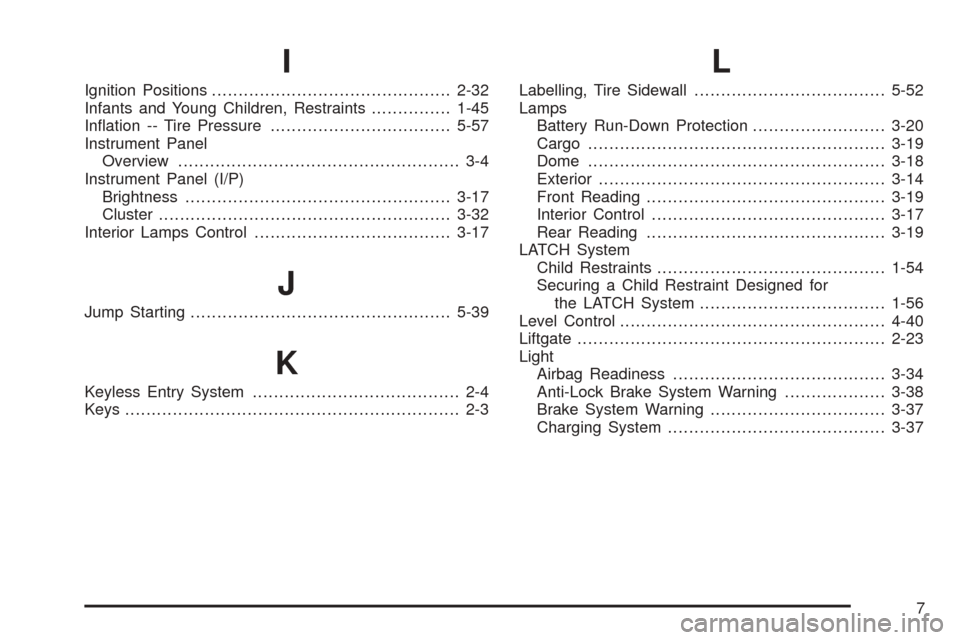
Ination -- Tire Pressure..................................5-57
Instrument Panel
Overview..................................................... 3-4
Instrument Panel (I/P)
Brightness..................................................3-17
Cluster.......................................................3-32
Interior Lamps Control.....................................3-17
J
Jump Starting.................................................5-39
K
Keyless Entry System....................................... 2-4
Keys............................................................... 2-3
L
Labelling, Tire Sidewall....................................5-52
Lamps
Battery Run-Down Protection.........................3-20
Cargo........................................................3-19
Dome........................................................3-18
Exterior......................................................3-14
Front Reading.............................................3-19
Interior Control............................................3-17
Rear Reading.............................................3-19
LATCH System
Child Restraints...........................................1-54
Securing a Child Restraint Designed for
the LATCH System...................................1-56
Level Control..................................................4-40
Liftgate..........................................................2-23
Light
Airbag Readiness........................................3-34
Anti-Lock Brake System Warning...................3-38
Brake System Warning.................................3-37
Charging System.........................................3-37
7
Page 456 of 460
Q
Questions and Answers About Safety Belts.........1-26
R
Radiator Pressure Cap....................................5-24
Radios..........................................................3-76
Care of Your CD and DVD Player................3-114
Care of Your CDs and DVDs.......................3-114
Radio with CD............................................3-77
Rear Seat Audio........................................3-110
Setting the Time..........................................3-76
Theft-Deterrent..........................................3-112
Understanding Reception............................3-113
Rear Climate Control System............................3-28
Rear Reading Lamps......................................3-19
Rear Safety Belt Comfort Guides......................1-39
Rear Seat Audio (RSA)..................................3-110
Rear Seat Entertainment System.......................3-95
Rear Seat Operation......................................... 1-7
Rear Seat Passengers, Safety Belts..................1-36
Rearview Mirrors.............................................2-43Reclining Seatbacks.......................................... 1-5
Recommended Fluids and Lubricants.................6-11
Recreational Vehicle Towing.............................4-39
Remote Keyless Entry System............................ 2-4
Remote Keyless Entry System, Operation............ 2-5
Removing the Flat Tire and Installing
the Spare Tire.............................................5-72
Removing the Spare Tire and Tools...................5-69
Replacement Bulbs.........................................5-49
Reporting Safety Defects
Canadian Government..................................7-11
General Motors...........................................7-11
United States Government............................7-10
Restraint System Check
Checking the Restraint Systems....................1-87
Replacing Restraint System Parts
After a Crash..........................................1-87
Retained Accessory Power (RAP)......................2-32
Right Front Passenger Position, Safety Belts......1-36
Roadside
Assistance Program....................................... 7-6
Rocking Your Vehicle to Get it Out....................4-33
Running the Engine While Parked.....................2-42
10