seats CHEVROLET UPLANDER 2007 1.G Owner's Guide
[x] Cancel search | Manufacturer: CHEVROLET, Model Year: 2007, Model line: UPLANDER, Model: CHEVROLET UPLANDER 2007 1.GPages: 592, PDF Size: 3.04 MB
Page 184 of 592
Replacing the Center Console
{CAUTION:
A second row center console that is not
locked into place properly can move
around in a crash or sudden stop. People
in the vehicle could be injured. Be sure to
lock the console into place properly when
installing it.
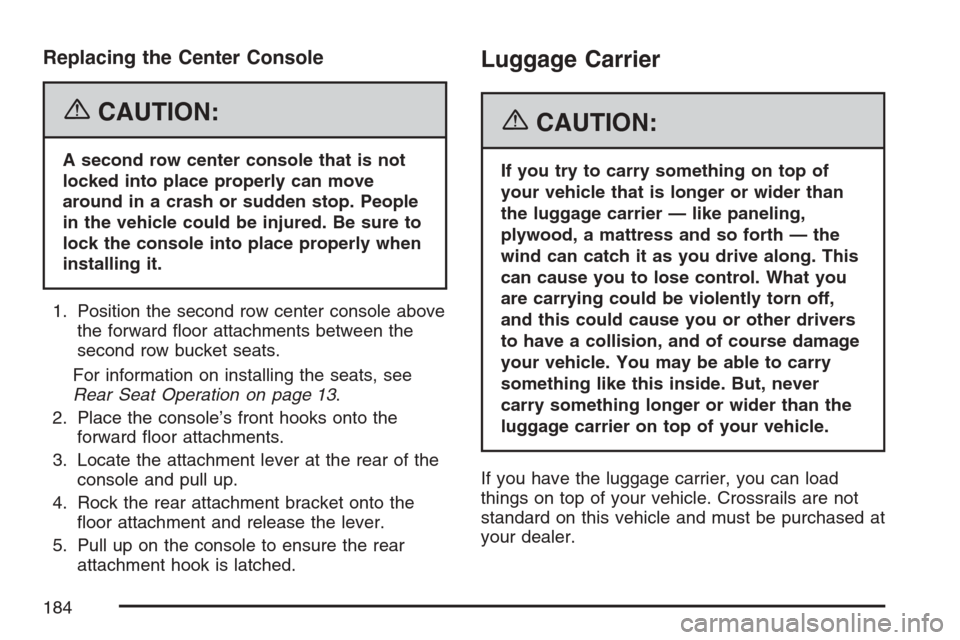
1. Position the second row center console above
the forward oor attachments between the
second row bucket seats.
For information on installing the seats, see
Rear Seat Operation on page 13.
2. Place the console’s front hooks onto the
forward oor attachments.
3. Locate the attachment lever at the rear of the
console and pull up.
4. Rock the rear attachment bracket onto the
oor attachment and release the lever.
5. Pull up on the console to ensure the rear
attachment hook is latched.
Luggage Carrier
{CAUTION:
If you try to carry something on top of
your vehicle that is longer or wider than
the luggage carrier — like paneling,
plywood, a mattress and so forth — the
wind can catch it as you drive along. This
can cause you to lose control. What you
are carrying could be violently torn off,
and this could cause you or other drivers
to have a collision, and of course damage
your vehicle. You may be able to carry
something like this inside. But, never
carry something longer or wider than the
luggage carrier on top of your vehicle.
If you have the luggage carrier, you can load
things on top of your vehicle. Crossrails are not
standard on this vehicle and must be purchased at
your dealer.
184
Page 193 of 592
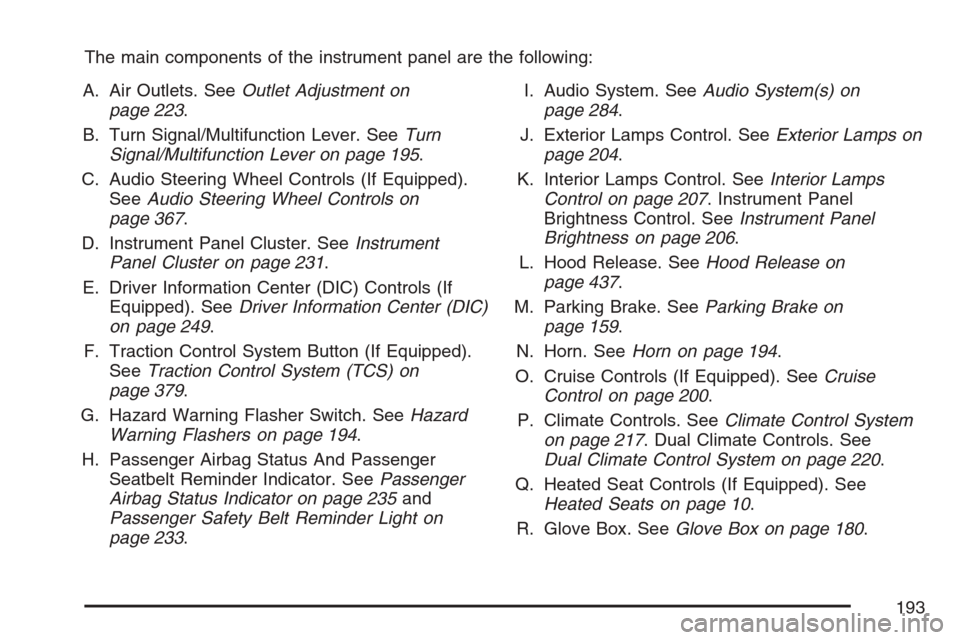
The main components of the instrument panel are the following:
A. Air Outlets. SeeOutlet Adjustment on
page 223.
B. Turn Signal/Multifunction Lever. SeeTurn
Signal/Multifunction Lever on page 195.
C. Audio Steering Wheel Controls (If Equipped).
SeeAudio Steering Wheel Controls on
page 367.
D. Instrument Panel Cluster. SeeInstrument
Panel Cluster on page 231.
E. Driver Information Center (DIC) Controls (If
Equipped). SeeDriver Information Center (DIC)
on page 249.
F. Traction Control System Button (If Equipped).
SeeTraction Control System (TCS) on
page 379.
G. Hazard Warning Flasher Switch. SeeHazard
Warning Flashers on page 194.
H. Passenger Airbag Status And Passenger
Seatbelt Reminder Indicator. SeePassenger
Airbag Status Indicator on page 235and
Passenger Safety Belt Reminder Light on
page 233.I. Audio System. SeeAudio System(s) on
page 284.
J. Exterior Lamps Control. SeeExterior Lamps on
page 204.
K. Interior Lamps Control. SeeInterior Lamps
Control on page 207. Instrument Panel
Brightness Control. SeeInstrument Panel
Brightness on page 206.
L. Hood Release. SeeHood Release on
page 437.
M. Parking Brake. SeeParking Brake on
page 159.
N. Horn. SeeHorn on page 194.
O. Cruise Controls (If Equipped). SeeCruise
Control on page 200.
P. Climate Controls. SeeClimate Control System
on page 217. Dual Climate Controls. See
Dual Climate Control System on page 220.
Q. Heated Seat Controls (If Equipped). See
Heated Seats on page 10.
R. Glove Box. SeeGlove Box on page 180.
193
Page 210 of 592
Cargo Lamp
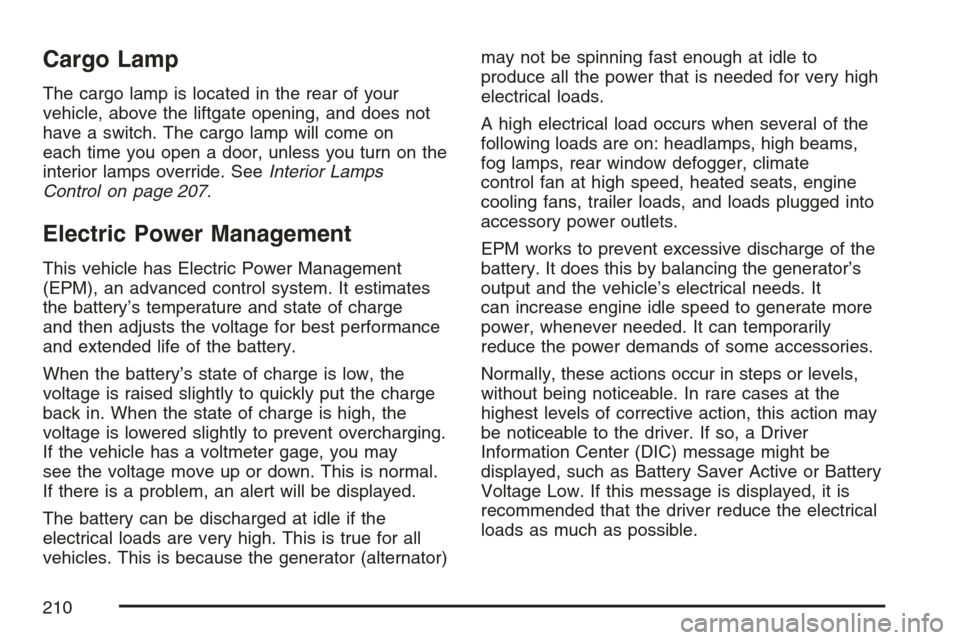
The cargo lamp is located in the rear of your
vehicle, above the liftgate opening, and does not
have a switch. The cargo lamp will come on
each time you open a door, unless you turn on the
interior lamps override. SeeInterior Lamps
Control on page 207.
Electric Power Management
This vehicle has Electric Power Management
(EPM), an advanced control system. It estimates
the battery’s temperature and state of charge
and then adjusts the voltage for best performance
and extended life of the battery.
When the battery’s state of charge is low, the
voltage is raised slightly to quickly put the charge
back in. When the state of charge is high, the
voltage is lowered slightly to prevent overcharging.
If the vehicle has a voltmeter gage, you may
see the voltage move up or down. This is normal.
If there is a problem, an alert will be displayed.
The battery can be discharged at idle if the
electrical loads are very high. This is true for all
vehicles. This is because the generator (alternator)may not be spinning fast enough at idle to
produce all the power that is needed for very high
electrical loads.
A high electrical load occurs when several of the
following loads are on: headlamps, high beams,
fog lamps, rear window defogger, climate
control fan at high speed, heated seats, engine
cooling fans, trailer loads, and loads plugged into
accessory power outlets.
EPM works to prevent excessive discharge of the
battery. It does this by balancing the generator’s
output and the vehicle’s electrical needs. It
can increase engine idle speed to generate more
power, whenever needed. It can temporarily
reduce the power demands of some accessories.
Normally, these actions occur in steps or levels,
without being noticeable. In rare cases at the
highest levels of corrective action, this action may
be noticeable to the driver. If so, a Driver
Information Center (DIC) message might be
displayed, such as Battery Saver Active or Battery
Voltage Low. If this message is displayed, it is
recommended that the driver reduce the electrical
loads as much as possible.
210
Page 216 of 592
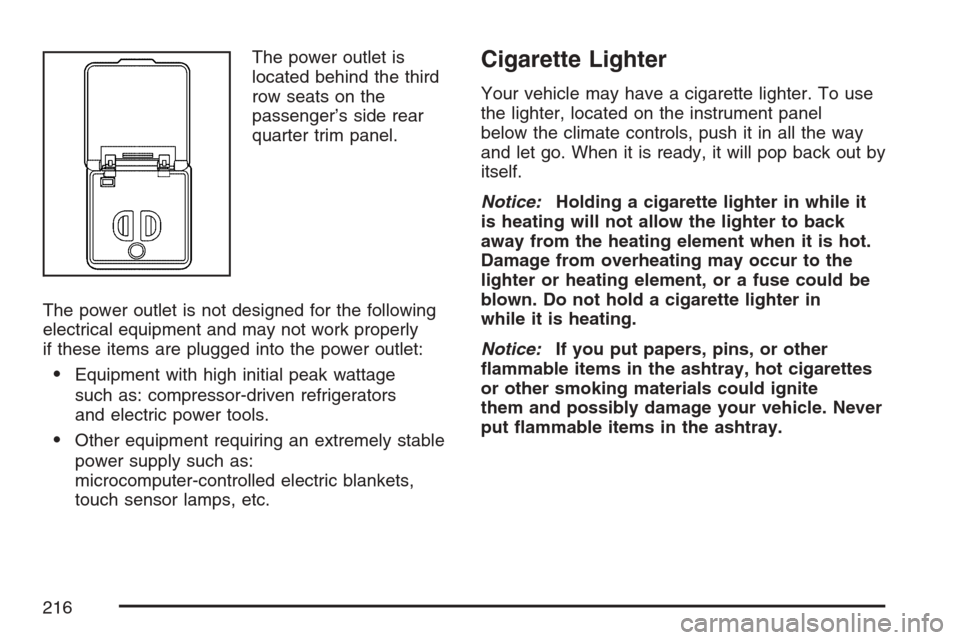
The power outlet is
located behind the third
row seats on the
passenger’s side rear
quarter trim panel.
The power outlet is not designed for the following
electrical equipment and may not work properly
if these items are plugged into the power outlet:
Equipment with high initial peak wattage
such as: compressor-driven refrigerators
and electric power tools.
Other equipment requiring an extremely stable
power supply such as:
microcomputer-controlled electric blankets,
touch sensor lamps, etc.
Cigarette Lighter
Your vehicle may have a cigarette lighter. To use
the lighter, located on the instrument panel
below the climate controls, push it in all the way
and let go. When it is ready, it will pop back out by
itself.
Notice:Holding a cigarette lighter in while it
is heating will not allow the lighter to back
away from the heating element when it is hot.
Damage from overheating may occur to the
lighter or heating element, or a fuse could be
blown. Do not hold a cigarette lighter in
while it is heating.
Notice:If you put papers, pins, or other
ammable items in the ashtray, hot cigarettes
or other smoking materials could ignite
them and possibly damage your vehicle. Never
put ammable items in the ashtray.
216
Page 217 of 592
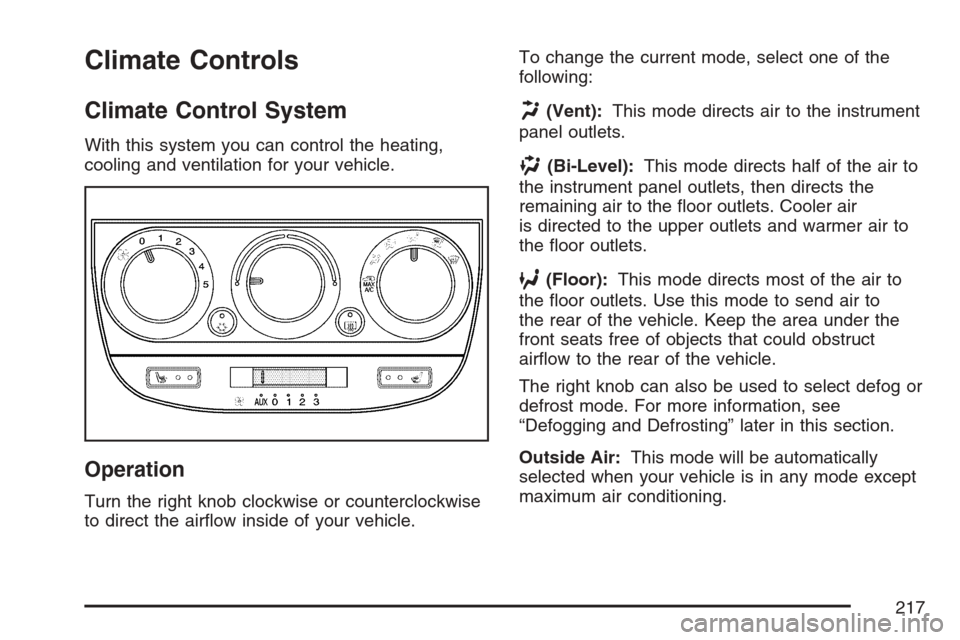
Climate Controls
Climate Control System
With this system you can control the heating,
cooling and ventilation for your vehicle.
Operation
Turn the right knob clockwise or counterclockwise
to direct the airow inside of your vehicle.To change the current mode, select one of the
following:
H(Vent):This mode directs air to the instrument
panel outlets.
)(Bi-Level):This mode directs half of the air to
the instrument panel outlets, then directs the
remaining air to the oor outlets. Cooler air
is directed to the upper outlets and warmer air to
the oor outlets.
6(Floor):This mode directs most of the air to
the oor outlets. Use this mode to send air to
the rear of the vehicle. Keep the area under the
front seats free of objects that could obstruct
airow to the rear of the vehicle.
The right knob can also be used to select defog or
defrost mode. For more information, see
“Defogging and Defrosting” later in this section.
Outside Air:This mode will be automatically
selected when your vehicle is in any mode except
maximum air conditioning.
217
Page 218 of 592
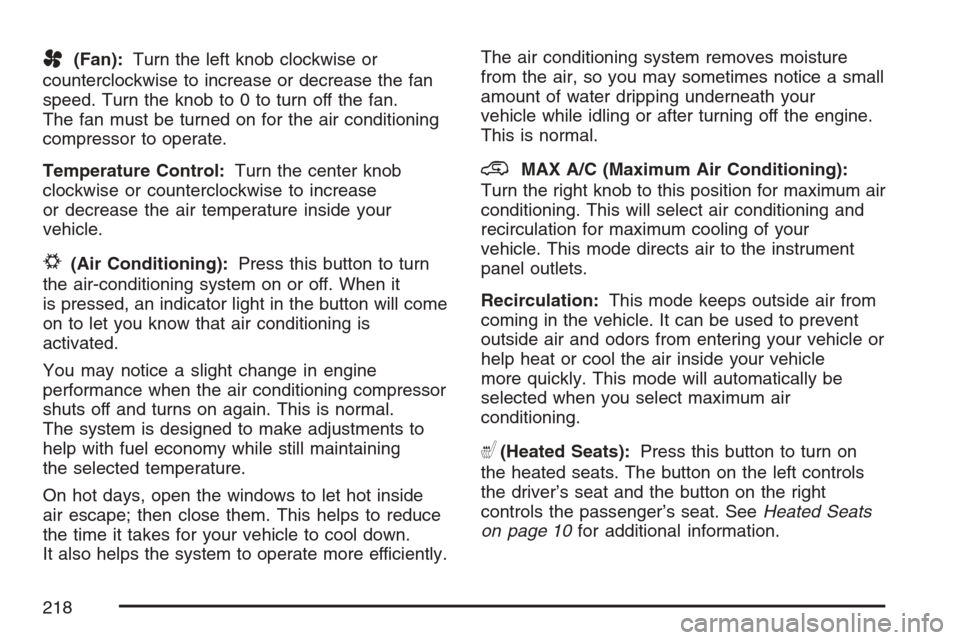
A(Fan):Turn the left knob clockwise or
counterclockwise to increase or decrease the fan
speed. Turn the knob to 0 to turn off the fan.
The fan must be turned on for the air conditioning
compressor to operate.
Temperature Control:Turn the center knob
clockwise or counterclockwise to increase
or decrease the air temperature inside your
vehicle.
#(Air Conditioning):Press this button to turn
the air-conditioning system on or off. When it
is pressed, an indicator light in the button will come
on to let you know that air conditioning is
activated.
You may notice a slight change in engine
performance when the air conditioning compressor
shuts off and turns on again. This is normal.
The system is designed to make adjustments to
help with fuel economy while still maintaining
the selected temperature.
On hot days, open the windows to let hot inside
air escape; then close them. This helps to reduce
the time it takes for your vehicle to cool down.
It also helps the system to operate more efficiently.The air conditioning system removes moisture
from the air, so you may sometimes notice a small
amount of water dripping underneath your
vehicle while idling or after turning off the engine.
This is normal.
@MAX A/C (Maximum Air Conditioning):
Turn the right knob to this position for maximum air
conditioning. This will select air conditioning and
recirculation for maximum cooling of your
vehicle. This mode directs air to the instrument
panel outlets.
Recirculation:This mode keeps outside air from
coming in the vehicle. It can be used to prevent
outside air and odors from entering your vehicle or
help heat or cool the air inside your vehicle
more quickly. This mode will automatically be
selected when you select maximum air
conditioning.
((Heated Seats):Press this button to turn on
the heated seats. The button on the left controls
the driver’s seat and the button on the right
controls the passenger’s seat. SeeHeated Seats
on page 10for additional information.
218
Page 221 of 592
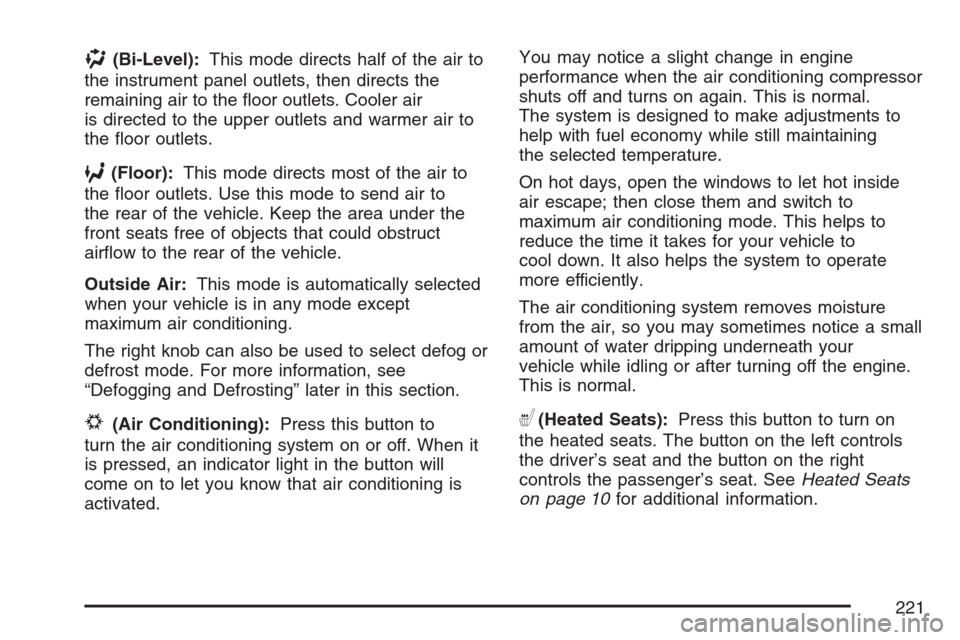
)(Bi-Level):This mode directs half of the air to
the instrument panel outlets, then directs the
remaining air to the oor outlets. Cooler air
is directed to the upper outlets and warmer air to
the oor outlets.
6(Floor):This mode directs most of the air to
the oor outlets. Use this mode to send air to
the rear of the vehicle. Keep the area under the
front seats free of objects that could obstruct
airow to the rear of the vehicle.
Outside Air:This mode is automatically selected
when your vehicle is in any mode except
maximum air conditioning.
The right knob can also be used to select defog or
defrost mode. For more information, see
“Defogging and Defrosting” later in this section.
#(Air Conditioning):Press this button to
turn the air conditioning system on or off. When it
is pressed, an indicator light in the button will
come on to let you know that air conditioning is
activated.You may notice a slight change in engine
performance when the air conditioning compressor
shuts off and turns on again. This is normal.
The system is designed to make adjustments to
help with fuel economy while still maintaining
the selected temperature.
On hot days, open the windows to let hot inside
air escape; then close them and switch to
maximum air conditioning mode. This helps to
reduce the time it takes for your vehicle to
cool down. It also helps the system to operate
more efficiently.
The air conditioning system removes moisture
from the air, so you may sometimes notice a small
amount of water dripping underneath your
vehicle while idling or after turning off the engine.
This is normal.((Heated Seats):Press this button to turn on
the heated seats. The button on the left controls
the driver’s seat and the button on the right
controls the passenger’s seat. SeeHeated Seats
on page 10for additional information.
221
Page 223 of 592
Rear Window Defogger
The rear window defogger uses a warming grid to
remove fog from the rear window.
<(Rear Window Defogger):Press this button
to turn the rear window defogger on or off. An
indicator light in the button will come on to let you
know that the rear window defogger is activated.
The rear window defogger will turn off about
10 minutes after the button is pressed. If turned on
again, the defogger will only run for about
ve minutes before turning off. The defogger can
also be turned off by pressing the button again
or by turning off the engine.
Notice:Do not use anything sharp on the
inside of the rear window. If you do, you could
cut or damage the warming grid, and the
repairs would not be covered by your warranty.
Do not attach a temporary vehicle license,
tape, a decal or anything similar to the
defogger grid.
Outlet Adjustment
k(Open):Turn the thumbwheel to this position
to open the air outlets.
l(Closed):Turn the thumbwheel to this position
to close the air outlets.
Use the louvers located on the air outlets to
change the direction of the airow.
Operation Tips
Clear away any ice, snow, or leaves from the
air inlets at the base of the vehicle that may
block the ow of air into your vehicle.
Use of non-GM approved hood deectors may
adversely affect the performance of the
system.
Keep the path under the front seats clear of
objects to help circulate the air inside of
your vehicle more effectively.
223
Page 226 of 592
Rear Air Outlets
The outlet behind the left rear seat is the cold air
return outlet. Be sure to keep it free from
obstructions. Also, keep the area around the base
of the center instrument panel console, between
and under the front seats, free of objects that could
also obstruct airow to the rear seating area.
For more information on how to use the main
climate control system, seeDual Climate Control
System on page 220. For information on
ventilation, seeOutlet Adjustment on page 223.
Rear Climate Control System
(Option B, Uplevel)
Your vehicle may have a rear climate control
system that allows the driver to adjust the
fan speed for the rear seating area. This system
works with the main climate control system in your
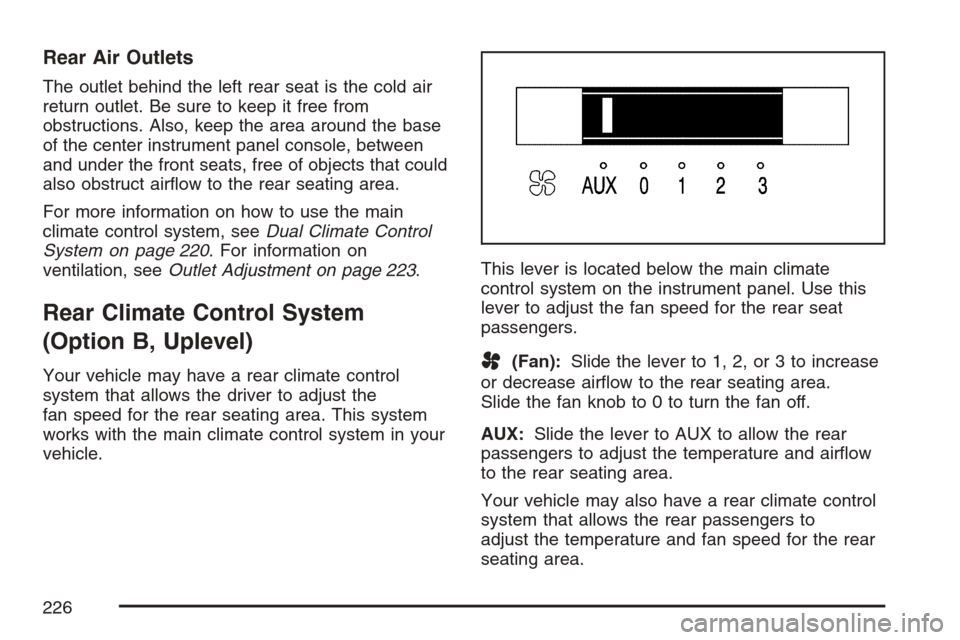
vehicle.This lever is located below the main climate
control system on the instrument panel. Use this
lever to adjust the fan speed for the rear seat
passengers.A(Fan):Slide the lever to 1, 2, or 3 to increase
or decrease airow to the rear seating area.
Slide the fan knob to 0 to turn the fan off.
AUX:Slide the lever to AUX to allow the rear
passengers to adjust the temperature and airow
to the rear seating area.
Your vehicle may also have a rear climate control
system that allows the rear passengers to
adjust the temperature and fan speed for the rear
seating area.
226
Page 228 of 592
Rear Air Outlets
The outlet behind the left rear seat is the cold air
return outlet. Be sure to keep it free from
obstructions. Also, keep the area around the base
of the center instrument panel console, between
and under the front seats, free of objects that could
also obstruct airow to the rear seating area.
For more information on how to use the main
climate control system, seeDual Climate Control
System on page 220. For information on
ventilation, seeOutlet Adjustment on page 223.
Passenger Compartment Air Filter
Passenger compartment air, both outside and
recirculated air, is routed through a passenger
compartment lter. The lter removes most
particles from the air, including dust particles.
Reductions in airow, which may occur more
quickly in dusty areas, indicate that the lter needs
to be replaced early. For how often to change
the air lter, seeScheduled Maintenance on
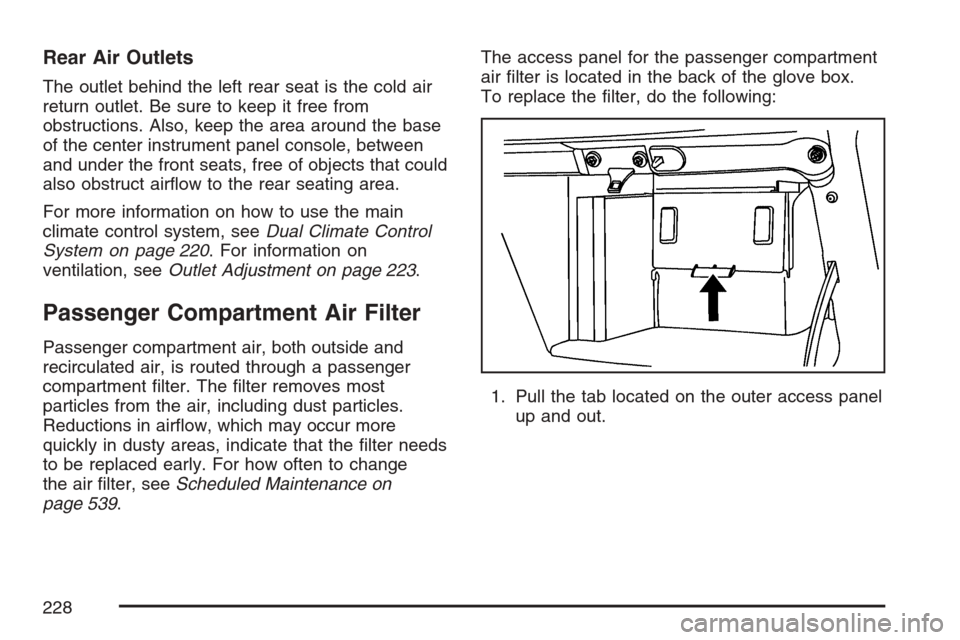
page 539.The access panel for the passenger compartment
air lter is located in the back of the glove box.
To replace the lter, do the following:
1. Pull the tab located on the outer access panel
up and out.
228