page 6 CHEVROLET UPLANDER 2008 1.G Owner's Guide
[x] Cancel search | Manufacturer: CHEVROLET, Model Year: 2008, Model line: UPLANDER, Model: CHEVROLET UPLANDER 2008 1.GPages: 476, PDF Size: 5.77 MB
Page 91 of 476
If your vehicle does not have a rear seat that will
accommodate a rear-facing child restraint, we
recommend that rear-facing child restraints not be
transported in your vehicle, even if the airbag(s) are off.
The passenger sensing system is designed to turn
off the right front passenger’s frontal airbag and
seat-mounted side impact airbag (if equipped) if:
The right front passenger seat is unoccupied.
The system determines that an infant is present in
a rear-facing infant seat.
The system determines that a small child is present
in a child restraint.
The system determines that a small child is present
in a booster seat.
A right front passenger takes his/her weight off of
the seat for a period of time.
The right front passenger seat is occupied by a
smaller person, such as a child who has outgrown
child restraints.
Or, if there is a critical problem with the airbag
system or the passenger sensing system.
When the passenger sensing system has turned off the
right front passenger’s frontal airbag and seat-mounted
side impact airbag (if equipped), the off indicator will light
and stay lit to remind you that the airbag or airbags are
off. SeePassenger Airbag Status Indicator on page 3-38.If a child restraint has been installed and the on
indicator is lit, turn the vehicle off. Remove the child
restraint from the vehicle and reinstall the child restraint
following the child restraint manufacturer’s directions
and refer toSecuring a Child Restraint in the Right Front
Seat Position on page 1-64.
If, after reinstalling the child restraint and restarting
the vehicle, the on indicator is still lit, check to make
sure that the vehicle’s seatback is not pressing the child
restraint into the seat cushion. If this happens, slightly
recline the vehicle’s seatback and adjust the seat
cushion if possible. Also make sure the child restraint
is not trapped under the vehicle head restraint.
If this happens, adjust the head restraint. SeeHead
Restraints on page 1-6.
Remove any additional material from the seat such
as blankets, cushions, seat covers, seat heaters,
or seat massagers before reinstalling or securing the
child restraint.
If the on indicator is still lit, secure the child in the child
restraint in a rear seat position in the vehicle, and
check with your dealer/retailer. If no rear seat is
available, do not install a child restraint in this vehicle,
and check with your dealer/retailer.
1-87
Page 93 of 476
If you ever pull the shoulder portion of the belt out all
the way, you will engage the child restraint locking
feature. This may unintentionally cause the passenger
sensing system to turn the airbag(s) off for some
adult size occupants. If this happens, just let the belt
go back all the way and start again.
{CAUTION:
If the airbag readiness light in the instrument
panel cluster ever comes on and stays on,
it means that something may be wrong with
the airbag system. If this ever happens, have
the vehicle serviced promptly, because an
adult-size person sitting in the right front
passenger’s seat may not have the protection
of the airbag(s). SeeAirbag Readiness Light
on page 3-37for more on this, including
important safety information.A thick layer of additional material, such as a blanket
or cushion, or aftermarket equipment such as seat
covers, seat heaters, and seat massagers can affect
how well the passenger sensing system operates.
We recommend that you not use seat covers or other
aftermarket equipment other than any that GM has
approved for your specic vehicle. SeeAdding
Equipment to Your Airbag-Equipped Vehicle on
page 1-90for more information about modications
that can affect how the system operates.
{CAUTION:
Stowing of articles under the passenger’s
seat or between the passenger’s seat cushion
and seatback may interfere with the proper
operation of the passenger sensing system.
1-89
Page 94 of 476
Servicing Your Airbag-Equipped
Vehicle
Airbags affect how your vehicle should be serviced.
There are parts of the airbag system in several places
around your vehicle. Your dealer/retailer and the service
manual have information about servicing your vehicle and
the airbag system. To purchase a service manual, see
Service Publications Ordering Information on page 7-15.
{CAUTION:
For up to 10 seconds after the ignition is
turned off and the battery is disconnected,
an airbag can still inate during improper
service. You can be injured if you are close
to an airbag when it inates. Avoid yellow
connectors. They are probably part of the
airbag system. Be sure to follow proper
service procedures, and make sure the person
performing work for you is qualied to do so.
Adding Equipment to Your
Airbag-Equipped Vehicle
Q:Is there anything I might add to or change
about the vehicle that could keep the airbags
from working properly?
A:Yes. If you add things that change your vehicle’s
frame, bumper system, height, front end or side
sheet metal, they may keep the airbag system from
working properly. Changing or moving any parts
of the front seats, safety belts, the airbag sensing
and diagnostic module, steering wheel, instrument
panel, front sensors, or airbag wiring can affect
the operation of the airbag system.
In addition, your vehicle has a passenger sensing
system for the right front passenger’s position,
which includes sensors that are part of the
passenger’s seat. The passenger sensing system
may not operate properly if the original seat
trim is replaced with non-GM covers, upholstery
or trim, or with GM covers, upholstery or trim
designed for a different vehicle. Any object,
such as an aftermarket seat heater or a comfort
enhancing pad or device, installed under or on
top of the seat fabric, could also interfere with
the operation of the passenger sensing system.
1-90
Page 95 of 476
This could either prevent proper deployment of
the passenger airbag(s) or prevent the passenger
sensing system from properly turning off the
passenger airbag(s). SeePassenger Sensing
System on page 1-85.
If you have any questions about this, you should
contact Customer Assistance before you modify
your vehicle. The phone numbers and addresses
for Customer Assistance are in Step Two of
the Customer Satisfaction Procedure in this manual.
SeeCustomer Satisfaction Procedure on page 7-2.
Q:Because I have a disability, I have to get
my vehicle modied. How can I nd out whether
this will affect my airbag system?
A:If you have questions, call Customer Assistance.
The phone numbers and addresses for Customer
Assistance are in Step Two of the Customer
Satisfaction Procedure in this manual. See
Customer Satisfaction Procedure on page 7-2.
In addition, your dealer/retailer and the service manual
have information about the location of the airbag sensors,
sensing and diagnostic module and airbag wiring.
Restraint System Check
Checking the Restraint Systems
Now and then, make sure the safety belt reminder light
and all your belts, buckles, latch plates, retractors and
anchorages are working properly. If your vehicle has the
built-in child restraint, also periodically make sure the
harness straps, latch plates, buckle, clip, child head
restraint and anchorages are working properly.
Look for any other loose or damaged safety belt system
parts. If you see anything that might keep a safety belt
system from doing its job, have it repaired. Torn or frayed
safety belts may not protect you in a crash. They can rip
apart under impact forces. If a belt is torn or frayed, get a
new one right away. If your vehicle has the built-in child
restraint, torn or frayed harness straps can rip apart
under impact forces just like torn or frayed safety belts
can. They may not protect a child in a crash. If a harness
strap is torn or frayed, get a new harness right away.
Make sure the safety belt reminder light is working.
SeeSafety Belt Reminders on page 3-36for more
information.
Keep safety belts clean and dry. SeeCare of Safety
Belts and Built-in Child Restraint Harness on page 5-93
for more information.
1-91
Page 96 of 476
Replacing Restraint System Parts
After a Crash
{CAUTION:
A crash can damage the restraint systems
in your vehicle. A damaged restraint system
may not properly protect the person using it,
resulting in serious injury or even death in
a crash. To help make sure your restraint
systems are working properly after a crash,
have them inspected and any necessary
replacements made as soon as possible.If you have had a crash, do you need new belts or
LATCH system (if equipped) parts?
After a very minor crash, nothing may be necessary.
But the belt assemblies that were used during any
crash may have been stressed or damaged. See your
dealer/retailer to have your safety belt assemblies
inspected or replaced.
If your vehicle has the LATCH system and it was being
used during a crash, you may need new LATCH
system parts.
New parts and repairs may be necessary even if the
belt or LATCH system (if equipped), was not being
used at the time of the crash.
If an airbag inates, you will need to replace airbag
system parts. See the part on the airbag system earlier
in this section.
Have your safety belt pretensioners checked if your
vehicle has been in a crash, if your airbag readiness
light stays on after you start your vehicle, or while you
are driving. SeeAirbag Readiness Light on page 3-37.
1-92
Page 100 of 476
Any new PASS-Key®III key must be programmed
before it will start your vehicle. SeePASS-Key®III on
page 2-29for more information on programming
your new key.
Notice:If you ever lock your keys in your vehicle,
you may have to damage the vehicle to get in.
Be sure you have spare keys.
If you are locked out of your vehicle, contact Roadside
Assistance. SeeRoadside Assistance Program on
page 7-6for more information.
Remote Keyless Entry (RKE)
System
If the vehicle has the Remote Keyless Entry (RKE)
system, it operates on a radio frequency subject
to Federal Communications Commission (FCC) Rules
and with Industry Canada.
This device complies with Part 15 of the FCC Rules.
Operation is subject to the following two conditions:
1. This device may not cause interference.
2. This device must accept any interference received,
including interference that may cause undesired
operation of the device.This device complies with RSS-210 of Industry Canada.
Operation is subject to the following two conditions:
1. This device may not cause interference.
2. This device must accept any interference received,
including interference that may cause undesired
operation of the device.
Changes or modications to this system by other than
an authorized service facility could void authorization to
use this equipment.
At times you may notice a decrease in range. This is
normal for any RKE system. If the transmitter does not
work or if you have to stand closer to your vehicle
for the transmitter to work, try this:Check the distance. You may be too far from your
vehicle. You may need to stand closer during
rainy or snowy weather.
Check the location. Other vehicles or objects may
be blocking the signal. Take a few steps to the
left or right, hold the transmitter higher, and
try again.
Check to determine if battery replacement is
necessary. See “Battery Replacement” later in this
section.
If you are still having trouble, see your dealer/retailer
or a qualied technician for service.
2-4
Page 101 of 476
Remote Keyless Entry (RKE)
System Operation
You can lock and unlock the vehicle’s doors and the
liftgate using the Remote Keyless Entry (RKE)
transmitter supplied with your vehicle.
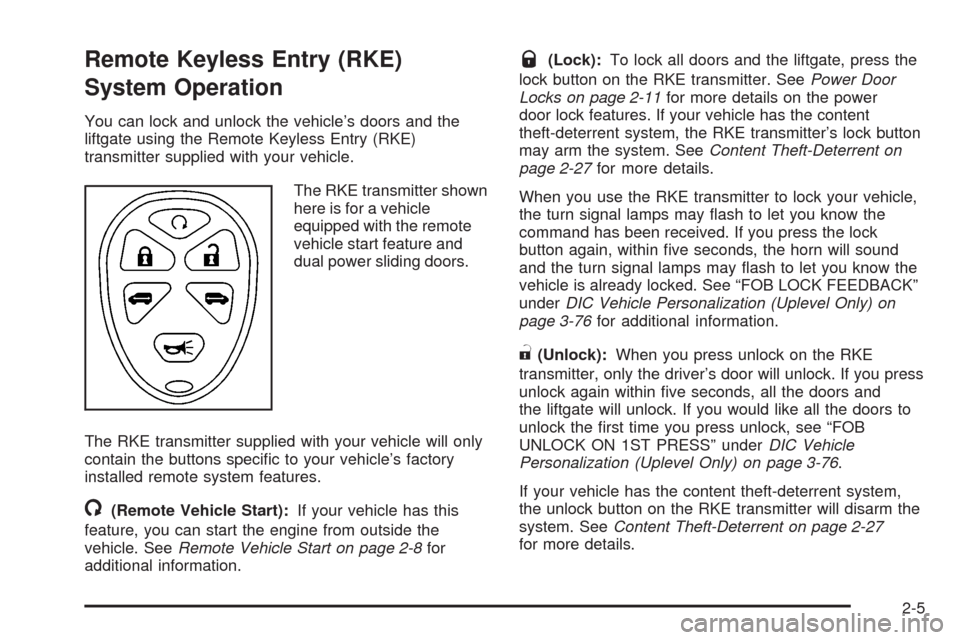
The RKE transmitter shown
here is for a vehicle
equipped with the remote
vehicle start feature and
dual power sliding doors.
The RKE transmitter supplied with your vehicle will only
contain the buttons specic to your vehicle’s factory
installed remote system features.
/(Remote Vehicle Start):If your vehicle has this
feature, you can start the engine from outside the
vehicle. SeeRemote Vehicle Start on page 2-8for
additional information.
Q(Lock):To lock all doors and the liftgate, press the
lock button on the RKE transmitter. SeePower Door
Locks on page 2-11for more details on the power
door lock features. If your vehicle has the content
theft-deterrent system, the RKE transmitter’s lock button
may arm the system. SeeContent Theft-Deterrent on
page 2-27for more details.
When you use the RKE transmitter to lock your vehicle,
the turn signal lamps may ash to let you know the
command has been received. If you press the lock
button again, within ve seconds, the horn will sound
and the turn signal lamps may ash to let you know the
vehicle is already locked. See “FOB LOCK FEEDBACK”
underDIC Vehicle Personalization (Uplevel Only) on
page 3-76for additional information.
"(Unlock):When you press unlock on the RKE
transmitter, only the driver’s door will unlock. If you press
unlock again within ve seconds, all the doors and
the liftgate will unlock. If you would like all the doors to
unlock the rst time you press unlock, see “FOB
UNLOCK ON 1ST PRESS” underDIC Vehicle
Personalization (Uplevel Only) on page 3-76.
If your vehicle has the content theft-deterrent system,
the unlock button on the RKE transmitter will disarm the
system. SeeContent Theft-Deterrent on page 2-27
for more details.
2-5
Page 102 of 476
When you use your RKE transmitter to unlock your
vehicle the turn signal lamps will ash to let you know
the command was received.
L(Remote Alarm):When you press the horn button
on the RKE transmitter, the turn signal lamps will
ash and the horn will sound. This will allow you to
attract attention, if needed.
Press this button again to stop the alarm from sounding.
Remote Power Sliding Door Operation
+
(Power Sliding Door):If your vehicle has
one power sliding door, the RKE transmitter will have a
button with a van symbol on it. Press and hold this
button to open or close the power sliding door.
SeePower Sliding Door (PSD) on page 2-16.
*+(Dual Power Sliding Doors):If your vehicle
has dual power sliding doors, your RKE transmitter
will have two buttons that have a van symbol on them.
The van symbol on the left is for the driver’s side
sliding door and the van symbol on the right is for the
passenger’s side sliding door. Press and hold the
passenger’s or driver’s side button, with the van symbol
on it, to open or close the selected power sliding
door. SeePower Sliding Door (PSD) on page 2-16.You can operate the power sliding door(s) with the RKE
transmitter even if the power sliding door override
switch(es), on the overhead console, are active or
inactive. SeePower Sliding Door (PSD) on page 2-16
for additional information.
If the sliding door is closed and the power sliding door
button on the transmitter is pressed and held, the
vehicle’s doors will be unlocked and then the power
sliding door will open. If the power sliding door has been
locked using the manual door lock lever, you will
need to unlock the power sliding door before it can be
opened with the RKE transmitter sliding door button.
If your vehicle’s fuel ller door is opened, the driver’s
side power sliding door will not open completely. Do not
try to force the door. Once the fuel ller door is
closed, the driver’s side sliding door can be opened
normally.
2-6
Page 105 of 476
After your vehicle’s engine has been started two times
using the remote start button, the vehicle’s ignition
switch must be turned to ON/RUN and then back to
LOCK/OFF using the key before the remote start
procedure can be used again.
After entering the vehicle during a remote start, insert
and turn the key to ON/RUN to drive the vehicle.
To manually shut off the engine after a remote start,
do any of the following:
Aim the RKE transmitter at the vehicle and press the
remote start button until the parking lamps turn off.
Turn on the hazard warning ashers.
Insert the vehicle’s key into the ignition switch and
turn the switch to ON/RUN and then back to
LOCK/OFF.
The remote vehicle start feature will not operate if:
The remote start system is disabled. See “REMOTE
START” underDIC Vehicle Personalization
(Uplevel Only) on page 3-76.
The vehicle’s key is in the ignition.
The vehicle’s hood, liftgate or doors are not closed.
The hazard warning ashers are on.
There is an emission control system malfunction.
The engine coolant temperature is too high.
The oil pressure is low.
Two remote vehicle starts have already been
provided. The maximum number of remote starts or
remote start attempts between ignition cycles
with the key is two.
Remote Start Ready
If your vehicle does not have the remote vehicle start
feature, it may have the remote start ready feature.
This feature allows your dealer/retailer to add the
manufacturer’s remote vehicle start feature.
If the RKE transmitter has a plus (+) symbol on the
back cover, your vehicle has the remote start ready
feature. You can lock or unlock your vehicle from
approximately 197 feet (60 m) away.
See your dealer/retailer if you would like to add the
manufacturer’s remote vehicle start feature to your
vehicle.
2-9
Page 107 of 476
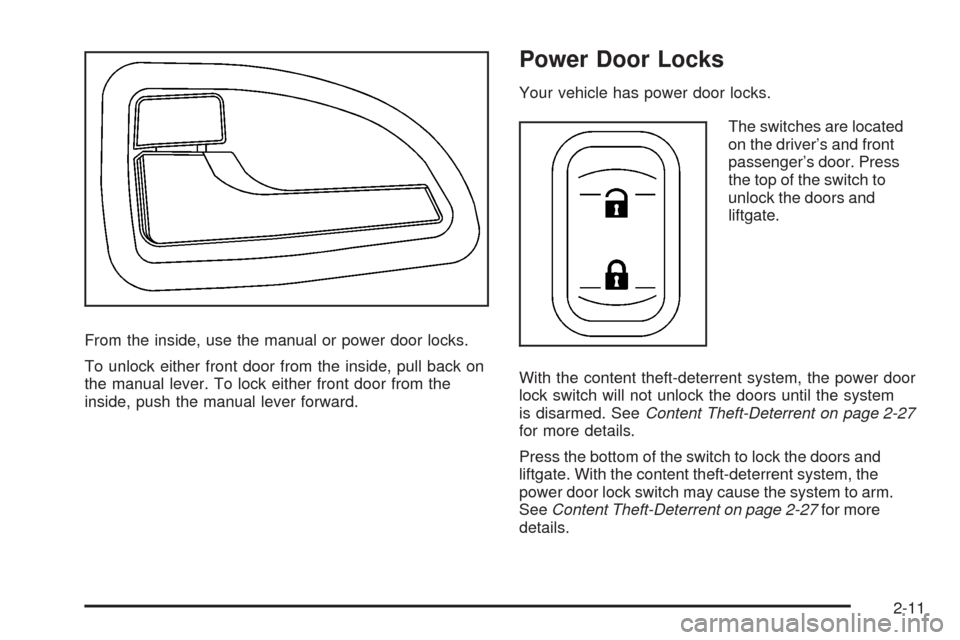
From the inside, use the manual or power door locks.
To unlock either front door from the inside, pull back on
the manual lever. To lock either front door from the
inside, push the manual lever forward.
Power Door Locks
Your vehicle has power door locks.
The switches are located
on the driver’s and front
passenger’s door. Press
the top of the switch to
unlock the doors and
liftgate.
With the content theft-deterrent system, the power door
lock switch will not unlock the doors until the system
is disarmed. SeeContent Theft-Deterrent on page 2-27
for more details.
Press the bottom of the switch to lock the doors and
liftgate. With the content theft-deterrent system, the
power door lock switch may cause the system to arm.
SeeContent Theft-Deterrent on page 2-27for more
details.
2-11