ESP CHEVROLET VEGA 1976 1.G Owners Manual
[x] Cancel search | Manufacturer: CHEVROLET, Model Year: 1976, Model line: VEGA, Model: CHEVROLET VEGA 1976 1.GPages: 87, PDF Size: 32.36 MB
Page 5 of 87
Downloaded from www.Manualslib.com manuals search engine YOUR VEGA'S FIRST
FEW HUNDRED MILES OF DRIVING
You can operate your new car
from its very first mile without ad
hering to a formal
"break-in" sched
ule. However, during the first
few
hundred miles of driving you can,
by observing a few simple precau
tions , add to the future performance
and economy of your car.
It is recommended that your speed
during the first
500 miles
be confined to a maximum of 55
M.P.H., but do not drive for ex
tended periods at
anyone constant
speed, either fast
or slow. Dur
ing this period , avoid full throttle
starts and, if possible, avoid hard
stops especially during the first
200
miles of operation since brake mis- use
during this period will destroy
much future brake efficiency.
Always drive at moderate speed
until the engine has completely
warmed up.
If you plan to use your new
car for trailer hauling see additional
information on page 1-9.
SEE PAGE 5-21 FOR ADDITIONAL INFORMATION
ON HOW TO IMPROVE YOUR GAS MILEAGE.
ii
Page 16 of 87
Downloaded from www.Manualslib.com manuals search engine Operation Foreign Countries • In
Your car is designed to operate
on unleaded fuel of approximately
91 research octane number.
If you plan to operate your car
outside the Continental limits of
the United
States or Canada, there
is a possibility that the best fuels
available in some countries are so
low in octane rating that excessive
knocking and serious engine
dam
age may result from their use. Also ,
if leaded fuels are used in vehicles
designed for unleaded fuels, it may result
in the deactivation of the
catalytic converter, if the vehicle
is
so equipped, and possibly other
related problems.
The use of leaded
fuel in a vehicle designed
for un
leaded fuel will require different
maintenance intervals.
To obtain in
formation on the octane rating and
availability of non-leaded fuels
available in the countries in which
you plan to travel, and a mainte
nance schedule to be used when
operating on leaded fuel, write to
Chevrolet Motor Division,
Service
Department, Detroit, Michigan
48202, (or in Canada write to
General Motors of Canada Limited,
Owner Relations Department,
Oshawa, Ontario LlJ 5Z6), giving:
1-11
• The vehicle identification num
ber (on plate on instrument
panel ahead of the steering wheel
and visible through the wind
shield,
or from registration slip
or title),.
• The country or countries in which
you plan to travel.
It is recommended that you not
operate your car in any country not
having fuels meeting the require
ments of your car's engine
as these
may cause engine damage for which
Chevrolet
is not responsible under
the terms of the Chevrolet New
Vehicle Warranty or Emission
Control Systems Warranty.
Page 20 of 87
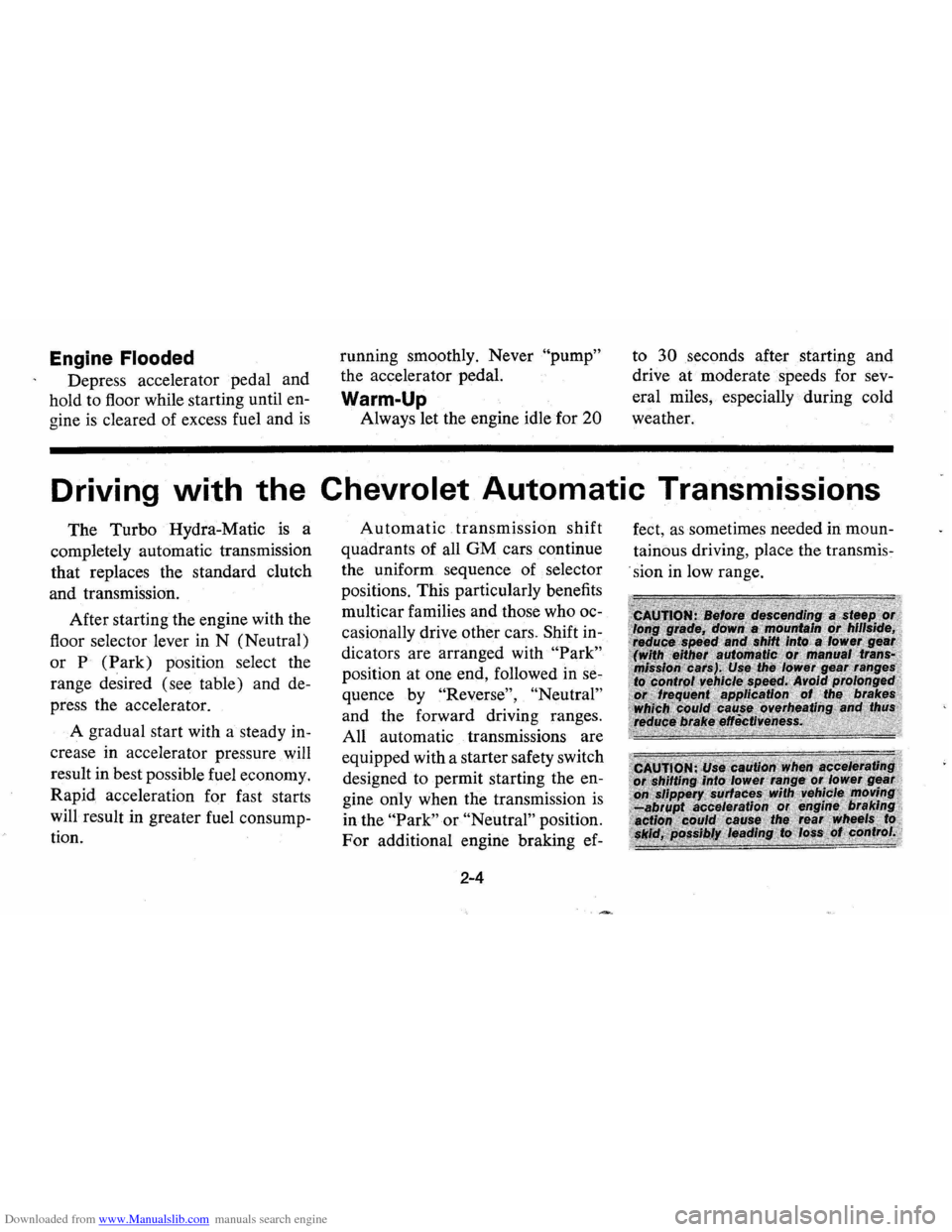
Downloaded from www.Manualslib.com manuals search engine Engine Flooded
Depress accelerator pedal and
hold to floor while starting until en
gine
is cleared of excess fuel and is
running smoothly. Never "pump"
the accelerator pedal.
Warm-Up
Always let the engine idle for 20
to 30 seconds after starting and
drive at moderate speeds for sev
eral miles, especially during cold
weather.
Driving with the Chevrolet Automatic Transmissions
The Turbo Hydra-Matic is a
completely automatic transmission
that replaces the standard clutch
and transmission.
After starting the engine with the
floor selector lever in N (Neutral)
or
P (Park) position select the
range desired (see table) and de
press the accelerator.
A gradual start with a steady in
crease in accelerator pressure will
result in best possible fuel economy.
Rapid acceleration for fast starts
will result in greater fuel consump
tion.
Automatic transmission shift
quadrants of all GM cars continue
the uniform sequence of selector
positions. This particularly benefits
multicar families and those who oc
casionally drive other cars.
Shift in
dicators are arranged with
"Park"
position at one end, followed in se
quence by
"Reverse", "Neutral"
and the forward driving ranges.
All automatic transmissions are
equipped with a starter safety switch
designed to permit starting the en
gine only when the transmission
is
in the "Park" or "Neutral" position.
For additional engine braking ef-
2-4
fect, as sometimes needed in moun
tainous driving, place the transmis
. sion in low range.
Page 26 of 87
Downloaded from www.Manualslib.com manuals search engine Parking Your Car
Always engage the parking brake
and place the automatic transmis
sion selector lever in
"Park" posi- tion
when leaving your
car un
attended. Also with automatic
transmissions, never park for pro
longed periods with engine idling
and transmission in gear, especially
FLOOR CONTROLS
Braking System
The service brake system is de
signed for braking performance
under a wide range of driving con
ditions even when the vehicle
is
loaded to its full rated vehicle load.
NOTE: Operation of the brake
system warning light
is covered on
page 2-15 in the section on
"In
strument Panel."
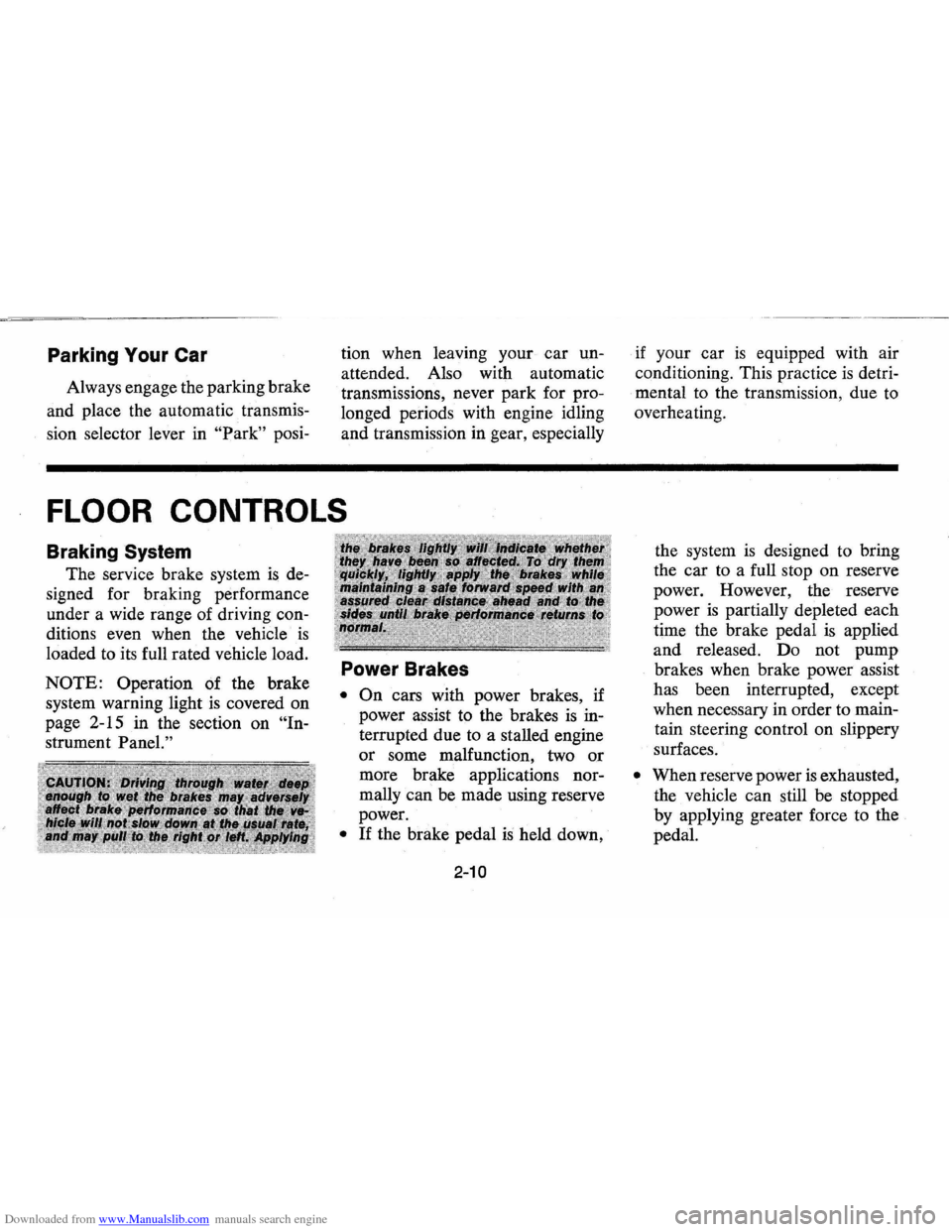
Power Brakes
• On cars with power brakes, if
power assist to the brakes
is in
terrupted due to a stalled engine
or some malfunction, two or
more brake applications nor
mally can be made using reserve
power.
• If the brake pedal is held down,
2-10
if your car is equipped with air
conditioning. This practice
is detri
mental to the transmission, due
to
overheating.
the system
is designed to bring
the car to a full stop on reserve
power. However, the reserve
power
is partially depleted each
time the brake pedal
is applied
and released. Do not pump
brakes when brake power assist
has been interrupted, except
when necessary in order to main
tain steering control on slippery
surfaces.
• When reserve power is exhausted,
the vehicle can still be stopped
by applying greater force to the
pedal.
Page 33 of 87
Downloaded from www.Manualslib.com manuals search engine especially useful when driving on
dark roads since they provide ex
cellent long range illumination. The
headlight beam indicator will be on
whenever the high beams or
"brights" are in use. The Headlight
Beam
Switch controls the headlight
beams (see Page
2-12).
Light Switch
The three position light switch
controls the headlights, taillights,
parking lights, side marker lights,
instrument lights and dome lights
as shown. The headlamp circuit
is protected by a circuit breaker in
the light switch.
An overload on
the breaker will cause the lamps to
"flicker" on and off. If this condi
tion develops, have your headlamp
wiring checked immediately.
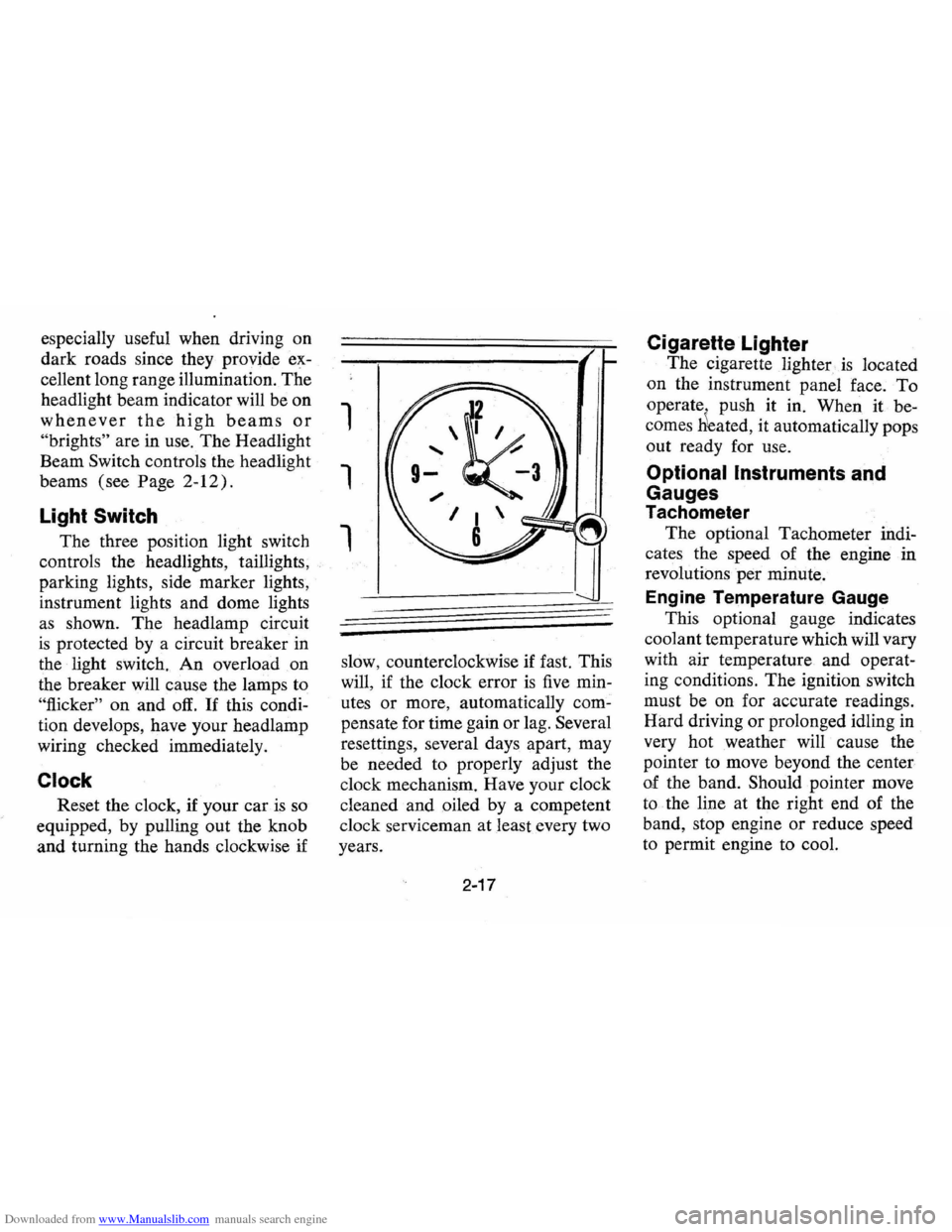
Clock
Reset the clock, if your car is so
equipped, by pulling out the knob
and turning the hands clockwise if
1
1
1
slow, counterclockwise if fast. This
will,
if the clock error is five min
utes
or more, automatically com
pensate for time gain or lag. Several
resettings, several days apart, may
be needed to properly adjust the
clock mechanism. Have your clock
cleaned and oiled by a competent
clock serviceman at least every two
years.
2-17
Cigarette Lighter
The cigarette lighter is located
on the instrument panel
face. To
operate . push it in. When it be
comes
Heated, it automatically pops
out ready for use.
Optional Instruments and
Gauges
Tachometer
The optional Tachometer indi
cates the speed of the engine in
revolutions
per minute.
Engine Temperature Gauge
This optional gauge indicates
coolant temperature which will vary
with air temperature and operat
ing conditions.
The ignition switch
must be on for accurate readings.
Hard driving
or prolonged idling in
very hot weather will cause the
pointer to move beyond the center
of the band. Should pointer move
to the line at the right end of the
band, stop engine or reduce speed
to permit engine to cool.
Page 66 of 87
Downloaded from www.Manualslib.com manuals search engine Every two years or 30,000 miles,
whichever occurs first, the cooling
system should be· flushed and re
filled using
the following recom
mended procedure:
1. Remove radiator cap when en
gine
is cool:
• Rotate cap slowly counter
clockwise to detent
(Do not
press down while rotating.)
• Wait until residual pressure
(indicated by a hissing
sound) is relieved, then press
down on cap and continue
to rotate counterclockwise.
2.
Run engine, with radiator cap
removed, until upper radiator
hose
is hot (indicates thermo
stat
is open). 3.
Stop engine
and open radiator
valve to drain coolant. (Opera
tion may be speeded by remov
ing drain plugs in the block.)
4. Close valve (install block drain
plugs, if removed) and add
sufficient water to
fill system.
5. Repeat steps 1, 2, 3, and 4, a
sufficient number of times until
the drained liquid is nearly
colorless.
6. Allow system to drain com
pletely and then close radiator
drain valve tightly. (Install
block drain plugs, if removed.)
7. Remove recovery cap leaving
hoses in place. Remove coolant
recovery tank,. empty fluid,
scrub and clean bottom and
sides of tank with detergent and
water, flush well with clean
water, drain and reinstall.
5-8
8. Add sufficient ethylene glycol
coolant, meeting
GM Specifica
tion 1899-M, to provide the re
quired freezing and corrosion
protection-at least a 50 per
cent solution
-34°F, -37°C.
Fill radiator to the base of the
radiator filler neck and bring
level of coolant in the recovery
tank to the
"FULL HOT"
mark. Reinstall recovery tank
cap.
9.
Run engine, with radiator cap
removed, until radiator upper
hose becomes hot.
10. With engine idling, add coolant
to radiator until level reaches
bottom of filler neck; install cap
making certain arrows line up
with overflow tube.
It is the owner's responsibility to:
• Maintain cooling system freeze
Page 74 of 87
Downloaded from www.Manualslib.com manuals search engine for 3 hours or more, or driven
less than 1 mile.
2 .
It is normal for tire pressures to
increase 4-8
PSI when the tires
become hot from driving. Do not
"bleed" (reduce tire inflation
pressures) after driving your
vehicle. Bleeding serves to in
crease tire flexing and heat build
up which can result in tire dam
age and failure.
3. For sustained driving at turn
pike speeds, cold inflation
pressures should be increased 4
PSI above the recommended
cold inflation pressures on the
tire placard up to a maximum of
32
PSI for load range Btires, 36
PSI for load range C, and 40 PSI
for load range D. Sustained
speeds above 75 mph are not
recommended when the 4
PSI
adjustment would require pres
sures greater than the maximum
pressures above.
4. Always use a tire pressure gauge
(a pocket type gauge is recom
mended) when checking
infla~
tion pressures. Underinflated
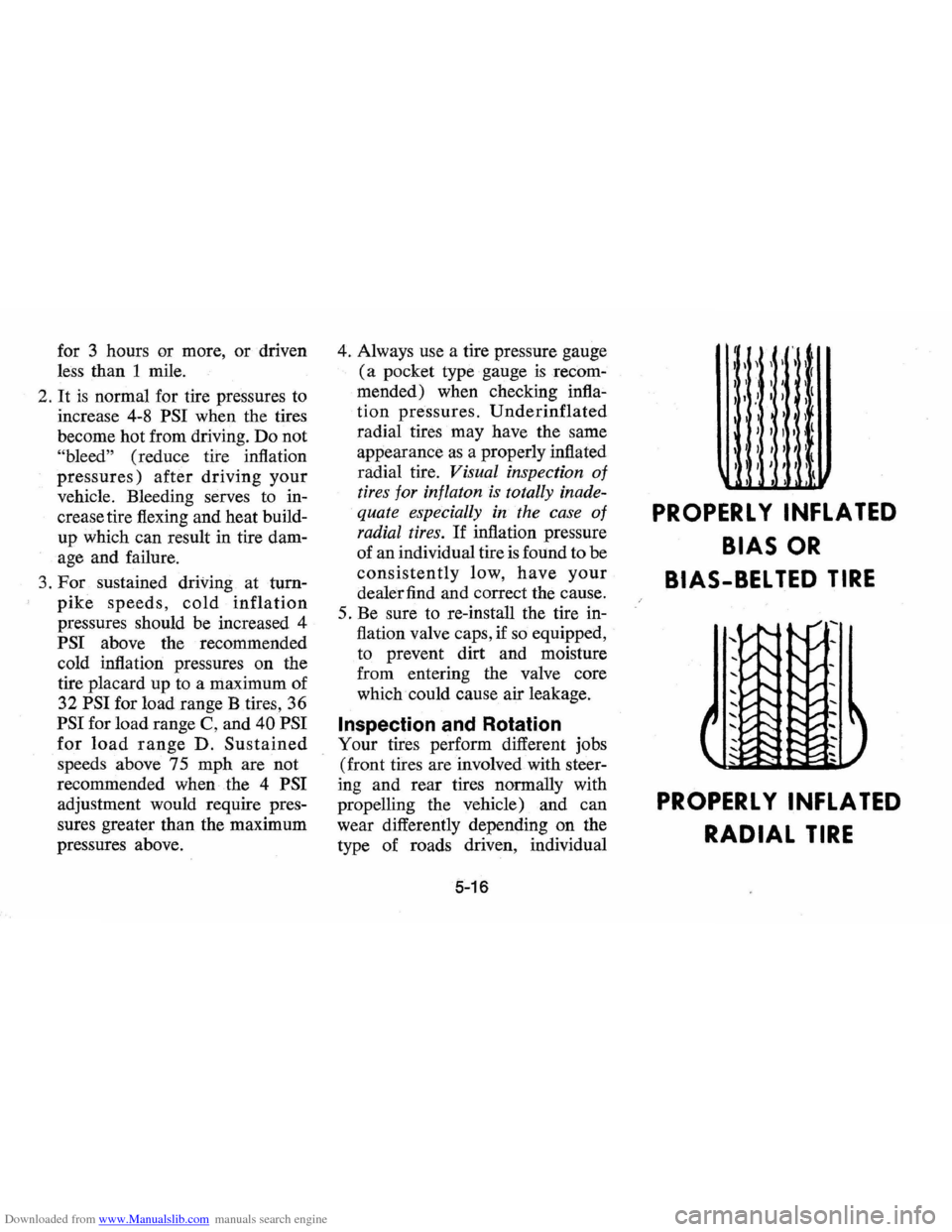
radial tires may have the same
appearance
as a properly inflated
radial tire.
Visual inspection of
tires for inflaton is totally inade
quate especially in the case
of
radial tires. If inflation pressure
of an individual tire
is found to be
consistently low, have your
dealer find and correct the cause.
5. Be sure to re-install the tire in
flation valve caps, if
so equipped,
to prevent dirt and moisture
from entering the valve core
which could cause air leakage.
Inspection and Rotation
Your tires perform different jobs
(front tires are involved with steer
ing and rear tires normally with
propelling the vehicle) and can
wear differently depending on the
type of roads driven, individual
5-16
1\ II(
" I I ,t " I' ,I
I' I I j , I I I
I I , I I I I
I I I I I I
I 1
PROPERL Y INFLATED
BIAS OR
BIAS-BEL TED TIRE
PROPERL Y INFLATED
RADIAL TIRE
Page 86 of 87
Downloaded from www.Manualslib.com manuals search engine OWNER
ASSISTANCE
The satisfaction and goodwill of
the owners of Chevrolet products
are of primary concern to your
dealer and the Chevrolet Motor
Division. Normally, any problems
that arise in connection with the
sales transaction
or the operation of
your car will be handled by your
dealer's
Sales or Service Depart
ments.
It is recognized , however,
that despite the best intentions of
everyone concerned, misunder
standings will sometimes occur. If
you have a problem that has not
been handled to your satisfaction
through normal channels,
we sug
gest that you take the following
steps:
STEP ONE-Discuss your prob
lem with a member of dealer
ship management. Frequently,
6-5
complaints are the result of a break
down in communications and can
quickly be resolved by a member of
the dealership management.
If the
problem already has been reviewed
with the
Sales Manager or Service
Manager, contact the Dealer him
self
or the General Manager.
STEP TWO-Contact the Chev
rolet Zone Office closest to you
listed on the following pages
(or
in Canada contact the Gen
eral Motors Zone Office). When
it appears that your problem can
not be readily resolved by the deal
ership without additional assist
ance, the matter should be called
to the attention of the Zone's Cus
tomer
Services Department and
the following information pro
vided: