cooling CHEVROLET VEGA 1976 1.G Owners Manual
[x] Cancel search | Manufacturer: CHEVROLET, Model Year: 1976, Model line: VEGA, Model: CHEVROLET VEGA 1976 1.GPages: 87, PDF Size: 32.36 MB
Page 15 of 87
Downloaded from www.Manualslib.com manuals search engine Maintenance
More frequent vehicle mainte
nance
is required when using your
car to pull a trailer. Change the:
• Automatic transmission fluid
and filter each
15,000 miles,
(see Trailering brochure for addi
tional information).
• Rear axle fluid each 15,000
miles,
• Engine oil each 90 days or 3,000
miles, whichever occurs first,
• Positive crankcase ventilation
valve each
12 months or 15,000
miles, whichever occurs first.
• See index for important informa
tion on belts, cooling system care
and automatic brake adjustment.
Break-in Schedule
In addition to the new car preak-in
instructions in this manual, it is
recommended that your new car
be operated for
500 miles before
trailer towing.
If it is necessary to
tow during this period, avoid speeds
over
50 MPH and full throttle
starts. The same precautions should
be observed whenever a new en
gine, transmission or axle
is in
stalled in your car.
1-10
Page 17 of 87
Downloaded from www.Manualslib.com manuals search engine STARTING AND OPERATING
Engine Exhaust Gas Caution (Carbon Monoxide)
AvoId Inhaling exhaust gases because
they contaIn carbon monoxide, which by
Itselt is colorless and odorless. Carbon
monoxide Is a dangerous gas that can
cause unconsciousness and is potentially
lethal.
If at any time you suspect that exhaust
fumes are entering the passenger compartment, have the cause determined and
corrected as soon as possible. If you must
drIve under these conditions, drive only
with
all windows fully open.
The best protection agaInst carbon
monoxide entry Into the car body Is a
properly maIntaIned engine exhaust system, car body and body ventilatIon system, It Is recommended that the exhaust system
and body be Inspected by a competent
mechanIc.
• Each time the vehIcle Is raised for an 011 change.
• Whenever 8 change Is noticed In the
sound Of the exhaust system.
• Whenever the exhaust system, underbody or rear of the vehicle Is damaged.
See your MaIntenance Schedule folder
for inspection procedure.
To allow proper operation of the car's
ventilation system, keep aIr Inlet grille
forward of windshield and rear ventilation
grille on station wagon quarter. panels
clear ot snow or other
obstruction at all times, and prevent cargo from blocking
the inside vent holes on the underside of the quarter panels.
SITTING IN A PARKED CAR WITH ENGINE RUNNING FOR AN EXTENDED PERIOD IS NOT RECOMMENDED.
Do not run engine In confined areas
such as garages any more than needed
to move vehIcle In
or out of area. When vehIcle Is stopped In an UNCONFINED area with the engine runnIng for any more
than a short perIod, adjust heating or cooling system to force outsIde aIr into
car as follows:
2-1
1. On cars not equipped with air conditioning, set fan to medium or high
speed and upper control lever to any
position except OFF.
2. On cars equipped with air conditIoning, set fan to medium or high speed
and upper control lever to any position
except
OFF or MAX.
The trunk lid should be closed while drIving to help prevent inadvertently drawing exhaust gases into the car. It is
unwise to drIve at high speeds for long
durations with the trunk lid open. However, it tor some reason the trunk must remain
open for a period while moving, or electrical wiring or other cable connections to
a trailer must pass through the seal be
tween trunk
lid and body, the following
precautions should be observed:
• Close all windows.
• Adjust heating or cooling system to
force outsIde air into car as described In Items 1 and 2 above but with fan set
at hIgh speed.
• On cars equIpped with outside aIr vents In or under Instrument panel, open vents
fully.
Page 31 of 87
Downloaded from www.Manualslib.com manuals search engine Generator Indicator Light
The red light will go on when
the ignition key
is in the "on" posi
tion, but before the engine
is started.
After the engine starts, the light
should go out and remain out.
If
the light remains on when engine
is running, have your Authorized
Chevrolet Dealer locate and correct
the trouble
as soon as possible.
Temp. Pressure Indicator
Light
This indicator light is provided
in the instrument cluster to quickly
warn of an overheated engine
and/or extreme low oil pressure
or oil supply. This light will be on
when the ignition switch is turned
"ON" and should go out after the
engine
is started. Occasionally the
light may be seen to flicker momen
tarily, but this will do no harm. Ex
treme low oil pressure or oil supply
will prevent the electric fuel pump from
operating and under this con
dition the engine will not run.
If the light comes on during ex
treme driving conditions, such
as an
extended idle, turn off the air con
ditioner (if used) and run the en
gine slightly faster than idle speed
with the transmission in
neutral
gear. If the light does not go off
within a short period of time (1-2
minutes), then turn the engine off
until the cause of
the overheating is
corrected. Glance at the instrument
cluster frequently
as you drive to
see if this light is on.
Add Coolant Indicator Light
This indicator light is provided to
warn of a low coolant condition in
the radiator.
If coolant level is low
the yellow
"Add Coolant" warning
light will glow. Coolant level in the
coolant recovery tank, and radiator,
should be checked at the first oppor
tunity.
If necessary add sufficient
2-15
coolant to both the radiator and
coolant recovery tank.
(See Service
and Maintenance, Section 5, for
proper procedure) .
If frequent
additions are required, see your
dealer for a complete cooling sys
tem check.
Brake System Warning
Light
The service brake system is a dual
system designed so that one part will
provide some braking action in the
event of loss of hydraulic pressure
in the other part of the system.
If the
warning light labeled
"Brake" lo
cated in the speedometer face comes
on and stays
on when the ignition is
on and after the brakes have been
firmly applied
it may indicate that
there
is a malfunction in one part of
the brake system.
• As a reminder, the light is de
signed to come
on with the park
ing brake applied and the igni
tion on.
Page 36 of 87
Downloaded from www.Manualslib.com manuals search engine ventilation comfort, made possible
by the addition of air vent provi
sions in each quarter panel on sta
tion wagon and panel express
models and each rear lock pillar
on notchback and hatchback mod
els. Another feature of the system
is continuous low-speed operation
of the heater and air conditioner
blower, resulting in an uninter
rupted supply of outside air
flow
into the car whenever the ignition
switch
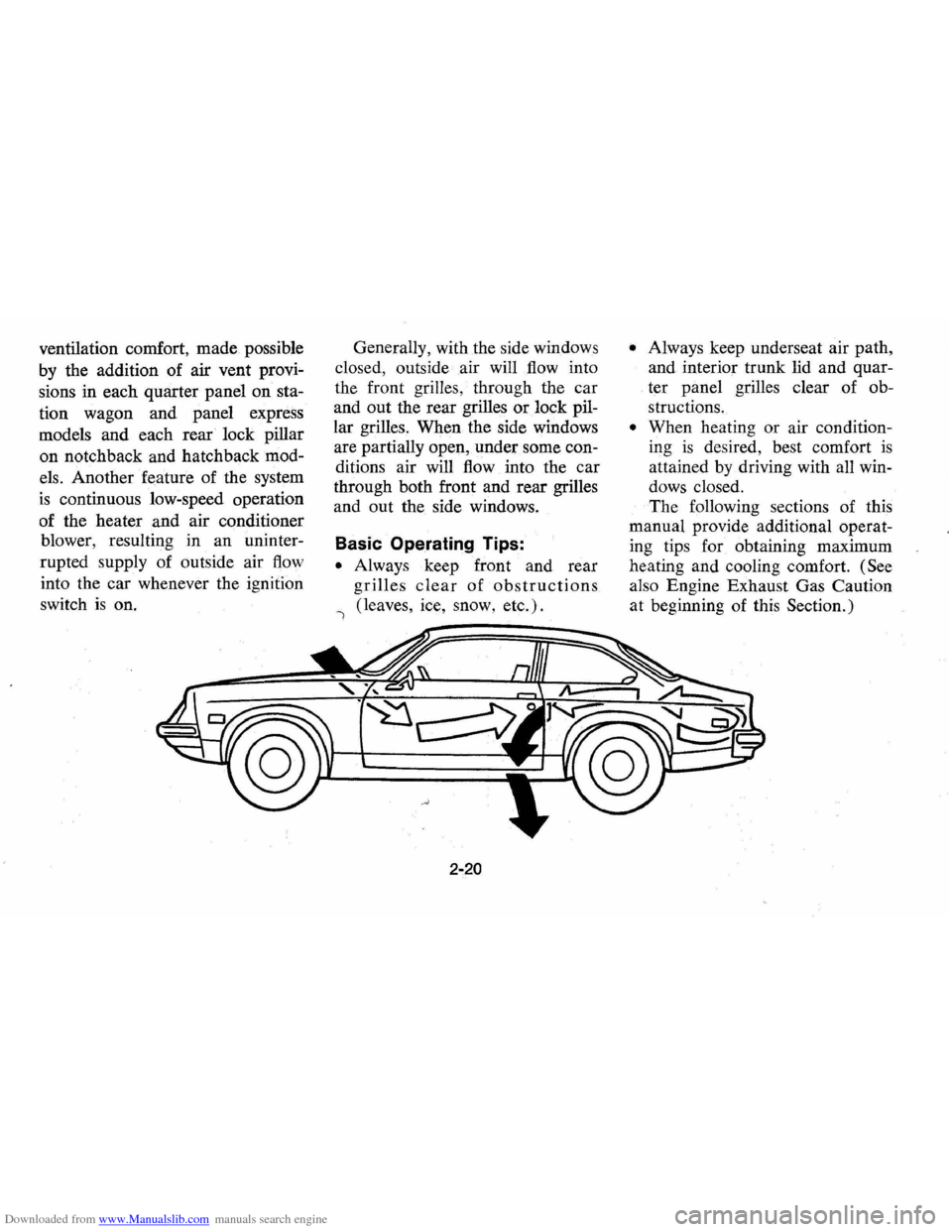
is on. Generally,
with the side windows
closed, outside· air will
flow into
the front grilles, through the car
and out the rear grilles
or lock pil
lar grilles. When the side windows
are partially open, under some con
ditions air will
flow into the car
through both front and rear grilles
and out the side windows.
Basic Operating Tips:
• Always keep front and rear
grilles clear of obstructions
, (leaves, ice, snow, etc.).
2-20
• Always keep underseat air path,
and interior trunk lid and quar
ter panel grilles clear of ob
structions.
• When heating or air condition
ing
is desired, best comfort is
attained by driving with all win
dows closed.
The following sections of this
manual provide additional operat
ing tips for obtaining maximum
heating and cooling comfort.
(See
also Engine Exhaust Gas Caution
at beginning of this Section.)
Page 39 of 87
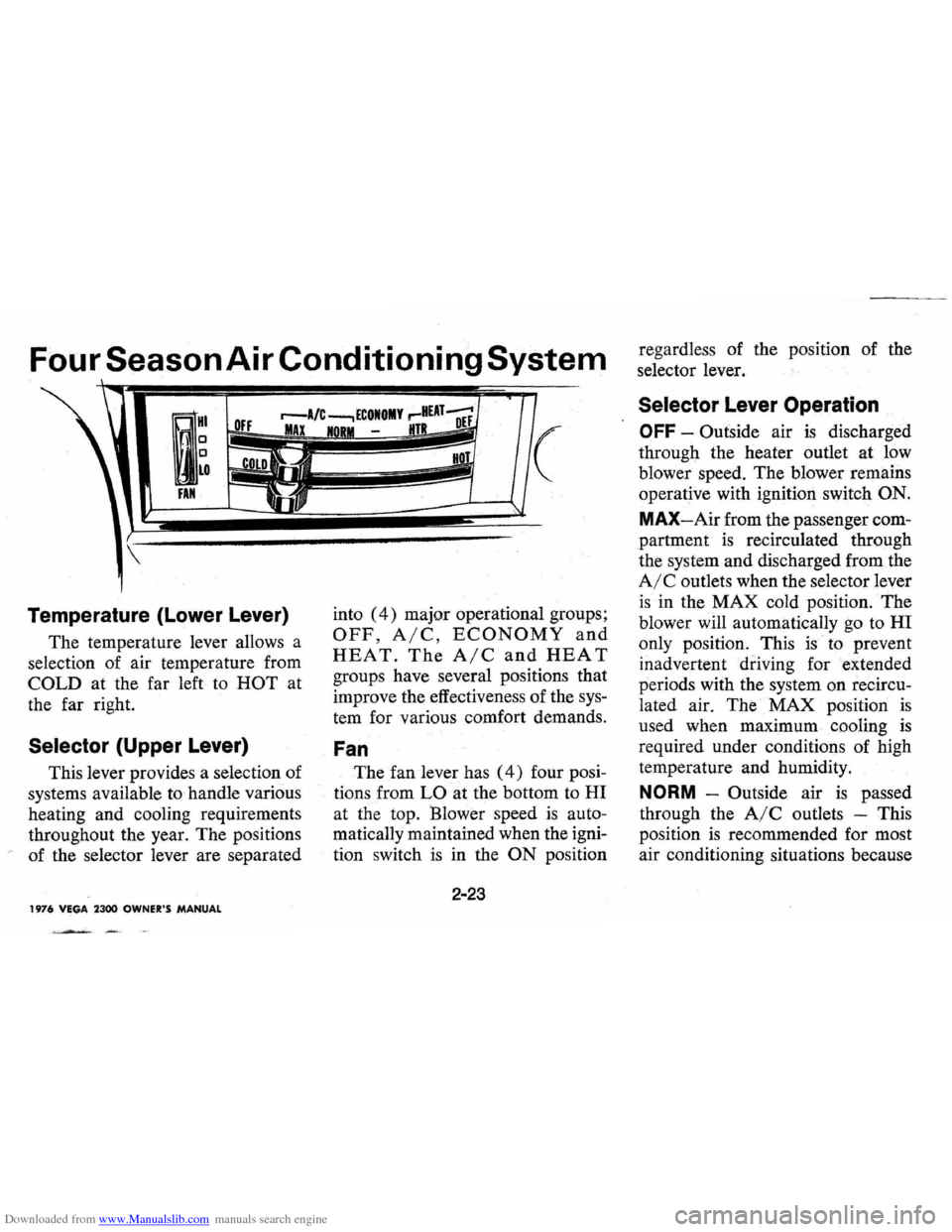
Downloaded from www.Manualslib.com manuals search engine Four Season Air Conditioning System
g
HI OFF r--A/C ---. ECOIIOMY ,-HUT D'Ef MAX -HT
(
. 0 o
LO
nil
Temperature (Lower Lever)
The temperature lever allows a
selection of air temperature from
COLD at the far left to HOT at
the far right.
Selector (Upper Lever)
This lever provides a selection of
systems available to handle various
heating and cooling requirements
throughout the year. The positions
of the selector lever are separated
1976 VEGA 2300 OWNER'S MANUAL
.. ~ -..-~.
into (4) major operational groups;
OFF, AIC, ECONOMY and
HEAT. The AIC and HEA T
groups have several positions that
improve the effectiveness of the
sys
tem for various comfort demands.
Fan
The fan lever has (4) four posi
tions from
LO at the bottom to HI
at the top. Blower speed is auto
matically maintained when the igni
tion switch
is in the ON position
2-23
regardless of the position of the
selector lever.
Selector Lever Operation
OFF -Outside air is discharged
through the heater outlet at low
blower speed. The blower remains
operative with ignition switch
ON.
MAX-Air from the passenger com
partment
is recirculated through
the system and discharged from the
AIC outlets when the selector lever
is in the MAX cold position. The
blower will automatically go to
HI
only position. This is' to prevent
inadvertent driving for extended
periods with the system on recircu
lated air. The MAX position
is
used when maximum cooling is
req uired under conditions of high
temperature and humidity.
NORM -Outside air is passed
through the
AIC outlets -This
position
is recommended for most
air conditioning situations because
Page 65 of 87
Downloaded from www.Manualslib.com manuals search engine ENGINE COOLING
SYSTEM
The recovery type cooling sys
tem 'is standard on all Chevrolet
passenger cars. The coolant ex
pands with rising temperature and
the overflow
is collected in the
recovery tank. When the system
temperature drops, the coolant
is
drawn back into the radiator. The
cooling system has been filled at
the factory with a high -quality, in
hibited ,
year-around coolant that
meets the standards of General
Motor s Specification 1899-M. This
coolant solution provides freezing
protection to
-20oP (- 28 °C),
and in Canada to -35°P
(-37°C), and it has been formu
lated to be used without replace
ment for two years
or 30,000 miles.
After two years or
30,000 miles,
the coolant should be drained to
prevent rust
or corrosion in the
radiator and engine.
Cooling System Care
Do not remove radiator cap to
check coolant level, but check visu
ally in the
"see thru" coolant re
covery tank at
least as frequently
as needed. Level should be at the
"full cold" mark on the recovery
tank when the system
is cold and
at the
"full hot" mark at normal
operating temperature.
Add a 50/
50
mixture of high-quality ethylene
glycol antifreeze and water for
coolant additions.
If frequent addi
tions are required, see
your' dealer
for a cooling system check.
NOTE: If recommended quality
antifreeze
is used, supplemental in
hibitors or additives claiming to
provide increased capability are not
necessary. They may be detrimen
tal to the efficient operation of the
system, and represent an unneces
sary operating expense.
5-7
The cooling system should be
serviced every year as follows:
1. Wash radiator cap and filler neck
with clean water.
2. Check coolant for proper level
and freeze protection.
3 . Test system and radiator cap for
proper pressure holding capacity
(15 psi). If required, use cap
designed by
AC for coolant re
covery systems, and specified for
your model.
4. Tighten hose clamps and inspect
all hoses. Replace hoses if swol
len, checked or otherwise deteri
orated.
5 . Clean frontal area of radiator
core and air conditioning con
denser.
Page 66 of 87
Downloaded from www.Manualslib.com manuals search engine Every two years or 30,000 miles,
whichever occurs first, the cooling
system should be· flushed and re
filled using
the following recom
mended procedure:
1. Remove radiator cap when en
gine
is cool:
• Rotate cap slowly counter
clockwise to detent
(Do not
press down while rotating.)
• Wait until residual pressure
(indicated by a hissing
sound) is relieved, then press
down on cap and continue
to rotate counterclockwise.
2.
Run engine, with radiator cap
removed, until upper radiator
hose
is hot (indicates thermo
stat
is open). 3.
Stop engine
and open radiator
valve to drain coolant. (Opera
tion may be speeded by remov
ing drain plugs in the block.)
4. Close valve (install block drain
plugs, if removed) and add
sufficient water to
fill system.
5. Repeat steps 1, 2, 3, and 4, a
sufficient number of times until
the drained liquid is nearly
colorless.
6. Allow system to drain com
pletely and then close radiator
drain valve tightly. (Install
block drain plugs, if removed.)
7. Remove recovery cap leaving
hoses in place. Remove coolant
recovery tank,. empty fluid,
scrub and clean bottom and
sides of tank with detergent and
water, flush well with clean
water, drain and reinstall.
5-8
8. Add sufficient ethylene glycol
coolant, meeting
GM Specifica
tion 1899-M, to provide the re
quired freezing and corrosion
protection-at least a 50 per
cent solution
-34°F, -37°C.
Fill radiator to the base of the
radiator filler neck and bring
level of coolant in the recovery
tank to the
"FULL HOT"
mark. Reinstall recovery tank
cap.
9.
Run engine, with radiator cap
removed, until radiator upper
hose becomes hot.
10. With engine idling, add coolant
to radiator until level reaches
bottom of filler neck; install cap
making certain arrows line up
with overflow tube.
It is the owner's responsibility to:
• Maintain cooling system freeze
Page 67 of 87
Downloaded from www.Manualslib.com manuals search engine protection at -20o
P (-28°C) or
below to ensure protection against
corrosion
and · loss of coolant
from boiling even though freezing
temperatures are not expected.
• Add ethylene glycol base coolant
that meets
GM Specification
1899-M when coolant additions
are required because of coolant
loss
or to provide additional pro
tection against freezing at tem
peratures lower than -20oP
(-28°C), and in Canada to
-35°P (-37°C).
NOTE: Alcohol or methanol base
coolants or plain water are not
recommended for your vehicle at
any time.
Your vehicle, if equipped with
standard 4-cylinder engine, has
an aluminum cylinder block.
When adding anti-freeze, rust
inhibitors, or cleaners, make
certain they are safe for
use
with aluminum components.
Radiator Pressure Cap
The radiator cap, a 15 lb. pres
sure type, must be installed tightly,
otherwise coolant may be lost and
damage
t6 engine may result from
overheating. Radiator pressure caps
should be checked periodically for
proper operation.
If replacement is
required specify AC.
Thermostat
The cooling system is protected
and controlled by a thermostat that
maintains a satisfactory engine
operating temperature. This
ther
mostat is installed in the engine
coolant outlet and
is designed for
continuous use through both winter
and summer. When replacement
is
necessary, Delco parts are recom
mended.
5-9
CHASSIS ITEMS
Rear Axle Lubricant
Standard -Every 6 months or
7,500 miles, whichever occurs first,
check lubricant level and add
lubri
cant, if necessary, to fill to level of
filler plug hole.
Use SAE 80W or
SAE80W-90GL-5 Gear Lubricant.
cant.
(Por vehicles operated in
Canada, use
SAE 80W Gear Lubri
cant.)
Positraction -Drain aJ,ld refill
after the first 15,000 miles then
maintain same
as standard axle but
use only the special positraction lu
bricant available from your Chev
rolet Dealer, part number 1051022.
Page 70 of 87
Downloaded from www.Manualslib.com manuals search engine Hood Latche$
Every 6 months or 7,500 miles,
whichever occurs first, lubricate
hood latch assembly and hood
hinge assembly
as follows:
1. Wipe off any accumulation of
dirt or contamination on latch
parts.
2 . Apply Lubriplate or equivalent
to latch pilot bolts and latch
locking plate.
.
3. Apply light engine oil to all pivot
points in release mechanism,
as
well as primary and secondary
latch mechanisms.
4. Lubricate hood hinges.
5. Make hood hinge and latch
mechanism functional check
to
assure the assembly is working
correctly .
Accelerator Linkage
Lubricate with engine oil every
15,000 miles.
Hinges
The following points should be
checked and lubricated every 6
months or
7,500 miles, whichever
occurs first:
hingeS on all doors,
fuel filler door, trunk lid, door lock
striker and door
jamb switches. '
5-12
Air Conditioning
Have your Authorized Dealer
check your Air Conditioning
sys
tem at some time during the winter
months to be sure there has been
no loss in cooling output. During
the summer , see your Authorized
Dealer immediately if you suspect
the system
is not performing as it
should.
NOTE: Your car's air condition
ing system will not operate below
ambient temperature of
300 F
( -1 0 C) , regardless of control
position.
Page 78 of 87
Downloaded from www.Manualslib.com manuals search engine belted, or radial) as originally in
stalled on your vehicle. Use of any
other size
or type tire may seriously
affect ride, handling, speedometer /
odometer calibration, vehicle
ground clearance, and tire clear
ance to the body and chassis.
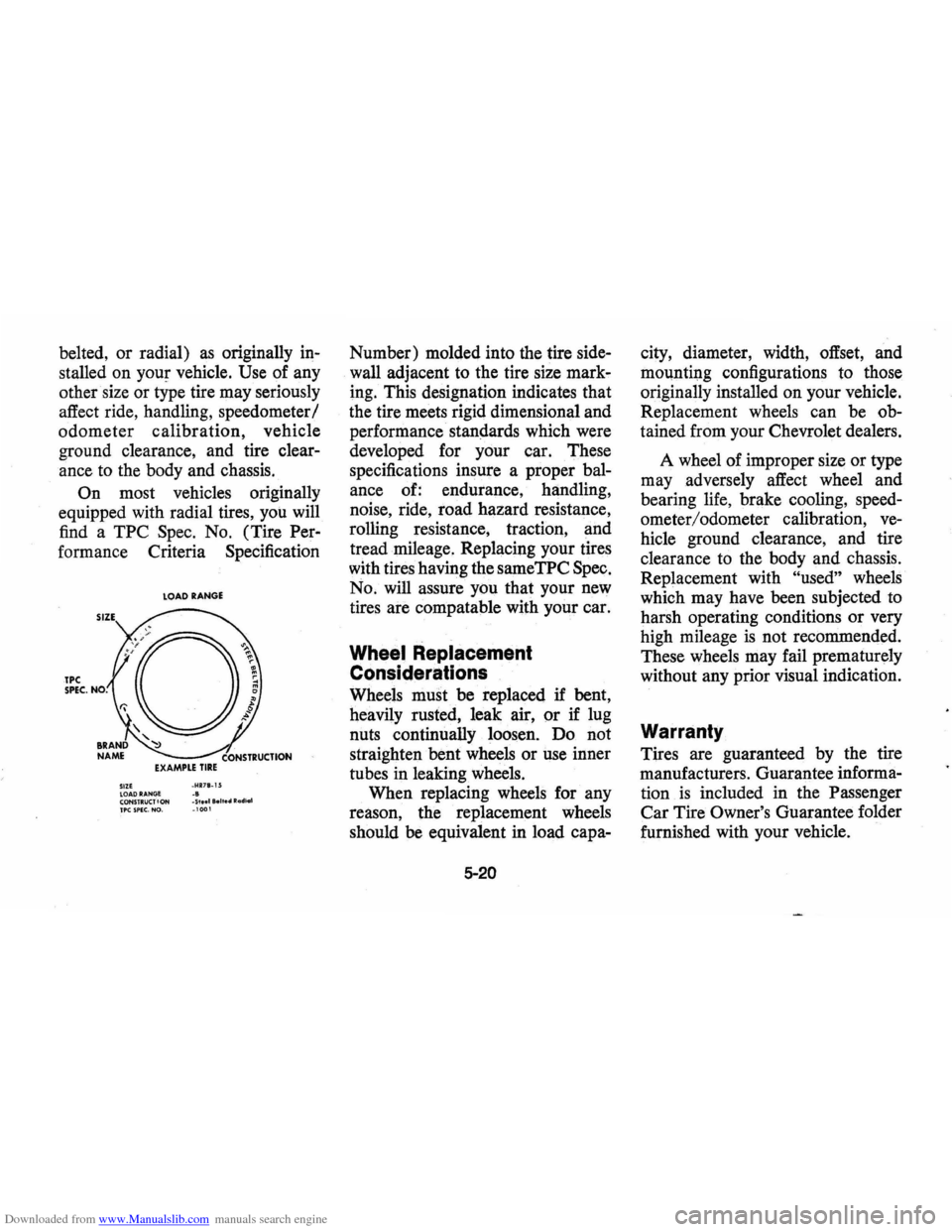
On most vehicles originally
equipped with radial tires,
you will
find a
TPC Spec. No. (Tire Per
formance Criteria Specification
LOAD RANGE
TPC SPEC. NO.
SItE _HUI_ U LOAD RANG! .8 CONSTRUCT' ON _5, .. 1 a.lt •• Radle.! TPC SPEC. NO. _ 1 00 1
Number) molded into the tire side
wall adjacent to the tire size mark.,.
ing. This designation indicates that
the tire meets rigid dimensional and
performance standards which were
developed for your car. These
specifications insure a proper
bal
ance of: endurance, handling,
noise, ride,
road hazard resistance,
rolling resistance, traction,
and
tread mileage. Replacing your tires
with tires having the sameTPC Spec.
No. will assure you that your new
tires are compatable with your car.
Wheel Replacement
Considerations
Wheels must be replaced if bent,
heavily rusted, leak air,
or if lug
nuts continually loosen.
Do not
straighten
bent wheels or use inner
tubes in leaking wheels.
When replacing wheels for any
reason, the replacement wheels
should
be equivalent in load capa-
5-20
city, diameter, width, offset, and
mOllnting configurations to those
originally installed
on your vehicle.
Replacement wheels
can be ob
tained from your Chevrolet dealers.
A wheel
of improper size or type
may adversely affect wheel and
bearing life, brake cooling, speed
ometer/odometer calibration,
ve
hicle ground clearance, and tire
clearance to the body
and chassis.
Replacement with
"used" wheels
which may have been subjected to
harsh operating conditions
or very
high mileage is
not recommended.
These wheels
may fail prematurely
without any prior visual indication.
Warranty
Tires are guaranteed by the tire
manufacturers. Guarantee informa
tion
is included in the Passenger
Car Tire Owner's Guarantee folder
furnished with your vehicle.