ECO mode CHEVROLET VEGA 1976 1.G Owners Manual
[x] Cancel search | Manufacturer: CHEVROLET, Model Year: 1976, Model line: VEGA, Model: CHEVROLET VEGA 1976 1.GPages: 87, PDF Size: 32.36 MB
Page 5 of 87
Downloaded from www.Manualslib.com manuals search engine YOUR VEGA'S FIRST
FEW HUNDRED MILES OF DRIVING
You can operate your new car
from its very first mile without ad
hering to a formal
"break-in" sched
ule. However, during the first
few
hundred miles of driving you can,
by observing a few simple precau
tions , add to the future performance
and economy of your car.
It is recommended that your speed
during the first
500 miles
be confined to a maximum of 55
M.P.H., but do not drive for ex
tended periods at
anyone constant
speed, either fast
or slow. Dur
ing this period , avoid full throttle
starts and, if possible, avoid hard
stops especially during the first
200
miles of operation since brake mis- use
during this period will destroy
much future brake efficiency.
Always drive at moderate speed
until the engine has completely
warmed up.
If you plan to use your new
car for trailer hauling see additional
information on page 1-9.
SEE PAGE 5-21 FOR ADDITIONAL INFORMATION
ON HOW TO IMPROVE YOUR GAS MILEAGE.
ii
Page 19 of 87
Downloaded from www.Manualslib.com manuals search engine Starting Engine
Automatic Transmission
Models
1. Apply the parking brake.
2. Place transmission selector
in uP" or "N" ("P" preferred).
A starter safety switch prevents
starter operation while the trans
mission selector
is in any drive
position.
(If it is necessary to·
re-start the engine with the car
moving, place the selector lever
in
"N".)
3. Depress accelerator pedal and
activate starter
as outlined be
low for different conditions.
IMPORTANT: Do not keep the starter
engaged for more than 15 seconds
at a time. Wait 1 0 or 15 seconds
before trying agair.
• Cold Engine -Fully depress
accelerator pedal and slowly
release.
Wilh fOOl 00 the pedal,
crank
the engine by
turning the ignition key to the
Start position -release when
engine starts.
If engine starts, but fails to
run, repeat this procedure.
When engine is running
smoothly (approximately
30
seconds), the idle speed may
be reduced by slightly de
pressing the accelerator pedal
and then slowly releasing.
• Warm Engine -Depress ac
celerator
pedal about halfway
and hold while cranking the
engine.
• Extremely Cold Weather
(Below 00 F. -180 C.) Or
After Car Has Been Standing
Idle Several Days-
2-3
Fully depress and release ac
celerator pedal two
or three
times before cranking the
engine.
With foot 00 the ac
celerator pedal,
crank the en
gine by turning the key to the
Start position and release
when engine starts.
Manual Transmission Models
1. Apply parking brake, fully de
press
clutch pedal, and shift
transmission to neutral.
2. Hold clutch pedal to the floor
throughout
the starting proce
dure, A starter safety switch pre
vents starter operation when the
clutch
is not fully depressed.
(Select the proper gear posi
tion before releasing the clutch
pedal).
3. Operate accelerator pedal and
starter
as outlined in step 3
(under Automatic Transmission
Models).
Page 20 of 87
Downloaded from www.Manualslib.com manuals search engine Engine Flooded
Depress accelerator pedal and
hold to floor while starting until en
gine
is cleared of excess fuel and is
running smoothly. Never "pump"
the accelerator pedal.
Warm-Up
Always let the engine idle for 20
to 30 seconds after starting and
drive at moderate speeds for sev
eral miles, especially during cold
weather.
Driving with the Chevrolet Automatic Transmissions
The Turbo Hydra-Matic is a
completely automatic transmission
that replaces the standard clutch
and transmission.
After starting the engine with the
floor selector lever in N (Neutral)
or
P (Park) position select the
range desired (see table) and de
press the accelerator.
A gradual start with a steady in
crease in accelerator pressure will
result in best possible fuel economy.
Rapid acceleration for fast starts
will result in greater fuel consump
tion.
Automatic transmission shift
quadrants of all GM cars continue
the uniform sequence of selector
positions. This particularly benefits
multicar families and those who oc
casionally drive other cars.
Shift in
dicators are arranged with
"Park"
position at one end, followed in se
quence by
"Reverse", "Neutral"
and the forward driving ranges.
All automatic transmissions are
equipped with a starter safety switch
designed to permit starting the en
gine only when the transmission
is
in the "Park" or "Neutral" position.
For additional engine braking ef-
2-4
fect, as sometimes needed in moun
tainous driving, place the transmis
. sion in low range.
Page 23 of 87
Downloaded from www.Manualslib.com manuals search engine after the car has stopped. Always
depress and release the clutch pedal
fully when shifting.
On the 4-speed transmission lift
up on the release handle (below
the shift knob) momentarily when
shifting into reverse.
Good Driving Practice
The lower gears of the transmis
sion are used to normally accelerate
the vehicle to the desired cruising
(Cruising speed
is defined as a rela- tively
constant speed operation that
includes steady speed operation
as
well as moderate variations in speed
consistant with road and traffic con
ditions.) speed and the highest gear
of the transmission is used to
maintain the desired speed. The 5th
gear (overdrive) of a 5-speed man
ual transmission
is recommended
for use in maintaining extended
highway cruising speeds. Use of 5th
gear in city traffic
is not recom
mended.
If the vehicle speed is re-duced
below
20 MPH, or if the en
gine
is obviously lugging, the trans
mission should be downshifted from
high gear to the next lowest gear.
Downshifting two or more gear
positions may be necessary to pre
vent lugging the engine or to pro
vide a satisfactory performance
leveL As the first (1 st) gear of the
transmission
is fully synchronized,
the transmission should be down
shifted to first gear whenever the
vehicle stops or the vehicle speed
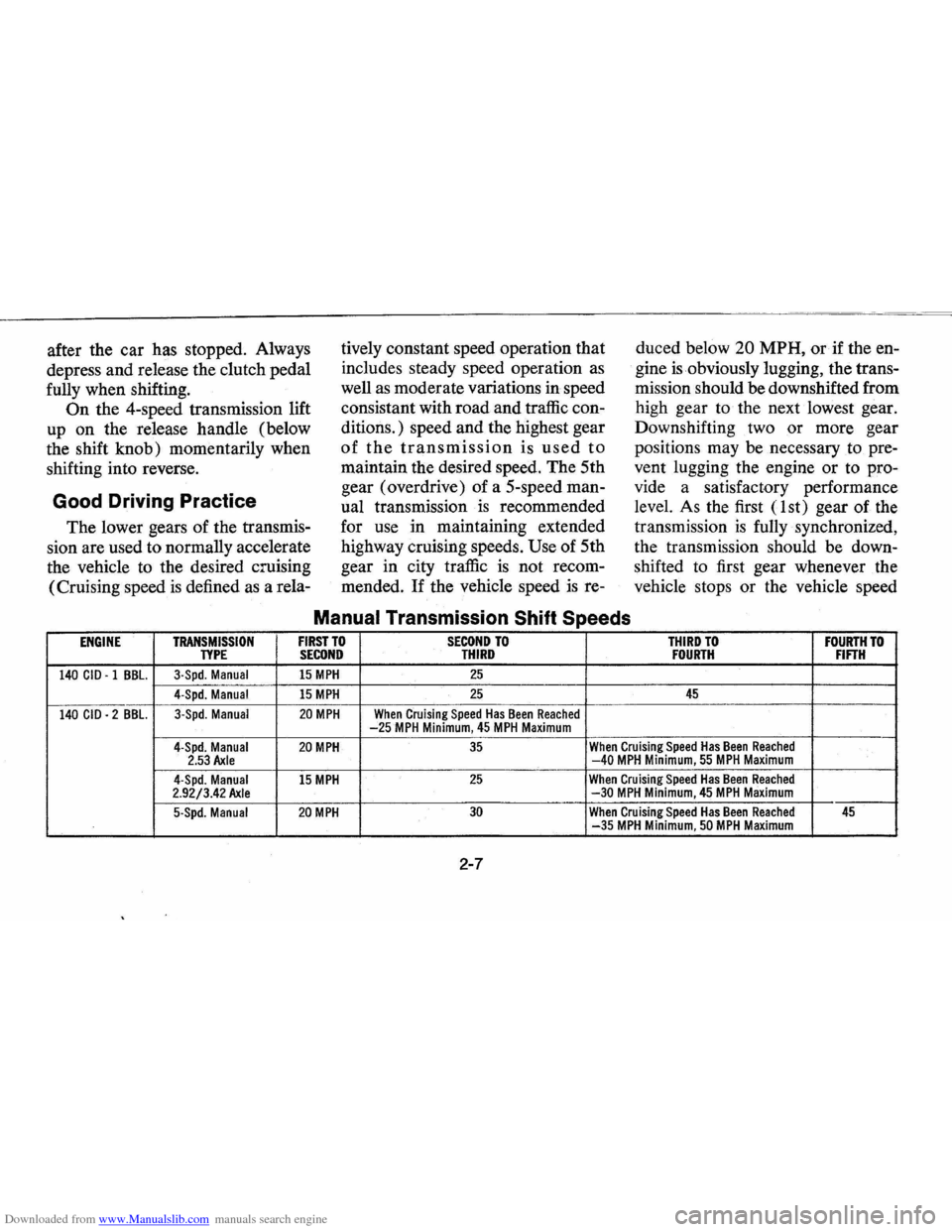
Manual Transmission Shift Speeds
ENGINE TRANSMISSION FIRST TO SECOND TO THIRD TO FOURTH TO TYPE SECOND THIRD FOURTH FIFTH
140 CID . 1 BBL. 3·Spd. Manual 15 MPH 25
4·Spd. Manua! 15 MPH 25 45
140 CID • 2 BBL. 3·Spd. Manual 20 MPH When Cruising Speed Has Been Reached -25 MPH Minimum, 45 MPH Maximum
4·Spd. Manual 20 MPH 35 When Cruising Speed Has Been Reached 2.53 Axle -40 MPH Minimum, 55 MPH Maximum
4·Spd. Manual 15 MPH 25 When Cruising Speed Has Been Reached 2.92/3.42 Axle -30 MPH Minimum, 45 MPH Maximum
5·Spd. Manual 20 MPH 30 When Cruising Speed Has Been Reached 45 -35 MPH Minimum, 50 MPH Maximum
2-7
Page 40 of 87
Downloaded from www.Manualslib.com manuals search engine of reduced blower noise. Temper
ature lever may be adjusted
as
desired.
ECONOMY-Outside air is passed
through the system and emitted
from the
A/C outlets and the
compressor
is off. Adjust tempera
ture lever
as desired. This position
is provided for cool to moderate
weather when refrigeration
is not
required.
HTR -Outside air is discharged
from the floor outlets with some air
emitted from the defroster outlets.
Temperature lever may be adjusted
as desired. This position is recom
mended for most winter driving.
DEF -Outside air is emitted from
the defroster outlets with some
air
discharged from the floor outlets.
Temperature lever may be adjusted
as desired. This position
is recom
mended for fogging
and/or icing
conditions.
Four Season System
Air Outlets
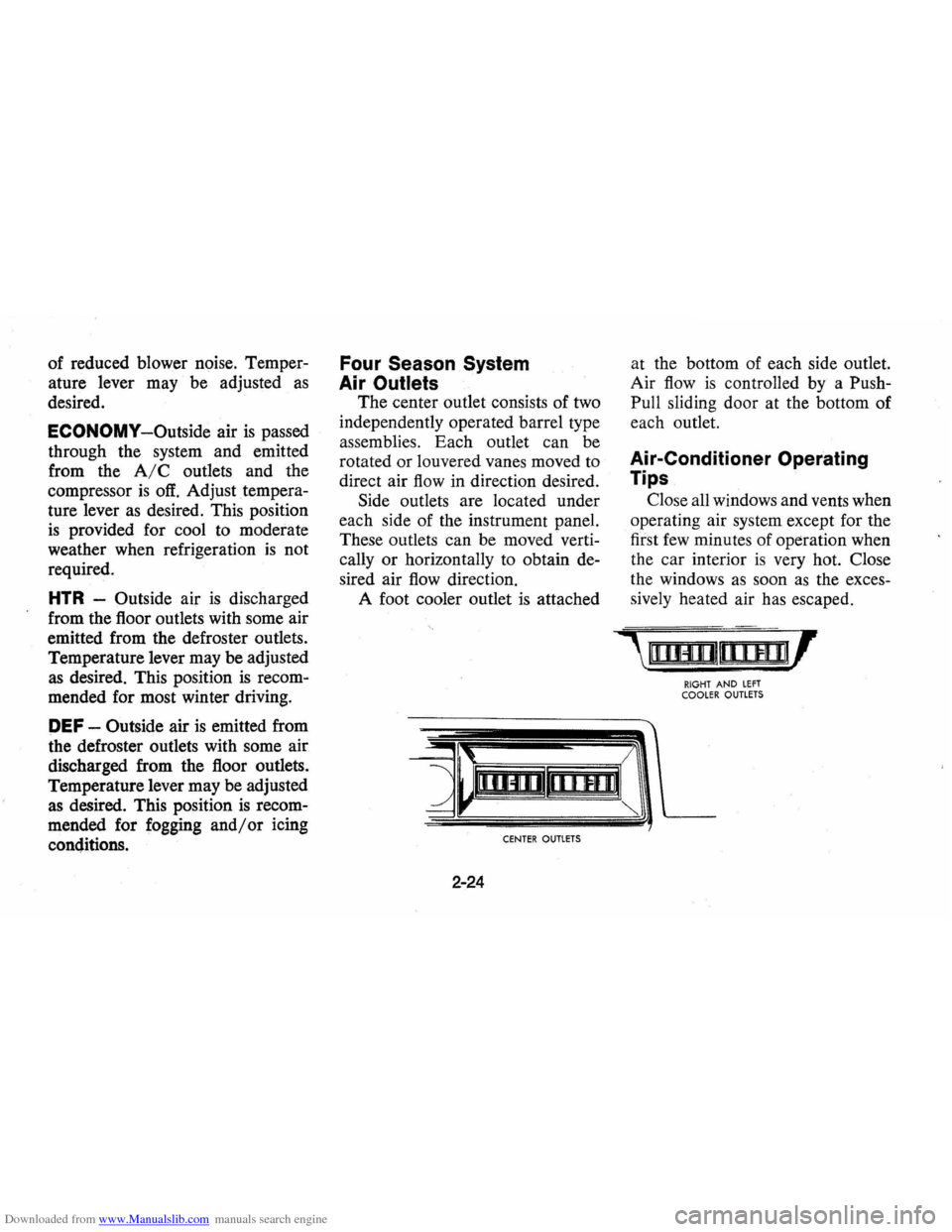
The center outlet consists of two
independently operated barrel type
assemblies. Each outlet can be
rotated or louvered vanes moved to
direct air
flow in direction desired.
Side outlets are located under
each side of the instrument panel.
These outlets can be moved verti
cally or horizontally to obtain de
sired air
flow direction.
A foot cooler outlet
is attached
CENTER OUTLETS
2-24
at the bottom of each side outlet.
Air
flow is controlled by a Push
Pull
sliding door at the bottom of
each outlet.
Air-Conditioner Operating
Tips
Close all windows and vents when
operating air system except for the
first few minutes of operation when
the car interior
is very hot. Close
the windows
as soon as the exces
sively heated air has escaped.
' 11111"111111111 1:1111'
RIGHT AND LEFT COOLER OUTLETS
Page 46 of 87
Downloaded from www.Manualslib.com manuals search engine In Case of Emergency
Four Way Hazard
Warning
Flasher
• Use the warning flasher to warn
other drivers any time your
ve
hicle becomes a traffic hazard,
day or night.
• A void stopping on the roadway
if possible.
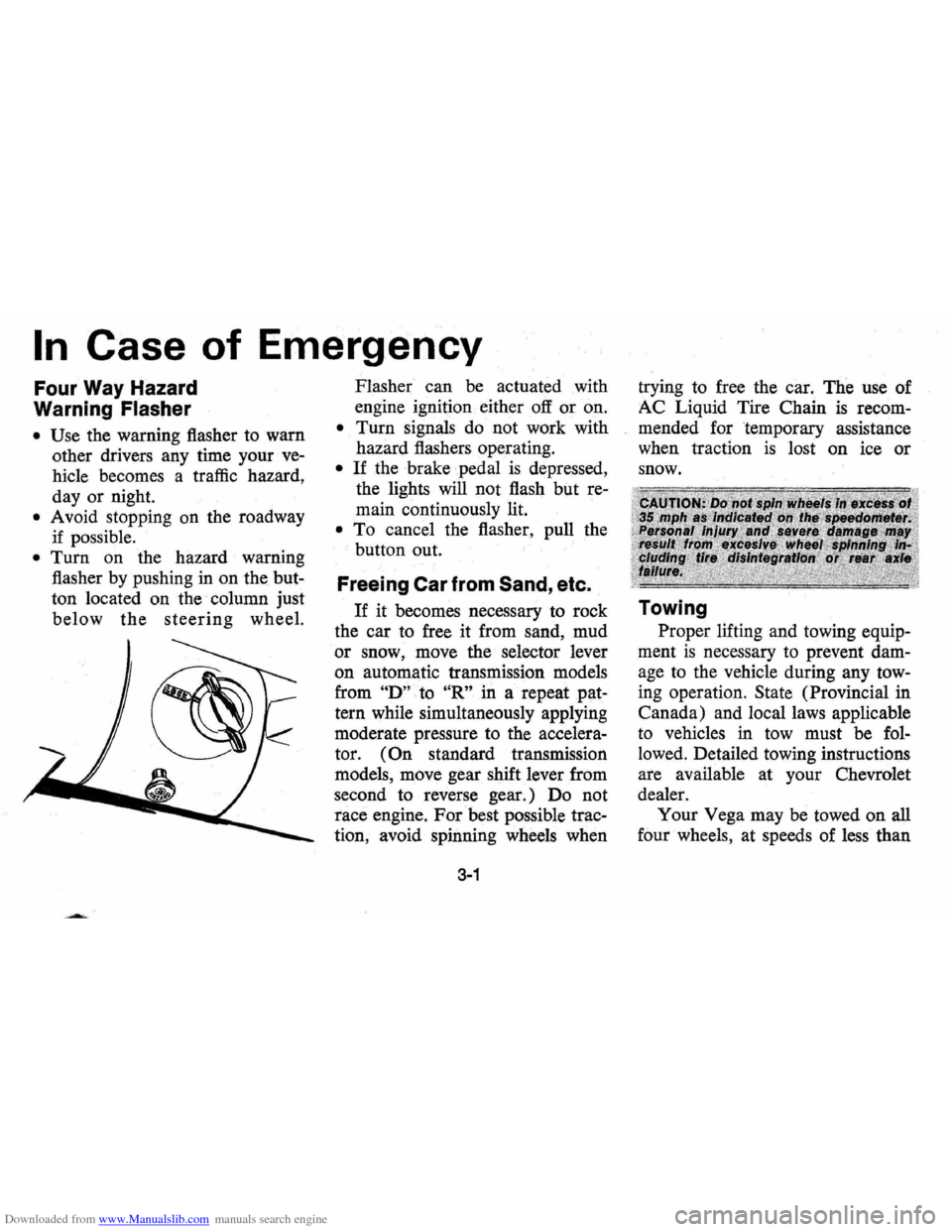
• Turn on the hazard warning
flasher by pushing
in on the but
ton located on the column just
below the steering wheel. Flasher
can
be actuated with
engine ignition either
off or on.
• Turn signals do not work with
hazard flashers operating.
• If the brake pedal is depressed,
the lights will not flash but
re
main continuously lit.
• To cancel the flasher, pull the
button out.
Freeing Car from Sand, etc.
If it becomes necessary to rock
the car to free it from sand, mud
or snow, move the selector lever
on automatic transmission models
from
"D" to "R" in a repeat pat
tern while simultaneously applying
moderate pressure
to the accelera
tor.
(On standard transmission
models, move gear shift lever from
second to reverse gear.) Do not
race engine. For best possible trac
tion, avoid· spinning wheels when
3-1
trying to free the car. The use of
AC Liquid Tire Chain
is recom
mended for temporary assistance
when traction
is lost on ice or
snow.
Towing
Proper lifting and towing equip
ment
is necessary to prevent dam
age to the vehicle during any tow
ing operation. State (Provincial in
Canada) and local laws applicable
to vehicles in tow must be
fol
lowed. Detailed towing instructions
are available at your Chevrolet
dealer. Your Vega may be towed on
all
four wheels, at speeds of less · than
Page 47 of 87
Downloaded from www.Manualslib.com manuals search engine 35 mph, for distances up to 50
miles, provided the driveline, axle,
transmission, and steering system
are otherwise normally operable.
Use only towing equipment specifi
cally designed for
this purpose
following the instructions of the
towing equipment manufacturer.
A separate safety chain system
must
be used for such towing and
steering must be unlocked, trans
mission in neutral and the parking
brake released. Attachments must
be made to main structural mem
bers of the car. Do not attach to
bumpers or associated brackets.
Remember that power brake and
power steering assist will not be
available when engine
is inopera
tive.
Recreational Towing
Vega models with a manual 3-
or 4-speed transmission may be
towed (with propshaft installed) be-hind
another vehicle
as a "dinghy"
at freeway speeds if additional SAE
80
or SAE 90 Gear Lubricant is
added to the transmission. This can
be accomplished · by removing the
filler plug and installing a
900-;.2
inch pipe street elbow fitting and
adding one quart
(2 lbs.) of SAE
80
or 90 Gear Lubricant. Use the
filler plug to cap the elbow fitting.
The additional lubricant will have
no adverse affect to the transmis
sion during normal use of the
ve
hicle and may be left in the trans
mission.
EMERGENCY STARTING
A car with a discharged battery
may
be started by using energy
3-2
from a battery in another car
called "jump starting".
NOTICE: Do not push or tow this
vehicle
to start. Damage to the cata
lytic converter and/or to other parts
of the vehicle may result.
Jump Starting
Jump starting may be dangerous
and should
be attempted only if, the
following three conditions are met.
If they are not,we strongly recom
mend that you leave the starting to
a competent mechanic.
• The battery in the OTHER vehi
cle must
be 12 volt and nega
tively grounded,
like the one in
THIS car. (Check the other car's
owner's manual to
see if it is.)
• The battery in THIS car must be
equipped with flame arrestor
vents (like the original-equip
ment Delco Freedom battery)
Page 51 of 87
Downloaded from www.Manualslib.com manuals search engine APPEARANCE CARE
CARE AND CLEANING OF
INTERIOR TRIM
IMPORTANT: Be sure vehicle is
well ventilated while using any
cleaning agents. Follow manufac
turer's recommendations in using
such products.
With the advent of modern trim
materials composed of synthetic
plastics and/or man made fibers,
it
is EXTREMELY IMPORTANT
that proper cleaning techniques
and cleaners be used when clean
ing interior trim. Failure to
do this
on the first cleaning may result in
water spots, spot rings, setting of
stains or soilage, all of which make
it more difficult or impossible to
remove in a second cleaning.
Certain portions of the following
cleaning instructions are in bold type;
they are particularly impor
tant and
must be performed.
Dust and loose dirt that accu
mulates on interior
fabric trim
should be removed frequently with
a vacuum cleaner, whisk broom or
DESCRIPTION*
G.M. Spot Lifter (8 oz. Solvent Type)
soft brush. Vinyl or leather trim
should
be wiped regularly with a
clean damp cloth. Normal trim
soilage, spots or stains can be
cleaned with the following G.M.
cleaners.
G.M. Multi-Purpose Powdered Cleaner (16 oz. Foam Type)
G.M. PART NO.
1051398
1050803
·T~e a,bove cJeaner~ are EXCELLENT CLEANERS when used properly aooording to
directions on containers, They are available through your Chevrolet Dealer.
4-1
Page 65 of 87
Downloaded from www.Manualslib.com manuals search engine ENGINE COOLING
SYSTEM
The recovery type cooling sys
tem 'is standard on all Chevrolet
passenger cars. The coolant ex
pands with rising temperature and
the overflow
is collected in the
recovery tank. When the system
temperature drops, the coolant
is
drawn back into the radiator. The
cooling system has been filled at
the factory with a high -quality, in
hibited ,
year-around coolant that
meets the standards of General
Motor s Specification 1899-M. This
coolant solution provides freezing
protection to
-20oP (- 28 °C),
and in Canada to -35°P
(-37°C), and it has been formu
lated to be used without replace
ment for two years
or 30,000 miles.
After two years or
30,000 miles,
the coolant should be drained to
prevent rust
or corrosion in the
radiator and engine.
Cooling System Care
Do not remove radiator cap to
check coolant level, but check visu
ally in the
"see thru" coolant re
covery tank at
least as frequently
as needed. Level should be at the
"full cold" mark on the recovery
tank when the system
is cold and
at the
"full hot" mark at normal
operating temperature.
Add a 50/
50
mixture of high-quality ethylene
glycol antifreeze and water for
coolant additions.
If frequent addi
tions are required, see
your' dealer
for a cooling system check.
NOTE: If recommended quality
antifreeze
is used, supplemental in
hibitors or additives claiming to
provide increased capability are not
necessary. They may be detrimen
tal to the efficient operation of the
system, and represent an unneces
sary operating expense.
5-7
The cooling system should be
serviced every year as follows:
1. Wash radiator cap and filler neck
with clean water.
2. Check coolant for proper level
and freeze protection.
3 . Test system and radiator cap for
proper pressure holding capacity
(15 psi). If required, use cap
designed by
AC for coolant re
covery systems, and specified for
your model.
4. Tighten hose clamps and inspect
all hoses. Replace hoses if swol
len, checked or otherwise deteri
orated.
5 . Clean frontal area of radiator
core and air conditioning con
denser.
Page 73 of 87
Downloaded from www.Manualslib.com manuals search engine comfort, the reduced tire pressures
listed on the placard may
be used
when reduced loads of 5 occupants
or less are carried. Improper tire
inflation pressures can adversely
affect tire life and vehicle perform
ance. Too
Iowan air pressure results
in increased tire flexing and heat
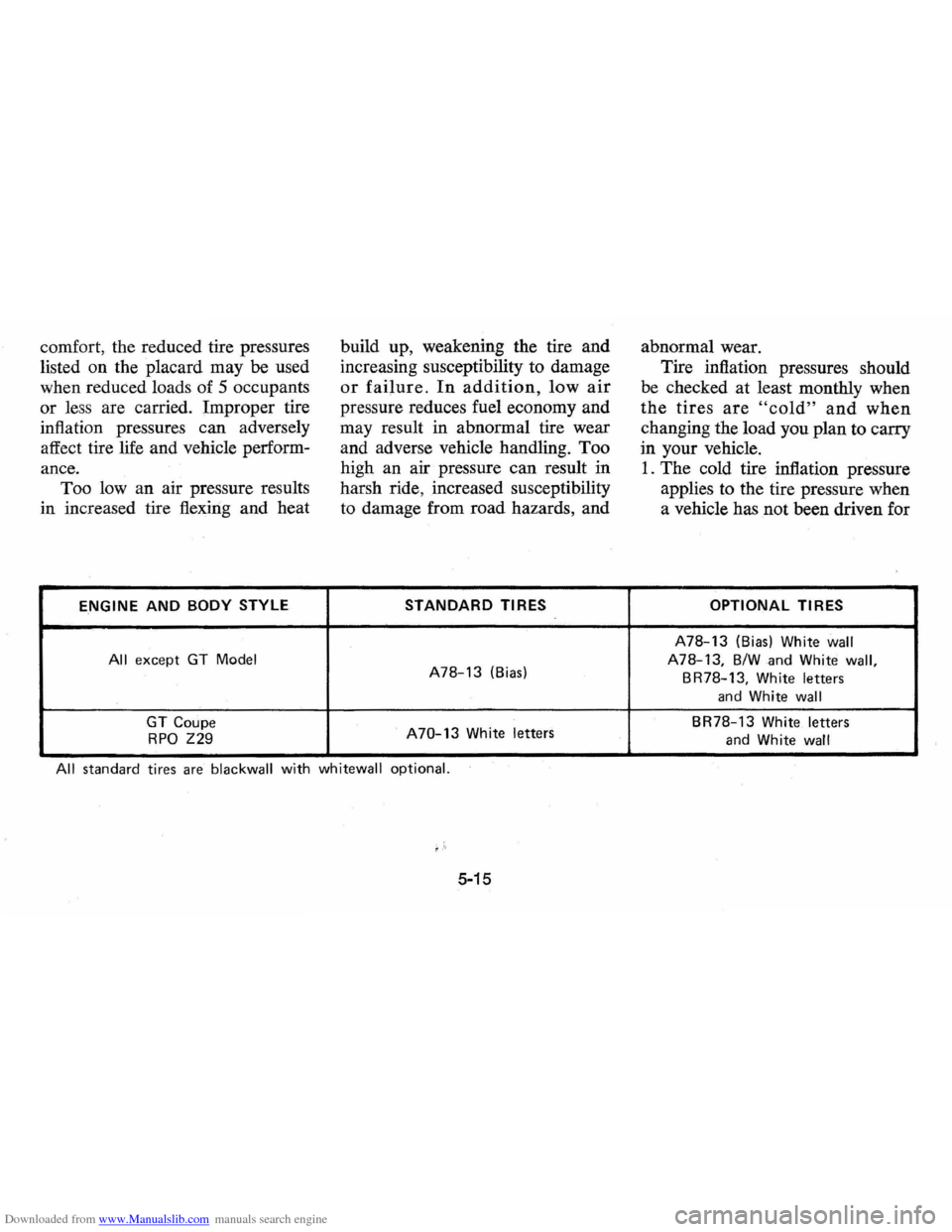
ENGINE AND BODY STYLE
All except GT Model
GT Coupe
RPO Z29
build up, weakening the tire and
increasing susceptibility to damage
or failure. In addition, low air
pressure reduces fuel economy and
may result in abnormal tire wear
and adverse vehicle handling. Too
high an air pressure can result in
harsh ride, increased susceptibility
to damage from road hazards, and
STANDARD TIRES
A78-13 (Bias)
A70-13 White letters
All standard tires are blackwall with whitewall optional.
f'"
5-15
abnormal wear.
Tire inflation pressures should
be checked at least monthly when
the tires are "cold" and when
changing the load you plan to carry
in your vehicle.
1. The cold tire inflation pressure
applies to the tire pressure when
a vehicle has not been driven for
OPTIONAL TIRES
A78-13 (Bias) White wall
A78-13, B/W and White wall,
BR78-13, White letters
and White wall
BR78-13 White letters
and White wall