lock CHEVROLET VENTURE 1998 Owners Manual
[x] Cancel search | Manufacturer: CHEVROLET, Model Year: 1998, Model line: VENTURE, Model: CHEVROLET VENTURE 1998Pages: 474, PDF Size: 25.26 MB
Page 321 of 474
If a Tire Goes Flat
It’s unusual for a tire to “blow out” while you’re driving,
especially if you maintain your tires properly. If
air goes
out of a tire, it’s much more likely to leak out slowly.
But
if you should ever have a “blowout,” here are a few
tips about what to expect and what to do:
If a front tire fails, the flat tire
will create a drag that
pulls the vehicle toward that side. Take your foot
off the
accelerator pedal and grip the steering wheel fiiy.
Steer to maintain lane position, and then gently brake to
a stop well out of the
traffic lane.
A rear blowout, particularly on a curve, acts much like a
skid and may require the same correction you’d use in a
skid. In any rear blowout, remove your foot from the
accelerator pedal. Get the vehicle under control by
steering the way you want the vehicle to go. It may be
very bumpy and noisy, but you can still steer. Gently
brake to a stop
-- well off the road if possible.
If a tire goes flat, the next part shows how to use your
jacking equipment to change a flat tire safely.
Air Inflator (Option)
Your vehicle may have an air inflator used to bring tires
up to the proper pressure. See “Accessory Inflator
System” in the Index for more details.
Changing a Flat Tire
If a tire goes flat, avoid further tire and wheel damage
by driving slowly to a level place. Turn on your hazard
warning flashers.
- 1
’ A CAUTION:
--
Changing a tire can cause an injury. The vehicle
can slip
off the jack and roll over you or other
people. You and they could be badly injured.
Find
a level place to change your tire. To help
prevent the vehicle from moving:
1. Set the parking brake firmly.
2. Put the shift lever in PARK (P).
3. I’urn off the engine.
To be even more certain the vehicle won’t move,
you can put blocks
at the front and rear of the
tire farthest
away from the one being changed.
That would be the tire on the other side of the
vehicle, at the opposite end.
i-24
ProCarManuals.com
Page 341 of 474
Gasoline vapor is highly flammable. It burns
violently, and that can cause very bad injuries.
Don’t smoke if you’re near gasoline or refueling
your vehicle. Keep sparks, flames and smoking
materials away from gasoline.
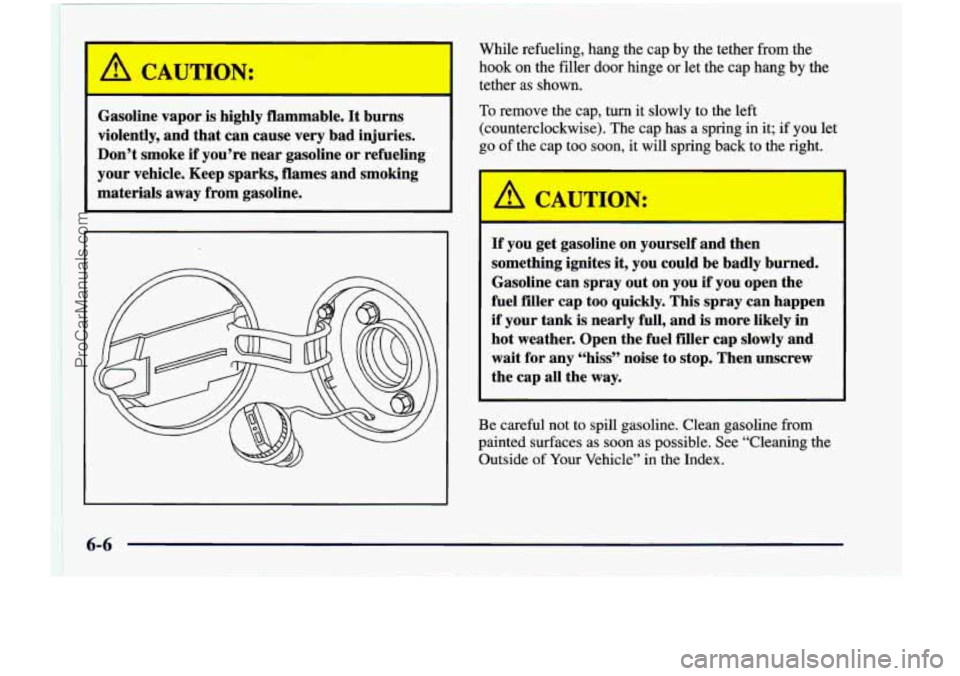
While refueling, hang the cap by the tether from the
hook
on the filler door hinge or let the cap hang by the
tether as shown.
To remove the cap, turn it slowly to the left
(counterclockwise). The cap has a spring in it; if
you let
go of the cap too sc I, it will spring back to the right.
If you get gasoline on yourself and then
something ignites
it, you could be badly burned.
Gasoline can spray out on you
if‘ you open the
fuel filler cap too quickly. This spray can happen
if your tank is nearly full, and is more likely in
hot weather. Open the fuel filler cap slowly and
wait for any “hiss” noise to stop. Then unscrew
the cap all the way.
Be careful not to spill gasoline. Clean gasoline from
painted surfaces as soon as possible. See “Cleaning
the
Outside of Your Vehicle” in the Index.
I ,
6-6
ProCarManuals.com
Page 342 of 474
When you put the cap back on, turn it to the right
(clockwise) until you hear a clicking sound. Make
sure you fully install the cap. The diagnostic system
can determine if the fuel cap has been left
off or
improperly installed. This would allow fuel to
evaporate into the atmosphere. See “Malfunction
Indicator Lamp’’
* L the Index.
Fillinq a Portable Fuel Container
-.
NOTICE:
If you need a new cap, be sure to get the right
type. Your dealer can get one for you.
If you get
the wrong type, it
may not fit properly. This may
cause your malfunction indicator lamp to light
and your fuel tank and emissions system may be
damaged. See “Malfunction Indicator Lamp” in
the Index.
I
Never fill a portable fuel container while it is in
your vehicle. Static electricity discharge from the
container can ignite the gasoline vapor. You can
be badly burned and your vehicle damaged if this
occurs.
To help avoid injury to you and others:
Dispense gasoline only into approved
containers.
Do not fill a container while it is inside a
vehicle, in a vehicle’s trunk, pickup bed or
on any surface other than the ground.
inside of the fill opening before operating
the nozzle. Contact should be maintained
until the filling is complete.
Bring the fill nozzle in contact with the
Don’t smoke while pumping gasoline.
6-7
ProCarManuals.com
Page 393 of 474
Fuses and Circuit Breakers
The wiring circuits in your vehicle are protected from
short circuits by a combination of fuses, circuit breakers
and fusible thermal links.
Look at the silver-colored band inside the fuse. If
the
band is broken or melted, replace the fuse. Be sure you
replace a bad fuse with a new one of the identical size
and rating.
If you ever have a problem on the road and don’t have
a spare fuse, you can borrow one that has the same
amperage or use one of the spare fuses in the underhood
fuse and relay center. Just pick some feature of your
vehicle that you can get along without
-- like the radio
or cigarette lighter -- and use its fuse, if it is the right
amperage. Replace it as
soon as you can.
There are two fuse blocks in your vehicle: the
instrument panel fuse block and the underhood fuse
and relay center.
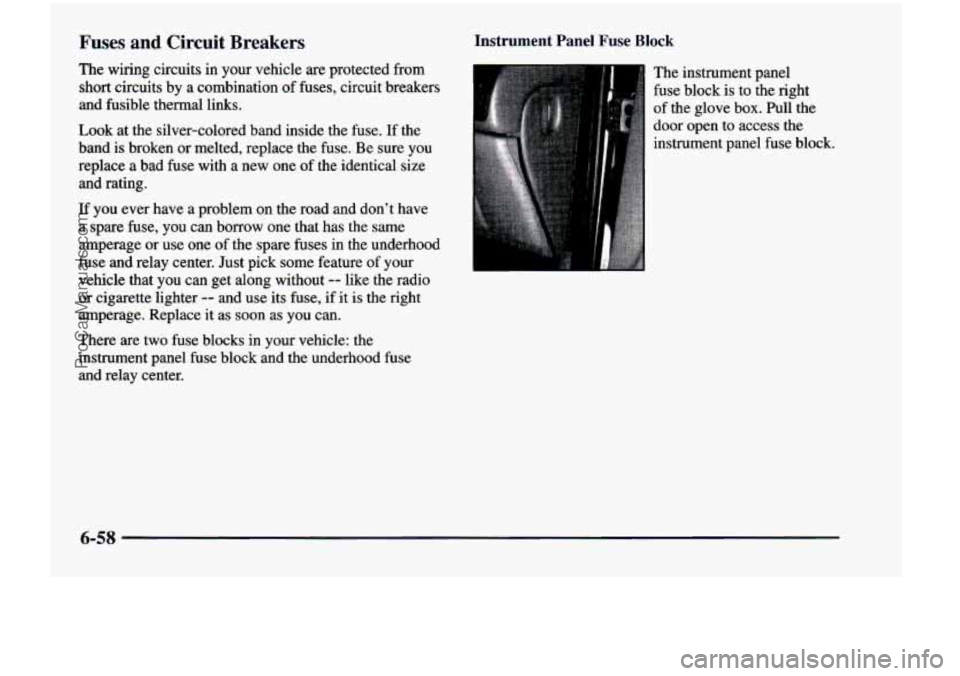
Instrument Panel Fuse Block
The instrument panel
fuse block is to the right
of the glove box. Pull the
door open to access the
instrument panel fuse block.
6-58
ProCarManuals.com
Page 394 of 474
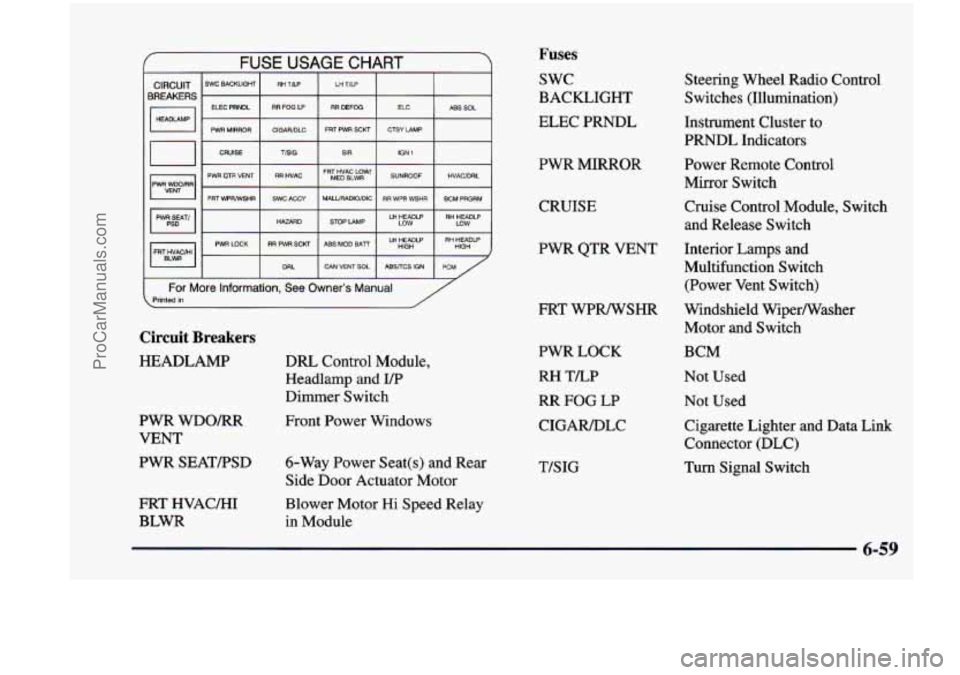
CIRCUIT BREAKERS
FUSE USAGE CHART
SWC BACKLIGHT RH TLP LH TILP
ELEC PRNDL RR
FOG LP RR DEFOG ELC ABS SOL
PWR
MIRROR ClGARiDLC FRT PWR SCU CTSY LAMP
CRUISE TBIG
SIR IGN 1
PWR am VENT RR HVAC MED BLWR SUNROOF HVACIDRL FRT HVAC Low’
FRT WRNSHR SWC ACCY MALURADIO/DIC RR WPR WSHR BCM PRGRM I I I I
HAZARD LAMP LH HEADLP RH HEADLP
LOW LOW
I I I I I
I- I DRL 1 CAN VENTSOL I ABSflCS IGN I PCM /
For More Information, See Owner’s Manual Printed in /
Circuit Breakers
HEADLAMP
PWR
WDOm
VENT
PWR SEATPSD
FRT HVAC/HI
BLWR DRL
Control Module,
Headlamp and
UP
Dimmer Switch
Front Power Windows
6-Way Power Seat(s) and Rear
Side Door Actuator Motor
Blower Motor
Hi Speed Relay
in Module
Fuses
swc
BACKLIGHT
ELEC PRNDL
PWR MIRROR
CRUISE Steering Wheel
Radio Control
Switches (Illumination)
Instrument Cluster to
PRNDL Indicators
Power Remote Control
Mirror Switch
Cruise Control Module, Switch
and Release Switch
PWR QTR VENT Interior Lamps and
Multifunction Switch
(Power Vent Switch)
Motor
and Switch
FRT
WPWSHR Windshield Wiperwasher
PWR LOCK
RH TLP
RR FOG LP
CIGAR/DLC
T/SIG BCM
Not Used
Not Used
Cigarette Lighter and Data Link
Connector
(DLC)
Turn Signal Switch
ProCarManuals.com
Page 397 of 474
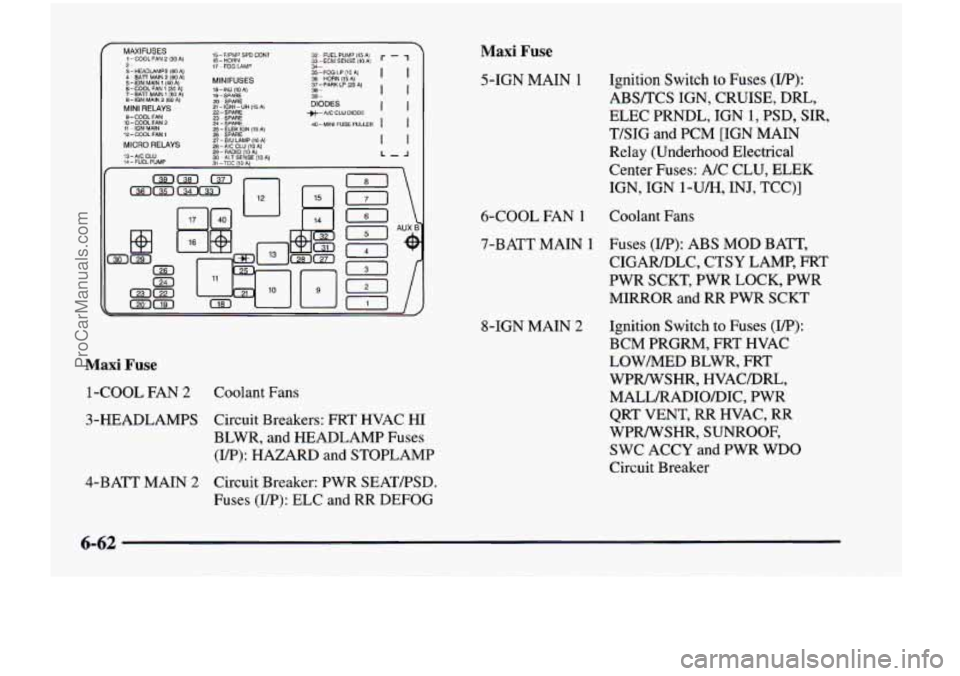
Maxi Fuse
5-IGN MAIN 1 Ignition Switch to Fuses (VP):
ABS/TCS IGN, CRUISE, DRL,
ELEC PRNDL, IGN
1, PSD, SIR,
T/SIG and PCM [IGN MAIN
Relay (Underhood Electrical
Center Fuses:
A/C CLU, ELEK
IGN, IGN
l-U/H, INJ, TCC)]
8-IGN MAIN
2
Maxi Fuse
1-COOL FAN 2 Coolant Fans
3-HEADLAMPS Circuit Breakers: FRT HVAC
HI
BLWR, and HEADLAMP Fuses
(UP): HAZARD and STOPLAMP
4-BATT MAIN
2 Circuit Breaker: PWR SEATPSD.
Fuses
(VP): ELC and RR DEFOG 6-COOL
FAN
1 Coolant Fans
7-BATT MAIN
1 Fuses (UP): ABS MOD BATT,
CIGARDLC, CTSY LAMP, FRT
PWR SCKT, PWR LOCK, PWR MIRROR and RR PWR SCKT
Ignition Switch to Fuses
(VP):
BCM PRGRM, FRT HVAC
LOWMED BLWR, FRT
WPWSHR, HVACDRL,
MALL/RADIO/DIC, PWR QRT
VENT, RR HVAC, RR
WPWSHR, SUNROOF,
SWC ACCY and PWR WDO
Circuit Breaker
6-62
ProCarManuals.com
Page 398 of 474
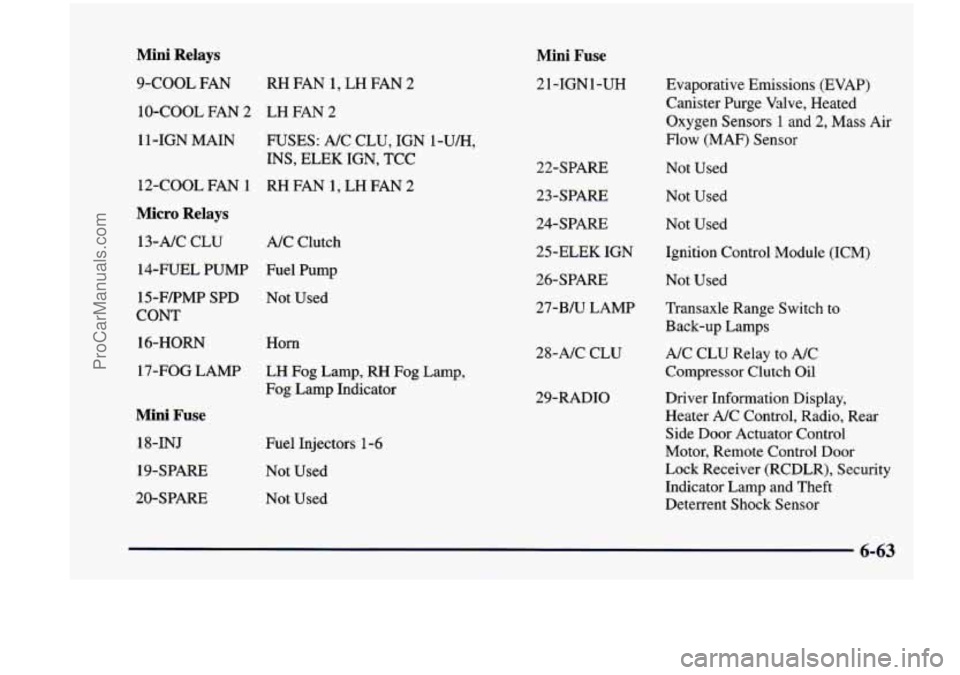
Mini Relays
9-COOL FAN RH FAN 1, LH FAN 2
10-COOL FAN 2 LH FAN 2
1 1 -1GN MAIN
FUSES: A/C CLU, IGN l-U/H,
INS, ELEK IGN, TCC
12-COOL FAN
1 RH FAN 1, LH FAN 2
Micro Relays
13-AIC CLU
A/C Clutch
14-FUEL PUMP Fuel Pump
15-FFMP SPD Not Used
cow
16-HORN
17-FOG LAMP
Mini Fuse
18-INJ
19-SPARE
20-SPARE Horn
LH Fog
Lamp, RH Fog Lamp,
Fog Lamp Indicator
Fuel Injectors 1-6
Not Used
Not Used
Mini Fuse
21-IGN1-UH
22-SPARE
23-SPARE
24-SPARE
25-ELEK IGN
26-SPARE
27-Bh-J LAMP
28-NC CLU
29-RADIO Evaporative
Emissions (EVAP)
Canister Purge Valve, Heated
Oxygen Sensors
1 and 2, Mass Air
Flow (MAF) Sensor
Not Used
Not Used
Not Used
Ignition Control Module (ICM)
Not Used
Transaxle Range Switch to
Back-up Lamps
A/C CLU Relay to A/C
Compressor Clutch Oil
Driver Information Display,
Heater A/C Control, Radio, Rear
Side Door Actuator Control
Motor, Remote Control Door
Lock Receiver (RCDLR), Security
Indicator Lamp and Theft
Deterrent Shock Sensor
6-63
ProCarManuals.com
Page 433 of 474
At Least Twice a Year
Restraint System Check
Make sure the safety belt reminder light and all your
belts, buckles, latch plates, retractors and anchorages are
working properly. If your vehicle has a built-in child
restraint, also periodically make sure the harness straps,
latch plates, buckle, clip, child head restraint and
anchorages are working properly.
Look for any other
loose or damaged safety belt and built-in child restraint
system
parts. If you see anything that might keep a
safety belt or built-in child restraint system from doing
its job, have it repaired. Have any torn or frayed safety
belts or harness straps replaced.
Also look for
any opened or broken air bag coverings,
and have them repaired or replaced. (The air bag system
does not need regular maintenance.)
Wiper Blade Check
Inspect wiper blades for wear or cracking. Replace blade
inserts that appear worn or damaged or that streak or
miss areas of the windshield. Also see “Wiper Blades,
Cleaning”
in the Index.
Automatic Transaxle Check
Check the transaxle fluid level; add if needed. See
“Automatic Transaxle” in the Index. A fluid loss may
indicate
a problem. Check the system and repair if needed.
At Least Once a Year
Key Lock Cylinders Service
Lubricate the key lock cylinders with the lubricant
specified in
Part D.
Body Lubrication Service
Lubricate all body door hinges, including the liftgate.
Also lubricate all hinges and latches, including those for
the hood, power sliding door cable, rear compartment,
glove box door and any folding seat hardware.
Part D
tells you what to use. More frequent lubrication may be
required when exposed to a corrosive environment.
7-30
ProCarManuals.com
Page 434 of 474
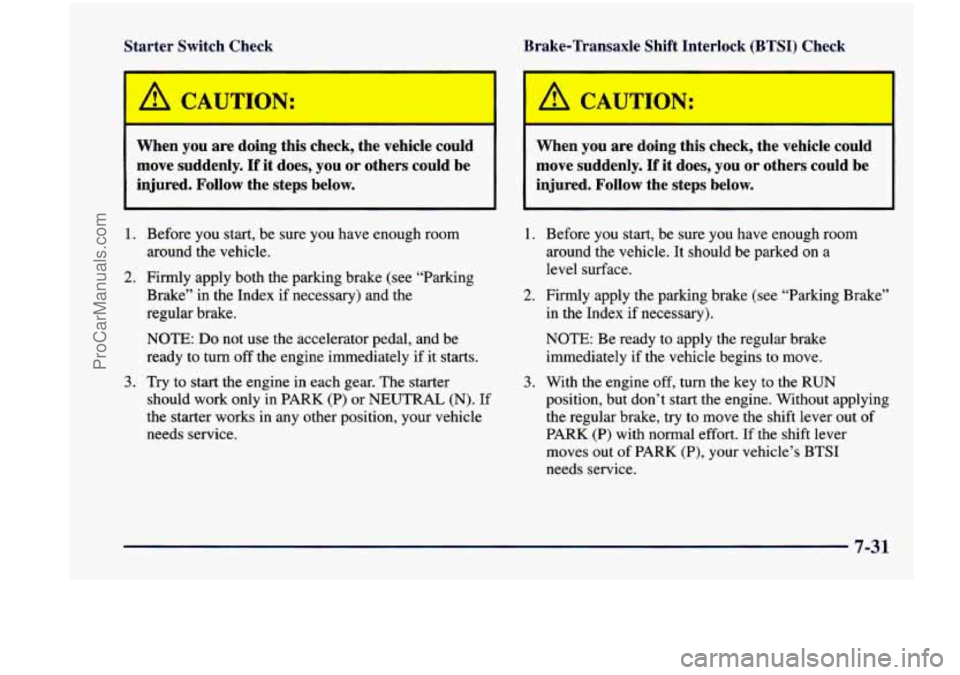
Starter Switch Check
1 A CAUTION:
When you are doing this check, the vehicle could
move suddenly.
If it does, you or others could be
injured. Follow the steps below.
1. Before you start, be sure you have enough room
2. Firmly apply both the parking brake (see “Parking
around the vehicle.
Brake”
in the Index if necessary) and the
regular brake.
NOTE:
Do not use me accelerator pedal, and be
ready to turn
off the engine immediately if it starts.
should work only in PARK (P) or NEUTRAL (N). If
the starter works in any other position, your vehicle
needs service.
3. Try to start the engine in each gear. The starter
1.
2.
3.
Brake-Transaxle Shift Interlock (BTT”’1 Check
A CAUTION:
When you are doing this check, the vehicle could
move suddenly.
If it does, you or others could be
injured. Follow the steps below.
Before you start, be sure you have enough room
around the vehicle. It should be parked on a
level surface.
Firmly apply the parking brake (see “Parking Brake”
in the Index
if necessary).
NOTE: Be ready
to apply the regular brake
immediately if
the vehicle begins to move.
With the engine off, turn the key
to the RUN
position, but don’t start the engine. Without applying
the regular brake,
try to move the shift lever out of
PARK
(P) with normal effort. If the shift lever
moves out of PARK
(P), your vehicle’s BTSI
needs service.
7-31
ProCarManuals.com
Page 435 of 474
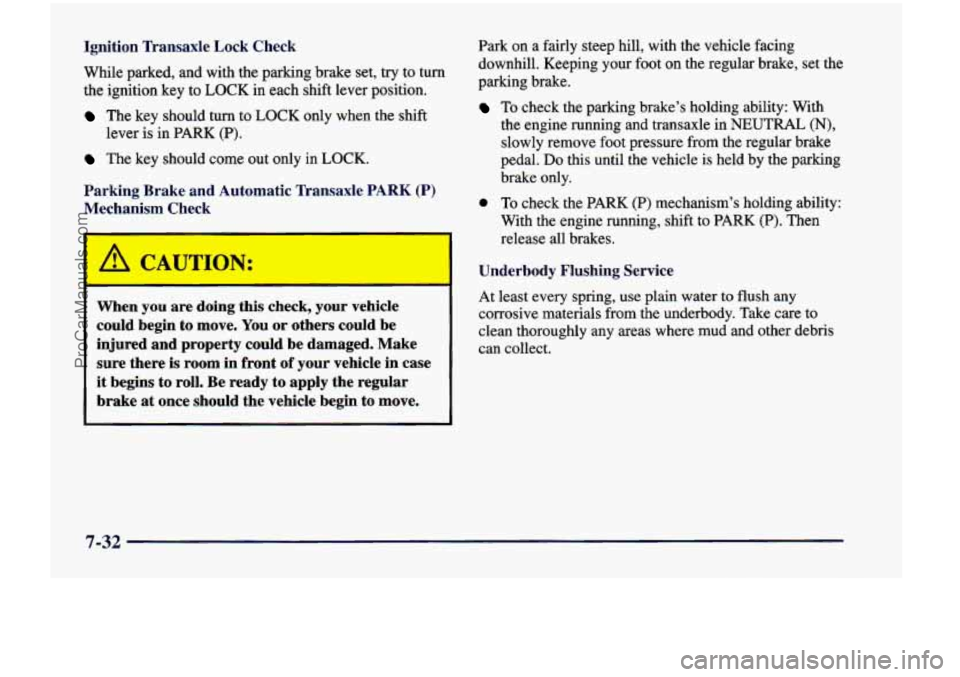
Ignition Transaxle Lock Check
While parked, and with the parking brake set, try to turn
the ignition key to
LOCK in each shift lever position.
The key should turn to LOCK only when the shift
The key should come out only in LOCK.
Parking Brake and Automatic Transaxle PARK (P)
Me -:-anism Check
lever is in PARK (P).
A CAUTION:
When you are doing this check, your vehicle
could begin
to move. You or others could be
injured and property could be damaged. Make
sure there
is room in front of your vehicle in case
it begins to roll. Be ready to apply the regular
brake at once should the vehicle begin
to move.
Park on a fairly steep hill, with the vehicle facing
downhill. Keeping your foot on the regular brake,
set the
parking brake.
To check the parking brake’s holding ability: With
the engine running and transaxle in
NEUTRAL (N),
slowly remove foot pressure from the regular brake
pedal.
Do this until the vehicle is held by the parking
brake only.
0 To check the PARK (P) mechanism’s holding ability:
With the engine running, shift to PARK (P). Then release all brakes.
Underbody Flushing Service
At least every spring, use plain water to flush any
corrosive materials
from the underbody. Take care to
clean thoroughly any areas where mud and other debris
can collect.
7-32
ProCarManuals.com