belt CHEVROLET VENTURE 1998 Service Manual
[x] Cancel search | Manufacturer: CHEVROLET, Model Year: 1998, Model line: VENTURE, Model: CHEVROLET VENTURE 1998Pages: 474, PDF Size: 25.26 MB
Page 85 of 474
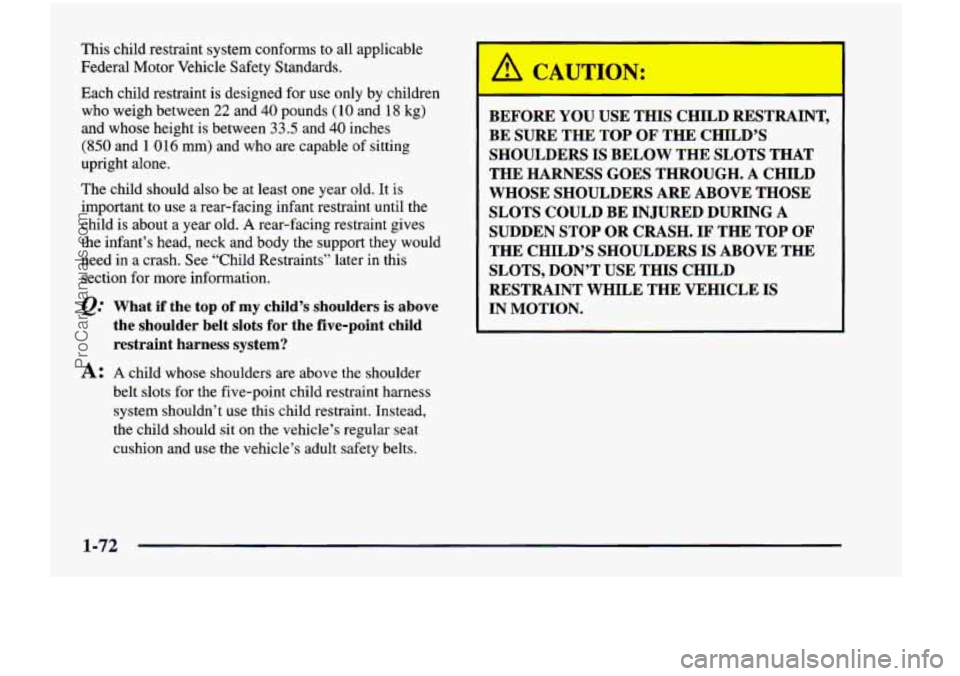
This child restraint system conforms to all applicable
Federal Motor Vehicle Safety Standards.
Each child restraint is designed for
use only by children
who weigh between
22 and 40 pounds (10 and 18 kg)
and whose height is between
33.5 and 40 inches
(850 and 1 016 mm) and who are capable of sitting
upright alone.
The child should also be at least one year old. It is
important
to use a rear-facing infant restraint until the
child
is about a year old. A rear-facing restraint gives
the infant’s head, neck and body the support they would
need in a crash. See “Child Restraints” later in this
section
for more information.
e.’ What if the top of my child’s shoulders is above
the shoulder belt slots for the five-point child
restraint harness system?
A: A child whose shoulders are above the shoulder
belt slots for the five-point child restraint harness
system shouldn’t use this child restraint. Instead,
the child should sit on the vehicle’s regular seat
cushion and use the vehicle’s adult safety belts. BEFORE
YOU USE THIS CHILD RESTRAINT,
BE SURE THE TOP
OF THE CHILD’S
SHOULDERS IS BELOW THE SLOTS THAT
THE HARNESS GOES THROUGH.
A CHILD
WHOSE SHOULDERS ARE ABOVE
THOSE
SLOTS COULD BE INJURED DURING A
SUDDEN STOP OR CRASH. IF THE TOP OF
THE CHILD’S SHOULDERS IS ABOVE THE
SLOTS, DON’T
USE THIS CHILD
RESTRAINT WHILE THE VEHICLE IS
IN MOTION.
1-72
-
ProCarManuals.com
Page 87 of 474
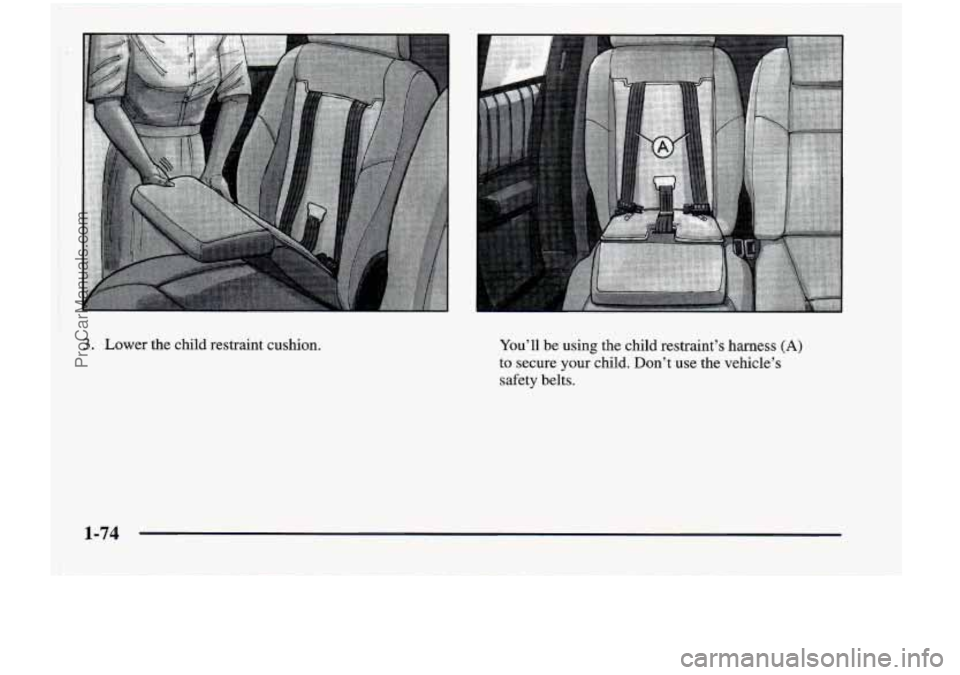
3. Lower the child restraint cushion. You’ll be using the child restraint’s harness (A)
to secure your child. Don’t use the vehicle’s
safety belts.
ProCarManuals.com
Page 88 of 474
A CAUTION:
Using the vehicle’s regular safety belts on a child
seated
on the child restraint cushion can cause
serious injury to the child in a sudden stop or
crash.
If a child is the proper size for the built-in
child restraint, secure the child using the child
restraint’s harness. But children who are too
~ large for the built-in child restraint should sit on
the vehicle’s regular seat and use the vehicle’s
adult safety belts.
WARNING! FAILURE TO FOLLOW THE
MANUFACTURER’S INSTRUCTIONS ON
THE
USE OF THIS CHILD RESTRAINT SYSTEM
CAN RESULT IN YOUR CHILD STRIKING THE
VEHICLE’S INTERIOR DURING A SUDDEN
STOP OR CRASH. SNUGLY ADJUST THE
BELTS PROVIDED WITH THIS CHILD
RESTRAINT AROUND YOUR CHILD.
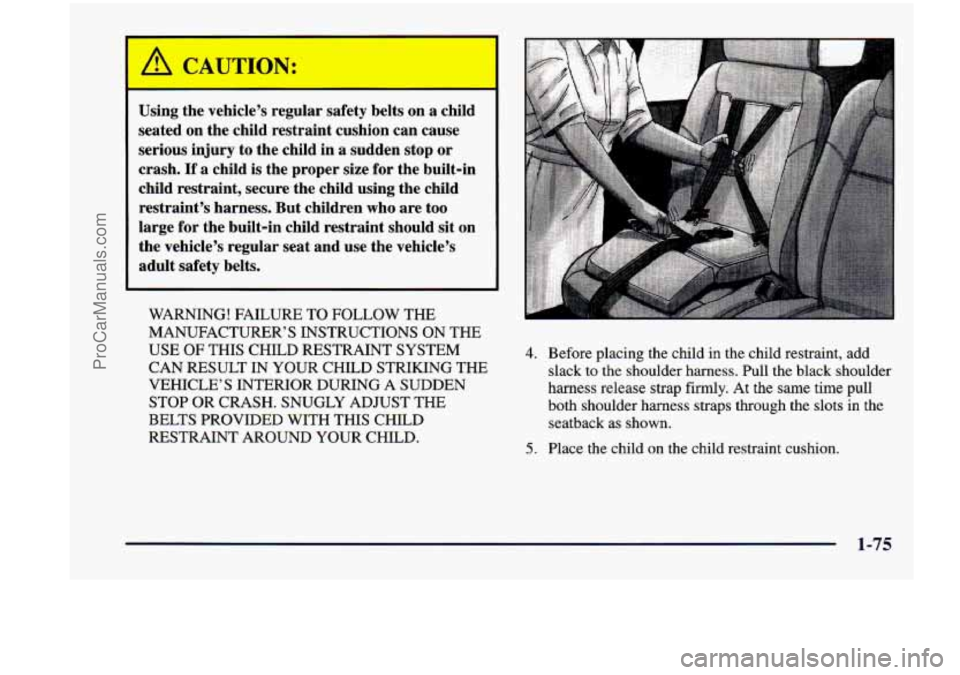
4. Before placing the child in the child restraint, add slack to the shoulder harness. Pull the black shoulder
harness release strap firmly.
At the same time pull
both shoulder harness straps through the slots in the seatback as shown.
5. Place the child on the child restraint cushion.
1-75
ProCarManuals.com
Page 93 of 474

I
2.
3.
4.
5.
Unlatch the harness by pushing the button on
the buckle.
Move one side of the harness
off the child’s shoulder.
Move the other side of the harness
off the
child’s shoulder.
Remove the child from the child restraint cushion.
Storing the Built-In Child Restraint
Always properly store the built-in child restraint before
using the vehicle’s lap-shoulder belt.
1. Move both latch plates and both sides of the shoulder
harness clip to the bottom of the harness straps.
1-80
ProCarManuals.com
Page 99 of 474
When choosing a child restraint, be sure the child
restraint is designed to be used in
a vehicle. If it is, it
will have a label saying that it meets Federal Motor
Vehicle Safety Standards.
Then follow the instructions for the restraint.
You may
find these instructions on the restraint itself or in a
booklet,
or both. These restraints use the belt system in
your vehicle, but
the child also has to be secured within
the restraint to help reduce the chance of personal injury.
The instructions that come with the infant or child
restraint will show you how to do that. Both the owner's
manual and the child restraint instructions are important,
so if either one of these is not available, obtain a
replacement copy from the manufacturer.
Where to Put the Restraint (Except Cargo Vans)
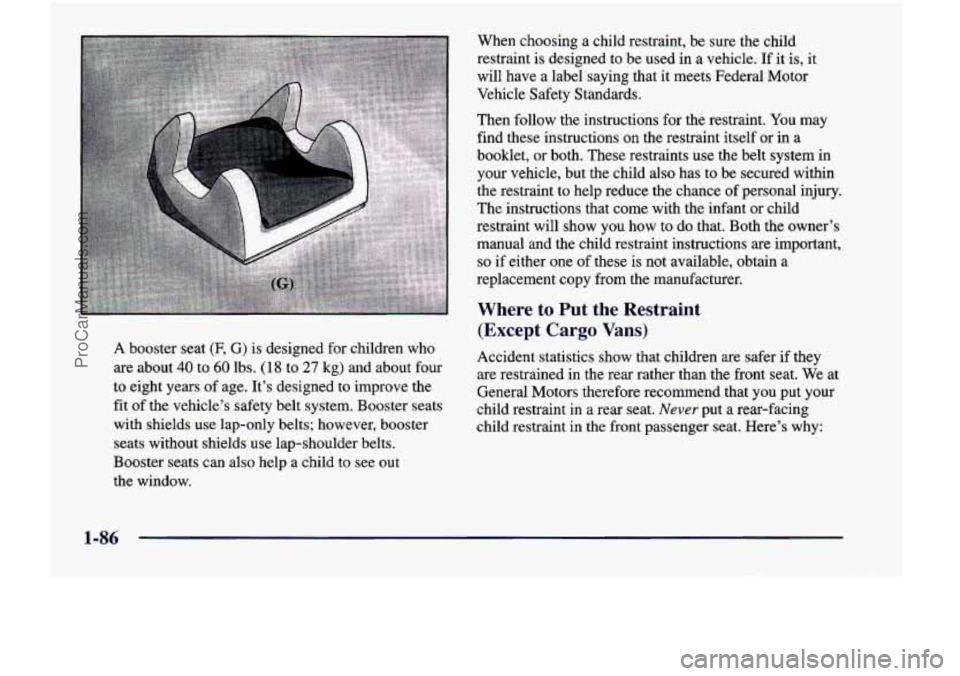
A booster seat (F, G, is designed for who Accident statistics show that children me safer if they
are about 40 to 6o lbs* (18 to 27 kg) and about four are restrained in the rear rather than the front seat. We at
to eight years of age. It's designed to improve the
General Motors therefore recommend that you put your
with shields use lap-only belts; however, booster child restraint
in the front passenger seat. Here's why:
seats without shields use lap-shoulder belts.
Booster seats
can also help a child to see out
the window.
fit
Of the
vehicle's safety belt system. Booster seats child restraint in a rear seat. Never put a rear-facing
1-86
ProCarManuals.com
Page 101 of 474
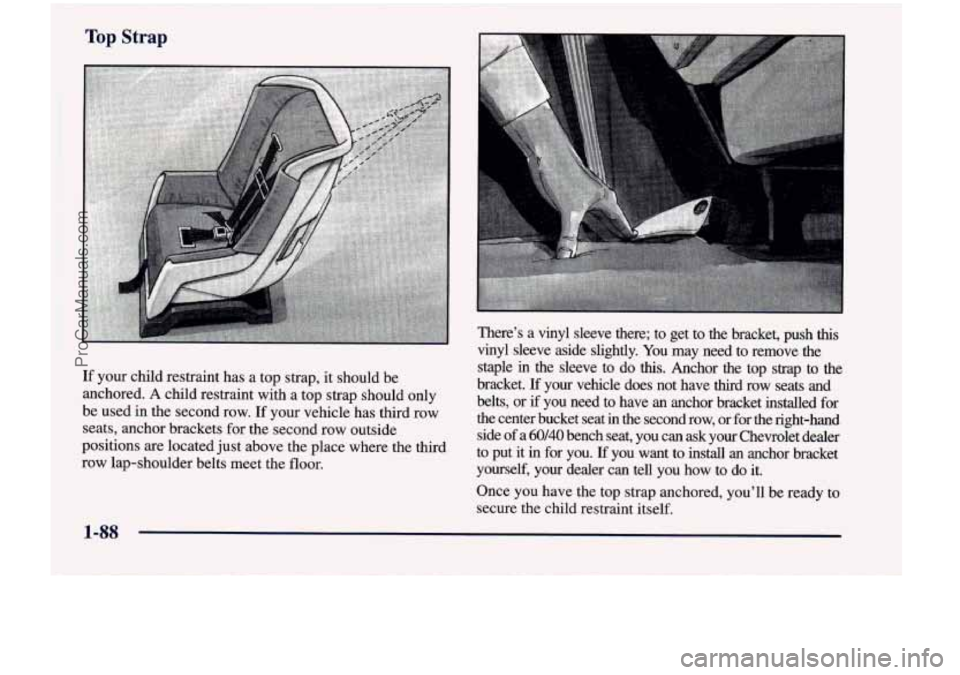
Top Strap
There's a vinyl sleeve there; to get to the bracket, push this
vinyl sleeve aside slightly. You may need to remove the
staple
in the sleeve to do this. Anchor the top strap to the
bracket.
If your vehicle does not have third row seats and
If your child restraint has a top strap,
it should be
anchored. A child restraint with a top should only belts, or if you need to have an anchor bracket installed for
be used in the second row. If your vehicle has third row the center bucket seat in the second row, or for the right-ha\
nd
seats, anchor brackets for the second row outside
side
of a 60140 bench seat, you can ask your Chevrolet dealer
positions are located just above the place where the third
to put it in for you. you want to install an anchor bracket
row lap-shoulder belts meet the floor.
yourself, your dealer can tell you how to do it.
Once you have the top strap anchored, you'll be ready to
secure the child restraint itself.
ProCarManuals.com
Page 102 of 474
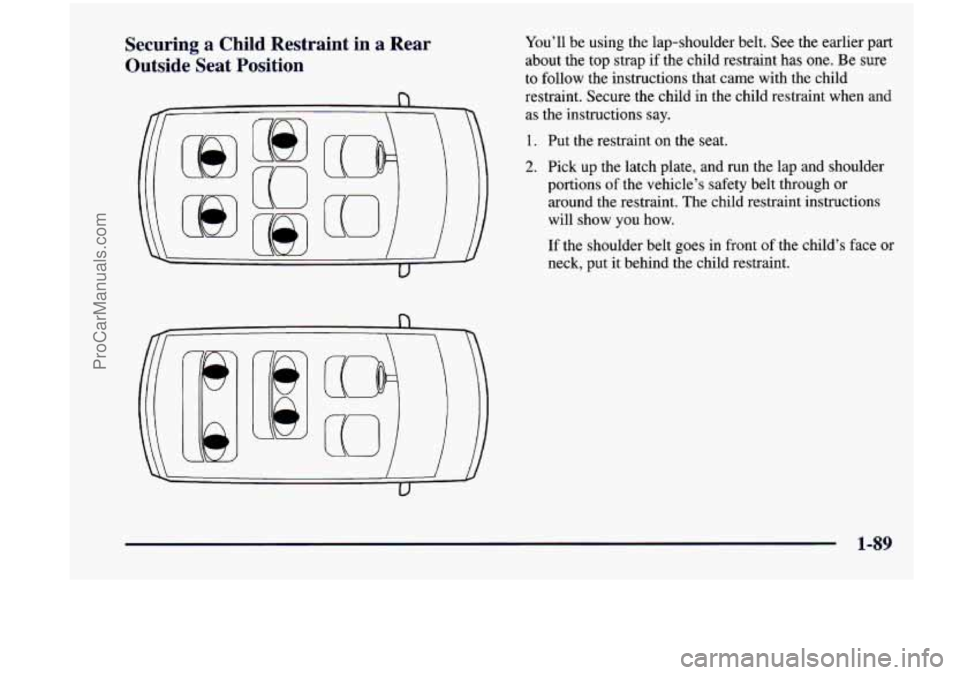
Securing a Child Restraint in a Rear
Outside Seat Position You’ll be using the lap-shoulder belt. See the earlier part
about the top strap if the child restraint has one. Be sure
to follow the instructions that came with the child
restraint. Secure the child in the child restraint when and
as the instructions say.
1. Put the restraint on the seat.
2. Pick up the latch plate, and run the lap and shoulder
portions
of the vehicle’s safety belt through or
around the restraint. The child restraint instructions
will show you how.
If the shoulder belt goes in front of the child’s face or
neck, put
it behind the child restraint.
1-89
ProCarManuals.com
Page 103 of 474
I
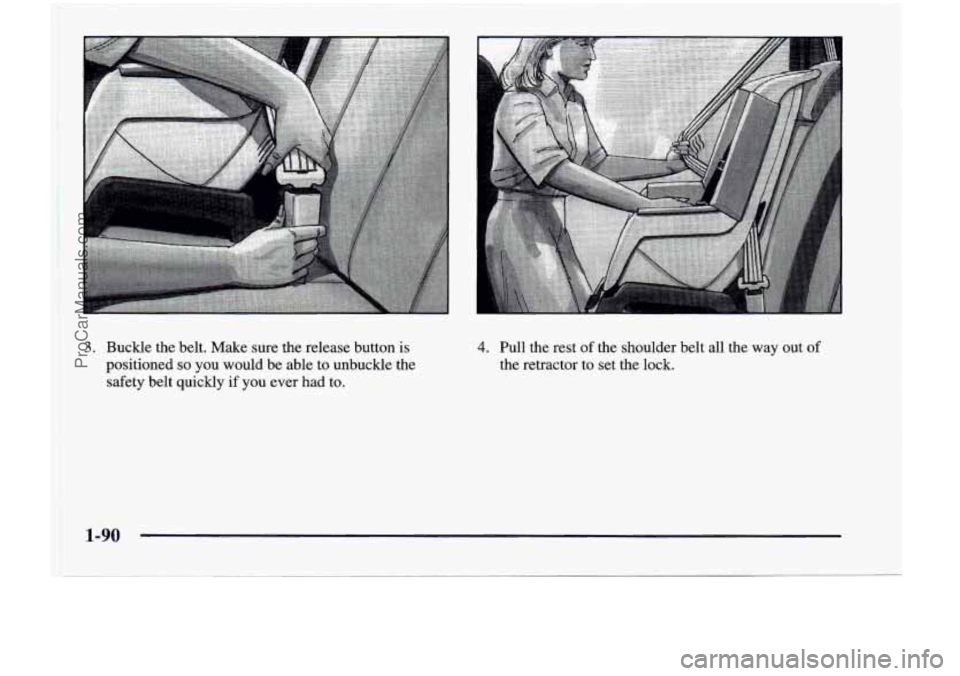
3. Buckle the belt. Make sure the release button is
positioned
so you would be able to unbuckle the
safety belt quickly
if you ever had to.
4. Pull the rest of the shoulder belt all the way out of
the retractor to set the lock.
1-90
ProCarManuals.com
Page 104 of 474
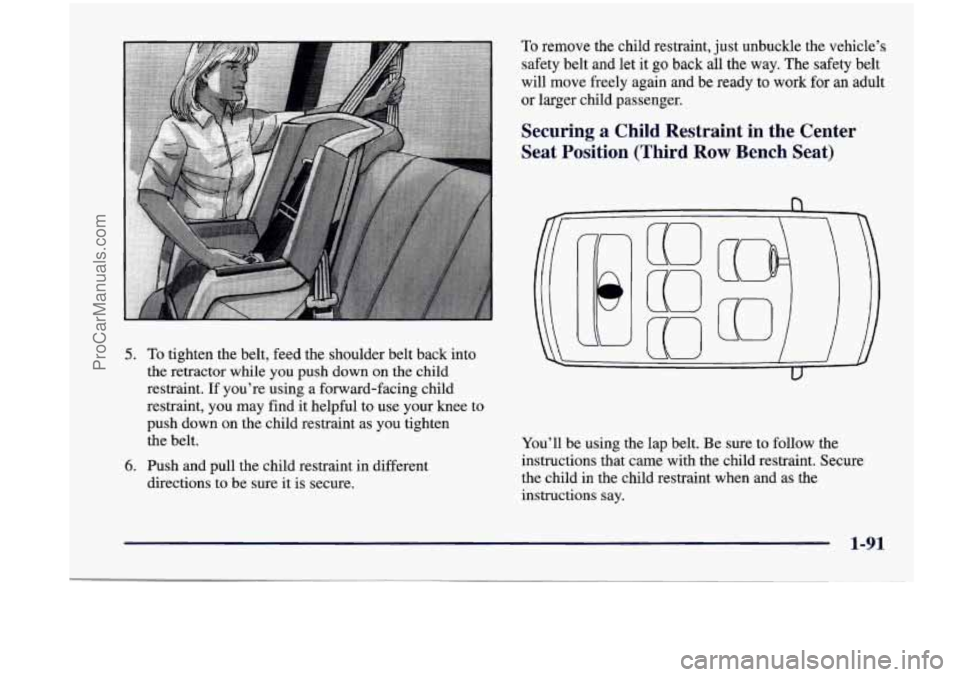
5.
6.
To tighten the belt, feed the shoulder belt back into
the retractor while you push down on the child
restraint. If you’re using a forward-facing child
restraint, you may find it helpful to use your knee to
push down on the child restraint as you tighten
the belt.
Push
and pull the child restraint in different
directions to be sure it is secure. To
remove the child restraint, just unbuckle the vehicle’s
safety belt and let
it go back all the way. The safety belt
will move freely again
and be ready to work for an adult
or larger child passenger.
Securing a Child Restraint in the Center Seat Position (Third
Row Bench Seat)
n
You’ll be using the lap belt. Be sure to follow the
instructions that came with the child restraint. Secure
the child in the child restraint when and as the
instructions say.
1-91
ProCarManuals.com
Page 105 of 474
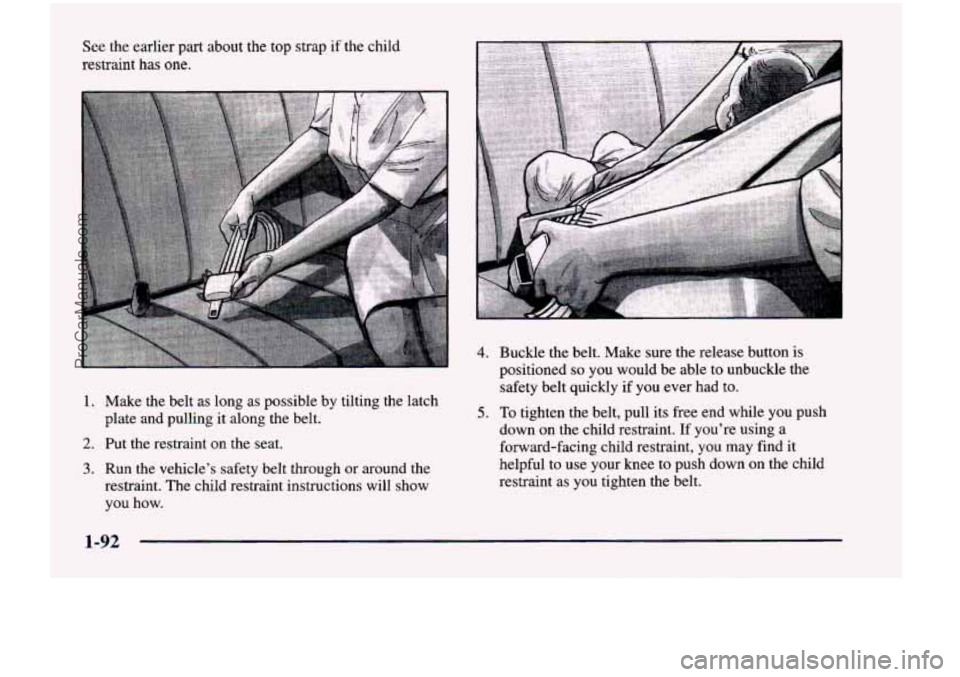
See the earlier part about the top strap if the child
restraint has
one.
1. Make the belt as long as possible by tilting the latch
2. Put the restraint on the seat.
3. Run the vehicle's safety belt through or around the
restraint. The child restraint instructions will show
you how.
plate and pulling
it along the belt.
4.
5.
Buckle the belt. Make sure the release button
is
positioned
so you would be able to unbuckle the
safety belt quickly
if you ever had to.
To tighten the belt, pull its free end while you push
down on the child restraint. If you're using a
forward-facing child restraint,
you may find it
helpful to use your knee to push
down on the child
restraint as you tighten the belt.
1-92
ProCarManuals.com