cruise control CHEVROLET VENTURE 2003 1.G Owners Manual
[x] Cancel search | Manufacturer: CHEVROLET, Model Year: 2003, Model line: VENTURE, Model: CHEVROLET VENTURE 2003 1.GPages: 486, PDF Size: 3.3 MB
Page 187 of 486
Horn
You can sound the horn by pressing the horn symbols
on your steering wheel.
Tilt Wheel
A tilt wheel allows you to adjust the steering wheel
before you drive. You can raise it to the highest level to
give your legs more room when you exit and enter
the vehicle.
The lever that allows you to tilt the steering wheel is
located on the left side of the steering column.
To tilt the wheel, hold
the steering wheel and pull
the lever.
Then move the steering wheel to a comfortable position
and release the lever to lock the wheel in place.
Turn Signal/Multifunction Lever
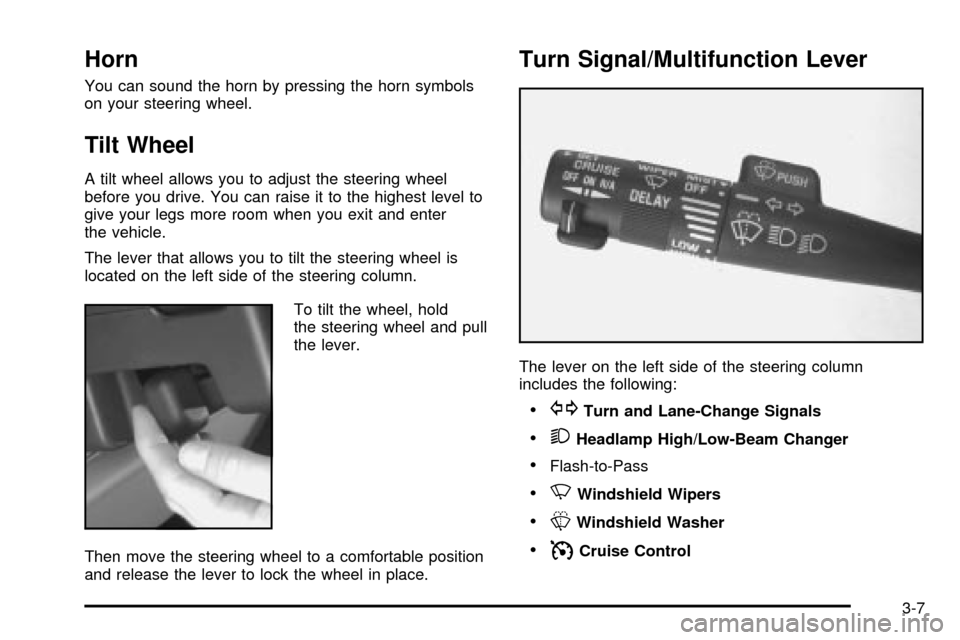
The lever on the left side of the steering column
includes the following:
·GTurn and Lane-Change Signals
·2Headlamp High/Low-Beam Changer
·Flash-to-Pass
·NWindshield Wipers
·LWindshield Washer
·ICruise Control
3-7
Page 191 of 486
To wash the rear window when the rear wiper is already
on, press the top of the switch with the wash symbol
on it. Press in the bottom of the switch to continue the
intermittent wiper cycle after the washing cycle is
completed.
Cruise Control
Your vehicle may have cruise control. With cruise
control, you can maintain a speed of about 25 mph
(40 km/h) or more without keeping your foot on
the accelerator. This can really help on long trips.
Cruise control does not work at speeds below about
25 mph (40 km/h).
When you apply your brakes, the cruise control
disengages.
{CAUTION:
·Cruise control can be dangerous where
you can not drive safely at a steady speed.
So, do not use your cruise control on
winding roads or in heavy traffic.
·Cruise control can be dangerous on
slippery roads. On such roads, fast
changes in tire traction can cause
needless wheel spinning, and you could
lose control. Do not use cruise control on
slippery roads.
If your vehicle is in cruise control when the optional
traction control system begins to limit wheel spin, the
cruise control will automatically disengage. See
Traction
Control System (TCS) on page 4-8. When road
conditions allow you to safely use it again, you may turn
the cruise control back on.
3-11
Page 192 of 486
Setting Cruise Control
{CAUTION:
If you leave your cruise control on when you
are not using cruise, you might hit a button
and go into cruise when you do not want to.
You could be startled and even lose control.
Keep the cruise control switch off until you
want to use cruise control.
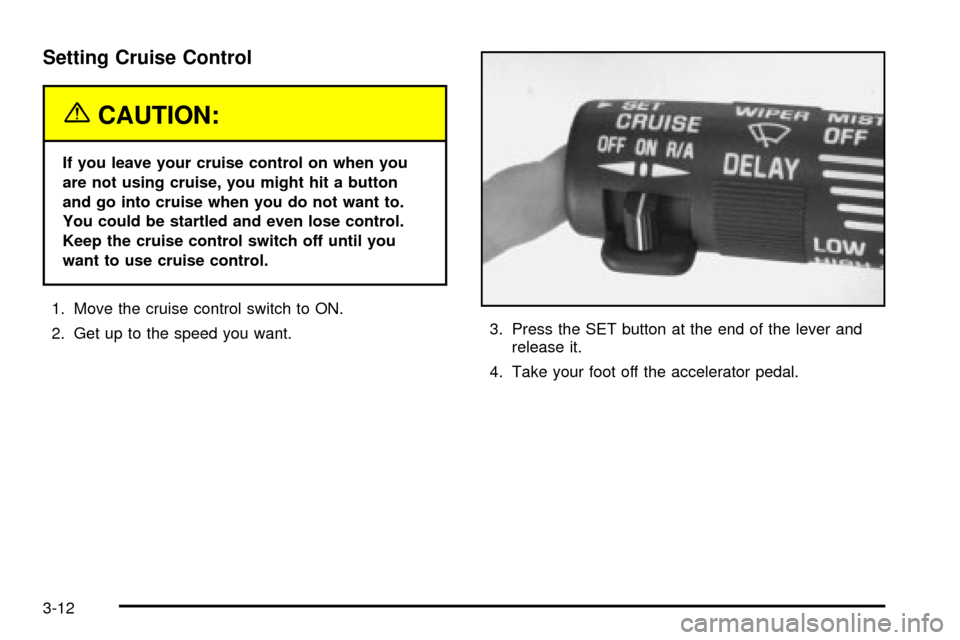
1. Move the cruise control switch to ON.
2. Get up to the speed you want.3. Press the SET button at the end of the lever and
release it.
4. Take your foot off the accelerator pedal.
3-12
Page 193 of 486

Resuming a Set Speed
Suppose you set your cruise control at a desired speed
and then you apply the brake. This, of course, shuts
off the cruise control. But you don't need to reset
it. Once you're going about 25 mph (40 km/h) or more,
you can move the cruise control switch from ON to
R/A (resume/accelerate) brie¯y.
You'll go right back up to your chosen speed and
stay there.
If you hold the switch at R/A, the vehicle will keep going
faster until you release the switch or apply the brake.
So unless you want to go faster, don't hold the switch
at R/A.
Increasing Speed While Using Cruise
Control
There are two ways to go to a higher speed:
·Use the accelerator pedal to get to the higher
speed. Press the SET button at the end of the lever,
then release the button and the accelerator pedal.
You'll now cruise at the higher speed.
·Move the cruise switch from ON to R/A. Hold it
there until you get up to the speed you want,
and then release the switch. (To increase your
speed in very small amounts, move the switch to
R/A brie¯y and then release it. Each time you
do this, your vehicle will go about 1 mph (1.6 km/h)
faster.)
The accelerate feature will work whether or not you
have set an initial cruise control speed.
3-13
Page 194 of 486

Reducing Speed While Using Cruise
Control
There are two ways to reduce speed while using cruise
control:
·Press the SET button at the end of the lever
until you reach the lower speed you want,
then release it.
·To slow down in very small amounts, press the
SET button brie¯y. Each time you do this, you'll
go about 1 mph (1.6 km/h) slower.
Passing Another Vehicle While Using
Cruise Control
Use the accelerator pedal to increase your speed.
When you take your foot off the pedal, your vehicle will
slow down to the cruise control speed you set earlier.
Using Cruise Control on Hills
How well your cruise control will work on hills depends
upon your speed, load and the steepness of the
hills. When going up steep hills, you may have to step
on the accelerator pedal to maintain your speed.
When going downhill, you may have to brake or shift to
a lower gear to keep your speed down. Of course,
applying the brake takes you out of cruise control. Many
drivers ®nd this to be too much trouble and don't use
cruise control on steep hills.
Ending Cruise Control
There are two ways to turn off the cruise control:
·Step lightly on the brake pedal, or
·move the cruise switch to OFF.
Erasing Speed Memory
When you turn off the cruise control or the ignition, your
cruise control set speed memory is erased.
3-14
Page 295 of 486

If your vehicle is in cruise control when the traction
control system begins to limit wheel spin, the cruise
control will automatically disengage. When road
conditions allow you to safely use it again, you may
reengage the cruise control. See ªCruise Controlº under
Turn Signal/Multifunction Lever on page 3-7.
If this message comes on and stays on or comes on
while you are driving, there's a problem with your
traction control system.
See
Service Traction System Warning Message on
page 3-50. When this warning message is on, the TRAC
OFF light will come on to remind you that the system
will not limit wheel spin. Adjust your driving accordingly.
The traction control system automatically comes on
whenever you start your vehicle. To limit wheel
spin, especially in slippery road conditions, you should
always leave the system on. But you can turn the
traction control system off if you ever need to.You should turn the system off if your vehicle ever gets
stuck in sand, mud or snow and rocking the vehicle
is required. See ªRocking Your Vehicleº under
If You Are
Stuck: In Sand, Mud, Ice or Snow on page 4-30.
To turn the system off,
press the TCS button
located on the instrument
panel switchbank.
If the system is limiting wheel spin when you press the
button, the traction active message will go off, but
the system will not turn off until there is no longer a
current need to limit wheel spin. The TRAC OFF light will
come on to remind you the system is off. You can
turn the system back on at any time by pressing the
button again. The traction control system warning
message should go off. United States
Canada
4-9
Page 427 of 486
Instrument Panel Fuse Block
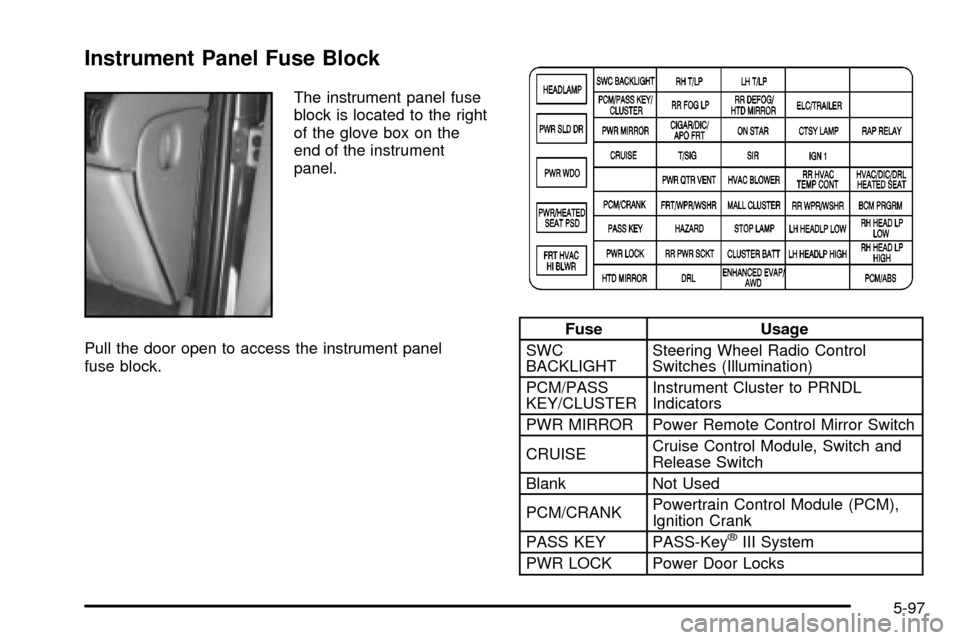
The instrument panel fuse
block is located to the right
of the glove box on the
end of the instrument
panel.
Pull the door open to access the instrument panel
fuse block.
Fuse Usage
SWC
BACKLIGHTSteering Wheel Radio Control
Switches (Illumination)
PCM/PASS
KEY/CLUSTERInstrument Cluster to PRNDL
Indicators
PWR MIRROR Power Remote Control Mirror Switch
CRUISECruise Control Module, Switch and
Release Switch
Blank Not Used
PCM/CRANKPowertrain Control Module (PCM),
Ignition Crank
PASS KEY PASS-Key
žIII System
PWR LOCK Power Door Locks
5-97
Page 431 of 486
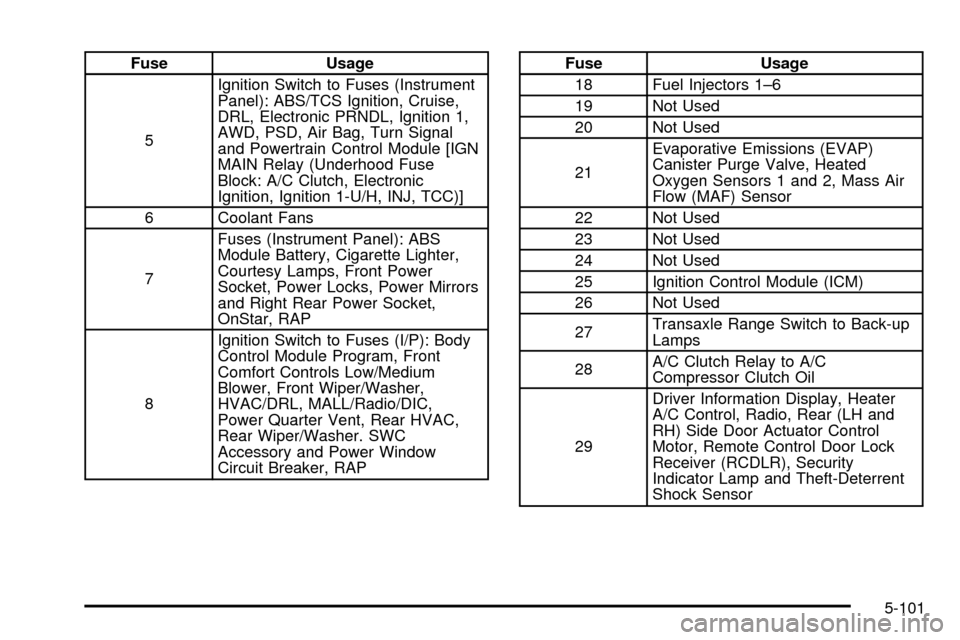
Fuse Usage
5Ignition Switch to Fuses (Instrument
Panel): ABS/TCS Ignition, Cruise,
DRL, Electronic PRNDL, Ignition 1,
AWD, PSD, Air Bag, Turn Signal
and Powertrain Control Module [IGN
MAIN Relay (Underhood Fuse
Block: A/C Clutch, Electronic
Ignition, Ignition 1-U/H, INJ, TCC)]
6 Coolant Fans
7Fuses (Instrument Panel): ABS
Module Battery, Cigarette Lighter,
Courtesy Lamps, Front Power
Socket, Power Locks, Power Mirrors
and Right Rear Power Socket,
OnStar, RAP
8Ignition Switch to Fuses (I/P): Body
Control Module Program, Front
Comfort Controls Low/Medium
Blower, Front Wiper/Washer,
HVAC/DRL, MALL/Radio/DIC,
Power Quarter Vent, Rear HVAC,
Rear Wiper/Washer. SWC
Accessory and Power Window
Circuit Breaker, RAPFuse Usage
18 Fuel Injectors 1±6
19 Not Used
20 Not Used
21Evaporative Emissions (EVAP)
Canister Purge Valve, Heated
Oxygen Sensors 1 and 2, Mass Air
Flow (MAF) Sensor
22 Not Used
23 Not Used
24 Not Used
25 Ignition Control Module (ICM)
26 Not Used
27Transaxle Range Switch to Back-up
Lamps
28A/C Clutch Relay to A/C
Compressor Clutch Oil
29Driver Information Display, Heater
A/C Control, Radio, Rear (LH and
RH) Side Door Actuator Control
Motor, Remote Control Door Lock
Receiver (RCDLR), Security
Indicator Lamp and Theft-Deterrent
Shock Sensor
5-101
Page 450 of 486

Fuel System Inspection
Inspect the complete fuel system for damage or leaks.
Engine Cooling System Inspection
Inspect the hoses and have them replaced if they
are cracked, swollen or deteriorated. Inspect all pipes,
®ttings and clamps; replace as needed. Clean the
outside of the radiator and air conditioning condenser.
To help ensure proper operation, a pressure test of
the cooling system and pressure cap is recommended
at least once a year.
Throttle System Inspection
Inspect the throttle system for interference or binding,
and for damaged or missing parts. Replace parts
as needed. Replace any components that have high
effort or excessive wear. Do not lubricate accelerator
and cruise control cables.
All-Wheel Drive Inspection
Inspect the transfer case (power transfer unit) and
carrier assembly-differential (rear drive module) every
12 months or at engine oil change intervals, check rear
differential and transfer case and add lubricant when
necessary. A ¯uid loss could indicate a problem; check
and have it repaired, if needed. Check vent hoses at
transfer case and differential for kinks and proper
installation.
Brake System Inspection
Inspect the complete system. Inspect brake lines and
hoses for proper hook-up, binding, leaks, cracks,
cha®ng, etc. Inspect disc brake pads for wear and rotors
for surface condition. Also inspect drum brake linings
for wear and cracks. Inspect other brake parts, including
drums, wheel cylinders, calipers, parking brake, etc.
Check parking brake adjustment. You may need to have
your brakes inspected more often if your driving
habits or conditions result in frequent braking.
6-16
Page 472 of 486

Cleaning Glass Surfaces..................................5-89
Cleaning Interior Plastic Components.................5-89
Cleaning Leather............................................5-89
Cleaning the Top of the Instrument Panel...........5-89
Cleaning Tires................................................5-92
Cleaning Vinyl................................................5-89
Cleaning Windshield, Backglass and
Wiper Blades..............................................5-92
Cleaning........................................................5-87
Inside of Your Vehicle..................................5-87
Outside of Your Vehicle................................5-90
Underbody Maintenance...............................5-93
Video Screen............................................3-105
Weatherstrips..............................................5-90
Your DVD Player.......................................3-105
Climate Control System...................................3-25
Air Filter, Passenger Compartment.................3-33
Outlet Adjustment........................................3-28
Rear..................................................3-29, 3-31
Compact Disc Messages.................3-71, 3-81, 3-92
Compact Overhead Console.............................2-52
Compact Spare Tire........................................5-86
Compass Variance..........................................3-59
Content Theft-Deferrent....................................2-27
Content Theft-Deterrent System,
Arming and Disarming..................................2-68
Content Theft-Deterrent System........................2-67Control of a Vehicle.......................................... 4-5
Convenience Center........................................2-58
Convenience Net............................................2-57
Coolant.........................................................3-44
Engine Temperature Gage............................3-44
Engine Temperature Warning Message...........3-51
Heater, Engine............................................2-33
Cooling System..............................................5-29
Cruise Control................................................3-11
Cupholder(s)..................................................2-51
Current and Past Model Order Forms................7-11
Customer Assistance Information........................ 7-7
Courtesy Transportation.................................. 7-7
Customer Assistance for Text Telephone
(TTY) Users.............................................. 7-4
Customer Assistance Offices........................... 7-4
Customer Satisfaction Procedure..................... 7-2
GM Mobility Program for Persons with
Disabilities................................................ 7-5
Reporting Safety Defects to General Motors....7-10
Reporting Safety Defects to the Canadian
Government............................................7-10
Reporting Safety Defects to the United
States Government.................................... 7-9
Roadside Assistance Program......................... 7-6
Service Publications Ordering Information........7-10
4