climate control CHEVROLET VOLT 2011 Owner's Guide
[x] Cancel search | Manufacturer: CHEVROLET, Model Year: 2011, Model line: VOLT, Model: CHEVROLET VOLT 2011Pages: 516, PDF Size: 6.61 MB
Page 305 of 516
Black plate (3,1)Chevrolet Volt Owner Manual - 2011
Driving and Operating 9-3
Drive Mode and PRNDL Selection
Use Normal Mode when possible.
Sport Mode provides more
responsive acceleration than
Normal Mode but can reduce
efficiency.
Use Mountain Mode prior to
climbing long, steep grades in
mountainous areas. Be sure to
engage Mountain Mode before
starting to climb. Mountain Mode
reduces electric range and power
but may be needed to maintain
speeds above 96 km/h (60 mph)
when climbing grades of 5% or
greater.
Use L (Low) in heavy stop‐and‐go
traffic or when traveling downhill.
L (Low) requires less brake
pedal application and provides
a controlled, efficient way to
slow the vehicle down.Climate Setting
Using the heat and air conditioning
systems decreases the energy
available for electric driving.
Optimal energy efficiency is
achieved with the heat, air
conditioning, and fan turned off.
Less energy is used at low fan
speeds. When using the fan:
.Fan Only is the most energy
efficient climate setting as long
as
0is not selected.
.ECO is for moderate air
conditioning and heater
operation and is the next
most energy efficient setting as
long as
0is not selected.
.Comfort provides the most
comfort but is the least energy
efficient.
Use the auto heated seat feature
instead of climate settings. Heating
the seat uses less energy than
heating the vehicle interior. Use remote start to heat or cool the
interior when the vehicle is plugged
in to maximize the electric range by
utilizing electricity from the electrical
outlet.
In hot weather, avoid parking in
direct sunlight or use sunshades
inside the vehicle.
Turn off the front and rear window
defog/defrost when they are no
longer needed.
Avoid driving with the windows open
at highway speeds.
Vehicle Charging/Maintenance
Charging
Keep the vehicle plugged in, even
when fully charged, to keep the
battery temperature ready for the
next drive. This is important when
outside temperatures are extremely
hot or cold.
Page 314 of 516
Black plate (12,1)Chevrolet Volt Owner Manual - 2011
9-12 Driving and Operating
Blizzard Conditions
Being stuck in snow can be
a serious situation. Stay with
the vehicle unless there is help
nearby. If possible, use the
Roadside Assistance Program.
To get help and keep everyone
in the vehicle safe:
.Turn on the hazard warning
flashers.
.Tie a red cloth to an outside
mirror.
{WARNING
Snow can trap engine exhaust
under the vehicle. This may
cause exhaust gases to get
inside. Engine exhaust contains
Carbon Monoxide (CO) which
cannot be seen or smelled. It can
cause unconsciousness and even
death.(Continued)
WARNING (Continued)
If the vehicle is stuck in the snow:
.Clear away snow from
around the base of the
vehicle, especially any that
is blocking the exhaust pipe.
.Check again from time to
time to be sure snow does
not collect there.
.Open a window about 5 cm
(2 in) on the side of the
vehicle that is away from
the wind to bring in fresh air.
.Fully open the air outlets
on or under the instrument
panel.
.Adjust the climate control
system to a setting that
circulates the air inside
the vehicle and set the fan
speed to the highest setting.
See Climate Control Systems
in the Index.(Continued)
WARNING (Continued)
For more information about
carbon monoxide, see Engine
Exhaust on page 9‑30.
To conserve energy, run the
vehicle for only short periods as
needed to warm the vehicle and
then shut the vehicle off and close
the window most of the way to
save heat. Repeat this until help
arrives but only when you feel really
uncomfortable from the cold. Moving
about to keep warm also helps.
If it takes some time for help to
arrive, start the vehicle. The engine
may start to charge the 12‐volt
battery. Turn off unnecessary
accessories to conserve energy.
Page 432 of 516
Black plate (66,1)Chevrolet Volt Owner Manual - 2011
10-66 Vehicle Care
The grades are molded on the
sidewalls of most passenger
car tires. The Uniform Tire
Quality Grading (UTQG)
system does not apply to deep
tread, winter-type snow tires,
space-saver, or temporary use
spare tires, tires with nominal
rim diameters of 10 to 12 inches
(25 to 30 cm), or to some
limited-production tires.
While the tires available on
General Motors passenger
cars and light trucks may vary
with respect to these grades,
they must also conform to
federal safety requirements and
additional General Motors Tire
Performance Criteria (TPC)
standards.
All Passenger Car Tires Must
Conform to Federal Safety
Requirements In Addition
To These Grades.Treadwear
The treadwear grade is a
comparative rating based
on the wear rate of the tire
when tested under controlled
conditions on a specified
government test course.
For example, a tire graded
150 would wear one and a
half (1½) times as well on
the government course as
a tire graded 100. The relative
performance of tires depends
upon the actual conditions of
their use, however, and may
depart significantly from the
norm due to variations in
driving habits, service practices
and differences in road
characteristics and climate.
Traction
–AA, A, B, C
The traction grades, from
highest to lowest, are AA, A, B,
and C. Those grades represent
the tire's ability to stop on
wet pavement as measured
under controlled conditions
on specified government
test surfaces of asphalt and
concrete. A tire marked C may
have poor traction performance.
Warning: The traction grade
assigned to this tire is based
on straight-ahead braking
traction tests, and does not
include acceleration, cornering,
hydroplaning, or peak traction
characteristics.
Page 505 of 516
Black plate (1,1)Chevrolet Volt Owner Manual - 2011
INDEX i-1
A
Accessories andModifications . . . . . . . . . . . . . . . . . 10-4
Accessory Power . . . . . . . . . . . . . . 9-22
Add-On Electrical Equipment . . . . . . . . . . . . . . . . . . . 9-63
Air Cleaner/Filter, Engine . . . . . 10-16
Air Conditioning . . . . . . . . . . . . . . . . 8-1
Air Vents . . . . . . . . . . . . . . . . . . . . . . . 8-9
Airbag Adding Equipment to the
Vehicle . . . . . . . . . . . . . . . . . . . . . . 3-38
Airbag System Check . . . . . . . . . . . . . . . . . . . . . . . . 3-40
How Does an AirbagRestrain? . . . . . . . . . . . . . . . . . . . 3-30
Passenger Sensing System . . . . . . . . . . . . . . . . . . . . . . 3-33
What Makes an Airbag Inflate? . . . . . . . . . . . . . . . . . . . . . . 3-30
What Will You See after an Airbag Inflates? . . . . . . . . . . . . . 3-31
When Should an Airbag Inflate? . . . . . . . . . . . . . . . . . . . . . . 3-28
Where Are the Airbags? . . . . . . 3-27 Airbags
Passenger Status Indicator . . . 5-20
Readiness Light . . . . . . . . . . . . . . 5-19
Servicing Airbag-Equipped
Vehicles . . . . . . . . . . . . . . . . . . . . . 3-38
System Check . . . . . . . . . . . . . . . . 3-25
Alarm System
Anti-theft . . . . . . . . . . . . . . . . . . . . . . 2-13
Alert Pedestrian Friendly . . . . . . . . . . . . 6-2
AM-FM Radio . . . . . . . . . . . . . . . . . . 7-10
Antenna
Multi-band . . . . . . . . . . . . . . . . . . . . 7-18
Anti-theft Alarm System . . . . . . . . . . . . . . . . 2-13
Alarm System Messages . . . . . 5-51
Antilock Brake System (ABS) . . . . . . . . . . . . . . . . 9-33
Warning Light . . . . . . . . . . . . . . . . . 5-26
Appearance Care Exterior . . . . . . . . . . . . . . . . . . . . . 10-89
Interior . . . . . . . . . . . . . . . . . . . . . . 10-93
Assistance Program, Roadside . . . . . . . . . . . . . . . . . . . . . 13-6 Audio Players
CD/DVD . . . . . . . . . . . . . . . . . . . . . . 7-18
MP3 . . . . . . . . . . . . . . . . . . . . . . . . . . 7-23
Audio System Hard Drive Device (HDD) . . . . . 7-26
Radio Reception . . . . . . . . . . . . . . 7-17
Theft-Deterrent Feature . . . . . . . . 7-3
Automatic Climate Control System . . . . . . . . 8-1
Door Locks . . . . . . . . . . . . . . . . . . . 2-11
Auxiliary Devices . . . . . . . . . . . . . . 7-38
B
Battery . . . . . . . . . . . . . . . . . . . . . . . 10-28
Gauge . . . . . . . . . . . . . . . . . . . . . . . . 5-16
High Voltage . . . . . . . . . . . . . . . . . . 5-16
Jump Starting . . . . . . . . . . . . . . . 10-79
Power Protection . . . . . . . . . . . . . . 6-6
Battery and Charging Messages. . . . . . . . . . . . . . . . . . . . 5-45
Blade Replacement, Wiper . . . 10-31
Bluetooth . . . . . . . . . . . . . . . . . . . . . . 7-85
Brake Parking, Electric . . . . . . . . . . . . . . 9-35
Page 506 of 516
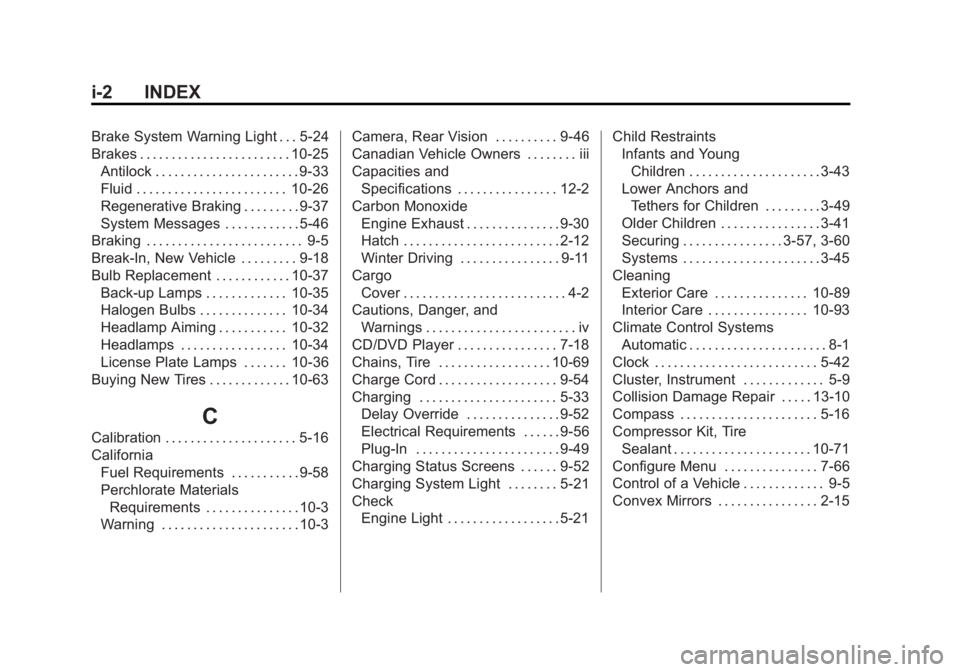
Black plate (2,1)Chevrolet Volt Owner Manual - 2011
i-2 INDEX
Brake System Warning Light . . . 5-24
Brakes . . . . . . . . . . . . . . . . . . . . . . . . 10-25Antilock . . . . . . . . . . . . . . . . . . . . . . . 9-33
Fluid . . . . . . . . . . . . . . . . . . . . . . . . 10-26
Regenerative Braking . . . . . . . . . 9-37
System Messages . . . . . . . . . . . . 5-46
Braking . . . . . . . . . . . . . . . . . . . . . . . . . 9-5
Break-In, New Vehicle . . . . . . . . . 9-18
Bulb Replacement . . . . . . . . . . . . 10-37
Back-up Lamps . . . . . . . . . . . . . 10-35
Halogen Bulbs . . . . . . . . . . . . . . 10-34
Headlamp Aiming . . . . . . . . . . . 10-32
Headlamps . . . . . . . . . . . . . . . . . 10-34
License Plate Lamps . . . . . . . 10-36
Buying New Tires . . . . . . . . . . . . . 10-63
C
Calibration . . . . . . . . . . . . . . . . . . . . . 5-16
California Fuel Requirements . . . . . . . . . . . 9-58
Perchlorate MaterialsRequirements . . . . . . . . . . . . . . . 10-3
Warning . . . . . . . . . . . . . . . . . . . . . . 10-3 Camera, Rear Vision . . . . . . . . . . 9-46
Canadian Vehicle Owners . . . . . . . . iii
Capacities and
Specifications . . . . . . . . . . . . . . . . 12-2
Carbon Monoxide Engine Exhaust . . . . . . . . . . . . . . . 9-30
Hatch . . . . . . . . . . . . . . . . . . . . . . . . . 2-12
Winter Driving . . . . . . . . . . . . . . . . 9-11
Cargo Cover . . . . . . . . . . . . . . . . . . . . . . . . . . 4-2
Cautions, Danger, and
Warnings . . . . . . . . . . . . . . . . . . . . . . . . iv
CD/DVD Player . . . . . . . . . . . . . . . . 7-18
Chains, Tire . . . . . . . . . . . . . . . . . . 10-69
Charge Cord . . . . . . . . . . . . . . . . . . . 9-54
Charging . . . . . . . . . . . . . . . . . . . . . . 5-33 Delay Override . . . . . . . . . . . . . . . 9-52
Electrical Requirements . . . . . . 9-56
Plug-In . . . . . . . . . . . . . . . . . . . . . . . 9-49
Charging Status Screens . . . . . . 9-52
Charging System Light . . . . . . . . 5-21
Check Engine Light . . . . . . . . . . . . . . . . . . 5-21 Child Restraints
Infants and Young
Children . . . . . . . . . . . . . . . . . . . . . 3-43
Lower Anchors and Tethers for Children . . . . . . . . . 3-49
Older Children . . . . . . . . . . . . . . . . 3-41
Securing . . . . . . . . . . . . . . . . 3-57, 3-60
Systems . . . . . . . . . . . . . . . . . . . . . . 3-45
Cleaning Exterior Care . . . . . . . . . . . . . . . 10-89
Interior Care . . . . . . . . . . . . . . . . 10-93
Climate Control Systems Automatic . . . . . . . . . . . . . . . . . . . . . . 8-1
Clock . . . . . . . . . . . . . . . . . . . . . . . . . . 5-42
Cluster, Instrument . . . . . . . . . . . . . 5-9
Collision Damage Repair . . . . . 13-10
Compass . . . . . . . . . . . . . . . . . . . . . . 5-16
Compressor Kit, Tire Sealant . . . . . . . . . . . . . . . . . . . . . . 10-71
Configure Menu . . . . . . . . . . . . . . . 7-66
Control of a Vehicle . . . . . . . . . . . . . 9-5
Convex Mirrors . . . . . . . . . . . . . . . . 2-15