fuel CHEVROLET VOLT 2012 1.G User Guide
[x] Cancel search | Manufacturer: CHEVROLET, Model Year: 2012, Model line: VOLT, Model: CHEVROLET VOLT 2012 1.GPages: 454, PDF Size: 7.89 MB
Page 118 of 454
Black plate (2,1)Chevrolet Volt Owner Manual - 2012
5-2 Instruments and Controls
Fuel System Messages . . . . . . 5-50
Key and Lock Messages . . . . . 5-51
Lamp Messages . . . . . . . . . . . . . 5-51
Object Detection SystemMessages . . . . . . . . . . . . . . . . . . 5-52
Propulsion Power Messages . . . . . . . . . . . . . . . . . . 5-52
Ride Control System Messages . . . . . . . . . . . . . . . . . . 5-53
Airbag System Messages . . . . 5-53
Anti-theft Alarm System Messages . . . . . . . . . . . . . . . . . . 5-53
Service Vehicle Messages . . . 5-54
Starting the Vehicle Messages . . . . . . . . . . . . . . . . . . 5-54
Tire Messages . . . . . . . . . . . . . . . 5-55
Vehicle Reminder Messages . . . . . . . . . . . . . . . . . . 5-55
Vehicle Speed Messages . . . . 5-55
Washer Fluid Messages . . . . . 5-55
Vehicle Personalization
Vehicle Personalization . . . . . . 5-56
Universal Remote System
Universal Remote System . . . 5-65
Universal Remote System Programming . . . . . . . . . . . . . . . 5-65
Universal Remote System Operation . . . . . . . . . . . . . . . . . . 5-68
Page 128 of 454

Black plate (12,1)Chevrolet Volt Owner Manual - 2012
5-12 Instruments and Controls
A.Battery Gauge (High Voltage)
on page 5‑14.
B. Fuel Gauge on page 5‑15.
C. Service Electric Parking Brake
Light on page 5‑23.
D. Security Light on page 5‑27.
E. Engine Coolant Temperature
Warning Light on page 5‑25.
F. Charging System Light (12-Volt
Battery) on page 5‑19.
G. Engine Oil Pressure Light on
page 5‑26.
H. High-Beam On Light on
page 5‑27.
I. Second Row Passenger Safety Belt Reminder Light. See Safety
Belt Reminders on page 5‑16.
J. Turn and Lane-Change Signals
on page 6‑4.
K. Compass on page 5‑14.
L. Speedometer on page 5‑14. M.
Cruise Control Light on
page 5‑28.
N. Electric Parking Brake Light on
page 5‑22.
O. Door, Hood, or Hatch Open
Light on page 5‑28.
P. Low Fuel Warning Light on
page 5‑27.
Q. Antilock Brake System (ABS)
Warning Light on page 5‑23.
R. Electric Drive Unit Positions. See Electric Drive Unit on
page 9‑31.
S. Driver Efficiency Gauge on
page 5‑15.
T. Brake System Warning Light on
page 5‑22.
U. Driver Safety Belt Reminder Light. See Safety Belt
Reminders on page 5‑16.
V. Airbag Readiness Light on
page 5‑17. W.
Total Vehicle Range on
page 5‑15.
X. Vehicle Ready Light on
page 5‑27.
Y. StabiliTrak
®OFF Light on
page 5‑24.
Z. Driver Information Center (DIC)
on page 5‑45.
AA. Traction Off Light on page 5‑24.
AB. Sport Mode Light on page 5‑24
and Mountain Mode Light on
page 5‑24.
AC. Lamps On Reminder on
page 5‑28.
AD. Odometer on page 5‑14.
AE. Malfunction Indicator Lamp on
page 5‑19.
AF. Traction Control System (TCS)/
StabiliTrak
®Light on page 5‑25.
AG. Tire Pressure Light on
page 5‑25.
Page 131 of 454
Black plate (15,1)Chevrolet Volt Owner Manual - 2012
Instruments and Controls 5-15
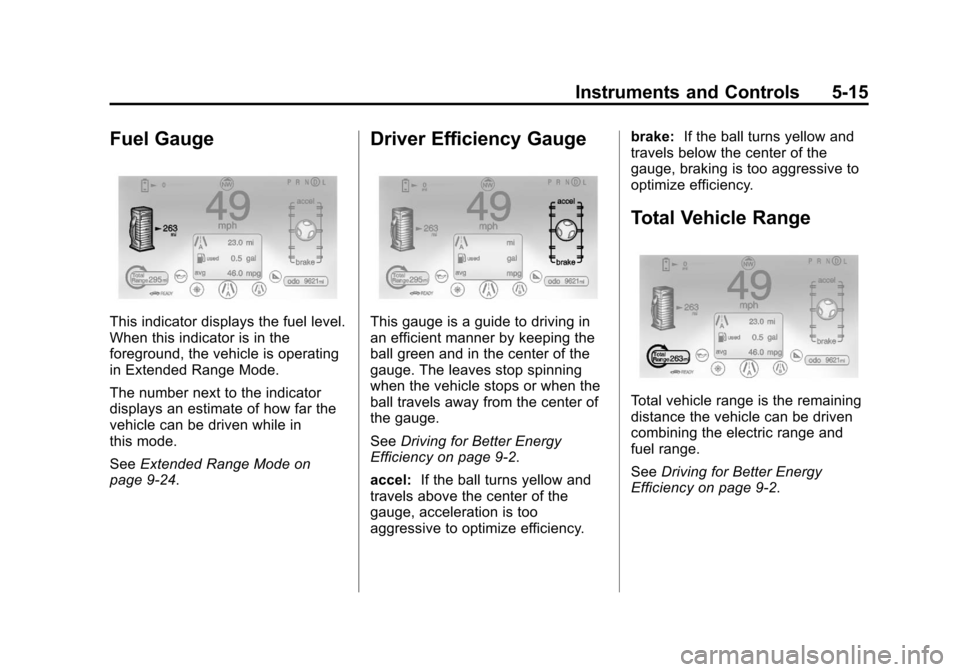
Fuel Gauge
This indicator displays the fuel level.
When this indicator is in the
foreground, the vehicle is operating
in Extended Range Mode.
The number next to the indicator
displays an estimate of how far the
vehicle can be driven while in
this mode.
SeeExtended Range Mode on
page 9‑24.
Driver Efficiency Gauge
This gauge is a guide to driving in
an efficient manner by keeping the
ball green and in the center of the
gauge. The leaves stop spinning
when the vehicle stops or when the
ball travels away from the center of
the gauge.
See Driving for Better Energy
Efficiency on page 9‑2.
accel: If the ball turns yellow and
travels above the center of the
gauge, acceleration is too
aggressive to optimize efficiency. brake:
If the ball turns yellow and
travels below the center of the
gauge, braking is too aggressive to
optimize efficiency.
Total Vehicle Range
Total vehicle range is the remaining
distance the vehicle can be driven
combining the electric range and
fuel range.
See Driving for Better Energy
Efficiency on page 9‑2.
Page 135 of 454
Black plate (19,1)Chevrolet Volt Owner Manual - 2012
Instruments and Controls 5-19
Charging System Light
(12-Volt Battery)
The charging system light comes on
briefly when the vehicle is in ON/
RUN, as a check to show the light is
working.
If the light stays on, or comes on
while driving, there could be a
problem with the electrical charging
system. Have it checked by your
dealer. Driving while this light is on
could drain the 12‐volt battery.
If a short distance must be driven
with the light on, be sure to turn off
all accessories, such as the radio.
Malfunction
Indicator Lamp
A computer system called OBD II
(On-Board Diagnostics-Second
Generation) monitors operation of
the fuel, ignition, and emission
control systems. It ensures that
emissions are at acceptable levels
for the life of the vehicle, helping to
produce a cleaner environment.
This light comes on when the
vehicle is placed in Service Only
Mode, as a check to show it is
working. If it does not, have the
vehicle serviced by your dealer. See
Power Button on page 9‑18for more
information.
If the malfunction indicator lamp
comes on and stays on, while the
engine is in ON/RUN, this indicates
that there is an OBD II problem and
service is required.
Malfunctions often are indicated by
the system before any problem is
apparent. Being aware of the light
can prevent more serious damage
to the vehicle. This system assists
the dealer technician in correctly
diagnosing any malfunction.
Notice: If the vehicle is
continually driven with this light
on, the emission controls might
not work as well, the vehicle fuel
economy might not be as good,
and the engine might not run as
smoothly. This could lead to
costly repairs that might not be
covered by the vehicle warranty.
Page 136 of 454
Black plate (20,1)Chevrolet Volt Owner Manual - 2012
5-20 Instruments and Controls
Notice:Modifications made to
the engine, electric drive unit,
exhaust, intake, or fuel system of
the vehicle or the replacement of
the original tires with other
than those of the same Tire
Performance Criteria (TPC) can
affect the vehicle emission
controls and can cause this light
to come on. Modifications to
these systems could lead to
costly repairs not covered by the
vehicle warranty. This could also
result in a failure to pass a
required Emission Inspection/
Maintenance test. See
Accessories and Modifications on
page 10‑3.
This light comes on during a
malfunction in one of two ways:
Light Flashing: A misfire condition
has been detected. A misfire
increases vehicle emissions and
could damage the emission control
system on the vehicle. Diagnosis
and service might be required. The following can prevent more
serious damage to the vehicle:
.Reduce vehicle speed.
.Avoid hard accelerations.
.Avoid steep uphill grades.
If the light continues to flash, when
it is safe to do so, stop the vehicle.
Find a safe place to park the
vehicle. Turn the vehicle off, wait at
least 10 seconds, and restart the
vehicle. If the light is still flashing,
follow the previous steps and see
your dealer for service as soon as
possible.
Light On Steady: An emission
control system malfunction has
been detected on the vehicle.
Diagnosis and service might be
required. The following may correct an
emission system malfunction:
.Check that the fuel cap is fully
installed. The diagnostic system
can determine if the fuel cap has
been left off or improperly
installed. A loose or missing fuel
cap allows fuel to evaporate into
the atmosphere. A few driving
trips with the cap properly
installed should turn the light off.
.Check that good quality fuel is
used. Poor fuel quality causes
the engine not to run as
efficiently as designed and may
cause stalling after start-up or
misfiring. These conditions might
go away once the engine is
warmed up.
If one or more of these
conditions occurs, change the
fuel brand used. It will require at
least one full tank of the proper
fuel to turn the light off.
Page 143 of 454
Black plate (27,1)Chevrolet Volt Owner Manual - 2012
Instruments and Controls 5-27
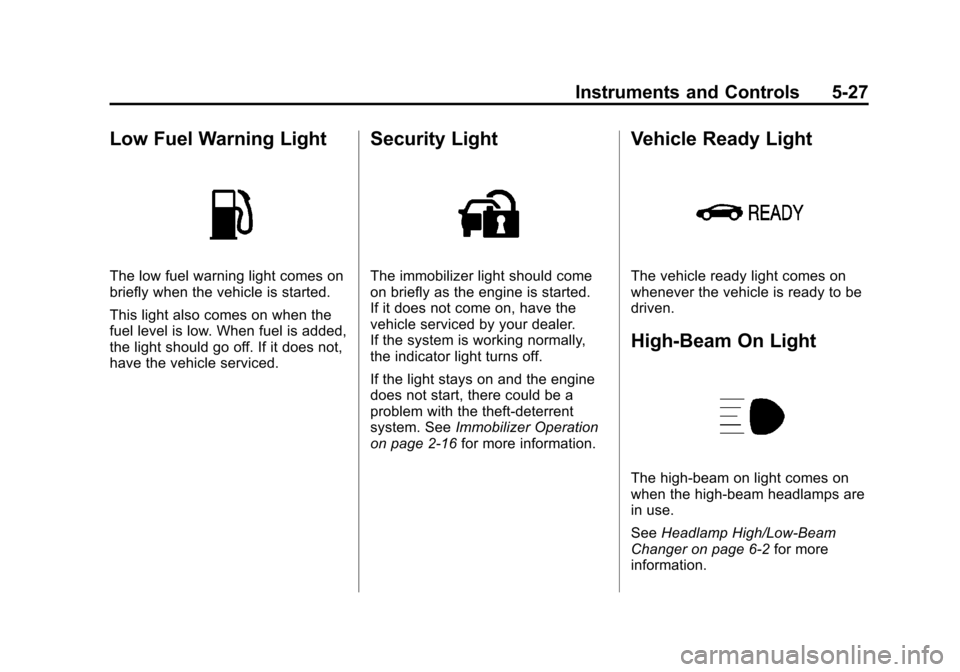
Low Fuel Warning Light
The low fuel warning light comes on
briefly when the vehicle is started.
This light also comes on when the
fuel level is low. When fuel is added,
the light should go off. If it does not,
have the vehicle serviced.
Security Light
The immobilizer light should come
on briefly as the engine is started.
If it does not come on, have the
vehicle serviced by your dealer.
If the system is working normally,
the indicator light turns off.
If the light stays on and the engine
does not start, there could be a
problem with the theft-deterrent
system. SeeImmobilizer Operation
on page 2‑16 for more information.
Vehicle Ready Light
The vehicle ready light comes on
whenever the vehicle is ready to be
driven.
High-Beam On Light
The high-beam on light comes on
when the high-beam headlamps are
in use.
SeeHeadlamp High/Low-Beam
Changer on page 6‑2 for more
information.
Page 159 of 454
Black plate (43,1)Chevrolet Volt Owner Manual - 2012
Instruments and Controls 5-43
Energy Information
To view the Energy Usage, Energy
Efficiency, and Efficiency Tips, press
the
[button on the center stack
and then press the Energy Info
button at the top of the touch
screen.
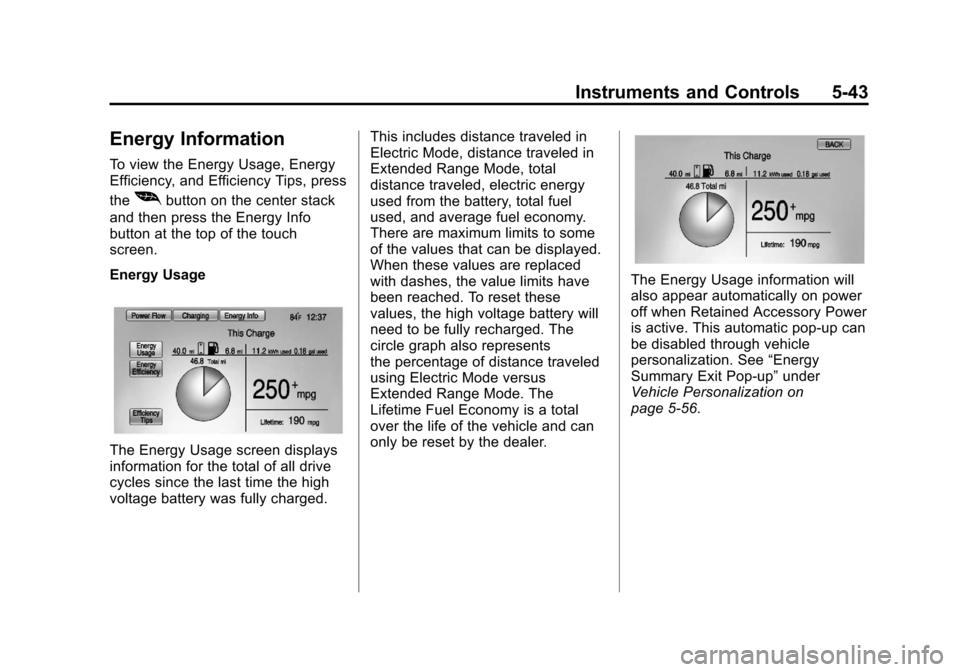
Energy Usage
The Energy Usage screen displays
information for the total of all drive
cycles since the last time the high
voltage battery was fully charged. This includes distance traveled in
Electric Mode, distance traveled in
Extended Range Mode, total
distance traveled, electric energy
used from the battery, total fuel
used, and average fuel economy.
There are maximum limits to some
of the values that can be displayed.
When these values are replaced
with dashes, the value limits have
been reached. To reset these
values, the high voltage battery will
need to be fully recharged. The
circle graph also represents
the percentage of distance traveled
using Electric Mode versus
Extended Range Mode. The
Lifetime Fuel Economy is a total
over the life of the vehicle and can
only be reset by the dealer.
The Energy Usage information will
also appear automatically on power
off when Retained Accessory Power
is active. This automatic pop-up can
be disabled through vehicle
personalization. See
“Energy
Summary Exit Pop-up” under
Vehicle Personalization on
page 5‑56.
Page 160 of 454
Black plate (44,1)Chevrolet Volt Owner Manual - 2012
5-44 Instruments and Controls
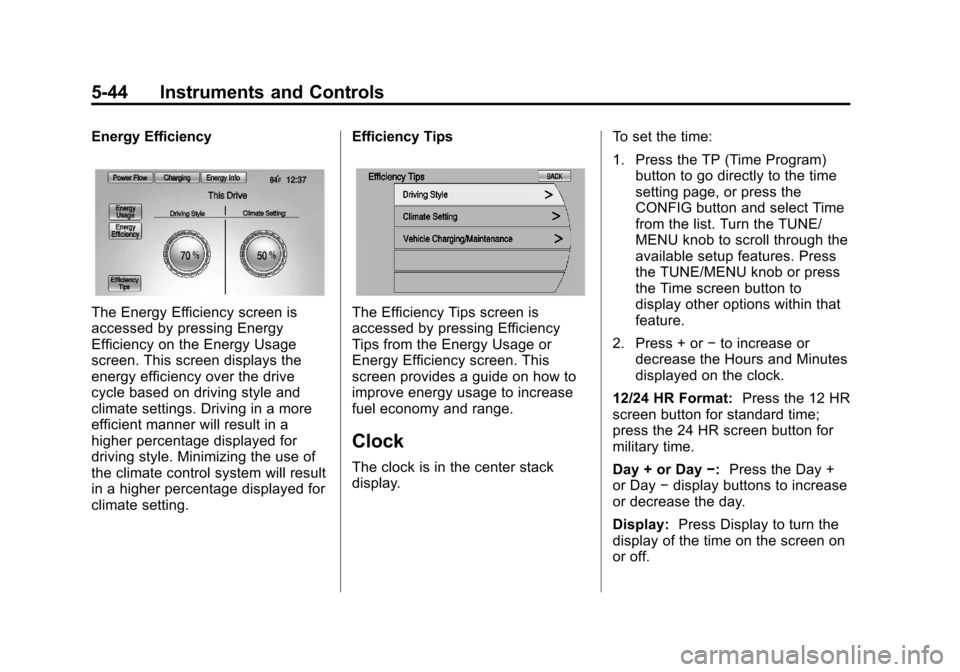
Energy Efficiency
The Energy Efficiency screen is
accessed by pressing Energy
Efficiency on the Energy Usage
screen. This screen displays the
energy efficiency over the drive
cycle based on driving style and
climate settings. Driving in a more
efficient manner will result in a
higher percentage displayed for
driving style. Minimizing the use of
the climate control system will result
in a higher percentage displayed for
climate setting.Efficiency TipsThe Efficiency Tips screen is
accessed by pressing Efficiency
Tips from the Energy Usage or
Energy Efficiency screen. This
screen provides a guide on how to
improve energy usage to increase
fuel economy and range.
Clock
The clock is in the center stack
display.
To set the time:
1. Press the TP (Time Program)
button to go directly to the time
setting page, or press the
CONFIG button and select Time
from the list. Turn the TUNE/
MENU knob to scroll through the
available setup features. Press
the TUNE/MENU knob or press
the Time screen button to
display other options within that
feature.
2. Press + or −to increase or
decrease the Hours and Minutes
displayed on the clock.
12/24 HR Format: Press the 12 HR
screen button for standard time;
press the 24 HR screen button for
military time.
Day + or Day −:Press the Day +
or Day −display buttons to increase
or decrease the day.
Display: Press Display to turn the
display of the time on the screen on
or off.
Page 161 of 454
Black plate (45,1)Chevrolet Volt Owner Manual - 2012
Instruments and Controls 5-45
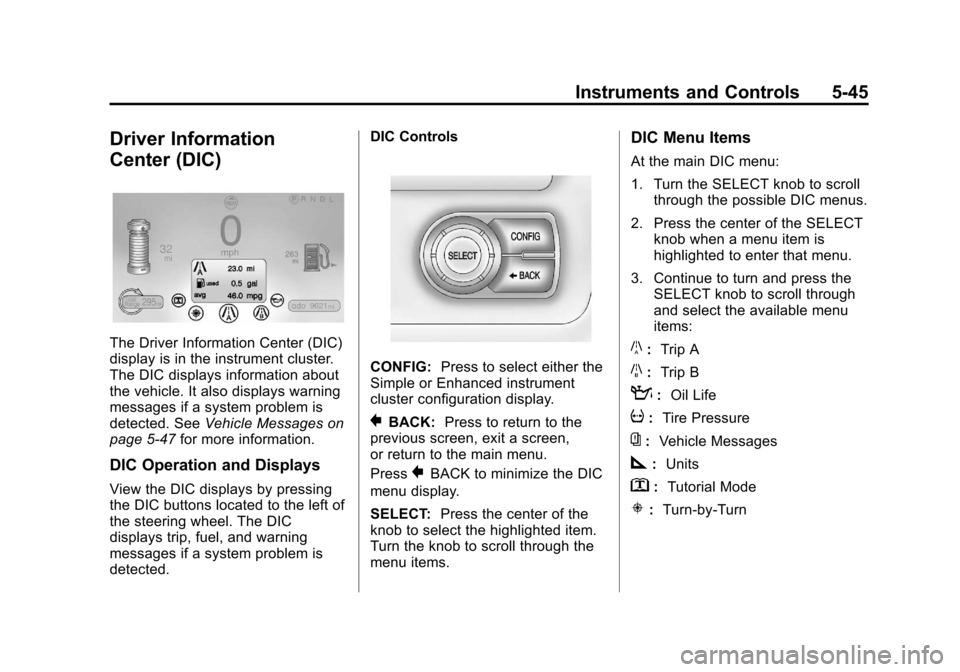
Driver Information
Center (DIC)
The Driver Information Center (DIC)
display is in the instrument cluster.
The DIC displays information about
the vehicle. It also displays warning
messages if a system problem is
detected. SeeVehicle Messages on
page 5‑47 for more information.
DIC Operation and Displays
View the DIC displays by pressing
the DIC buttons located to the left of
the steering wheel. The DIC
displays trip, fuel, and warning
messages if a system problem is
detected. DIC Controls
CONFIG:
Press to select either the
Simple or Enhanced instrument
cluster configuration display.
}BACK: Press to return to the
previous screen, exit a screen,
or return to the main menu.
Press
}BACK to minimize the DIC
menu display.
SELECT: Press the center of the
knob to select the highlighted item.
Turn the knob to scroll through the
menu items.
DIC Menu Items
At the main DIC menu:
1. Turn the SELECT knob to scroll through the possible DIC menus.
2. Press the center of the SELECT knob when a menu item is
highlighted to enter that menu.
3. Continue to turn and press the SELECT knob to scroll through
and select the available menu
items:
}:Trip A
x:Trip B
:: Oil Life
v:Tire Pressure
{:Vehicle Messages
z:Units
y: Tutorial Mode
u:Turn-by-Turn
Page 162 of 454
Black plate (46,1)Chevrolet Volt Owner Manual - 2012
5-46 Instruments and Controls
Trip A and Trip B
The trip displays show fuel used,
average fuel economy, and distance
traveled since the last trip reset.
Reset the trip data by pressing and
holding the SELECT button when
either Trip A or Trip B is displayed.
Oil Life
This displays the percentage of
remaining oil life. The lower
the percentage, the closer the
vehicle is to needing an oil change.
When the oil life is depleted, the
CHANGE ENGINE OIL SOON
message displays. Change the oil
as soon as possible. Additional
maintenance is also recommended
in the Maintenance Schedule. See
Maintenance Schedule on
page 11‑3andEngine Oil on
page 10‑9. The oil life must be reset after each
oil change. Avoid accidental
resetting of the Engine Oil Life
System. It cannot be reset
accurately until the next oil change.
To reset the Engine Oil Life System,
see
Engine Oil Life System on
page 10‑12. The system is reset
when 100% displays.
Tire Pressure
The display will show a vehicle with
the approximate pressures of all
four tires. Tire pressure is displayed
in either kilopascals (kPa) or in
pounds per square inch (psi).
If a low or high tire pressure is
detected, a message is displayed
advising to check the tire pressure
in the specified tire. See Tire
Pressure on page 10‑50 andTire
Messages on page 5‑55 for more
information. If the tire pressure display shows
dashes instead of a value, there
may be a problem with the vehicle.
See your dealer for service.
Vehicle Messages
Turn the SELECT knob to scroll
through any active warning
messages. Press SELECT to review
the messages.
Units
Turn the SELECT knob to change
the unit display to METRIC or US
when the display is active. Press
SELECT to confirm the setting. This
will change the displays on the
cluster and DIC to either metric or
English (US) measurements.