open hood CHEVROLET VOLT 2012 1.G User Guide
[x] Cancel search | Manufacturer: CHEVROLET, Model Year: 2012, Model line: VOLT, Model: CHEVROLET VOLT 2012 1.GPages: 454, PDF Size: 7.89 MB
Page 263 of 454
Black plate (25,1)Chevrolet Volt Owner Manual - 2012
Driving and Operating 9-25
In either Electric Mode or Extended
Range Mode, when the hood is
open, the engine will run without
turning off if the vehicle is on. The
high voltage battery is neither
charged nor discharged when this
occurs.
In either Electric Mode or Extended
Range Mode, if there is a high
voltage battery fault, the engine may
run without turning off to generate
needed electricity. The malfunction
indicator lamp will turn on. See
Malfunction Indicator Lamp on
page 5‑19.Driver Selected Operating
Modes
While driving in Electric or Extended
Range Mode, additional operating
modes can be selected.
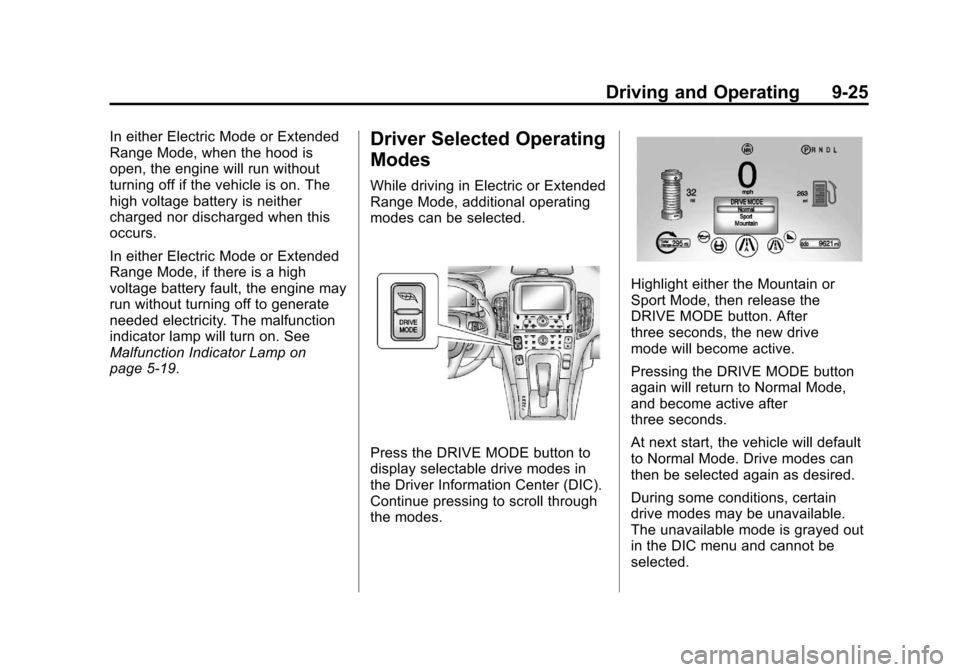
Press the DRIVE MODE button to
display selectable drive modes in
the Driver Information Center (DIC).
Continue pressing to scroll through
the modes.
Highlight either the Mountain or
Sport Mode, then release the
DRIVE MODE button. After
three seconds, the new drive
mode will become active.
Pressing the DRIVE MODE button
again will return to Normal Mode,
and become active after
three seconds.
At next start, the vehicle will default
to Normal Mode. Drive modes can
then be selected again as desired.
During some conditions, certain
drive modes may be unavailable.
The unavailable mode is grayed out
in the DIC menu and cannot be
selected.
Page 298 of 454
Black plate (60,1)Chevrolet Volt Owner Manual - 2012
9-60 Driving and Operating
Gasoline Specifications
(U.S. and Canada Only)
At a minimum, gasoline should
meet ASTM specification D 4814 in
the United States or CAN/
CGSB‐3.5 or 3.511 in Canada.
Some gasolines contain an
octane-enhancing additive called
methylcyclopentadienyl manganese
tricarbonyl (MMT). We recommend
against the use of gasolines
containing MMT. SeeFuel Additives
on page 9‑60 for additional
information.
California Fuel
Requirements
If the vehicle is certified to meet
California Emissions Standards, it is
designed to operate on fuels that
meet California specifications. See
the underhood emission control
label. If this fuel is not available in
states adopting California Emissions
Standards, the vehicle will operate
satisfactorily on fuels meeting
federal specifications, but emission
control system performance might
be affected. The malfunction
indicator lamp could turn on and the
vehicle might fail a smog‐check test.
See Malfunction Indicator Lamp on
page 5‑19. If this occurs, return to
your authorized dealer for diagnosis.
If it is determined that the condition
is caused by the type of fuel used,
repairs might not be covered by the
vehicle warranty.
Fuels in Foreign
Countries
Never use leaded gasoline or any
other fuel not recommended in the
previous text on fuel. Costly repairs
caused by use of improper fuel
would not be covered by the vehicle
warranty.
To check the fuel availability, ask an
auto club, or contact a major oil
company that does business in the
country where you will be driving.
Fuel Additives
To provide cleaner air, all gasolines
in the United States are now
required to contain additives that
help prevent engine and fuel system
deposits from forming, allowing the
emission control system to work
properly. In most cases, nothing
should have to be added to the fuel.
However, some gasolines contain
only the minimum amount of
additive required to meet U.S.
Page 311 of 454
Black plate (7,1)Chevrolet Volt Owner Manual - 2012
Vehicle Care 10-7
Keep a record with all parts receipts
and list the mileage and the date of
any service work performed. See
Maintenance Records on
page 11‑14.
Hood
To open the hood:
1. Turn the vehicle off beforeopening the hood. If the vehicle
is on, the engine will start when
the hood is opened. See Electric
Mode on page 9‑24 and
Extended Range Mode on
page 9‑24.
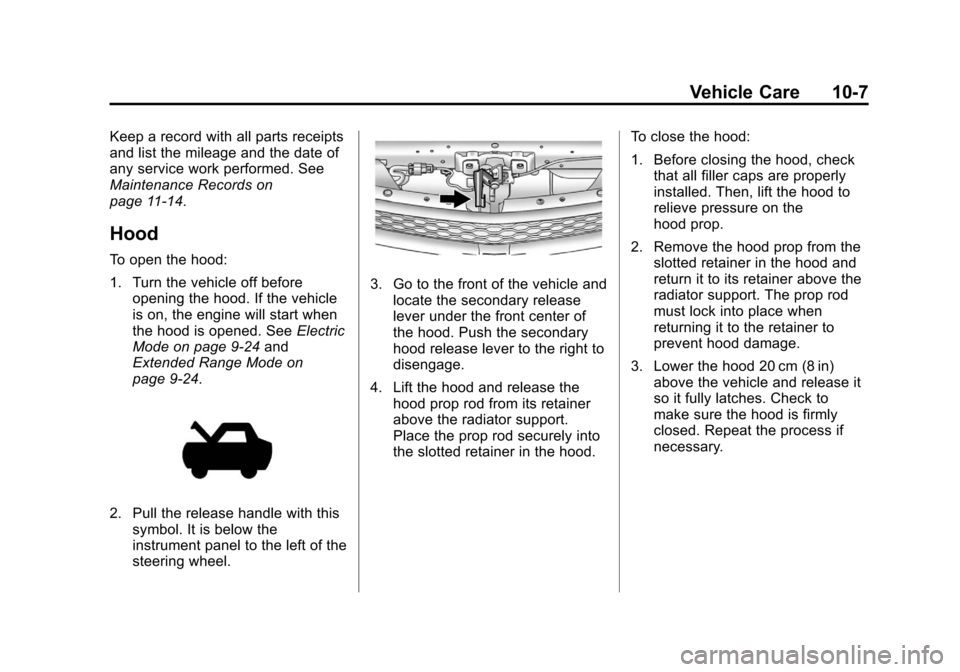
2. Pull the release handle with this symbol. It is below the
instrument panel to the left of the
steering wheel.
3. Go to the front of the vehicle andlocate the secondary release
lever under the front center of
the hood. Push the secondary
hood release lever to the right to
disengage.
4. Lift the hood and release the hood prop rod from its retainer
above the radiator support.
Place the prop rod securely into
the slotted retainer in the hood. To close the hood:
1. Before closing the hood, check
that all filler caps are properly
installed. Then, lift the hood to
relieve pressure on the
hood prop.
2. Remove the hood prop from the slotted retainer in the hood and
return it to its retainer above the
radiator support. The prop rod
must lock into place when
returning it to the retainer to
prevent hood damage.
3. Lower the hood 20 cm (8 in) above the vehicle and release it
so it fully latches. Check to
make sure the hood is firmly
closed. Repeat the process if
necessary.
Page 317 of 454
Black plate (13,1)Chevrolet Volt Owner Manual - 2012
Vehicle Care 10-13
How to Reset the Engine Oil
Life System
Reset the system whenever the
engine oil is changed so that the
system can calculate the next
engine oil change. To reset the
system:
1. Use the SELECT knob to selectOIL LIFE on the DIC menu.
2. Press SELECT to start the OIL LIFE reset procedure.
3. The DIC menu will display “Are
you sure that you want to reset?”
Use SELECT to choose YES to
reset oil life or NO to exit and
return to the previous menu.
4. If YES is selected, the DIC menu will display RESET OIL LIFE for
a short time and then 100% OIL
LIFE will be displayed when OIL
LIFE is successfully reset.
If the CHANGE ENGINE OIL SOON
message comes back on when the
vehicle is started, the engine oil life
system has not reset. Repeat the
procedure.
Engine Air Cleaner/Filter
See Engine Compartment Overview
on page 10‑8 for the location of the
engine air cleaner/filter.
When to Inspect the Engine Air
Filter
Inspect the air filter at the scheduled
maintenance intervals and replace it
at the first oil change after each
80 000 km (50,000 mi) interval. See
Maintenance Schedule on
page 11‑3 for more information.
If driving in dusty/dirty conditions,
inspect the air filter at each engine
oil change.
How to Inspect the Engine Air
Filter
To inspect the air filter, remove it
from the engine air cleaner/filter
assembly and lightly shake to
release loose dust and dirt. If the air
filter remains covered with dirt, a
new air filter is required.
To inspect or replace the air filter:
1. Open the hood. See Hood on
page 10‑7.
2. Locate the engine air cleaner/ filter assembly on the passenger
side of the engine compartment.
See Engine Compartment
Overview on page 10‑8.
Page 325 of 454
Black plate (21,1)Chevrolet Volt Owner Manual - 2012
Vehicle Care 10-21
Engine Overheating
The vehicle has an indicator to warn
of engine overheating.
If the decision is made not to lift the
hood when this warning appears,
get service help right away. See
Roadside Assistance Program on
page 13‑6.
If the decision is made to lift the
hood, make sure the vehicle is
parked on a level surface.
Then check to see if the engine
cooling fans are running. If the
engine is overheating, the fans
should be running. If they are not,
do not continue to run the vehicle
and have the vehicle serviced.
Notice:Engine damage from
running the engine without
coolant is not covered by the
warranty.
Washer Fluid
What to Use
When adding windshield washer
fluid to the vehicle, be sure to read
the manufacturer's instructions
before use. If operating the vehicle
in an area where the temperature
may fall below freezing, use a fluid
that has sufficient protection against
freezing.
Adding Washer Fluid
The WASHER FLUID LOW ADD
FLUID message will appear on the
Driver Information Center (DIC)
when the fluid level is low. See
Driver Information Center (DIC) on
page 5‑45 for more information.
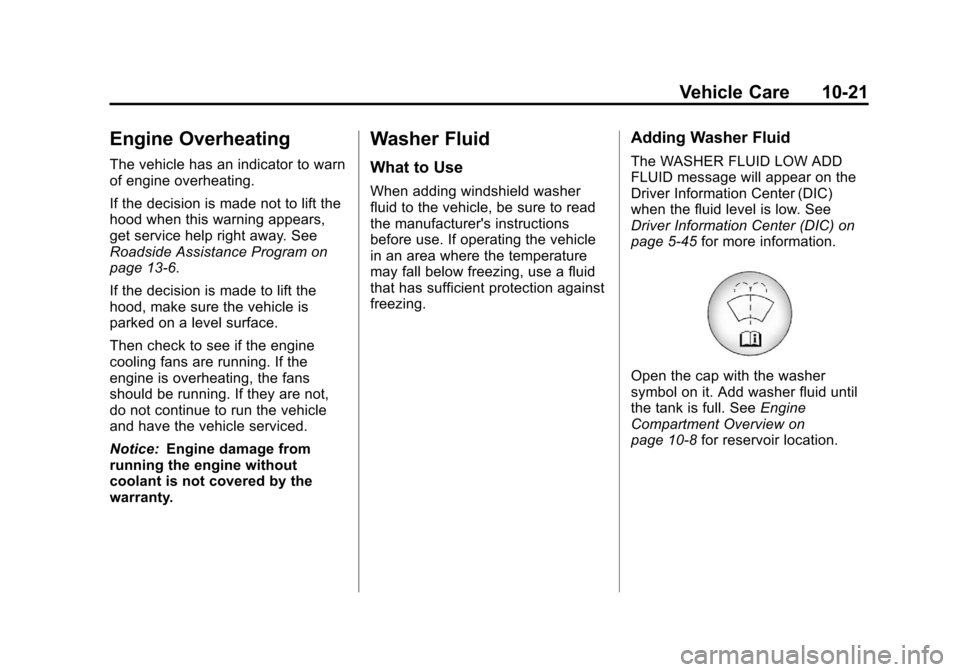
Open the cap with the washer
symbol on it. Add washer fluid until
the tank is full. See Engine
Compartment Overview on
page 10‑8 for reservoir location.
Page 333 of 454
Black plate (29,1)Chevrolet Volt Owner Manual - 2012
Vehicle Care 10-29
Bulb Replacement
For the proper type of replacement
bulbs, seeReplacement Bulbs on
page 10‑32.
For any bulb‐changing procedure
not listed in this section, contact
your dealer.
Halogen Bulbs
{WARNING
Halogen bulbs have pressurized
gas inside and can burst if you
drop or scratch the bulb. You or
others could be injured. Be sure
to read and follow the instructions
on the bulb package.
LED Lighting
This vehicle has several LED lamps.
For replacement of any LED lighting
assembly, contact your dealer.
Headlamps
Driver Side Headlamps
To replace the high/low‐beam
headlamp:
1. Open the hood. See Hood on
page 10‑7.
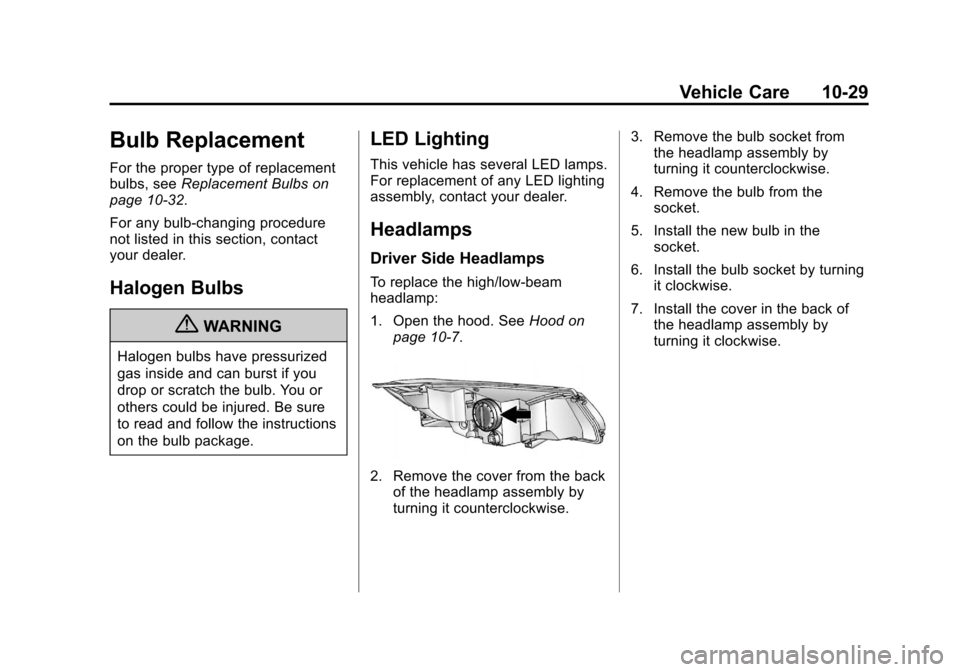
2. Remove the cover from the back of the headlamp assembly by
turning it counterclockwise. 3. Remove the bulb socket from
the headlamp assembly by
turning it counterclockwise.
4. Remove the bulb from the socket.
5. Install the new bulb in the socket.
6. Install the bulb socket by turning it clockwise.
7. Install the cover in the back of the headlamp assembly by
turning it clockwise.
Page 334 of 454
Black plate (30,1)Chevrolet Volt Owner Manual - 2012
10-30 Vehicle Care
Passenger Side Headlamps
To replace the high/low‐beam
headlamp:
1. Open the hood. SeeHood on
page 10‑7.
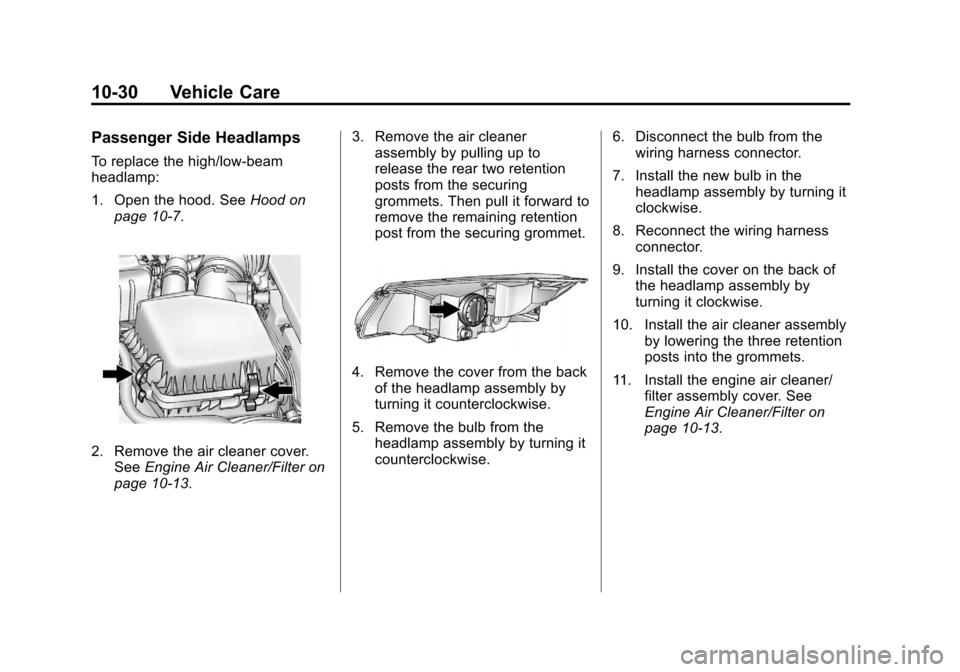
2. Remove the air cleaner cover. See Engine Air Cleaner/Filter on
page 10‑13. 3. Remove the air cleaner
assembly by pulling up to
release the rear two retention
posts from the securing
grommets. Then pull it forward to
remove the remaining retention
post from the securing grommet.
4. Remove the cover from the back
of the headlamp assembly by
turning it counterclockwise.
5. Remove the bulb from the headlamp assembly by turning it
counterclockwise. 6. Disconnect the bulb from the
wiring harness connector.
7. Install the new bulb in the headlamp assembly by turning it
clockwise.
8. Reconnect the wiring harness connector.
9. Install the cover on the back of the headlamp assembly by
turning it clockwise.
10. Install the air cleaner assembly by lowering the three retention
posts into the grommets.
11. Install the engine air cleaner/ filter assembly cover. See
Engine Air Cleaner/Filter on
page 10‑13.
Page 379 of 454
Black plate (75,1)Chevrolet Volt Owner Manual - 2012
Vehicle Care 10-75
Jump Starting
Jump starting is connecting jumper
cables between the two vehicles to
enable vehicle starting. If the Volt or
another vehicle has a run‐down
12‐volt battery, it can be jump
started using good condition jumper
cables. There are different
procedures depending on if the Volt
has a run‐down battery or another
vehicle has a run‐down battery.
Read the appropriate procedures
that follow.
{WARNING
The high voltage battery cannot
be jump started either with
another vehicle or battery
charger. Personal injury, death,
or damage to the vehicle could
result.
{WARNING
Batteries are dangerous and can
cause injury. Batteries contain
acid and can explode or ignite.
They contain electricity that can
burn. Follow the exact steps
provided or injuries could occur.
Using an open flame near a
battery can cause battery gas to
explode; you or others could be
hurt. Battery acid can cause
blindness.
Be sure the battery in the other
vehicle has enough water. Add
water if the level is low. A low
water level could cause explosive
gas to be present.
Battery fluid contains acid that
can burn. If battery fluid gets in
eyes or on skin; flush with water
and get medical help immediately.
{WARNING
Electric fans can start up even
when the engine is not running
and can cause injury. Keep
hands, clothing, and tools away
from any underhood electric fans.
Notice: Ignoring these steps
could result in costly damage to
the vehicle that would not be
covered by the warranty.
Trying to start the vehicle by
pushing or pulling it will not
work, and it could damage the
vehicle.
Page 380 of 454
Black plate (76,1)Chevrolet Volt Owner Manual - 2012
10-76 Vehicle Care
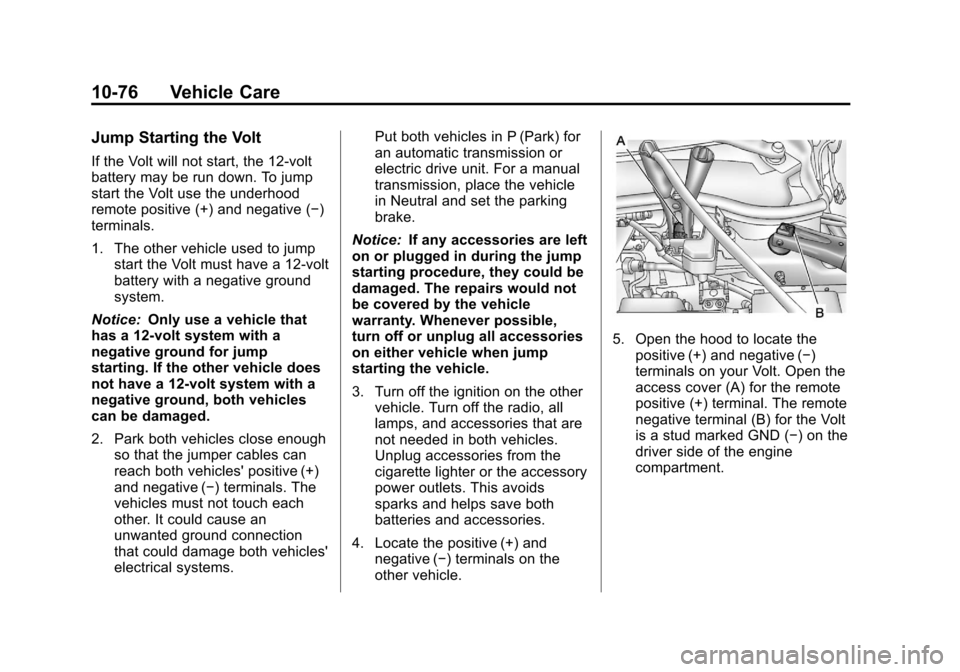
Jump Starting the Volt
If the Volt will not start, the 12‐volt
battery may be run down. To jump
start the Volt use the underhood
remote positive (+) and negative (−)
terminals.
1. The other vehicle used to jumpstart the Volt must have a 12‐volt
battery with a negative ground
system.
Notice: Only use a vehicle that
has a 12-volt system with a
negative ground for jump
starting. If the other vehicle does
not have a 12-volt system with a
negative ground, both vehicles
can be damaged.
2. Park both vehicles close enough so that the jumper cables can
reach both vehicles' positive (+)
and negative (−) terminals. The
vehicles must not touch each
other. It could cause an
unwanted ground connection
that could damage both vehicles'
electrical systems. Put both vehicles in P (Park) for
an automatic transmission or
electric drive unit. For a manual
transmission, place the vehicle
in Neutral and set the parking
brake.
Notice: If any accessories are left
on or plugged in during the jump
starting procedure, they could be
damaged. The repairs would not
be covered by the vehicle
warranty. Whenever possible,
turn off or unplug all accessories
on either vehicle when jump
starting the vehicle.
3. Turn off the ignition on the other vehicle. Turn off the radio, all
lamps, and accessories that are
not needed in both vehicles.
Unplug accessories from the
cigarette lighter or the accessory
power outlets. This avoids
sparks and helps save both
batteries and accessories.
4. Locate the positive (+) and negative (−) terminals on the
other vehicle.
5. Open the hood to locate thepositive (+) and negative (−)
terminals on your Volt. Open the
access cover (A) for the remote
positive (+) terminal. The remote
negative terminal (B) for the Volt
is a stud marked GND (−) on the
driver side of the engine
compartment.
Page 447 of 454

Black plate (5,1)Chevrolet Volt Owner Manual - 2012
INDEX i-5
G
Garage Door Opener . . . . . . . . . . 5-65Programming . . . . . . . . . . . . . . . . . 5-65
Gasoline Specifications . . . . . . . . . . . . . . . . . 9-60
Gauges Battery . . . . . . . . . . . . . . . . . . . . . . . 5-14
Driver Efficiency . . . . . . . . . . . . . . 5-15
Fuel . . . . . . . . . . . . . . . . . . . . . . . . . . 5-15
Odometer . . . . . . . . . . . . . . . . . . . . . 5-14
Speedometer . . . . . . . . . . . . . . . . . 5-14
Trip Odometer . . . . . . . . . . . . . . . . 5-14
Warning Lights and
Indicators . . . . . . . . . . . . . . . . . . . . 5-8
General Information Service and Maintenance . . . . . 11-1
Towing . . . . . . . . . . . . . . . . . . . . . . . . 9-64
Vehicle Care . . . . . . . . . . . . . . . . . . 10-2
Glove Box . . . . . . . . . . . . . . . . . . . . . . 4-1
GM Mobility Reimbursement Program . . . . . . . . . . . . . . . . . . . . . . 13-6
H
Halogen Bulbs . . . . . . . . . . . . . . . . 10-29
Hatch . . . . . . . . . . . . . . . . . . . . . . . . . . 2-14
Hazard Warning Flashers . . . . . . . 6-3
Head Restraints . . . . . . . . . . . . . . . . 3-2
Headlamps . . . . . . . . . . . . . . . . . . . 10-29Aiming . . . . . . . . . . . . . . . . . . . . . . 10-28
Bulb Replacement . . . . . . . . . . 10-29
Daytime Running
Lamps (DRL) . . . . . . . . . . . . . . . . . 6-2
Flash-to-Pass . . . . . . . . . . . . . . . . . . 6-2
High-Beam On Light . . . . . . . . . . 5-27
High/Low Beam Changer . . . . . . 6-2
Lamps On Reminder . . . . . . . . . 5-28
Heated Front Seats . . . . . . . . . . . . . 3-6
Heated Mirrors . . . . . . . . . . . . . . . . . 2-17
Heating and Air Conditioning . . . 8-1
High Voltage Battery Gauge . . . 5-14
High Voltage Devices and Wiring . . . . . . . . . . . . . . . . . . . . . . . 10-32
High-Beam On Light . . . . . . . . . . . 5-27
Highway Hypnosis . . . . . . . . . . . . . . 9-9
Hill and Mountain Roads . . . . . . . . 9-9
Hood . . . . . . . . . . . . . . . . . . . . . . . . . . 10-7 Hood, Door, Hatch Open
Light . . . . . . . . . . . . . . . . . . . . . . . . . 5-28
Horn . . . . . . . . . . . . . . . . . . . . . . . . . . . . 5-6
How to Wear Safety Belts Properly . . . . . . . . . . . . . . . . . . . . . . 3-12
I
Immobilizer . . . . . . . . . . . . . . . . . . . . 2-16
Infants and Young Children,Restraints . . . . . . . . . . . . . . . . . . . . 3-36
Information Energy . . . . . . . . . . . . . . . . . . . . . . . 5-43
Infotainment . . . . . . . . . . . . . . . . . . . . 7-1
Instrument Cluster . . . . . . . . . . . . . . 5-9
Instrument Panel
Storage Area . . . . . . . . . . . . . . . . . . 4-1
Introduction . . . . . . . . . . . . . . . . . . . . . . . iii
J
Jump Starting . . . . . . . . . . . . . . . . . 10-75