ignition CHRYSLER 200 2013 1.G Owner's Manual
[x] Cancel search | Manufacturer: CHRYSLER, Model Year: 2013, Model line: 200, Model: CHRYSLER 200 2013 1.GPages: 517, PDF Size: 3.4 MB
Page 37 of 517
•For vehicles not equipped with the EVIC, perform the
following procedure:
1. Close all doors and place the key in the ignition.
2. Cycle the ignition switch between LOCK and ON/ RUN and then back to LOCK four times, ending up in
the LOCK position.
3. Press the power door unlock switch to unlock the doors.
4. A single chime will indicate the completion of the programming.
5. Repeat these steps if you want to return this feature to its previous setting.
NOTE: Use the Automatic Unlock Doors On Exit feature
in accordance with local laws.Child-Protection Door Lock System — Rear Doors
To provide a safer environment for children riding in the
rear seat, the rear doors of your vehicle have a Child-
Protection Door Lock system.
Child-Protection Door Lock Location
2
THINGS TO KNOW BEFORE STARTING YOUR VEHICLE 35
Page 38 of 517
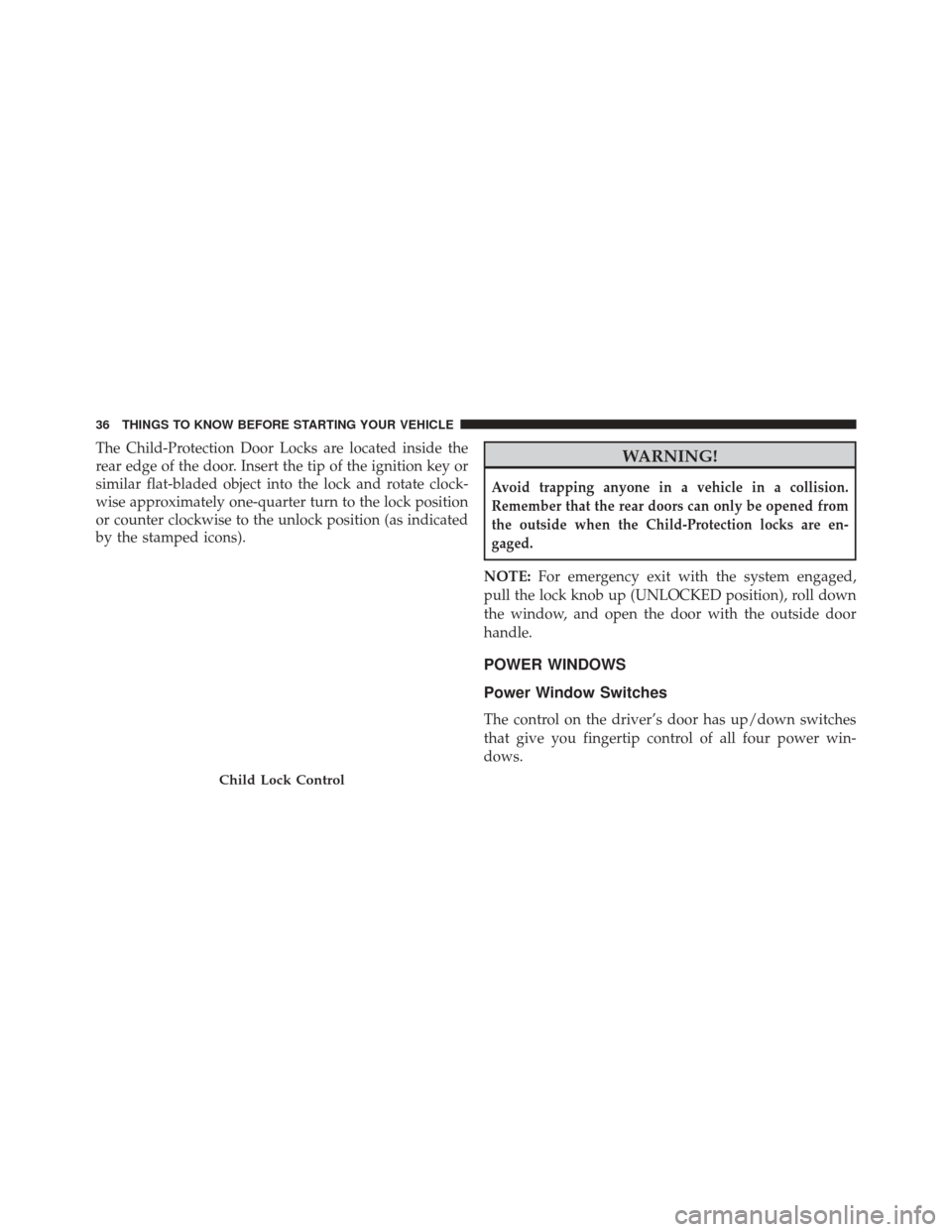
The Child-Protection Door Locks are located inside the
rear edge of the door. Insert the tip of the ignition key or
similar flat-bladed object into the lock and rotate clock-
wise approximately one-quarter turn to the lock position
or counter clockwise to the unlock position (as indicated
by the stamped icons).WARNING!
Avoid trapping anyone in a vehicle in a collision.
Remember that the rear doors can only be opened from
the outside when the Child-Protection locks are en-
gaged.
NOTE:For emergency exit with the system engaged,
pull the lock knob up (UNLOCKED position), roll down
the window, and open the door with the outside door
handle.
POWER WINDOWS
Power Window Switches
The control on the driver’s door has up/down switches
that give you fingertip control of all four power win-
dows.
Child Lock Control
36 THINGS TO KNOW BEFORE STARTING YOUR VEHICLE
Page 39 of 517
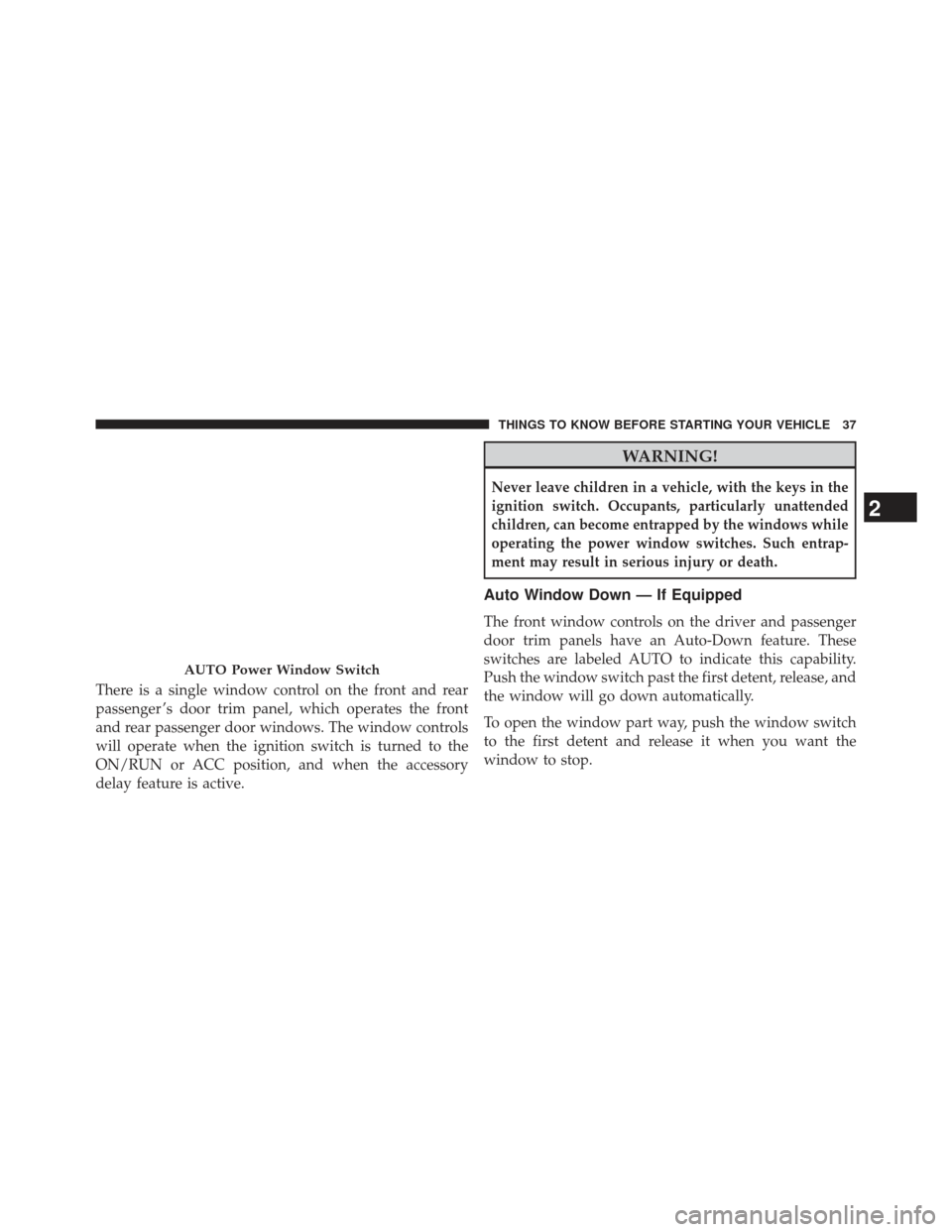
There is a single window control on the front and rear
passenger ’s door trim panel, which operates the front
and rear passenger door windows. The window controls
will operate when the ignition switch is turned to the
ON/RUN or ACC position, and when the accessory
delay feature is active.
WARNING!
Never leave children in a vehicle, with the keys in the
ignition switch. Occupants, particularly unattended
children, can become entrapped by the windows while
operating the power window switches. Such entrap-
ment may result in serious injury or death.
Auto Window Down — If Equipped
The front window controls on the driver and passenger
door trim panels have an Auto-Down feature. These
switches are labeled AUTO to indicate this capability.
Push the window switch past the first detent, release, and
the window will go down automatically.
To open the window part way, push the window switch
to the first detent and release it when you want the
window to stop.
AUTO Power Window Switch
2
THINGS TO KNOW BEFORE STARTING YOUR VEHICLE 37
Page 40 of 517
To cancel the Auto-Down movement, operate the switch
either in the up or down direction and release the switch.
For vehicles not equipped with the Electronic Vehicle
Information Center (EVIC), the power window switches
will remain active for 45 seconds after the ignition switch
is turned to the LOCK position. Opening either door will
cancel this feature.
For vehicles equipped with EVIC, the power window
switches will remain active for up to 10 minutes after the
ignition switch is turned off. Opening either door will
cancel this feature. The time for this feature is program-
mable. Refer to “Electronic Vehicle Information Center
(EVIC)/Personal Settings (Customer-Programmable Fea-
tures)” in “Understanding Your Instrument Panel” for
further information.Auto Window Up With Anti-Pinch Protection —
If Equipped
Lift the window switch fully upward to the second
detent, release, and the window will go up automatically.
To cancel the Auto Up movement, operate the switch
either in the up or down direction and release the switch.
To close the window part way, lift the window switch to
the first detent and release it when you want the window
to stop.
NOTE:
•If the window runs into any obstacle during auto-
closure, anti-pinch protection will reverse the window
direction and then go back down. Remove the obstacle
and use the window switch again to close the window.
38 THINGS TO KNOW BEFORE STARTING YOUR VEHICLE
Page 43 of 517
With the ignition switch in the ON/RUN position, the
word “dECK ” will display in place of the odometer
display indicating that the trunk is open. The odometer
display will reappear once the trunk is closed or if the
trip button is depressed.
With the ignition switch in the LOCK position or with the
key out, the word “dECK” will display until the trunk is
closed.
On EVIC-equipped vehicles, the words “Trunk Ajar” will
display.TRUNK SAFETY WARNING
WARNING!
Do not allow children to have access to the trunk,
either by climbing into the trunk from outside, or
through the inside of the vehicle. Always close the
trunk lid when your vehicle is unattended. Once in
the trunk, young children may not be able to escape,
even if they entered through the rear seat. If trapped
in the trunk, children can die from suffocation or
heat stroke.2
THINGS TO KNOW BEFORE STARTING YOUR VEHICLE 41
Page 60 of 517
4. The AHR front soft foam and trim half should lockinto the back decorative plastic half. NOTE:
•
If you have difficulties or problems resetting the Active
Head Restraints, see an authorized dealer.
• For safety reasons, have the Active Head Restraints
checked by a qualified specialist at an authorized
dealer.
Enhanced Seat Belt Use Reminder System
(BeltAlert®)
BeltAlert® is a feature intended to remind the driver and
front passenger (if equipped with front passenger
BeltAlert®) to fasten their seat belts. The feature is active
whenever the ignition is on. If the driver or front seat
passenger is unbelted, the Seat Belt Reminder Light will
turn on and remain on until both front seat belts are
fastened.
AHR In Reset Position
58 THINGS TO KNOW BEFORE STARTING YOUR VEHICLE
Page 70 of 517
The ORC monitors the readiness of the electronic parts of
the air bag system whenever the ignition switch is in the
START or ON/RUN position. If the key is in the OFF
position, in the ACC position, or not in the ignition, the
air bag system is not on and the air bags will not inflate.
The ORC contains a backup power supply system that
may deploy the air bags even if the battery loses power or
it becomes disconnected prior to deployment.Also, the ORC turns on the Air Bag Warning
Light in the instrument panel for approxi-
mately four to eight seconds for a self-check
when the ignition is first turned on. After the
self-check, the Air Bag Warning Light will turn off. If the
ORC detects a malfunction in any part of the system, it
turns on the Air Bag Warning Light, either momentarily
or continuously. A single chime will sound if the light
comes on again after initial startup. It also includes diagnostics that will illuminate the instru-
ment cluster Air Bag Warning Light if a malfunction is
noted that could affect the air bag system. The diagnos-
tics also record the nature of the malfunction.
WARNING!
Ignoring the Air Bag Warning Light in your instru-
ment panel could mean you won’t have the air bags
to protect you in a collision. If the light does not come
on as a bulb check when the ignition is first turned
on, stays on after you start the vehicle, or if it comes
on as you drive, have an authorized dealer service the
air bag system immediately.
68 THINGS TO KNOW BEFORE STARTING YOUR VEHICLE
Page 73 of 517
Enhanced Accident Response System
In the event of an impact causing air bag deployment, if the
communication network remains intact, and the power
remains intact, depending on the nature of the event the
ORC will determine whether to have the Enhanced Accident
Response System perform the following functions:
•Cut off fuel to the engine.
• Flash hazard lights as long as the battery has power or
until the ignition key is turned off.
• Turn on the interior lights, which remain on as long as
the battery has power or until the ignition key is
removed.
• Unlock the doors automatically.
In order to reset the Enhanced Accident Response System
functions after an event, the ignition switch must be
changed from IGN ON to IGN OFF.
If A Deployment Occurs
The Advanced Front Air Bags are designed to deflate
immediately after deployment.
NOTE: Front and/or side air bags will not deploy in all
collisions. This does not mean something is wrong with
the air bag system.
If you do have a collision, which deploys the air bags, any
or all of the following may occur:
• The nylon air bag material may sometimes cause
abrasions and/or skin reddening to the driver and
front passenger as the air bags deploy and unfold. The
abrasions are similar to friction rope burns or those
you might get sliding along a carpet or gymnasium
floor. They are not caused by contact with chemicals.
They are not permanent and normally heal quickly.
2
THINGS TO KNOW BEFORE STARTING YOUR VEHICLE 71
Page 76 of 517
Air Bag Warning Light
You will want to have the air bags ready to
inflate for your protection in a collision. The
Air Bag Warning Light monitors the internal
circuits and interconnecting wiring associated
with air bag system electrical components. While the air
bag system is designed to be maintenance free, if any of
the following occurs, have an authorized dealer service
the air bag system immediately.
• The Air Bag Warning Light does not come on during
the four to eight seconds when the ignition switch is
first turned to the ON/RUN position.
• The Air Bag Warning Light remains on after the four to
eight-second interval.
• The Air Bag Warning Light comes on intermittently or
remains on while driving. NOTE:
If the speedometer, tachometer, or any engine
related gauges are not working, the Occupant Restraint
Controller (ORC) may also be disabled. The air bags may
not be ready to inflate for your protection. Promptly
check the fuse block for blown fuses. Refer to the label
located on the inside of the fuse block cover for the
proper air bag fuses. See your authorized dealer if the
fuse is good.
Event Data Recorder (EDR)
This vehicle is equipped with an event data recorder
(EDR). The main purpose of an EDR is to record, in
certain crash or near crash-like situations, such as an air
bag deployment or hitting a road obstacle, data that will
assist in understanding how a vehicle’s systems per-
formed. The EDR is designed to record data related to
vehicle dynamics and safety systems for a short period of
74 THINGS TO KNOW BEFORE STARTING YOUR VEHICLE
Page 101 of 517
Safety Checks You Should Make Inside The
Vehicle
Seat Belts
Inspect the belt system periodically, checking for cuts,
frays, and loose parts. Damaged parts must be replaced
immediately. Do not disassemble or modify the system.
Front seat belt assemblies must be replaced after a
collision. Rear seat belt assemblies must be replaced after
a collision if they have been damaged (i.e., bent retractor,
torn webbing, etc.). If there is any question regarding belt
or retractor condition, replace the belt.
Air Bag Warning Light
The light should come on and remain on for four
to eight seconds as a bulb check when the ignition
switch is first turned ON. If the light is not lit
during starting, see your authorized dealer. If the
light stays on, flickers, or comes on while driving, have the
system checked by an authorized dealer.
Defroster
Check operation by selecting the defrost mode and place
the blower control on high speed. You should be able to feel
the air directed against the windshield. See your autho-
rized dealer for service if your defroster is inoperable.
2
THINGS TO KNOW BEFORE STARTING YOUR VEHICLE 99