light CHRYSLER 200 2015 2.G User Guide
[x] Cancel search | Manufacturer: CHRYSLER, Model Year: 2015, Model line: 200, Model: CHRYSLER 200 2015 2.GPages: 698, PDF Size: 5.12 MB
Page 41 of 698
To Enter The Trunk
With a valid Passive Entry RKE transmitter within 3 ft
(1.0 m) of the decklid, push the button located on the
light bar between the license plate lamps.
NOTE:If you inadvertently leave your vehicle’s Passive
Entry RKE transmitter in the trunk and try to close the
decklid, the decklid will automatically unlatch, unless
another one of the vehicle’s Passive Entry RKE transmit-
ters is outside the vehicle and within 3 ft (1.0 m) of the
decklid.
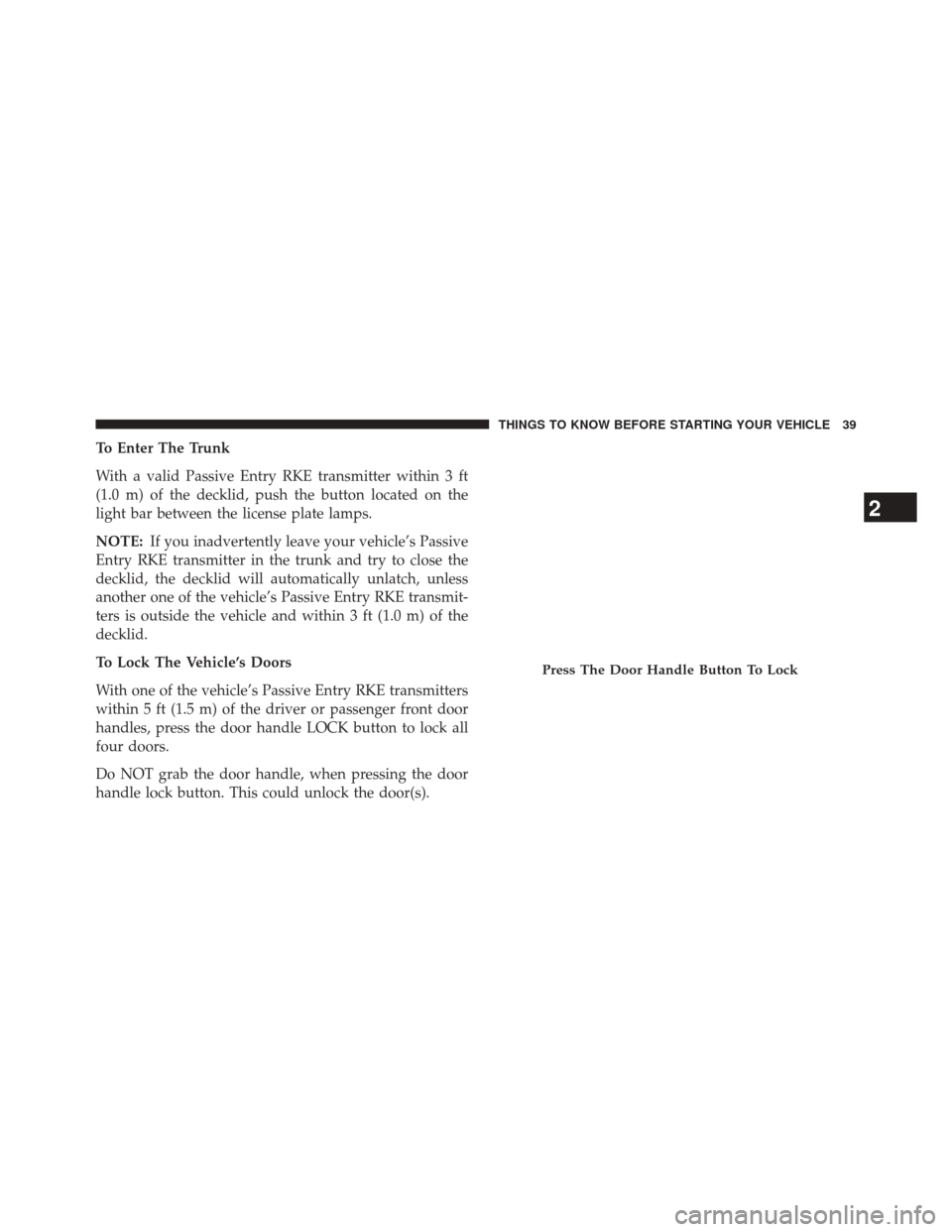
To Lock The Vehicle’s Doors
With one of the vehicle’s Passive Entry RKE transmitters
within 5 ft (1.5 m) of the driver or passenger front door
handles, press the door handle LOCK button to lock all
four doors.
Do NOT grab the door handle, when pressing the door
handle lock button. This could unlock the door(s).
Press The Door Handle Button To Lock
2
THINGS TO KNOW BEFORE STARTING YOUR VEHICLE 39
Page 45 of 698
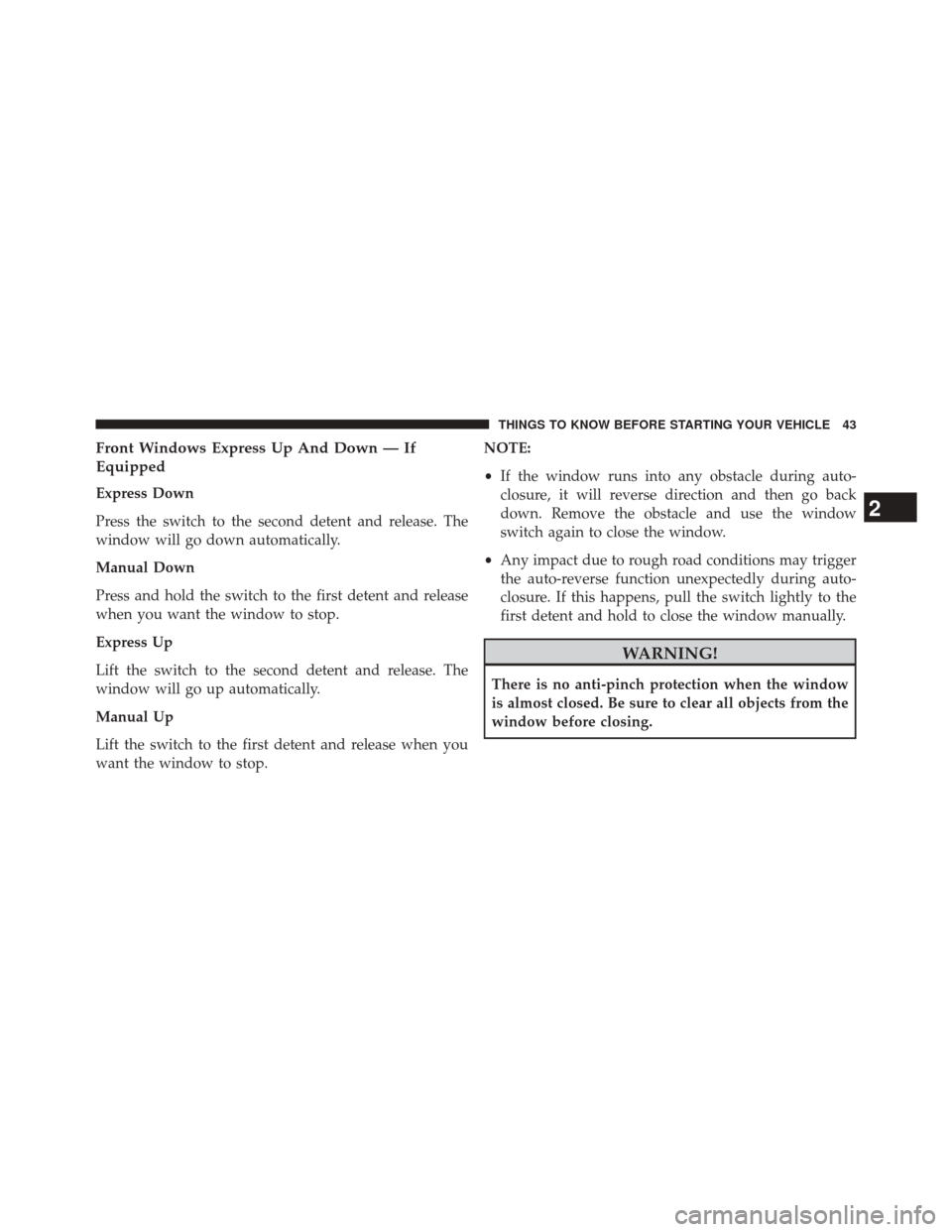
Front Windows Express Up And Down — If
Equipped
Express Down
Press the switch to the second detent and release. The
window will go down automatically.
Manual Down
Press and hold the switch to the first detent and release
when you want the window to stop.
Express Up
Lift the switch to the second detent and release. The
window will go up automatically.
Manual Up
Lift the switch to the first detent and release when you
want the window to stop.NOTE:
•
If the window runs into any obstacle during auto-
closure, it will reverse direction and then go back
down. Remove the obstacle and use the window
switch again to close the window.
• Any impact due to rough road conditions may trigger
the auto-reverse function unexpectedly during auto-
closure. If this happens, pull the switch lightly to the
first detent and hold to close the window manually.
WARNING!
There is no anti-pinch protection when the window
is almost closed. Be sure to clear all objects from the
window before closing.
2
THINGS TO KNOW BEFORE STARTING YOUR VEHICLE 43
Page 51 of 698
ejection and the risk of injury caused by striking the
inside of the vehicle. Everyone in a motor vehicle should
be belted at all times.
Enhanced Seat Belt Use Reminder System
(BeltAlert®)
BeltAlert® is a feature intended to remind the
driver and outboard front passenger (if equipped with
outboard front passenger BeltAlert®) to buckle their
seat belts. The feature is active whenever the ignition
switch is in the START or ON/RUN position. If the
driver or outboard front seat passenger is unbelted,
the Seat Belt Reminder Light will turn on and remain
on until both outboard front seat belts are buckled.
The BeltAlert® warning sequence begins after the vehicle
speed is over 5 mph (8 km/h) by blinking the Seat Belt
Reminder Light and sounding an intermittent chime.
Once the sequence starts, it will continue for the entire
duration or until the respective seat belts are buckled. After the sequence completes, the Seat Belt Reminder
Light remains illuminated until the respective seat belts
are buckled. The driver should instruct all other occu-
pants to buckle their seat belts. If an outboard front seat
belt is unbuckled while traveling at speeds greater than
5 mph (8 km/h), BeltAlert® will provide both audio and
visual notification.
The outboard front passenger seat BeltAlert® is not
active when the outboard front passenger seat is unoc-
cupied. BeltAlert® may be triggered when an animal or
heavy object is on the outboard front passenger seat or
when the seat is folded flat (if equipped). It is recom-
mended that pets be restrained in the rear seat (if
equipped) in pet harnesses or pet carriers that are se-
cured by seat belts, and cargo is properly stowed.
BeltAlert® can be activated or deactivated by your au-
thorized dealer. Chrysler Group LLC does not recom-
mend deactivating BeltAlert®.
2
THINGS TO KNOW BEFORE STARTING YOUR VEHICLE 49
Page 52 of 698
NOTE:If BeltAlert® has been deactivated, the Seat Belt
Reminder Light will continue to illuminate while the
driver ’s or outboard front passenger ’s (if equipped with
BeltAlert®) seat belt remains unbuckled.
Lap/Shoulder Belts
All seating positions in your vehicle are equipped with
lap/shoulder belts.
The seat belt webbing retractor will lock only during very
sudden stops or collisions. This feature allows the shoul-
der part of the seat belt to move freely with you under
normal conditions. However, in a collision the seat belt
will lock and reduce your risk of striking the inside of the
vehicle or being thrown out of the vehicle.
WARNING!
• Relying on the air bags alone could lead to more
severe injuries in a collision. The air bags work
with your seat belt to restrain you properly. In
some collisions, the air bags won’t deploy at all.
Always wear your seat belt even though you have
air bags.
• In a collision, you and your passengers can suffer
much greater injuries if you are not properly buck-
led up. You can strike the interior of your vehicle or
other passengers, or you can be thrown out of the
vehicle. Always be sure you and others in your
vehicle are buckled up properly.
• It is dangerous to ride in a cargo area, inside or
outside of a vehicle. In a collision, people riding in
these areas are more likely to be seriously injured
or killed.
(Continued)
50 THINGS TO KNOW BEFORE STARTING YOUR VEHICLE
Page 62 of 698
How To Disengage The Automatic Locking Mode
Unbuckle the combination lap/shoulder belt and allow it
to retract completely to disengage the Automatic Locking
Mode and activate the vehicle sensitive (emergency)
locking mode.
WARNING!
•The seat belt assembly must be replaced if the
switchable Automatic Locking Retractor (ALR) fea-
ture or any other seat belt function is not working
properly when checked according to the proce-
dures in the Service Manual.
• Failure to replace the seat belt assembly could
increase the risk of injury in collisions.
(Continued)
WARNING! (Continued)
•Do not use the Automatic Locking Mode to restrain
occupants who are wearing the seat belt or children
who are using booster seats. The locked mode is
only used to install rear-facing or forward-facing
child restraints that have a harness for restraining
the child.
Supplemental Restraint System (SRS)
Air Bag System Components
Your vehicle may be equipped with the following air bag
system components:
• Occupant Restraint Controller (ORC)
• Air Bag Warning Light
•Steering Wheel and Column
• Instrument Panel
60 THINGS TO KNOW BEFORE STARTING YOUR VEHICLE
Page 67 of 698
Seat belts are necessary for your protection in all colli-
sions, and also are needed to help keep you in position,
away from an inflating air bag.
When the ORC detects a collision requiring the Ad-
vanced Front Air Bags, it signals the inflator units. A large
quantity of non-toxic gas is generated to inflate the
Advanced Front Air Bags.
The steering wheel hub trim cover and the upper right
side of the instrument panel separate and fold out of the
way as the air bags inflate to their full size. The Advanced
Front Air Bags fully inflate in less time than it takes to
blink your eyes. The air bags then quickly deflate while
helping to restrain the driver and front passenger.Occupant Classification System (OCS) — Front
Passenger Seat
The OCS is part of a Federally regulated safety system for
this vehicle. It is designed to provide Passenger Ad-
vanced Front Air Bag output appropriate to the occu-
pant’s seated weight, as determined by the OCS.
The Occupant Classification System (OCS) consists of the
following:
•Occupant Restraint Controller (ORC)
• Occupant Classification Module (OCM) and Sensor
located in the front passenger seat
• Air Bag Warning Light
2
THINGS TO KNOW BEFORE STARTING YOUR VEHICLE 65
Page 68 of 698
Occupant Classification Module (OCM) and Sensor
The Occupant Classification Module (OCM) is located
underneath the front passenger seat. The Sensor is lo-
cated beneath the passenger seat cushion foam. Any
weight on the seat will be sensed by the Sensor. The OCM
uses input from the Sensor to determine the front pas-
senger ’s most probable classification. The OCM commu-
nicates this information to the ORC. The ORC may
reduce the inflation rate of the Passenger Advanced Front
Air Bag deployment based on occupant classification. In
order for the OCS to operate as designed, it is important
for the front passenger to be seated properly and prop-
erly wearing the seat belt.
The OCS will NOT prevent deployment of the Passenger
Advanced Front Air Bag. The OCS may reduce the
inflation rate of the Passenger Advanced Front Air Bag if
the OCS estimates that:•
The front passenger seat is unoccupied or has very
light objects on it; or
• The front passenger seat is occupied by a small pas-
senger, including a child; or
• The front passenger seat is occupied by a rear-facing
child restraint; or
• The front passenger is not properly seated or his or her
weight is taken off of the seat for a period of time.
Front Passenger Seat Oc- cupant Status Front Passenger Air
Bag Output
Rear-facing child restraint Reduced-power de- ployment
Child, including a child in
a forward-facing child re-
straint or booster seat* Reduced-power de-
ployment OR Full-
power deployment
66 THINGS TO KNOW BEFORE STARTING YOUR VEHICLE
Page 71 of 698
Lighter Weight Passengers (Including Small Adults)
When a lighter weight passenger, including a small adult,
occupies the front passenger seat, the OCS may reduce the
inflation rate of the Passenger Advanced Front Air Bag.
This does not mean that the OCS is working improperly.
Do not decrease OR increase the front passenger ’s
seated weight on the front passenger seat
The front passenger ’s seated weight must be properly
positioned on the front passenger seat. Failure to do so
may result in serious injury or death. The OCS deter-
mines the most probable classification of the occupant
that it detects.
The OCS will detect the front passenger ’s decreased or
increased seated weight, which may result in an adjusted
inflation rate of the Passenger Advanced Front Air Bag in a
collision. This does not mean that the OCS is working
improperly.
Decreasing the front passenger ’s seated weight on the
front passenger seat may result in a reduced-power
deployment of the Passenger Advanced Front Air Bag.
Increasing the front passenger ’s seated weight on the
front passenger seat may result in a full-power deploy-
ment of the Passenger Advanced Front Air Bag.
Examples of improper front passenger seating include:
•The front passenger ’s weight is transferred to another
part of the vehicle (like the door, arm rest or instru-
ment panel).
• The front passenger leans forward, sideways, or turns
to face the rear of the vehicle.
• The front passenger ’s seatback is not in the full upright
position.
• The front passenger carries or holds an object while
seated (e.g., backpack, box, etc.)
2
THINGS TO KNOW BEFORE STARTING YOUR VEHICLE 69
Page 75 of 698
WARNING!(Continued)
•Placing an object on the floor under the front
passenger seat may prevent the OCS from working
properly, which may result in serious injury or
death in a collision. Do not place any objects on the
floor under the front passenger seat.
The Air Bag Warning Light
in the instrument panel
will turn on whenever the OCS is unable to classify the
front passenger seat status. A malfunction in the OCS
may affect the operation of the air bag system.
If the Air Bag Warning Lightdoes not come on, or
stays on after you start the vehicle, or it comes on as
you drive, take the vehicle to an authorized dealer for
service immediately.
The passenger seat assembly contains critical OCS com-
ponents that may affect the Passenger Advanced Front
Air Bag inflation. In order for the OCS to properly classify the seated weight of a front seat passenger, the
OCS components must function as designed.
Do not make any modifications to the front passenger
seat components, assembly, or to the seat cover. If the
seat, trim cover, or cushion needs service for any reason,
take the vehicle to your authorized dealer. Only Chrysler
Group LLC approved seat accessories may be used.
The following requirements must be strictly followed:
•
Do not modify the front passenger seat assembly or
components in any way.
• Do not use prior or future model year seat covers or
cushions not designated by Chrysler Group LLC for
the specific model being repaired. Always use the
correct seat cover and cushion specified for the vehicle.
• Do not replace the seat cover or cushion with an
aftermarket seat cover or cushion.
2
THINGS TO KNOW BEFORE STARTING YOUR VEHICLE 73
Page 76 of 698
•Do not add a secondary seat cover or mat.
• At no time should any Supplemental Restraint System
(SRS) component or SRS related component or fastener
be modified or replaced with any part except those
which are approved by Chrysler Group LLC .
WARNING!
Unapproved modifications or service procedures to
the passenger seat assembly, its related components,
seat cover or cushion may inadvertently change the
air bag deployment in case of a frontal collision. This
could result in death or serious injury to the front
passenger if the vehicle is involved in a collision. A
modified vehicle may not comply with required
Federal Motor Vehicle Safety Standards (FMVSS)
and/or Canadian Motor Vehicle Safety Standards
(CMVSS).
Knee Impact Bolsters
The Knee Impact Bolsters help protect the knees of the
driver and front passenger, and position the front occu-
pants for improved interaction with the Advanced Front
Air Bags.
WARNING!
• Do not drill, cut, or tamper with the knee impact
bolsters in any way.
• Do not mount any accessories to the knee impact
bolsters such as alarm lights, stereos, citizen band
radios, etc.
74 THINGS TO KNOW BEFORE STARTING YOUR VEHICLE