belt CHRYSLER 200 2017 2.G Workshop Manual
[x] Cancel search | Manufacturer: CHRYSLER, Model Year: 2017, Model line: 200, Model: CHRYSLER 200 2017 2.GPages: 539, PDF Size: 5.18 MB
Page 239 of 539
NOTE:You may experience deformation in the seat cush-
ion from the seat belt buckles if the seats are left folded for
an extended period of time. This is normal and by simply
opening the seats to the open position, over time the seat
cushion will return to its normal shape.
When the seatback is folded to the upright position, make
sure it is latched by strongly pulling on the top of the
seatback above the seat strap.
WARNING!
• Be certain that the seatback is securely locked into
position. If the seatback is not securely locked into
position, the seat will not provide the proper stabil-
ity for child seats and/or passengers. An improperly
latched seat could cause serious injury.
• The cargo area in the rear of the vehicle (with the rear
seatbacks in the locked-up or folded down position)
should not be used as a play area by children when
the vehicle is in motion. They could be seriously
injured in a collision. Children should be seated and
using the proper restraint system.
• To help protect against personal injury, passengers
should not be seated in the rear cargo area. The rear
cargo space is intended for load carrying purposes
only, not for passengers, who should sit in seats and
use seat belts.
(Continued)
Folded Rear Seatback
3
UNDERSTANDING THE FEATURES OF YOUR VEHICLE 237
Page 249 of 539
WARNING AND INDICATOR LIGHTS
IMPORTANT:The warning / indicator lights switch on in
the instrument panel together with a dedicated message
and/or acoustic signal when applicable. These indications
are indicative and precautionary and as such must not be
considered as exhaustive and/or alternative to the
information contained in the Owner ’s Manual, which you
are advised to read carefully in all cases. Always refer to
the information in this chapter in the event of a failure
indication. All active telltales will display first if applicable. The
system check menu may appear different based upon
equipment options and current vehicle status. Some tell-
tales are optional and may not appear.
Red Telltale Indicator Lights
Seat Belt Reminder Warning Light
Red Telltale
Light What It Means
Seat Belt Reminder Warning Light
When the ignition is first placed in the ON/RUN position, if the driver ’s seat belt is unbuckled, a
chime will sound and the light will turn on. When driving, if the driver or front passenger seat
belt remains unbuckled, the Seat Belt Reminder Light will flash or remain on continuously and a
chime will sound. Refer to “Occupant Restraints” in “Things To Know Before Starting Your Ve-
hicle” for further information.
4
UNDERSTANDING YOUR INSTRUMENT PANEL 247
Page 276 of 539
3. Without pushing the brake pedal, push the ENGINESTART/STOP button once to return the ignition to the
OFF/LOCK position.
The Oil Life can also be reset through the instrument
cluster display.
Secondary Method Of Navigating To The Oil Life Screen
In The Display And Holding OK
1. Without pushing the brake pedal, push the ENGINE START/STOP button and cycle the ignition to the ON/
RUN position (do not start the engine).
2. Push and release the DOWN
arrow button to scroll
downward through the main menu to “Vehicle Info.”
3. Push and release the RIGHTarrow button to access
the “Oil Life” screen.
4. Push and hold the OKbutton to reset the Oil Life.
5. Push and release the UP
arrow button to exit the
screen.
NOTE: If the indicator message illuminates when you
start the vehicle, the oil change indicator system did not
reset. If necessary, repeat this procedure.
Instrument Cluster Display Messages
• Front Seatbelts Unbuckled
• Driver Seatbelt Unbuckled
• Passenger Seatbelt Unbuckled
• Service Airbag System
• Traction Control Off
• Washer Fluid Low
• Oil Pressure Low
• Oil Change Due
• Fuel Low
• Service Antilock Brake System
• Service Electronic Throttle Control
• Service Power Steering
• Cruise Off
• Cruise Ready
• Cruise Set To XXX MPH
• Cruise Set To XXX KM/H
274 UNDERSTANDING YOUR INSTRUMENT PANEL
Page 346 of 539
STARTING PROCEDURES
Before starting your vehicle, adjust your seat, adjust both
inside and outside mirrors, and fasten your seat belts.
WARNING!
•When leaving the vehicle, always remove the key fob
from the ignition and lock your vehicle.
• Never leave children alone in a vehicle, or with
access to an unlocked vehicle.
• Allowing children to be in a vehicle unattended is
dangerous for a number of reasons. A child or others
could be seriously or fatally injured. Children
should be warned not to touch the parking brake,
brake pedal or the gear selector.
• Do not leave the key fob in or near the vehicle, or in
a location accessible to children, and do not leave the
ignition of a vehicle equipped with Keyless Enter-
N-Go in the ACC or ON/RUN mode. A child could
operate power windows, other controls, or move the
vehicle.
Start the engine with the gear selector in the NEUTRAL or
PARK position. Apply the brake before shifting to any
driving range.
Normal Starting — Gasoline Engine
NOTE: Normal starting of either a cold or a warm engine
is obtained without pumping or pressing the accelerator
pedal.
Cycle the ignition switch to the START position and release
when the engine starts. If the engine fails to start within 10
seconds, cycle the ignition switch to the LOCK/OFF posi-
tion, wait 10 to 15 seconds, then repeat the “Normal
Starting” procedure.
Tip Start Feature
Cycle the ignition switch to START position and release it.
The starter motor will continue to run, and will automati-
cally disengage itself when the engine is running. If the
engine fails to start, the starter will disengage automati-
cally in 10 seconds. If this occurs, cycle the ignition switch
to the OFF position, wait 10 to 15 seconds, then repeat the
“Normal Starting” procedure.
Extreme Cold Weather (Below –22°F Or 30°C)
To ensure reliable starting at these temperatures, use of an
externally powered electric engine block heater (available
from your authorized dealer) is recommended.
344 STARTING AND OPERATING
Page 362 of 539
To apply the park brake manually, pull up on the switch
momentarily. You may hear a slight whirring sound from
the back of the vehicle while the park brake engages. Once
the park brake is fully engaged, the BRAKE warning lamp
in the instrument cluster and an indicator on the switch
will illuminate. If your foot is on the brake pedal while you
apply the park brake, you may notice a small amount of
brake pedal movement. The park brake can be applied
even when the ignition switch if OFF, however, it can only
be released when the ignition switch in the RUN position.NOTE:
The EPB fault lamp will illuminate if the EPB
switch is held for longer than 20 seconds in the applied
position or 90 seconds in the released position. The light
will extinguish upon releasing the switch.
If the Auto Park Brake feature is enabled, the parking brake
will automatically engage whenever the transmission is
placed into PARK. Once the park brake is engaged, the
BRAKE warning lamp in the instrument cluster and the
LED indicator on the switch will illuminate. If your foot is
on the brake pedal, you may notice a small amount of
brake pedal movement while the parking brake is engag-
ing.
The park brake will release automatically when the igni-
tion is cycled to the RUN position, the transmission is in
DRIVE or REVERSE, the driver seat belt is buckled, and an
attempt is made to drive away by pressing the accelerator
pedal.
To release the parking brake manually, the ignition switch
must be in the RUN position. Press on the brake pedal,
then push the park brake switch down momentarily. You
may hear a slight whirring sound from the back of the
vehicle while the parking brake disengages. You may also
notice a small amount of movement in the brake pedal.
Electric Park Brake Switch
360 STARTING AND OPERATING
Page 364 of 539
CAUTION!
If the Brake System Warning Light remains on with the
parking brake released, a brake system malfunction is
indicated. Have the brake system serviced by an au-
thorized dealer immediately.
If exceptional circumstances should make it necessary to
engage the park brake while the vehicle is in motion,
maintain upward pressure on the electric park brake
switch for as long as engagement is desired. The BRAKE
warning lamp will illuminate, and a continuous chime will
sound. The rear stop lamps will also be illuminated auto-
matically while the vehicle remains in motion.
To disengage the park brake while the vehicle is in motion,
release the switch. If the vehicle is brought to a complete
stop using the park brake, when the vehicle reaches
approximately 3 mph (4.8 km/h), the park brake will
remain engaged.
In the unlikely event of a malfunction of the Electric Park
Brake system, a yellow EPB fault lamp will illuminate. This
may be accompanied by the BRAKE warning lamp flash-
ing. In this case, urgent service of the electric park brake
system is required. Do not rely on the park brake to hold
the vehicle stationary.
Auto Park Brake
The Electric Park Brake can be programmed to be applied
automatically whenever the vehicle is at a standstill and
the automatic transmission is placed in PARK. Auto Park
Brake is enabled and disabled by customer selection
through the customer programmable features section of the
Uconnect Settings.
Any single Auto Park Brake application can be bypassed
by holding the EPB switch in the release position while the
transmission is being placed into PARK. This bypass can be
reset by cycling the ignition off and back on again, or by
driving the vehicle up to at least 12 mph (20 km/h), or by
going to the personal setting menu and turning the Auto
Park Brake function OFF and then back ON again.
SafeHold
SafeHold is a safety feature of the Electric Park Brake
System that will engage the park brake automatically if the
vehicle is left unsecured. If the automatic transmission is
not in PARK, the seat belt is unbuckled, the driver door is
open, the vehicle is at a standstill, and there is no attempt
to depress the brake pedal or accelerator pedal, the park
brake will automatically engage to prevent the vehicle
from rolling.
362 STARTING AND OPERATING
Page 461 of 539
cleaning of the condenser fins and a performance test.
Drive belt tension should also be checked at this time.
WARNING!
•Use only refrigerants and compressor lubricants ap-
proved by the manufacturer for your air conditioning
system. Some unapproved refrigerants are flam-
mable and can explode, injuring you. Other unap-
proved refrigerants or lubricants can cause the sys-
tem to fail, requiring costly repairs. Refer to
Warranty Information Book, located on the DVD, for
further warranty information.
• The air conditioning system contains refrigerant un-
der high pressure. To avoid risk of personal injury or
damage to the system, adding refrigerant or any
repair requiring lines to be disconnected should be
done by an experienced technician.
CAUTION!
Do not use chemical flushes in your air conditioning
system as the chemicals can damage your air condition-
ing components. Such damage is not covered by the
New Vehicle Limited Warranty.
Refrigerant Recovery And Recycling HFO 1234yf
HFO 1234yf Air Conditioning Refrigerant is a hydro-
fluoolefine HFO that is endorsed by the Environmental
Protection Agency and is an ozone-saving product. The
manufacturer recommends that air conditioning service be
performed by authorized dealer using recovery and recy-
cling equipment.
NOTE: Use only manufacturer approved A/C system
PAG compressor oil, and refrigerants.
Cabin Air Filter
WARNING!
Do not remove the cabin air filter while the vehicle is
running, or while the ignition is in the ACC or ON/
RUN mode. With the cabin air filter removed and the
blower operating, the blower can contact hands and
may propel dirt and debris into your eyes, resulting in
personal injury.
7
MAINTAINING YOUR VEHICLE 459
Page 478 of 539
with electric defrosters or windows equipped with radio
antennas. Do not use scrapers or other sharp instrument
that may scratch the elements.
When cleaning the rear view mirror, spray cleaner on the
towel or cloth that you are using. Do not spray cleaner
directly on the mirror.
Cleaning Plastic Instrument Cluster Lenses
The lenses in front of the instruments in this vehicle are
molded in clear plastic. When cleaning the lenses, care
must be taken to avoid scratching the plastic.
1. Clean with a wet soft cloth. A mild soap solution may beused, but do not use high alcohol content or abrasive
cleaners. If soap is used, wipe clean with a clean damp
cloth.
2. Dry with a soft cloth.
Seat Belt Maintenance
Do not bleach, dye or clean the belts with chemical solvents
or abrasive cleaners. This will weaken the fabric. Sun
damage can also weaken the fabric.
If the belts need cleaning, use a mild soap solution or
lukewarm water. Do not remove the belts from the vehicle
to wash them. Dry with a soft cloth. Replace the belts if they appear frayed or worn or if the
buckles do not work properly.
NOTE:
If the belts retract slowly, inspect the upper turning
loop for soiling. If soiling is present, clean with a wet soft
cloth until all residue is removed.
WARNING!
A frayed or torn belt could rip apart in a collision and
leave you with no protection. Inspect the belt system
periodically, checking for cuts, frays, or loose parts.
Damaged parts must be replaced immediately. Do not
disassemble or modify the system. Seat belt assemblies
must be replaced after a collision if they have been
damaged (i.e., bent retractor, torn webbing, etc.).
FUSES
WARNING!
• When replacing a blown fuse, always use an appro-
priate replacement fuse with the same amp rating as
the original fuse. Never replace a fuse with another
fuse of higher amp rating. Never replace a blown
(Continued)
476 MAINTAINING YOUR VEHICLE
Page 510 of 539
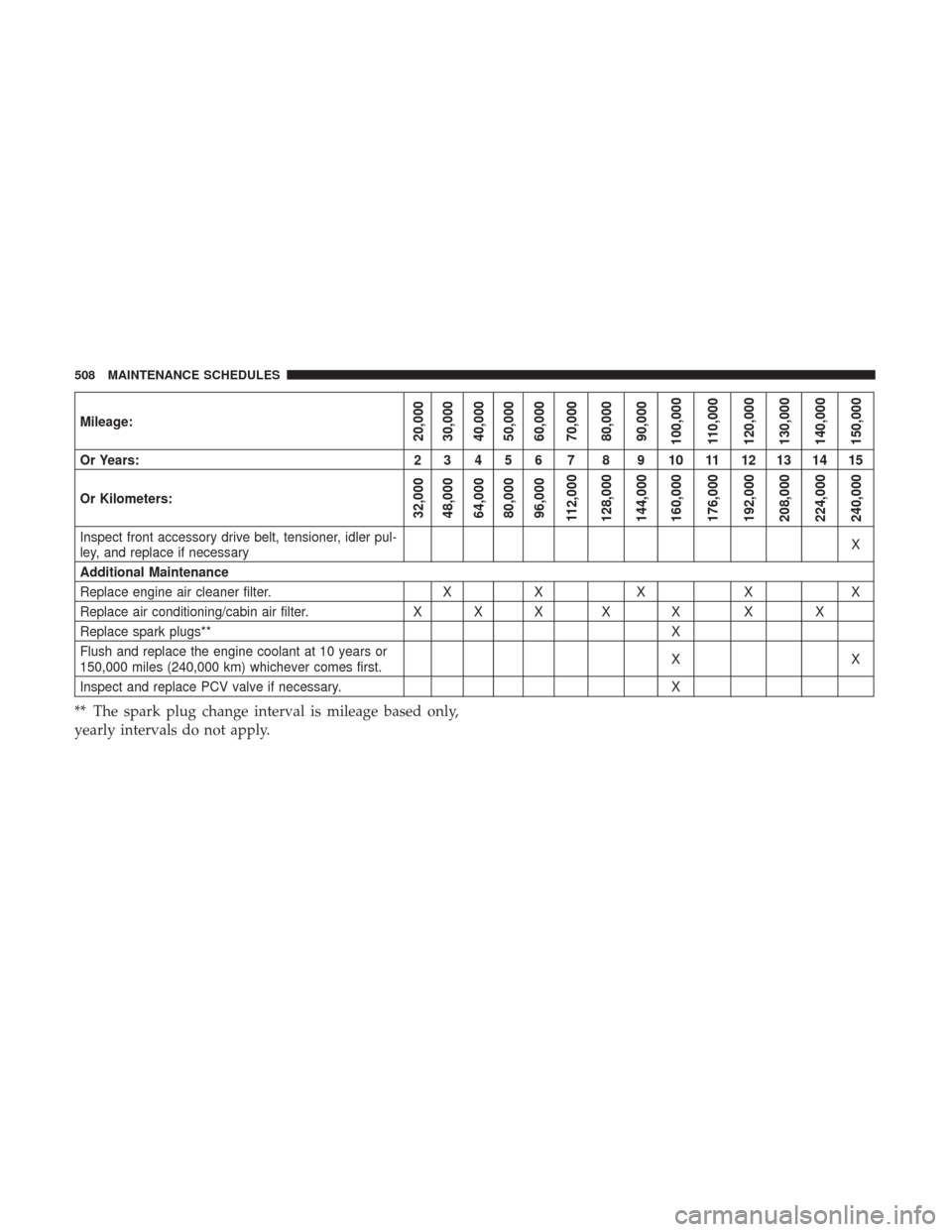
Mileage:20,000
30,000
40,000
50,000
60,000
70,000
80,000
90,000
100,000
110,000
120,000
130,000
140,000
150,000
Or Years: 2 3 4 5 6 7 8 9 10 11 12 13 14 15
Or Kilometers:
32,000
48,000
64,000
80,000
96,000
112,000
128,000
144,000
160,000
176,000
192,000
208,000
224,000
240,000
Inspect front accessory drive belt, tensioner, idler pul-
ley, and replace if necessary X
Additional Maintenance
Replace engine air cleaner filter. XX X XX
Replace air conditioning/cabin air filter. X X X X X X X
Replace spark plugs** X
Flush and replace the engine coolant at 10 years or
150,000 miles (240,000 km) whichever comes first. XX
Inspect and replace PCV valve if necessary. X
** The spark plug change interval is mileage based only,
yearly intervals do not apply.
508 MAINTENANCE SCHEDULES
Page 523 of 539
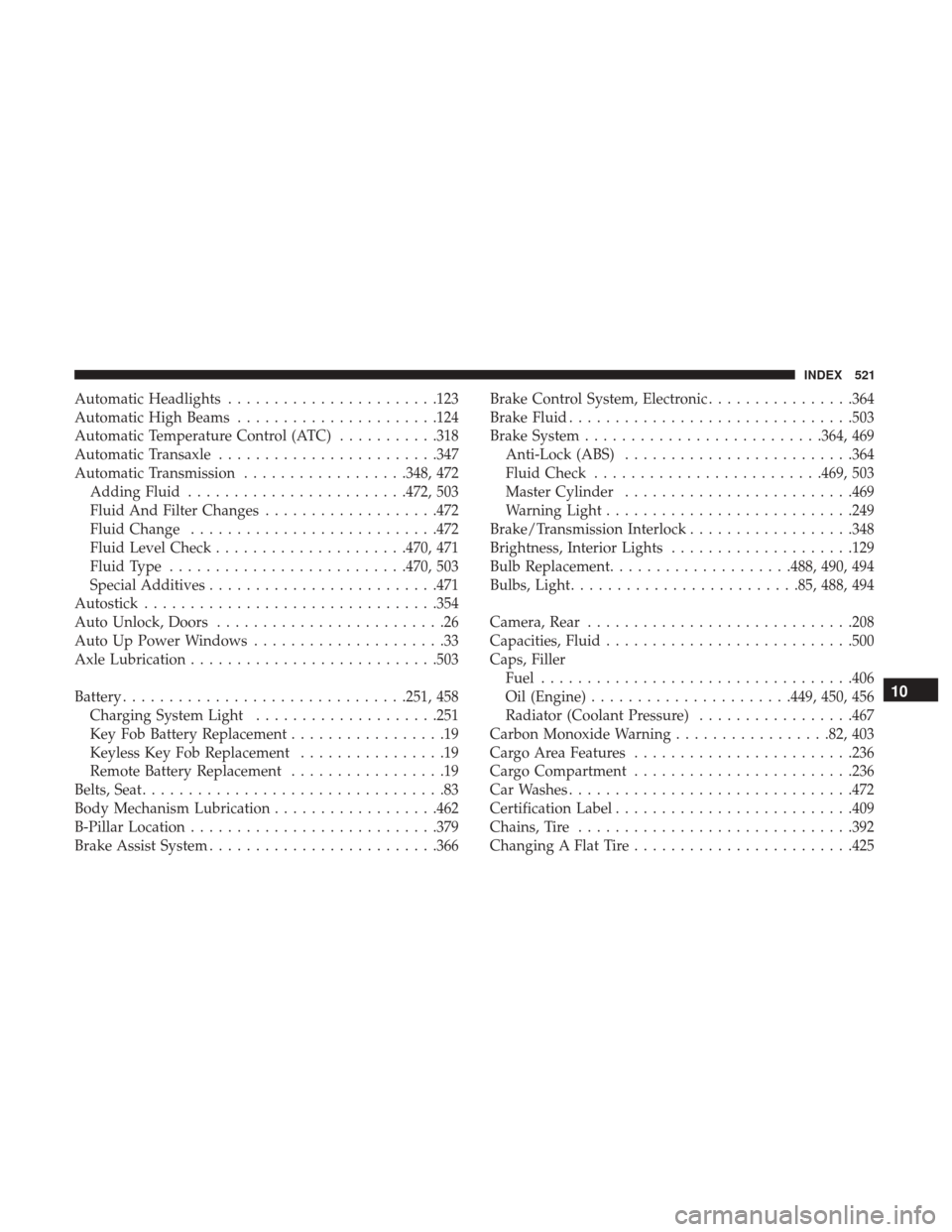
Automatic Headlights...................... .123
Automatic High Beams ..................... .124
Automatic Temperature Control (ATC) ...........318
Automatic Transaxle ....................... .347
Automatic Transmission ..................348, 472
Adding Fluid ....................... .472, 503
Fluid And Filter Changes ...................472
Fluid Change .......................... .472
Fluid Level Check .....................470, 471
Fluid Type ......................... .470, 503
Special Additives ........................ .471
Autostick ............................... .354
Auto Unlock, Doors .........................26
Auto Up Power Windows .....................33
Axle Lubrication .......................... .503
Battery .............................. .251, 458
Charging System Light ....................251
Key Fob Battery Replacement .................19
Keyless Key Fob Replacement ................19
Remote Battery Replacement .................19
Belts, Seat .................................83
Body Mechanism Lubrication ..................462
B-Pillar Location .......................... .379
Brake Assist System ........................ .366Brake Control System, Electronic
................364
Brake Fluid .............................. .503
Brake System ......................... .364, 469
Anti-Lock (ABS) ........................ .364
Fluid Check ........................ .469, 503
Master Cylinder ........................ .469
Warning Light .......................... .249
Brake/Transmission Interlock ..................348
Brightness, Interior Lights ....................129
Bulb Replacement ....................488, 490, 494
Bulbs, Light ........................ .85, 488, 494
Camera, Rear ............................ .208
Capacities,
Fluid .......................... .500
Caps, Filler Fuel ................................. .406
Oil (Engine) ..................... .449, 450, 456
Radiator (Coolant Pressure) .................467
Carbon Monoxide Warning .................82, 403
Cargo Area Features ....................... .236
Cargo Compartment ....................... .236
Car Washes .............................. .472
Certification Label ......................... .409
Chains, Tire ............................. .392
Changing A Flat Tire ....................... .425
10
INDEX 521