brake CHRYSLER 300 2013 2.G Owner's Manual
[x] Cancel search | Manufacturer: CHRYSLER, Model Year: 2013, Model line: 300, Model: CHRYSLER 300 2013 2.GPages: 132, PDF Size: 5.2 MB
Page 90 of 132

BATTERY LOCATION
• The battery is stored under an access cover in the trunk. Remote battery posts are located onthe right side of the engine compartment for jump-starting.
JUMP-STARTING
• If your vehicle has a discharged battery itcan be jump-started using a set of jumper
cables and a battery in another vehicle or by
using a portable battery booster pack.
• Jump-starting can be dangerous if done improperly so please follow the procedures
in this section carefully.
NOTE:
When using a portable battery booster pack
follow the manufacturer’s operating instruc-
tions and precautions.
Preparations for Jump-Start
• The battery is stored under an access cover in the trunk. Remote battery posts are located on the right side of the engine compartment for jump-starting.
NOTE:
The remote battery posts are viewed by standing on the right side of the vehicle looking over the
fender.
• Set the parking brake, shift the automatic transmission into PARK and turn the ignition to OFF.
• Turn off the heater, radio, and all unnecessary electrical accessories.
• If using another vehicle to jump-start the battery, park the vehicle within the jumper cables reach, set the parking brake and make sure the ignition is OFF.
Jump-Starting Procedure
• Connect the positive (+)end of the jumper cable to the remote positive (+)post of the
discharged vehicle.
• Connect the opposite end of the positive (+)jumper cable to the positive (+)post of the
booster battery.
•
Connect the negative end(-) of the jumper cable to the negative (-)post of the booster battery.
• Connect the opposite end of the negative (-)jumper cable to the remote negative (-)post of
the vehicle with the discharged battery.
• Start the engine in the vehicle that has the booster battery, let the engine idle a few minutes, and then start the engine in the vehicle with the discharged battery.
WHAT TO DO IN EMERGENCIES
88
Page 92 of 132

SHIFT LEVER OVERRIDE
• If a malfunction occurs and the shift levercannot be moved out of the PARK position,
you can use the following procedure to tem-
porarily move the shift lever:• The shift lever override port is located in
the storage bin to the right of shift lever.
• Firmly set the parking brake.
• Turn the ignition switch to the ACC or ON position without starting the engine.
• Press and maintain firm pressure on the brake pedal.
• Using a screwdriver or similar tool, press and hold the override tab through the
access port on the center console.
• Move the shift lever into the NEUTRAL position.
• The vehicle may then be started in NEUTRAL.
• Reinstall the override cover.
MANUAL PARK RELEASE — 8 SPEED TRANSMISSION
(3.6L Engine)
• If a malfunction occurs and the shift lever cannot be moved out of the PARK position,
you can use the following procedure to tem-
porarily move the shift lever:
• Remove the console storage bin to access the Manual Park Release lever.
• Using a small screwdriver or similar tool, fish the tether strap up through the opening in
the console base.
• Insert the screwdriver into the slot in the center of the lever, and disengage the spring
steel lever locking tab by pushing it to the right.
WHAT TO DO IN EMERGENCIES
90
Page 93 of 132

• While holding the locking tab in the disengaged position, pull the tether strap to rotate thelever up and rearward, until it locks in place in the vertical position. The vehicle is now out of
PARK and can be towed. Release the parking brake only when the vehicle is securely
connected to a tow vehicle.
To Reset The Manual Park Release:
• Push the latch (at the base of the lever, on the rear side) rearward (away from the lever)
to unlatch the lever.
• Rotate the Manual Park Release lever for- ward and down, to its original position, until
the locking tab snaps into place to secure
the lever.
• Pull up gently on the tether strap to confirm that the lever is locked in its stowed position.
• Tuck the tether strap into the base of the console. Reinstall the console storage bin.
WARNING!
Always secure your vehicle by fully applying the parking brake, before activating the Manual
Park Release. Activating the Manual Park Release will allow your vehicle to roll away if it is not
secured by the parking brake or by proper connection to a tow vehicle. Activating the Manual
Park Release on an unsecured vehicle could lead to serious injury or death for those in or
around the vehicle.
WHAT TO DO IN EMERGENCIES
91
Page 96 of 132

EVENT DATA RECORDER (EDR)
• This vehicle is equipped with an Event Data Recorder (EDR). The main purpose of an EDR isto record, in certain crash or near crash-like situations, such as an air bag deployment or hitting
a road obstacle, data that will assist in understanding how a vehicle’s systems performed. The
EDR is designed to record data related to vehicle dynamics and safety systems for a short
period of time, typically 30 seconds or less. The EDR in this vehicle is designed to record such
data as:• How various systems in your vehicle were operating.
• Whether or not the driver and passenger safety belts were buckled/fastened.
• How far (if at all) the driver was depressing the accelerator and/or brake pedal.
• How fast the vehicle was traveling.
• These data can help provide a better understanding of the circumstances in which crashes and injuries occur.
NOTE:
EDR data are recorded by your vehicle only if a non-trivial crash situation occurs; no data are
recorded by the EDR under normal driving conditions and no personal data (e.g. name, gender,
age, and crash location) are recorded. However, other parties, such as law enforcement, could
combine the EDR data with the type of personally identifying data routinely acquired during a
crash investigation.
• To read data recorded by an EDR, special equipment is required, and access to the vehicle or the EDR is needed. In addition to the vehicle manufacturer, other parties such as law
enforcement, that have the special equipment, can read the information if they have access to
the vehicle or the EDR.
WHAT TO DO IN EMERGENCIES
94
Page 103 of 132
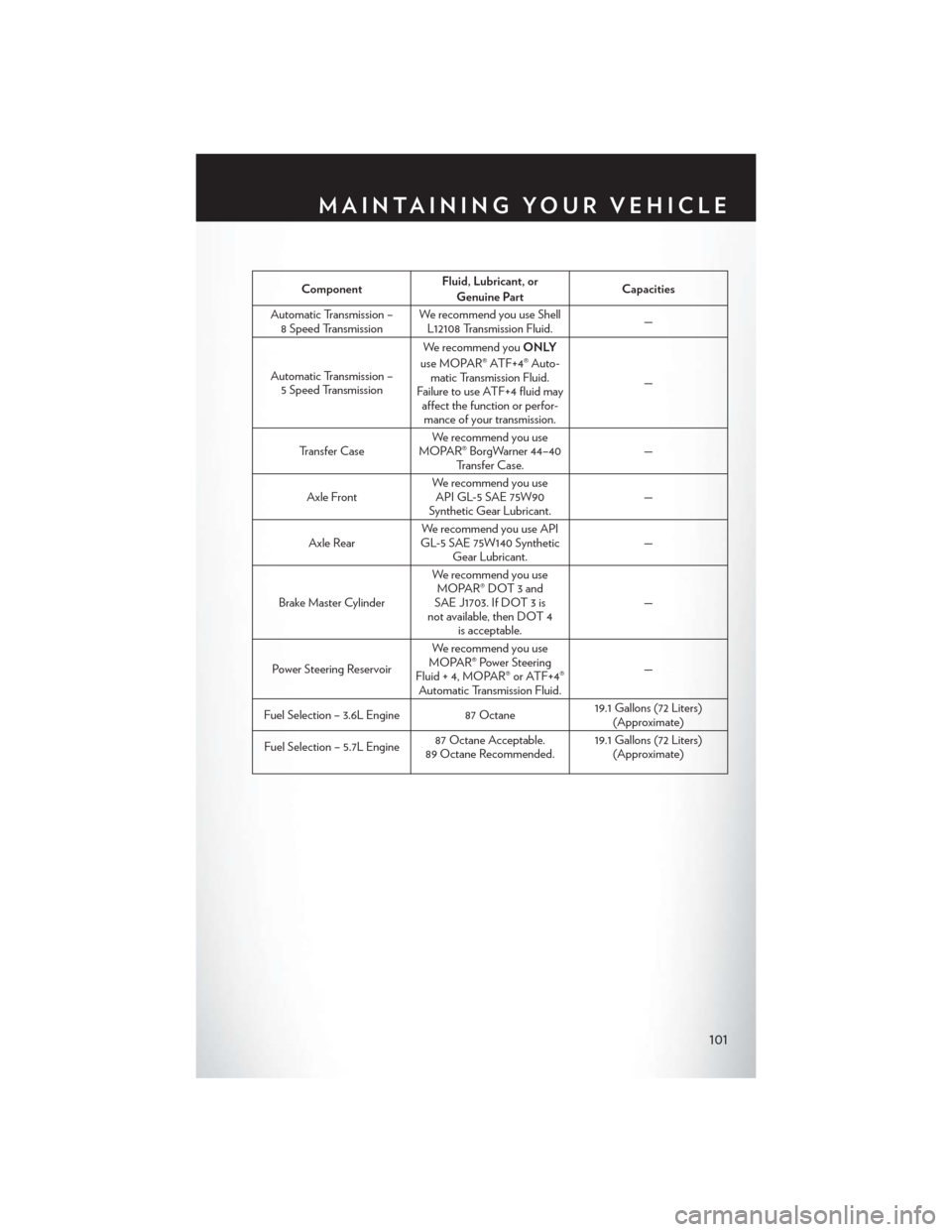
ComponentFluid, Lubricant, or
Genuine Part Capacities
Automatic Transmission – 8 Speed Transmission We recommend you use Shell
L12108 Transmission Fluid. —
Automatic Transmission – 5 Speed Transmission We recommend you
ONLY
use MOPAR® ATF+4® Auto- matic Transmission Fluid.
Failure to use ATF+4 fluid may affect the function or perfor-mance of your transmission. —
Transfer Case We recommend you use
MOPAR® BorgWarner 44–40 Transfer Case. —
Axle Front We recommend you use
API GL-5 SAE 75W90
Synthetic Gear Lubricant. —
Axle Rear We recommend you use API
GL-5 SAE 75W140 Synthetic Gear Lubricant. —
Brake Master Cylinder We recommend you use
MOPAR® DOT 3 and
SAE J1703. If DOT 3 is
not available, then DOT 4 is acceptable. —
Power Steering Reservoir We recommend you use
MOPAR® Power Steering
Fluid + 4, MOPAR® or ATF+4® Automatic Transmission Fluid. —
Fuel Selection – 3.6L Engine 87 Octane19.1 Gallons (72 Liters)
(Approximate)
Fuel Selection – 5.7L Engine 87 Octane Acceptable.
89 Octane Recommended. 19.1 Gallons (72 Liters)
(Approximate)
MAINTAINING YOUR VEHICLE
101
Page 106 of 132
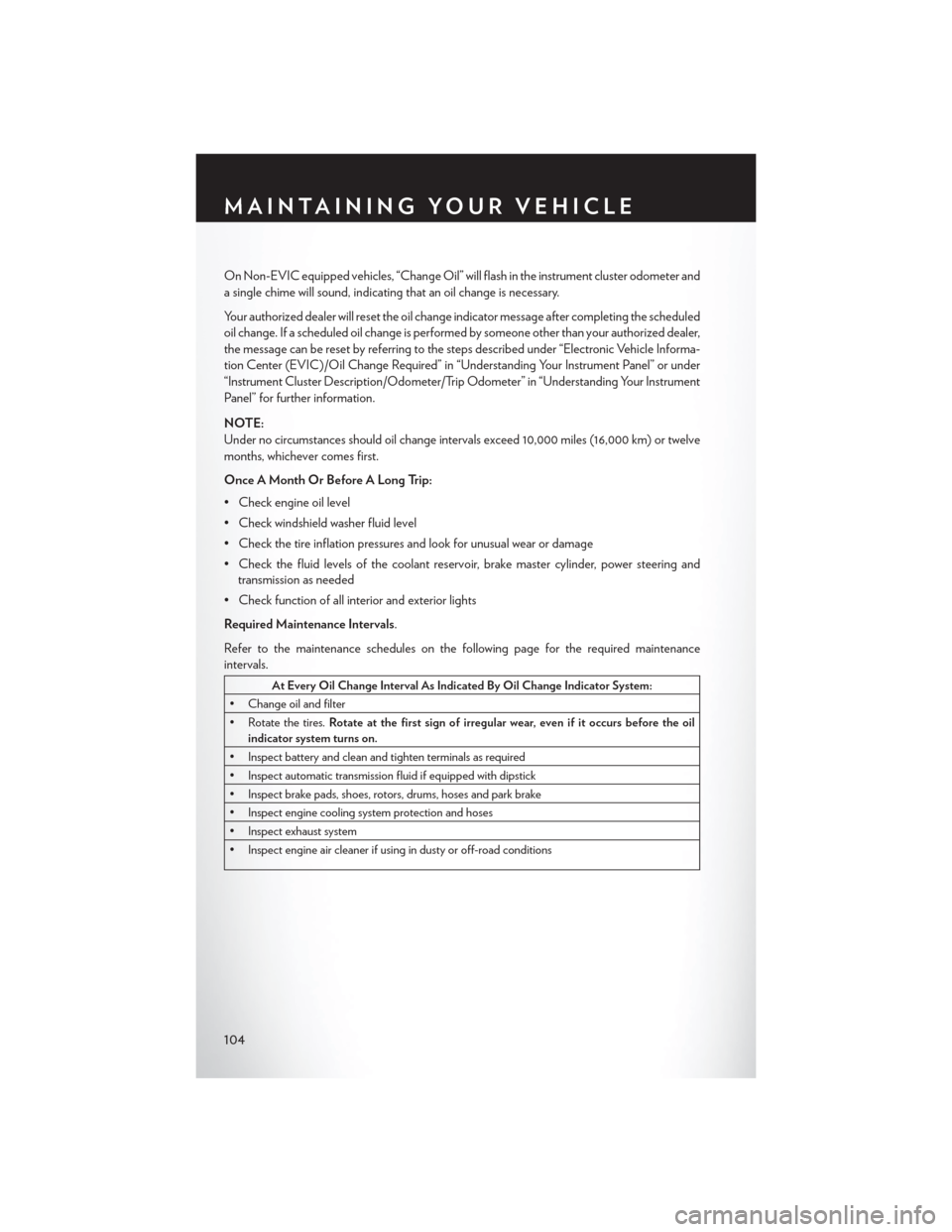
On Non-EVIC equipped vehicles, “Change Oil” will flash in the instrument cluster odometer and
a single chime will sound, indicating that an oil change is necessary.
Your authorized dealer will reset the oil change indicator message after completing the scheduled
oil change. If a scheduled oil change is performed by someone other than your authorized dealer,
the message can be reset by referring to the steps described under “Electronic Vehicle Informa-
tion Center (EVIC)/Oil Change Required” in “Understanding Your Instrument Panel” or under
“Instrument Cluster Description/Odometer/Trip Odometer” in “Understanding Your Instrument
Panel” for further information.
NOTE:
Under no circumstances should oil change intervals exceed 10,000 miles (16,000 km) or twelve
months, whichever comes first.
Once A Month Or Before A Long Trip:
• Check engine oil level
• Check windshield washer fluid level
• Check the tire inflation pressures and look for unusual wear or damage
• Check the fluid levels of the coolant reservoir, brake master cylinder, power steering andtransmission as needed
• Check function of all interior and exterior lights
Required Maintenance Intervals.
Refer to the maintenance schedules on the following page for the required maintenance
intervals.
At Every Oil Change Interval As Indicated By Oil Change Indicator System:
• Change oil and filter
• Rotate the tires. Rotate at the first sign of irregular wear, even if it occurs before the oil
indicator system turns on.
• Inspect battery and clean and tighten terminals as required
• Inspect automatic transmission fluid if equipped with dipstick
• Inspect brake pads, shoes, rotors, drums, hoses and park brake
• Inspect engine cooling system protection and hoses
• Inspect exhaust system
• Inspect engine air cleaner if using in dusty or off-road conditions
MAINTAINING YOUR VEHICLE
104
Page 107 of 132
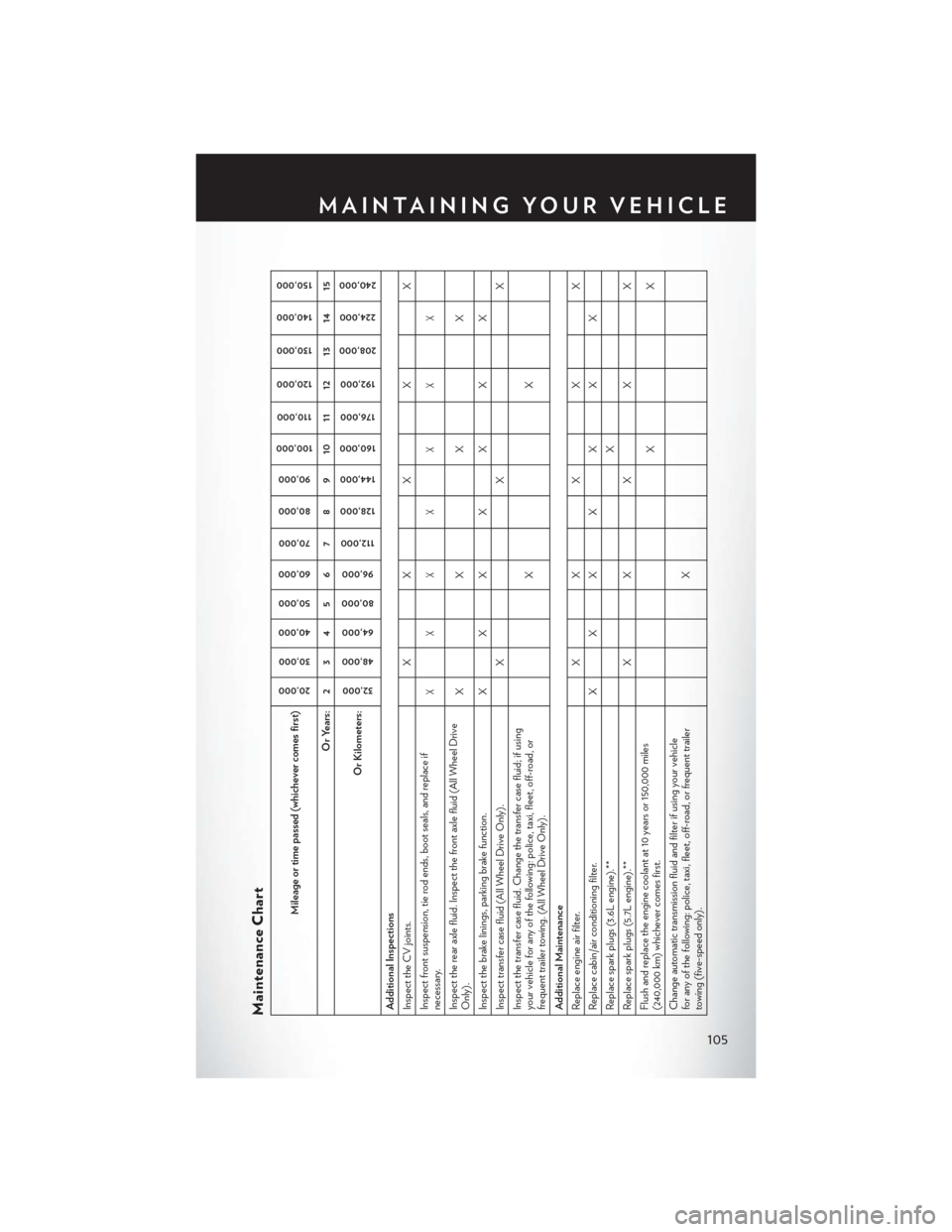
Maintenance Chart
Mileage or time passed (whichever comes first)
20,00030,000
40,000 50,000
60,000
70,000
80,000 90,000
100,000
110,000
120,000
130,000
140,000 150,000
Or Years: 2 3 4 5 6 7 8 9 10 11 12 13 14 15
Or Kilometers:
32,000
48,000 64,000
80,000
96,000
112,000
128,000
144,000
160,000
176,000
192,000
208,000 224,000
240,000
Additional Inspections
Inspect the CV joints. X X X X X
Inspect front suspension, tie rod ends, boot seals, and replace if
necessary.
XXX X X X X
Inspect the rear axle fluid. Inspect the front axle fluid (All Wheel Drive
Only). XX X X
Inspect the brake linings, parking brake function. X X X X X X X
Inspect transfer case fluid (All Wheel Drive Only). X X X
Inspect the transfer case fluid. Change the transfer case fluid; if using
your vehicle for any of the following: police, taxi, fleet, off-road, or
frequent trailer towing. (All Wheel Drive Only). XX
Additional Maintenance
Replace engine air filter. X X X X X
Replace cabin/air conditioning filter. X X X X X X X
Replace spark plugs (3.6L engine).** X
Replace spark plugs (5.7L engine).** X X X X X
Flush and replace the engine coolant at 10 years or 150,000 miles
(240,000 km) whichever comes first. XX
Change automatic transmission fluid and filter if using your vehicle
for any of the following: police, taxi, fleet, off-road, or frequent trailer
towing (five-speed only). X
MAINTAINING YOUR VEHICLE
105
Page 110 of 132
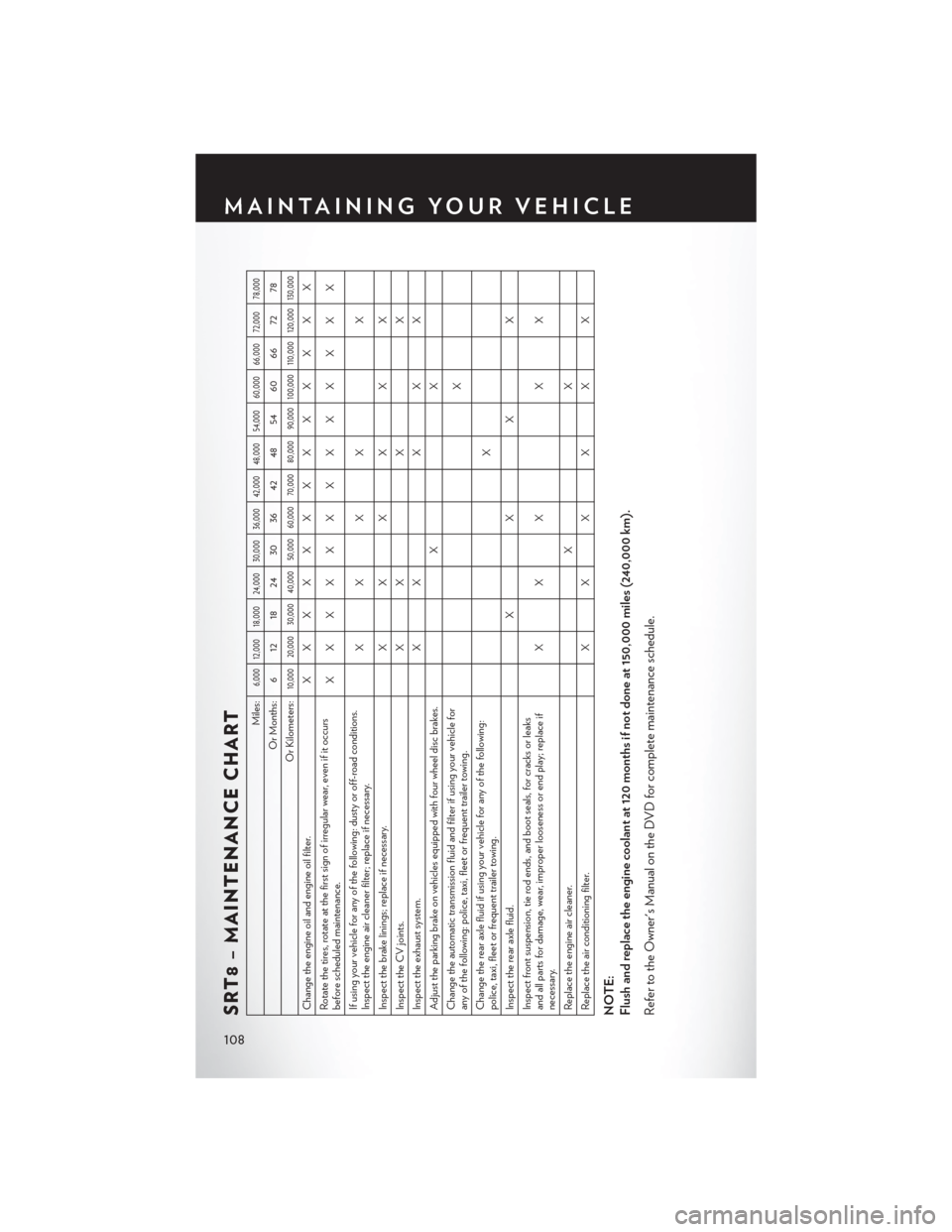
SRT8 – MAINTENANCE CHART
Miles:
6,000 12,000 18,000 24,000 30,000 36,000 42,000 48,000 54,000 60,000 66,000 72,000 78,000
Or Months: 6 12 18 24 30 36 42 48 54 60 66 72 78
Or Kilometers:
10,000 20,000 30,000 40,000 50,000 60,000 70,000 80,000 90,000 100,000 110,000 120,000 130,000
Change the engine oil and engine oil filter. X X X X X X X X X X X X X
Rotate the tires, rotate at the first sign of irregular wear, even if it occurs
before scheduled maintenance. XXXXXXXX X XXXX
If using your vehicle for any of the following: dusty or off-road conditions.
Inspect the engine air cleaner filter; replace if necessary. XXXX
X
Inspect the brake linings; replace if necessary. XXX X XX
Inspect the CV joints. XX X X
Inspect the exhaust system. XX XXX
Adjust the parking brake on vehicles equipped with four wheel disc brakes. XX
Change the automatic transmission fluid and filter if using your vehicle for
any of the following: police, taxi, fleet or frequent trailer towing. X
Change the rear axle fluid if using your vehicle for any of the following:
police, taxi, fleet or frequent trailer towing. X
Inspect the rear axle fluid. XX X X
Inspect front suspension, tie rod ends, and boot seals, for cracks or leaks
and all parts for damage, wear, improper looseness or end play; replace if
necessary. XXX
X X
Replace the engine air cleaner. XX
Replace the air conditioning filter. XXX X XXNOTE:
Flush and replace the engine coolant at 120 months if not done at 150,000 miles (240,000 km).
Refer to the Owner's Manual on the DVD for complete maintenance schedule.
MAINTAINING YOUR VEHICLE
108
Page 112 of 132
FUSES
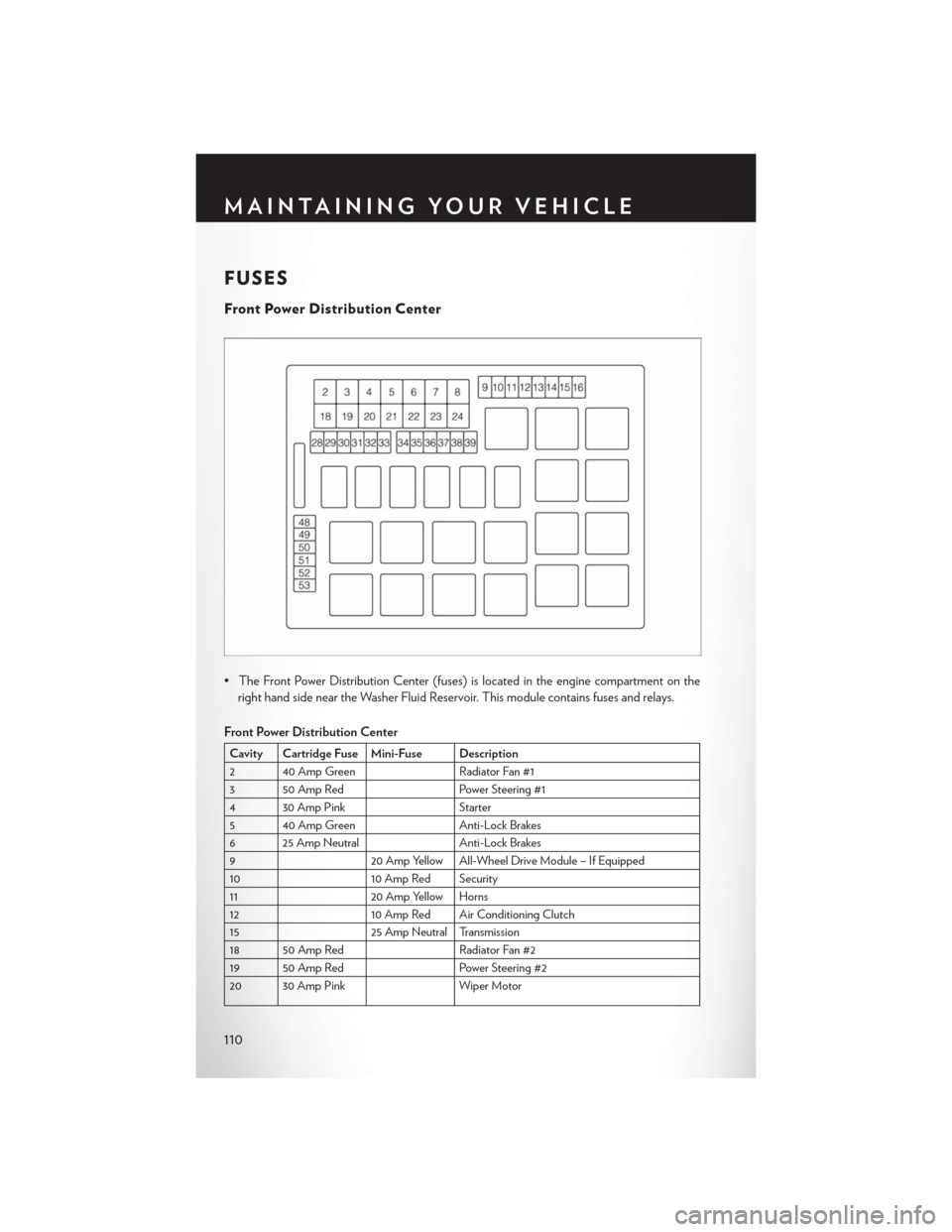
Front Power Distribution Center
• The Front Power Distribution Center (fuses) is located in the engine compartment on theright hand side near the Washer Fluid Reservoir. This module contains fuses and relays.
Front Power Distribution Center
Cavity Cartridge Fuse Mini-Fuse Description
2 40 Amp Green Radiator Fan #1
3 50 Amp Red Power Steering #1
4 30 Amp Pink Starter
5 40 Amp Green Anti-Lock Brakes
6 25 Amp Neutral Anti-Lock Brakes
9 20 Amp Yellow All-Wheel Drive Module – If Equipped
10 10 Amp Red Security
11 20 Amp Yellow Horns
12 10 Amp Red Air Conditioning Clutch
15 25 Amp Neutral Transmission
18 50 Amp Red Radiator Fan #2
19 50 Amp Red Power Steering #2
20 30 Amp Pink Wiper Motor
MAINTAINING YOUR VEHICLE
110
Page 113 of 132
Cavity Cartridge Fuse Mini-Fuse Description
21 30 Amp PinkHeadlamp Washers
28 25 Amp Neutral Fuel Pump
29 15 Amp Blue Transmission Shifter
31 25 Amp Neutral Engine Module
34 25 Amp Neutral Powertrain #1
35 20 Amp Yellow Powertrain #2
36 10 Amp Red Anti-Lock Brake Module
37 10 Amp Red Engine Controller/Rad Fan Relays
38 10 Amp Red Airbag Module
39 10 Amp Red Power Steering Module/AC Clutch Relay
48 10 Amp Red AWD Module/Front Axle Disconnect
51 20 Amp Yellow Vacuum Pump
Rear Power Distribution Center
• There is also a power distribution center located in the trunk under the spare tire access panel.
This center contains fuses and relays.
Cavity Cartridge Fuse Mini-Fuse Description
2 60 Amp Yellow Front PDC Feed #1
4 60 Amp Yellow Front PDC Feed #2
5 30 Amp Pink Sunroof
6 40 Amp Green Exterior Lighting #1
7 40 Amp Green Exterior Lighting #2
8 30 Amp Pink Interior Lighting/Washer Pump
9 30 Amp Pink Power Locks
10 30 Amp Pink Driver Door
11 30 Amp Pink Passenger Door
12 20 Amp Yellow Cigar Lighters, Instrument Panel & Power Outlet
Console Rear
15 40 Amp Green HVAC Blower
23 10 Amp Red Fuel Door/Diagnostic Port
24 15 Amp Blue Radio Screen
25 10 Amp Red Tire Pressure Monitor
27 25 Amp Neutral Amplifier
31 25 Amp Neutral Power Seats
32 15 Amp Blue HVAC Module/Cluster
33 15 Amp Blue Ignition Switch/Wireless Module
34 10 Amp Red Steering Column Module/Clock
35 10 Amp Red Battery Sensor
MAINTAINING YOUR VEHICLE
111