fuel CHRYSLER 300 2015 2.G User Guide
[x] Cancel search | Manufacturer: CHRYSLER, Model Year: 2015, Model line: 300, Model: CHRYSLER 300 2015 2.GPages: 574, PDF Size: 14.59 MB
Page 284 of 574
appears next to the setting, showing that setting has been
selected. Press the back arrow button on the touchscreen
to return to the previous menu.
•Navigation Turn-By-Turn In Cluster — If Equipped
When this feature is selected, the turn-by-turn directions
will appear in the display as the vehicle approaches a
designated turn within a programmed route. To make
your selection, press the “Navigation Turn-By-Turn In
Cluster” button on the touchscreen, until a check-mark
appears next to the setting, showing that setting has been
selected. Press the back arrow button on the touchscreen
to return to the previous menu.
Units
After pressing the “Units” button on the touchscreen you
may select each unit of measure independently displayed
in the Driver Information Display (DID), and navigation
system (if equipped). The following selectable units of
measure are listed below:
•Speed
Select from: “MPH” or “km/h.”
•Distance
Select from: “mi” or “km.”
•Fuel Consumption
Select from: “MPG” (US), “MPG” (UK), “L/100 km” or
“km/L.”
•Pressure
Select from: “psi,” “kPa,” or “bar.”
282 UNDERSTANDING YOUR INSTRUMENT PANEL
Page 311 of 574
•Mix Mode
Air comes from the floor, defrost and side
window demist outlets. This mode works best
in cold or snowy conditions.
12. Climate Control OFF Button
Press and release this button to turn the Climate Control
ON/OFF.
13. Driver Temperature Control Down Button
Provides the driver with independent temperature con-
trol. Push the button on the faceplate for cooler tempera-
ture settings or on the touchscreen, press and slide the
temperature bar button towards the blue arrow for cooler
temperature settings.
NOTE:In Sync mode, this button will also automatically
adjust the passenger temperature setting at the same
time.
14. Driver Temperature Control Up Button
Provides the driver with independent temperature con-
trol. Push the button on the faceplate for warmer tem-
perature settings or on the touchscreen, press and slide
the temperature bar button towards the red arrow for
warmer temperature settings.
NOTE:In Sync mode, this button will also automatically
adjust the passenger temperature setting at the same
time.
Climate Control Functions
A/C (Air Conditioning)
The Air Conditioning (A/C) button allows the operator
to manually activate or deactivate the air conditioning
system. When the air conditioning system is turned on,
cool dehumidified air will flow through the outlets into
the cabin. For improved fuel economy, press the A/C
button to turn off the air conditioning and manually
4
UNDERSTANDING YOUR INSTRUMENT PANEL 309
Page 331 of 574
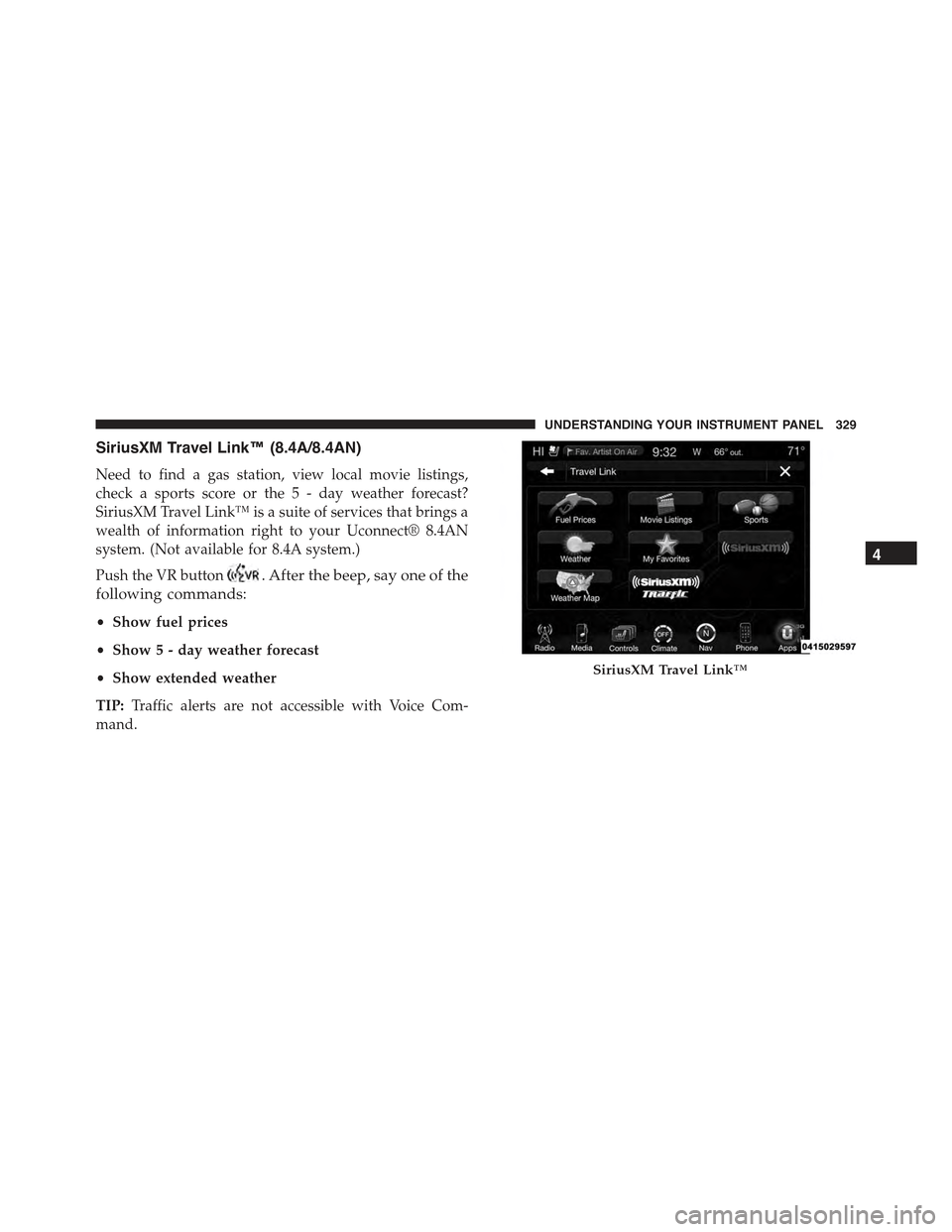
SiriusXM Travel Link™ (8.4A/8.4AN)
Need to find a gas station, view local movie listings,
check a sports score or the 5 - day weather forecast?
SiriusXM Travel Link™ is a suite of services that brings a
wealth of information right to your Uconnect® 8.4AN
system. (Not available for 8.4A system.)
Push the VR button. After the beep, say one of the
following commands:
•Show fuel prices
•Show 5 - day weather forecast
•Show extended weather
TIP:Traffic alerts are not accessible with Voice Com-
mand.
SiriusXM Travel Link™
4
UNDERSTANDING YOUR INSTRUMENT PANEL 329
Page 336 of 574
▫Shallow Standing Water.................357
!ELECTRIC POWER STEERING.............359
!FUEL SAVER TECHNOLOGY 5.7L ENGINE ONLY
— IF EQUIPPED.......................360
!PARKING BRAKE......................361
!BRAKE SYSTEM.......................363
!ELECTRONIC BRAKE CONTROL SYSTEM . . . .364
▫Anti-Lock Brake System (ABS)............364
▫Traction Control System (TCS)............366
▫Brake Assist System (BAS)...............367
▫Electronic Stability Control (ESC)..........367
▫Hill Start Assist (HSA).................371
▫Ready Alert Braking...................373
▫Rain Brake Support....................373
▫ESC Activation/Malfunction Indicator Light And
ESC OFF Indicator Light................373
▫Synchronizing ESC....................375
!TIRE SAFETY INFORMATION.............375
▫Tire Markings........................375
▫Tire Identification Number (TIN)...........379
▫Tire Terminology And Definitions..........381
▫Tire Loading And Tire Pressure...........382
!TIRES — GENERAL INFORMATION........387
▫Tire Pressure........................387
▫Tire Inflation Pressures.................389
▫Tire Pressures For High Speed Operation . . . .390
334 STARTING AND OPERATING
Page 337 of 574
▫Radial Ply Tires......................390
▫Tire Types...........................391
▫Run Flat Tires — If Equipped.............393
▫Spare Tires — If Equipped...............393
▫Tire Spinning........................396
▫Tread Wear Indicators..................396
▫Life Of Tire.........................397
▫Replacement Tires.....................398
!TIRE CHAINS (TRACTION DEVICES).......399
!TIRE ROTATION RECOMMENDATIONS.....401
!TIRE PRESSURE MONITOR SYSTEM (TPMS) . .402
▫Base System.........................405
▫Premium System — If Equipped...........408
▫General Information...................412
!FUEL REQUIREMENTS..................413
▫3.6L Engine — If Equipped...............413
▫5.7L Engine — If Equipped...............413
▫Reformulated Gasoline.................414
▫Gasoline/Oxygenate Blends..............414
▫E-85 Usage In Non-Flex Fuel Vehicles.......415
▫MMT In Gasoline.....................415
▫Materials Added To Fuel................415
▫Fuel System Cautions...................416
▫Carbon Monoxide Warnings.............417
!FLEXIBLE FUEL (3.6L ENGINE ONLY) — IF
EQUIPPED...........................417
5
STARTING AND OPERATING 335
Page 338 of 574
▫E-85 General Information...............417
▫Ethanol Fuel (E-85)....................418
▫Fuel Requirements....................418
▫Selection Of Engine Oil For Flexible Fuel Vehicles
(E-85) And Gasoline Vehicles.............419
▫Starting............................419
▫Cruising Range.......................420
▫Replacement Parts....................420
▫Maintenance........................420
!ADDING FUEL........................421
▫Emergency Fuel Filler Door Release.........423
!VEHICLE LOADING....................424
▫Vehicle Certification Label...............424
▫Gross Vehicle Weight Rating (GVWR).......425
▫Gross Axle Weight Rating (GAWR).........425
▫Overloading.........................425
▫Loading............................426
!TRAILER TOWING.....................426
▫Common Towing Definitions.............426
▫Trailer Hitch Classification...............430
▫Trailer Towing Weights (Maximum Trailer Weight
Ratings)............................431
▫Trailer And Tongue Weight..............432
▫Towing Requirements..................433
▫Towing Tips.........................439
!RECREATIONAL TOWING (BEHIND
MOTORHOME, ETC.)...................440
▫Two-Wheel Drive And All-Wheel Drive......440
336 STARTING AND OPERATING
Page 342 of 574
To change the ignition switch positions without starting
the vehicle and use the accessories follow these steps:
1. Starting with the ignition in the OFF position:
2. Push the ENGINE START/STOP button once to
change the ignition to the ACC position.
3. Push the ENGINE START/STOP button a second time
to change the ignition to the RUN position.
4. Push the ENGINE START/STOP button a third time to
return the ignition to the OFF position.
Extreme Cold Weather (Below –20°F Or−29°C)
To ensure reliable starting at these temperatures, use of
an externally powered electric engine block heater (avail-
able from your authorized dealer) is recommended.
If Engine Fails To Start
WARNING!
•Never pour fuel or other flammable liquid into the
throttle body air inlet opening in an attempt to start
the vehicle. This could result in flash fire causing
serious personal injury.
•Do not attempt to push or tow your vehicle to get it
started. Vehicles equipped with an automatic trans-
mission cannot be started this way. Unburned fuel
could enter the catalytic converter and once the
engine has started, ignite and damage the converter
and vehicle.
(Continued)
340 STARTING AND OPERATING
Page 343 of 574
WARNING!(Continued)
•If the vehicle has a discharged battery, booster
cables may be used to obtain a start from a booster
battery or the battery in another vehicle. This type
of start can be dangerous if done improperly. Refer
to “Jump-Starting” in “What To Do In Emergen-
cies” for further information.
Clearing A Flooded Engine (Using ENGINE
START/STOP Button)
If the engine fails to start after you have followed the
“Normal Starting” or “Extreme Cold Weather#proce-
dures, it may be flooded. To clear any excess fuel:
1. Press and hold the brake pedal.
2. Press the accelerator pedal all the way to the floor and
hold it.
3. Push and release the ENGINE START/STOP button
once.
The starter motor will engage automatically, run for 10
seconds, and then disengage. Once this occurs, release
the accelerator pedal and the brake pedal, wait 10 to 15
seconds, then repeat the “Normal Starting” procedure.
After Starting
The idle speed is controlled automatically and it will
decrease as the engine warms up.
5
STARTING AND OPERATING 341
Page 352 of 574
CAUTION!
Towing the vehicle, coasting, or driving for any other
reason with the transmission in NEUTRAL can cause
severe transmission damage. Refer to “Recreational
Towing” in “Starting And Operating” and “Towing A
Disabled Vehicle” in “What To Do In Emergencies”
for further information.
DRIVE (D)
This range should be used for most city and highway
driving. It provides the smoothest upshifts and down-
shifts, and the best fuel economy. The transmission
automatically upshifts through all forward gears. The
DRIVE position provides optimum driving characteris-
tics under all normal operating conditions.
When frequent transmission shifting occurs (such as
when operating the vehicle under heavy loading condi-
tions, in hilly terrain, traveling into strong head winds, or
while towing heavy trailers), use the AutoStick shift
control (if equipped; refer to AutoStick in this section for
further information) to select a lower gear. Under these
conditions, using a lower gear will improve performance
and extend transmission life by reducing excessive shift-
ing and heat buildup.
During extremely cold temperatures (-22°F [-30°C] or
below), transmission operation may be modified depend-
ing on engine and transmission temperature as well as
vehicle speed. Normal operation will resume once the
transmission temperature has risen to a suitable level.
SPORT (S) — If Equipped
This mode alters the transmission’s automatic shift
schedule for sportier driving. Upshift speeds are in-
creased to make full use of available engine power. To
350 STARTING AND OPERATING
Page 357 of 574
WARNING!
Do not downshift for additional engine braking on a
slippery surface. The drive wheels could lose their
grip and the vehicle could skid, causing a collision or
personal injury.
ALL-WHEEL DRIVE (AWD) — IF EQUIPPED
This vehicle is equipped with an active on-demand
All-Wheel Drive (AWD) system which makes available
optimum traction for a wide variety of road surface and
driving conditions. The system minimizes wheel slip by
automatically redirecting torque to the front and rear
wheels as necessary.
To maximize fuel economy, your AWD vehicle automati-
cally defaults to rear-wheel drive (RWD) when road and
environmental conditions are such that wheel slip is
unlikely to occur. When specific road and environmental
conditions require increased levels of road traction, the
vehicle automatically shifts into AWD mode. Automatic
AWD operation could be activated by outside tempera-
ture, wheel slip, or other predetermined conditions (there
may be a slight delay for AWD engagement after a wheel
slip condition occurs). AWD can also be manually se-
lected by activating AutoStick mode (+/-), engaging
Sport Mode or activating the windshield wipers for an
extended period of time. Drive mode, RWD or AWD, can
be found in the Driver Information Display (DID). Refer
to “Driver Information Display (DID)” in “Understand-
ing Your Instrument Panel” for further information.
NOTE:If the “SERVICE AWD SYSTEM” warning mes-
sage appears after engine start up, or during driving, it
means that the AWD system is not functioning properly
and that service is required. Refer to “Driver Information
Display (DID)” in “Understanding Your Instrument
Panel” for further information.
5
STARTING AND OPERATING 355