traction control CHRYSLER 300 2015 2.G User Guide
[x] Cancel search | Manufacturer: CHRYSLER, Model Year: 2015, Model line: 300, Model: CHRYSLER 300 2015 2.GPages: 574, PDF Size: 14.59 MB
Page 376 of 574
malfunction has been detected in the ESC system. If this
light remains on after several ignition cycles, and the
vehicle has been driven several miles (kilometers) at
speeds greater than 30 mph (48 km/h), see your autho-
rized dealer as soon as possible to have the problem
diagnosed and corrected.
The “ESC Activation/Malfunction Indicator Light” (lo-
cated in the instrument cluster) starts to flash as soon as
the tires lose traction and the ESC system becomes active.
The “ESC Activation/Malfunction Indicator Light” also
flashes when TCS is active. If the “ESC Activation/
Malfunction Indicator Light” begins to flash during ac-
celeration, ease up on the accelerator and apply as little
throttle as possible. Be sure to adapt your speed and
driving to the prevailing road conditions.
NOTE:
•Each time the ignition is cycled ON, the ESC system
will be ON even if it was cycled off previously.
•The ESC system will make buzzing or clicking sounds
when it is active. This is normal; the sounds will stop
when ESC becomes inactive following the maneuver
that caused the ESC activation.
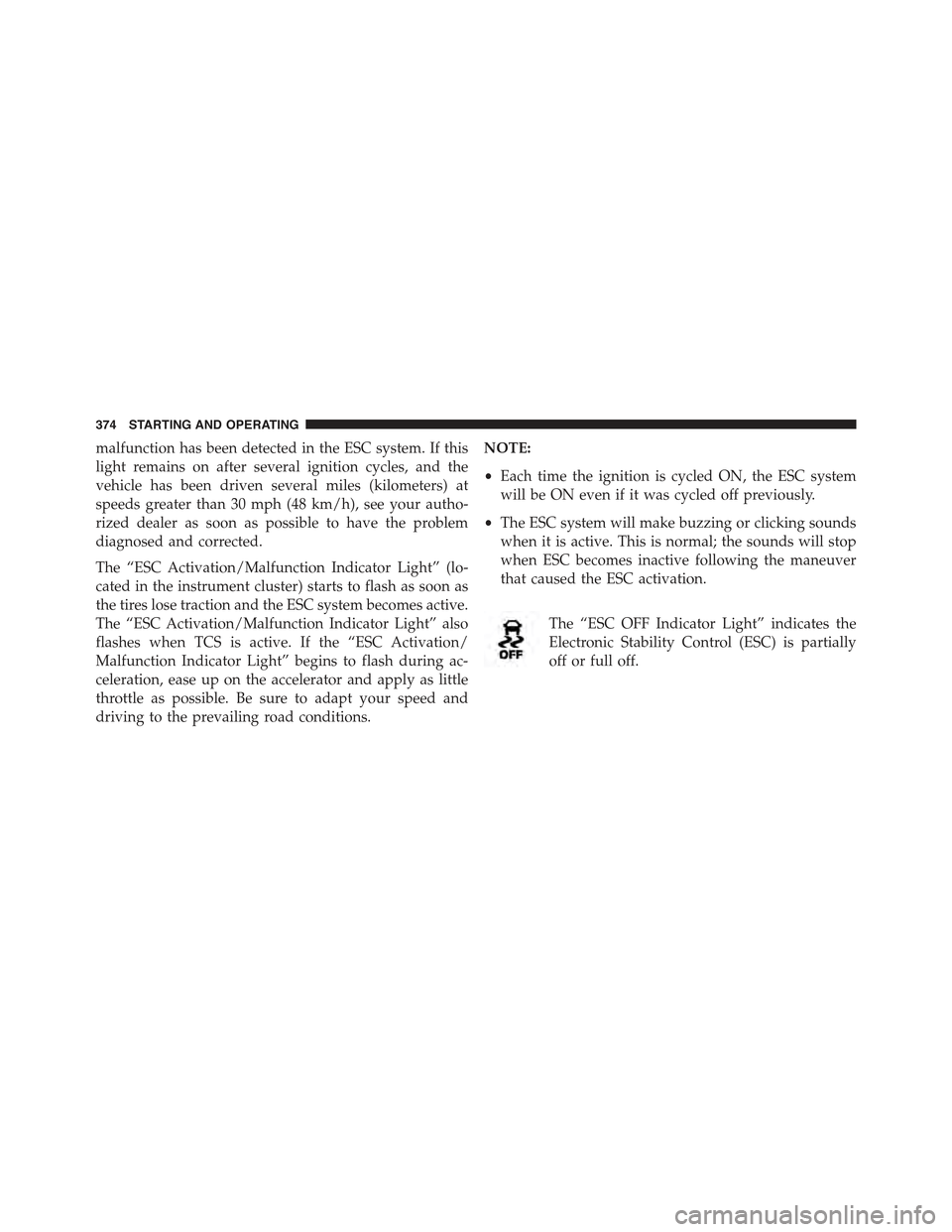
The “ESC OFF Indicator Light” indicates the
Electronic Stability Control (ESC) is partially
off or full off.
374 STARTING AND OPERATING
Page 394 of 574
Summer tires do not contain the all season designation or
mountain/snowflake symbol on the tire sidewall. Use
Summer tires only in sets of four; failure to do so may
adversely affect the safety and handling of your vehicle.
WARNING!
Do not use Summer tires in snow/ice conditions. You
could lose vehicle control, resulting in severe injury
or death. Driving too fast for conditions also creates
the possibility of loss of vehicle control.
Snow Tires
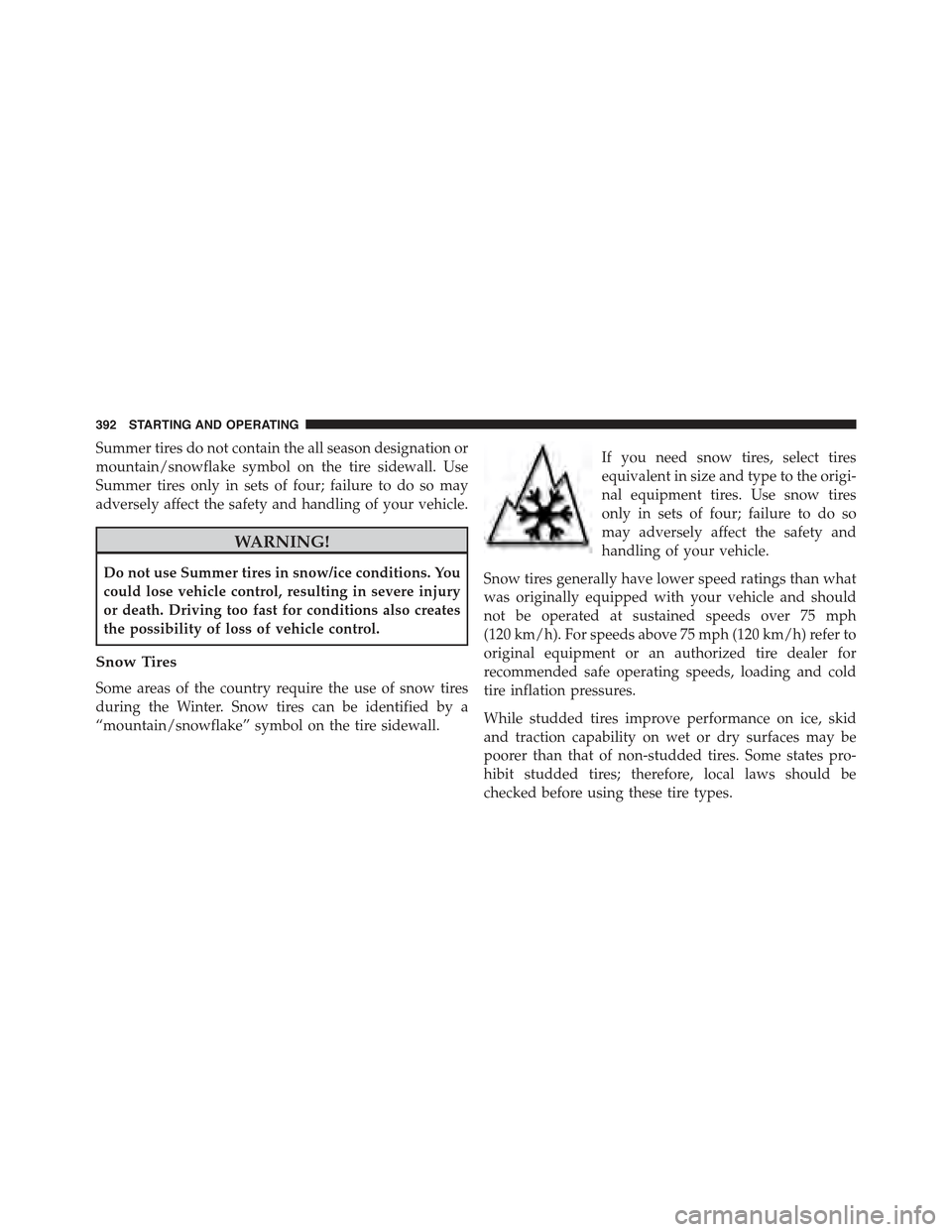
Some areas of the country require the use of snow tires
during the Winter. Snow tires can be identified by a
“mountain/snowflake” symbol on the tire sidewall.
If you need snow tires, select tires
equivalent in size and type to the origi-
nal equipment tires. Use snow tires
only in sets of four; failure to do so
may adversely affect the safety and
handling of your vehicle.
Snow tires generally have lower speed ratings than what
was originally equipped with your vehicle and should
not be operated at sustained speeds over 75 mph
(120 km/h). For speeds above 75 mph (120 km/h) refer to
original equipment or an authorized tire dealer for
recommended safe operating speeds, loading and cold
tire inflation pressures.
While studded tires improve performance on ice, skid
and traction capability on wet or dry surfaces may be
poorer than that of non-studded tires. Some states pro-
hibit studded tires; therefore, local laws should be
checked before using these tire types.
392 STARTING AND OPERATING
Page 401 of 574

WARNING!
•Do not use a tire, wheel size or rating other than
that specified for your vehicle. Some combinations
of unapproved tires and wheels may change sus-
pension dimensions and performance characteris-
tics, resulting in changes to steering, handling, and
braking of your vehicle. This can cause unpredict-
able handling and stress to steering and suspen-
sion components. You could lose control and have
a collision resulting in serious injury or death. Use
only the tire and wheel sizes with load ratings
approved for your vehicle.
•Never use a tire with a smaller load index or
capacity, other than what was originally equipped
on your vehicle. Using a tire with a smaller load
index could result in tire overloading and failure.
You could lose control and have a collision.
(Continued)
WARNING!(Continued)
•Failure to equip your vehicle with tires having
adequate speed capability can result in sudden tire
failure and loss of vehicle control.
CAUTION!
Replacing original tires with tires of a different size
may result in false speedometer and odometer read-
ings.
TIRE CHAINS (TRACTION DEVICES)
Use of traction devices require sufficient tire-to-body
clearance. Follow these recommendations to guard
against damage.
•Traction device must be of proper size for the tire, as
recommended by the traction device manufacturer.
5
STARTING AND OPERATING 399
Page 402 of 574

•Install on Rear Tires Only.
•Due to limited clearance for a Rear Wheel Drive
(RWD) vehicle, on P215/65R17, P225/60R18 and
P235/55R18 tires with a Security Chain Company
(SCC) Super Z6 low profile traction device or equiva-
lent is recommended.
•Due to limited clearance for an All Wheel Drive
(AWD) vehicle, P245/45R20 tire with the use of a
traction device that meets the SAE type “Class S”
specification is recommended.
•No other tire sizes are recommended for use with a tire
chain or traction device.
WARNING!
Using tires of different size and type (M+S, Snow)
between front and rear axles can cause unpredictable
handling. You could lose control and have a collision.
CAUTION!
To avoid damage to your vehicle or tires, observe the
following precautions:
•Because of restricted traction device clearance be-
tween tires and other suspension components, it is
important that only traction devices in good condi-
tion are used. Broken devices can cause serious
damage. Stop the vehicle immediately if noise
occurs that could indicate device breakage. Remove
the damaged parts of the device before further use.
•Install device as tightly as possible and then re-
tighten after driving about½mile (0.8 km).
•Do not exceed 30 mph (48 km/h).
•Drive cautiously and avoid severe turns and large
bumps, especially with a loaded vehicle.
•Do not drive for a prolonged period on dry pave-
ment.
(Continued)
400 STARTING AND OPERATING
Page 548 of 574
Call toll free at:
•1-800-890-4038 (U.S.)
•1-800-387-1143 (Canada)
Or
Visit us on the Worldwide Web at:
•www.techauthority.com
DEPARTMENT OF TRANSPORTATION UNIFORM
TIRE QUALITY GRADES
The following tire grading categories were established by
the National Highway Traffic Safety Administration. The
specific grade rating assigned by the tire’s manufacturer
in each category is shown on the sidewall of the tires on
your vehicle.
All passenger car tires must conform to Federal safety
requirements in addition to these grades.
Treadwear
The Treadwear grade is a comparative rating, based on
the wear rate of the tire when tested under controlled
conditions on a specified government test course. For
example, a tire graded 150 would wear one and one-half
times as well on the government course as a tire graded
100. The relative performance of tires depends upon the
actual conditions of their use, however, and may depart
significantly from the norm due to variations in driving
habits, service practices, and differences in road charac-
teristics and climate.
Traction Grades
The Traction grades, from highest to lowest, are AA, A, B,
and C. These grades represent the tire’s ability to stop on
wet pavement, as measured under controlled conditions
on specified government test surfaces of asphalt and
concrete. A tire marked C may have poor traction perfor-
mance.
546 IF YOU NEED CONSUMER ASSISTANCE
Page 549 of 574
WARNING!
The traction grade assigned to this tire is based on
straight-ahead braking traction tests, and does not
include acceleration, cornering, hydroplaning, or
peak traction characteristics.
Temperature Grades
The temperature grades are A (the highest), B, and C,
representing the tire’s resistance to the generation of heat
and its ability to dissipate heat, when tested under
controlled conditions on a specified indoor laboratory
test wheel. Sustained high temperature can cause the
material of the tire to degenerate and reduce tire life, and
excessive temperature can lead to sudden tire failure. The
grade C corresponds to a level of performance, which all
passenger car tires must meet under the Federal Motor
Vehicle Safety Standard No. 109. Grades B and A repre-
sent higher levels of performance on the laboratory test
wheel, than the minimum required by law.
WARNING!
The temperature grade for this tire is established for
a tire that is properly inflated and not overloaded.
Excessive speed, under-inflation, or excessive load-
ing, either separately or in combination, can cause
heat buildup and possible tire failure.
9
IF YOU NEED CONSUMER ASSISTANCE 547
Page 557 of 574
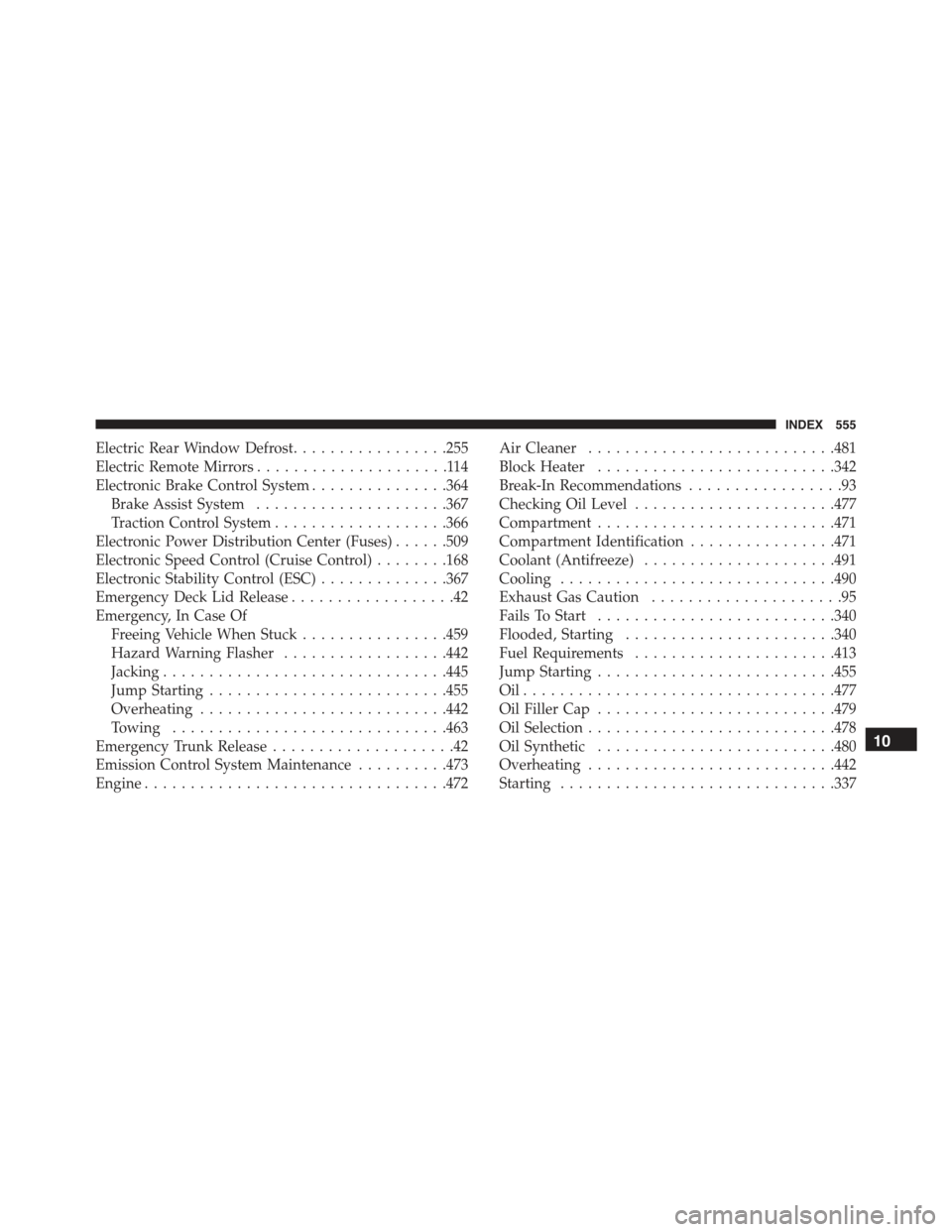
Electric Rear Window Defrost.................255
Electric Remote Mirrors.....................114
Electronic Brake Control System...............364
Brake Assist System.....................367
Traction Control System...................366
Electronic Power Distribution Center (Fuses)......509
Electronic Speed Control (Cruise Control)........168
Electronic Stability Control (ESC)..............367
Emergency Deck Lid Release..................42
Emergency, In Case Of
Freeing Vehicle When Stuck................459
Hazard Warning Flasher..................442
Jacking...............................445
Jump Starting..........................455
Overheating...........................442
Towing..............................463
Emergency Trunk Release....................42
Emission Control System Maintenance..........473
Engine.................................472
Air Cleaner...........................481
Block Heater..........................342
Break-In Recommendations.................93
Checking Oil Level......................477
Compartment..........................471
Compartment Identification................471
Coolant (Antifreeze).....................491
Cooling..............................490
Exhaust Gas Caution.....................95
Fails To Start..........................340
Flooded, Starting.......................340
Fuel Requirements......................413
Jump Starting..........................455
Oil . . . . . . . . . . . . . . . . . . . . . . . . . . . . . . . . ..477
Oil Filler Cap..........................479
Oil Selection...........................478
Oil Synthetic..........................480
Overheating...........................442
Starting..............................337
10
INDEX 555
Page 563 of 574
Seat Belt Reminder......................263
Security Alarm.........................263
Service...............................521
Service Engine Soon (Malfunction Indicator) . . . .263
Tire Pressure Monitoring (TPMS)............263
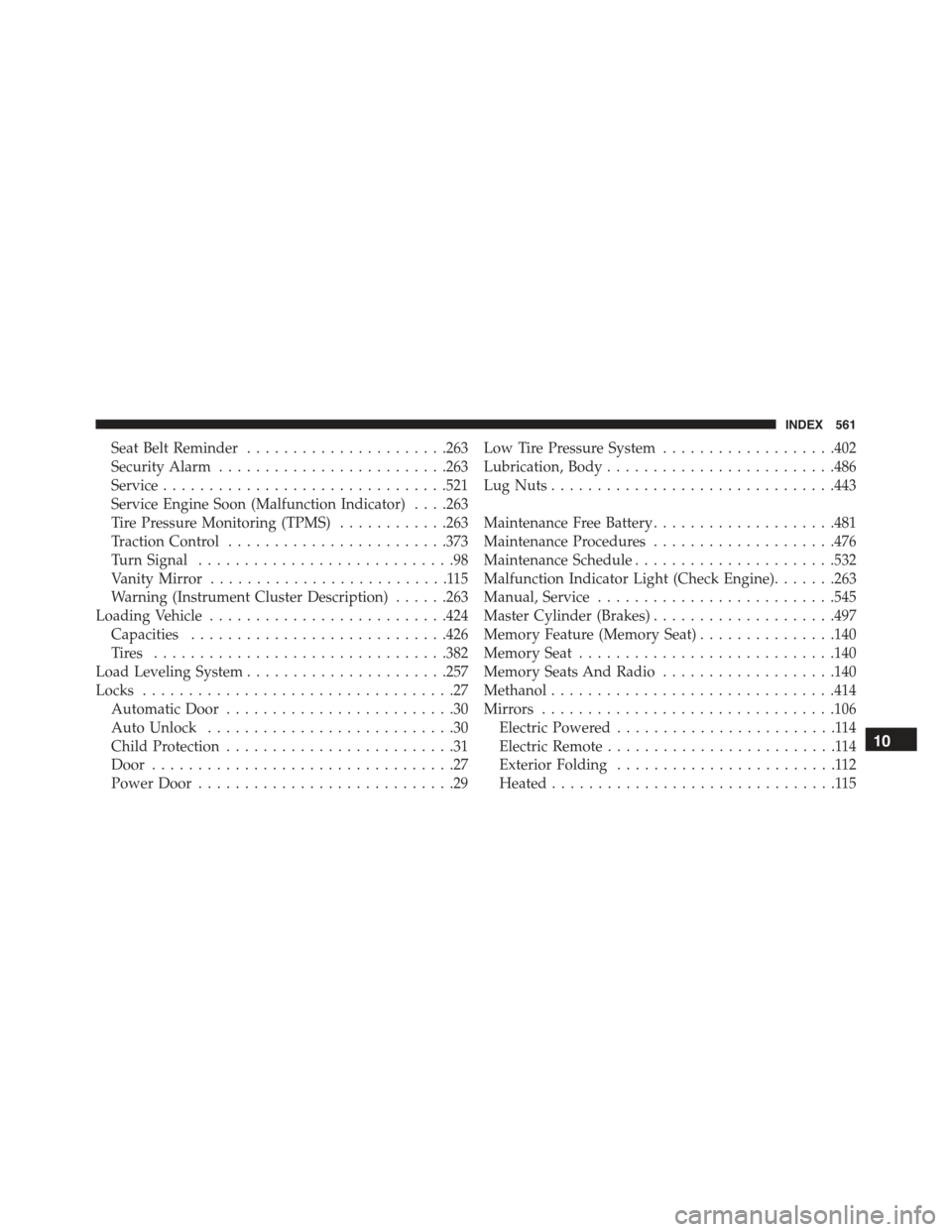
Traction Control........................373
Turn Signal............................98
Vanity Mirror..........................115
Warning (Instrument Cluster Description)......263
Loading Vehicle..........................424
Capacities............................426
Ti re s . . . . . . . . . . . . . . . . . . . . . . . . . . . . . . ..382
Load Leveling System......................257
Locks..................................27
Automatic Door.........................30
Auto Unlock...........................30
Child Protection.........................31
Door.................................27
Power Door............................29
Low Tire Pressure System...................402
Lubrication, Body.........................486
Lug Nuts...............................443
Maintenance Free Battery....................481
Maintenance Procedures....................476
Maintenance Schedule......................532
Malfunction Indicator Light (Check Engine).......263
Manual, Service..........................545
Master Cylinder (Brakes)....................497
Memory Feature (Memory Seat)...............140
Memory Seat............................140
Memory Seats And Radio...................140
Methanol...............................414
Mirrors................................106
Electric Powered........................114
Electric Remote.........................114
Exterior Folding........................112
Heated...............................115
10
INDEX 561
Page 570 of 574
Jacking...............................445
Life Of Tires...........................397
Load Capacity.........................382
Pressure Monitor System (TPMS)............402
Pressure Warning Light...................263
Quality Grading........................546
Radial...............................390
Replacement...........................398
Rotation..............................401
Safety...............................375
Sizes................................377
Snow Tires............................392
Spare Tire.............................446
Spinning.............................396
Trailer Towing.........................435
Tread Wear Indicators....................396
Tire Safety Information.....................375
Tongue Weight/Trailer Weight................432
To Open Hood...........................144
Towing................................426
Disabled Vehicle........................463
Guide...............................431
Recreational...........................440
Weight...............................431
Towing Vehicle Behind A Motorhome...........440
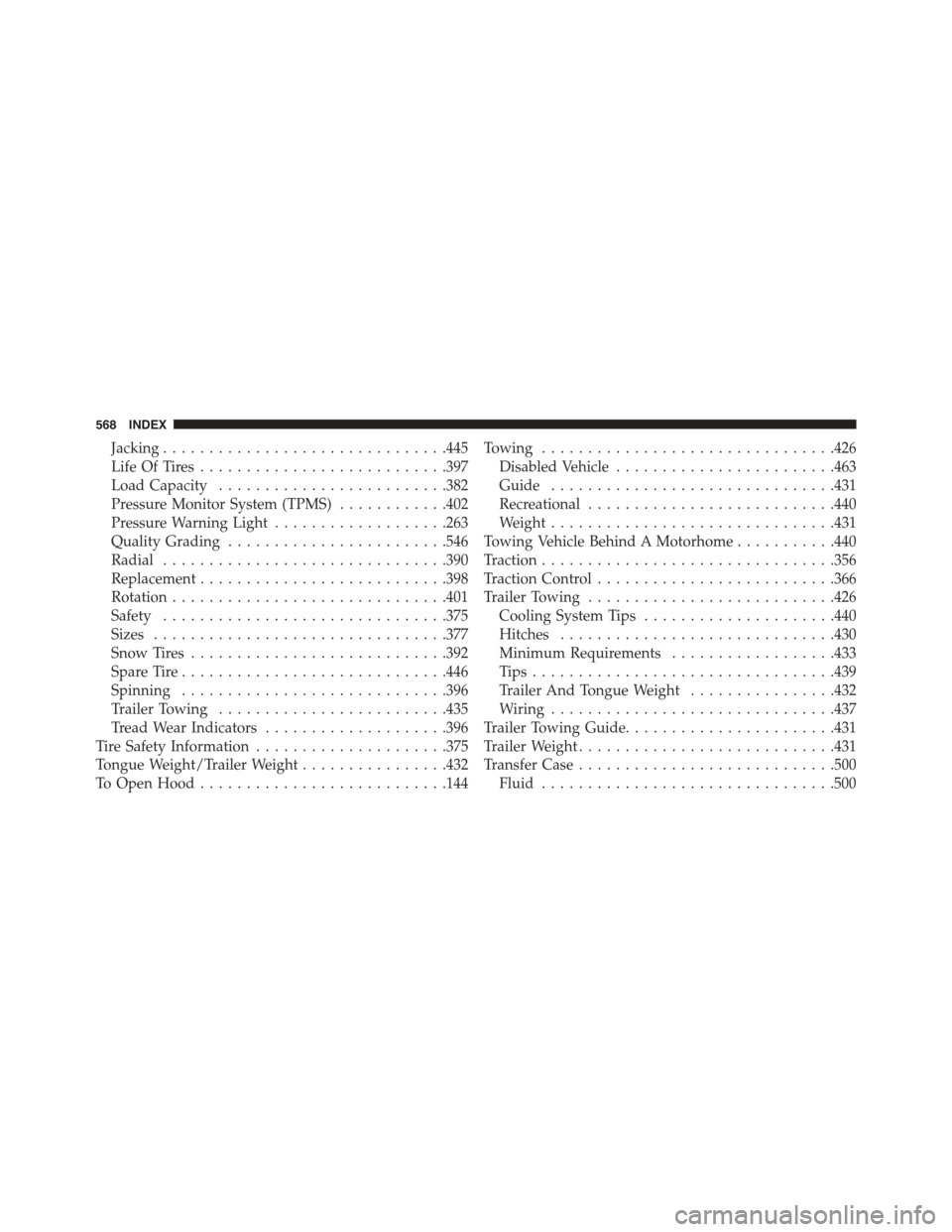
Traction................................356
Traction Control..........................366
Trailer Towing...........................426
Cooling System Tips.....................440
Hitches..............................430
Minimum Requirements..................433
Ti p s . . . . . . . . . . . . . . . . . . . . . . . . . . . . . . . ..439
Trailer And Tongue Weight................432
Wiring...............................437
Trailer Towing Guide.......................431
Trailer Weight............................431
Transfer Case............................500
Fluid................................500
568 INDEX