tire pressure CHRYSLER 300 2019 Vehicle Warranty
[x] Cancel search | Manufacturer: CHRYSLER, Model Year: 2019, Model line: 300, Model: CHRYSLER 300 2019Pages: 270, PDF Size: 2.52 MB
Page 202 of 270
Road Hazard Policy For Run Flat Tires Only
Pirelli Run Flat tires are manufactured with technology that allows
limited low-inflation operation in the event of sudden loss of pressure.
Pirelli does not recommend the repair of run flat tires and as a result,
Pirelli provides road hazard coverage on all Pirelli produced tires that are
manufactured with run flat technology. To qualify for Run Flat Road
Hazard coverage, a completed claim form along with the tire exhibiting
the road hazard must be returned to Pirelli through an authorized Pirelli
dealer.
If a Run Flat tire becomes unserviceable due to workmanship or materials
anomalies or road hazard injury during the initial warranty period,
which is one year from the date of original retail purchase of the vehicle
or purchase of replacement tires (purchase receipt required) or within the
first 2/32” of the original usable tread, whichever occurs first, the tire will
be replaced with the same or comparable tire at no charge for the tire to
the owner. After the initial warranty period, if a Run Flat tire becomes
unserviceable due to workmanship or materials anomalies or road
hazard injury, the owner must pay the cost of a comparable new Pirelli
brand or PTI private brand replacement tire on a pro-rata basis. The
authorized Pirelli dealer will determine the cost by multiplying the
percentage of the original usable tread worn by the current dealer selling
price. The owner must pay for any associated service charges, including
costs associated with mounting and balancing of the tire. This Road
Hazard Policy is not a warranty. PTI does not warranty that a Pirelli tire
will not fail due to road hazard and does not authorize any person,
including authorized Pirelli dealers, to make such a warranty.
PIRELLI TIRES
201
Page 207 of 270
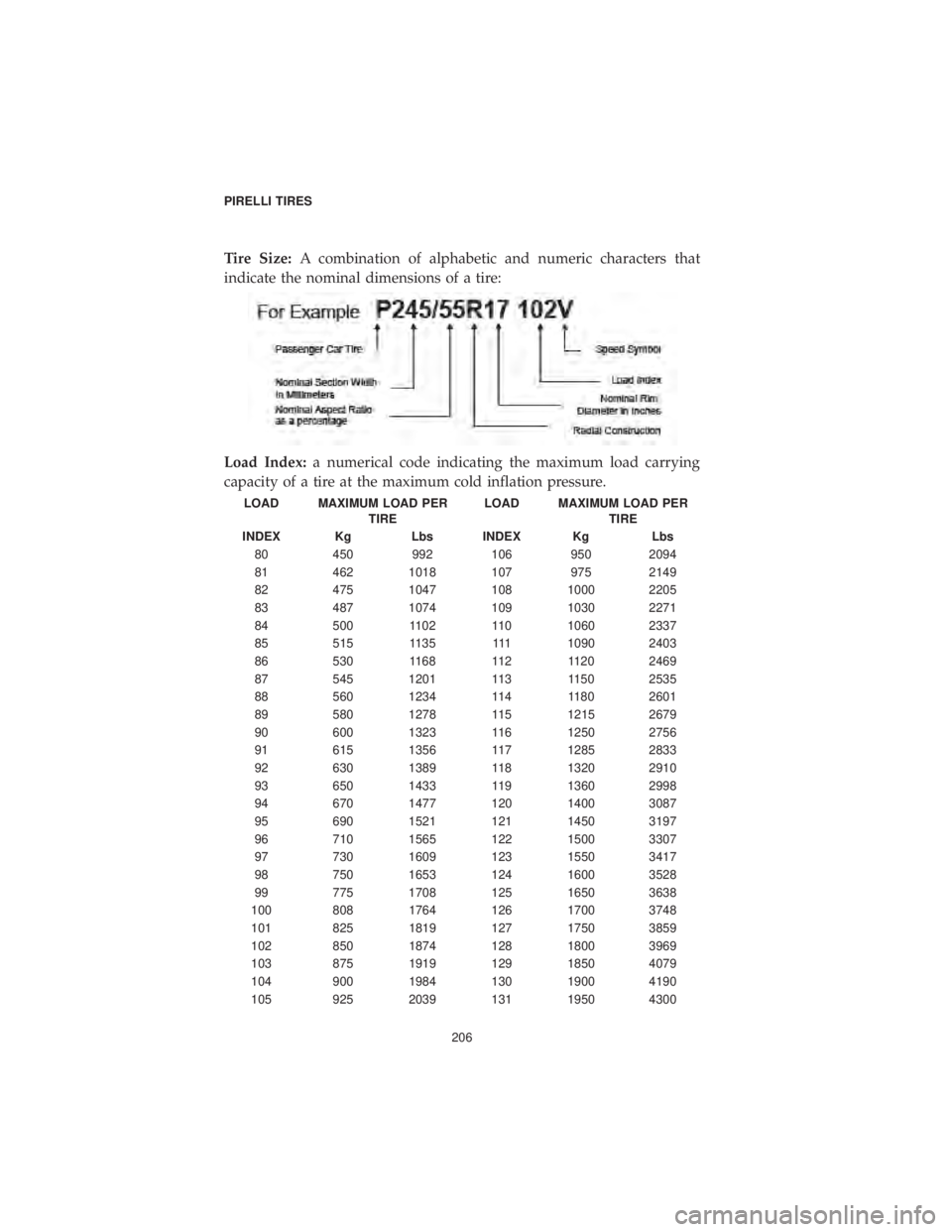
Tire Size:A combination of alphabetic and numeric characters that
indicate the nominal dimensions of a tire:
Load Index: a numerical code indicating the maximum load carrying
capacity of a tire at the maximum cold inflation pressure.
LOAD MAXIMUM LOAD PER TIRELOAD MAXIMUM LOAD PER
TIRE
INDEX Kg Lbs INDEX Kg Lbs
80 450 992 106 950 2094
81 462 1018 107 975 2149
82 475 1047 108 1000 2205
83 487 1074 109 1030 2271
84 500 1102 110 1060 2337
85 515 1135 111 1090 2403
86 530 1168 112 1120 2469
87 545 1201 113 1150 2535
88 560 1234 114 1180 2601
89 580 1278 115 1215 2679
90 600 1323 116 1250 2756
91 615 1356 117 1285 2833
92 630 1389 118 1320 2910
93 650 1433 119 1360 2998
94 670 1477 120 1400 3087
95 690 1521 121 1450 3197
96 710 1565 122 1500 3307
97 730 1609 123 1550 3417
98 750 1653 124 1600 3528
99 775 1708 125 1650 3638
100 808 1764 126 1700 3748
101 825 1819 127 1750 3859
102 850 1874 128 1800 3969
103 875 1919 129 1850 4079
104 900 1984 130 1900 4190
105 925 2039 131 1950 4300
PIRELLI TIRES
206
Page 208 of 270
Speed Symbol: an alphabetic code indicating the maximum speed at
which the tire can carry a load corresponding to its Load Index under
specified service conditions.
SPEED SYMBOLMAXIMUM SPEED
KM/H MPH
L 120 74
M 130 80
N 140 86
P 150 93
Q 160 99
R 170 105
S 180 112
T 190 118
U 200 124
H 210 130
V 240 149
W 270 168
*ZR Y300 186
(Y) ABOVE 300 ABOVE 186
*For tires having a maximum speed capability above 149 mph, a “ZR”
may appear in the size designation; above 186 mph, a “ZR” must appear
in the size designation, including a ”Y” speed symbol in brackets.
Other Markings:
P-As part of the tire size designation (e.g., P205/65R15), is used to
indicate the tires intended for service on passenger cars.
LT -As part of the tire size designation (e.g. LT235/75R15), is used to
indicate the tires are intended for service on light truck vehicles.
M&S - Letters used to indicate a tire suitable for Mud and Snow and/or
All Season usage.
XL - As part of the size designation (e.g. P235/75R16 XL), is used to
indicate the tire can carry more load as the maximum inflation pressure
and load are greater than a standard load version. (Also could be called
REINFORCED).
PIRELLI TIRES
207
Page 209 of 270
2. Tire Categories
ALL SEASON TIRES (ALL WEATHER TIRES): Tires that are designed to
perform in a variety of road conditions in all seasons of the year. An all
season tire will carry “M+S”, “M&S”, or “M/S” designation on the
sidewall. All Season tires may carry a Limited Treadwear Warranty
depending on line.
SUMMER TIRES ( MAXIMUM PERFORMANCE, HIGH PERFOR-
MANCE, ULTRA HIGH PERFORMANCE): Summer Performance tires
offer superior handling, grip and cornering ability compared to standard
tires. They are rated for operation at higher speeds. Maximum Perfor-
mance, High Performance and Ultra High Performance categories each
have different performance characteristics, UTQG ratings and rate of
wear depending on line. Some lines may carry a limited treadwear
warranty.
WINTER TIRES (SNOW TIRES): A winter tire is a tire with a tread design
and compound made specifically for snowy and icy conditions and is
identified by M&S, M+S or M/S markings on the sidewalls. Tires
designed for use in severe snow conditions are further identified with a
pictograph of a mountain with a snowflake on the sidewalls and must
meet specific snow performance test requirements. Pirelli Winter tires do
not carry a mileage warranty.
The information provided above is an overview of tire types. Tread
patterns and rubber compounds vary among the seasonal tire types and
provide varying performance characteristics and limitations based on
your individual needs and vehicle specifications. Summer performance
tires are different than winter and all season types. To determine which
Pirelli lines carry a Limited Treadwear Warranty, please refer to The PTI
Treadwear Mileage Warranty Conditions and Mileage Warranty sections
found in this document.
3. Pressure Recommendations
Recommended tire inflation pressures for your vehicle can be found
either on your vehicle’s tire placard or in your vehicle owner ’s manual.
Correct pressures are related to load, speed and vehicle handling and are
vital for even braking, maximum traction and good tire life. Under no
circumstances should your tire’s cold inflation pressure be less than that
indicated on your vehicle’s tire placard or in your vehicle owner ’s
manual or higher than the maximum cold inflation pressure molded on
PIRELLI TIRES208
Page 210 of 270
to the tire’s sidewall. Under inflation causes excessive flexing, deteriora-
tion of the tire and rapid wear of the tread edges. Over inflation results
in an uncomfortable ride, a reduced area of tire contact with the road
surface (i.e., smaller tire footprint), higher susceptibility to impact
damage and rapid wear on the tread center.
WARNING!
Driving on tires with improper inflation pressure is dangerous.
These situations can cause a tire failure, including tread/belt
separation, even at a later date, which could lead to an accident and
serious personal injury or death.
Inflation pressure must be checked at least once a month and should be
checked only when the tire is cold or before it has been driven. Driving
even a short distance (1 kilometer or 2 to 3 minutes) causes tires to heat
up and the air pressure to increase approximately 4 psi. In case it is
necessary to adjust the air pressure in tires that have been driven, the air
pressure should be increased to a gauge reading of 4 psi higher than the
recommended cold inflation pressure.
For Example Only:
Gauge Reading of Hot Tire: 27 PSI.
Recommended Cold Inflation Pressure: 26 PSI
Desired Gauge Reading of Hot Tire: 26 PS I+4PSI=30PSI
Therefore: Add 3 PSI
Check the cold inflation pressure on the tires, at least by the next day.
Never reduce or “bleed” pressure from hot tires since your tires will then
be underinflated when they cool down. Always use a reliable pressure
gauge.
4. UHP Summer Tires
Rubber compounds formulated for ultra high performance summer tires
can lose flexibility and may develop random surface cracks at cold
temperatures. Therefore extra care should be used in handling tires in this
condition. These compounds are optimized for maximum dry and wet
performance in warm conditions. Special tread compounds in these tires
will have decreased performance, such as lateral and braking traction, at
temperatures below 7° C or when driving on snow or ice. Therefore, it is
recommended to install winter tires in these conditions.
PIRELLI TIRES
209
Page 211 of 270
5. DOT Street Legal Competition Tires
P Zero Trofeo and P Zero Corsa tire lines use special tire construction and
compounds to achieve their distinctive performance in dry conditions. As
a result of that, their performance in cold temperatures, heavy rain or
standing water will be decreased. Use extreme caution and drive slowly
on wet roads.
The minimum tread depth will be reached earlier than normal road tires,
resulting in reduced tread life.
6. Winter Tires
The standard Pirelli tires may be effective in light snow conditions.
However, for winter use, you may wish to install winter tires. During
winter use, Pirelli strongly recommends the fitment of 4 winter tires.
Please check your vehicle owner ’s manual concerning winter tire size
recommendation. If the winter tires have a lower speed rating than the
original equipment tires, vehicle handling may be affected, and the
vehicle maximum speed must be reduced to the winter tire speed rating.
Pirelli requires that studded tires be installed on all four positions.
Installing studded tires only on the drive positions of any vehicle,
including a front wheel drive vehicle, may cause adverse handling
characteristics.
7. Run Flat Tires
Always refer to the vehicle owners’ manual with respect to specific safety
and operating information relating to the vehicle. Damaged Run Flat tires
or Run Flat tires that have experienced a loss of pressure should
immediately be replaced with another Run Flat tire of identical size and
Service Description (Load Index and Speed Symbol).
Run Flat tires have been developed based on the specifications of the
vehicles on which they are mounted. Accordingly, Run Flat tires should
only be mounted on vehicles specifically manufactured to accommodate
Run Flat tires.
Run Flat tires must be mounted in conjunction with a functional Tire
Pressure Monitoring System (TPMS).
The mounting of tires and installation of the Tire Pressure Monitoring
System (TPMS) should be carried out by a specialized dealer.
PIRELLI TIRES210
Page 212 of 270
8. Tire Replacement
The tires fitted to your vehicle as original equipment were tested and
approved by the vehicle manufacturer and the tire manufacturer and take
into account all aspects of the vehicle’s operation. Changes in the tire size,
type or construction should not be made without seeking advice from the
vehicle or tire manufacturer or an authorized Pirelli dealer since unap-
proved tires on your vehicle could adversely affect steering, handling,
braking and traction. The tire information (tire size, load index and speed
symbol) as found on the vehicle placard or in the owner ’s manual should
always be followed when replacing tires.
It is strongly recommended that Pirelli tires be mounted in sets of four
with the same tread type. Pirelli tires should not be mixed with other tire
brands. It is necessary to follow this procedure because different tire
constructions have different handling characteristics. Tires on the same
axle must be the same manufacturer, brand, tire size, load index, speed
rating and Pirelli part number.
When changing only two tires on a vehicle which is homogeneously
fitted (four tires of the same tire size), fit the new tires on the rear axle.
This applies to all vehicles regardless of their drive axle. (Front or Rear
Drive).
On all wheel drive or four wheel drive vehicles the tires must always be
replaced in sets of four.
When replacing tires on light truck vehicles, you should always follow
the vehicle manufacturer ’s recommendations. Passenger and light truck
tires are not interchangeable, due to differences in their pressures and
load carrying capacity.
P-Metric and Euro-metric Interchangeability: Euro-metric (Example: 225/
45R17) tires have a load index which is equal to or greater than that of the
same size P-metric (Example: P225/45R17) tire. Therefore, they have the
same or higher load carrying capacity at the maximum rated inflation
pressure. Always check with your tire dealer or Pirelli Tire Consumer
Affairs to be sure of the exact interchangeability to maintain proper
vehicle dynamics.
Please be aware that it is important that, before fitting the suggested tires,
the fitment is allowed by the technical specifications of the vehicle, the
vehicle manufacturer and the relevant homologations. Pirelli Tire does
not express any view as to the compatibility of the wheel/tire combina-
tion with the technical specifications for the chassis and vehicle.
PIRELLI TIRES
211
Page 213 of 270
TO MAINTAIN PROPER VEHICLE DYNAMICS AND LOAD CARRY-
ING CAPACITY, REPLACEMENT TIRES MUST ALWAYS HAVE A
LOAD INDEX AND SPEED SYMBOL EQUAL TO OR GREATER THAN
THOSE FITTED AS ORIGINAL EQUIPMENT.
When making plus size fitments, you should consult with the dealer
regarding any suspension or braking system modifications which may be
recommended for the vehicle.
9. Tire Inspection
As a minimum, tires (including the spare tire) should be examined and air
pressure checked monthly and always prior to long trips. They should also
be examined if you strike any unusual object on the road. Tires showing
bulges, cracks, cuts, penetrations or uneven wear must be dismounted and
examined by an authorized Pirelli tire dealer and replaced if necessary.
Pirelli tires have treadwear indicators in the tread grooves, which show up
when the tread has worn to 2/32” remaining. At this point, your tires must
be replaced because they are illegal and dangerous.
The mere passage of time (age) does not cause tires to deteriorate, but
rather exposure to outside forces. Such outside forces can include, but are
not limited to: road hazards, punctures, improper repairs, misalignment,
under inflated operation, over inflated operation, excessive heat caused
by over deflected operation, excessive exposure to ozone, improper
storage conditions, etc. Tire companies can only have an impact on a few
of these exposures. Tire companies add antiozinants and anti-oxidants
(anti-degradation compounds) to minimize degradation. Pirelli believes
that since there is no way to accurately predict what outside forces a tire
will be exposed to there is no scientifically supportable age limit that can
be set for tires.
To avoid cosmetic damage, use a mild soap solution to clean sidewalls
and rinse off with low-pressure tap water. Never apply cleaners or
dressings to enhance sidewall appearance to avoid removal of antioxi-
dants, which are intended to prevent ozone degradation. The removal of
anti-oxidants may degrade the rubber and can lead to sidewall cracking.
Use of high-pressure sprayers may cause sidewall damage.
WARNING!
Driving on a damaged tire is dangerous, as the tire can suddenly fail,
which can lead to an accident and serious personal injury or death.
PIRELLI TIRES212
Page 215 of 270
12. Storage
Should you need to store tires after removal from a vehicle (as in the case
of winter tires), they should be stored in a cool, dry place. To protect your
tires from damage related to: heat, water, ozone and direct sunlight, it is
suggested you place them in opaque, waterproof containers (e.g., plastic
trash bags).
13. Tubes in Tubeless Tires
Under no circumstances are tubes to be used in Pirelli tires marked
“Tubeless”. This includes tires that have been repaired. If the tire’s
pressure retention ability has been affected, so as to necessitate a tube
being installed, the tire must be replaced.
14. Tire Valves
Whenever new tires are installed on your wheels, new tire valves of the
correct type must be installed. During your routine tire inspection, verify
that all your valves have proper valve caps. Replace as necessary, since
the valve cap is also a seal against pressure loss.
15. Tire Demounting and Mounting
Tire fitting is best left to professionals who have the proper tools and
equipment to perform the task properly and safely. Your tires should be
mounted or demounted, using Tire and Rubber Association of Canada
procedures or the vehicle manufacturers’ recommendations. Your wheels
should be in good, clean condition. Wheels should be inspected for
distortion, dents, cracks, rust and foreign matter, and be replaced as
necessary. NEVER EXCEED 40 PSI WHEN SEATING BEADS.
PIRELLI TIRES214
Page 219 of 270
WHAT IS NOT COVERED?
This Limited Warranty does not cover the following categories of claims:
Rapid Treadwear: Original equipment tires are not guaranteed to last a
specified number of miles.
Damage from road hazards (not limited to cuts, snags, bruises, impact
breaks, bulges, punctures, stone drills, chips, and scales), fire, theft, or
collision.
Conditions arising from improper tire/vehicle maintenance or use, not
limited to:
•Irregular or excessive treadwear due to: Incorrect inflation; overload-
ing; vehicle misalignment; failure to rotate tires; and poor or defective
mechanical condition of brakes, shocks, and wheels; or other factors
attributable to the vehicle or wheel.
• Any tire which has been run with low air pressure or while flat.
• Damage due to abuse; vandalism; tire alteration; tire spinning; racing;
or other competitive activities.
• Damage, corrosion, or deterioration from using oil-based chemicals,
water-based sealers, balancing substances, or flammable gases.
• Damage from improper use of tire chains.
Tires with the DOT identification number removed or rendered illegible.
Improper mounting, balancing or repair, not limited to:
• Improper tire mounting, or tire/wheel assembly imbalance.
• Damage from incorrect mounting or dismounting of the tire, incorrect
wheel size, water or other material trapped inside the tire during
mounting, or failure to keep the tires balanced.
• Damage resulting from improper repair materials or procedures.
TOYO TIRES – LIMITED WARRANTY
218