tire pressure CHRYSLER 300 2019 Vehicle Warranty
[x] Cancel search | Manufacturer: CHRYSLER, Model Year: 2019, Model line: 300, Model: CHRYSLER 300 2019Pages: 270, PDF Size: 2.52 MB
Page 99 of 270
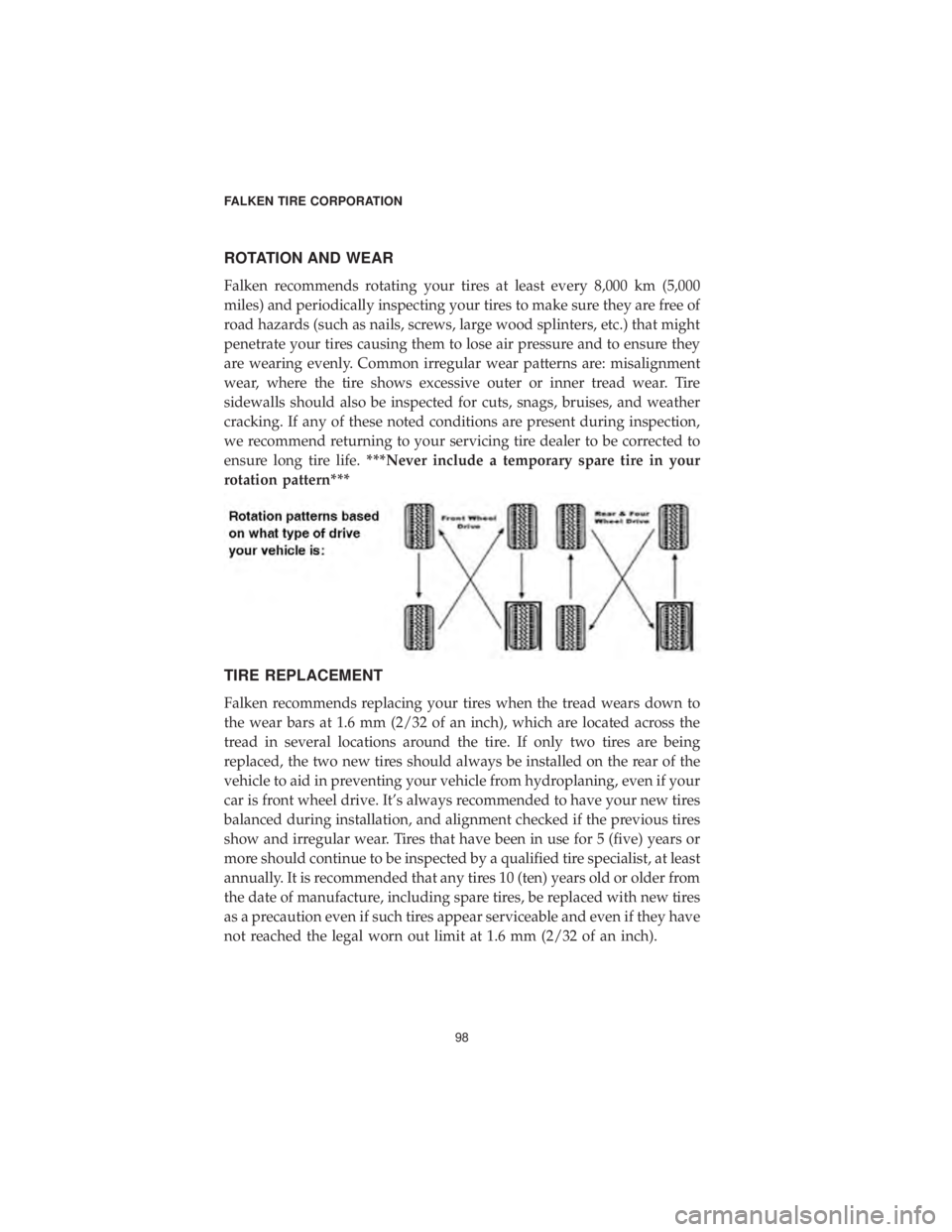
ROTATION AND WEAR
Falken recommends rotating your tires at least every 8,000 km (5,000
miles) and periodically inspecting your tires to make sure they are free of
road hazards (such as nails, screws, large wood splinters, etc.) that might
penetrate your tires causing them to lose air pressure and to ensure they
are wearing evenly. Common irregular wear patterns are: misalignment
wear, where the tire shows excessive outer or inner tread wear. Tire
sidewalls should also be inspected for cuts, snags, bruises, and weather
cracking. If any of these noted conditions are present during inspection,
we recommend returning to your servicing tire dealer to be corrected to
ensure long tire life.***Never include a temporary spare tire in your
rotation pattern***
TIRE REPLACEMENT
Falken recommends replacing your tires when the tread wears down to
the wear bars at 1.6 mm (2/32 of an inch), which are located across the
tread in several locations around the tire. If only two tires are being
replaced, the two new tires should always be installed on the rear of the
vehicle to aid in preventing your vehicle from hydroplaning, even if your
car is front wheel drive. It’s always recommended to have your new tires
balanced during installation, and alignment checked if the previous tires
show and irregular wear. Tires that have been in use for 5 (five) years or
more should continue to be inspected by a qualified tire specialist, at least
annually. It is recommended that any tires 10 (ten) years old or older from
the date of manufacture, including spare tires, be replaced with new tires
as a precaution even if such tires appear serviceable and even if they have
not reached the legal worn out limit at 1.6 mm (2/32 of an inch).
FALKEN TIRE CORPORATION
98
Page 104 of 270
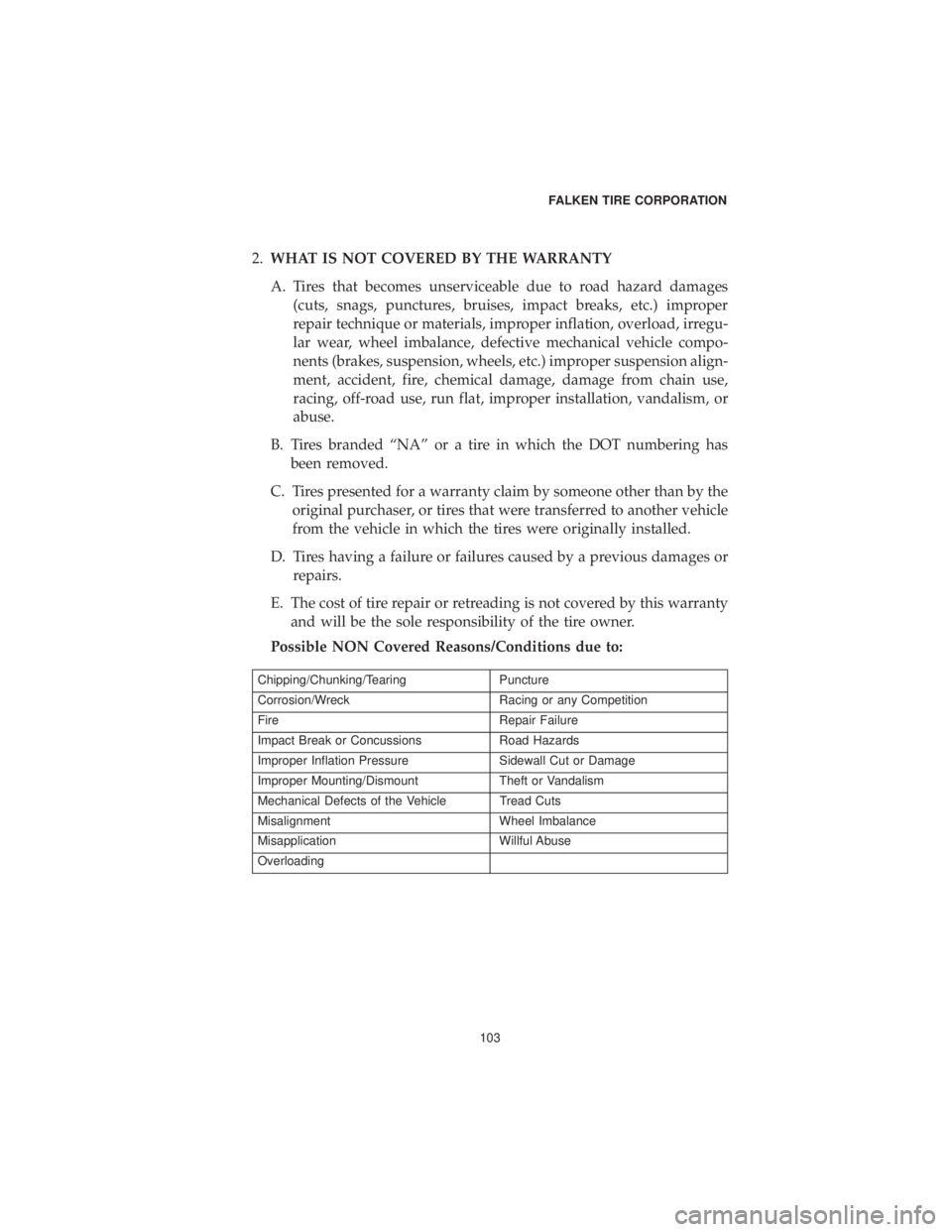
2.WHAT IS NOT COVERED BY THE WARRANTY
A. Tires that becomes unserviceable due to road hazard damages (cuts, snags, punctures, bruises, impact breaks, etc.) improper
repair technique or materials, improper inflation, overload, irregu-
lar wear, wheel imbalance, defective mechanical vehicle compo-
nents (brakes, suspension, wheels, etc.) improper suspension align-
ment, accident, fire, chemical damage, damage from chain use,
racing, off-road use, run flat, improper installation, vandalism, or
abuse.
B. Tires branded “NA” or a tire in which the DOT numbering has been removed.
C. Tires presented for a warranty claim by someone other than by the original purchaser, or tires that were transferred to another vehicle
from the vehicle in which the tires were originally installed.
D. Tires having a failure or failures caused by a previous damages or repairs.
E. The cost of tire repair or retreading is not covered by this warranty and will be the sole responsibility of the tire owner.
Possible NON Covered Reasons/Conditions due to:
Chipping/Chunking/Tearing Puncture
Corrosion/Wreck Racing or any Competition
Fire Repair Failure
Impact Break or Concussions Road Hazards
Improper Inflation Pressure Sidewall Cut or Damage
Improper Mounting/Dismount Theft or Vandalism
Mechanical Defects of the Vehicle Tread Cuts
Misalignment Wheel Imbalance
Misapplication Willful Abuse
Overloading FALKEN TIRE CORPORATION
103
Page 105 of 270
3.OWNER’S OBLIGATIONS
At least monthly, the vehicle owner(s) should check the tires’ air
pressure with a gauge and inflate to the recommended cold air
pressure level listed on the driver ’s door placard. Do not rely on car
servicers to perform the checks. The tires should be rotated at least
every 8,000km (5,000 miles) or earlier if uneven wear is occurring, and
proof of maintenance records should be kept. The owner(s) should
have the tires rebalanced if vibration is experienced, and the vehicle’s
alignment should be checked if uneven or rapid wear is occurring, or
when suggested by the vehicle’s manufacturer.
All warranty claims must be presented to an authorized Falken dealer
or participating car dealership. The owner(s) must present any sup-
porting maintenance records and documentation necessary to help
determine if the tire(s) in question are deemed covered by the limited
warranty or not.
4. LEGAL RIGHTS
All implied warranties, including warranties of merchantability and
fitness for a particular purpose shall be limited in duration to the above
period. To the extent permitted by law, Falken Tire Corporation shall not
be responsible for incidental or consequential damages, such as loss of
use of the tire or the vehicle on which it is used, inconvenience, or
commercial loss, some states do not allow limitations on how long an
implied warranty lasts, or the exclusion or limitation of incidental or
consequential damages, so the above limitations or exclusions may not
apply to you. This warranty gives you specific legal rights and you may
also have other rights, which vary from state to state. This is the only
express warranty applicable to Falken brand tires and supersedes the
terms of any previous warranty. Falken neither assumes nor authorizes
anyone to make or assume for it any other warranty.
C) UNDERSTANDING YOUR TIRES
TIRE SPEED SYMBOLS
Tires that are speed-rated are identified by the following letter symbols:
Q, S, T, U, H, V, W, Y, (Y), or (ZR). The Speed Rating’s Symbol can be
found as a part of the tire size designation (ex: 215/65HR16) or after the
load index immediately following the tire size designation (ex: 215/
65R16 97H). The Speed Rating’s Symbol indicates the maximum speed
that a tire can handle when properly inflated and loaded.
FALKEN TIRE CORPORATION
104
Page 108 of 270
MAX LOAD AND INFLATION
The maximum load and inflation pressure is marked on the tire sidewall
in English and metric units.
PLY COMPOSITION AND MATERIALS
The number of plies and their generic composition of cord materials in
the sidewall and tread areas can be found on at least one sidewall of a
tire.
RADIAL MARKING
A radial ply tire will have the word “radial” marked on at least one
sidewall. An “R” found in the tire size marking also refers to the tire
being a radial ply tire.
UNIFORM TIRE QUALITY GRADING SYSTEM (UTQG)
The Uniform Tire Quality Grading Standards (UTQG) were created to
help you make an informed decision when purchasing passenger car tires
by providing relative information about a tire’s treadwear, traction, and
temperature characteristics. Here is a breakdown of the different catego-
ries that the UTQG grades:
TREAD WEAR
The tread wear grade is a comparative rating based on the wear rate of
the tire when tested under controlled conditions on a specified govern-
ment test course. For example, a tire graded150would wear one and a
half (1½) times as well on the government course as a tire graded 100. The
relative performance of tires depends upon the actual conditions of their
use, however, and may depart significantly from the norm due to
variations in driving habits, service practices, and differences in road
characteristics and climate.
TRACTION
The traction grades, from highest to lowest, are AA, A, BandC. Those
grades represent the tire’s ability to stop on wet pavement as measured
under controlled conditions on specific government test surfaces of
asphalt and concrete. A tire marked C may have poor traction perfor-
mance.
FALKEN TIRE CORPORATION
107
Page 120 of 270
IN OBSERVANCE OF U.S. FEDERAL LAW, THIS LIMITED WAR-
RANTY AND ADJUSTMENT POLICY HAS BEEN DESIGNATED A
“LIMITED WARRANTY”. CTNA DOES NOT INTEND TO REPRE-
SENT THROUGH THIS LIMITED WARRANTY AND ADJUSTMENT
POLICY THAT TIRE FAILURES CAN OR CANNOT HAPPEN.
CTNA’S OBLIGATIONS
Contact the vehicle dealer from where you purchased the vehicle. Your
tires may be covered under the vehicle manufacturer ’s limited warranty.
If not, this CTNA Policy applies and replacement of Eligible Tires can be
made by any vehicle dealer authorized to handle General brand tire
adjustments or a General brand authorized dealer (“Authorized Dealer”).
CTNA will replace the tire pursuant to the terms of this Limited Warranty
and Adjustment Policy. Tires that are replaced under an adjustment basis
under this Limited Warranty and Adjustment Policy become the property
of CTNA.
OWNER’S OBLIGATIONS
To make an eligible claim under this Limited Warranty and Adjustment
Policy, the owner must present a claim with the tire to an Authorized
Dealer. For the nearest Authorized Dealer, consult the Yellow Pages, the
General brand internet address, or the 800 telephone numbers shown on
the back of this Limited Warranty and Adjustment Policy. Owner must
present new vehicle registration form or new vehicle sales invoice
indicating the date of purchase. Owner will be required to sign the CTNA
Limited Warranty Claim Form or dealer replacement sales receipt.
Owner is responsible for paying all applicable taxes set forth under this
Limited Warranty and Adjustment Policy. Owner is also responsible for
paying local tire disposal fees and any parts or service regardless of
mileage or months of service. This includes payment for tire rotation,
alignment, towing, road service, valve stems and tire repairs. Owner is
responsible for maintaining proper tire air pressure and for proper
maintenance of the tire.
GENERAL TIRE
11 9
Page 127 of 270
•Tires with weather-cracking that were purchased more than four (4)
years prior to presentation for adjustment or, if purchase date cannot
be verified, manufactured more than four years prior to presentation
for adjustment.
• Temporary spare tires used on vehicles used in racing and on
passenger cars in special applications such as police pursuit service.
• Goodyear Unisteel Commercial Radial Light Truck Tires.
• Tires removed from service due to improper repairs.
• Tires supplied as Original Equipment are not eligible for any tread life
warranty consideration.
• Cosmetic weather checking
• Low tire pressure-monitoring system – refer to vehicle manufacturer ’s
warranty.
• Ultra High-Performance summer tires are not recommended for
winter use, and tread or shoulder cracking on those tires resulting from
winter use will not be covered under our warranty.
WHAT ARE YOUR LEGAL RIGHTS?
No Representative or Dealer has authority to make any representation,
promise or agreement on behalf of Goodyear, except as stated herein. Any
tire, no matter how well constructed, may fail in service or otherwise
become unserviceable due to conditions beyond the control of the
manufacturer. Under no circumstances is this warranty a representation
that a tire failure cannot occur.
DISCLAIMER: THIS WARRANTY IS IN LIEU OF, AND GOODYEAR
HEREBY DISCLAIMS, ANY AND ALL OTHER WARRANTIES AND
REPRESENTATIONS, EXPRESS OR IMPLIED, INCLUDING WITHOUT
LIMITATION ANY WARRANTY OF MERCHANTABILITY OR FITNESS
FOR A PARTICULAR PURPOSE, AND NO OTHER WARRANTY OR
REPRESENTATION OF ANY KIND IS MADE BY GOODYEAR OR
SHALL BE IMPLIED BY LAW.
LIMITATION OF DAMAGES: IN NO EVENT AND UNDER NO CIR-
CUMSTANCE SHALL GOODYEAR BE LIABLE TO THE BUYER FOR
ANY INDIRECT, SPECIAL, INCIDENTAL, CONSEQUENTIAL, LOST
PROFIT, LOSS OF BUSINESS, LOSS OF GOODWILL OR REPUTATION,
GOODYEAR DUNLOP TIRES
126
Page 128 of 270
PUNITIVE OR OTHER DAMAGE, COST (INCLUDING FOR REPLACE-
MENT TRANSPORTATION), EXPENSE OR LOSS OF ANY KIND.
SOME STATES AND PROVINCES DO NOT ALLOW THE EXCLUSION
OR LIMITATION OF INCIDENTAL OR CONSEQUENTIAL DAMAGES,
SO THE ABOVE LIMITATION OR EXCLUSION MAY NOT APPLY TO
YOU.
This warranty gives you specific legal rights and you may also have other
rights that vary from state to state or province to province.
HOW DO YOU OBTAIN AN ADJUSTMENT?
1. You must present the tire to be adjusted to an authorized Goodyear orDunlop service facility. Tires replaced on an adjustment basis become
the property of The Goodyear Tire & Rubber Company or Goodyear
Canada Inc.
2. You must pay for taxes and any additional services you order at the time of adjustment plus any additional service that may be unique to
your application, e.g., Tire Pressure Monitoring System.
3. You must submit your claim on an approved claim form supplied by an authorized Goodyear or Dunlop service facility. The form must be
filled out completely and signed, where you the owner or your
authorized agent presented the tire for adjustment. You must go to an
authorized Goodyear or Dunlop outlet for replacement tires and all
warranty service.
SAFETY WARNINGS
Property damage, serious injury or death may result from:
•TIRE FAILURE DUE TO UNDERINFLATION/OVERLOADING/
MISAPPLICATION. Follow the vehicle owner ’s manual or tire plac-
ard in vehicle.
• TIRE FAILURE DUE TO IMPACT DAMAGE/IMPROPER MAIN-
TENANCE. Tires should be inspected regularly by a qualified techni-
cian for signs of damage, such as punctures or impacts.
• TIRE FAILURE DUE TO IMPROPER REPAIRS. See Rubber Manu-
facturers Association (RMA) established repair procedures at
www.rma.organd/or go towww.goodyear.comfor information on
proper repair procedures.
GOODYEAR DUNLOP TIRES
127
Page 129 of 270
•EXPLOSION OF TIRE/RIM ASSEMBLY DUE TO IMPROPER
MOUNTING. Only specially trained persons should mount tires.
• FAILURE TO MOUNT RADIAL TIRES ON APPROVED RIMS.
• FAILURE TO DEFLATE SINGLE OR DUAL ASSEMBLIES COM-
PLETELY BEFORE DEMOUNTING.
• TIRE SPINNING. On slippery surfaces such as snow, mud, ice, etc.,
do not spin tires in excess of 35 mph (55 kph), as indicated on the
speedometer.
• EXCESSIVE WHEEL SPINNING. This can also result in tire disinte-
gration or axle failure.
WARNING!
Vehicle handling, traction, ride comfort and other performance
parameters may be significantly affected by a change in tire size or
type. Before replacing tires, always consult and follow the vehicle
owner ’s manual because some vehicle manufacturers prohibit
changing tire size. When selecting tires that are different from the
original equipment size make certain:
1. The tires have adequate load-carrying capacity based on the vehicle placard,
2. The tires have sufficient inflation pressure to carry the load and
3. There is proper clearance with no interference points between the tire and vehicle.
The consumer must be aware to always drive safely and obey all
traffic laws. Avoid sudden, sharp turns or aggressive lane changes.
Failure to follow any of these warnings may result in loss of control
of the vehicle, leading to an accident and serious injury or death.
TIRE CARE AND MAINTENANCE GUIDE
The easiest way to help ensure satisfactory mileage and performance
from your Goodyear or Dunlop tires is to give them a simple but frequent
(at least monthly) inspection for proper inflation, even tread wear and the
presence of any damage.
DO MAINTAIN PROPER INFLATION PRESSURE IN YOUR TIRES
Proper inflation pressure is necessary for optimum tire performance,
safety and fuel economy. Check inflation pressures at least once a month
and before long trips. Use an accurate tire pressure gauge. Always check
GOODYEAR DUNLOP TIRES
128
Page 130 of 270
pressures when the tires are cold (when the vehicle has been driven less
than one mile). If you must check inflation when the tires are hot, add
4 psi (27 kPa) to the recommended cold inflation pressure. It is difficult
to tell just by looking at radial tires whether they are underinflated.*
Furthermore, when operating a vehicle equipped with radial tires, it is
difficult to notice when a tire has gone flat or nearly flat since the “feel”
of the vehicle does not change significantly.
*Evidence of air loss or repeated underinflation always requires expert
inspection to determine the source of leakage and tire removal to
determine repairability.To avoid injury, NEVER attempt to reinflate a
tire that has been run severely underinflated. Progressive air loss may
result from punctures, cuts, curbing, impacts or partial bead unseating.
Some fitment causes for air loss are (1) incomplete bead seating, (2) bead
tearing caused by a machine tool due to insufficient lubrication or
improper adjustment. Leaking valve core or rubber valve components
should be replaced when problems are detected and whenever tires are
replaced.
Always maintain inflation pressure at the level recommended by the
vehicle manufacturer as shown on the vehicle placard, vehicle certifi-
cation label or in the vehicle owner ’s manual:
Under inflation is the leading cause of tire failure and may result in
severe cracking, component separation or “blowout.” It reduces tire load
capacity, allows excessive sidewall flexing and increases rolling resis-
tance, resulting in heat and mechanical damage. Maintaining proper
inflation pressure is the single most important thing you can do to
promote tire durability and maximize tread life.
Over inflation increases stiffness, which may deteriorate ride and gener-
ate unwanted vibration. Over inflation also increases the chances of
impact damage.
DON’T OVERLOAD YOUR VEHICLE
Check your vehicle owner ’s manual to determine the load limits.
Overloading your vehicle places stress on your tires and other critical
vehicle components. Overloading a vehicle can cause poor handling or
increased fuel consumption and may cause tire failure. Overloading your
tires can result in severe cracking, component separation or “blowout.”
Never fit your vehicle with new tires that have less load capacity than
shown on the vehicle tire placard and remember that optimum rim width
GOODYEAR DUNLOP TIRES
129
Page 132 of 270
Tire Pressure Monitoring System Alert
Refer to your vehicle Owner ’s Manual for more information on what to
do if the tire pressure warning system activates.
THE CONVENIENCE (TEMPORARY) SPARE
The Convenience (Temporary) Spare is designed, built and tested to the
high engineering standards set by North America’s leading car manufac-
turers and to Goodyear ’s own high standards of quality control. It is
designed to take up a minimum of storage space and, at the same time,
fulfill the function of a spare tire when needed. The spare is kept in its
storage space, fully inflated at 60 psi. To be sure it is always ready for use,
the air pressure should be checked on a regular basis.
The Convenience (Temporary) Spare can be used in combination with the
original tires on your vehicle. You can expect a tire tread life of up to 3,000
miles (4,800 kilometers), depending on road conditions and your driving
habits. To conserve tire tread life, return the spare to the storage area as
soon as it is convenient to have the standard tire repaired or replaced.
The Convenience (Temporary) Spare weighs less than a standard tire so
it’s easier to handle. It also helps reduce the total car weight, which
contributes to fuel economy. The wheels used with the Convenience
(Temporary) Spare are specifically designed for use with high pressure
spares and should never be used with any other type tire.
DON’T ATTEMPT TO MOUNT YOUR OWN TIRES
Serious injury or death may result from explosion of tire/rim assembly
due to improper mounting procedures. Follow tire manufacturer ’s
instructions and match tire diameter to rim diameter. Mount light truck
radials on rims approved for radial service. Do not apply bead sealer.
This can inhibit bead seating. Lubricate beads and tire rim (including
tube or flap) contact surfaces. Lock assembly on mounting machine or
place in safety cage. STAND BACK and never exceed 40 psi to seat beads.
Never use a volatile substance or a rubber “donut” (also known as a bead
expander or “O-Ring”) to aid bead seating. Only specially trained
persons should mount tires.
GOODYEAR DUNLOP TIRES
131