flat tire CHRYSLER 300 2019 Vehicle Warranty
[x] Cancel search | Manufacturer: CHRYSLER, Model Year: 2019, Model line: 300, Model: CHRYSLER 300 2019Pages: 270, PDF Size: 2.52 MB
Page 57 of 270
TIPS FOR SAFE TIRE INFLATION
WARNING!
Inflating an unsecured tire is dangerous. If it bursts, it could be
hurled into the air with explosive force resulting in serious personal
injury or death. Never inflate a tire unless it is secured to the vehicle
or a tire mounting machine.
• Check your tire pressures, including your spare tire, monthly and
before long trips or carrying extra weight. Be sure to use an accurate
pressure gauge.
• Check inflation pressure when the tires are “cold.” Tires are considered
“cold” when the vehicle has been parked for three hours or more, or if
the vehicle has been driven less than a mile at moderate speed.
• Never release pressure from a hot tire in order to reach the recom-
mended cold tire pressure. Normal driving causes tires to run hotter
and inflation pressure to increase. If you reduce inflation pressure
when your tires are hot, you may dangerously underinflate your tires.
• If it is necessary to adjust inflation pressure when your tires are “hot,”
set their pressure to 4 psi (28 kPa) above the recommended cold
inflation pressure. Recheck the inflation pressure when the tires are
cold.
• If your tires lose more than 2 psi (14 kPa) per month, the tire, the valve,
or wheel may be damaged. Consult a qualified tire service professional
for an inspection.
• Use valve caps to keep the valves clear of debris and to help guard
against inflation pressure loss.
BRIDGESTONE® - FIRESTONE®
56
Page 58 of 270
TIPS FOR SAFE LOADING
WARNING!
Driving your vehicle in an overloaded condition is dangerous.
Overloading causes excessive tire heat build-up and internal
structural damage. This can cause a tire failure, even at a later date,
which could lead to serious personal injury or death. Consult the
vehicle tire information placard, certification label, and owner ’s
manual for the recommended vehicle load limits and loading
recommendations.
• Always keep the vehicle manufacturer ’s recommended inflation pres-
sure in all your tires, including the spare. Check their pressure monthly
and before long trips or carrying extra weight.
• Never exceed the maximum load rating stamped on the sidewall of
your tire.
• Never exceed the gross vehicle weight rating (GVWR) or front/rear
gross axle weight ratings (GAWR) of your vehicle.
• Consult your vehicle owner ’s manual for load recommendations and
special instructions (such as for trailer/towing and snow plow
installations).
TIRE DAMAGE, INSPECTION AND SERVICE LIFE
Evaluation and maintenance of your tires is important to their perfor-
mance and the service they provide to you. Over time and/or through
use, the condition of a tire can change from exposure to everyday road
conditions, the environment, damaging events such as punctures, and
other external factors.
WARNING!
Driving on damaged tires is dangerous. A damaged tire can
suddenly fail causing serious personal injury or death. Have your
tires regularly inspected by a qualified tire service professional.
You should visually inspect your tires on a regular basis throughout their
life, and you should have your tires periodically evaluated by a qualified
tire service professional when your vehicle is serviced such as routine
BRIDGESTONE® - FIRESTONE®
57
Page 59 of 270
maintenance intervals, oil changes, and tire rotations. In particular, note
the following tips for spotting tire damage:
•After striking anything unusual in the roadway, have a qualified tire
service professional demount the tire and inspect it for damage. A tire
may not have visible signs of damage on the tire surface. Yet, the tire
may suddenly fail without warning, a day, a week, or even months
later.
• Inspect your tires for cuts, cracks, splits or bruises in the tread and
sidewall areas. Bumps or bulges may indicate a separation within the
tire body. Have your tire inspected by a qualified tire service profes-
sional. It may be necessary to have it removed from the wheel for a
complete inspection.
• Inspect your tires for adequate tread depth. When the tire is worn to
the built-in indicators at 2/32 inch (1.6 mm) or less tread groove depth,
or the tire cord or fabric is exposed, the tire is dangerously worn and
must be replaced immediately.
• Inspect your tires for uneven wear. Wear on one side of the tread or flat
spots in the tread may indicate a problem with the tire or vehicle.
Consult a qualified tire service professional.
• Inspect your wheels also. If you have a bent or cracked wheel, it must
be replaced.
• Don’t forget to check the spare tire.
Make sure your tires, including the spare tire, continue to be regularly
inspected after 5 years of service to determine if they can continue in
service. Even when your tires appear to be usable from their external
appearance or the tread depth may have not reached the minimum wear
out depth, it is recommended that all tires (including spare tires and
“temporary use” spares) more than 10 years old be replaced with new
tires.
The 10 year period after the date of production is not an indicator of
actual service life for any individual tire. Some tires will need to be
replaced before 10 years due to conditions such as punctures, impact
damage, improper inflation, overloading, tread wear or other conditions
involving use or misuse of the tire. If a tire is worn out or otherwise
unserviceable from damage or conditions of use, it should be replaced
regardless of when it was produced or placed in service.
BRIDGESTONE® - FIRESTONE®
58
Page 61 of 270
TIRE REPAIRS
WARNING!
Driving on an improperly repaired tire is dangerous. An improper
repair can be unreliable or permit further damage to the tire. The
tire may suddenly fail, causing serious personal injury or death.
A complete inspection and repair of your tire in accordance with Rubber
Manufacturers Association (RMA) procedures should be conducted by a
qualified tire service professional. While the comprehensive procedures
and recommendations for tire repair are beyond the scope of this manual,
a proper tire repair includes the following:
• The tire is demounted from the wheel for a complete inspection,
inside and out. Some damage to the tire may only be evident on the
interior of the tire.
• The puncture injury is 1/4 inch (6 mm) or less and must be within the
tread area as shown in the graphic. This helps ensure long-term tire
and repair durability.
• A patch is applied to the interior of the tire and the puncture hole is
filled with a suitable plug/stem filler. This helps ensure that the
interior of the tire is adequately sealed to prevent inflation pressure
loss and prevents contamination of the steel belts and other plies from
the elements (such as water) in the outside world.
BRIDGESTONE® - FIRESTONE®
60
Page 63 of 270
•Any tire repair done without removing the tire from the wheel is
improper. The tire must be demounted from the wheel and the interior
inspected for damage that may not be evident on the exterior of the
tire.
• Using only a plug/stem, or using only a patch, is not a safe or proper
repair. A patch must be applied to the interior of the tire and the
puncture hole must be filled with a suitable plug/stem filler to prevent
inflation pressure loss and contamination of the steel belts and other
plies.
• NEVER substitute a tube for a proper repair or to remedy an improper
repair.
• Tubes, like tires, should only be repaired by a qualified tire service
professional.
• Some vehicle manufacturers do not recommend using repaired tires.
Consult your vehicle owner ’s manual or contact the vehicle manufac-
turer before operating a repaired tire on your vehicle.
ASK how your tire will be repaired. ALWAYS insist on a proper tire
repair.
Emergency/Temporary Sealant or Filler Repairs: An emergency/
temporary sealant or filler injected into the tire, such as by aerosol can or
injection/squeeze-tube, is not a proper repair and voids the tire Limited
Warranty. A tire injected with such sealant/filler must be replaced by a
qualified tire service professional as soon as possible.
WARNING!
Tell the tire service professional if you have used an aerosol fixer to
inflate/seal the tire. Aerosol fixers could contain a highly volatile
gas. Always remove the valve core outdoors, away from sources of
excessive heat, flame, or sparks and completely deflate the tire
before removing it from the wheel.
Speed Rating: The tire’s speed rating is void if the tire is repaired,
retreaded, damaged, abused, or otherwise altered from its original
condition. Thereafter, it should be treated as a non-speed rated tire. See
“Tire Speed Ratings” in this manual.
Improper repair voids the tire Limited Warranty. See “Limited War-
ranty” in this manual.
BRIDGESTONE® - FIRESTONE®
62
Page 64 of 270
RFT (Run-Flat Technology) Tires:In addition to the above, there are
recommendations specific to the repair of RFT tires; see “RFT Tires with
Run-Flat Technology” in this manual.
TIRE MOUNTING AND OTHER SERVICING
WARNING!
Removing and replacing tires on wheels can be dangerous.
Attempting to mount tires with improper tools or procedures may
result in a tire explosion causing serious personal injury or death.
This is only a job for a qualified tire service professional. Never
perform tire service procedures without proper training, tools, and
equipment.
This manual is not intended to provide proper training or service
procedures for tire mounting, demounting, balancing, rotation, or
repair. Please leave these tasks to qualified tire service professionals.
For your safety and that of others:
• Always stand well clear of any tire mounting operation. This is
especially important when the service operator inflates the tire. If the
tire has been improperly mounted, it may burst with explosive force
causing serious personal injury or death.
• Tires must match the width and diameter requirements of the wheels.
For example, 16 inch diameter tires must only be mounted to 16 inch
diameter wheels. Radial tires must only be mounted to wheels
approved for radial tires.
• Wheels must be free of cracks, dents, chips, and rust. Tires must be free
of bead damage, cuts, and punctures.
• Never inflate a tire beyond 40 psi (275 kPa) to seat the beads. Be
absolutely certain beads are fully seated before adjusting inflation
pressure to the level recommended for vehicle operation.
• Never put flammable substances in tire/wheel assemblies at any time.
Never put any flammable substance into a tire/wheel assembly and
attempt to ignite to seat the beads.
• Always stand well away from the work area when tires are being spin
balanced either on or off the vehicle.
BRIDGESTONE® - FIRESTONE®
63
Page 65 of 270
HIGH PERFORMANCE, LOW ASPECT RATIO TIRES
Many new vehicles come equipped from the factory with high perfor-
mance and/or low aspect ratio tires. Generally, these tires provide
increased vehicle handling capability, but may also have numerous
engineering performance trade-offs associated with their designs.
•Low aspect ratio tires, with reduced sidewall height, may be more
susceptible to damage from potholes, road hazards, and other objects
such as curbs. This is true for the wheels as well. Therefore, as with all
other tires, it is important to drive with care and maintain proper
inflation pressure and load conditions. See “Tire Inflation Pressure”
and “Tire Damage, Inspection and Service Life” in this manual.
• Some sports cars and other handling performance enhanced vehicles,
including sedans and light trucks/SUVs, may be originally equipped
with high performance tires that are more optimized for warmer
weather use. Colder, winter weather traction may be reduced for these
types of tires. Winter tires may be recommended by the vehicle
manufacturer for colder weather application. See “Winter Tires,” the
next section in this manual.
• High performance tires may also wear more quickly, ride more firmly,
and produce more noise during operation.
Consult your vehicle owner ’s manual and tire information placard, or a
qualified tire service professional, for more information and specifics
regarding these types of tires.
WINTER TIRES
WARNING!
Winter driving presents special challenges for vehicle mobility. The
use of winter tires (including studs and chains)—while improving
traction performance in snow and ice—requires special care with
regard to acceleration, braking, cornering, and speed. It is important
to drive with care, not only on snow and ice, but on dry and wet
roads as well.
In winter driving conditions, vehicle control and safe operation under
braking and cornering is especially dependent upon the rear tires. For
this reason, winter tires are best applied to all wheel positions. Some
BRIDGESTONE® - FIRESTONE®
64
Page 67 of 270
•High-speed driving should be left to trained professionals operating
under controlled conditions.
• No tire, regardless of its design or speed rating, has unlimited capacity
for speed, and a sudden tire failure can occur if its limits are exceeded.
See “Tire Speed Ratings,” the next section in this manual.
Refer to your vehicle owner ’s manual for any tire pressure recommen-
dations for high speed driving.
TIRE SPEED RATINGS
A tire bearing a letter “speed rating” designation indicates the tire’s
speed capability according to standardized laboratory tests. This speed
rating system is intended to permit comparison of the speed capabilities
of different tires. When replacing your tires, consult your vehicle owner ’s
manual and tire information placard for recommendations, if any,
concerning the use of speed rated tires.
• To avoid reducing the speed capability of the vehicle, replace a speed
rated tire only with another tire having at least the same speed rating.
It is the “top speed” of the “slowest” tire on the vehicle which limits
the vehicle’s top speed without tire failure.
• The tire’s speed rating is void if the tire is repaired, retreaded,
damaged, abused, or otherwise altered from its original condition.
Thereafter, it should be treated as a non-speed rated tire.
• Non-speed rated tires are usually for ordinary passenger car or light
truck service and not for high speed driving.
• For winter tires used in cold weather conditions, it is generally
acceptable to apply a tire with a lower speed rating than your original
tires; however, speed should be reduced accordingly. All winter tires
should be the same speed rating. Some vehicles have specific recom-
mendations regarding winter tire use; consult your vehicle owner ’s
manual and tire information placard. See “Winter Tires” in this
manual.
These speed ratings are based on standardized laboratory tests under
specific, controlled conditions. While these tests may relate to perfor-
mance on the road, real-world driving is rarely identical to any test
conditions. Your tire’s actual speed capability may be less than its rated
speed since it is affected by factors such as inflation pressure, load, tire
BRIDGESTONE® - FIRESTONE®
66
Page 68 of 270
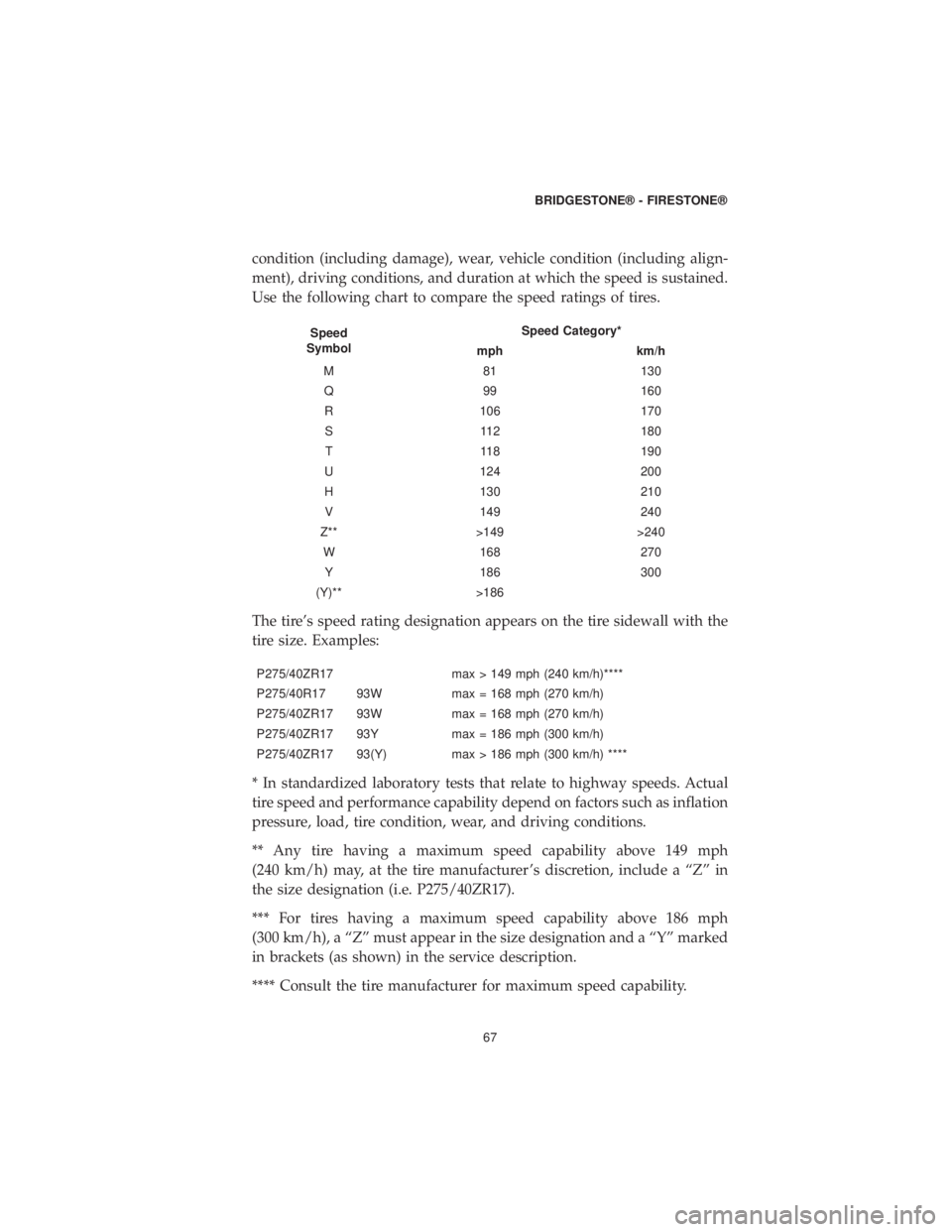
condition (including damage), wear, vehicle condition (including align-
ment), driving conditions, and duration at which the speed is sustained.
Use the following chart to compare the speed ratings of tires.
Speed
Symbol Speed Category*
mph km/h
M8 1130
Q9 9160
R 106 170
S 112 180
T 118 190
U 124 200
H 130 210
V 149 240
Z** >149 >240
W 168 270
Y 186 300
(Y)** >186
The tire’s speed rating designation appears on the tire sidewall with the
tire size. Examples:
P275/40ZR17 max > 149 mph (240 km/h)****
P275/40R17 93W max = 168 mph (270 km/h)
P275/40ZR17 93W max = 168 mph (270 km/h)
P275/40ZR17 93Y max = 186 mph (300 km/h)
P275/40ZR17 93(Y) max > 186 mph (300 km/h) ****
* In standardized laboratory tests that relate to highway speeds. Actual
tire speed and performance capability depend on factors such as inflation
pressure, load, tire condition, wear, and driving conditions.
** Any tire having a maximum speed capability above 149 mph
(240 km/h) may, at the tire manufacturer ’s discretion, include a “Z” in
the size designation (i.e. P275/40ZR17).
*** For tires having a maximum speed capability above 186 mph
(300 km/h), a “Z” must appear in the size designation and a “Y” marked
in brackets (as shown) in the service description.
**** Consult the tire manufacturer for maximum speed capability.
BRIDGESTONE® - FIRESTONE®
67
Page 71 of 270
YOUR SPARE TIRE
Consult your vehicle owner ’s manual for proper application of your
spare tire. Your car may be equipped with a “temporary use” spare tire;
this spare may differ in size and construction from the other tires on your
vehicle.
WARNING!
Check inflation pressure before use. Failure to have proper inflation
pressure when using your spare tire can result in serious personal
injury or death. See Tire Inflation Pressure in this manual.
WARNING!
Mounting a “temporary use” tire on a wheel which is not
specifically designed for it, or placing another type tire on a wheel
designated for temporary use can be dangerous. Your vehicle’s
handling characteristics can be seriously affected. You could have an
accident resulting in serious personal injury or death. Consult your
vehicle owner ’s manual for proper application of your “temporary
use” spare tire.
The spare tire in your vehicle is intended to be used as a spare when
needed. The spare tire carrier is not intended to be used for long term
storage, except for “temporary use” tires. If your spare is the same size,
load rating, and type of tire as your road tires, it should be included in the
tire rotation process; see “Radial Tire Rotation” in this manual for more
information.
The spare should be included in regular tire inspections and inflation
pressure checks. In addition, it should be replaced 10 years after date of
manufacture, regardless of condition or tread depth. For more informa-
tion, see the “Tire Damage, Inspection and Service Life” in this manual.
TIRE STORAGE
Tires should be stored indoors in a cool, dry place where water cannot
collect inside them. Tires should be placed away from electric
generators/motors and sources of heat such as hot pipes. Storage
surfaces should be clean and free of grease, gasoline or other substances
which can deteriorate the rubber.
BRIDGESTONE® - FIRESTONE®
70