light CHRYSLER 300 C 2008 1.G Owners Manual
[x] Cancel search | Manufacturer: CHRYSLER, Model Year: 2008, Model line: 300 C, Model: CHRYSLER 300 C 2008 1.GPages: 520, PDF Size: 5.43 MB
Page 329 of 520

CAUTION!
Prolonged operation of the steering system at the end
of the steering wheel travel will increase the steering
fluid temperature and it should be avoided when
possible. Damage to the power steering pump may
occur.
MULTI DISPLACEMENT SYSTEM (MDS) — 5.7L
Engine Only
This feature offers improved fuel economy by shutting
off four of the engine’s eight cylinders during light load
and cruise conditions. The system is automatic with no
driver inputs or additional driving skills required.
NOTE:The MDS system may take some time to return
to full functionality after a battery disconnect.
TRACTION CONTROL SYSTEM (TCS) — IF
EQUIPPED
WARNING!
The Traction Control System (TCS) cannot prevent
the natural laws of physics from acting on the ve-
hicle, nor can it increase the traction afforded. The
TCS cannot prevent accidents, including those result-
ing from excessive speed in turns, or hydroplaning.
Only a safe, attentive, and skillful driver can prevent
accidents. The capabilities of a TCS-equipped ve-
hicle must never be exploited in a reckless or dan-
gerous manner, which could jeopardize the user’s
safety or the safety of others.
The Traction Control System (TCS) is standard on ve-
hicles equipped with Electronic Stability Program (ESP).
328 STARTING AND OPERATING
Page 330 of 520

The TCS monitors the amount of wheel spin of each
driven wheel. If wheel spin is detected, brake pressure is
applied to the slipping wheel(s) and engine power is
reduced to provide enhanced acceleration and stability.
The ESP/TCS indicator light, located in the
instrument cluster, starts to flash as soon as the
tires lose traction and the ESP system becomes
active. The indicator light also flashes when the
TCS is active. If the indicator light begins to flash during
acceleration, ease up on the accelerator and apply as little
throttle as possible. Be sure to adapt your speed and
driving to the prevailing road conditions.
When the TCS is switched off, the torque reduction
feature is cancelled. However, a feature of the system
remains active. This feature controls wheel spin across an
axle quite similarly to a limited slip differential. If one
wheel on an axle is spinning faster than the other, the
system will apply the brake of the spinning wheel andallow more engine torque to be applied to the wheel that
is not spinning. This wheel slip control is active up to 50
mph (80 km/h).
CAUTION!
When the ESP/TCS indicator light is illuminated
continuously, the ESP is switched off. Avoid spin-
ning one drive wheel. This may cause serious dam-
age to the drive train.
NOTE:
•The Traction Control System comes on each time the
ignition switch is turned ON. This will occur even if
you used the ESP OFF button to turn OFF the system.
•The Traction Control System will make buzzing or
clicking sounds when in operation.
STARTING AND OPERATING 329
5
Page 333 of 520
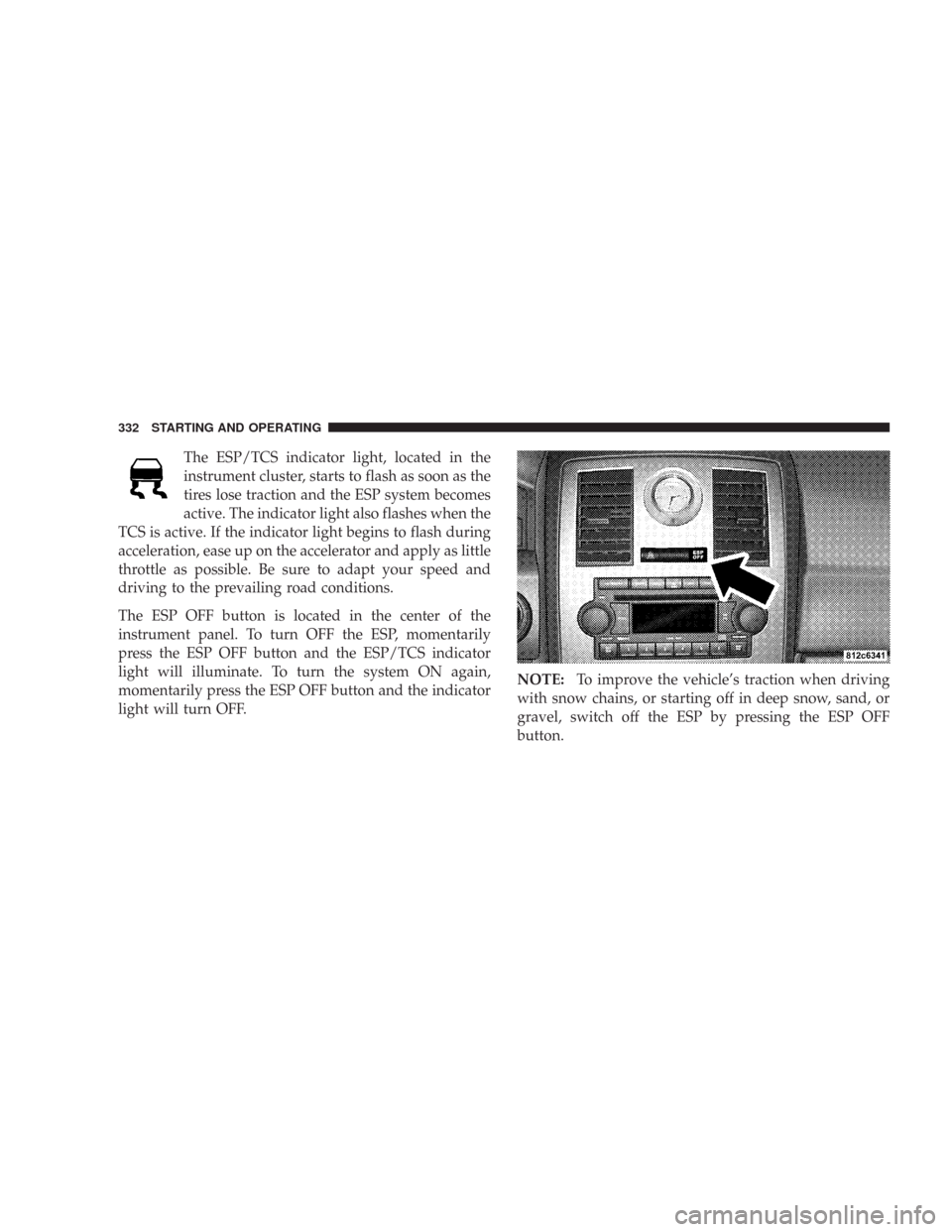
The ESP/TCS indicator light, located in the
instrument cluster, starts to flash as soon as the
tires lose traction and the ESP system becomes
active. The indicator light also flashes when the
TCS is active. If the indicator light begins to flash during
acceleration, ease up on the accelerator and apply as little
throttle as possible. Be sure to adapt your speed and
driving to the prevailing road conditions.
The ESP OFF button is located in the center of the
instrument panel. To turn OFF the ESP, momentarily
press the ESP OFF button and the ESP/TCS indicator
light will illuminate. To turn the system ON again,
momentarily press the ESP OFF button and the indicator
light will turn OFF.NOTE:To improve the vehicle’s traction when driving
with snow chains, or starting off in deep snow, sand, or
gravel, switch off the ESP by pressing the ESP OFF
button.
332 STARTING AND OPERATING
Page 334 of 520

CAUTION!
When the ESP/TCS indicator light is illuminated
continuously, the ESP is switched off. Avoid spin-
ning one drive wheel. This may cause serious dam-
age to the drive train.
CAUTION!
If the vehicle is towed with the front axle raised, the
engine must be shut off (key in the ignition switch to
the LOCK or ACC position). Otherwise, the ESP will
immediately be engaged and it will apply the rear
wheel brakes.
Synchronizing ESP
The malfunction indicator light for the ESP is
combined with BAS indicator. If the power
supply is interrupted (battery disconnected or
discharged), the ESP/BAS malfunction indica-
tor light may illuminate with the engine running. If this
should occur, turn the steering wheel completely to the
left and then to the right. The ESP/BAS malfunction
indicator light should go out. However, if the light
remains on, have the ESP and BAS checked at your
authorized dealer as soon as possible.
ESP/BAS Malfunction Indicator and ESP/TCS
Indicator Lights
The malfunction indicator light for the ESP is
combined with the BAS indicator. The yellow
ESP/BAS malfunction indicator light and the
STARTING AND OPERATING 333
5
Page 335 of 520
yellow ESP/TCS indicator light in the instrument cluster
both come on when the ignition switch is turned to the
“ON” position. They should go out with the engine
running.
The system will turn the ESP/BAS malfunction indicator
light on continuously while the engine running if it
detects a malfunction in either the ESP or the BAS or
both. If the light remains on after several ignition cycles,
and you have driven the vehicle several miles at speeds
greater than 30 mph (48 km/h), and the ESP is synchro-
nized (refer to Synchronizing ESP), see your authorized
dealer as soon as possible to have the problem diagnosed
and corrected.TIRE SAFETY INFORMATION
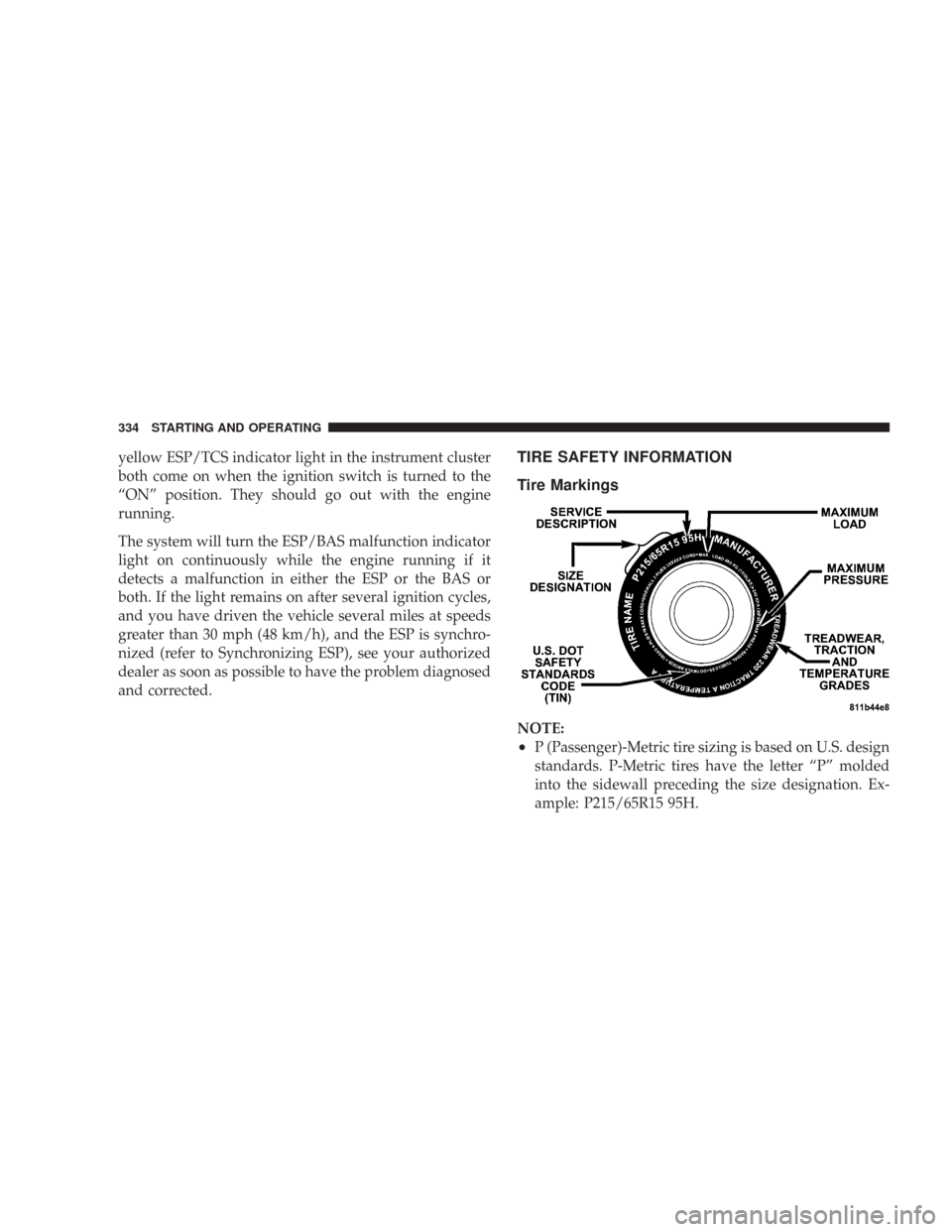
Tire Markings
NOTE:
•P (Passenger)-Metric tire sizing is based on U.S. design
standards. P-Metric tires have the letter “P” molded
into the sidewall preceding the size designation. Ex-
ample: P215/65R15 95H.
334 STARTING AND OPERATING
Page 336 of 520
•European Metric tire sizing is based on European
design standards. Tires designed to this standard have
the tire size molded into the sidewall beginning with
the section width. The letter\4P\4is absent from this tire
size designation. Example: 215/65R15 96H
•LT (Light Truck)-Metric tire sizing is based on U.S.
design standards. The size designation for LT-Metric
tires is the same as for P-Metric tires except for the
letters “LT” that are molded into the sidewall preced-
ing the size designation. Example: LT235/85R16.
•Temporary Spare tires are high-pressure compact
spares designed for temporary emergency use only.
Tires designed to this standard have the letter “T”
molded into the sidewall preceding the size designa-
tion. Example: T145/80D18 103M.
•High Flotation tire sizing is based on U.S. design
standards and it begins with the tire diameter molded
into the sidewall. Example: 31x10.5 R15 LT.
STARTING AND OPERATING 335
5
Page 337 of 520
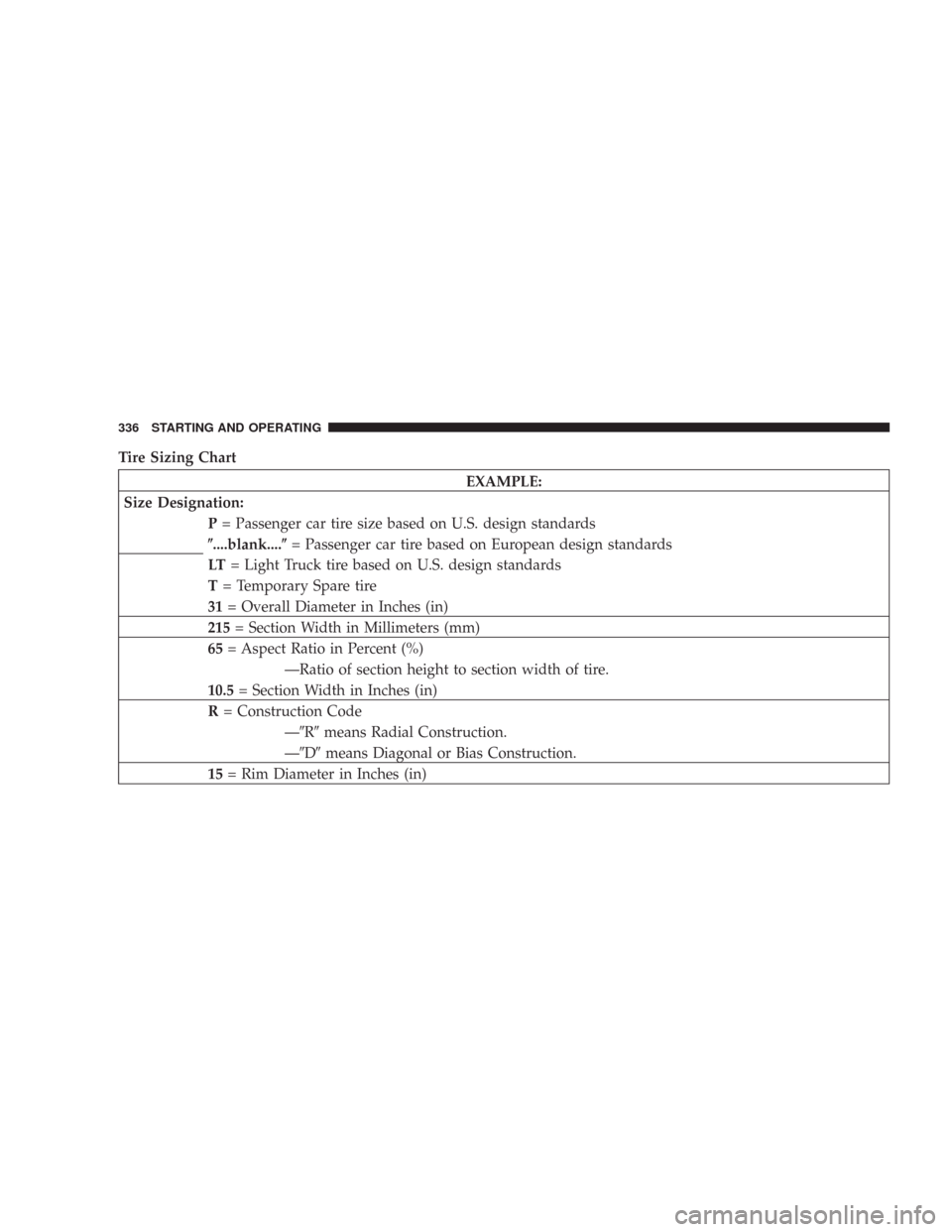
Tire Sizing Chart
EXAMPLE:
Size Designation:
P= Passenger car tire size based on U.S. design standards
\10....blank....\10= Passenger car tire based on European design standards
LT= Light Truck tire based on U.S. design standards
T= Temporary Spare tire
31= Overall Diameter in Inches (in)
215= Section Width in Millimeters (mm)
65= Aspect Ratio in Percent (%)
—Ratio of section height to section width of tire.
10.5= Section Width in Inches (in)
R= Construction Code
—\4R\4means Radial Construction.
—\4D\4means Diagonal or Bias Construction.
15= Rim Diameter in Inches (in)
336 STARTING AND OPERATING
Page 338 of 520

EXAMPLE:
Service Description:
95= Load Index
—A numerical code associated with the maximum load a tire can carry.
H= Speed Symbol
—A symbol indicating the range of speeds at which a tire can carry a load corresponding
to its load index under certain operating conditions.
—The maximum speed corresponding to the Speed Symbol should only be achieved un-
der specified operating conditions (i.e. tire pressure, vehicle loading, road conditions,
and posted speed limits).
Load Identification:
\10....blank....\10= Absence of any text on sidewall of the tire indicates a Standard Load (SL) Tire
Extra Load (XL)= Extra Load (or Reinforced) Tire
Light Load= Light Load Tire
C,D,E= Load range associated with the maximum load a tire can carry at a specified pressure
Maximum Load— Maximum Load indicates the maximum load this tire is designed to carry.
Maximum Pressure— Maximum Pressure indicates the maximum permissible cold tire inflation pressure for this
tire.
STARTING AND OPERATING 337
5
Page 352 of 520

WARNING!
Tires and spare tire should be replaced after six years,
regardless of the remaining tread. Failure to follow
this warning can result in sudden tire failure. You
could lose control and have an accident resulting in
serious injury or death.
Keep dismounted tires in a cool, dry place with as little
exposure to light as possible. Protect tires from contact
with oil, grease, and gasoline.
Replacement Tires
The tires on your new vehicle provide a balance of many
characteristics. They should be inspected regularly for
wear and correct cold tire inflation pressure. The manu-
facturer strongly recommends that you use tires equiva-
lent to the originals in size, quality and performance
when replacement is needed (refer to the paragraph on
“Tread Wear Indicators”). Refer to the “Tire and Loading
Information” placard for the size designation of your tire.
The service description and load identification will be
found on the original equipment tire. Failure to use
equivalent replacement tires may adversely affect the
safety, handling, and ride of your vehicle. We recommend
that you contact your original equipment or an autho-
rized tire dealer with any questions you may have on tire
specifications or capability.
STARTING AND OPERATING 351
5
Page 357 of 520

pressure will also increase as the vehicle is driven - this
is normal and there should be no adjustment for this
increased pressure.
•The TPM System will warn the driver of a low tire
pressure if the tire pressure falls below the low-
pressure warning limit for any reason, including low
temperature effects and natural pressure loss through
the tire.
•The TPM System will continue to warn the driver of
low tire pressure as long as the condition exists, and
will not turn off until the tire pressure is at or above
the recommended cold placard pressure. Once the low
tire pressure warning (Tire Pressure Monitoring Tell-
tale Light) illuminates, you must increase the tire
pressure to the recommended cold placard pressure in
order for the Tire Pressure Monitoring Telltale Light to
turn off. The system will automatically update and the
Tire Pressure Monitoring Telltale Light will turn offonce the system receives the updated tire pressures.
The vehicle may need to be driven for up to 10 minutes
above 15 mph (25 km/h) in order for the TPMS to
receive this information.
\25For example, your vehicle may have a recom-
mended cold (parked for more than 3 hours) placard
pressure of 30 psi (207 kPa). If the ambient tempera-
ture is 68°F (20°C) and the measured tire pressure is
27 psi (186 kPa), a temperature drop to 20°F (-7°C)
will decrease the tire pressure to approximately 26
psi (179 kPa). This tire pressure is sufficiently low
enough to turn ON the Tire Pressure Monitoring
Telltale light. Driving the vehicle may cause the tire
pressure to rise to approximately 27 psi (186 kPa),
but the Tire Pressure Monitoring Telltale Light will
still be ON. In this situation, the Tire Pressure
Monitoring Telltale Light will turn OFF only after
the tires are inflated to the vehicle’s recommended
cold placard pressure value.
356 STARTING AND OPERATING