brake CHRYSLER 300 C 2008 1.G Owner's Manual
[x] Cancel search | Manufacturer: CHRYSLER, Model Year: 2008, Model line: 300 C, Model: CHRYSLER 300 C 2008 1.GPages: 520, PDF Size: 5.43 MB
Page 217 of 520
•ACC Off — When the Adaptive Cruise Control (ACC)
system is turned off. Refer to “Adaptive Cruise Con-
trol (ACC)” in Section 3 of this manual for detailed
information (if so equipped).
•ACC Ready — When the Adaptive Cruise Control
(ACC) system is activated. Refer to “Adaptive Cruise
Control (ACC)” in Section 3 of this manual for detailed
information (if so equipped).
•ACC Set — After setting the desired speed in the
Adaptive Cruise Control (ACC) system. Refer to
“Adaptive Cruise Control (ACC)” in Section 3 of this
manual for detailed information (if so equipped).
•Driver Override — If you apply the accelerator after
setting the desired speed in the Adaptive Cruise
Control (ACC) system. Refer to “Adaptive Cruise
Control (ACC)” in Section 3 of this manual for detailed
information (if so equipped).
•Distance Set — After changing the desired following
distance in the Adaptive Cruise Control (ACC) system,
this message will display momentarily. Refer to
“Adaptive Cruise Control (ACC)” in Section 3 of this
manual for detailed information (if so equipped).
•Attention — If the Adaptive Cruise Control (ACC)
system predicts that its maximum braking level is not
sufficient to maintain the set distance, this message
will flash and a chime will sound while ACC continues
to apply its maximum braking capacity. When this
occurs, you should immediately apply the brakes as
needed to maintain a safe distance from the vehicle
ahead. Refer to “Adaptive Cruise Control (ACC)” in
Section 3 of this manual for detailed information (if so
equipped).
216 UNDERSTANDING YOUR INSTRUMENT PANEL
Page 296 of 520

STARTING AND OPERATING
CONTENTS
\1Starting Procedures.....................299
\3Automatic Transmission................300
\3Normal Starting (Tip Start)..............301
\3Extremely Cold Weather
(Below\120°F Or\129°C)................301
\3If Engine Fails To Start.................302
\3After Starting........................303
\1Engine Block Heater — If Equipped.........303
\1Automatic Transmission..................303\3Automatic Transmission —
General Information...................304
\3Brake/Transmission Shift Interlock System . . . 306
\34 Speed Automatic Transmission..........307
\35 Speed Automatic Transmission..........312
\1AutoStick\2— If Equipped................318
\3AutoStick\2Operation..................318
\1All Wheel Drive — If Equipped............319
\1Driving On Slippery Surfaces..............319
5
Page 297 of 520

\3Acceleration.........................319
\3Traction............................320
\1Driving Through Water..................320
\3Flowing/Rising Water..................320
\3Shallow Standing Water.................321
\1Parking Brake.........................322
\1Brake System..........................324
\3Anti-Lock Brake System — If Equipped.....325
\1Power Steering........................327
\1Multi Displacement System (MDS) —
5.7L Engine Only.......................328
\1Traction Control System (TCS) — If Equipped . . 328
\1Brake Assist System (BAS) — If Equipped.....330\1Electronic Stability Program (ESP) —
If Equipped...........................331
\3Synchronizing ESP....................333
\3ESP/BAS Malfunction Indicator And
ESP/TCS Indicator Lights...............333
\1Tire Safety Information...................334
\3Tire Markings........................334
\3Tire Identification Number (TIN)..........338
\3Tire Loading And Tire Pressure...........340
\1Tires — General Information...............344
\3Tire Pressure.........................344
\3Tire Inflation Pressures.................345
\3Radial-Ply Tires......................347
\3Compact Spare Tire — If Equipped.........348
296 STARTING AND OPERATING
Page 301 of 520

Automatic Transmission
The gear selector must be in the “N” (Neutral) or “P”
(Park) position before you can start the engine. Apply the
brakes before shifting into any driving gear.CAUTION!
Damage to the transmission may occur if the follow-
ing precautions are not observed:
•Shift into PARK only after the vehicle has come to
a complete stop.
•Shift into or out of REVERSE only after the
vehicle has come to a complete stop and the engine
is at idle speed.
•Do not shift from REVERSE, PARK, or NEUTRAL
into any forward gear when the engine is above
idle speed.
•Before shifting into any gear, make sure your foot
is firmly on the brake pedal.
300 STARTING AND OPERATING
Page 304 of 520
After Starting
The idle speed is controlled automatically and it will
decrease as the engine warms up.
ENGINE BLOCK HEATER — IF EQUIPPED
The engine block heater warms engine coolant and
permits quicker starts in cold weather. Connect the cord
to a standard 110-115 volt AC electrical outlet with a
grounded, three-wire extension cord.
The engine block heater cord is routed under the hood on
the driver side of the vehicle. It has a removable cap that
is located on the driver side of the Integrated Power
Module.
WARNING!
Remember to disconnect the cord before driving.
Damage to the 110-115 volt electrical cord could cause
electrocution.
AUTOMATIC TRANSMISSION
CAUTION!
Damage to the transmission may occur if the follow-
ing precautions are not observed:
•Shift into PARK only after the vehicle has come to
a complete stop.
•Shift into or out of REVERSE only after the
vehicle has come to a complete stop and the engine
is at idle speed.
•Do not shift from REVERSE, PARK, or NEUTRAL
into any forward gear when the engine is above
idle speed.
•Before shifting into any gear, make sure your foot
is firmly on the brake pedal.
STARTING AND OPERATING 303
5
Page 305 of 520
WARNING!
It is dangerous to shift the selector lever out of “P” or
“N” if the engine speed is higher than idle speed. If
your foot is not firmly on the brake pedal, the vehicle
could accelerate quickly forward or in reverse. You
could lose control of the vehicle and hit someone or
something. Only shift into gear when the engine is
idling normally and when your right foot is firmly on
the brake pedal.
Automatic Transmission — General Information
The automatic transmission selects individual gears au-
tomatically, dependent upon:
•Altitude
•Vehicle Loading
•Driving Style
•Selector lever position
•Accelerator position
•Vehicle speed
The gear shifting process is continuously adapted, de-
pendent on the driving style, the driving situation, and
the road characteristics.
NOTE:
•After selecting any driving position, wait a moment to
allow the gear to engage fully before accelerating,
especially when the engine is cold.
•If there is a need to restart the engine, be sure to cycle
the key to the LOCK position before restarting. Trans-
mission engagement may be delayed up to 10 seconds
after restart if the key is not cycled to the LOCK
position first.
304 STARTING AND OPERATING
Page 306 of 520
•The electronically controlled transmission provides a
precise shift schedule. The transmission electronics are
self-calibrating. Therefore, the first few shifts on a new
vehicle may be somewhat abrupt or soft until after the
break-in period. This is a normal condition, and pre-
cision shifts will develop within a few shift cycles.
The selector lever is automatically locked while in the
“P” (Park) position. To move the selector lever out of the
“P” (Park) position, the brake pedal must be firmly
depressed before the shift lock will release.
Shift the selector lever to the desired position only when
the engine is idling normally and the brake pedal is
applied. Do not release the brake until ready to drive. The
vehicle may otherwise accelerate quickly when the selec-
tor lever is in “D” (Drive) or “R” (Reverse) position.WARNING!
Unintended movement of a vehicle could injure
those in and near the vehicle. As with all vehicles,
you should never exit a vehicle while the engine is
running. Before exiting a vehicle, you should always
shift the vehicle into “P” (Park), remove the key from
the ignition, and apply the parking brake. Once the
key is removed from the ignition, the transmission
selector lever is locked in the “P” (Park) position,
securing the vehicle against unwanted movement.
Furthermore, you should never leave children unat-
tended inside a vehicle.
STARTING AND OPERATING 305
5
Page 307 of 520
Over Temperature Mode
The transmission electronics constantly monitor the
transmission oil temperature. If the transmission exceeds
normal operating temperature, the transmission will
change the way it shifts to help control the condition.
This may result in a slightly different feeling or response
during normal operation in “D” (Drive) position. After
the transmission cools down, it will return to normal
operation.
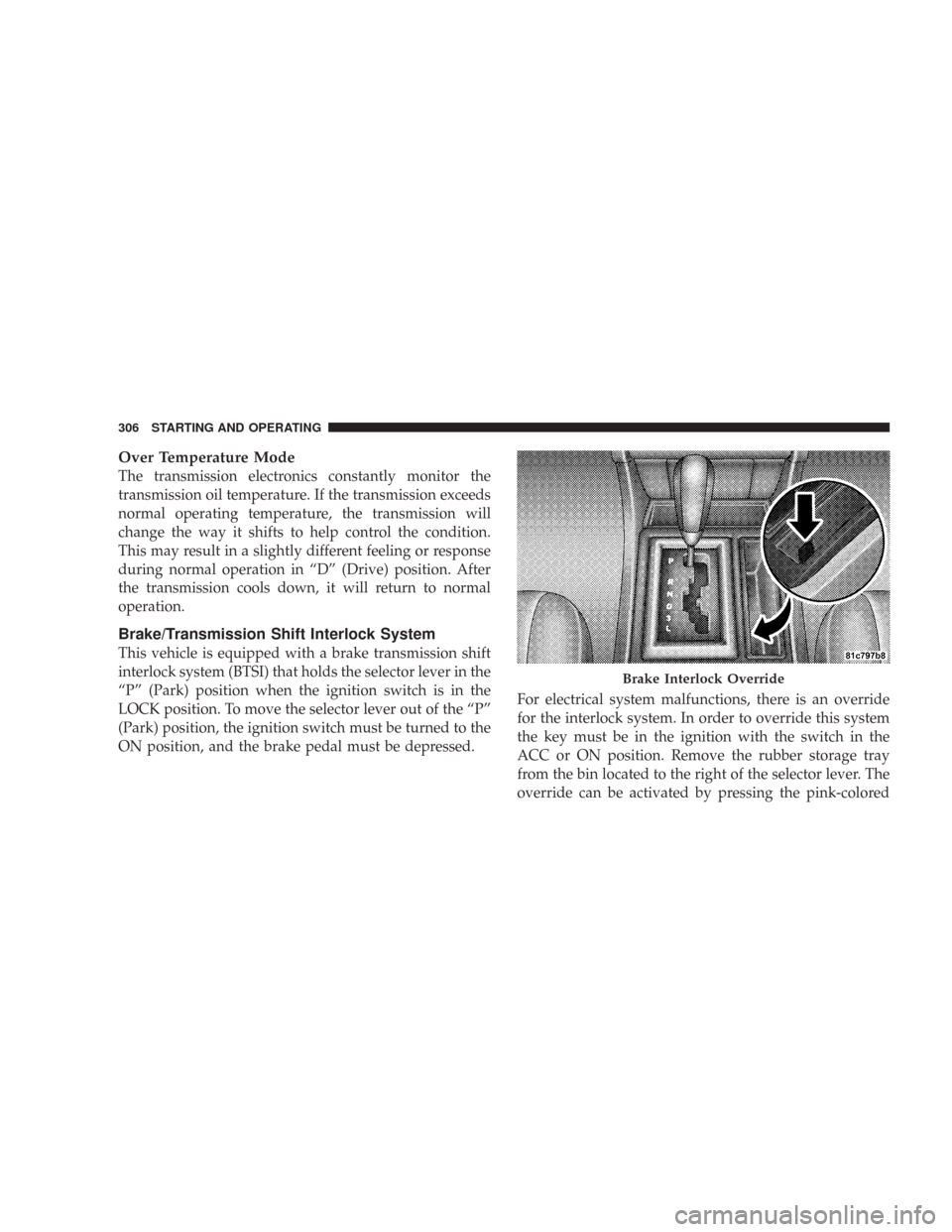
Brake/Transmission Shift Interlock System
This vehicle is equipped with a brake transmission shift
interlock system (BTSI) that holds the selector lever in the
“P” (Park) position when the ignition switch is in the
LOCK position. To move the selector lever out of the “P”
(Park) position, the ignition switch must be turned to the
ON position, and the brake pedal must be depressed.For electrical system malfunctions, there is an override
for the interlock system. In order to override this system
the key must be in the ignition with the switch in the
ACC or ON position. Remove the rubber storage tray
from the bin located to the right of the selector lever. The
override can be activated by pressing the pink-colored
Brake Interlock Override
306 STARTING AND OPERATING
Page 308 of 520

tab, which can be accessed through a hole inside the bin.
While the override is pressed, the shifter can be moved
out of the “P” (Park) position without pressing the brake.
After operation, return the rubber storage tray to its
original position.
4 Speed Automatic Transmission
Shifting from “D” (Drive) to “P” (Park) or “R” (Reverse)
(or from P or R to D) should be done only after the
accelerator pedal is released and the vehicle is stopped.
Be sure to keep your foot on the brake when moving the
selector lever between these gears.
Gear Ranges
“P” (Park)
“P” (Park) supplements the parking brake by locking the
transmission. The engine can be started in this range.
Selector Lever
STARTING AND OPERATING 307
5
Page 309 of 520

Never use “P” (Park) while the vehicle is in motion.
Apply the parking brake when leaving the vehicle in this
range.
When parking on a flat surface, place the gear selector in
the “P” (Park) position first, and then apply the parking
brake.
When parking on a hill, it is important to set the parking
brake before placing the gear selector in “P” (Park),
otherwise the load on the transmission locking mecha-
nism may make it difficult to move the selector out of
park. As an added precaution, turn the front wheels
toward the curb on a downhill grade and away from the
curb on an uphill grade.WARNING!
Never use “P” (Park) position on an automatic trans-
mission as a substitute for the parking brake. Always
apply parking brake fully when parked to guard
against vehicle movement and possible injury or
damage.
The following indicators should be used to ensure that
you have engaged the selector lever into the “P” (Park)
position:
•When shifting into “P’ (Park) move the lever all the
way forward until it stops, and is fully seated.
•Look at the shift indicator display on the instrument
panel to ensure it is in the “P” (Park) position.
308 STARTING AND OPERATING