power steering fluid CHRYSLER 300 C 2008 1.G Owners Manual
[x] Cancel search | Manufacturer: CHRYSLER, Model Year: 2008, Model line: 300 C, Model: CHRYSLER 300 C 2008 1.GPages: 520, PDF Size: 5.43 MB
Page 81 of 520
Door Latches
Check for positive closing, latching, and locking.
Fluid Leaks
Check area under vehicle after overnight parking for fuel,
engine coolant, oil, or other fluid leaks. Also, if gasoline
fumes are detected or if fuel, power steering fluid, or
brake fluid leaks are suspected, the cause should be
located and corrected immediately.
80 THINGS TO KNOW BEFORE STARTING YOUR VEHICLE
Page 84 of 520
\3Lights-On Reminder...................134
\3Fog Lights — If Equipped...............134
\3Multi-Function Lever...................134
\3Overhead Console Map/Reading Lights.....136
\3Interior Lights.......................136
\1Windshield Wipers And Washers............138
\3Intermittent Wiper System...............138
\3Mist Feature.........................139
\3Windshield Washers...................139
\3Headlights On With Wipers
(Available With Auto Headlights Only)......139
\3Rain Sensing Wipers — If Equipped........140
\3Adding Washer Fluid..................141\1Headlight Washers — If Equipped...........142
\3Adding Washer Fluid..................143
\1Tilt/Telescoping Steering Column...........144
\1Power Tilt/Telescoping Steering Column —
If Equipped...........................145
\1Adjustable Pedals — If Equipped...........147
\1Electronic Speed Control..................148
\3Electronic Speed Control Operation........149
\3To Activate..........................149
\3To Set At A Desired Speed...............150
\3To Deactivate........................150
\3To Resume Speed.....................150
\3To Vary The Speed Setting...............150
UNDERSTANDING THE FEATURES OF YOUR VEHICLE 83
3
Page 328 of 520
If both the Brake Warning Light and the ABS Light
remain on, the Anti-Lock brakes (ABS) and Electronic
Brake Force Distribution (EBD) systems are not function-
ing. Immediate repair to the ABS system is required.
POWER STEERING
The standard power steering system will give you good
vehicle response and increased ease of maneuverability
in tight spaces. The system will provide mechanical
steering capability if power assist is lost.
If for some reason the power assist is interrupted, it will
still be possible to steer your vehicle. Under these condi-
tions, you will observe a substantial increase in steering
effort, especially at very low vehicle speeds and during
parking maneuvers.NOTE:Increased noise levels at the end of the steering
wheel travel are considered normal and do not indicate
that there is a problem with the power steering system.
Upon initial start-up in cold weather, the power steering
pump may make noise for a short amount of time. This is
due to the cold, thick fluid in the steering system. This
noise should be considered normal, and it does not in any
way damage the steering system.
WARNING!
Continued operation with reduced power steering
assist could pose a safety risk to yourself and others.
Service should be obtained as soon as possible.
STARTING AND OPERATING 327
5
Page 329 of 520

CAUTION!
Prolonged operation of the steering system at the end
of the steering wheel travel will increase the steering
fluid temperature and it should be avoided when
possible. Damage to the power steering pump may
occur.
MULTI DISPLACEMENT SYSTEM (MDS) — 5.7L
Engine Only
This feature offers improved fuel economy by shutting
off four of the engine’s eight cylinders during light load
and cruise conditions. The system is automatic with no
driver inputs or additional driving skills required.
NOTE:The MDS system may take some time to return
to full functionality after a battery disconnect.
TRACTION CONTROL SYSTEM (TCS) — IF
EQUIPPED
WARNING!
The Traction Control System (TCS) cannot prevent
the natural laws of physics from acting on the ve-
hicle, nor can it increase the traction afforded. The
TCS cannot prevent accidents, including those result-
ing from excessive speed in turns, or hydroplaning.
Only a safe, attentive, and skillful driver can prevent
accidents. The capabilities of a TCS-equipped ve-
hicle must never be exploited in a reckless or dan-
gerous manner, which could jeopardize the user’s
safety or the safety of others.
The Traction Control System (TCS) is standard on ve-
hicles equipped with Electronic Stability Program (ESP).
328 STARTING AND OPERATING
Page 413 of 520
\3Air Conditioner Maintenance.............430
\3A/C Air Filter — If Equipped............431
\3Power Steering — Fluid Check............432
\3Front & Rear Suspension Ball Joints........432
\3Steering Linkage......................433
\3Body Lubrication.....................433
\3Windshield Wiper Blades................433
\3Windshield Washers/Headlight Washers —
If Equipped.........................434
\3Exhaust System......................434
\3Cooling System.......................435
\3Hoses And Vacuum/Vapor Harnesses.......440
\3Fuel System.........................441\3Brake System........................441
\3Automatic Transmission................444
\3All Wheel Drive (AWD) — If Equipped.....445
\3Front And Rear Wheel Bearings...........446
\3Appearance Care And Protection From
Corrosion...........................446
\3Cleaning The Center Console Cup Holders . . . 450
\1Fuses (Power Distribution Centers)..........451
\3Fuses (Front Power Distribution Center).....451
\3Fuses (Rear Power Distribution Center)......453
\1Vehicle Storage........................458
\1Replacement Bulbs......................459
\1Bulb Replacement......................460
412 MAINTAINING YOUR VEHICLE
Page 415 of 520
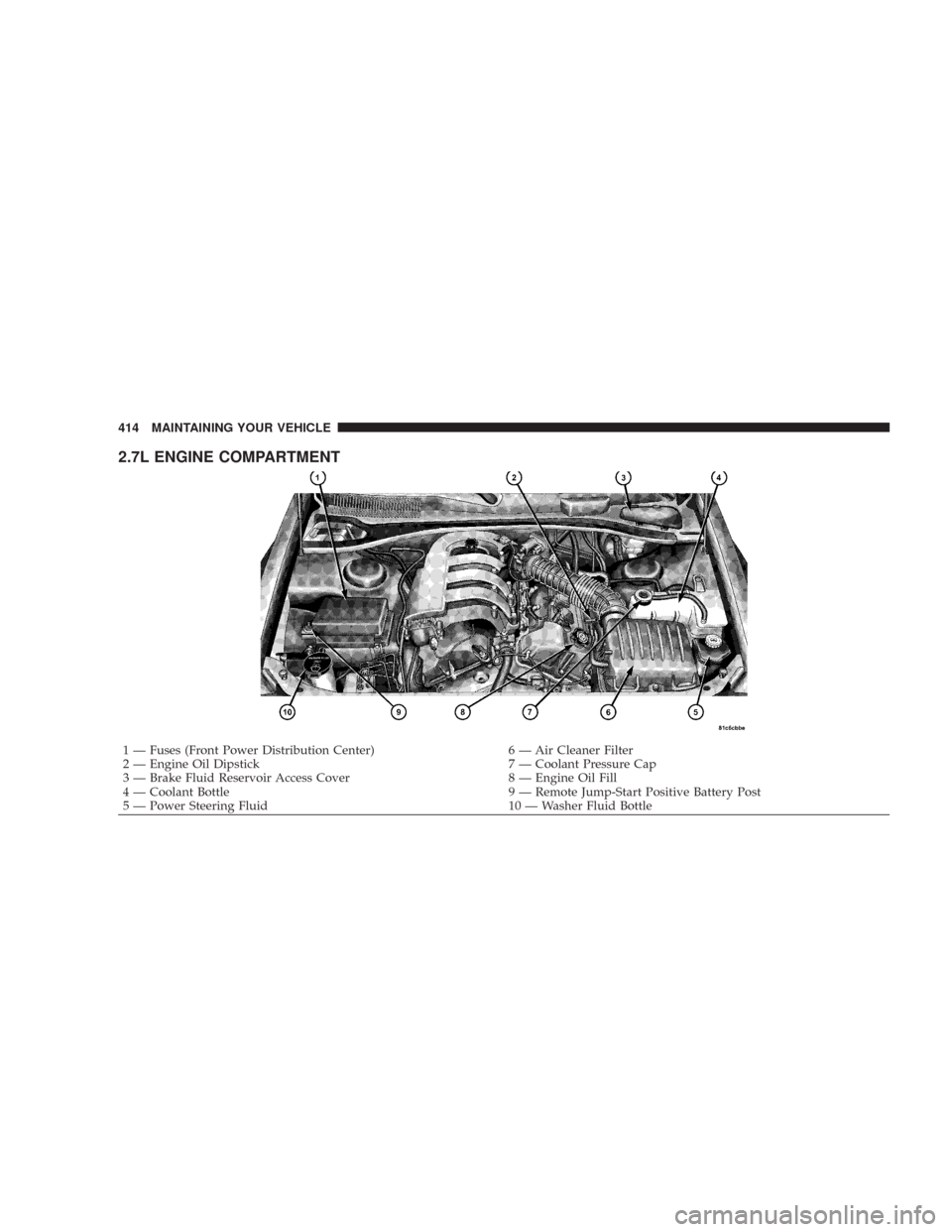
2.7L ENGINE COMPARTMENT
1 — Fuses (Front Power Distribution Center) 6 — Air Cleaner Filter
2 — Engine Oil Dipstick 7 — Coolant Pressure Cap
3 — Brake Fluid Reservoir Access Cover 8 — Engine Oil Fill
4 — Coolant Bottle 9 — Remote Jump-Start Positive Battery Post
5 — Power Steering Fluid 10 — Washer Fluid Bottle 414 MAINTAINING YOUR VEHICLE
Page 416 of 520
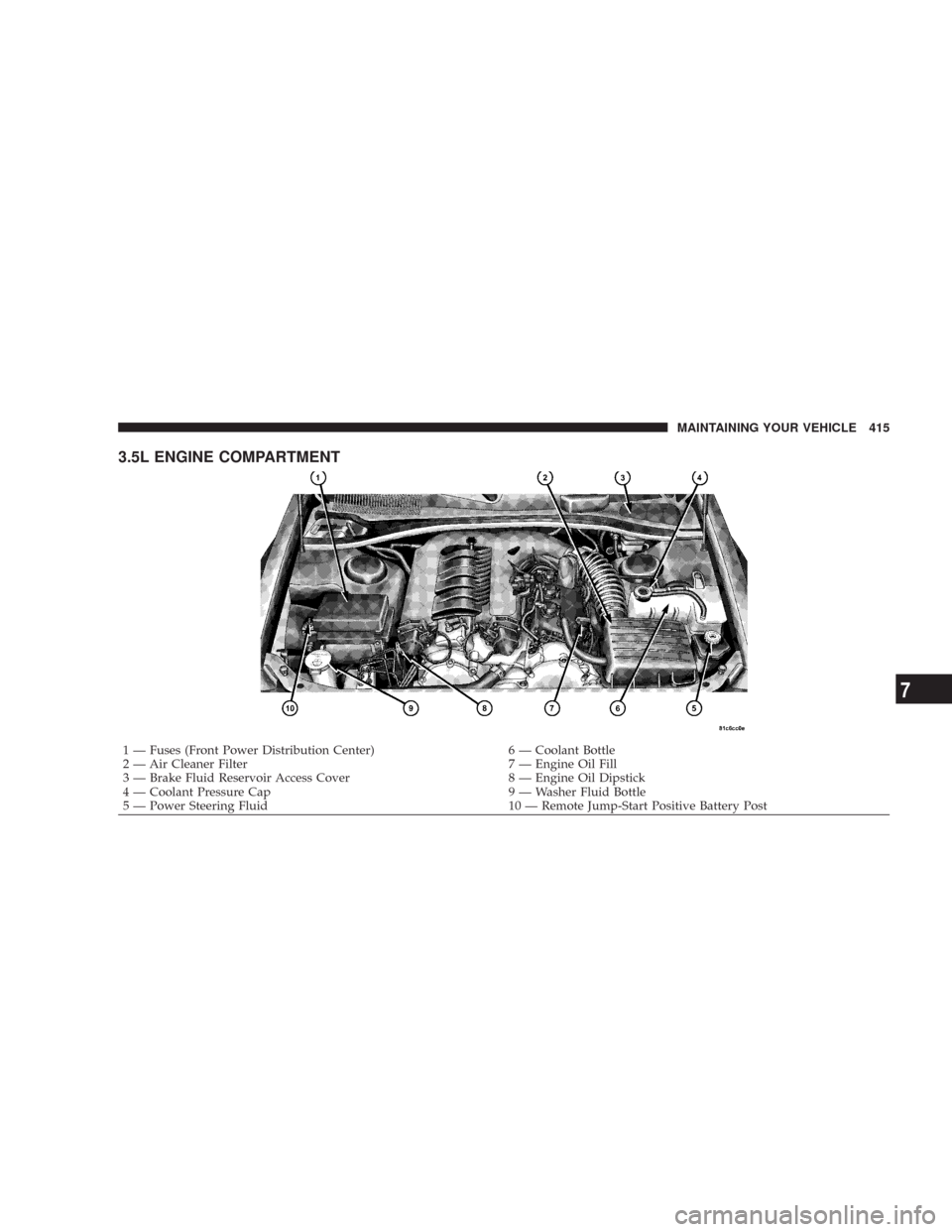
3.5L ENGINE COMPARTMENT
1 — Fuses (Front Power Distribution Center) 6 — Coolant Bottle
2 — Air Cleaner Filter 7 — Engine Oil Fill
3 — Brake Fluid Reservoir Access Cover 8 — Engine Oil Dipstick
4 — Coolant Pressure Cap 9 — Washer Fluid Bottle
5 — Power Steering Fluid 10 — Remote Jump-Start Positive Battery PostMAINTAINING YOUR VEHICLE 415
7
Page 417 of 520
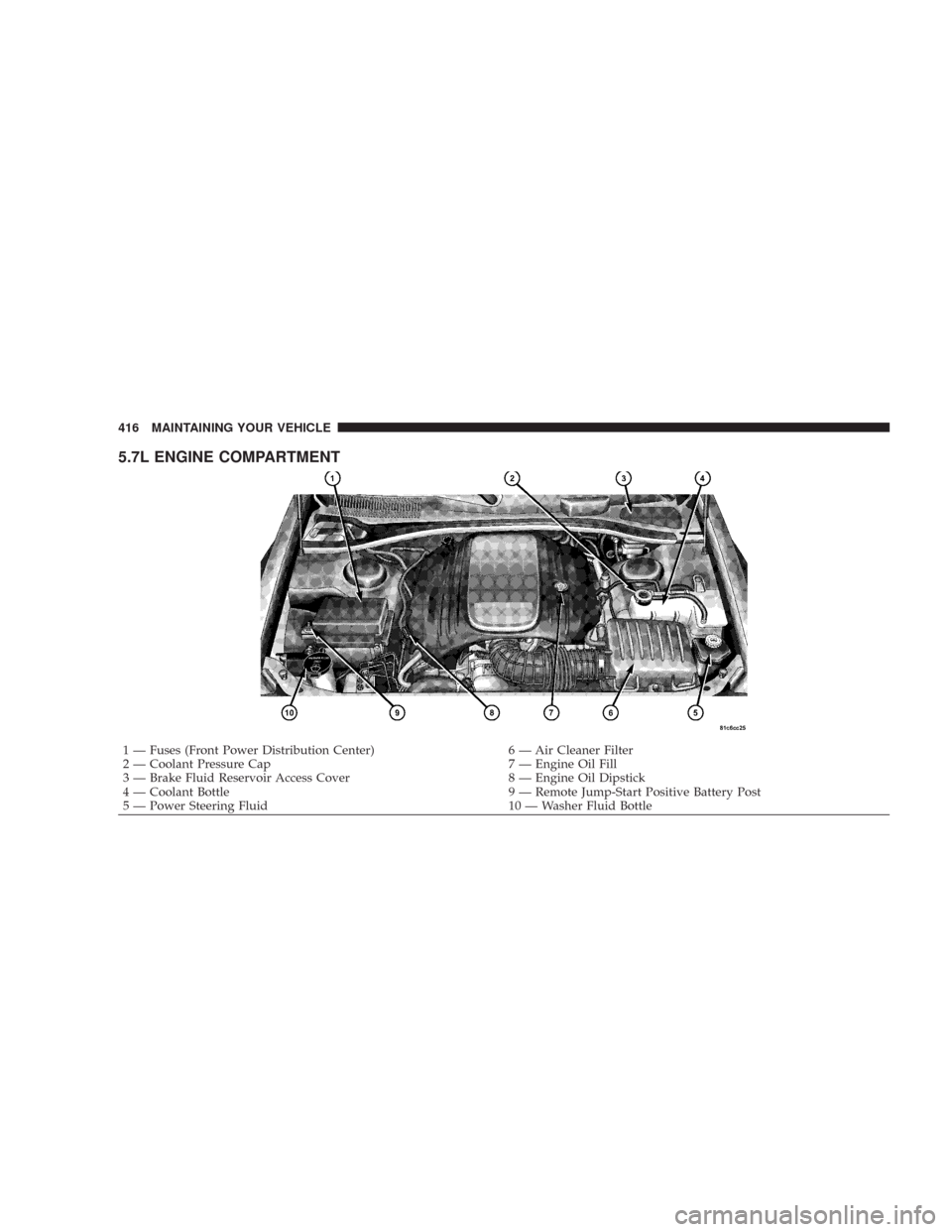
5.7L ENGINE COMPARTMENT
1 — Fuses (Front Power Distribution Center) 6 — Air Cleaner Filter
2 — Coolant Pressure Cap 7 — Engine Oil Fill
3 — Brake Fluid Reservoir Access Cover 8 — Engine Oil Dipstick
4 — Coolant Bottle 9 — Remote Jump-Start Positive Battery Post
5 — Power Steering Fluid 10 — Washer Fluid Bottle 416 MAINTAINING YOUR VEHICLE
Page 433 of 520
Install new filter with arrows pointing in the direction of
airflow, which is toward the rear of the vehicle (text and
arrows on the filter indicate this).
Refer to the “Maintenance Schedule” in Section 8 of
this manual for the recommended air conditioning
filter replacement intervals.
Power Steering — Fluid Check
Checking the power steering fluid level at a defined
service interval is not required. The fluid should only be
checked if a leak is suspected, abnormal noises are
apparent, and/or the system is not functioning as antici-
pated. Coordinate inspection efforts through a certified
DaimlerChrysler Dealership.
WARNING!
Fluid level should be checked on a level surface and
with the engine off to prevent injury from moving
parts and to insure accurate fluid level reading. Do
not overfill. Use only manufacturer’s recommended
power steering fluid.
If necessary, add fluid to restore to the proper indicated
level. With a clean cloth, wipe any spilled fluid from all
surfaces. Refer to “Fluids, Lubricants, and Genuine
Parts” in this section for the correct fluid type.
Front & Rear Suspension Ball Joints
The suspension ball joints should be inspected for exter-
nal leakage or damage when other maintenance is per-
formed.
432 MAINTAINING YOUR VEHICLE
Page 443 of 520
Brake and Power Steering Hoses
When the vehicle is serviced for scheduled maintenance,
inspect surface of hoses and nylon tubing for evidence of
heat and mechanical damage. Hard and brittle rubber,
cracking, tears, cuts, abrasion, and excessive swelling
indicate deterioration of the rubber. Particular attention
should be made to examining those hose surfaces nearest
to high heat sources, such as the exhaust manifold.
Insure nylon tubing in these areas has not melted or
collapsed.
Inspect all hose connections such as clamps and cou-
plings to make sure they are secure and no leaks are
present.
NOTE:
•Often, fluid such as oil, power steering fluid, and
brake fluid are used during assembly plant operations
to facilitate the assembly of hoses to couplings. There-
fore, oil wetness at the hose-coupling area is notnecessarily an indication of leakage. Actual dripping
of hot fluid when systems are under pressure (during
vehicle operation), should be noted before a hose is
replaced based on leakage.
•Inspect the brake hoses whenever the brake system is
serviced and at every engine oil change. Inspect hy-
draulic brake hoses for surface cracking, scuffing, or
worn spots. If there is any evidence of cracking,
scuffing, or worn spots, the hose should be replaced
immediately! Eventual deterioration of the hose can
take place resulting in a possibility of a burst failure.
WARNING!
Worn brake hoses can burst and cause brake failure.
You could have an accident. If you see any signs of
cracking, scuffing, or worn spots, have the brake
hoses replaced immediately.
442 MAINTAINING YOUR VEHICLE